Chiến tranh Seminole thứ hai, nguồn gốc chủ nghĩa đế quốc Mỹ và sự im lặng của chế độ nô lệ - Daniel Scallet, Washington University
Chiến tranh Seminole thứ hai: Nguyên nhân, diễn biến và vai trò của nó trong việc hình thành chủ nghĩa đế quốc Mỹ.
Washington University in St. Louis
Luan An
Luận án tiến sĩ
Năm xuất bản
Số trang
378
Thời gian đọc
57 phút
Lượt xem
0
Lượt tải
0
Phí lưu trữ
60 Point
Tổng quan nhanh
- Chủ đề:
- 1. Bối cảnh Chiến tranh Seminole thứ hai, nguồn gốc xung đột.
- Số trang:
- 378 trang
- Trường:
- Washington University in St. Louis
- Chuyên ngành:
- History
- Tác giả:
- Daniel Scallet
- Năm:
- 2011
Tóm tắt nội dung luận án
I. Bối cảnh Chiến tranh Seminole thứ hai nguồn gốc xung đột
Hoa Kỳ kiên quyết mở rộng lãnh thổ. Mục tiêu chính là các vùng đất của người bản địa. Lãnh thổ Florida hấp dẫn người định cư. Đất đai ở đây màu mỡ, lý tưởng cho nông nghiệp. Chính quyền Hoa Kỳ muốn kiểm soát hoàn toàn vùng này. Người Seminole đã sinh sống hàng thế kỷ trên đất tổ tiên. Quyền sở hữu đất của họ bị đe dọa nghiêm trọng. Xung đột về đất đai là nguyên nhân sâu xa. Người Seminole từ chối rời bỏ quê hương. Sự kháng cự này trực tiếp dẫn đến Chiến tranh Seminole thứ hai. Cuộc chiến này định hình chính sách đối với người da đỏ và sự phát triển của Chủ nghĩa đế quốc Mỹ.
1.1. Chính sách Di dời người da đỏ tại Florida.
Hoa Kỳ thúc đẩy chính sách di dời người bản địa. Florida là một mục tiêu chiến lược quan trọng. Chính quyền muốn giải phóng đất cho người định cư da trắng. Người Seminole ở Florida bị coi là vật cản. Các hiệp ước di dời được đề xuất. Những hiệp ước này thường thiếu công bằng, mang tính ép buộc. Người Seminole phản đối mạnh mẽ. Quyết tâm ở lại đất của họ là không lay chuyển. Tình hình căng thẳng leo thang nhanh chóng. Chính sách này tạo tiền đề cho chiến tranh.
1.2. Vai trò Andrew Jackson và Đạo luật Di dời người da đỏ.
Andrew Jackson là người ủng hộ mạnh mẽ việc di dời. Ông tin vào sự cần thiết của việc mở rộng quốc gia. Năm 1830, Đạo luật Di dời người da đỏ được thông qua. Đạo luật này cho phép đàm phán các hiệp ước. Mục tiêu là chuyển người bản địa sang phía Tây sông Mississippi. Các bộ tộc phải rời bỏ đất đai truyền thống. Người Seminole không chấp nhận các điều khoản này. Sự phản kháng của họ thách thức chính sách của Jackson. Đạo luật này là công cụ pháp lý cho sự bành trướng.
II. Diễn biến chính của Chiến tranh Seminole Người Seminole chiến đấu
Chiến tranh Seminole thứ hai kéo dài từ năm 1835 đến 1842. Đây là cuộc xung đột đẫm máu và tốn kém nhất. Quân đội Hoa Kỳ gặp phải sự kháng cự quyết liệt. Người Seminole sử dụng chiến thuật du kích hiệu quả. Họ quen thuộc với địa hình đầm lầy Florida. Điều này gây khó khăn lớn cho quân Mỹ. Chi phí chiến tranh của Hoa Kỳ lên đến hàng triệu đô la. Nhiều binh lính Mỹ thiệt mạng vì bệnh tật và chiến đấu. Cuộc chiến này thể hiện sự kiên cường của người Seminole. Đây cũng là một chương đen tối trong lịch sử quân sự Hoa Kỳ. Thể hiện sự thiếu chuẩn bị và đánh giá thấp đối thủ.
2.1. Lãnh đạo Osceola và sự kháng cự quyết liệt.
Osceola là thủ lĩnh Seminole nổi bật nhất. Ông lãnh đạo cuộc kháng chiến chống Hoa Kỳ. Osceola từ chối ký hiệp ước di dời Wthlacoochie. Lời kêu gọi chiến đấu của ông truyền cảm hứng. Người Seminole gây ra nhiều tổn thất cho quân Mỹ. Các cuộc phục kích bất ngờ làm suy yếu tinh thần lính Mỹ. Osceola trở thành biểu tượng của sự phản kháng. Sự dũng cảm của ông được nhiều người ngưỡng mộ. Ông bị bắt bằng mưu mẹo, gây phẫn nộ trong dư luận.
2.2. Sự tham gia của Người Seminole da đen.
Người Seminole da đen đóng vai trò then chốt. Họ là những nô lệ trốn thoát tìm tự do. Người Seminole cho họ tị nạn và coi như đồng minh. Mối quan hệ giữa hai nhóm rất bền chặt. Người Seminole da đen tham gia chiến đấu tích cực. Họ cung cấp kiến thức về địa hình và chiến thuật. Hoa Kỳ muốn trả lại họ cho các chủ nô. Điều này làm tăng quyết tâm kháng chiến của liên minh Seminole. Sự liên minh này là thách thức lớn cho Hoa Kỳ.
2.3. Các chiến thuật của Hoa Kỳ và chi phí chiến tranh.
Quân đội Hoa Kỳ huy động lực lượng lớn. Tướng Thomas Jesup chỉ huy nhiều chiến dịch. Tuy nhiên, họ khó khăn trong việc đánh bại Seminole. Các cuộc phục kích gây tổn thất nặng nề. Hoa Kỳ phải chi một khoản tiền khổng lồ. Cuộc chiến trở nên vô cùng tốn kém. Phương pháp lừa dối cũng được sử dụng. Osceola bị bắt trong một cuộc đàm phán hòa bình. Điều này bị coi là hành động phản bội. Sự tiêu hao nguồn lực là rất lớn.
III. Ảnh hưởng Chiến tranh Seminole đối với Chủ nghĩa đế quốc Mỹ
Chiến tranh Seminole thứ hai là minh chứng cho sự bành trướng. Hoa Kỳ đã mở rộng lãnh thổ một cách mạnh mẽ. Cuộc chiến khẳng định quyền kiểm soát Florida Territory. Nó cũng đặt nền móng cho Chủ nghĩa đế quốc Mỹ. Quốc gia này sẵn sàng sử dụng vũ lực. Mục đích là để đạt được mục tiêu địa chính trị. Cuộc chiến thể hiện ý chí chinh phục. Hoa Kỳ tin vào quyền mở rộng lãnh thổ. Sự chiến thắng này củng cố quan điểm 'Vận mệnh hiển nhiên'.
3.1. Sự mở rộng lãnh thổ Hoa Kỳ và Florida Territory.
Chiến tranh Seminole củng cố quyền kiểm soát Florida. Florida Territory trở thành một phần không thể tách rời. Hoa Kỳ đã hoàn thành việc loại bỏ người bản địa. Vùng đất này mở ra cho người định cư da trắng. Đây là một bước tiến lớn trong bành trướng lãnh thổ. Biên giới phía Nam của Hoa Kỳ được ổn định. Nông nghiệp và kinh tế phát triển nhanh chóng. Sự kiểm soát đất đai là yếu tố then chốt.
3.2. Vận mệnh hiển nhiên và quan điểm thực dân.
Cuộc chiến thể hiện rõ tinh thần 'Vận mệnh hiển nhiên'. Hoa Kỳ tin vào quyền thiêng liêng để mở rộng. Mục tiêu là kiểm soát toàn bộ lục địa. Người bản địa bị coi là rào cản cho sự tiến bộ. Chính sách di dời được biện minh là cần thiết. Đây là một hình thức sơ khai của Chủ nghĩa đế quốc Mỹ. Hoa Kỳ áp đặt ý chí lên các dân tộc khác. Cuộc chiến là bài học về sức mạnh quân sự. Nó củng cố niềm tin vào sự ưu việt của người da trắng.
IV. Hệ quả và di sản của Chiến tranh Seminole thứ hai
Chiến tranh Seminole thứ hai để lại nhiều hậu quả. Nó tác động sâu sắc đến người Seminole và Hoa Kỳ. Hầu hết người Seminole bị di dời cưỡng bức. Một số ít trốn thoát và tiếp tục tồn tại. Cuộc chiến bị coi là một thất bại đạo đức. Nó phơi bày sự tàn nhẫn của chính sách di dời. Di sản của cuộc chiến thường bị lãng quên. Tuy nhiên, nó là một phần quan trọng. Nó giúp hiểu rõ nguồn gốc Chủ nghĩa đế quốc Mỹ. Sự im lặng lịch sử che giấu sự thật đau lòng.
4.1. Sự di dời và mất mát của người Seminole.
Phần lớn người Seminole bị di dời cưỡng bức. Họ phải rời bỏ quê hương đến Oklahoma. Nhiều người thiệt mạng trong cuộc di cư gian khổ. Một số ít Seminole trốn thoát vào Everglades. Họ tiếp tục duy trì văn hóa và truyền thống. Sự mất mát đất đai là vĩnh viễn và không thể bù đắp. Cộng đồng Seminole phải đối mặt với khó khăn lớn. Cuộc chiến là bi kịch lớn của họ. Họ đã mất đi mọi thứ, trừ tinh thần.
4.2. Cuộc chiến vô danh và sự im lặng lịch sử.
Chiến tranh Seminole thường bị lãng quên trong lịch sử. Nghệ sĩ George Catlin gọi đó là "cuộc chiến vô danh". Nhiều người Mỹ muốn bỏ qua nó. Sự im lặng này có lý do rõ ràng. Cuộc chiến là một vết nhơ trong lịch sử Hoa Kỳ. Nó bộc lộ mặt trái của chính sách di dời. Di sản của cuộc chiến vẫn còn đó. Việc ghi nhớ giúp hiểu rõ hơn lịch sử. Điều này giúp tránh lặp lại sai lầm trong tương lai.
Tải xuống file đầy đủ để xem toàn bộ nội dung
Tải đầy đủ (378 trang)Trích đoạn nội dung luận án
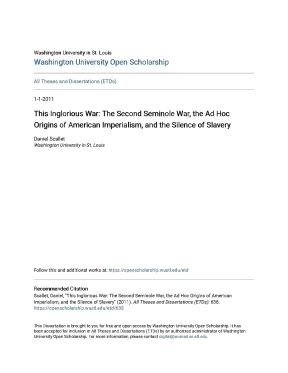
Tải xuống để đọc toàn bộWashington University in St. Louis Washington University Open Scholarship All Theses and Dissertations (ETDs) 1-1-2011 This Inglorious War: The Second Seminole War, the Ad Hoc Origins of American Imperialism, and the Silence of Slavery Daniel Scallet Washington University in St. Louis Follow this and additional works at: https://openscholarship.edu/etd Recommended Citation Scallet, Daniel, "This Inglorious War: The Second Seminole War, the Ad Hoc Origins of American Imperialism, and the Silence of Slavery" (2011). All Theses and Dissertations (ETDs).edu/etd/638 This Dissertation is brought to you for free and open access by Washington University Open Scholarship.
It has been accepted for inclusion in All Theses and Dissertations (ETDs) by an authorized administrator of Washington University Open Scholarship. For more information, please contact digital@wumail. Washington University in St. Louis Department of History Dissertation Examination Committee: Iver Bernstein, Chair Elizabeth Borgwardt Randall Calvert Wayne Fields Peter Kastor David Konig "This Inglorious War": The Second Seminole War, the Ad Hoc Origins of American Imperialism, and the Silence of Slavery by Daniel Scallet A dissertation presented to the Graduate School of Arts and Sciences of Washington University in partial fulfillment of the requirements for the degree of Doctor of Philosophy December 2011 Saint Louis, Missouri Copyright by Daniel Scallet 2011 Acknowledgements I would like to thank the Dwight D.
Eisenhower Institute whose Clifford Roberts Fellowship Program provided funding for this project. I have also benefitted greatly from the Lynne Cooper Harvey Fellowship in American Culture Studies. Finally, I would like to thank the faculty at Washington University from whom I have learned so much as well as friends and family to whom I am eternally grateful. Table of Contents Introduction 1 Chapter 1 - “Perish Principle But Save the Country”: Andrew Jackson, Florida, and the Evolution of United States Indian Policy 39 Chapter 2 - “A Reckless Waste of Blood and Treasure”: Thomas Jesup, the Politics of Florida, and the State 96 Chapter 3 -“You Will Gird on Your Swords”: Volunteers, Nationalism, and Violence during the Second Seminole War 153 Chapter 4 - The “War-Whoop in the Doors of Your Capitol”: The March of Empire in the Halls of Congress 192 Chapter 5 - “The Very Obscurest of the Obscure”: The Second Seminole War and the Future of Antislavery in the United States 233 Chapter 6 - “We Do Not Live for Our Selves Only”: The Competing Strategies of Seminoles and BlackSeminoles amidst a Crusade of Conquest 266 Chapter 7 - The “Mock-War Spirit”: The Unsteady Path from Conquest to Imperialism 298 Conclusion 335 Bibliography 343 Introduction In 1844, the famed artist George Catlin published Letters and Notes on the Manners, Customs, and Conditions of North American Indians, a grand synthesis of all that he had learned on the indigenous nations of the United States.
He was largely sympathetic to the plight of the Indians, opposing removal as a violation of their rights and mourning the dozens of nations whose culture appeared to him lost, their morals corrupted. Near his conclusion, Catlin noted the recently completed struggle with the Seminole Indians in Florida, a conflict he believed to represent the last stand of Indians east of the Mississippi. He included only a brief summary of the war and begged the reader’s indulgence for his brevity, explaining that he was too close to the end of the book to detail it further. To Catlin, that was a lucky coincidence, but one that established a pattern he hoped later writers would follow, rationalizing that “the world will pardon me for saying no more of this inglorious war; … [but] as an American citizen I would pray, amongst thousands of others, that all books yet to be made might have as good an excuse for leaving it out.” He need not have bothered; the implications of the war had never been comprehended well enough to be forgotten.1 Nevertheless, it was a remarkable admission.
Just six years before in January 1838, Catlin had traveled far south to Fort Moultrie, a United States fort on the coast of Charleston, to meet the captured Seminole war leader Osceola and several prominent Seminole chiefs. Though prisoners, the Seminoles had freedom to move within the fort, and they spent hours with Catlin in the fort’s officers’ quarters. There they recounted their own perspectives on the war and bitterly denounced the circumstances of their 1 George Catlin, Letters and Notes on the Manners, Customs, and Conditions of the North American Indians: Written During Eight Years' Travel amongst the Wildest Tribes of Indians in North America (New York: Wiley and Putnam, 1844), 219. 1 capture, having been lured into the open by a white flag and then deceitfully placed in chains under the orders of General Thomas Jesup.2 The details of Catlin’s visit to the Seminoles were well known for another reason - the great Seminole leader Osceola lay dying, suffering from quinsy, a complication of tonsillitis, an illness he had almost certainly contracted before his capture in October 1837.
Inside the fort, Catlin spoke with the dying warrior and offered to paint his portrait. Osceola welcomed the attentions of a famous painter like Catlin and one can easily see how he influenced his own portrayal. Proud, dignified, and resolute, the Osceola depicted in Catlin’s Osceola, the Black Drink, a Warrior of Great Distinction made a clear statement of Osceola’s essential humanity in an era of Indian dispossession and removal.3 Before the artist’s arrival, the warrior had sent for his white doctor and, knowing his death was imminent, declared through an interpreter “his country had been taken from him … by the strong & oppressive hand of the white people, & if he wished to live, it was only to show them that an Indian never forgot an Injury.” The Osceola of Catlin’s depiction memorialized the history of injustice the true Osceola swore never to forget; it was etched in the very melancholy of his features. It fit Catlin’s ideology as well.
He believed Indians were to be celebrated, but only with a mournful tinge reflecting their 2 Catlin, Letters and Notes 220. 3 The title of Catlin’s painting, The Black Drink, was a translation of Osceola’s name and referred to a ceremonial liquid. 2 inexorable march toward extinction. Following his visit, Catlin returned to the northeast to exhibit his paintings of the Seminole leaders, inspiring numerous homages and copies.
The morning that Catlin left South Carolina, Osceola himself provided the final brushstroke for Catlin’s image, passing away with his family at his side.4 Catlin may have hoped that the Second Seminole War might be forgotten, but it was not an isolated conflict on the outskirts of a nation. In Florida, several of the most powerful antebellum political, social, and economic movements collided with discomforting results. There, Jackson and his fellow Democrats spent over thirty million dollars and ordered nearly 1600 men to their death to make their vision of the nation manifest. By obliterating the last vestiges of non-United States collective sovereignty and threatening the future of nonwhite autonomy, Jackson intended to extend the geographic reach of his two most vital constituencies, white settlers and Southern slaveholders, and consolidate the hegemony of the United States in the southeast, one of the most unstable regions in the Americas over the preceding several centuries.
Removing the Seminoles would further integrate Florida into Deep South slave society and legitimize white owners’ specious claims on dozens of the Seminoles’ relatively autonomous African- American allies. His actions had disastrous consequences for his nation, in both the short and long term. Yet, even as Jackson pursued the policies that would bring his nation to the brink of destruction, many of his most prominent opponents remained silent, 4 John K. Mahon, History of the Second Seminole War, 1835-1842 (Gainesville: University of Florida Press, 1985), 214-218; Patricia Wickman, Osceola’s Legacy (Tuscaloosa: University of Alabama Press, 2006), 26- 28; Frederick Weedon’s Diary Pages, January 28-31, Fort Moultrie, S., Frederick Weedon Family Papers, SPR 251, Alabama Dept.
of Archives and History; Daily Cleveland Herald, February 13, 1838; New York Spectator, February 8, 1838. On Catlin’s personal views on Indians and their destiny, see William H Truettner, The Natural Man Observed: A Study of Catlin’s Indian Gallery (Washington: Smithsonian Institution Press, 1979); John Hausdoerffer, Catlin’s Lament: Indians, Manifest Destiny, and the Ethics of Nature (Lawrence: University Press of Kansas, 2009). 3 unwilling to alienate or antagonize powerful slaveholding interests. Their silence ensured that the contours of Jacksonian expansion would become the sole precedent for United States continental and overseas expansion, a blueprint which demanded the colonization of native populations and the annihilation of their nonwhite political forms.
He laid the groundwork for the imperial state.5 In arguing for a link between Jackson’s crusade of conquest and the imperialists of the nineteenth century, I define imperialism as a form of domination in which an alien power imposes its authority over a subject people in an alien land. This is distinguished from an imperial state, in which political institutions are explicitly tasked with ruling subject peoples, erecting a legal framework to ensure their subjugation, and appropriating their resources for the benefit of the dominant nation. Through their Indian policy, Jackson and his ideological allies set out to annihilate Indian sovereignty on the United States’ frontiers, but did not institutionalize the subjugation of the southeast Indians into law nor did they impose direct rule upon them following their removal. Rather, Jackson pursued conquest, the subjugation of a people and assumption of authority within a defined geographic space.
His policies provided a blueprint for Gilded Age leaders, but stopped short of transforming the United States itself into an imperial state.6 5 To put those figures in perspective, Andrew Jackson’s administration predicted that the total cost of Indian Removal for all the remaining Indians in the eastern United States would total three million dollars out of total yearly federal expenditures of around twenty-five million dollars during the war years. For budgeting information, see Historical Statistics of the United States 1789-1945 (Washington: United States Department of Commerce, 1949), 310-311. 6 The use of the word “imperialism” is somewhat anachronistic here as it did not come into use until coined by an anonymous British writer in 1858 to criticize Napoleon III’s imperial pretensions. See “France, Under Napoleon III,” The Westminster Review, 344 (Oct.
On the history of the word “imperialism,” itself, see Richard Koebner and Helmut Dan Schmidt, Imperialism: The Story and Significance of a Political Word, 1840-1960, (Cambridge: Cambridge University Press, 1964). Jackson’s crusade of conquest differed markedly from what historian Peter Onuf identified as the central premise of the Jeffersonian creed, the creation of a new republican empire founded on the principles of the American Revolution. Where the conquests of Jackson and the imperialists of later eras were rooted in 4 I argue that Jackson designed his policies to eliminate the possibility of both nonwhite autonomy and Indian sovereignty within the North American continent. The two concepts are linked, though the latter is a specific form of the former.
Georgia, Justice John Marshall famously declared Indian nations to be “domestic dependent nations,” recognizing their right to self-government but subordinating their laws to United States federal authority and eliminating their right to form relationships with any foreign power except the United States. Throughout the first quarter of the nineteenth century, a succession of presidential administrations established the principle that the United States would negotiate with Indian nations through the medium of treaties, recognizing and reinforcing their claims to sovereignty. Through he expressed little interest in curtailing Indian self-government, Jackson was militantly opposed to negotiating with Indian entities, and attempted to form a new relationship with Indian nations founded on the imposition of control. Similarly, Jackson was hostile to nonwhite autonomy in general, and feared the influence of the Black Seminoles upon the slave populations of the southeast.
Nội dung được bảo vệ bản quyền — Tải xuống đầy đủ
Trích dẫn luận án này
Daniel Scallet (2011). Chiến tranh Seminole thứ hai và nguồn gốc chủ nghĩa đế quốc Mỹ [Luận án tiến sĩ, Washington University in St. Louis]. LuanAn.net. https://luanan.net/lich-su/chien-tranh-seminole-thu-hai-va-nguon-goc-chu-nghia-de-quoc-my
Câu hỏi thường gặp
Luận án "Chiến tranh Seminole thứ hai và nguồn gốc chủ nghĩa đế quốc Mỹ" nghiên cứu về vấn đề gì?
Chiến tranh Seminole thứ hai: Nguyên nhân, diễn biến và vai trò của nó trong việc hình thành chủ nghĩa đế quốc Mỹ.
Luận án "Chiến tranh Seminole thứ hai và nguồn gốc chủ nghĩa đế quốc Mỹ" được bảo vệ tại trường nào?
Luận án này được bảo vệ tại Washington University in St. Louis. Năm bảo vệ: 2011.
Luận án "Chiến tranh Seminole thứ hai và nguồn gốc chủ nghĩa đế quốc Mỹ" thuộc chuyên ngành gì?
Luận án "Chiến tranh Seminole thứ hai và nguồn gốc chủ nghĩa đế quốc Mỹ" thuộc chuyên ngành History. Danh mục: Lịch Sử.
Luận án "Chiến tranh Seminole thứ hai và nguồn gốc chủ nghĩa đế quốc Mỹ" có bao nhiêu trang?
Luận án "Chiến tranh Seminole thứ hai và nguồn gốc chủ nghĩa đế quốc Mỹ" có 378 trang. Bạn có thể xem trước một phần tài liệu ngay trên trang web trước khi tải về.
Cách tải luận án "Chiến tranh Seminole thứ hai và nguồn gốc chủ nghĩa đế quốc Mỹ" về máy như thế nào?
Để tải luận án về máy, bạn nhấn nút "Tải xuống ngay" trên trang này, sau đó hoàn tất thanh toán phí lưu trữ. File sẽ được tải xuống ngay sau khi thanh toán thành công. Hỗ trợ qua Zalo: 0559 297 239.