Luận án tiến sĩ: Tổng hợp và đặc trưng polymer rào cản oxy hoạt tính - Kamal Mahajan (Đại học Toledo, 2010)
Tổng hợp đặc trưng polymer rào cản oxy hoạt tính mới (PET) cho ngành bao bì. Phân tích cấu trúc, tính chất và ứng dụng thực tiễn.
Năm xuất bản
Số trang
268
Thời gian đọc
41 phút
Lượt xem
0
Lượt tải
0
Phí lưu trữ
50 Point
Tổng quan nhanh
- Chủ đề:
- 1. Tổng quan công nghệ rào cản oxy chủ động trên nền PET
- Số trang:
- 268 trang
- Trường:
- The University of Toledo
- Chuyên ngành:
- Engineering
- Tác giả:
- Kamal Mahajan
- Năm:
- 2010
Tóm tắt nội dung luận án
I. Tổng quan công nghệ rào cản oxy chủ động trên nền PET
Polyethylene terephthalate (PET) đóng vai trò then chốt trong ngành sản xuất bao bì hiện đại. Vật liệu này có độ bền cơ học cao, độ trong suốt quang học xuất sắc và khả năng định hình linh hoạt. Tuy nhiên, rào cản oxy thụ động của màng PET truyền thống chưa đáp ứng đủ yêu cầu bảo quản khắt khe cho thực phẩm nhạy cảm. Sự thẩm thấu khí tự nhiên qua cấu trúc polymer làm giảm chất lượng sản phẩm đóng gói. Công nghệ rào cản oxy chủ động (active oxygen barrier) là giải pháp công nghệ tiên tiến nhằm khắc phục triệt để nhược điểm này. Thay vì chỉ cản trở cơ học dòng khí đi qua, hệ vật liệu mới tích hợp các chất hấp thụ oxy (oxygen scavenger) trực tiếp vào mạch nền polymer. Giải pháp này giúp kiểm soát nồng độ oxy ở mức cực thấp. Khả năng bảo quản thực phẩm nhờ vậy được kéo dài rõ rệt.
1.1. Tầm quan trọng của kiểm soát oxy trong bao bì thực phẩm
Khí oxy là tác nhân chính gây suy giảm chất lượng thực phẩm và đồ uống đóng gói. Oxy kích hoạt sự phát triển mạnh mẽ của vi sinh vật hiếu khí. Phản ứng oxy hóa lipid tạo ra các hợp chất gây ôi thiu và mùi lạ. Vitamin cùng các dưỡng chất thiết yếu dễ bị phân hủy khi tiếp xúc với oxy phân tử. Màu sắc tự nhiên của nước trái cây và thực phẩm tươi sống cũng nhanh chóng biến đổi. Việc duy trì hạn sử dụng dài hạn đòi hỏi bao bì phải ngăn chặn sự xâm nhập của oxy từ môi trường bên ngoài. Màng bao bì thông thường không đủ khả năng duy trì môi trường yếm khí tối ưu. Do đó, việc ứng dụng rào cản oxy chủ động (active oxygen barrier) trở thành yêu cầu kỹ thuật tất yếu cho chuỗi cung ứng thực phẩm toàn cầu.
1.2. Cơ chế bẫy khí của chất hấp thụ oxy trong màng bao gói
Chất hấp thụ oxy (oxygen scavenger) hoạt động dựa trên cơ chế phản ứng oxy hóa khử chọn lọc. Khi phân tử oxy khuếch tán qua thành bao bì, các nhóm chức có hoạt tính hóa học cao sẽ phản ứng ngay lập tức. Phân tử oxy bị giữ lại vĩnh viễn trong mạng lưới polymer dưới dạng liên kết hóa học bền vững. Cơ chế này loại bỏ hoàn toàn oxy trước khi khí chạm tới không gian bên trong hộp chứa. Quá trình bẫy khí diễn ra liên tục trong suốt vòng đời của bao bì. Tốc độ truyền oxy qua màng nhờ vậy giảm xuống mức gần như bằng không. Kỹ thuật này giúp bảo vệ tối đa độ tươi ngon và giá trị dinh dưỡng của sản phẩm.
II. Tổng hợp trùng ngưng đồng trùng hợp PET và scavenger
Phương pháp tổng hợp trùng ngưng (polycondensation) ở trạng thái nóng chảy cho phép gắn trực tiếp các chất hấp thụ oxy vào khung phân tử PET. Quá trình biến tính polymer (polymer modification) này tạo nên vật liệu đồng nhất và ổn định nhiệt. Phản ứng đồng trùng hợp (copolymerization) diễn ra trong lò phản ứng mẻ ở nhiệt độ cao kèm chân không sâu. Việc đưa các mắt xích chức năng vào chuỗi PET không làm suy giảm nghiêm trọng độ bền cơ lý vốn có của vật liệu. Sự phân tán ở cấp độ phân tử ngăn chặn hiện tượng tách pha hay di chuyển tạp chất ra bề mặt bao bì. Đây là bước đột phá công nghệ giúp nâng cao hiệu quả rào cản khí một cách bền vững.
2.1. Lựa chọn monomer mô hình monoolein và cycloalkene
Nghiên cứu tập trung sử dụng hai hợp chất mô hình chính gồm monoolein (MO) và 3-cyclohexene-1,1-dimethanol (CHEDM). Monoolein chứa liên kết đôi không bão hòa trong chuỗi acid béo mạch dài. Hợp chất CHEDM sở hữu vòng cyclohexene giàu mật độ điện tử và hai nhóm hydroxyl hoạt tính. Cả hai monomer đều có khả năng tham gia phản ứng gắn kết vào mạch chính của polyethylene terephthalate (PET). Vị trí liên kết đôi nhạy cảm với oxy đóng vai trò là tâm phản ứng bẫy khí chủ động. Nhờ cấu trúc phân tử linh hoạt, các monomer này dễ dàng phân tán đều trong khối polymer nóng chảy mà không gây hiện tượng kết tụ bất lợi.
2.2. Quy trình biến tính polymer bằng phản ứng nóng chảy
Quy trình biến tính polymer (polymer modification) được tiến hành trong hệ thống phản ứng trùng hợp quy mô mẻ. Polyethylene terephthalate (PET) cùng monomer hoạt tính được gia nhiệt vượt quá điểm nóng chảy dưới sự hiện diện của chất xúc tác thích hợp. Áp suất chân không được kiểm soát nghiêm ngặt để loại bỏ hoàn toàn các sản phẩm phụ phân tử nhỏ. Phản ứng trao đổi ester và đồng trùng hợp (copolymerization) diễn ra mạnh mẽ giữa các chuỗi polymer. Quá trình khuấy trộn liên tục bảo đảm độ đồng đều của hỗn hợp phản ứng. Sản phẩm copolyester thu được sở hữu chuỗi phân tử liên tục chứa các nhóm chức hấp thụ oxy phân bố ngẫu nhiên và bền vững.
III. Phân tích cấu trúc phân tử qua FTIR và phổ 1H NMR
Việc xác nhận cấu trúc hóa học của copolymer là yếu tố quyết định để đánh giá độ thành công của quá trình tổng hợp. Kỹ thuật cộng hưởng từ hạt nhân 1H-NMR và quang phổ hồng ngoại FTIR cung cấp các bằng chứng thực nghiệm rõ ràng về sự hình thành liên kết hóa học. Các tín hiệu cộng hưởng đặc trưng cho thấy monomer hấp thụ oxy đã gắn kết cộng hóa trị vào mạch polyethylene terephthalate (PET). Phương pháp quang phổ hai chiều 2D-COSY hỗ trợ xác định chính xác vị trí tương tác giữa các proton lân cận. Kết quả phân tích khẳng định không có sự tồn tại của monomer tự do dạng vật lý trong mẫu polymer sau phản ứng.
3.1. Xác định liên kết cộng hóa trị bằng phổ 1H NMR và COSY
Phổ cộng hưởng từ hạt nhân 1H-NMR ghi nhận các dịch chuyển hóa học mới xuất hiện tại vùng liên kết đôi của vòng cyclohexene và chuỗi olefin. Sự biến mất của các nhóm đầu mạch tự do chứng minh phản ứng đồng trùng hợp (copolymerization) đã hoàn tất. Kỹ thuật phổ tương quan hai chiều COSY (2-D correlation spectroscopy) xác nhận rõ mối liên kết giữa proton của monomer biến tính và khung PET. Mật độ tín hiệu định lượng cho phép tính toán chính xác tỷ lệ kết hợp của chất hấp thụ oxy (oxygen scavenger) trong chuỗi polymer. Dữ liệu phổ khẳng định cấu trúc copolymer có độ tinh khiết cao, không chứa tạp chất đơn phân tự do.
3.2. Đánh giá nhóm chức đặc trưng qua quang phổ hồng ngoại FTIR
Quang phổ hồng ngoại FTIR đóng vai trò quan trọng trong việc theo dõi các dao động hóa học đặc trưng của vật liệu. Phổ FTIR hiển thị các dải hấp thụ mạnh của liên kết ester carbonyl (C=O) tại vùng bước sóng 1715 cm⁻¹. Dao động kéo giãn của liên kết C-H không bão hòa xuất hiện rõ nét, phản ánh sự tích hợp thành công của monomer hoạt tính. Sự suy giảm dần của các đỉnh hấp thụ liên kết đôi trong quá trình già hóa oxy hóa phản ánh trực tiếp hoạt tính bẫy oxy của copolymer. Dữ liệu quang phổ hồng ngoại FTIR cung cấp cái nhìn sâu sắc về trạng thái hóa học và độ ổn định liên kết của hệ vật liệu.
IV. Đặc tính nhiệt và đo tốc độ truyền oxy qua màng PET
Sự kết hợp giữa monomer biến tính và chuỗi polyethylene terephthalate (PET) ảnh hưởng trực tiếp đến tính chất nhiệt và khả năng cản khí. Phép đo nhiệt lượng kế quét vi sai DSC giúp đánh giá chi tiết quá trình chuyển pha nhiệt, điểm nóng chảy và động học kết tinh. Đồng thời, việc xác định tốc độ truyền oxy (OTR - Oxygen Transmission Rate) cung cấp thước đo định lượng cho hiệu năng cản khí thực tế. Kết quả đo đạc cho thấy vật liệu mới vừa duy trì được độ ổn định nhiệt cơ bản, vừa giảm đáng kể lượng oxy thẩm thấu qua màng. Đây là tiền đề then chốt cho ứng dụng sản xuất bao bì công nghiệp.
4.1. Khảo sát nhiệt độ nóng chảy và kết tinh bằng DSC
Phân tích nhiệt lượng kế quét vi sai DSC cho thấy sự thay đổi nhẹ về hành vi nhiệt của copolymer so với PET nguyên bản. Điểm nóng chảy (Tm) và nhiệt độ kết tinh (Tc) dịch chuyển nhẹ tùy thuộc vào hàm lượng chất hấp thụ oxy được đưa vào mạch. Chuỗi bên linh động của monoolein hoặc cấu trúc vòng CHEDM làm giảm nhẹ độ kết tinh tổng thể của màng polymer. Tuy nhiên, vật liệu vẫn duy trì được độ ổn định nhiệt cần thiết cho quá trình gia công ép đùn và thổi chai. Dữ liệu nhiệt lượng kế quét vi sai DSC chứng minh cấu trúc pha của vật liệu hoàn toàn phù hợp với các dây chuyền gia công bao bì hiện hành.
4.2. Hiệu quả giảm tốc độ truyền oxy OTR trên màng polymer
Hiệu năng rào cản khí được định lượng chính xác thông qua phép đo tốc độ truyền oxy (OTR - Oxygen Transmission Rate). Màng mỏng chế tạo từ copolymer PET/MO ghi nhận mức cải thiện khả năng cản oxy lên tới 30% so với PET tiêu chuẩn. Đặc biệt, hệ copolymer PET/CHEDM thể hiện hiệu quả vượt trội khi giảm tốc độ truyền oxy tới 40%. Cơ chế phản ứng chủ động đã triệt tiêu phần lớn các phân tử oxy trên đường khuếch tán qua màng. Kết quả đo OTR khẳng định tính ưu việt của giải pháp rào cản oxy chủ động (active oxygen barrier) trong việc bảo vệ sản phẩm nhạy cảm với khí oxy.
V. Động học oxy hóa và tính toán module Thiele của PET
Đánh giá định lượng dung lượng bẫy oxy và tốc độ phản ứng là nội dung cốt lõi của nghiên cứu vật liệu rào cản khí. Động học phản ứng oxy hóa được khảo sát kỹ lưỡng thông qua sự kết hợp của quang phổ hồng ngoại FTIR và phổ cộng hưởng từ hạt nhân 1H-NMR. Việc phân tích sản phẩm phụ oxy hóa bằng phương pháp sắc ký khí ghép khối phổ (GC-MS) giúp xác định độ an toàn thực phẩm của vật liệu. Ngoài ra, việc thiết lập mô hình toán học dựa trên module Thiele (Thiele modulus) cho phép dự đoán chính xác hiệu quả ngăn khí trong điều kiện thực tế. Phương pháp luận này hỗ trợ đắc lực cho việc thiết kế vật liệu bao bì tối ưu.
5.1. Cơ chế phản ứng oxy hóa và xác định sản phẩm phụ
Quá trình oxy hóa của chất hấp thụ oxy (oxygen scavenger) diễn ra qua cơ chế gốc tự do tại vị trí carbon allylic liền kề liên kết đôi. Phản ứng tạo ra các nhóm hydroperoxide trung gian trước khi chuyển hóa thành các hợp chất ổn định như aldehyde, ketone hoặc acid. Phép phân tích sắc ký khí ghép khối phổ (GC-MS) xác định rõ thành phần và nồng độ của các sản phẩm phụ dễ bay hơi. Kết quả chứng minh quá trình oxy hóa không giải phóng các hợp chất độc hại vượt ngưỡng cho phép đối với bao bì tiếp xúc thực phẩm. Việc kiểm soát sản phẩm phụ bảo đảm an toàn vệ sinh và duy trì mùi vị tự nhiên của sản phẩm đóng gói.
5.2. Mô hình toán học đánh giá dung lượng hấp thụ oxy
Nghiên cứu đã xây dựng thành công phương pháp luận dự đoán khả năng bẫy khí thông qua thông số module Thiele (Thiele modulus). Module Thiele phản ánh tỷ số giữa tốc độ phản ứng hóa học bẫy oxy và tốc độ khuếch tán của khí qua màng polyethylene terephthalate (PET). Khi module Thiele đạt giá trị đủ lớn, phản ứng bẫy khí chiếm ưu thế tuyệt đối, làm triệt tiêu dòng thẩm thấu oxy. Kết hợp thông số này với dữ liệu động học từ quang phổ hồng ngoại FTIR giúp xác định chính xác tuổi thọ hoạt tính của màng bao bì. Mô hình toán học đóng vai trò định hướng thiết kế cấu trúc copolymer tối ưu cho từng ứng dụng bảo quản cụ thể.
Mục lục chi tiết luận án
Tải xuống file đầy đủ để xem toàn bộ nội dung
Tải đầy đủ (268 trang)Trích đoạn nội dung luận án
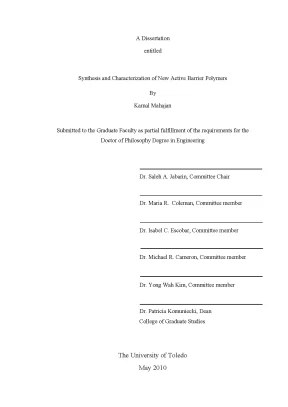
Tải xuống để đọc toàn bộA Dissertation entitled Synthesis and Characterization of New Active Barrier Polymers By Kamal Mahajan Submitted to the Graduate Faculty as partial fulfillment of the requirements for the Doctor of Philosophy Degree in Engineering Dr. Jabarin, Committee Chair Dr. Coleman, Committee member Dr. Escobar, Committee member Dr.
Cameron, Committee member Dr. Yong Wah Kim, Committee member Dr. Patricia Komuniecki, Dean College of Graduate Studies The University of Toledo May 2010 Copyright 2010, Kamal Mahajan This document is copyrighted material. Under copyright law, no parts of this document may be reproduced without the expressed permission of the author.
An abstract of Synthesis and Characterization of New Active Barrier Polymers by Kamal Mahajan Submitted to the Graduate Faculty in partial fulfillment of the requirements for the Doctor of Philosophy Degree in Engineering The University of Toledo May 2010 For many foods and beverages, a fundamental requirement for shelf stability is the minimization of oxygen exposure and thus minimal possible reaction with the food. Common problems associated with the presence of oxygen in food products include microbial spoilage, nutrient loss, as well as flavor and odor changes. There is a need in the industry to improve the oxygen barrier properties of polyesters. Among the approaches available to improve the barrier properties, one of the most promising approaches is the addition of an active oxygen scavenger directly into the poly(ethylene terephthalate) (PET) material.
An active oxygen scavenger is a substance capable of intercepting and scavenging oxygen by undergoing a chemical reaction with it, as the oxygen permeates through the PET packaging wall. There is also a need to develop a methodology for determining the scavenging capacity of potential oxygen scavengers and to ultimately help in efficiently designing the copolymers of PET and potential scavengers with better barrier properties. iii The oxygen scavengers used in this research were two simple model compounds: monoolein (MO) and 3-cyclohexene-1,1-dimethanol (CHEDM). The new active barrier copolymers were synthesized by melt polymerizing PET with the oxygen scavengers in a batch scale polymerization system.
It was found using proton NMR (1H NMR) and 2-D correlation spectroscopy (COSY) that PET has reacted with MO and CHEDM leading to the formation of the copolymers. The effect of oxygen scavengers on the physical properties (melting, crystallization, and rheological behavior) of PET was also studied. The effects of oxygen scavengers on the barrier properties of PET were evaluated by determining oxygen permeation rates. The oxygen barrier properties of copolymers of PET/MO and PET/CHEDM were respectively improved by about 30 and 40%.
The oxidation by-products of the copolymers were determined by using gas chromatography- mass spectrometry (GC-MS). Finally, a methodology was developed to determine the scavenging capacity of potential oxygen scavengers by studying the oxidation kinetics followed by the calculation of Thiele modulus. The oxidation kinetics of the copolymers of PET and oxygen scavengers was determined by using nuclear magnetic resonance spectroscopy (NMR) and fourier transform infrared spectroscopy (FTIR). iv Dedication This dissertation is dedicated to my family and Dr.
Jabarin for their constant support and love. v Acknowledgements First I would like to express thanks to my advisor, Dr. Jabarin, for giving me this great opportunity to work with him on this project at the Polymer Institute. Without his invaluable guidance, encouragement and support throughout my dissertation research, the completion of this work would not have been possible.
Many thanks are due to Ms. Lofgren for her valuable advice, teaching me analysis techniques and reviewing my dissertation. I am very grateful to Mr. Mike Mumford for his assistance in using the lab equipments at the Polymer Institute.
Thanks are due to Dr. Cameron and Dr. Yong Wah Kim for their help and support throughout this work. Thanks also to Ms.
Zydorczyk for her kind help. I especially would like to thank Dr. Escobar, and Dr. Yong Wah Kim for serving on my dissertation committee.
My grateful acknowledgement is also given for the financial support provided by the PET and Active Barrier Industrial Consortium. Finally, I would like to thank all my friends in the University of Toledo for their support and friendship making my stay at the Polymer Institute a memorable one. vi Table of Contents Abstract………………….vi Table of Contents………………….vii List of Figures………………………………….………………xiii List of Tables……………………………….1 Active oxygen scavenger………………………………………………………….2 Polymerization of PET/scavenger copolymers……………………………………4 1.3 Reaction analysis of PET/scavenger copolymers…………………………………6 1.4 Literature review of PET copolymers.1 PET as a passive barrier……………………………………………………….2 PET modified with oxygen scavengers……………………………………….1 PET modified with oxidizable groups in its main chain…………………12 vii 1.2 Advantages of PET modified with oxidizable groups versus sachet and iron based films……………………….3 Disadvantages of PET modified with oxidizable groups……………….3 PET with non-oxidizable pendant groups…………………………………….4 PET with oxidizable pendant groups………………………………………….5 Projected advantages of PET modified with oxidizable pendant groups…….5 Oxygen transmission rate/Permeability………………………………………….6 Rationale and objectives…………………………………………………………19 1.7 Selection of active oxygen scavengers for this research…………………………22 Chapter 2.3 Preparation of the physical blends……………………………………………….6 Melt IV/Intrinsic viscosity measurement……………………………………….8 Solid state polymerization……………………………………………………….10 Single screw extrusion………………………………………………………….11 Barrier property measurement………………………………………………….13 Microscopy of PET/scavenger copolymers…………………………………….2 Small angle light scattering…………………………………………………44 2.14 GC-MS analysis………………………………………………………………….15 Gas chromatographic analysis………………………………………………….16 Oxygen scavenging capacity calculations………………………………………. Results and Discussion 47 3.1 In situ polymerization of PET/scavenger copolymers………………………….2 Reaction analysis between PET and MO using NMR spectroscopy…………….1 1H NMR spectrum of pure PET………………………………………………49 3.2 1H NMR spectrum of pure MO……………………………………………….3 1H NMR spectra of PET/MO copolymer…………………………………….4 COSY plot for PET/MO copolymer………………………………………….5 1H NMR spectra for extracted samples of PET/MO copolymer…………….6 1H NMR spectra for physical blend of PET/MO…………………………….7 1H NMR spectra for extracted sample of physical blend of PET/MO……….3 Reaction analysis between PET and CHEDM using NMR spectroscopy……….1 1H NMR spectrum of pure CHEDM………………………………………….2 1H NMR spectra of PET/CHEDM copolymer……………………………….3 1H NMR spectra of physical blend of PET/CHEDM…………………………69 3.1 For WA314 PET………………………………………………………………73 3.2 For PET/MO copolymers…………………………………………………….3 For PET/CHEDM copolymers……………………………………………….1 For WA314 PET………………………………………………………………78 3.2 For PET/MO copolymers…………………………………………………….3 For PET/CHEDM copolymers……………………………………………….7 Melting and isothermal crystallization behavior of PET/scavenger copolymers………………………………………………………………………….1 Approach used to study isothermal crystallization behavior of PET/scavenger copolymers……………………………………………………….2 Equilibrium melting point……….4 Half time method…………………………….8 Microscopy of PET/scavenger copolymers……………………….9 Spherulite radii determination using SALS………………………………….10 SSP of PET/scavenger copolymers……………………………………….1 For PET/scavenger copolymers……………………………………….2 Effect of catalyst on oxygen permeability………………………………….12 Density of PET/scavenger copolymers………………………………….14 Calculation of oxygen scavenging capacity of scavengers………………….2 For 3-cyclohexene-1,1-dimethanol…………….2 Experimental determination of oxygen scavenging capacity of scavengers………………………………………………………………………….15 Effect of oxidation catalyst on rheological and thermal properties………….1 Rheological behavior of PET/scavenger copolymers………………….1 For PET/CHEDM copolymer………………………………….2 For PET/MO copolymer………………………………………….3 For WA314 PET…………………………………………….2 Thermal behavior of PET/scavenger copolymers…………………….1 DSC data for PET/MO copolymer……………………….2 DSC data for PET/CHEDM copolymer……………………….17 A methodology to determine the scavenging capacity of potential O2 scavengers……………………………………………………………………….1 Determination of oxidation kinetics of pure MO and PET/MO copolymer.2 Determination of oxidation kinetics of pure CHEDM and PET/CHEDM copolymer……………………………….3 Determination of Thiele Modulus for pure scavengers and the PET/scavenger copolymers………………………………….18 Oxidation byproducts of pure scavengers and PET/scavenger copolymers……220 3.1 Analysis of the oxidation byproducts using GC-MS………………….2 Analysis of the oxidation byproducts using GC…………………….
Conclusions and Recommendations 229 4.2 Future work/Recommendations. References 237 xii List of Figures Figure 1.1: Chemical structure of PET…………………………………………….2: Reaction of active oxygen scavenger with oxygen ………….3: Melt polymerization steps in PET and additives………………………….4: Advantage of active oxygen scavenger………………………………….5: Structures of scavengers (a) Monoolein, (b) 3-cyclohexene-1,1- dimethanol……………………………………………………………………………….1: Schematic diagram of melt polymerization reactor…………………………28 Figure 2.2: The schematic of an NMR instrument………….3: The calibration curve of melt intrinsic viscosity………….4: Schematic diagram of Buhler solid state polymerization reactor……………38 Figure 2.5: Diagram of small angle light scattering setup………………………….6: Pressure-drop (∆p) oxygen consumption test……………………………….1: Structure of PET………………….2: 1H NMR spectrum of pure PET…………………………………………….3: Structure of Monoolein (MO)……………………………………………….4: 1H NMR spectrum of pure MO in a mixture of d-TFA and d-chloroform….5: 1H NMR spectrum of PET/MO(5wt%) copolymer………………………….6: COSY plot for PET/MO(5wt%) copolymer……………………………….7: COSY plot (expanded) for PET/MO(5wt%) copolymer…………………….8: 1H NMR spectrum of PET/MO(5wt%) copolymer…………………….9: 1H NMR spectrum of PET/MO(5wt%) copolymer after extraction ……….10: 1H NMR spectra for PET/MO (physical blends)………………………….11: H NMR spectrum of pure CHEDM in a mixture of d-TFA and d- chloroform (Fresh)……………………………………………………………………….12: 1H NMR spectrum of pure CHEDM in a mixture of d-TFA and d- chloroform (After 1 day)…………………………………………………………………66 Figure 3.13: 1H NMR spectrum of PET/CHEDM(5wt%) copolymer ………………….14: 1H NMR spectrum of physical blend of PET/CHEDM ……….15: Viscosity versus shear rate for WA314 PET…….16: Viscosity versus shear rate for PET/MO copolymers…………………….17: Viscosity versus shear rate for PET/CHEDM copolymers……………….18: DSC plot for WA314 PET (heating after the quench)………………….19: DSC plot for WA314 PET (cooling from the melt)…………………….20: DSC plot for PET/MO copolymers (heating after the quench)………….21: DSC plot for PET/MO copolymers (cooling from the melt)…………….22: DSC plot for PET/CHEDM copolymers (heating after the quench)…….23: DSC plot for PET/CHEDM copolymers (cooling from the melt)……….24: DSC results from fusion of PET. The isothermal crystallization conditions were, a) 460K,b) 465K, c) 470K, d) 478K…………………………………………….25: Multiple melting peaks of isothermally crystallized WA314 PET.26: Multiple melting peaks of isothermally crystallized PET/MO(1wt%) copolymer……………………………………………………………………………….27: Multiple melting peaks of isothermally crystallized PET/MO(5wt%) copolymer……………………………………………………………………………….28: Multiple melting peaks of isothermally crystallized PET/CHEDM(1wt%) copolymer……………………………………………………………………………….29: Multiple melting peaks of isothermally crystallized PET/CHEDM(3wt%) copolymer……………………………………………………………………………….30: Multiple melting peaks of isothermally crystallized PET/CHEDM(5wt%) copolymer……………………………………………………………………………….31: Multiple melting peaks of isothermally crystallized PET/CHEDM(5wt%) copolymer……………………………………………………………………………….32: A plot used to obtain the equilibrium melting temperature (Tmo) of PET/MO(1wt%) copolymer (showing melting peaks Tm1, Tm2, Tm3) versus crystallization temperature…………………………………….33: The depression of equilibrium melting point of PET/CHEDM copolymers…………………….34: The depression of equilibrium melting point of PET/MO copolymers…….35: Crystallization behavior for isothermally crystallized PET/CHEDM(5wt%) copolymer………………………………………………………………………….36: Half time plotted as a function of crystallization temperature for isothermally crystallized WA314 PET………………………………….37: Half time plotted as a function of crystallization temperature for isothermally crystallized PET/MO copolymers…………………………………….38: Half time plotted as a function of degree of undercooling for PET/MO copolymers…….39: Half time plotted as a function of crystallization temperature for isothermally crystallized PET/CHEDM copolymers……………….40: Half time plotted as a function of degree of undercooling for PET/CHEDM copolymers…….41: θa versus ln(t) for isothermally crystallized WA314 PET.42: θa versus ln(t) for isothermally crystallized PET/MO(5wt%) copolymer………………………………………………………………………………106 Figure 3.43: θa versus ln(t) for isothermally crystallized PET/CHEDM(3wt%) copolymer………………………………………………………………………………107 Figure 3.44: ln(-ln(θa)) versus ln(t) for isothermally crystallized WA314 PET……….45: ln(-ln(θa)) versus ln(t) for isothermally crystallized PET/MO(5wt%) copolymer………………………………………………………………………………108 Figure 3.47: Microphotograph of WA314 PET spherulite growth at 200oC for 120 sec………………………………………………………………………………………116 Figure 3.48: Microphotograph of PET/MO(5wt%) spherulite growth at 200oC for 120 sec………………………………………………………………………………………116 Figure 3.49: Impurities in a) WA314 PET; b) PET/MO(5wt%) copolymer sample….50: Impurities in a) PET/CHEDM(5wt%) copolymer b) Pure CHEDM compound……………………………………………………………………………….51: Spherulite growth for WA314 PET during isothermal crystallization at 200oC………………………………………………………………………………….52: Spherulite growth for PET/MO(5wt%) copolymer during isothermal crystallization at 200oC…………………………………………………………….53: Spherulite growth for PET/CHEDM(5wt%) copolymer during isothermal crystallization at 200oC………………………………………………………….54: WA314 PET spherulite growth from the melt at 200oC.55: PET/MO(5wt%) spherulite growth from the melt at 200oC…………….56: Apparent intrinsic viscosity (dL/g) versus time (min) for PET/CHEDM(3wt%) copolymer…………………………………….57: Apparent intrinsic viscosity (dL/g) versus time (min) for PET/CHEDM(1wt%) copolymer…………………………….58: IV comparison of PET/CHEDM copolymers (before and after SSP reaction)……………………………………………………………………………….59: Oxygen permeability of PET/MO, PET/CHEDM copolymer and PET sheets……………………………………………………………………………………131 Figure 3.60: Average oxygen permeability for PET/MO copolymer and pure PET….61: Average densities versus concentration of scavenger…………………….62: Pressure of oxygen versus time of oxidation………………………….63: Shear viscosity versus shear rate for PET/CHEDM(1wt%) copolymer….64: Shear viscosity versus shear rate for PET/CHEDM(5wt%) copolymer….65: Shear viscosity versus shear rate for PET/MO(5wt%) copolymer……….66: Shear viscosity versus shear rate for WA314 PET sample……………….67: Melting and crystallization behavior for PET/MO(5wt%) copolymer samples………………………………………………………………………………….68: Crystallization behavior for PET/MO(5wt%) copolymer samples……….69: Melting and crystallization behavior for PET/MO(5wt%) copolymer samples………………………………………………………………………………….70: Crystallization behavior for PET/MO(5wt%) copolymer samples……….71: Melting and Crystallization behavior for PET/CHEDM(5wt%) copolymer………………………………………………………………………………155 Figure 3.72: Crystallization behavior for PET/CHEDM(5wt%) copolymer sample….73: Melting and crystallization behavior for PET/CHEDM(1wt%) copolymer sample………………………………………………………………………………….74: Crystallization behavior for PET/CHEDM(1wt%) copolymer sample….75: Crystallization behavior for PET/CHEDM copolymer (from glassy state).76: Crystallization behavior for PET/CHEDM copolymer (cooling from the melt)…………………………………………………………………………………….77: Structure of pure MO………………………………………………….78: FTIR spectrum of pure MO (before oxidation and after oxidation at 50oC)………………………………………………………………………………….79: Expanded FTIR spectrum of pure MO (before oxidation and after oxidation at 50oC)………………………………………………………………………….80: Expanded FTIR spectrum of pure MO (before oxidation and after oxidation at 50oC)……………………………………………………………………….81: Plot of ln(R/R(t0)) versus time for pure monoolein……………………….82: Plot of normalized height of double bond peak versus time for pure monoolein…………………………………………………………………………….83: Plot of ln(-rate) versus ln(CA) for pure monoolein………………….84: 1H NMR spectrum of pure MO (before oxidation)…………………….85: 1H NMR spectrum of pure MO (after oxidation for 8 days at 50oC)…….
Nội dung được bảo vệ bản quyền — Tải xuống đầy đủ
Trích dẫn luận án này
Kamal Mahajan (2010). Tổng hợp và đặc trưng polymer rào cản oxy hoạt tính mới (PET) [Luận án tiến sĩ, The University of Toledo]. LuanAn.net. https://luanan.net/ky-thuat-hoa-hoc-thuc-pham/cong-nghe-hoa-hoc/tong-hop-va-dac-trung-polymer-rao-can-oxy-hoat-tinh-moi
Câu hỏi thường gặp
Luận án "Tổng hợp và đặc trưng polymer rào cản oxy hoạt tính mới (PET)" nghiên cứu về vấn đề gì?
Tổng hợp đặc trưng polymer rào cản oxy hoạt tính mới (PET) cho ngành bao bì. Phân tích cấu trúc, tính chất và ứng dụng thực tiễn.
Luận án "Tổng hợp và đặc trưng polymer rào cản oxy hoạt tính mới (PET)" được bảo vệ tại trường nào?
Luận án này được bảo vệ tại The University of Toledo. Năm bảo vệ: 2010.
Luận án "Tổng hợp và đặc trưng polymer rào cản oxy hoạt tính mới (PET)" thuộc chuyên ngành gì?
Luận án "Tổng hợp và đặc trưng polymer rào cản oxy hoạt tính mới (PET)" thuộc chuyên ngành Engineering. Danh mục: Công Nghệ Hóa Học.
Luận án "Tổng hợp và đặc trưng polymer rào cản oxy hoạt tính mới (PET)" có bao nhiêu trang?
Luận án "Tổng hợp và đặc trưng polymer rào cản oxy hoạt tính mới (PET)" có 268 trang. Bạn có thể xem trước một phần tài liệu ngay trên trang web trước khi tải về.
Cách tải luận án "Tổng hợp và đặc trưng polymer rào cản oxy hoạt tính mới (PET)" về máy như thế nào?
Để tải luận án về máy, bạn nhấn nút "Tải xuống ngay" trên trang này, sau đó hoàn tất thanh toán phí lưu trữ. File sẽ được tải xuống ngay sau khi thanh toán thành công. Hỗ trợ qua Zalo: 0559 297 239.