Intangible values in financial accounting and reporting an analysis from the per
Tìm hiểu vai trò của giá trị vô hình trong kế toán và báo cáo tài chính. Phân tích ảnh hưởng đến quyết định đầu tư và quản trị doanh nghiệp.
University of St. Gallen
Management, Economics, Law, Social Sciences and International Affairs
Luan An
Dissertation
Năm xuất bản
Số trang
264
Thời gian đọc
40 phút
Lượt xem
0
Lượt tải
0
Phí lưu trữ
50 Point
Tổng quan nhanh
- Chủ đề:
- 1. Tầm quan trọng giá trị vô hình trong kế toán tài chính
- Số trang:
- 264 trang
- Trường:
- University of St. Gallen
- Chuyên ngành:
- Management, Economics, Law, Social Sciences and International Affairs
- Tác giả:
- Stephan Grüber
- Năm:
- 2014
Tóm tắt nội dung luận án
I. Tầm quan trọng giá trị vô hình trong kế toán tài chính
Giá trị vô hình đã trở thành động lực tăng trưởng quan trọng trong nền kinh tế hiện đại. Tuy nhiên, kế toán tài chính và báo cáo vẫn chưa thể tích hợp và phản ánh đầy đủ các giá trị này. Dù đã có nhiều cuộc tranh luận kéo dài hàng thập kỷ, một giải pháp toàn diện vẫn chưa được phát triển. Điều này dẫn đến việc báo cáo tài chính cung cấp một bức tranh không đầy đủ về nguồn lực và các khoản phải thu thực sự của một thực thể. Cần thừa nhận các hạn chế cố hữu của kế toán tài chính. Nó không nhằm mục đích trình bày dữ liệu tuyệt đối. Tuy nhiên, việc phân tích sâu hơn là cần thiết. Điều này giúp hiểu rõ hơn và có thể thu hẹp khoảng cách thông tin hiện có.
1.1. Giá trị vô hình động lực tăng trưởng doanh nghiệp
Trong nền kinh tế hiện đại, giá trị vô hình trở thành yếu tố quyết định. Chúng là động lực tăng trưởng chủ chốt của doanh nghiệp. Các tài sản vô hình này thúc đẩy sự đổi mới. Chúng tạo ra lợi thế cạnh tranh bền vững. Khả năng tạo ra giá trị dài hạn của công ty phụ thuộc nhiều vào chúng. Ví dụ bao gồm thương hiệu, bằng sáng chế, và mối quan hệ khách hàng. Việc nhận diện và quản lý các tài sản vô hình này rất cần thiết.
1.2. Hạn chế kế toán truyền thống về intangibles
Hệ thống kế toán tài chính truyền thống đang đối mặt nhiều thách thức. Nó chưa thể tích hợp và báo cáo đầy đủ các giá trị vô hình. Dù đã có nhiều cuộc tranh luận trong nhiều thập kỷ, một giải pháp phổ quát vẫn chưa xuất hiện. Do đó, báo cáo tài chính thường cung cấp một bức tranh không hoàn chỉnh. Nguồn lực thực sự và các khoản phải thu của một thực thể bị che khuất. Việc phân tích sâu hơn là cần thiết để hiểu rõ và thu hẹp khoảng trống thông tin hiện có. Các chuẩn mực kế toán cho intangibles cần được xem xét.
II. Thách thức báo cáo tài sản vô hình và thông tin
Việc báo cáo tài sản vô hình đặt ra nhiều thách thức đáng kể. Các phương pháp kế toán hiện tại thường không nắm bắt được toàn bộ giá trị. Điều này dẫn đến sự thiếu hụt thông tin quan trọng. Khoảng trống này ảnh hưởng đến khả năng phân tích và đánh giá của các chuyên gia. Cần cải thiện cách tiếp cận để cung cấp cái nhìn chính xác hơn. Các vấn đề bao gồm định giá tài sản trí tuệ và việc hạch toán goodwill. Các yêu cầu về báo cáo IFRS intangible assets cũng cần được làm rõ.
2.1. Khoảng trống thông tin về tài sản vô hình
Khoảng trống thông tin về tài sản vô hình vẫn còn tồn tại. Kế toán hiện tại chưa cung cấp cái nhìn toàn diện. Việc này gây khó khăn cho việc đánh giá giá trị doanh nghiệp. Các nhà đầu tư và chuyên gia tài chính cần dữ liệu đầy đủ hơn. Thiếu thông tin dẫn đến quyết định kém hiệu quả. Việc cải thiện độ minh bạch là cấp thiết.
2.2. Khó khăn định giá tài sản trí tuệ và thương hiệu
Định giá tài sản trí tuệ là một thách thức lớn. Định giá thương hiệu cũng vậy. Các phương pháp định giá truyền thống không phù hợp. Giá trị thị trường của các tài sản này thường biến động. Kế toán goodwill cũng đối mặt với nhiều phức tạp. Việc tìm kiếm một phương pháp intellectual property valuation chuẩn mực là cần thiết. Brand value accounting yêu cầu cách tiếp cận đặc biệt.
2.3. Hạch toán chi phí R D và mối quan hệ khách hàng
Hạch toán chi phí nghiên cứu và phát triển (R&D) gây tranh cãi. Việc ghi nhận chi phí này thường không nhất quán. Mối quan hệ khách hàng là một tài sản vô hình quan trọng. Tuy nhiên, việc ghi nhận giá trị của chúng trong báo cáo tài chính vẫn chưa rõ ràng. Kế toán cho các tài sản này cần được cải thiện. Research and development costs accounting và customer relationships accounting cần quy định rõ ràng hơn.
III. Phân tích tài sản vô hình từ góc độ chuyên gia
Nghiên cứu tập trung vào việc sử dụng thông tin của các chuyên gia tài chính. Họ là những người dùng chính của IFRSs. Việc tìm hiểu cách họ sử dụng và tích hợp thông tin về giá trị vô hình là trọng tâm. Điều này giúp đánh giá liệu thông tin đó có ảnh hưởng đến các quyết định của họ hay không. Nghiên cứu cũng xem xét các ưu tiên của chuyên gia đối với kế toán và báo cáo tài sản vô hình trong tương lai. Việc này cung cấp cái nhìn sâu sắc về nhu cầu thực tế của thị trường.
3.1. Chuyên gia tài chính sử dụng thông tin intangibles
Chuyên gia tài chính là người sử dụng chính các chuẩn mực IFRS. Họ sử dụng thông tin về tài sản vô hình trong quá trình ra quyết định. Cách họ tích hợp thông tin này rất quan trọng. Phân tích tài sản vô hình giúp họ đưa ra nhận định tốt hơn. Các chuyên gia cần dữ liệu đáng tin cậy về IFRS intangible assets.
3.2. Ảnh hưởng thông tin tài sản vô hình đến quyết định
Thông tin về giá trị vô hình có tác động đáng kể. Nó ảnh hưởng đến các quyết định đầu tư của chuyên gia. Hiểu rõ sự ảnh hưởng này là trọng tâm nghiên cứu. Các quyết định mua bán hay định giá đều bị tác động. Báo cáo minh bạch về các intangible assets giúp cải thiện chất lượng quyết định.
3.3. Các nhóm phân tích và mục tiêu quyết định
Nghiên cứu phân biệt các nhóm chuyên gia tài chính. Bao gồm chuyên gia mua và bán. Có cả chuyên gia phân tích cổ phiếu và trái phiếu. Mỗi nhóm có mục tiêu quyết định khác nhau. Việc này ảnh hưởng đến cách họ sử dụng thông tin tài sản vô hình. Các nhóm này có thể có sở thích khác nhau về human capital reporting hoặc patents and trademarks financial reporting.
IV. Cải thiện chuẩn mực kế toán tài sản vô hình IFRS
Việc cải thiện các chuẩn mực kế toán cho tài sản vô hình là một ưu tiên hàng đầu. Các tiêu chuẩn IFRS hiện tại đã có những quy định. Tuy nhiên, chúng vẫn còn những hạn chế. Cần phát triển thêm các khái niệm và phương pháp mới. Mục tiêu là cung cấp thông tin minh bạch và toàn diện hơn. Điều này sẽ giúp người dùng báo cáo tài chính đánh giá chính xác hơn giá trị thực của doanh nghiệp. Việc này cũng bao gồm việc giải quyết các thách thức trong việc hạch toán các tài sản như goodwill và intellectual property valuation.
4.1. Chuẩn mực kế toán IFRS cho tài sản vô hình
Các chuẩn mực kế toán quốc tế (IFRS) là cơ sở quan trọng. Chúng định hướng việc ghi nhận và báo cáo tài sản vô hình. Tuy nhiên, vẫn còn nhiều khoảng trống cần lấp đầy. Việc áp dụng IFRS intangible assets đang được xem xét. Cần làm rõ thêm các hướng dẫn về accounting standards for intangibles.
4.2. Khái niệm cải thiện báo cáo giá trị vô hình
Nhiều khái niệm đã được giới thiệu để cải thiện báo cáo. Các phương pháp mới tập trung vào tính minh bạch. Chúng nhằm mục đích cung cấp cái nhìn toàn diện hơn. Việc này bao gồm cả cách hạch toán goodwill accounting. Các đề xuất mới cần được đánh giá kỹ lưỡng.
4.3. Nhu cầu tương lai về báo cáo tài sản vô hình
Nghiên cứu xem xét sở thích của chuyên gia tài chính. Họ mong muốn gì về kế toán và báo cáo tài sản vô hình trong tương lai? Nhu cầu về thông tin chi tiết, đáng tin cậy là rất lớn. Việc này định hình các tiêu chuẩn mới. Thông tin về patents and trademarks financial reporting cũng cần được chú trọng.
V. Tương lai báo cáo giá trị vô hình doanh nghiệp
Tương lai của báo cáo tài chính cần phản ánh đầy đủ hơn giá trị vô hình. Các công ty ngày càng phụ thuộc vào các tài sản này để tạo ra giá trị. Do đó, việc cải tiến các phương pháp kế toán và báo cáo là điều cấp thiết. Mục tiêu là cung cấp thông tin hữu ích cho các nhà đầu tư và chuyên gia tài chính. Điều này bao gồm việc phát triển các giải pháp cho hạch toán goodwill, định giá tài sản trí tuệ, và tích hợp các chỉ số phi tài chính vào báo cáo. Việc minh bạch hóa các intangible assets sẽ tăng cường niềm tin thị trường.
5.1. Phát triển báo cáo giá trị vô hình hiệu quả
Việc phát triển các phương pháp báo cáo hiệu quả là cấp thiết. Mục tiêu là thu hẹp khoảng cách thông tin. Báo cáo cần phản ánh đầy đủ giá trị thực của doanh nghiệp. Các tài sản vô hình cần được hiển thị rõ ràng. Việc này đòi hỏi sự hợp tác giữa các nhà hoạch định chính sách và doanh nghiệp.
5.2. Giải pháp cho hạch toán goodwill và tài sản trí tuệ
Cần có giải pháp cụ thể cho hạch toán goodwill. Việc ghi nhận và định giá tài sản trí tuệ cũng cần được chuẩn hóa. Bao gồm cả bằng sáng chế và nhãn hiệu. Sự rõ ràng sẽ cải thiện độ tin cậy của báo cáo. Goodwill accounting và intellectual property valuation là những lĩnh vực cần được ưu tiên cải cách.
5.3. Vai trò thông tin phi tài chính trong báo cáo
Thông tin phi tài chính đóng vai trò ngày càng quan trọng. Nó bổ trợ cho báo cáo tài chính truyền thống. Các chỉ số về vốn con người (human capital reporting) hay mối quan hệ khách hàng rất hữu ích. Chúng cung cấp cái nhìn sâu sắc hơn về giá trị vô hình. Customer relationships accounting cần được tích hợp. Các thông tin này giúp chuyên gia tài chính đưa ra nhận định toàn diện.
Mục lục chi tiết luận án
Tải xuống file đầy đủ để xem toàn bộ nội dung
Tải đầy đủ (264 trang)Trích đoạn nội dung luận án
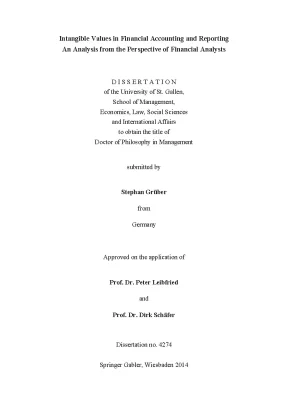
Tải xuống để đọc toàn bộIntangible Values in Financial Accounting and Reporting An Analysis from the Perspective of Financial Analysts DISSERTATION of the University of St. Gallen, School of Management, Economics, Law, Social Sciences and International Affairs to obtain the title of Doctor of Philosophy in Management submitted by Stephan Grüber from Germany Approved on the application of Prof. Peter Leibfried and Prof. Dirk Schäfer Dissertation no.
4274 Springer Gabler, Wiesbaden 2014 The University of St. Gallen, School of Management, Economics, Law, Social Sciences and International Affairs hereby consents to the printing of the present dissertation, without hereby expressing any opinion on the views herein expressed. Gallen, May 19, 2014 The President: Prof. Thomas Bieger Intangible Values in Financial Accounting and Reporting Stephan Grüber Intangible Values in Financial Accounting and Reporting An Analysis from the Perspective of Financial Analysts With a Foreword by Prof.
Peter Leibfried Stephan Grüber St. Gallen, Switzerland Dissertation, University of St. Gallen, Switzerland ISBN 978-3-658-06549-2 ISBN 978-3-658-06550-8 (eBook) DOI 10.1007/978-3-658-06550-8 The Deutsche Nationalbibliothek lists this publication in the Deutsche Nationalbibliografie; detailed bibliographic data are available in the Internet at http://dnb. Library of Congress Control Number: 2014944657 Springer Gabler © Springer Fachmedien Wiesbaden 2015 This work is subject to copyright.
All rights are reserved by the Publisher, whether the whole or part of the material is concerned, specifically the rights of translation, reprinting, reuse of illustrations, recitation, broadcasting, reproduction on microfilms or in any other physical way, and transmission or information storage and retrieval, electronic adaptation, compu- ter software, or by similar or dissimilar methodology now known or hereafter developed. Exempted from this legal reservation are brief excerpts in connection with reviews or schol- arly analysis or material supplied specifically for the purpose of being entered and executed on a computer system, for exclusive use by the purchaser of the work. Duplication of this publication or parts thereof is permitted only under the provisions of the Copyright Law of the Publisher’s location, in its current version, and permission for use must always be obtained from Springer. Permissions for use may be obtained through RightsLink at the Copyright Clearance Center.
Violations are liable to prosecution under the respective Copyright Law. The use of general descriptive names, registered names, trademarks, service marks, etc. in this publication does not imply, even in the absence of a specific statement, that such names are exempt from the relevant protective laws and regulations and therefore free for general use. While the advice and information in this book are believed to be true and accurate at the date of publication, neither the authors nor the editors nor the publisher can accept any legal re- sponsibility for any errors or omissions that may be made.
The publisher makes no warranty, express or implied, with respect to the material contained herein. Printed on acid-free paper Springer Gabler is a brand of Springer DE. Springer DE is part of Springer Science+Business Media.de Foreword V FOREWORD Even though intangible values have continuously become significant value drivers of companies in today’s economy, financial accounting and reporting still lacks to properly incorporate and to report such values. Despite the ongoing debate throughout the past decades, a universal solution inside or outside of the traditional information means has not yet been developed.
As a consequence, financial accounting and reporting still provides an incomplete picture of an entity’s true resources and claims. While it is necessary to acknowledge that financial accounting and reporting has inherent limitations and is not supposed to present absolute data, further analysis is required to better understand and to potentially close the information gap. In this thesis, Stephan Grüber focuses on the information use of financial analysts, one of the primary users of IFRSs. He investigates how financial analysts utilize and incorporate information on intangible values in their decision-making processes and whether such information influences decisions.
In addition, the study examines the preferences of financial analysts in regard to accounting for and reporting intangibles in the future. Upon outlining the fundamentals of financial accounting and reporting, Stephan examines the foundations and challenges of intangible values and provides an overview of concepts introduced to improve the accounting and reporting of intangibles. As a next step, he distinguishes various groups of financial analysts and their decision-making objectives, such as buy- and sell-side analysts and equity and fixed income analysts. Chapter 5 represents the main body of this thesis, presenting and discussing two empirical studies.
The first part describes the results of a content analysis of sell-side research reports, offering insights into the information use of sell- side analysts. The second part analyzes the results of a web-based experimental survey with over 1,100 financial analysts, focusing on the importance of information of intangibles for their decision-making. The present analysis offers detailed and comprehensive evidence on the actual information use and preferences of financial analysts, contributing to an improved understanding of the user perspective in financial accounting and reporting, i. what users effectively require with respect to information on intangible values.
Hence, this thesis may not only be valuable to individuals in academia, but is also useful for VI Foreword practitioners and executives focusing on corporate communication. In addition, the results may further provide financial analysts with stimulating self-insight regarding their decision-making. I therefore wish this thesis to be widely read and accepted by a broad audience. Gallen, June 2014 Prof.
Peter Leibfried, CPA, MBA Managing Director of the Institute of Accounting, Control and Auditing (ACA-HSG) at the University of St.Gallen and doctoral advisor of Stephan Grüber Acknowledgements VII ACKNOWLEDGEMENTS The present thesis is the result of my Ph. studies at the University of St. Gallen (HSG) in Switzerland. It was submitted and approved to obtain the title Doctor of Philosophy in Management.
Throughout the course of my studies, there has been much support from many different people and I would like to take this opportunity to thank all of them. First and foremost, I am particularly indebted to my doctoral advisor, Prof. Peter Leibfried, who made this research possible, continuously providing me with guidance and encouragement over many years. His insights and advice significantly helped me to complete this work.
I would further like to express my sincere gratitude to Prof. Dirk Schäfer, who served as co-advisor and supported this project with valuable thoughts and ideas. I have written this thesis while being a full-time employee at KPMG LLP in New York. In order to participate in the Ph.
program in St. Gallen and to draft my thesis I was granted several study leaves. I would therefore like to express my genuine thanks to Dr. Norbert Fischer and Jan Storbeck for their trust and flexibility.
Moreover, I also thank Ingo Zielhoff, who supported me during the final phase of this project. I would also like to specifically thank Dr. Torsten Jaskolski for discussing and exchanging our ideas throughout the years. Special thanks go to Nicholas Jungovic for supporting me and reading the draft of this thesis.
In addition, I further extend my thanks to my family and friends, who have always been there for me despite my limited time. My deepest gratitude goes to my love Sophie for her unbounded patience, understanding and sacrifices along the way, as well as for her motivating and encouraging words during difficult times. Last but not least, I would also like to extend my appreciation and thanks to my parents for their love and unconditional support. This thesis is dedicated to them – it would not have been possible without them.
Zurich, June 2014 Stephan Grüber Brief Contents IX BRIEF CONTENTS 1. Relevance and Motivation of this Study. Purpose and Methodology of this Study. THE FUNDAMENTALS OF FINANCIAL ACCOUNTING AND REPORTING.
Introduction to the Chapter. Justification for the Existence of Financial Accounting and Reporting. Principles of Capital Markets-Oriented Financial Accounting and Reporting. FOUNDATION AND CHALLENGES OF INTANGIBLE VALUES IN FINANCIAL ACCOUNTING AND REPORTING.
Introduction to the Chapter. Characteristics and Attributes of Intangibles. Intangibles and International Financial Reporting Standards. Concepts to Improve Financial Accounting and Reporting of Intangible Values.
Consequences for the Further Analysis. FINANCIAL ANALYSTS AS USERS OF FINANCIAL ACCOUNTING AND REPORTING INFORMATION. Introduction to the Chapter. Fundamentals of Financial Analysts.
The Elements of Financial Analysts’ Decision-Making. Financial Analysts and Information on Intangible Values. Summary and Implications for this Study. EMPIRICAL ANALYSES OF THE PERSPECTIVE OF FINANCIAL ANALYSTS ON INFORMATION ABOUT INTANGIBLES.
Introduction to the Chapter. Content-Analysis of Sell-Side Research Reports. Limitations of the Selected Methodologies. SUMMARY AND CONSEQUENCES FOR REPORTING INTANGIBLE VALUES.
Introduction to the Chapter. Summary and Implications of the Findings. Recommendations for Accounting and Reporting Intangible Values. 411 Table of Contents XI TABLE OF CONTENTS FOREWORD.
VII BRIEF CONTENTS. IX TABLE OF CONTENTS. XVII LIST OF ABBREVIATIONS. XIX LIST OF FIGURES.
XXV LIST OF TABLES. Relevance and Motivation of this Study. Purpose and Methodology of this Study. THE FUNDAMENTALS OF FINANCIAL ACCOUNTING AND REPORTING.
Introduction to the Chapter. Justification for the Existence of Financial Accounting and Reporting. Neoclassical Economic and Finance Theory. The Efficient-Market Hypothesis and Empirical Evidence.
Implications of the Efficient-Market Hypothesis. New Institutional Economics and Principal Agent Theory. Information Asymmetries and Agency Costs. Financial Information as a Solution to the Agency Problem.
Summary and Consequences for the Design of Financial Accounting and Reporting. Principles of Capital Markets-Oriented Financial Accounting and Reporting. Primary User Group and Objectives of International Financial Reporting Standards. Definition and Criteria of Decision-Useful Information .33 XII Table of Contents 3.
FOUNDATION AND CHALLENGES OF INTANGIBLE VALUES IN FINANCIAL ACCOUNTING AND REPORTING. Introduction to the Chapter. Characteristics and Attributes of Intangibles. Definition and Distinction of Intangibles.
Economic Properties of Intangible Values. Classification of Intangible Values. Legal Classification Scheme. Economic Classification Schemes.
Intangibles and International Financial Reporting Standards. Initial Recognition and Measurement of Intangible Assets. Definition of Intangible Assets. Recognition and Measurement of Intangible Assets.
Acquisition as Part of a Business Combination. Additional Requirements for Internally Generated Intangibles. Current Disclosure Requirements for Intangible Assets. Constraints and their Impact.
Decreasing Relevance of IFRSs and It Reasons. Impact of Failing to Provide Information on Intangible Values. Concepts to Improve Financial Accounting and Reporting of Intangible Values. Extended Reporting within the Classic Presentation Formats.
The AASB Discussion Paper. Proposals for an Extended Business Reporting of Intangible Values. Top-Down Methods of an Extended Business Reporting. Bottom-Up Methods of an Extended Business Reporting.
Consequences for the Further Analysis. FINANCIAL ANALYSTS AS USERS OF FINANCIAL ACCOUNTING AND REPORTING INFORMATION. Introduction to the Chapter. Fundamentals of Financial Analysts.
Definition and Responsibilities of Financial Analysts. Classification and Different Types of Financial Analysts. 120 Table of Contents XIII 4. Financial Analysts as Providers of Useful Information.
The Elements of Financial Analysts’ Decision-Making. Equity Financial Analysts. Fixed Income Financial Analysts. Distribution of Information.
Financial Analysts and Information on Intangible Values. Methods Employed by Equity Analysts. Additional Valuation Models. Methods Employed by Fixed Income Analysts.
Decision-Making Concepts. Summary and Implications for this Study. EMPIRICAL ANALYSES OF THE PERSPECTIVE OF FINANCIAL ANALYSTS ON INFORMATION ABOUT INTANGIBLES. Introduction to the Chapter.
Content-Analysis of Sell-Side Research Reports. Purpose of this Content Analysis. General Objectives and Methodology of Content Analysis. Prior Content Analyses in Accounting Research.
Research Gap and Hypotheses for this Study. Research Design of this Study. Description of the Research Object. Sample Selection and Data Collection.
Test Procedures and Constructing the Intangible Score. Applied Statistical Tests. Validity and Reliability of the Content Analysis. Findings and Discussion.
Descriptive Statistics of the Sample. Preferred Valuation Methods. Results for the Total Sample. Human Capital Information Items.
225 XIV Table of Contents 5.
Nội dung được bảo vệ bản quyền — Tải xuống đầy đủ
Trích dẫn luận án này
Stephan Grüber (2014). Intangible values in financial accounting and reporting an a [Luận án tiến sĩ, University of St. Gallen]. LuanAn.net. https://luanan.net/kinh-te/tai-chinh-ngan-hang/intangible-values-in-financial-accounting-and-reporting-an-analysis-from-the
Câu hỏi thường gặp
Luận án "Intangible values in financial accounting and reporting an a" nghiên cứu về vấn đề gì?
Tìm hiểu vai trò của giá trị vô hình trong kế toán và báo cáo tài chính. Phân tích ảnh hưởng đến quyết định đầu tư và quản trị doanh nghiệp.
Luận án "Intangible values in financial accounting and reporting an a" được bảo vệ tại trường nào?
Luận án này được bảo vệ tại University of St. Gallen. Năm bảo vệ: 2014.
Luận án "Intangible values in financial accounting and reporting an a" thuộc chuyên ngành gì?
Luận án "Intangible values in financial accounting and reporting an a" thuộc chuyên ngành Management, Economics, Law, Social Sciences and International Affairs. Danh mục: Tài Chính - Ngân Hàng.
Luận án "Intangible values in financial accounting and reporting an a" có bao nhiêu trang?
Luận án "Intangible values in financial accounting and reporting an a" có 264 trang. Bạn có thể xem trước một phần tài liệu ngay trên trang web trước khi tải về.
Cách tải luận án "Intangible values in financial accounting and reporting an a" về máy như thế nào?
Để tải luận án về máy, bạn nhấn nút "Tải xuống ngay" trên trang này, sau đó hoàn tất thanh toán phí lưu trữ. File sẽ được tải xuống ngay sau khi thanh toán thành công. Hỗ trợ qua Zalo: 0559 297 239.