Theorizing girlboss culture mediated neoliberal feminisms from
Phân tích văn hóa girlboss trong bối cảnh feminisms hậu tư bản. Nghiên cứu sự tương tác giữa nữ quyền và chủ nghĩa tư bản trong thời đại hiện đại.
Media, Cinema, and Digital Studies
Luan An
Luận án tiến sĩ
Năm xuất bản
Số trang
136
Thời gian đọc
21 phút
Lượt xem
0
Lượt tải
0
Phí lưu trữ
40 Point
Tổng quan nhanh
- Chủ đề:
- Understanding #Girlboss Feminism: Neoliberal Empowerment
- Số trang:
- 136 trang
- Trường:
- Virginia Commonwealth University
- Chuyên ngành:
- Media, Cinema, and Digital Studies
- Tác giả:
- Frankie Mastrangelo
- Năm:
- 2021
Tóm tắt nội dung luận án
I.Understanding Girlboss Feminism Neoliberal Empowerment
Girlboss feminism represents a contemporary manifestation of feminist thought. It merges aspirations of female empowerment with capitalistic pursuits. This ideology equates true liberation with individual financial success. Market competition becomes a pathway to independence. Personal achievement defines feminist progress. Focus rests on achieving an individualized work-life balance. This balance is seen as a personal responsibility, not a systemic challenge. Curated digital and physical presences are crucial. Self-monetization drives participation. Girlboss feminism frames entrepreneurialism as a feminist act. It often overlooks collective action or structural inequalities. The discourse prioritizes individual gains. This approach contrasts with earlier feminist movements emphasizing systemic change. Empowerment becomes a commodity, obtainable through personal effort and consumption.
1.1. Defining Girlboss Feminism s Core Tenets
Girlboss feminism represents a contemporary manifestation of feminist thought. It merges aspirations of female empowerment with capitalistic pursuits. This ideology equates true liberation with individual financial success. Market competition becomes a pathway to independence. Personal achievement defines feminist progress. Focus rests on achieving an individualized work-life balance. This balance is seen as a personal responsibility, not a systemic challenge. Curated digital and physical presences are crucial. Self-monetization drives participation. Girlboss feminism frames entrepreneurialism as a feminist act. It often overlooks collective action or structural inequalities. The discourse prioritizes individual gains. This approach contrasts with earlier feminist movements emphasizing systemic change. Empowerment becomes a commodity, obtainable through personal effort and consumption.
1.2. Historicizing its Neoliberal Postfeminist Roots
The emergence of girlboss feminism is rooted in neoliberal and postfeminist ideologies. Neoliberal feminism incorporates market logic into gender equality efforts. It suggests women's advancement is best achieved through free-market principles. This perspective individualizes systemic issues. Gender inequality transforms into a problem of individual choice or skill. Postfeminism declares gender equality largely achieved. It then shifts focus to individual agency and lifestyle choices. This framework allows for the reintegration of traditional feminine tropes with claims of empowerment. Girlboss culture operates within this postfeminist landscape. It encourages women to 'lean in' to corporate structures. It promotes self-optimization within existing power dynamics. Historical analyses demonstrate this shift. Feminist ideals are reframed for capitalist consumption. The focus on individual resilience masks broader societal issues.
1.3. Digital Mediation Entrepreneurial Discourses
Digital platforms significantly mediate girlboss feminism. Social media becomes a primary channel for its dissemination. Influencers embody the girlboss ideal. Their online personas showcase curated success stories. This mediation fosters an entrepreneurial discourse. Women are encouraged to become their own bosses. This narrative promotes a 'hustle culture.' Constant productivity and self-promotion are valorized. Digital spaces offer visible examples of 'successful' women. These representations often simplify complex realities of business and labor. The individualistic nature of social media amplifies personal branding. It downplays collective support systems. The entrepreneurial drive becomes tied to identity. Online communities form around shared aspirational goals. These communities, however, frequently reinforce consumerist values. This constant digital presence fuels the visibility economy. Women are pressured to monetize every aspect of their lives.
II.Neoliberal Wellness Culture Girlboss Ideologies
Wellness culture has undergone a significant transformation. Its origins trace back to counterculture movements. Early iterations often emphasized holistic health and community. A shift occurred towards a more individualized, market-driven approach. This evolution aligns with neoliberal principles. Wellness transformed from a lifestyle choice into a consumer product. Corporate entities increasingly dominate the wellness industry. Products and services promise self-optimization and self-care. This industry frames health and well-being as personal achievements. It often ignores systemic health disparities. The emphasis moved from collective well-being to individual perfection. This corporate capture makes wellness a luxury. It requires financial investment and privileged access. The girlboss ideology finds a natural home here. It promotes wellness as a tool for personal and professional success. This aligns with the capitalist empowerment narrative.
2.1. Wellness Culture s Evolution From Hippie to Corporate
Wellness culture has undergone a significant transformation. Its origins trace back to counterculture movements. Early iterations often emphasized holistic health and community. A shift occurred towards a more individualized, market-driven approach. This evolution aligns with neoliberal principles. Wellness transformed from a lifestyle choice into a consumer product. Corporate entities increasingly dominate the wellness industry. Products and services promise self-optimization and self-care. This industry frames health and well-being as personal achievements. It often ignores systemic health disparities. The emphasis moved from collective well-being to individual perfection. This corporate capture makes wellness a luxury. It requires financial investment and privileged access. The girlboss ideology finds a natural home here. It promotes wellness as a tool for personal and professional success. This aligns with the capitalist empowerment narrative.
2.2. Goop s Influence Branding Girlboss Wellness
Goop stands as a prime example of girlboss feminism in wellness culture. This brand exemplifies the fusion of celebrity, entrepreneurship, and health. Goop promotes a specific wellness ideology. It positions expensive products and exclusive practices as paths to optimal living. The brand leverages aspirational marketing. It creates a vision of empowered, healthy womanhood. This vision often involves significant financial outlay. Goop's approach encourages self-curation and personal transformation. It reinforces the idea that women can 'have it all' through specific consumption choices. The brand's success illustrates the profitability of rebellion. It markets unconventional health claims. These claims often lack scientific backing. Yet, they resonate with audiences seeking alternatives. This commercialization of wellness aligns perfectly with corporate feminism. It turns self-improvement into a branded endeavor.
2.3. Racial Capitalism Ableism in Wellness Narratives
Neoliberal wellness narratives, including girlboss wellness, often perpetuate racial capitalism and ableism. Access to expensive wellness products and services is not universal. It disproportionately benefits privileged groups. This creates an exclusionary environment. Wellness becomes a status symbol, reinforcing economic disparities. Racial capitalism frames health and beauty ideals. It often appropriates practices from marginalized cultures. These practices are then repackaged and sold at a premium. The original cultural context is stripped away. Ableism also pervades these narratives. The industry frequently promotes 'cures' or 'fixes' for various conditions. This implies inherent deficits in bodies that do not conform. It positions disability as something to be overcome or eradicated. This perspective places blame on individuals for their health challenges. It ignores systemic barriers and social determinants of health. These narratives contribute to a culture of perfectionism. They pressure women to achieve an idealized state of health and appearance.
III.Manifesting Capitalist Success Girlboss Self Help
American self-help culture boasts a long, influential history. Its roots intertwine with the prosperity gospel. This theological movement suggests financial blessing is a reward for faith. Success, therefore, becomes a sign of divine favor. This ideology promotes a direct link between spiritual devotion and material wealth. It reinforces the belief in individual agency for economic outcomes. The prosperity gospel fosters a mindset of personal responsibility. It encourages believers to visualize and 'manifest' their desires. This framework provides a spiritual justification for capitalist accumulation. It minimizes the role of systemic factors in wealth distribution. Self-help literature and seminars often echo these themes. They emphasize personal mindset over structural realities. The focus remains on what an individual can control. This approach resonates with girlboss feminism. It aligns personal effort with financial prosperity.
3.1. American Self Help Roots in Prosperity Gospel
American self-help culture boasts a long, influential history. Its roots intertwine with the prosperity gospel. This theological movement suggests financial blessing is a reward for faith. Success, therefore, becomes a sign of divine favor. This ideology promotes a direct link between spiritual devotion and material wealth. It reinforces the belief in individual agency for economic outcomes. The prosperity gospel fosters a mindset of personal responsibility. It encourages believers to visualize and 'manifest' their desires. This framework provides a spiritual justification for capitalist accumulation. It minimizes the role of systemic factors in wealth distribution. Self-help literature and seminars often echo these themes. They emphasize personal mindset over structural realities. The focus remains on what an individual can control. This approach resonates with girlboss feminism. It aligns personal effort with financial prosperity.
3.2. Individual Responsibility The American Dream
The self-help industry strongly reinforces the American Dream narrative. This narrative centers on individual responsibility and meritocracy. It posits that anyone can achieve success through hard work. Failure, conversely, is often attributed to a lack of effort or wrong mindset. This perspective absolves structural inequalities. It overlooks the impact of socioeconomic background and systemic barriers. Self-help gurus, from figures like Tony Robbins to Sheryl Sandberg, promote this view. Their messages emphasize internal transformation as the key to external success. They advocate for individual change rather than collective action. This aligns with individualistic feminism. It frames professional advancement as a personal journey. The burden of achievement falls solely on the individual. This ideology inadvertently supports hustle culture. It encourages relentless pursuit of personal goals. It often ignores the human cost of this constant striving.
3.3. Visualizing Manifesting Girlboss Status
Manifestation and visualization techniques are central to girlboss culture. These practices originate from self-help and New Thought movements. They suggest that focused thought can create desired realities. Individuals are encouraged to envision their ideal lives, careers, and financial status. This mental exercise becomes a perceived path to success. Manifesting girlboss status involves specific actions. It includes creating vision boards and repeating affirmations. These practices promise to attract wealth, opportunities, and personal fulfillment. The emphasis lies on belief and intention. It lessens the importance of external circumstances. This approach fits neatly within capitalist empowerment. It provides a psychological framework for individual accumulation. The underlying message: success is a choice. Lack of success reflects a failure of personal will or belief. This narrative can be particularly appealing. It offers a sense of control in unpredictable economic landscapes.
IV.Multi Level Marketing Community Capitalist Feminism
Multi-level marketing (MLM) schemes represent a significant facet of girlboss culture. These businesses often recruit women as independent distributors. The #BossBabe moniker becomes a common identity. It signifies an entrepreneurial spirit within a hierarchical sales structure. MLMs promise financial independence and flexible work schedules. This appeals to women seeking autonomy and work-life balance. The model typically involves selling products directly and recruiting new members. Success in MLMs often relies heavily on recruitment. It creates a pyramid-like structure. Corporate feminism manifests strongly in this environment. MLMs use feminist language. They frame participation as empowerment and sisterhood. They position themselves as alternatives to traditional corporate jobs. Yet, the underlying structure often benefits those at the top. Many participants struggle to achieve significant income. This perpetuates a hustle culture.
4.1. BossBabe Phenomenon in Multi Level Marketing
Multi-level marketing (MLM) schemes represent a significant facet of girlboss culture. These businesses often recruit women as independent distributors. The #BossBabe moniker becomes a common identity. It signifies an entrepreneurial spirit within a hierarchical sales structure. MLMs promise financial independence and flexible work schedules. This appeals to women seeking autonomy and work-life balance. The model typically involves selling products directly and recruiting new members. Success in MLMs often relies heavily on recruitment. It creates a pyramid-like structure. Corporate feminism manifests strongly in this environment. MLMs use feminist language. They frame participation as empowerment and sisterhood. They position themselves as alternatives to traditional corporate jobs. Yet, the underlying structure often benefits those at the top. Many participants struggle to achieve significant income. This perpetuates a hustle culture.
4.2. Community Engagement as a Power Technology
MLMs leverage community as a powerful recruitment and retention tool. These organizations foster a strong sense of belonging among members. Online groups and events create supportive networks. This community acts as a technology of power. It encourages participation and minimizes dissent. Members feel connected to a shared mission. This sense of sisterhood can be deeply appealing. It addresses feelings of isolation. The community provides emotional support and motivation. It also creates social pressure. Members feel obligated to maintain sales targets or recruitment quotas. This social capital reinforces commitment. The group dynamic often promotes conformity. Critical thinking about the business model can be discouraged. The collective identity strengthens individual adherence. This makes it harder for members to leave. It perpetuates the cycle of capitalist empowerment within the group.
4.3. Leveraging Vulnerability for Profit in MLMs
Many multi-level marketing schemes exploit vulnerability for profit. Recruitment strategies often target individuals facing economic insecurity. They appeal to desires for personal growth and financial freedom. Presenting personal struggles within the community is encouraged. Sharing vulnerabilities creates an illusion of authenticity. This fosters deeper connections among members. Examples like LimeLife and doTERRA demonstrate this. LimeLife emphasizes sharing personal stories and challenges. doTERRA positions essential oils as remedies for isolation. The narratives highlight overcoming adversity through the MLM opportunity. This emotional transparency builds trust. It makes recruitment more effective. The shared experiences of struggle are then channeled into capitalist endeavors. The community becomes a support system for sales and recruitment. Emotional labor is monetized. This blurs the lines between genuine support and commercial gain. The individual's personal journey is reframed as a business asset.
V.Critiquing Girlboss Culture Inequality Postfeminism
Girlboss culture heavily promotes a myth of meritocracy. It suggests that success is solely a result of individual effort and talent. This narrative implies a level playing field for all women. It disregards systemic barriers and structural inequalities. The concept of the 'underdog narrative' is central. This narrative posits that anyone can overcome obstacles through sheer willpower. It offers an illusion of control over economic outcomes. This belief system deflects attention from broader societal issues. It individualizes problems that are inherently social or economic. For instance, wage gaps or lack of affordable childcare are reframed. They become personal challenges to navigate. This approach limits true social justice advocacy. It encourages women to adapt to existing systems. It does not challenge the systems themselves. The myth of meritocracy ultimately serves to maintain the status quo. It prevents collective action for change.
5.1. The Myth of Meritocracy Individual Success
Girlboss culture heavily promotes a myth of meritocracy. It suggests that success is solely a result of individual effort and talent. This narrative implies a level playing field for all women. It disregards systemic barriers and structural inequalities. The concept of the 'underdog narrative' is central. This narrative posits that anyone can overcome obstacles through sheer willpower. It offers an illusion of control over economic outcomes. This belief system deflects attention from broader societal issues. It individualizes problems that are inherently social or economic. For instance, wage gaps or lack of affordable childcare are reframed. They become personal challenges to navigate. This approach limits true social justice advocacy. It encourages women to adapt to existing systems. It does not challenge the systems themselves. The myth of meritocracy ultimately serves to maintain the status quo. It prevents collective action for change.
5.2. Profitable Rebellion Systemic Blindspots
Girlboss feminism often positions itself as a form of rebellion. It claims to disrupt traditional power structures. Yet, this 'rebellion' is frequently profitable for corporations. It channels women's aspirations into market consumption. The movement celebrates individual achievement within existing capitalist frameworks. It does not fundamentally challenge them. This form of corporate feminism repackages dissent. It turns social justice language into marketing slogans. Systemic blindspots become evident. The focus on personal empowerment overshadows collective struggle. Issues like intersectionality or labor exploitation receive less attention. The critique of hustle culture highlights this. Constant striving for individual success can lead to burnout. It diverts energy from advocating for broader systemic reforms. The profitability of this 'rebellion' reinforces neoliberal feminisms. It maintains a system where true change is superficial.
5.3. Reinforcing Existing Power Structures
Despite its rhetoric of empowerment, girlboss culture frequently reinforces existing power structures. It encourages women to assimilate into corporate hierarchies. It celebrates success within a male-dominated capitalist system. The emphasis on individual wealth accumulation overlooks issues of economic justice. It does not question the source or distribution of wealth. This ideology can exacerbate inequalities. It creates a divide between 'successful' girlbosses and others. Those who do not achieve similar financial outcomes may feel personally responsible. This deflects blame from systemic failures. The focus on curated digital presences creates new pressures. It promotes unrealistic standards of perfection and achievement. This contributes to mental health challenges. Girlboss culture ultimately adapts women to capitalism. It does not adapt capitalism to women. The core structures of power remain unchallenged. This perpetuates a cycle of individualistic struggle.
Mục lục chi tiết luận án
Tải xuống file đầy đủ để xem toàn bộ nội dung
Tải đầy đủ (136 trang)Trích đoạn nội dung luận án
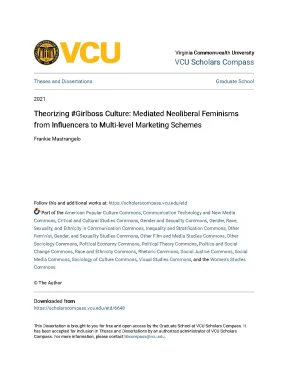
Tải xuống để đọc toàn bộVirginia Commonwealth University VCU Scholars Compass Theses and Dissertations Graduate School 2021 Theorizing #Girlboss Culture: Mediated Neoliberal Feminisms from Influencers to Multi-level Marketing Schemes Frankie Mastrangelo Follow this and additional works at: https://scholarscompass.edu/etd Part of the American Popular Culture Commons, Communication Technology and New Media Commons, Critical and Cultural Studies Commons, Gender and Sexuality Commons, Gender, Race, Sexuality, and Ethnicity in Communication Commons, Inequality and Stratification Commons, Other Feminist, Gender, and Sexuality Studies Commons, Other Film and Media Studies Commons, Other Sociology Commons, Political Economy Commons, Political Theory Commons, Politics and Social Change Commons, Race and Ethnicity Commons, Rhetoric Commons, Social Justice Commons, Social Media Commons, Sociology of Culture Commons, Visual Studies Commons, and the Women's Studies Commons © The Author Downloaded from https://scholarscompass.edu/etd/6648 This Dissertation is brought to you for free and open access by the Graduate School at VCU Scholars Compass. It has been accepted for inclusion in Theses and Dissertations by an authorized administrator of VCU Scholars Compass. For more information, please contact libcompass@vcu. 1 Theorizing #Girlboss Culture: Mediated Neoliberal Feminisms from Influencers to Multi-level Marketing Schemes A dissertation submitted in partial fulfillment of the requirements for the degree of Doctor of Philosophy at Virginia Commonwealth University by Frankie Mastrangelo Master of Arts, Media, Cinema, and Digital Studies, University of Wisconsin, Milwaukee 2016 Bachelor of Arts, English and Women’s Studies, Rollins College, 2010 Director: David Golumbia, Associate Professor, Department of English Virginia Commonwealth University Richmond, Virginia Copyright Frankie Mastrangelo 2021 All Rights Reserved 2 Acknowledgements Thank you to my committee advisors: David Golumbia, Jesse Goldstein, Karen Rader, Myrl Beam, and Jenny Rhee.
Thank you to my PhD cohort family: Chaz Barracks, Jeanette Vigliotti, Clare van Loenen, Beth Collins, Megan Ratliff – you all held me up when institutions fell short. Thank you to my parents, who remind me of my light. Thank you to my nanas, Gigi and Joanie, for being the clever forces to be reckoned with that propel me forward. Thank you to all of my sisters who saw me, celebrated me, and sustained my growth along the way: Katie, Victoria, KC, Mars, Meghan and so many others over the years that helped me become who I am.
Thank you to my comrades in Richmond Mutual Aid, who remind me that another world is possible. Thank you to Merm: my heart and grounding. Thank you to my dog Paulie Walnuts, who made sure I got up at 7am everyday to write. Thank you to VCU GSWS for providing me with necessary community and inspiring models of compassionate pedagogy during rough times.
Thank you to my students, for providing the wisdom, passion, and humor that keeps me going, laughing, and hopeful. 3 Table of Contents Abstract. 5 Chapter 1: Theorizing #Girlboss Feminism. 8 Historicizing Feminism, Racial Capitalism, and Neoliberal Cultural Politics.
8 #Girlboss Feminism, Discourses of Entrepreneurship, and Economies of Visibility. 19 Wealth, Health, & My Best Self: How to Be a Girlboss. 25 Girlboss Feminism in Digital Spaces. 28 Girlboss Feminism, Counterculture, and the Profitability of Rebellion.
30 The Underdog Narrative: Constructing a Feminist Myth of Meritocracy. 36 Chapter 2: The #Girlbosses of Neoliberal Wellness Culture. 39 A Brief Cultural History of Neoliberal Wellness Culture. 39 Hippies Turned Entrepreneurs.
40 Patriarchy and Wellness: From the Source Family to Dr. Oz to Goop: Girlboss Feminism Enters Neoliberal Wellness Culture. 51 The Wellness Ideology of Goop Feminism. 56 Racial Capitalism in the Goop Lab.
60 Goop’s Ableism: The Implications of Offering “Cures”. 69 Chapter 3: Visualizing and Manifesting Capitalist Success: American Self-Help as Neoliberal Education from Televangelist Preachers to Girlboss Influencers. 71 Change Starts from Within. 71 Acres of Diamonds and Bootstraps Fables.
71 From Prosperity Gospel to Contemporary Self-Help: Magical Thinking and the American Dream. 73 From Tony Robbins to Sheryl Sandberg, Change Starts from Within. 80 Manifesting and Visualizing Girlboss Status. 88 Chapter 4: Who Wants to be a #BossBabe?: Community and Capital in Multi-Level Marketing Schemes.
97 LuLaRoe: Engaging Community as a Technology of Power. 108 LimeLife : The Power of Sharing Vulnerability in Community. 115 doTERRA: Remedying Isolation with Essential Oils. 128 4 Abstract I define girlboss feminism as emergent, mediated formations of neoliberal feminism that equate feminist empowerment with financial success, market competition, individualized work-life balance, and curated digital and physical presences driven by self-monetization.
I look toward how the mediation of girlboss feminism utilizes branded and affective engagements with representational politics, discourses of authenticity and rebellion, as well as meritocratic aspiration to promote cultural interest in conceptualizing feminism in ways that are divorced from collective, intersectional struggle. I question the stakes involved in reducing feminist interrogations and commitments to discourses of representation, visibility, and meritocracy. I argue that while girlboss feminism may facilitate individual opportunities for stability and advancement under neoliberal constraints, the proliferation of girlboss feminism as an emergent and mediated thread of neoliberal feminism plays a vital role in perpetuating the severe inequalities required to sustain racial capitalism as an oppressive political-economic and socio- cultural framework. I look to three key spaces: wellness culture, self-help coaching, and multi- level marketing to understand how feminism and racial capitalism grow intertwined via mediated formations of girlboss culture.
In charting these formations, I initiate conversations that investigate the nuances and complications of feminist movement work under racial capitalism. I hope that identifying these emergent threads of neoliberal feminism provides insight on how intersectional and liberatory modes of collective struggle might remain more nimble, and generate more political power, than incarnations of feminism that reinforce an oppressive status quo. 5 Introduction In the Spring semester of 2021, I talked with my Digital Feminisms class about how concepts of feminism take on varied meanings under racial capitalism. Following Cedric Robinson and Jodi Melamed, we discussed how capital needs to continuously accumulate, and perpetuate relations of severe inequality in order to sustain itself as a political-economic system and series of cultural logics.
After reading Melamed, we needed to make the connection between racial capitalism and feminism. I asked them, “where do we see feminism conceptualized in pop culture as acquiring wealth and power to perpetuate structures of racial capitalism? In other words, where do we see feminism defined as getting a piece of the pie that reinforces systemic inequities and colonial legacies.a feminism defined as getting power and money?” A few students responded, “Oh, that’s girlboss culture.” As I’d been working on a dissertation project seeking to illuminate what “girlboss feminism” was, I asked them to define girlboss culture, and the connection it had to reproducing and sustaining racial capitalism. “It’s toxic positivity on Instagram -- those memes that say you just need to be positive and you’ll be successful. Those inspirational picture quotes.
It’s supporting Vice President Kamala Harris because of her intersecting identities, despite the fact that she’s incarcerated so many Black and brown folks, when she claims to support those communities. It’s peak white feminism. It’s looking out for yourself and no one else. It’s a performance of feminism.” Their thinking aligned with what I was actively investigating in mediated spaces.
Thanks to this brilliant community, our discussions helped me think through and consolidate a working definition of girlboss feminism. Girlboss feminism is fundamentally a product of racial capitalism in how it defines social change through the narrow constraints of capital accumulation, and its associated preservation of hierarchies and inequities. Girlboss feminism emerges from colonial legacies and structures of power that are predicated on maintaining inequalities based on race, ability, and normative gender expression. In contemporary culture today, white feminism is a shorthand for expressions of 6 feminism that are highly individualistic, divorced from collective struggle, and perpetuate various forms of systemic privilege and oppression.
While girlboss feminism aligns with these understandings of white feminism, I seek to deepen the conversation around how racial capitalism and feminism intersect in mediated realms. The intersection of racial capitalism and feminism produces emergent cultural threads that shift and evolve conceptualizations of feminism in tandem with neoliberal structures. Girlboss feminism is a mediated formation that takes shape through narratives claiming that anyone can attain wealth, regardless of gender, race, ability, and so on -- so long as you work hard, think positively, and rise above any obstacles thrown at you. By leveraging mediated spaces to perpetuate such aspirational narratives, girlboss feminism naturalizes and obscures the conditions of severe inequality endemic to racial capitalism.
Girlboss feminism is inspirational picture quotes, Instagram memes, and sales pitches that claim one’s mindset and behavior is the only thing standing between them and being a millionaire. This mediated content works to further entrench racial capitalism as a governing cultural rationality and the architecture for social and political relations. In this chapter, I first explore how girlboss feminism emerged as a formation of neoliberal cultural politics, drawing a connection between mediated socio-cultural material and the expansion of neoliberalism as a prevailing set of logics. This requires a historicization of feminism as a social movement, and associated interrogation of how racial capitalism and the feminist movement grew into overlapping forces.
I then move into a discussion around understanding the girlboss as a mediated cultural text that supports the expansion of racial capitalism through facilitating cultural commitments to entrepreneurship. By generating opportunities for affective connections to entrepreneurship as a cultural logic, girlboss feminism works to equate feminist empowerment with financial success, market competition, individualized work-life balance, and curated digital and physical presences driven by self- 7 monetization. Finally, I look toward how the mediation of girlboss feminism utilizes branded and affective engagements with representational politics, discourses of authenticity and rebellion, as well as meritocratic aspiration to promote cultural interest in conceptualizing feminism in ways that are divorced from collective, intersectional struggle. 1 This chapter questions the stakes involved in reducing feminist interrogations and commitments to discourses of representation, visibility, and meritocracy.
I argue that while girlboss feminism may facilitate individual opportunities for stability and advancement under neoliberal constraints, the proliferation of girlboss feminism as an emergent and mediated thread of neoliberal feminism plays a vital role in perpetuating the severe inequalities required to sustain racial capitalism as an oppressive political-economic and socio-cultural framework. 1 I follow Black feminist theorists and activists such as Kimberle Crenshaw, Vivian May, Patricia Hill Collins, Audre Lorde, and many others in defining intersectionality as a feminist framework that embraces multiplicity to discover how identities, experiences, structures, and institutions produce varied relationships to systemic privilege and oppression. Intersectionality values cultivating bridges between theory and practice to shift material realities and restructure systems in service of producing liberatory futures, and recognizes that centering those with multiple marginalizations enables us to build more complete and transformative grassroots solutions. 8 Chapter 1: Theorizing #Girlboss Feminism Historicizing Feminism, Racial Capitalism, and Neoliberal Cultural Politics From Beyonce unveiling a giant sign reading FEMINIST during the 2014 MTV Video Music Awards to actress Emma Watson’s viral “Why I’m a Feminist” speech, key watershed moments facilitated a twenty-tens cultural zeitgeist for feminism.
The concept of feminism seemed to suddenly become mainstream in the post-2010 media landscape. Pop journalism started focusing on getting celebrities to ask the million-dollar question: “are you a feminist?”2 With this cultural attention, feminist identification grew into a pivot point, distinguishing celebrities as either “progressive” or behind the times. Yet, what it means to be progressive in the Western cultural imaginary gains shape through the political and economic forces that structure experience and reality. When those political and economic forces prioritize market-driven logics and practices, mainstream conceptions of progressivism are constrained by capitalist values of self-responsibilization.
Our post-2010 era of feminism is the defining historical period for girlboss feminism, and this thread of contemporary feminism emerged within a framework of shifting neoliberal cultural politics. This set of cultural politics can be understood as the social and cultural practices, processes, texts, and techniques that proliferate neoliberalism as a governing rationality.
Nội dung được bảo vệ bản quyền — Tải xuống đầy đủ
Trích dẫn luận án này
Frankie Mastrangelo (2021). Theorizing girlboss culture mediated neoliberal feminisms fr [Luận án tiến sĩ, Virginia Commonwealth University]. LuanAn.net. https://luanan.net/khoa-hoc-xa-hoi/theorizing-girlboss-culture-mediated-neoliberal-feminisms-from
Câu hỏi thường gặp
Luận án "Theorizing girlboss culture mediated neoliberal feminisms fr" nghiên cứu về vấn đề gì?
Phân tích văn hóa girlboss trong bối cảnh feminisms hậu tư bản. Nghiên cứu sự tương tác giữa nữ quyền và chủ nghĩa tư bản trong thời đại hiện đại.
Luận án "Theorizing girlboss culture mediated neoliberal feminisms fr" được bảo vệ tại trường nào?
Luận án này được bảo vệ tại Virginia Commonwealth University. Năm bảo vệ: 2021.
Luận án "Theorizing girlboss culture mediated neoliberal feminisms fr" thuộc chuyên ngành gì?
Luận án "Theorizing girlboss culture mediated neoliberal feminisms fr" thuộc chuyên ngành Media, Cinema, and Digital Studies. Danh mục: Khoa Học Xã Hội.
Luận án "Theorizing girlboss culture mediated neoliberal feminisms fr" có bao nhiêu trang?
Luận án "Theorizing girlboss culture mediated neoliberal feminisms fr" có 136 trang. Bạn có thể xem trước một phần tài liệu ngay trên trang web trước khi tải về.
Cách tải luận án "Theorizing girlboss culture mediated neoliberal feminisms fr" về máy như thế nào?
Để tải luận án về máy, bạn nhấn nút "Tải xuống ngay" trên trang này, sau đó hoàn tất thanh toán phí lưu trữ. File sẽ được tải xuống ngay sau khi thanh toán thành công. Hỗ trợ qua Zalo: 0559 297 239.