Successful strategies to address disruptive innovation technologi
Chiến lược hiệu quả đối phó đổi mới đột phá công nghệ. Khám phá cách áp dụng và thích ứng để dẫn đầu thị trường.
Doctor of Business Administration
Luan An
Luận án tiến sĩ
Năm xuất bản
Số trang
153
Thời gian đọc
23 phút
Lượt xem
1
Lượt tải
0
Phí lưu trữ
50 Point
Tổng quan nhanh
- Chủ đề:
- Strategic Responses to Disruptive Innovation Challenges
- Số trang:
- 153 trang
- Trường:
- Walden University
- Chuyên ngành:
- Doctor of Business Administration
- Tác giả:
- LaTronya M. Acevedo-Berry
- Năm:
- 2020
Tóm tắt nội dung luận án
I.Strategic Responses to Disruptive Innovation Challenges
Digital media executives often lack clear strategic solutions. Preparation and response to changing media innovation technology remain insufficient. This absence of innovative technological strategies threatens marketplace sustainability. Digital-media corporations face risks from disruptive innovation technologies. A qualitative multiple case study explored solutions. It focused on innovative technological strategies used by executives. The goal was maintaining marketplace sustainability in the face of disruption. This research provides a framework for understanding and addressing these critical challenges. Effective strategic response to disruption is paramount for industry leaders.
1.1. Analyzing Digital Media Market Disruption
Digital media industries encounter constant evolution. Innovation technologies frequently disrupt established markets. Executives require robust plans for foresight and action. Lack of such plans jeopardizes corporate longevity. Market disruption demands a proactive stance. Understanding the nature of emerging technologies is critical. This enables an informed strategic response to disruption.
1.2. Foundational Theories of Innovation Management
The study grounds itself in key theoretical frameworks. Christensen’s disruptive innovation theory provides a core lens. Roger’s diffusion of innovation theory also informs the research. These theories offer insights into innovation management. They explain how new technologies emerge and spread. Applying these foundations helps develop successful disruptive innovation strategies.
1.3. Exploring Innovative Technological Strategies
The purpose centered on discovering effective strategies. Executives in digital-media corporations were the focus. These individuals successfully navigated technological changes. Strategies explored aimed at marketplace sustainability. They specifically addressed disruptive innovation technologies. Identifying these successful approaches offers valuable lessons for corporate innovation.
II.Key Strategies for Digital Innovation Management Success
Seven digital-media executives participated in the study. Participants from New York and California contributed insights. Data collection utilized semi-structured interviews. Responses from a demographic survey also provided information. Thematic analysis revealed four primary themes. These themes represent successful strategies. They are teamwork, data collection, budgeting, and corporate governance. These elements form pillars for effective innovation management. Implementing these strategies can enhance competitive advantage.
2.1. Fostering Teamwork and Collaboration
Teamwork emerged as a crucial strategic element. Collaborative efforts are vital for addressing disruption. Technology and marketing departments must integrate efforts. This cross-functional approach creates pioneering strategies. Outsourced digital-media companies also play a role. Their expertise supplements internal capabilities. Such collaboration strengthens corporate innovation efforts.
2.2. Leveraging Data Collection for Strategic Insights
Effective data collection provides a competitive edge. Gathering relevant information informs strategic decisions. This practice supports a proactive strategic response to disruption. Data-driven insights refine innovation management processes. They help predict market shifts and customer needs. This intelligence is fundamental for business model innovation.
2.3. Prudent Budgeting and Corporate Governance
Budgeting represents a critical component of successful strategies. Appropriate financial allocation supports innovation initiatives. Sound corporate governance ensures strategic alignment. It provides oversight for emerging technologies investments. These factors are essential for organizational agility. They contribute to sustained marketplace sustainability.
III.Building Competitive Advantage Amidst Market Disruption
Recommendations from the study emphasize collaboration. Digital-media and streaming-video executives should adopt these. Utilizing combined efforts of technology and marketing departments is key. Incorporating outsourced digital-media companies also proves beneficial. These actions foster pioneering strategies. Such strategies directly address disruptive innovation technology. This proactive approach secures competitive advantage. It moves beyond mere survival to proactive growth. Successful implementation requires a commitment to digital transformation.
3.1. Maintaining Marketplace Sustainability
The ultimate goal for corporations is sustainability. Effective strategies ensure long-term market presence. Addressing disruptive innovation directly contributes to this objective. Business model innovation becomes essential for endurance. Organizations must adapt their core operations. This constant adaptation secures marketplace viability.
3.2. Recommendations for Pioneering Strategies
Executives should prioritize collaborative team efforts. Technology and marketing expertise must converge. Outsourcing specialized digital-media capabilities is advisable. This combination generates innovative solutions. Pioneering strategies effectively counter emerging technologies. They establish a foundation for future competitive advantage. This represents a robust strategic response to disruption.
3.3. Driving Positive Social and Economic Change
Strategic initiatives hold potential for broader impact. Leaders acquiring new teams create job opportunities. This contributes to economic growth. Happier consumers result from improved services. Increased spending strengthens local and international economies. This demonstrates the societal benefits of successful corporate innovation.
IV.Implementing Effective Corporate Innovation Models
The study highlights the necessity of robust innovation models. Digital transformation is not merely a trend, but a requirement. Cultivating organizational agility allows for rapid adaptation. Enhancing business model innovation ensures sustained relevance. These elements are interconnected. They form a comprehensive approach to managing market disruption. Continuous learning and adaptation are fundamental. This provides a clear roadmap for executives. Such a framework drives strong corporate innovation and competitive advantage.
4.1. Integrating Digital Transformation Efforts
Digital transformation is essential for modern businesses. It involves integrating digital technology across all areas. This fundamentally changes how businesses operate. It delivers value to customers. Successful digital transformation supports a strong strategic response to disruption. It builds a foundation for embracing emerging technologies.
4.2. Cultivating Organizational Agility
Agility allows organizations to respond swiftly. Market changes and new technologies require flexibility. An agile culture supports rapid innovation management. It minimizes resistance to change. This responsiveness is key to maintaining competitive advantage. Organizational agility is a cornerstone of effective disruptive innovation strategies.
4.3. Enhancing Business Model Innovation
Disruptive innovation often necessitates new business models. Existing models may become obsolete. Continual innovation in business models is critical. It allows companies to create new value propositions. This proactive approach ensures long-term marketplace sustainability. It is a vital aspect of corporate innovation success.
Tải xuống file đầy đủ để xem toàn bộ nội dung
Tải đầy đủ (153 trang)Trích đoạn nội dung luận án
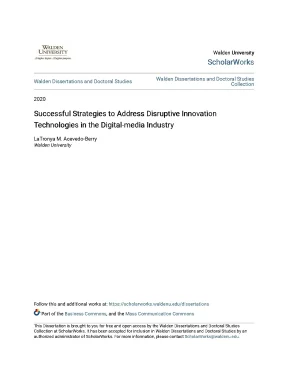
Tải xuống để đọc toàn bộWalden University ScholarWorks Walden Dissertations and Doctoral Studies Walden Dissertations and Doctoral Studies Collection 2020 Successful Strategies to Address Disruptive Innovation Technologies in the Digital-media Industry LaTronya M. Acevedo-Berry Walden University Follow this and additional works at: https://scholarworks.edu/dissertations Part of the Business Commons, and the Mass Communication Commons This Dissertation is brought to you for free and open access by the Walden Dissertations and Doctoral Studies Collection at ScholarWorks. It has been accepted for inclusion in Walden Dissertations and Doctoral Studies by an authorized administrator of ScholarWorks. For more information, please contact ScholarWorks@waldenu.
Walden University College of Management and Technology This is to certify that the doctoral study by LaTronya Acevedo-Berry has been found to be complete and satisfactory in all respects, and that any and all revisions required by the review committee have been made. Review Committee Dr. Lisa Cave, Committee Chairperson, Doctor of Business Administration Faculty Dr. Betsy Macht, Committee Member, Doctor of Business Administration Faculty Dr.
Mary Dereshiwsky, University Reviewer, Doctor of Business Administration Faculty Chief Academic Officer and Provost Sue Subocz, Ph. Walden University 2020 Abstract Successful Strategies to Address Disruptive Innovation Technologies in the Digital- media Industry by LaTronya Acevedo-Berry MBA, Capella University, 2016 MA, National University, 2008 BA, Kean University, 2003 Doctoral Study Submitted in Partial Fulfillment of the Requirements for the Degree of Doctor of Business Administration Student ID: A00664009 Walden University June 2020 Abstract Digital media executives lack strategic solutions for the preparation and response to changing media innovation technology. The lack of innovative technological strategies threatens digital-media corporations’ ability to maintain marketplace sustainability for addressing disruptive innovation technologies. Grounded in Christensen’s disruptive innovation theory and Roger’s diffusion of innovation theory, the purpose of this qualitative multiple case study was to explore innovative technological strategies some executives of digital-media corporations used to maintain marketplace sustainability for addressing disruptive innovation technologies.
The participants were 7 digital-media executives in New York and California, who used effective strategies to innovate technology and maintain marketplace sustainability. Data were collected using semistructured interviews and responses from a demographic survey. Four themes emerged through thematic analysis: teamwork, data collection, budgeting, and corporate governance. A key recommendation is digital-media, and streaming-video executives should utilize collaborative team efforts of technology and marketing departments and outsourced digital-media companies to create pioneering strategies that address disruptive innovation technology.
The potential for positive social change includes organizations’ leaders acquiring new teams to strategize for the future of the company, which creates new jobs and happier consumers willing to spend more money for services, which creates better economies internationally. Successful Strategies to Address Disruptive Innovation Technologies in the Digital- media Industry by LaTronya Acevedo-Berry MBA, Capella University, 2016 MA, National University, 2008 BA, Kean University, 2003 Doctoral Study Submitted in Partial Fulfillment of the Requirements for the Degree of Doctor of Business Administration Student ID: A00664009 Walden University June 2020 Dedication I dedicate this study to my mom, who had faith in me that I could accomplish this level of degree; and, I also dedicate this study to my spouse and children who allowed me to sacrifice family time spent with them to accomplish this goal. The final dedication is to the rest of my family members who’ve supported this goal completion in their distinctive ways. Acknowledgments I would like to thank my guardian angels and spiritual advisors for keeping me on task and providing me with the required essentials and attributes to accomplish this doctoral study.
I would like to thank myself for not giving up throughout this journey. Additionally, I would like to thank my doctoral study committee, Dr. Pamela Mertens, Dr. Lisa Cave, Dr.
Betsy Macht, Dr. Mary Dereshiwsky, and Dr. Reginald Taylor for their guidance, insight, and encouragement throughout this entire process. Finally, I want to thank Walden University for the life-changing experiences I’ve had during the pursuit of my doctoral degree.
Table of Contents List of Tables. iv List of Figures .v Section 1: Foundation of the Study.1 Background of the Problem .4 Nature of the Study .9 Assumptions, Limitations, and Delimitations. 12 Significance of the Study .13 Contribution to Business Practice. 13 Implications for Social Change.
13 A Review of the Professional and Academic Literature .14 Overview of Technology. 26 Theory of Diffusion Innovation. 27 Theory of Disruptive Innovation Technology. 30 The Role of Disruptive Innovation Technology .40 Section 2: The Project .42 Role of the Researcher .45 Research Method and Design.
49 Population and Sampling .52 Data Collection Instruments .56 Data Collection Technique .58 Data Organization Technique .61 Reliability and Validity. 64 ii Transition and Summary .65 Section 3: Application to Professional Practice and Implications for Change .67 Presentation of the Findings. 70 Theme 2: Data Collection. 78 Theme 4: Corporate Governance.
80 Applications to Professional Practice .87 Implications for Social Change .89 Recommendations for Action .90 Recommendations for Further Research .98 Appendix A: Script Semistructured Interview Protocol .134 Appendix B: Research and Interview Questions .136 Appendix C: Participants’ Responses that Collaborates Themes .137 iii List of Tables Table 1. Production Component of each period .18 iv List of Figures Figure 1. Diffusion of innovation theory adoption stages. The process of market penetration by disruptive innovations.
History, usage, and evolution of the term disruptive innovation. Low end and new market disruptions. Disruptive product penetration .33 v 1 Section 1: Foundation of the Study Due to technological advancement and the changing trends of consumer behavior, digital-media executives are consistently seeking new strategies to address disruptive innovation technology. Harris, McAdams, McDausland, and Reid (2013) contended that business and economic changes are the reasons why executives seek new strategies to increase profitability and sustainability.
Blair (2015) asserted that a company’s competitive advantage has the potential to improve with technological innovation. Subscription-based business models are the new trend for the digital-media industry. Golderman and Connelly (2017) declared that subscribing libraries are additional benefits to organizations because unlimited amounts of locally produced and licensed content are uploadable and quickly accessible to the company’s catalog content. Failing to make streaming-video options affordable, readily available, and user-friendly, may result in a loss of productivity and revenue for corporations and may further impair social-economic concerns such as poverty and joblessness (Kim & Min, 2015; Srivastava & Misra, 2014).
To address disruptive innovation technology (DIT), maintain sustainability, and technological progression, digital-media executives have explored a multitude of strategies for integrating technological innovations in their business processes. In this study, I sought to augment comprehension about the strategies digital-media executives of streaming-video corporations used to address DIT and maintain marketplace sustainability. My focus was on New York State and California headquarters of video- streaming companies because the top three leaders, Netflix, Hulu, and Amazon Prime Video, have offices in both states. 2 Background of the Problem The commercial setting of the business world has expanded far beyond the traditional brick-and-mortar store to a global e-commerce platform that is accessible to billions of users via the Internet; moving away from physical media, cutting the cord was the trending business model for digital and multi-media companies (Sadler & Evans, 2016).
Digital media provides the convenience of immediate connection for consumers to online home entertainment. Digital-media home entertainment includes applications such as Netflix, Hulu, Amazon Prime Video, YouTube, and Direct TV Now. Additionally, there are a variety of streaming boxes (e., Apple TV, Roku, Amazon Fire TV) and adapters (e., Chromecast and Roku). These devices allow smartphones and tablets to stream content to TVs (Bing, 2015).
In the first quarter of 2017, Netflix streaming subscribers in the United States surpassed 50 million for the first time, illustrating that 54% of all TV households in the country had a Netflix subscription in 2017, while 58% of consumers had a subscription to any of the other competitors (Seward, 2014). The success of Netflix’s online subscription services catapulted a technology that disrupted the traditional brick-and-mortar video store, while simultaneously creating a new and competitive marketplace for digital-media and online-home entertainment. The potential to reach billions of consumers directly through the comfort of their homes is substantial for businesses. Yet, some organizational leaders do not know how to make utilizing this method more cost-efficient for consumers.
The market research firm, GfK SE, showcased that almost half of the viewers surveyed, subscribed to at least one on- demand video streaming service; while, 17% subscribed to Netflix, and Amazon Prime 3 and nine percent have Netflix and Hulu Plus; five percent had Amazon Prime, Netflix and Hulu Plus (Nayak, 2016). In 2018, there were more streaming services that consumers subscribed to, which increased the percentage rates. DIT of digital-media video-streaming changed the way companies reach their consumers. DIT also transformed how consumers watch home entertainment; some executives of digital-media corporations lacked innovative technological strategies to maintain marketplace sustainability and address DIT.
Changes in technology influenced the two primary duties of executive boards: fiduciary and strategic (Evans, 2017). In this study, I explored innovative technological strategies that digital -media executives used to maintain marketplace sustainability and address DIT for their corporations. Problem Statement DIT has increasingly displaced established competitors selling home video entertainment. The emergence and proliferation of mobile devices have further accelerated online video consumption (Moon, Yoo, & Kim, 2016).
Web-based video sharing services could account for about 80% to 90% of the global Internet traffic in 2019 (Biernacki, 2017). For example, YouTube subscribers watch 6 billion hours of video streaming per month, per one billion users (Hasan, Kumar Jha, & Liu, 2018a). The general business problem was that multiple digital-media executives lack strategic solutions for the preparation and response to changing media innovation technology. The specific business problem was that some executives of digital-media corporations lack innovative technological strategies to maintain marketplace sustainability for addressing DITs.
4 Purpose Statement The purpose of this qualitative multiple case study was to explore innovative technological strategies that some executives of digital-media corporations used to maintain marketplace sustainability for addressing DITs. The sample population included executive technology and digital-media subscription service leaders of five corporations, Netflix, Hulu, Amazon Prime Video, Redbox, and Direct TV Now, in New York State and California, who demonstrated success in addressing DITs. The implications for positive social change included improving cost-effective video streaming options for consumers and the potential to advance business models for helping executives create innovative strategies to maintain marketplace sustainability and address DIT. Nature of the Study A qualitative methodology was appropriate to explore the innovative technological strategies that some executives of digital-media corporations used to maintain marketplace sustainability for addressing DITs.
Kozleski (2017) contended that the utility of qualitative methods shapes and advances essential questions of practice and policy, and sets benchmarks contributing to how researchers interpreted the landscape of scientific thought and discovery. Conversely, quantitative research is the collection and analysis of structured numerical data to build accurate and reliable instruments to obtain data for statistical analysis of variables’ relationships or differences (Goertzen, 2017). In my study, I intended to explore the strategies that executives use to maintain marketplace sustainability and address DIT. I did not test a hypothesis, which was only appropriate in the quantitative method research design and the quantitative portion of a mixed-method 5 study; therefore, I chose neither the quantitative method nor the mixed method for this study.
The qualitative research methodology was appropriate for this study. A multiple case study design was appropriate for exploring innovative technological strategies that some executives of digital-media corporations used to maintain marketplace sustainability and address DITs. Bloomberg and Volpe (2012) detailed that a case study design is a concentrated account and investigation of some circumscribed social or multiple bound phenomena of a social unit, system, group of people, program, institution, or process. Applying a single case study methodology was appropriate when the focus illustrated an issue that reflected in the specific business problem.
For this study, I considered the following qualitative research designs: (a) phenomenological, (b) ethnographic, (c) case study, and (d) narrative.
Nội dung được bảo vệ bản quyền — Tải xuống đầy đủ
Trích dẫn luận án này
LaTronya M. Acevedo-Berry (2020). Successful strategies to address disruptive innovation techn [Luận án tiến sĩ, Walden University]. LuanAn.net. https://luanan.net/khoa-hoc-xa-hoi/successful-strategies-to-address-disruptive-innovation-technologi
Câu hỏi thường gặp
Luận án "Successful strategies to address disruptive innovation techn" nghiên cứu về vấn đề gì?
Chiến lược hiệu quả đối phó đổi mới đột phá công nghệ. Khám phá cách áp dụng và thích ứng để dẫn đầu thị trường.
Luận án "Successful strategies to address disruptive innovation techn" được bảo vệ tại trường nào?
Luận án này được bảo vệ tại Walden University. Năm bảo vệ: 2020.
Luận án "Successful strategies to address disruptive innovation techn" thuộc chuyên ngành gì?
Luận án "Successful strategies to address disruptive innovation techn" thuộc chuyên ngành Doctor of Business Administration. Danh mục: Khoa Học Xã Hội.
Luận án "Successful strategies to address disruptive innovation techn" có bao nhiêu trang?
Luận án "Successful strategies to address disruptive innovation techn" có 153 trang. Bạn có thể xem trước một phần tài liệu ngay trên trang web trước khi tải về.
Cách tải luận án "Successful strategies to address disruptive innovation techn" về máy như thế nào?
Để tải luận án về máy, bạn nhấn nút "Tải xuống ngay" trên trang này, sau đó hoàn tất thanh toán phí lưu trữ. File sẽ được tải xuống ngay sau khi thanh toán thành công. Hỗ trợ qua Zalo: 0559 297 239.