Employee turnover intention in the u s fast food industry
Phân tích ý định nghỉ việc của nhân viên trong ngành thức ăn nhanh Mỹ. Tìm hiểu nguyên nhân, tác động và giải pháp giảm thiểu biến động nhân sự.
Luan An
Luận án tiến sĩ
Năm xuất bản
Số trang
244
Thời gian đọc
37 phút
Lượt xem
0
Lượt tải
0
Phí lưu trữ
50 Point
Tổng quan nhanh
- Chủ đề:
- Employee Turnover Intention in Fast Food: Insights
- Số trang:
- 244 trang
- Trường:
- Walden University
- Chuyên ngành:
- Business Administration
- Tác giả:
- Imelda A. Bebe
- Năm:
- 2016
Tóm tắt nội dung luận án
I.Employee Turnover Intention in Fast Food Insights
The U.S. fast food industry faces significant employee turnover challenges. Annual turnover rates average a staggering 150%. This constant churn impacts operational efficiency and profitability. A crucial study investigated the core reasons behind employees' intentions to leave. This research sought to identify factors influencing decisions to depart from quick-service restaurants. Understanding these dynamics is vital for business sustainability. Effective strategies are needed to address this persistent staffing challenge. The study provides critical insights for managers. Reducing turnover improves financial performance and long-term growth.
1.1. The Scale of Fast Food Staffing Challenges
The fast food sector consistently grapples with staffing challenges fast food industry. High turnover rates indicate a systemic issue within the labor shortage restaurant sector. New hires often leave quickly. This creates a continuous need for recruitment and training. Such rapid employee cycling strains resources. It also affects service quality and team morale. Businesses face mounting costs. These costs include recruitment, onboarding, and lost productivity. Addressing the root causes is paramount. Sustainable solutions are essential for stability.
1.2. Why Turnover Intention Matters for QSRs
Understanding employee turnover intention is key. It allows managers to intervene before actual departures. High intention correlates with actual resignations. Proactive measures can then be implemented. This protects the workplace culture QSR businesses strive for. Reduced turnover supports consistent service delivery. It also fosters a more experienced and engaged workforce. The study aimed to reveal the underlying drivers. Pinpointing these drivers enables targeted retention efforts. This leads to improved business outcomes.
II.Researching Fast Food Job Satisfaction Turnover
The study employed a correlational design. This approach examined relationships between various factors. It explored job satisfaction quick-service restaurants and dissatisfaction components. The research linked these to employee turnover intention. Data came from 144 fast food restaurant employees. Participants were located on the U.S. East Coast. An internet survey collected the necessary information. Statistical analysis included Pearson-product correlation coefficients. Multiple linear regression analysis also provided insights. These methods rigorously tested the hypotheses. The findings offer empirical evidence for improving employee retention strategies fast food businesses can adopt.
2.1. Study Design and Participant Demographics
A quantitative, correlational design underpinned the research. This design allowed for identifying connections between variables. The participant pool consisted of 144 fast food employees. All worked within the East Coast region of the United States. Data collection used an online survey instrument. This ensured anonymity and broad reach. The robust sample size supported statistical validity. Understanding this demographic is crucial. It contextualizes the findings for the fast food industry workforce.
2.2. Herzberg s Theory in Quick Service Settings
Herzberg's 2-factor motivation-hygiene needs theory served as the theoretical framework. This theory posits two distinct sets of factors affecting job satisfaction. Motivators (satisfaction factors) lead to positive feelings. Hygiene factors (dissatisfaction factors) prevent negative feelings. The study applied this framework to fast food environments. It investigated how intrinsic and extrinsic elements influence employee engagement fast food workers experience. This theoretical lens provided a structured way to analyze employee perceptions. It helped differentiate elements that truly motivate from those that merely avoid discontent. This understanding guides better HR practices in fast food.
III.Job Satisfaction Factors Fast Food Retention
The study revealed a statistically significant relationship. Job satisfaction factors significantly impact employee turnover intention (p < .01). Higher satisfaction correlates with lower turnover intentions. This finding underscores the importance of creating positive work environments. Managers must prioritize elements that foster contentment. Ignoring these factors contributes to high employee churn. Strategic employee retention strategies fast food must address these core motivators. The overall impact of satisfaction on retaining talent is substantial. It is a critical area for operational improvement.
3.1. The Link Between Satisfaction and Turnover
Strong evidence connects job satisfaction with a reduced likelihood of leaving. When employees feel content and valued, they are less inclined to seek new opportunities. This relationship is statistically robust. It highlights a clear pathway for managers. Investing in factors that boost satisfaction can directly lower turnover rates. This contributes to a stable workforce. It also improves productivity. Focusing on positive aspects of the work experience is paramount for employee engagement fast food workers.
3.2. Responsibility A Key Motivator for QSR Staff
Among all job satisfaction factors, responsibility showed the strongest relationship with lower turnover intentions (-.52). Empowering employees with meaningful tasks reduces their desire to leave. Giving staff ownership over their work makes them feel more valued. It also boosts their professional growth. This suggests that delegating appropriate levels of responsibility is a powerful employee retention strategy. Fast food managers should consider how to increase employee autonomy and decision-making where feasible. This cultivates a sense of purpose beyond routine tasks.
IV.Understanding Fast Food Employee Dissatisfaction
Just as satisfaction influences retention, job dissatisfaction factors significantly contribute to employee turnover intention (p < .01). Elements that cause discontent push employees towards resignation. Managers must identify and mitigate these negative aspects. Ignoring sources of dissatisfaction can lead to burnout restaurant employees experience. This directly fuels the high turnover rates observed. Addressing these issues is as important as fostering satisfaction. A balanced approach is crucial for maintaining a healthy workplace culture QSR environments require. Proactive management of dissatisfaction can transform the work environment.
4.1. The Impact of Dissatisfaction on Turnover
The research clearly established a strong link between job dissatisfaction and employees' intent to depart. Factors that create an unfavorable work environment increase the likelihood of turnover. These negative experiences erode loyalty and commitment. They can lead to burnout restaurant employees often report. Addressing the causes of unhappiness is fundamental. It prevents skilled workers from leaving. A clear understanding of these dissatisfiers enables targeted interventions. This improves overall employee engagement fast food workers feel.
4.2. Company Policy A Major Driver of Intent to Leave
Among all job dissatisfaction factors, company policy demonstrated the strongest negative relationship with turnover intentions (-.52). Restrictive, unclear, or unfair policies significantly increase an employee's desire to leave. This highlights the critical role of well-defined and equitable HR practices in fast food. Policies concerning compensation and benefits fast food workers receive, scheduling, or disciplinary actions can cause significant friction. Reviewing and revising company policies can be a powerful tool for reducing employee turnover. Clear, fair, and transparent guidelines foster a more positive working environment.
V.Strategies to Reduce Fast Food Staff Turnover
The study found that combined job satisfaction factors explained more variance in turnover intentions (35%) than job dissatisfaction factors (31%). This emphasizes the power of positive work experiences. While mitigating negative elements is crucial, actively building satisfaction has a slightly stronger impact. Managers should prioritize both. Effective employee retention strategies fast food must adopt a holistic view. They must foster positive motivators and eliminate irritants. This integrated approach creates a resilient workforce. It ensures business continuity and growth.
5.1. Balancing Satisfaction and Dissatisfaction Factors
A nuanced approach to HR practices in fast food is essential. Managers cannot simply remove dissatisfaction. They must also actively cultivate satisfaction. Providing opportunities for responsibility, recognition, and growth builds strong employee engagement fast food workers desire. Simultaneously, transparent and fair company policies are non-negotiable. Reviewing compensation and benefits fast food offers and ensuring clear communication are vital. A balanced focus creates a positive workplace culture QSR businesses need to thrive.
5.2. Actionable Insights for QSR Managers
The findings offer clear directives for managers. To reduce employee turnover intention, focus on empowering staff with responsibility. Review and revise company policies to ensure fairness and clarity. This can include policies related to scheduling, breaks, and minimum wage impact on turnover discussions, even if not directly studied here. Cultivating a supportive workplace culture QSR environments benefit from is key. Implementing these employee retention strategies fast food can lead to improved financial sustainability. Long-term business growth also follows. Proactive management creates a more stable and engaged workforce.
Mục lục chi tiết luận án
Tải xuống file đầy đủ để xem toàn bộ nội dung
Tải đầy đủ (244 trang)Trích đoạn nội dung luận án
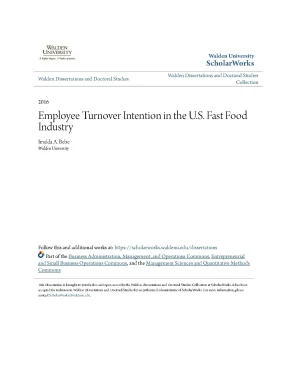
Tải xuống để đọc toàn bộWalden University ScholarWorks Walden Dissertations and Doctoral Studies Walden Dissertations and Doctoral Studies Collection 2016 Employee Turnover Intention in the U. Fast Food Industry Imelda A. Bebe Walden University Follow this and additional works at: https://scholarworks.edu/dissertations Part of the Business Administration, Management, and Operations Commons, Entrepreneurial and Small Business Operations Commons, and the Management Sciences and Quantitative Methods Commons This Dissertation is brought to you for free and open access by the Walden Dissertations and Doctoral Studies Collection at ScholarWorks. It has been accepted for inclusion in Walden Dissertations and Doctoral Studies by an authorized administrator of ScholarWorks.
For more information, please contact ScholarWorks@waldenu. Walden University College of Management and Technology This is to certify that the doctoral study by Imelda Bebe has been found to be complete and satisfactory in all respects, and that any and all revisions required by the review committee have been made. Review Committee Dr. Charles Needham, Committee Chairperson, Doctor of Business Administration Faculty Dr.
Kenneth Gossett, Committee Member, Doctor of Business Administration Faculty Dr. Matthew Gonzalez, University Reviewer, Doctor of Business Administration Faculty Chief Academic Officer Eric Riedel, Ph. Walden University 2016 Abstract Employee Turnover Intention in the U. Fast Food Industry by Imelda A.
Bebe MS, Kaplan University, 2011 BSBA, Philippine School of Business Administration, 1995 Doctoral Study Submitted in Partial Fulfillment of the Requirements for the Degree of Doctor of Business Administration Walden University January 2016 Abstract Employee turnover in the U. fast food industry has been high, averaging rate 150% per annum. The purpose of the correlational design study was to examine the relationships between job satisfaction factors, job dissatisfaction factors, and employee turnover intentions among fast food employees to determine whether a statistically significant relationship exists between these variables. The population for the study consisted of 144 fast food restaurant employees working in the East Coast in the United States.
The theoretical framework was Herzberg’s 2-factor motivation-hygiene needs theory, which describes job satisfaction factors and job dissatisfaction factors. Internet survey data of 144 participants were analyzed using Pearson-product correlation coefficients and multiple linear regressions analysis. The study findings revealed statistically significant relationships between job satisfaction factors and employee turnover intentions (p < .01), and job dissatisfaction factors and employee turnover intentions (p <. Among the job satisfaction factors, responsibility had a stronger relationship with employee turnover intentions (-.52) compared with other factors.
Under job dissatisfaction factors, company policy had a stronger relationship with employee turnover intentions (-.52) compared with other factors. In addition, criterion variance of employee turnover intentions associated with combined job satisfaction factors was stronger (35%) than were the combined job dissatisfaction factors (31%). The study findings are designed to inform fast food restaurant managers in taking actions to reduce employee turnover, resulting in improved business financial sustainability and long-term growth. Employee Turnover Intention in the U.
Fast Food Industry by Imelda A. Bebe MS, Kaplan University, 2011 BSBA, Philippine School of Business Administration, 1995 Doctoral Study Submitted in Partial Fulfillment of the Requirements for the Degree of Doctor of Business Administration Walden University January 2016 Dedication Praise to the Lord for this great opportunity entrusted me. I thank God for his guidance and help throughout this journey. Once again, God showed me that nothing is impossible in the world that I can do all things through Christ who strengthens me.
This achievement is greatly dedicated to my beloved father and mother who instilled in me the importance of education. I always remembered what my father said, “Education is the greatest treasure that you can have in this world that no one can take away from you;” he was definitely right!!! I dedicate this achievement also my husband, Fred Jr., our kids (Christina, Danika, Fred III, and Nenita), brothers, sisters, relatives, and friends who gave me the reasons to aim high and kept me going despite of many challenges. Completing this journey was challenging yet rewarding in the end. This achievement is so remarkable that I cannot compare.
I hope this great achievement will inspire Christina, Danika, Fred III, and Nenita to obtain their doctoral degrees in the future! Acknowledgments Thank God for this wonderful achievement I have accomplished in life and for all the blessings given to me and to my family. I extend my immense gratitude to my faculty members, Dr. Charles Needham and Dr. Kenneth Gossett for their endless support, help, guidance, and understanding throughout this journey.
I cannot thank you enough for helping me in many ways. Without your guidance and assistance, I would have not able to accomplish this task. To my URR, Dr. Matthew Gonzalez, thank you for your great support.
Reginald Taylor, thank you for sharing your knowledge that helped me understand the whole research study process. Thanks to Dr. Jet Mboga and Dr. Trenessa Williams for your moral and spiritual support; you both inspired me to keep going, be strong, and persevere throughout this journey.
To all my Kaplan and Walden University former professors, Dr. Carmen Castro, Dr. Wanda Curlee, Dr. Sherry Giddings, Dr.
John Yelvington, Dr. Ray Kalinski, Dr. Steve Roussas, and Dr. George Spark, thank you for all your advices and prayers.
Your successful achievements in life have also inspired me to finish this challenging journey. Thanks to all the participants who willingly helped me complete the collection of data. I thank Walden University staff for their endless support and abundant resources to support this challenging journey. Thank you, also, to the IRB members for your great feedback to meet the IRB requirements.
Table of Contents List of Tables .v List of Figures. vii Section 1: Foundation of the Study.1 Background of the Problem .3 Nature of the Study .9 Assumptions, Limitations, and Delimitations. 11 Significance of the Study .12 Contribution to Business Practice. 12 Implications for Social Change.
13 A Review of the Professional and Academic Literature .14 Herzberg’ Motivation-Hygiene Needs (Two-Factor Theory). 16 Rival Theories of the Theoretical Framework. 33 Job Satisfaction Factors. 37 Job Dissatisfaction Factors.
51 Employee Turnover Intention .86 Role of the Researcher .89 Research Method and Design. 93 Population and Sampling .96 Data Collection Instruments .98 Job Satisfaction Survey (JSS). 98 Turnover Intention Survey. 102 ii Data Collection Technique .109 Transition and Summary .112 Section 3: Application to Professional Practice and Implications for Change .114 Presentation of the Findings.128 Pearson Product-Moment Correlation Coefficient.
146 Applications to Professional Practice .151 Implications for Social Change .152 Recommendations for Action .152 iii Recommendations for Further Research .161 Summary and Study Conclusions .166 Appendix A: Job Satisfaction Survey .208 Appendix B: Turnover Intention to Leave the Job Scale .213 Appendix E: Permission to use the Turnover Intention Survey .217 Appendix F: Copyright Clearance to Reuse Herzberg’s Motivation-Hygiene Theory .219 Appendix G: Certification of Completion .223 Appendix H: Consent Form .224 Appendix I: Confidentiality Agreement .226 Appendix J: Letter of Cooperation from a Research Partner .227 Appendix K: Participant Invitation to Participate .229 Appendix L: Participants’ Reminder .230 iv List of Tables Table 1. Frequency and Percentage of the Study Sources……………………………. JSS Instrument Reliability Statistics–Cronbach’s Alpha. ILJ Instrument Reliability Statistics–Cronbach’s Alpha.
Frequency Distribution of Fast Food Participants’ Gender. Frequency Distribution of Fast Food Participants’ Age. Frequency Distribution of Fast Food Participants’ Educational Attainment. Frequency Distribution of Fast Food Participants’ Job Position.
Frequency Distribution of Fast Food Participants’ Job Classification. Frequency Distribution of Fast Food Participants’ Years of Service. Descriptive Statistics for Age and Years of Working Variables. Pearson Product-Moment Correlation Coefficient Between Job Satisfaction Factors and Employee Turnover Intentions.
Pearson Product-Moment Correlation Coefficient Between Job Dissatisfaction Factors and Employee Turnover Intentions. Multiple Regressions With Linear Combination of Job Satisfaction Factors and Employee Turnover Intentions. Multiple Regressions With Individual Factor of Job Satisfaction Factor and Employee Turnover Intentions. Multiple Regressions With Linear Combination of Job Dissatisfaction Factors and Employee Turnover Intentions.
Multiple Regressions With Individual Factor of Job Dissatisfaction and Employee Turnover Intentions.150 vi List of Figures Figure 1. Depiction of Herzberg’ motivation-hygiene needs (two-factor theory) as a theoretical framework. Depiction of Herzberg’ motivation-hygiene needs (two-factor theory) as a theoretical framework. Fast Food Participants’ Gender Distribution.
Fast Food Participants’ Age Distribution. Fast Food Participants’ Educational Attainment Distribution. Fast Food Participants’ Job Position Distribution. Fast Food Participants’ Job Classification Distribution.
Fast Food Participants’ Years of Service Distribution. 130 vii 1 Section 1: Foundation of the Study Fast food restaurants make up a major segment of the U. fast food industry comprised 25% of the total restaurant sales (DiPietro, Gregory, & Jackson, 2013). The four segments of the fast food industry are (a) quick-service restaurants (QSR), (b) takeaways, (c) mobile and street vendors, and (d) leisure locations (Kamal & Wilcox, 2014).
Quick-service restaurants are a top segment in the fast food industry in terms of sales performance (Kamal & Wilcox, 2014). fast food industry is a vital business sector in the economies because of its more than 53% market value, contributing to economic growth (Kamal & Wilcox, 2014). In 2011, the fast food market value in U.2 billion, having grown by 20% since 2006 (Kamal & Wilcox, 2014). The fast food restaurants throughout the United States numbered more than 200,000 (Sena, 2014).
The growth sales in the fast food industry increased dramatically, from $6 billion in 1970 to $16 billion in 1975 (Sena, 2014). In 2013, growth sales reached $160 billion, equivalent to about 8. With effective strategic approaches, the fast food industry expanded internationally successfully (Sena, 2014). Background of the Problem The fast food industry has contributed nationally to U.
economic growth; however, increasing employee turnover rates have become the main concern of many fast food managers (Batt et al. The turnover in the fast food industry is high compared to other industries (Dike, 2012; Perez & Mirabella, 2013; Sterrett, 2011; 2 Wyld, 2014). Employees’ voluntary withdrawal from a workplace occurs because of (a) low wages and benefits, (b) lack of training, (c) autonomy, (d) job opportunities, (e) lack of support from management, (f) and from unfavorable working conditions (Batt et al., 2014; Royle, 2005; Ryan, Ghazali, & Mohsin, 2011). Employee turnover is both disruptive and costly to employers, involving increased direct and indirect costs (Batt et al., 2014; French, 2014; Kacmar et al., 2006; Ryan et al.
The increasing number of voluntary withdrawals has caused many fast food managers to experience the hardship of replacing the quitters (Dipietro & Strate, 2008). The fast food industry is popular for having low skilled-labor that discourages highly skilled workers from applying for vacant positions (Batt et al. Fast food restaurants primarily hire students with less experience or no experience that implies highly skilled workers are over qualified. Employee turnover has an effect on employee efficiency that influences business financial performance in a negative fashion (Kacmar, Andrews, Van Rooy, Steilberg, & Cerrone, 2006).
The lack of organizational support, work socialization, and employee involvement creates isolation among employees, which results in lower productivity and effectiveness (DiPietro & Pizam, 2008; Mathe & Slevitch, 2013). Employee turnover is caused by lack of employee training, which affects employee competence (Perez & Mirabella, 2013). Employee incompetence affects the quality service of the fast food restaurants and thus diminishes the frequency of positive customer experiences (Harrington, Ottenbacher, Staggs, & Powell, 2012). 3 Problem Statement The employee turnover rate in the U.
fast food industry is high at approximately 150% per annum (Dike, 2012; Perez & Mirabella, 2013). Turnover is as high as 300% per annum for the lowest-level hourly paid employees in some fast food stores (Royle, 2010; Ryan et al. The general business problem is business operations become costly and disruptive for many organizational managers because of high turnover (Dipietro & Strate, 2008; Kacmar et al. The specific business problem is that some managers in the fast food industry did not understand the relationship between employee job satisfaction, employee job dissatisfaction, and employee turnover intentions.
Nội dung được bảo vệ bản quyền — Tải xuống đầy đủ
Trích dẫn luận án này
Imelda A. Bebe (2016). Employee turnover intention in the u s fast food industry [Luận án tiến sĩ, Walden University]. LuanAn.net. https://luanan.net/quan-tri-kinh-doanh/employee-turnover-intention-in-the-u-s-fast-food-industry
Câu hỏi thường gặp
Luận án "Employee turnover intention in the u s fast food industry" nghiên cứu về vấn đề gì?
Phân tích ý định nghỉ việc của nhân viên trong ngành thức ăn nhanh Mỹ. Tìm hiểu nguyên nhân, tác động và giải pháp giảm thiểu biến động nhân sự.
Luận án "Employee turnover intention in the u s fast food industry" được bảo vệ tại trường nào?
Luận án này được bảo vệ tại Walden University. Năm bảo vệ: 2016.
Luận án "Employee turnover intention in the u s fast food industry" thuộc chuyên ngành gì?
Luận án "Employee turnover intention in the u s fast food industry" thuộc chuyên ngành Business Administration. Danh mục: Quản Trị Kinh Doanh.
Luận án "Employee turnover intention in the u s fast food industry" có bao nhiêu trang?
Luận án "Employee turnover intention in the u s fast food industry" có 244 trang. Bạn có thể xem trước một phần tài liệu ngay trên trang web trước khi tải về.
Cách tải luận án "Employee turnover intention in the u s fast food industry" về máy như thế nào?
Để tải luận án về máy, bạn nhấn nút "Tải xuống ngay" trên trang này, sau đó hoàn tất thanh toán phí lưu trữ. File sẽ được tải xuống ngay sau khi thanh toán thành công. Hỗ trợ qua Zalo: 0559 297 239.