Community college transitioning experiences of dual enrollment st
"Khảo sát trải nghiệm chuyển đổi từ chương trình tham gia song song sang các trường cao đẳng cộng đồng."
Năm xuất bản
Số trang
137
Thời gian đọc
21 phút
Lượt xem
0
Lượt tải
0
Phí lưu trữ
40 Point
Tổng quan nhanh
- Chủ đề:
- 1. Exploring Dual Enrollment Student Transitioning Experiences
- Số trang:
- 137 trang
- Trường:
- Walden University
- Chuyên ngành:
- Education
- Tác giả:
- Sandra Lucille Fuline
- Năm:
- 2018
Tóm tắt nội dung luận án
I. Exploring Dual Enrollment Student Transitioning Experiences
Dual enrollment programs offer unique pathways to higher education. Understanding the transition experiences of these students is crucial. A research study investigated how dual enrollment participants navigate the shift from high school to community college. The aim was to uncover motivations, self-efficacy, and social interaction understanding. This knowledge can improve student support and retention. Many higher education stakeholders lack proper information regarding these critical transition phases. Addressing this gap ensures smoother pathways and increased student persistence in college. The study highlights the significance of early college programs in shaping future academic success.
1.1. Defining Dual Enrollment Pathways and Challenges
Dual enrollment represents a critical early college program. It allows high school students to earn college credit. However, specific transitioning experiences are poorly understood. This lack of insight creates challenges for institutions. Students moving from high school to community college face unique adjustments. These adjustments include academic rigor, social integration, and navigating college systems. Better understanding these pathways enables improved strategies. Institutions can then proactively support students. The goal is to smooth the community college transition process.
1.2. Identifying Key Factors in Community College Transition
Several factors influence a successful community college transition. Student motivations play a significant role. Self-efficacy, the belief in one's ability to succeed, is another key element. Understanding social interactions within the college environment also impacts adjustment. The study explored these specific aspects. It sought to provide clear insights into student experiences. This information helps identify areas where targeted support is most needed. Effective support can enhance student success in college.
1.3. Bridging High School to College Readiness Gaps
The transition from high school often reveals college readiness gaps. Dual enrollment programs aim to bridge some of these gaps. Students gain exposure to college-level coursework early. This exposure fosters academic adjustment. The study found dual enrollment students embraced rigorous courses. They successfully transitioned their learning skills. This indicates a higher level of preparedness. Such early exposure is vital for first-year experience success.
II. Unveiling Student Success in College Key Factors
Student success in college is a primary goal for educational institutions. This study illuminated several factors contributing to the completion of programs. Dual enrollment students demonstrated strong self-efficacy. This internal belief system powered their academic journey. The research also identified the presence of strong internal and external motivators. These elements are crucial for sustained engagement. Effective support systems also played a vital role. Understanding these interwoven factors provides a blueprint for fostering student persistence. It helps optimize early college programs for maximum impact.
2.1. The Role of Self Efficacy in Student Persistence
Self-efficacy proved a significant predictor of student persistence. Dual enrollment students reported high levels of self-belief. This confidence allowed them to tackle challenging coursework. It enabled them to adapt to new academic environments. Bandura's self-efficacy model provided a theoretical lens. This framework helped interpret student descriptions of their capabilities. A strong sense of self-efficacy aids academic adjustment. It supports students through the first-year experience. Promoting self-efficacy can be a key strategy for enhancing college readiness.
2.2. Understanding Motivators for Academic Completion
Both internal and external motivators propelled student completion. Internal drivers included a desire for academic achievement. External factors often involved family expectations or career aspirations. Keller's motivational theory, specifically the ARCS model, informed this analysis. It highlights attention, relevance, confidence, and satisfaction. Students found relevance in their early college programs. This relevance fueled their engagement. Identifying and nurturing these motivators is essential. It contributes directly to student success in college.
2.3. Impact of Support Systems on Program Completion
Strong support systems were instrumental in student completion. These systems offered guidance and encouragement. They provided a safety net during academic challenges. The study indicated that robust support structures contributed positively. These systems often involved family or mentors. This external support complements internal motivation and self-efficacy. Effective student support services are paramount. They ensure students navigate the community college transition successfully.
III. Understanding Academic Adjustment and College Readiness
Academic adjustment is a cornerstone of successful college readiness. Dual enrollment students often enter higher education with distinct advantages. Their early exposure to college-level academics refines crucial learning skills. This study specifically examined how these students adapted to new academic demands. It provided insights into their capacity to embrace rigor. The findings underscore the importance of early college programs in fostering academic preparedness. Effective strategies for academic adjustment contribute significantly to student success in college.
3.1. Adapting Learning Skills to College Rigor
Dual enrollment students demonstrated a remarkable ability to adapt. They embraced the rigor of college courses. They successfully transitioned their learning skills. This meant applying study habits and critical thinking honed in early college programs. This adaptability is vital for continued academic success. It minimizes the shock often experienced by first-year students. Strong academic adjustment facilitates a smoother community college transition.
3.2. Preparing for First Year College Experiences
Early college programs directly prepare students for the first-year experience. Dual enrollment participants develop essential academic competencies. They become familiar with college expectations. This familiarity reduces anxiety and enhances confidence. The study showed these students were well-equipped. Their college readiness was a key factor in their subsequent educational journey. Proactive preparation mitigates common first-year challenges.
3.3. Fostering College Readiness Through Early Rigor
The study highlighted how dual enrollment programs foster college readiness. Students engaged with rigorous coursework at an earlier stage. This early exposure built resilience and academic discipline. It cultivated skills directly transferable to subsequent college education. This proactive engagement with academic challenges is a significant aspect of preparedness. It equips students with the tools needed for successful academic adjustment.
IV. Impact of Student Support Services on Dual Enrollment
Student support services are often critical for successful educational transitions. This research explored the role these services and other support systems played. The findings indicated strong support structures significantly contribute to program completion. However, specific institutional relationships did not emerge as primary drivers. Understanding this nuance helps refine student support strategies. It ensures resources are effectively channeled to promote student success in college. The study differentiates between personal and institutional support impacts.
4.1. Identifying Effective Student Support Mechanisms
Effective student support mechanisms are crucial. The study identified that good support systems contributed to student completion. These systems likely included family, mentors, or peer networks. They provided encouragement and practical assistance. Such support aids students during their community college transition. It helps them navigate challenges and maintain focus. Prioritizing these effective support structures enhances student outcomes.
4.2. Differentiating Personal vs. Institutional Support
An interesting finding concerned the nature of support. Students reported strong support systems overall. However, they did not attribute completion to school-based relationships or club affiliations. This suggests a distinction between personal support networks and formal institutional structures. While formal services are valuable, personal connections appear paramount for dual enrollment students in this context. This insight guides the refinement of student support services. It highlights the importance of fostering broader support ecosystems.
4.3. Enhancing First Year Experience with Targeted Aid
Targeted aid can enhance the first-year experience for dual enrollment students. While formal school relationships were not a primary factor for completion in this study, understanding what types of support are valued is key. Institutions can design student support services that align with these needs. This includes mentoring programs or resources that strengthen personal support networks. Such tailored assistance improves academic adjustment and ensures student success in college.
V. Research Methods for Dual Enrollment Pathways Insights
Understanding complex student experiences requires appropriate research methodologies. This study employed a basic qualitative approach. It aimed to deeply explore the transitioning experiences of dual enrollment students. The methodology focused on direct student accounts. This qualitative lens allowed for rich, nuanced data collection. It provided insights not easily captured by quantitative methods. The chosen methods were instrumental in uncovering key themes related to student success in college.
5.1. Qualitative Approach to Student Transition Data
A basic qualitative study design was utilized. Interviews served as the primary data collection tool. Ten dual enrollment students participated. Their narratives provided direct accounts of their transition from high school to community college. This approach allowed for in-depth exploration. It revealed personal motivations, self-efficacy perceptions, and social interaction understandings. Qualitative data is crucial for capturing subjective experiences.
5.2. Theoretical Frameworks Guiding the Study Analysis
Two prominent theoretical frameworks guided the analysis. Badura’s self-efficacy model was applied. It helped interpret students' beliefs in their capabilities. Keller’s motivational theory, specifically the attention, relevance, confidence, and satisfaction (ARCS) model, was also used. This framework aided in understanding student motivations. These theories provided a robust lens for interpreting the qualitative data. They underpinned the findings regarding student success in college.
5.3. Data Analysis Techniques for Thematic Identification
Data analysis employed an open coding method. This systematic process categorized themes and patterns. It also identified discrepant information. Open coding allowed for the emergence of key findings directly from student interviews. This rigorous analysis ensures the validity of conclusions. It strengthens the insights derived from student accounts regarding academic adjustment and social integration.
VI. Social Implications of Effective Early College Programs
The effectiveness of early college programs extends beyond individual student success. It carries significant social change implications. Good transition experiences between high school and college directly impact student retention. This, in turn, influences graduation rates. Increased graduation rates lead to a more qualified workforce. Such outcomes contribute to a more educated community. They also foster a more productive economy. This study emphasizes the broader societal benefits of well-supported dual enrollment pathways.
6.1. Boosting Graduation Rates and Reducing Attrition
Effective transition experiences assist students in staying in college. This directly contributes to higher graduation rates. Conversely, smooth transitions help reduce attrition rates. When students feel supported and prepared, they are more likely to complete their programs. These improved rates indicate stronger student success in college. They demonstrate the tangible benefits of investing in dual enrollment pathways.
6.2. Fostering a More Educated Community and Economy
Higher graduation rates yield more qualified graduates. These individuals contribute to a more educated community. A better-educated populace often leads to a more productive economy. Graduates are more marketable in the workforce. They possess enhanced skills and knowledge. This positive cycle demonstrates the profound social impact of successful early college programs. It underscores the value of improving community college transition processes.
6.3. Informing Higher Education Stakeholder Decisions
The findings provide crucial information for higher education stakeholders. Institutions can use this knowledge to refine policies and support services. It helps in creating smoother community college transition processes. Understanding student motivations and support needs is vital. This informed decision-making strengthens dual enrollment pathways. It ultimately leads to better student outcomes and broader societal benefits.
Mục lục chi tiết luận án
Tải xuống file đầy đủ để xem toàn bộ nội dung
Tải đầy đủ (137 trang)Trích đoạn nội dung luận án
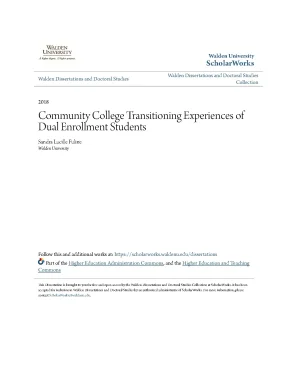
Tải xuống để đọc toàn bộWalden University ScholarWorks Walden Dissertations and Doctoral Studies Walden Dissertations and Doctoral Studies Collection 2018 Community College Transitioning Experiences of Dual Enrollment Students Sandra Lucille Fuline Walden University Follow this and additional works at: https://scholarworks.edu/dissertations Part of the Higher Education Administration Commons, and the Higher Education and Teaching Commons This Dissertation is brought to you for free and open access by the Walden Dissertations and Doctoral Studies Collection at ScholarWorks. It has been accepted for inclusion in Walden Dissertations and Doctoral Studies by an authorized administrator of ScholarWorks. For more information, please contact ScholarWorks@waldenu. Walden University College of Education This is to certify that the doctoral dissertation by Sandra Lucille Fuline has been found to be complete and satisfactory in all respects, and that any and all revisions required by the review committee have been made.
Review Committee Dr. Laura Weidner, Committee Chairperson, Education Faculty Dr. Alice Eichholz, Committee Member, Education Faculty Dr. Dimitrios Vlachopoulos, University Reviewer, Education Faculty Chief Academic Officer Eric Riedel, Ph.
Walden University 2018 Abstract Community College Transitioning Experiences of Dual Enrollment Students by Sandra Lucille Fuline MBA, Franklin University, 2009 BS, Franklin University, 2008 Dissertation Submitted in Partial Fulfillment of the Requirements for the Degree of Doctor of Philosophy Education Walden University April 2018 Abstract Dual enrollment transitioning experiences of students are poorly understood, leaving higher education stakeholders without the proper information to smooth the transitioning process and keep students in college. This basic qualitative study using interviews explored how 10 dual enrollment students described their transitioning experiences from high school to community college by investigating their motivations, ability to acknowledge self-efficacy, and understanding of social interactions using Badura’s self- efficacy model and Keller’s motivational theory and the attention, relevance, confidence, and satisfaction model. Data were analyzed through an open coding method to categorize themes and patterns as well as discrepant information. Key findings indicated that dual enrollment students embraced the rigor of courses and transitioned their learning skills to their non-dual enrollment college education.
They reported strong self-efficacy and indicated both internal and external motivators and good support systems that contributed to their completion. They did not attribute their completion of the dual enrollment program to school-based relationships or club affiliations. The social change implication is that good transition experiences between high school and college for these students assisted them in staying in college and completing programs. Increased graduation rates and attrition rates could result in better qualified and more marketable graduates, impacting a more educated community and productive economy.
Community College Transitioning Experiences of Dual Enrollment Students by Sandra Lucille Fuline MBA, Franklin University, 2009 BS, Franklin University, 2008 Dissertation Submitted in Partial Fulfillment of the Requirements for the Degree of Doctor of Philosophy Education Walden University April 2018 Dedication This dissertation is dedicated to the members of my family who have influenced the decisions I have made, making me the person I am today. To my husband, Dr. Daniel Fuline Jr., you were my inspiration to tackle such a grave endeavor. Every day you teach me something new and allow me to grow.
Thank you for always being supportive of my need to constantly better myself and always achieve more. To my sister, Rani, who always made me feel safe and loved. To my sister, Suzi, who taught me I had to throw before I could pitch. To my sister, Amii, who was always more intelligent, but never made me feel anything less.
To my brothers, Karl and Scott, who complete our family with humor, especially, when it is needed most. To my parents, Sandra and Ken, who will never know how my childhood experiences have shaped me. To all of my grandparents, who have taught me hard work and dedication will never go unrewarded. To my girls, Marissa and Rylie, may you reach every goal you set for yourself and overcome any obstacle you might encounter with confidence and poise.
Finally, to Isabella and Giovanni, your smiles kept me both blissfully distracted and motivated during the last 6 years. I love you both dearly, and I hope you both create a life of both purpose and happiness! Acknowledgments I want to acknowledge both Dr. Laura Weidner and Dr. Both of you have been more than supportive and more than patient with the multiple drafts of this important research.
Thank you for your words of encouragement and never-ending belief that I could finish this goal. I know the faculty work just as hard as the students when I get a response to an e-mail after my mentor just had surgery the same day. I also want to acknowledge my dear friend, Melissa Rose, who has impacted my goals and this success in particular through quality friendship and encouragement. Thank you for your dedication to me and always believing in me.
Table of Contents List of Tables. iv Chapter 1: Introduction to the Study.7 Purpose of the Study .10 Nature of the Study .13 Scope and Delimitations .16 Chapter 2: Literature Review .18 Literature Search Strategy.19 Conceptual and Theoretical Framework .20 Bandura: Self-efficacy. 21 Keller: ARCS Model.24 i Modality, Rigor, and Motivation. 34 Dual Enrollment Populations.
45 Critical Stakeholder Considerations .50 Chapter 3: Research Method.52 Research Design and Rationale .52 Role of the Researcher .55 Participation Selection Logic. 60 Procedures for Recruitment, Participation, and Data Collection. 61 Data Analysis Plan. 63 Issues of Trustworthiness .75 Evidence of Trustworthiness.78 RQ1: Transition Experiences.
79 RQ2: Sources of Motivation .96 Chapter 5: Discussion, Conclusions, and Recommendations .98 Summary of Findings .98 Interpretation of Findings .99 Keller: ARCS Model. 100 Bandura: Self Efficacy. 101 Limitations of Study .109 Appendix: Interview Protocol .124 iii List of Tables Table 1. Recruitment Revisions Summarized.
Interview Data: Headings and Codes.77 iv 1 Chapter 1: Introduction to the Study Dual enrollment programs totaling more than 2 million high school students have become an integral part of higher education in the United States (Taylor, 2015). College and high school partnerships form the underlying foundation of dual enrollment programs. These partnerships are responsible for implementing, promoting, sustaining, and evaluating their programs’ effectiveness (Taylor, Borden, & Park, 2015). Dual enrollment provides the opportunity for students to enroll in both high school and college courses at the same time, often at little or no additional cost to the student; however, financial specifics and many other elements of programs vary greatly by state models (Taylor et al.
In addition, credit is determined by the successful completion of on- level college courses (Karp, 2012). Remedial courses are not included in the program. Through dual enrollment programs, college classes can be offered in a variety of settings (Roach, Gamez Vargas, & David, 2015), as discussed in greater detail in Chapter 2. Regardless of the nature of the program, environment, or instructor, high school students are most likely to incur a different experience in dual enrollment courses with elevated levels of rigor and expectations (Karp, 2012; Stephenson, 2013).
As a result, dual enrollment is not appropriate for all high school students. Many choose another option, such as an Advanced Placement (AP) courses, International Baccalaureate programs, or an extra study hall (Hoffman, 2012). Tinto (2010) indicated that the transition into college must be successful in order for students to be retained. According to Wolf-Wendel, Ward, and Kinzie (2009), 2 students who integrate successfully into college undergo three phases: (a) separation from the past; (b) transition, when the individual begins to interact with the new setting and people; and (c) incorporation, when the individual adopts the norms and expectations of the new environment.
Dual enrollment students are unique in that they do not fully transition to college because they do not need to separate from their past, although they do practice in role rehearsal as they begin to adopt the norms and expectations of a college student (Karp, 2012). The majority of the research that focuses on the transition process addresses different topics, including, but not limited to behavioral risks of the transition process (Fromme, Corbin, & Kruse, 2008), the role of family and emotions (Johnson, Gans, Kerr, & LaValle, 2010), or social norms (Pelletier, Graham, & Laska, 2014). While there might be an abundance of literature that addresses college transition topics, there is little research that concentrates on dual enrollment students and their transition to a community college. Student retention is a viable topic in higher education with Tinto’s (2010) research at the forefront of the conversation, but for the dual enrollment population, there is much to be learned.
Minimal research has addressed community college dual enrollment students’ transitioning experiences to college, leaving not only the student but also those directly involved with the student, such as parents, faculty, and staff, more vulnerable to circumstances where they are not understood. The experiences that students retain from these college bound programs, specifically dual enrollment, are yet to be understood in the community college environment. If these experiences are better 3 understood, then there is greater potential for social impact. Students who participate in the program could possibly improve their college experience and become more successful during the educational journey.
In addition, college faculty and personnel are more informed about this population of students and how to better assist their learning and transition into college, making them more likely to succeed and become more marketable to an employer. There is a need for more in-depth understanding of the dual enrollment student experience in the transition from high school to community college in order for future students to be more likely recruited and retained as well as graduated. This study adds to that literature need. Specific sections for Chapter 1 include the background of dual enrollment approach, a problem statement with researchable problem, purpose, research questions, theoretical and conceptual framework, nature of the study, definitions, assumptions, scope and delimitations, limitations, significance, and an overall summary for this study.
Background In the past two decades, as dual enrollment has grown in visibility and popularity, several studies have emerged addressing dual enrollment (Allen & Dadgar, 2012; Taylor et al. Dual enrollment student motivation and demographics are as diverse as those in general postsecondary education, with one exception: Age. According to the American Association of Community Colleges (AACC, 2016), the average age of the community college population is 29 years-old. Those who participate in dual enrollment 4 are more than 10 years younger than the average community college student’s age, and could be considered more inexperienced than the traditional college student (Karp, 2012).
Karp (2012) explained that new dual enrollment students have not yet learned what it means to become a college student. They have not yet adopted more advanced ways of behaving, critically thinking, and producing mature and positive social interactions (Karp, 2012). The development of college ready skills, self-efficacy, and behaviors is a slow process that may or may not have been fully developed in high school (Allen & Lester, 2012). In empirical research conducted in the field of dual enrollment, a number of positive outcomes for the student have been found (Hanson, Prusha, & Iverson, 2015; Hebert, 2001; Hughes & Edwards, 2012).
Positive outcomes of dual enrollment include increased GPA (Allen & Dadgar, 2012; Foster, 2010), role rehearsal (Karp, 2012), increased retention with at-risk populations (An, 2013; Medvide & Bulstein, 2010; Taylor, 2015) and increased time to degree completion (Allen & Dadgar, 2012; Foster, 2010; Wang, Chan, Phelps, & Washbon, 2015). Each advantage is expanded upon in the literature review in Chapter 2. Role rehearsal is the most relevant to the research questions, because it allows for the understanding of the dual enrollment experience. Students in dual enrollment programs experience role rehearsal in practicing the role of a college student through developing a sense of community, belonging, and connection (Foster, 2010; Karp, 2012; Lewis & Overman, 2008; Lukes, 2014).
It is through role rehearsal that students naturally develop confidence approaching instructors, registering 5 for courses, and seeking help to face the challenges of being a college student (Kanny, 2015; Karp, 2012). Wang et al.
Nội dung được bảo vệ bản quyền — Tải xuống đầy đủ
Trích dẫn luận án này
Sandra Lucille Fuline (2018). Community college transitioning experiences of dual enrollme [Luận án tiến sĩ, Walden University]. LuanAn.net. https://luanan.net/giao-duc-hoc/community-college-transitioning-experiences-of-dual-enrollment-st
Câu hỏi thường gặp
Luận án "Community college transitioning experiences of dual enrollme" nghiên cứu về vấn đề gì?
"Khảo sát trải nghiệm chuyển đổi từ chương trình tham gia song song sang các trường cao đẳng cộng đồng."
Luận án "Community college transitioning experiences of dual enrollme" được bảo vệ tại trường nào?
Luận án này được bảo vệ tại Walden University. Năm bảo vệ: 2018.
Luận án "Community college transitioning experiences of dual enrollme" thuộc chuyên ngành gì?
Luận án "Community college transitioning experiences of dual enrollme" thuộc chuyên ngành Education. Danh mục: Giáo Dục Học.
Luận án "Community college transitioning experiences of dual enrollme" có bao nhiêu trang?
Luận án "Community college transitioning experiences of dual enrollme" có 137 trang. Bạn có thể xem trước một phần tài liệu ngay trên trang web trước khi tải về.
Cách tải luận án "Community college transitioning experiences of dual enrollme" về máy như thế nào?
Để tải luận án về máy, bạn nhấn nút "Tải xuống ngay" trên trang này, sau đó hoàn tất thanh toán phí lưu trữ. File sẽ được tải xuống ngay sau khi thanh toán thành công. Hỗ trợ qua Zalo: 0559 297 239.