Factors Predicting Academic Achievement Among Hispanic Community College Students by Lisa Marcelino
Khám phá các yếu tố dự báo thành tích học tập của sinh viên cộng đồng gốc Tây Ban Nha. Hiểu rõ những động lực chính thúc đẩy sự thành công trong giáo dục.
Năm xuất bản
Số trang
101
Thời gian đọc
16 phút
Lượt xem
0
Lượt tải
0
Phí lưu trữ
40 Point
Tổng quan nhanh
- Chủ đề:
- Introduction to Hispanic Academic Challenges
- Số trang:
- 101 trang
- Trường:
- Walden University
- Chuyên ngành:
- Educational Psychology
- Tác giả:
- Lisa Anne Marcelino
- Năm:
- 2018
Tóm tắt nội dung luận án
I.Introduction to Hispanic Academic Challenges
Hispanic college students face significant academic risks. Poor academic performance and high dropout rates are prevalent within this demographic. The Hispanic college population continues to expand rapidly. However, student retention rates and overall academic achievement for this group show a concerning decline. Previous academic research has investigated factors contributing to underachievement. Declining graduation rates have also been a focus. Such studies have typically concentrated on students enrolled in four-year institutions. A notable gap exists concerning Hispanic students attending community colleges. This study addresses that specific research void. It provides crucial insights into factors influencing academic success within this vital educational segment. Understanding these predictors is essential for improving educational outcomes and fostering greater equity.
1.1. Academic Performance Retention Concerns
Hispanic college students demonstrate a higher risk for poor academic outcomes. Dropping out of college is a more frequent occurrence. The population of Hispanic students in higher education steadily increases. Despite this growth, rates of student retention and overall academic achievement continue to fall. These trends highlight a critical area for intervention and support. Addressing these concerns is vital for future workforce development and social mobility. Improved student performance is a key objective for educators.
1.2. Research Gaps for Community College Students
Existing research on Hispanic college students primarily focuses on four-year universities. Limited studies examine factors predicting academic success at community colleges. This constitutes a significant research limitation. Community colleges serve a large and diverse student body, including many Hispanic individuals. A specific understanding of their unique challenges and predictors of achievement is necessary. This study fills this gap. It provides data specific to the community college environment, crucial for targeted support.
II.Theoretical Frameworks for Academic Success
The present study employed established psychological theories. These frameworks guided the investigation into factors influencing academic achievement. Bandura’s self-efficacy theory provided a foundational perspective. His social cognitive theory also informed the research design. These theories emphasize the role of an individual's beliefs in their capabilities. They highlight how self-perception impacts motivation and behavior. Additionally, Zuckerman and Kuhlman’s theory of sensation-seeking was integrated. This theory explores individual differences in the need for novel, varied, and complex sensations. It also considers the willingness to take physical and social risks for such experiences. Applying these diverse theoretical lenses offered a comprehensive view. The study aimed to understand complex psychological predictors of student performance.
2.1. Self Efficacy Social Cognitive Theory
Bandura's self-efficacy theory posits that beliefs in one's ability to succeed influence performance. Higher self-efficacy typically correlates with greater persistence and effort. This psychological construct is central to academic success. Social cognitive theory extends this by examining reciprocal interactions. Personal factors, behavioral patterns, and environmental influences all play a role. These theories suggest that students with strong academic self-efficacy are more likely to achieve. They persist through challenges, impacting overall student performance.
2.2. Sensation Seeking Theory Explained
Zuckerman and Kuhlman's theory defines sensation seeking as a personality trait. It involves the pursuit of varied, novel, complex, and intense sensations and experiences. This pursuit also includes a willingness to take risks. Risks can be physical, social, legal, or financial. High sensation seekers often exhibit impulsive behaviors. They may seek out stimulating activities. This theory offers insights into potential behavioral patterns that could affect academic engagement. Such behaviors might influence focus, study habits, and attendance, indirectly impacting graduation rates.
III.Predicting Academic Achievement Factors
This investigation aimed to identify specific predictors of academic achievement. The focus was on Hispanic community college students. Grade point averages (GPAs) served as the primary measure of academic performance. The study hypothesized relationships between GPAs and several psychological factors. Self-efficacy levels were a key variable. Resiliency, defined as coping with stress, was another important factor. Lastly, sensation-seeking behaviors were examined for their influence. These factors were chosen based on prior research and theoretical frameworks. Understanding their individual and combined impact is crucial. This knowledge can inform strategies to boost student performance and improve student retention rates.
3.1. Hypothesized Role of Self Efficacy
A central hypothesis involved self-efficacy. Students with high levels of self-efficacy were predicted to achieve higher GPAs. This expectation aligns with Bandura's theory. Belief in one's academic capabilities often translates into better study habits. It also leads to increased perseverance when facing academic challenges. Conversely, lower self-efficacy could contribute to reduced effort and poorer academic outcomes. This relationship is often critical for overall academic success.
3.2. Sensation Seeking s Impact on GPAs
Another hypothesis focused on sensation seeking. Students exhibiting high sensation-seeking tendencies were expected to have lower GPAs. Sensation-seeking behaviors often involve risk-taking and a preference for immediate gratification. These traits might detract from consistent academic engagement. Activities associated with high sensation seeking could compete with study time. This could negatively impact student performance and potentially graduation rates.
3.3. Resiliency as a Potential Predictor
Resiliency was also considered a crucial factor. Specifically, the aspect of "coping with stress makes me stronger" was investigated. It was hypothesized that higher levels of resilience would positively correlate with GPAs. Students who effectively manage stress often demonstrate better adaptation to academic pressures. Their ability to bounce back from setbacks is vital for sustained academic success. This factor could significantly influence overall student performance.
IV.Key Findings on Student Performance
The study yielded several important findings regarding student performance. These results offer nuanced insights into academic achievement among Hispanic community college students. Some hypotheses were supported, while others presented unexpected outcomes. The analysis revealed specific psychological factors influencing GPAs. These findings provide a data-driven basis for future educational interventions. Understanding these relationships is critical for enhancing academic success and increasing transfer rates to four-year institutions. The results challenge some long-held assumptions about common predictors of academic success.
4.1. Resiliency s Significant Contribution
A significant predictor of GPA emerged from the study: resiliency. Specifically, the belief "coping with stress makes me stronger" showed a strong correlation. Students who reported higher levels of this resilience aspect tended to have higher GPAs. This indicates the vital role of stress management and mental fortitude in academic success. Fostering resilience could be a powerful strategy for improving student performance.
4.2. Sensation Seeking Correlates with Lower GPAs
Sensation-seeking activities were found to correlate with lower GPAs. Specific examples included roller coaster riding, sex before marriage, and skiing. These behaviors align with the definition of sensation seeking. The correlation suggests that a preference for high-intensity, risky experiences may detract from academic focus. Such activities might divert time and energy away from studies. This could negatively impact overall student performance and ultimately, graduation rates.
4.3. Self Efficacy and GPA An Unexpected Outcome
Contrary to initial hypotheses, college self-efficacy did not show a relationship with GPAs. This was observed among the Hispanic community college students in the study. This finding is notable as self-efficacy is often considered a strong predictor of academic success. The absence of a correlation suggests other factors may be more influential in this specific population. This unexpected result warrants further investigation into the nuances of academic self-perception.
V.Implications for Student Retention Success
The study's findings carry significant implications for educational practice. Educators, administrators, and support staff can utilize these insights. The goal is to promote greater student success within community colleges. Identifying at-risk students earlier becomes a more achievable objective. This allows for the timely implementation of targeted intervention strategies. Improved student retention and higher graduation rates are direct potential benefits. The research contributes to a deeper understanding of the complex factors influencing academic achievement. This knowledge can facilitate the development of more effective support systems. It also has implications for transfer rates to four-year institutions.
5.1. Identifying At Risk Students Early
The study's results offer new avenues for identifying students at risk. Students prone to low academic performance or dropping out can be flagged earlier. Factors like specific sensation-seeking patterns could serve as indicators. Early identification allows institutions to proactively engage with students. This preventative approach can mitigate potential academic struggles. It also fosters a more supportive learning environment, improving overall academic success.
5.2. Developing Targeted Intervention Strategies
Understanding significant predictors like resiliency allows for focused interventions. Strategies can be developed to enhance students' stress coping mechanisms. Programs promoting healthy coping skills could improve academic achievement. Conversely, awareness campaigns around high-risk sensation-seeking behaviors might be beneficial. These targeted approaches aim to directly address factors impacting student performance. The ultimate goal is to improve student retention and increase graduation rates.
Mục lục chi tiết luận án
Tải xuống file đầy đủ để xem toàn bộ nội dung
Tải đầy đủ (101 trang)Trích đoạn nội dung luận án
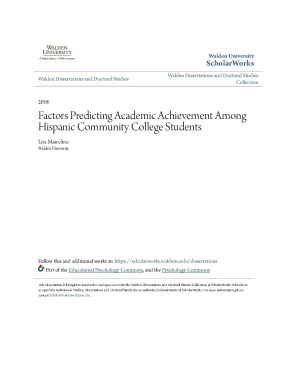
Tải xuống để đọc toàn bộWalden University ScholarWorks Walden Dissertations and Doctoral Studies Walden Dissertations and Doctoral Studies Collection 2018 Factors Predicting Academic Achievement Among Hispanic Community College Students Lisa Marcelino Walden University Follow this and additional works at: https://scholarworks.edu/dissertations Part of the Educational Psychology Commons, and the Psychology Commons This Dissertation is brought to you for free and open access by the Walden Dissertations and Doctoral Studies Collection at ScholarWorks. It has been accepted for inclusion in Walden Dissertations and Doctoral Studies by an authorized administrator of ScholarWorks. For more information, please contact ScholarWorks@waldenu. Walden University College of Social and Behavioral Sciences This is to certify that the doctoral dissertation by Lisa Marcelino has been found to be complete and satisfactory in all respects, and that any and all revisions required by the review committee have been made.
Review Committee Dr. Thomas King, Committee Chairperson, Psychology Faculty Dr. Brian Uldall, Committee Member, Psychology Faculty Dr. Timothy Lionetti, University Reviewer, Psychology Faculty Chief Academic Officer Eric Riedel, Ph.
Walden University 2018 Abstract Factors Predicting Academic Achievement Among Hispanic Community College Students by Lisa Anne Marcelino MA, Kean University, 2008 BA, Kean University, 2006 BA, Kean University, 2005 Dissertation Submitted in Partial Fulfillment of the Requirements for the Degree of Doctor of Philosophy Educational Psychology Walden University December 2017 Abstract Hispanic college students are more at risk of poor academic performance and dropping out than any other racial group. The Hispanic college population continues to grow, yet rates of retention and achievement for this group continue to decline. Previous research on Hispanic college students has examined factors that contribute to underachievement and declining graduation rates, but they are limited to students attending 4-year institutions. This study examined if grade point averages (GPAs) were affected by levels of self-efficacy, resiliency, and sensation seeking.
Bandura’s self-efficacy and social cognitive theories along with Zuckerman and Kuhlman’s theory of sensation-seeking were the theoretical frameworks that guided the present study. Hispanic students with high levels of self-efficacy were expected to have higher GPAs than students with low levels of self-efficacy. Students who were high sensation seekers were hypothesized to have lower GPAs than low sensation seekers. Lastly, it was hypothesized that sensation- seeking behaviors would be correlated with lower GPAs and lower levels of self-efficacy.
The resiliency aspect “coping with stress makes me stronger” was a significant predictor of GPA. Sensation-seeking activities such as roller coaster riding, sex before marriage, and skiing were shown to correlate with lower GPAs. College self-efficacy did not have a relationship to Hispanic community college students’ GPAs. These findings may be important to educators, administrators, and others directly involved in promoting student success in college because students at risk for low academic performance and dropping out of college can be identified earlier and therefore early intervention strategies can be implemented.
Factors Predicting Academic Achievement Among Hispanic Community College Students by Lisa Anne Marcelino MA, Kean University 2008 BA, Kean University 2006 BA, Kean University 2005 Dissertation Submitted in Partial Fulfillment of the Requirements for the Degree of Doctor of Philosophy Educational Psychology Walden University December 2017 Dedication I hereby dedicate this dissertation to my wonderful husband Carlos, who has been by my side for the entire journey and has provided endless amounts of encouragement and support. Thank you, Carlos, for being such a wonderful husband and father and for always being there for me when I needed you. I am such a lucky woman to have you in my life and I thank God for you every day. I also dedicate this dissertation to the memory of my grandmother, Irene Hinko, who always pushed for me to finish my education.
My grandmother, who I referred to as “Nan” always encouraged me to give my very best in all that I did, and she reminded me that one day my hard work would pay off. Thank you, Nan, for being such a loving, caring, giving grandmother, best friend, mentor, and supporter of all that I did! I miss you every day and I know you are watching me from Heaven and cheering me on as I complete this educational journey. Acknowledgments I want to thank Dr. King and Dr.
Uldall for their understanding, patience and level of commitment towards assisting me with completing this stage of my academic journey. I am very thankful for all of your guidance, input, feedback and assistance over the last few years. I will never forget this journey that we have shared together and will be forever grateful for the instruction and guidance you have provided. Table of Contents List of Tables.
iv List of Figures .v Chapter 1: Introduction to the Study.2 Gaps in Knowledge. 5 Purpose of Study. 6 Research Questions and Hypotheses .7 Nature of the Study .11 Assumptions, Limitations, Scope, and Delimitations. 13 Scope and Delimitations .15 Chapter 2: Literature Review .16 i Factors Leading to Academic Underachievement for Hispanic College Students.
21 Bandura, Zuckerman, and Kuhlman Explain Achievement .24 Gap in the Existing Literature .28 Chapter 3: Research Method .30 Introduction to Methodology .30 Multivariate Analysis Using Hierarchical Regression. 30 Research Design and Rationale. 32 Types and Sources of Data. 35 Instrumentation and Operationalization of Variables.
36 Data Analysis Plan. 40 Threats to Validity. 53 ii Research Question 1 and Hypothesis .53 Research Question 2 and Hypothesis .54 Research Question 3 and Hypothesis .54 Summary and Conclusion .57 Chapter 5: Discussion, Conclusions, and Recommendations. 61 Implications for Social Change .66 Appendix A: Institutional Review Board Approval Number .79 Appendix B: Permission Letter for Connor-Davidson Resilience Scale .80 Appendix C: Demographics Form .81 Appendix D: Permission to Use Sensation Seeking Scale.80 Appendix E: Permission to Use Self-Efficacy Inventory .82 Appendix F: Research Question 1 Table: Model Summary .83 Appendix G: Research Question 2 Table: ANOVA .83 Appendix H: Research Question 3 Table: Coefficients .84 iii List of Tables Table 1.
Frequency of GPA .52 iv List of Figures Figure 1. List of cases with regard to GPA. Total resiliency scores in relation to cumulative GPA for research. Frequency of cases shown for cumulative GPA in relation to total resiliency .57 v 1 Chapter 1: Introduction to the Study Introduction The present study examined factors affecting the academic achievement of the Hispanic American population.
Academic achievement of Hispanic Americans is an important area to be researched because the Hispanic population is showing steady growth, yet high school and college graduation rates are lower for this group than for any other race (US Census Bureau, 2012). The present study was important because it provided insight for teachers, parents, administrators, psychologists, and students by uncovering factors that contributed to the problem of underachievement of Hispanic- American undergraduate college students. As factors are identified that link to underachievement, changes can be made in high schools and colleges across America to address these factors so that Hispanic Americans can be more readily equipped to succeed in their academic endeavors, thus promoting positive social change. In this chapter I discussed the prevalence of underachievement for Hispanic Americans in junior high school, high school, and college settings.
I also discussed factors that have previously been identified as having an effect on academic achievement for this particular group. In this chapter I identified sensation-seeking as a factor which had previously not been explored to examine its possible connection to academic achievement. I identified the study’s hypotheses in this chapter as well as the operational definitions used and the theoretical frameworks of Bandura, Zuckerman, and Kuhlman from which the present study originated. Additionally, I explored the quantitative nature of the study and discussed the current study’s scope and limitations.
Finally, I elaborated 2 in the chapter on how the present study will provide a substantial contribution to the existing literature on achievement of Hispanic American college students and in turn help to shape the ever-evolving field of educational psychology. Background In recent years, various explanations have surfaced which attempted to explain why Hispanic undergraduate college students do not attain the same level of academic achievement as other ethnic groups. There is not one single factor that leads to Hispanic college students’ underachievement, but rather an array of factors (Cavazos et al. Some of these factors include parental involvement and encouragement and characteristics such as motivation and confidence (Cavazos et al.
Familial support has been noted as an important factor in helping Hispanic students reach success in college (Zalaquett, 2006). Strong emotional bonds with parents have also been shown to facilitate Hispanic students’ abilities to deal with the demands placed upon them in college (Kalsner & Pistole, 2003). The existing body of literature does not address whether or not Hispanic Americans’ academic achievement in college is affected by the factor of sensation- seeking. Sensation-seeking, for the purposes of this study, was defined as “the seeking of novel situations and the willingness to take risks for the sake of such stimulation” (Zuckerman & Kuhlman, 2000, p.
The reason why the factor of sensation-seeking was examined in the present study is because sensation-seeking behaviors provoke heightened arousal and immediate gratification, whereas schoolwork does not provide immediate gratification and can be 3 limited in terms of arousal. Therefore, it would be reasonable to believe that a person who has high sensation-seeking behaviors would be less enthusiastic about doing schoolwork, and therefore would possess a lower GPA. Recent studies have examined ethnicities other than Hispanics in relation to sensation-seeking and academic achievement. In fact, in a study by Simpson & Pychyl (2009), it was discovered that Caucasian, Asian, Middle-Eastern and African-American first-year university students who were high sensation-seekers were also general procrastinators, and these individuals believed that their procrastination was due to schoolwork having a limited arousal affect.
Simpson & Pychyl (2009) also discussed the possibility of high sensation-seekers procrastinating on schoolwork in order to obtain a “rush” by attempting to complete their work at the last minute. Doing schoolwork at the last minute can result in less effort being put forth, and less time devoted to studying, which could result in lower GPA’s. Moreover, according to Pedersen, Molina, Belendiuk, and Donovan (2012), European-American youth had higher rates of sensation-seeking behaviors than African-American youth. Furthermore, European- American youth were also found to have their sensation-seeking behaviors correlate with risky problem behavior such as academic underachievement.
Therefore, the present study sought to examine whether sensation-seeking behaviors affected Hispanic community college students in a similar way with relation to GPA. Sensation-seeking behaviors were measured using the 40-item Sensation Seeking Scale (SSS-V; 1978). The SSS-V, which used a forced-choice format, examined participants’ feelings regarding their likelihood to participate in various sensation-seeking 4 behaviors, or whether or not they had participated in various sensation-seeking behaviors in the past. Participants were asked questions regarding sensation-seeking behaviors that fell into four different categories: (a) thrill and adventure seeking, (b) experience seeking, (c) disinhibition, and (d) boredom susceptibility (Zuckerman & Kuhlman, 2000).
Thrill and adventure seeking items on the SSS-V included statements regarding behaviors such as roller coaster riding, water skiing, surfboard riding, and scuba diving. Experience seeking items included behaviors such as taking a road trip, trying different drugs, exploring unknown cities, and dressing in individual ways. Disinhibition items included behaviors such as drinking liquor or smoking marijuana, enjoying the company of swingers, and participation in unconventional or illegal activities. Lastly, boredom susceptibility included behaviors such as seeing a movie more than once, having exciting and unpredictable friends, spending time at home, and feelings regarding the predictability of others.
Gaps in Knowledge The present study sought to fill the gap in the existing literature by exploring whether or not sensation seeking, self-efficacy, and resiliency played a significant role in the academic achievement of Hispanic American community college students. The present study was needed because the Hispanic American population is the least likely of all ethnic groups in America to succeed in high school and college.
Nội dung được bảo vệ bản quyền — Tải xuống đầy đủ
Trích dẫn luận án này
Lisa Anne Marcelino (2018). Factors Predicting Academic Achievement Among Hispanic Community College Students [Luận án tiến sĩ, Walden University]. LuanAn.net. https://luanan.net/giao-duc-hoc/factors-predicting-academic-achievement-among-hispanic-community-2
Câu hỏi thường gặp
Luận án "Factors Predicting Academic Achievement Among Hispanic Community College Students" nghiên cứu về vấn đề gì?
Khám phá các yếu tố dự báo thành tích học tập của sinh viên cộng đồng gốc Tây Ban Nha. Hiểu rõ những động lực chính thúc đẩy sự thành công trong giáo dục.
Luận án "Factors Predicting Academic Achievement Among Hispanic Community College Students" được bảo vệ tại trường nào?
Luận án này được bảo vệ tại Walden University. Năm bảo vệ: 2018.
Luận án "Factors Predicting Academic Achievement Among Hispanic Community College Students" thuộc chuyên ngành gì?
Luận án "Factors Predicting Academic Achievement Among Hispanic Community College Students" thuộc chuyên ngành Educational Psychology. Danh mục: Giáo Dục Học.
Luận án "Factors Predicting Academic Achievement Among Hispanic Community College Students" có bao nhiêu trang?
Luận án "Factors Predicting Academic Achievement Among Hispanic Community College Students" có 101 trang. Bạn có thể xem trước một phần tài liệu ngay trên trang web trước khi tải về.
Cách tải luận án "Factors Predicting Academic Achievement Among Hispanic Community College Students" về máy như thế nào?
Để tải luận án về máy, bạn nhấn nút "Tải xuống ngay" trên trang này, sau đó hoàn tất thanh toán phí lưu trữ. File sẽ được tải xuống ngay sau khi thanh toán thành công. Hỗ trợ qua Zalo: 0559 297 239.