Luận án tiến sĩ khoa học và công nghệ môi trường impact analysis on door from op
Luận án tiến sĩ khoa học công nghệ môi trường phân tích tác động môi trường. Đề xuất giải pháp giảm thiểu ô nhiễm hiệu quả.
Tokyo Institute of Technology
Environmental Science and Technology
Luan An
Luận án
Năm xuất bản
Số trang
70
Thời gian đọc
11 phút
Lượt xem
1
Lượt tải
0
Phí lưu trữ
40 Point
Tổng quan nhanh
- Chủ đề:
- 1. Tác động của mùi từ bãi rác đến sức khỏe con người
- Số trang:
- 70 trang
- Trường:
- Tokyo Institute of Technology
- Chuyên ngành:
- Environmental Science and Technology
- Tác giả:
- Tran Linh Hoang
- Năm:
- 2020
Tóm tắt nội dung luận án
I. Tác động của mùi từ bãi rác đến sức khỏe con người
Bãi rác có thể tạo ra nhiều loại ô nhiễm không khí, bao gồm cả mùi hôi khó chịu. Mùi từ các bãi rác không chỉ ảnh hưởng đến chất lượng không khí mà còn tác động tiêu cực đến sức khỏe cộng đồng. Nghiên cứu này tập trung vào sự nhận thức của người dân về mùi hôi và các tác động của nó đến đời sống hàng ngày và sức khỏe con người.
1.1. Tác động sức khỏe do ô nhiễm mùi
Mùi hôi từ bãi rác có thể gây ra các vấn đề sức khỏe như đau đầu, buồn nôn và các triệu chứng hô hấp. Những ảnh hưởng này thường xảy ra ở những người sống gần bãi rác.
1.2. Tác động xã hội liên quan đến mùi
Các phản ứng của cộng đồng đối với mùi hôi có thể dẫn đến căng thẳng xã hội. Sự không hài lòng với chất lượng không khí có thể gia tăng khi mùi hôi trở nên rõ rệt hơn.
II. Phân tích khoảng cách và sự nhận thức về mùi hôi
Khoảng cách từ bãi rác đến khu dân cư có vai trò quan trọng trong việc xác định mức độ nhận thức về mùi hôi. Nghiên cứu cho thấy rằng ngay cả những khu vực cách bãi rác lên đến 10 km vẫn bị ảnh hưởng bởi mùi. Đặc biệt, những cư dân sống cách xa có cảm giác phiền toái hơn so với những người sống gần.
2.1. Kết quả khảo sát cộng đồng
Khảo sát đã chỉ ra rằng hơn 70% cư dân sống trong bán kính 10 km cảm thấy không hài lòng với bãi rác. Điều này cho thấy mùi hôi có thể lan xa hơn mong đợi.
2.2. Sự ảnh hưởng của hướng gió
Hướng gió là yếu tố chính ảnh hưởng đến sự phân tán của mùi. Khi gió thổi từ bãi rác về phía khu dân cư, mức độ nhận thức về mùi sẽ tăng lên.
III. Các yếu tố ảnh hưởng đến cảm nhận mùi hôi
Nghiên cứu đã xác định được bốn yếu tố chính ảnh hưởng đến cảm nhận về mùi. Những yếu tố này bao gồm: cảm giác khó chịu, thái độ đối với cơ sở xử lý chất thải, phản ứng đối phó với mùi hôi và nhận thức về cường độ mùi.
3.1. Cảm giác khó chịu
Cảm giác khó chịu là yếu tố đầu tiên và quan trọng nhất. Nó ảnh hưởng mạnh mẽ đến tâm lý của cư dân và cách họ phản ứng với bãi rác.
3.2. Thái độ đối với cơ sở xử lý
Thái độ đối với cơ sở xử lý chất thải cũng đóng vai trò quan trọng trong cảm nhận. Cư dân có thái độ tiêu cực thường sẽ phản ứng mạnh mẽ hơn với mùi.
IV. Đề xuất chính sách quản lý mùi hôi ở Việt Nam
Nghiên cứu khuyến nghị cần xây dựng một chính sách quản lý mùi hôi dựa trên Luật Kiểm soát Mùi hôi của Nhật Bản. Chính sách này cần được điều chỉnh để phù hợp với điều kiện tại Việt Nam nhằm bảo vệ sức khoẻ cộng đồng và chất lượng môi trường sống.
4.1. Cần thiết lập tiêu chuẩn quản lý
Việc thiết lập các tiêu chuẩn quản lý mùi hôi sẽ giúp giảm thiểu tác động đến sức khỏe và đảm bảo sự thoải mái cho cư dân.
4.2. Tăng cường giáo dục cộng đồng
Giáo dục cộng đồng về ảnh hưởng của mùi hôi và các biện pháp đối phó sẽ giúp nâng cao nhận thức và cải thiện chất lượng cuộc sống.
Mục lục chi tiết luận án
Tải xuống file đầy đủ để xem toàn bộ nội dung
Tải đầy đủ (70 trang)Nội dung chính
Tổng quan về luận án
Sự gia tăng nhanh chóng của chất thải rắn sinh hoạt (MSW - Municipal Solid Waste) tại các siêu đô thị đang phát triển ở Đông Nam Á đặt ra thách thức nghiêm trọng đối với công tác quản trị môi trường và sức khỏe cộng đồng. Tại Thành phố Hồ Chí Minh (TP.HCM), đô thị đầu tàu kinh tế của Việt Nam với dân số 8,83 triệu người (năm 2018) và diện tích 2.061 km², lượng chất thải rắn phát sinh đạt 8.175 tấn/ngày với tỷ lệ phát thải 1,02 kg/người/ngày và tốc độ tăng trưởng 5-6%/năm (DONRE, 2018). Trong bối cảnh khoảng 86% tổng lượng rác thải được xử lý bằng phương pháp chôn lấp tập trung chủ yếu tại Khu liên hợp xử lý chất thải rắn Đa Phước (huyện Bình Chánh, tiếp nhận 5.200 tấn/ngày với 83,3% là rác thải hữu cơ/thực phẩm), tình trạng phát tán khí thải và mùi hôi (odor emissions) đã gây ra các xung đột xã hội gay gắt. Hơn 500 đơn thư khiếu nại chính thức từ cư dân Khu đô thị Phú Mỹ Hưng (Quận 7) cách bãi chôn lấp hơn 7 km đã được gửi tới Sở Tài nguyên và Môi trường (DONRE, 2016). Tuy nhiên, các chính sách quản lý môi trường tại Việt Nam thời điểm đó hoàn toàn thiếu vắng các tiêu chuẩn quy chuẩn kỹ thuật quốc gia về kiểm soát mùi cũng như các nghiên cứu thực nghiệm học thuật toàn diện.
Luận án tiến sĩ mang tên "Impact Analysis on Odor from Open Landfill Site of Municipal Waste - Case of Ho Chi Minh City, Vietnam" do nghiên cứu sinh Tran Hoang Linh thực hiện tại Khoa Khoa học và Công nghệ Môi trường, Trường Sau đại học Khoa học và Kỹ thuật Liên ngành thuộc Viện Công nghệ Tokyo (Tokyo Institute of Technology, Nhật Bản) dưới sự hướng dẫn của GS. Takehiko Murayama và GS. Shigeo Nishikizawa (bảo vệ tháng 3/2020), là công trình tiên phong giải quyết khoảng trống nghiên cứu (research gap) trọng yếu này.
Nghiên cứu tập trung giải quyết ba câu hỏi nghiên cứu cốt lõi:
- Research Question 1 (RQ1): Phạm vi không gian tối đa và đặc tính vật lý của nồng độ mùi phát tán từ bãi chôn lấp hở trong điều kiện khí hậu nhiệt đới gió mùa là gì?
- Research Question 2 (RQ2): Nhận thức mùi (odor perception), mức độ phiền toái (odor annoyance), tác động sức khỏe và phản ứng hành vi của cộng đồng cư dân biến thiên như thế nào theo khoảng cách địa lý và đặc điểm nhân khẩu học - xã hội?
- Research Question 3 (RQ3): Mối quan hệ cấu trúc nhân - quả (cause-impact structure) giữa nồng độ mùi vật lý, mức độ phiền toái tâm lý và thái độ đánh giá đối với công tác quản lý bãi chôn lấp vận hành theo cơ chế nào?
Các giả thuyết nghiên cứu tương ứng được xác lập:
- Hypothesis 1 (H1): Khí hậu nhiệt đới gió mùa với sự đảo chiều gió theo mùa và độ ẩm cao khuếch tán mùi hôi vượt xa ngưỡng khoảng cách quy chuẩn thông thường (> 7 km đến 10,2 km).
- Hypothesis 2 (H2): Mức độ phiền toái không suy giảm tuyến tính đơn thuần theo khoảng cách vật lý mà chịu sự điều tiết mạnh mẽ bởi nhận thức rủi ro, phân tầng kinh tế - xã hội và đặc điểm kiến trúc nhà ở (cao tầng so với nhà thấp tầng).
- Hypothesis 3 (H3): Thái độ tiêu cực của cư dân đối với ban quản lý bãi chôn lấp tỷ lệ thuận với tần suất và cường độ phiền toái mùi trong sinh hoạt thường nhật.
Khung lý thuyết của luận án tích hợp mô hình FIDOL (Frequency, Intensity, Duration, Offensiveness, Location) của Freeman & Cudmore (2002) và Nicell (2009), thuyết thích ứng cảm giác / trơ khứu giác (Sensory Adaptation / Habituation Theory) của Dalton & Wysocki (1996), thuyết căng thẳng môi trường và đánh giá nhận thức (Environmental Stress & Cognitive Appraisal Theory) của Cavalini (1994), cùng khung pháp lý Đạo luật Kiểm soát Mùi khó chịu của Nhật Bản (Japanese Offensive Odor Control Law 1976). Phạm vi nghiên cứu bao quát mẫu điều tra xã hội học gồm 409 hộ gia đình trên 4 vùng khoảng cách (<3 km, 3-5 km, 5-7 km, >7 km) và 91 điểm đo nồng độ mùi thực địa bằng thiết bị cảm biến chuyên dụng XP-329III trong bán kính lên tới 10,2 km. Công trình mang lại đóng góp đột phá khi định lượng hóa nồng độ mùi khu vực cận kề bãi chôn lấp đạt 109,75 ou/m³ (vượt hơn 7 lần ngưỡng chuẩn Nhật Bản 10-15 ou/m³), đồng thời phát hiện nghịch lý phiền toái mùi tại các khu đô thị cao tầng cách xa trên 7 km, đặt nền móng khoa học trực tiếp cho việc xây dựng chính sách quản lý mùi hôi tại Việt Nam.
Literature Review và Positioning
Tổng quan tài liệu quốc tế cho thấy nghiên cứu về mùi hôi từ các cơ sở xử lý chất thải rắn đã trải qua nhiều giai đoạn phát triển với hai luồng quan điểm và phương pháp tiếp cận chính. Luồng nghiên cứu thứ nhất tập trung vào kỹ thuật đo đạc cảm quan bằng hội đồng đánh giá khứu giác (sniffing team / trained panelists) theo tiêu chuẩn VDI 3940 - Part 1 (2006) của Hiệp hội Kỹ sư Đức (Naddeo et al., 2012; Zarra et al., 2012). Phương pháp này tuy chuẩn hóa nhưng đòi hỏi chi phí lớn, tốn thời gian và phụ thuộc nghiêm trọng vào điều kiện thời tiết tức thời. Luồng nghiên cứu thứ hai dựa trên khảo sát bảng hỏi xã hội học nhằm đánh giá sự phiền toái và phản ứng tâm lý - sức khỏe của cộng đồng phơi nhiễm (Capelli et al., 2014; Hayes et al., 2014; Nicell, 2009).
Một cuộc tranh luận học thuật kéo dài tồn tại giữa hai trường phái:
- Trường phái suy giảm tuyến tính theo khoảng cách (Distance-Decay Linear Model): Các nghiên cứu kinh điển như Cavalini (1994), Al-Khatib et al. (2014), Babs-Shomoye & Kabir (2016), và Rahardyan et al. (2004) khẳng định tác động mùi và mức độ phiền toái giảm dần một cách đơn điệu khi khoảng cách từ nguồn thải tăng lên. Cư dân sống sát nguồn thải luôn chịu tác động nặng nề nhất về cả thể chất lẫn tâm lý.
- Trường phái điều tiết tâm lý - xã hội và thích ứng khứu giác (Socio-Psychological Modulation & Adaptation Model): Các nhà nghiên cứu như Dalton & Wysocki (1996), Dalton & Dilks (1997), Sucker et al. (2008), và Bliss et al. (1996) chỉ ra rằng nhận thức mùi là một trải nghiệm tâm lý chủ quan. Phơi nhiễm mạn tính liên tục ở nồng độ cao có thể dẫn đến hiện tượng trơ cảm giác (sensory desensitization / olfactory fatigue), trong khi những quần thể có trình độ học vấn, thu nhập cao và kỳ vọng chất lượng sống lớn sẽ phản ứng dữ dội và ghi nhận mức độ phiền toái cao hơn dù phơi nhiễm ngắt quãng ở nồng độ thấp hơn.
Luận án định vị chính xác khoảng trống tri thức then chốt: Hầu hết các công trình thực nghiệm quốc tế trước đây chỉ khảo sát phạm vi bán kính tác động mùi rất hạn chế:
- Tại Canada, nghiên cứu của Héroux et al. (2010) trên nhà máy phân compost cạnh bãi chôn lấp chỉ xác định bán kính tác động 1,5 km và bỏ qua khu vực ngoài phạm vi này.
- Tại Đức, Albrecht et al. (2008) và Fischer et al. (2008) ghi nhận tần suất mùi từ 10% đến 30% ở cự ly tối đa 870 m từ nhà máy ủ phân compost.
- Tại Bỉ, Nicolas et al. (2006) xác định khoảng cách phát hiện mùi tối đa của đội ngũ đánh giá là 810 m, trong khi Langenhove et al. ghi nhận khoảng cách trung bình từ 430 m đến 695 m tại 6 cơ sở xử lý.
- Tại Hàn Quốc, Lim et al. (2006) khảo sát nồng độ khí mùi (acetaldehyde, propionaldehydes) trong bán kính tối đa 5 km.
- Tại Thái Lan, Srangsriwong et al. (2018) nghiên cứu sự thay đổi nhận thức cộng đồng trong bán kính 5,7 km quanh bãi rác.
- Tại Nigeria (Babs-Shomoye & Kabir, 2016) và Palestine (Al-Khatib et al., 2014), các nghiên cứu chỉ giới hạn trong phạm vi 250 m đến 1 km.
- Tại Việt Nam, Tuan & MacLaren (2005) khảo sát cộng đồng nghèo quanh bãi rác Nam Sơn (Hà Nội) chỉ đề xuất bán kính bồi thường kinh tế mở rộng từ 500 m lên 1 km.
Chưa có bất kỳ công trình nào trên thế giới tiến hành phân tích tích hợp giữa đo đạc nồng độ mùi vật lý bằng cảm biến bán dẫn và khảo sát xã hội học đa vùng ở cự ly cực xa lên tới 10,2 km trong điều kiện khí hậu nhiệt đới gió mùa đặc thù. Luận án của Tran Hoang Linh đã thúc đẩy biên giới tri thức bằng cách chứng minh hiện tượng phát tán và phiền toái mùi vượt ngưỡng 7 km đến 10,2 km, lấp đầy khoảng trống dữ liệu thực nghiệm tại các siêu đô thị đang phát triển.
Đóng góp lý thuyết và khung phân tích
Đóng góp cho lý thuyết
Luận án mở rộng và thách thức các lý thuyết nền tảng trong lĩnh vực khoa học môi trường và tâm lý học môi trường:
- Mở rộng Khung phân tích FIDOL (Freeman & Cudmore, 2002; Nicell, 2009): Luận án chứng minh rằng trong điều kiện khí hậu nhiệt đới và kiến trúc đô thị hiện đại, yếu tố Vị trí ($L$ - Location) không chỉ là tọa độ mặt phẳng 2D mà phải được mở rộng thành không gian 3D (độ cao tầng nhà chung cư). Tốc độ gió tầng cao tỷ lệ thuận với chiều cao công trình (Chen, Bundy, & Hoff, 1998), biến các căn hộ cao tầng tại Quận 7 thành thụ thể tiếp nhận luồng khí mùi đậm đặc từ trên cao mà không bị cản trở bởi địa hình bề mặt.
- Thách thức Mô hình suy giảm khoảng cách đơn điệu (Distance-Decay Model): Bằng chứng thực nghiệm từ luận án chỉ ra mối quan hệ phi tuyến tính hình chữ U ngược hoặc đa cực giữa khoảng cách và sự phiền toái. Cư dân Vùng 4 (>7 km) có tỷ lệ phiền toái cực độ và đánh giá tiêu cực về bãi rác cao hơn đáng kể so với cư dân Vùng 1 (<3 km).
- Bổ sung Thuyết thích ứng khứu giác và Đánh giá nhận thức (Dalton & Wysocki, 1996; Cavalini, 1994): Luận án cung cấp minh chứng rõ nét về sự phân hóa cơ chế thích ứng: Cư dân bản địa nông thôn tiếp xúc mùi nền mạn tính bị giảm độ nhạy khứu giác, trong khi cư dân đô thị mới chuyển đến (<5 năm), có trình độ đại học trở lên và thu nhập cao trải qua quá trình nhạy cảm hóa nhận thức (cognitive sensitization), dẫn đến sự bức xúc xã hội và hành vi khiếu nại tập thể.
Khung phân tích độc đáo
Khung phân tích của luận án tích hợp đa chiều giữa khí tượng học, vật lý môi trường, tâm lý học hành vi và dịch tễ học cộng đồng. Khung khái niệm xác lập mối quan hệ cấu trúc nhân - quả (Cause - Impact Structure) được kiểm định thực nghiệm thông qua 4 thành phần tiềm ẩn (latent constructs):
[Nguồn thải MSW Đa Phước]
       │
       ▼ (Khuếch tán vật lý: Gió Tây Nam, Mùa mưa, Độ ẩm nhiệt đới)
[Nồng độ mùi vật lý (ou/m³)]
       │
       ├─────────────────────────────────────────┐
       ▼                                         ▼
[Vùng cận kề (<3 km): Nông thôn]         [Vùng xa (>7 km): Đô thị cao tầng]
- Nồng độ mùi: 109,75 ou/m³ (vượt >7 lần) - Nồng độ mùi: 10,97 - 18,97 ou/m³
- Phơi nhiễm mạn tính liên tục             - Phơi nhiễm ngắt quãng chiều tối (18h-24h)
- Thích ứng / Trơ khứu giác               - Nhạy cảm nhận thức & Kỳ vọng sống cao
- Phiền toái sinh hoạt: Thấp hơn kỳ vọng  - Phiền toái cực độ & Đánh giá rất xấu
       │                                         │
       └────────────────────┬────────────────────┘
                            ▼
      [Cấu trúc 4 Nhân tố Phân tích EFA]
      1. Sự phiền toái (Nuisance) - α = 0.908
      2. Thái độ đối với cơ sở MSW (Attitudes) - α = 0.653
      3. Hành động ứng phó (Actions) - α = 0.812
      4. Nhận thức cường độ mùi (Perception) - α = 0.651
Điều kiện biên (boundary conditions) của khung phân tích được xác định rõ: Khung lý thuyết áp dụng tối ưu cho các đô thị nhiệt đới gió mùa có cơ cấu xử lý rác thải chôn lấp hở với tỷ lệ hữu cơ cao (>80%), tồn tại sự đan xen giữa vùng nông thôn trũng thấp và các khu đô thị mới cao tầng ở hướng hạ phong.
Phương pháp nghiên cứu tiên tiến
Thiết kế nghiên cứu
Nghiên cứu vận dụng thế giới quan Thực chứng hậu kỳ kết hợp Hiện thực phê phán (Post-positivism & Critical Realism), kết hợp chặt chẽ giữa phương pháp định lượng thực nghiệm vật lý và điều tra xã hội học cấu trúc. Thiết kế đa tầng (multi-level design) được phân chia theo 4 vùng địa lý đại diện cho các khoảng cách và đặc tính kinh tế - xã hội khác biệt:
- Vùng 1 (< 3 km): Xã Đa Phước, huyện Bình Chánh (dân số 16.388 người, mật độ 965 người/km²; 90,2% ở nhà mặt đất; lao động nông nghiệp và công nghiệp thủ công chiếm chủ đạo; 50% cư trú trên 10 năm).
- Vùng 2 (3 - 5 km): Xã Nhơn Đức, huyện Nhà Bè (dân số 11.179 người, cự ly trung bình 3,5 km; 80% ở nhà mặt đất).
- Vùng 3 (5 - 7 km): Xã Phước Kiển, huyện Nhà Bè (dân số 24.765 người, cự ly trung bình 5,5 km; 58,9% cư trú tại các khu chung cư hiện đại).
- Vùng 4 (> 7 km): Phường Phú Mỹ, Khu đô thị Phú Mỹ Hưng, Quận 7 (dân số 24.270 người, cự ly 7 - 10,2 km; 69% ở căn hộ chung cư cao tầng; cư dân có trình độ đại học/sau đại học và thu nhập cao; hơn 50% sinh sống dưới 5 năm).
Quy trình nghiên cứu rigorous
Quy mô mẫu điều tra xã hội học được xác định nghiêm ngặt theo công thức Cochran (1977) cho tổng quần thể $N = 76.602$ người:
$$n = \frac{N \cdot Z^2 \cdot p \cdot (1-p)}{e^2 \cdot (N-1) + Z^2 \cdot p \cdot (1-p)}$$
Với độ tin cậy 95% ($Z = 1,96$), sai số cho phép $e = 5%$ ($0,05$), và tỷ lệ ước tính $p = 0,5$, quy mô mẫu tối ưu tính toán là 382 mẫu. Áp dụng phương pháp phân bổ tỷ lệ (proportional allocation), số mẫu tối thiểu cho Vùng 1, 2, 3, 4 lần lượt là 82, 56, 123, và 121. Trên thực tế, tác giả đã thu thập thành công 409 bảng hỏi hợp lệ thông qua phỏng vấn trực tiếp mặt đối mặt (face-to-face interviews) từ tháng 10 đến tháng 12/2018 (Vùng 1: 82; Vùng 2: 70; Vùng 3: 112; Vùng 4: 145 bảng hỏi).
Quy trình tam giác hóa dữ liệu (data triangulation) được thiết lập giữa:
- Dữ liệu khiếu nại lịch sử của cơ quan quản lý nhà nước (DONRE, 2016).
- Dữ liệu khảo sát xã hội học 409 hộ dân bằng bảng hỏi chuẩn hóa 7 phần (30 biến quan sát).
- Dữ liệu quan trắc nồng độ mùi thực địa bằng thiết bị cảm biến điện tử.
- Dữ liệu khí tượng vi mô (tốc độ, hướng gió, nhiệt độ, độ ẩm) thu thập từ trạm khí tượng quốc tế Tân Sơn Nhất (VVTS) và mô phỏng hoa gió bằng phần mềm WRPLOT View (Lakes Environmental).
Đo đạc nồng độ mùi vật lý được thực hiện vào tháng 9/2019 bằng thiết bị đo mùi cầm xoay chiều chuyên dụng XP-329III (New Cosmos Electric Co., Ltd., Nhật Bản). Thiết bị sử dụng cảm biến dây nóng bán dẫn oxit indi ($In_2O_3$) nung nóng ở 480°C, ghi nhận sự thay đổi điện trở khi các phân tử mùi bị oxy hóa chuyển hóa thành $CO_2$ và $H_2O$ với tốc độ đáp ứng 20 giây, dải đo 0 - 2000 đơn vị nồng độ mùi ($ou/m^3$). Tổng cộng 91 đợt quan trắc thực địa liên tục (5 phút/lần đo) được thực hiện: 20 quan trắc tại Vùng 1 (ngày 20/9/2019), 30 quan trắc tại Vùng 2 (ngày 16/9/2019), và 41 quan trắc tại Vùng 3 (ngày 17/9/2019).
Data và phân tích
Phân tích thống kê được thực hiện trên phần mềm SPSS phiên bản 25 và MS Excel:
- Kiểm định Chi-square ($\chi^2$) xác lập mức ý nghĩa thống kê giữa các nhóm biến nhân khẩu học, nhận thức mùi, ảnh hưởng sinh hoạt, phản ứng hành vi và thái độ đối với bãi rác.
- Phân tích nhân tố khám phá (Exploratory Factor Analysis - EFA) sử dụng phương pháp trích Principal Component Analysis (PCA) với phép xoay Varimax và chuẩn hóa Kaiser trên mẫu $N = 197$ quan sát đầy đủ, trích xuất thành công 4 nhân tố đại diện cho cấu trúc nhận thức - hành vi.
- Kiểm định độ tin cậy thang đo bằng hệ số Cronbach's Alpha ($\alpha$):
- Nhân tố 1 (Sự phiền toái - Nuisance, 8 biến quan sát: công việc/học tập, kinh doanh, sinh hoạt thường nhật, hoạt động ngoài trời, tần suất mùi, lo lắng tác động mùi, giá trị tài sản, đeo khẩu trang ngoài trời): $\alpha = 0,908$ (độ tin cậy rất cao).
- Nhân tố 2 (Thái độ đối với cơ sở MSW - Attitudes towards MSW treatment facility, 3 biến quan sát: mặt tích cực/tiêu cực, xếp hạng quản lý bãi rác, sự suy giảm chất lượng môi trường): $\alpha = 0,653$.
- Nhân tố 3 (Hành động ứng phó tác động mùi - Actions to cope with odor impacts, 2 biến quan sát: báo cáo ban quản lý bãi rác, báo cáo chính quyền): $\alpha = 0,812$.
- Nhân tố 4 (Nhận thức cường độ mùi - Perception of odor intensity, 2 biến quan sát: cường độ mùi, mùi nhiều hơn hay nhạy cảm hơn): $\alpha = 0,651$.
- Điểm số nhân tố hồi quy (Regression Factor Scores - REGR) được tính toán để so sánh sai số chuẩn và mức độ biểu hiện của 4 nhân tố trên từng khoảng cách địa lý.
Phát hiện đột phá và implications
Những phát hiện then chốt
Công trình mang lại 5 phát hiện then chốt có giá trị thực nghiệm sâu sắc:
-
Mức độ ô nhiễm mùi vật lý vượt quy chuẩn quốc tế trầm trọng tại nguồn: Nồng độ mùi trung bình đo được tại Vùng 1 (cách bãi rác 1,5 km) đạt $109,75 \pm 39,5\ ou/m^3$. Theo trích dẫn trực tiếp từ luận án: "the acceptable level of odor concentration in area 1 was more than 7 times the level specified by Japanese offensive odor control law promulgated in 1976 (Japan Ministry of the Environment, 2003)" (vốn quy định ngưỡng ranh giới chấp nhận được đối với khu dân cư chỉ từ $10 - 15\ ou/m^3$). Tại Vùng 2 (cách 8,2 km), nồng độ trung bình là $18,97 \pm 10,2\ ou/m^3$ (biến thiên 2 - 44 $ou/m^3$), vẫn vượt ngưỡng giới hạn tiếp nhận. Tại Vùng 3 (cách 10 km), nồng độ trung bình là $10,97 \pm 10,5\ ou/m^3$ với giá trị cực đại lên tới $40\ ou/m^3$.
-
Quy luật lan truyền mùi theo mùa gió nhiệt đới và khung giờ chiều tối: Có tới 46,5% cư dân xác nhận mùi hôi trở nên tồi tệ nhất từ tháng 6 đến tháng 8 và kéo dài đến tháng 11, trùng khớp hoàn toàn với dữ liệu hoa gió ghi nhận hướng gió Tây - Tây Nam thịnh hành thổi trực tiếp từ Đa Phước về phía Quận 7 và Nhà Bè. Dữ liệu đo đạc thực tế tại Vùng 3 khẳng định nồng độ mùi đạt đỉnh vào khung giờ 18:00 - 19:00, hoàn toàn đồng thuận với kết quả khảo sát cộng đồng khi đa số cư dân báo cáo mùi hôi xuất hiện nặng nề nhất từ 18:00 đến 24:00.
-
Suy giảm chất lượng sống và triệu chứng sức khỏe diện rộng: Theo dữ liệu công bố trong luận án: "the results showed that a majority of the respondents (86.1%) thought that the MSW treatment facility reduced their quality of life. Their daily activities, business activities, studying or working activities, and outdoor activities were 'extremely' affected, accounting for 47.9%, 43.3%, 45.7%, and 50.9% respectively." Ngoài ra, 82,9% người được hỏi bày tỏ lo ngại về sức khỏe và 84,6% khẳng định toàn bộ thành viên gia đình bị ảnh hưởng, với các triệu chứng lâm sàng phổ biến nhất là buồn nôn (15,7%) và khó thở (15,2%).
-
Nghịch lý nhận thức và phiền toái ở cự ly xa (> 7 km): Mặc dù nồng độ mùi vật lý tại Vùng 4 (> 7 km) thấp hơn Vùng 1, cư dân Vùng 4 lại thể hiện mức độ phiền toái cao nhất, ghi nhận điểm số nhân tố Nuisance và thái độ đánh giá tiêu cực (Negative Attitude) về bãi rác vượt trội so với các vùng khác. Có 67,2% tổng số người được hỏi đánh giá việc vận hành bãi rác là "xấu" (bad) và 49,3% đánh giá công tác quản lý là "rất xấu" (very bad). Hiện tượng này được giải thích bởi sự kết hợp giữa: hiệu ứng gió tầng cao tại các cụm chung cư cao tầng, kỳ vọng môi trường cao của tầng lớp trung lưu, và sự thiếu hụt khả năng thích nghi do thời gian cư trú ngắn (< 5 năm).
-
Phản ứng hành vi và xung đột xã hội: Để đối phó với mùi hôi, 74,7% cư dân phải sử dụng khẩu trang khi ra ngoài, 58% đóng kín toàn bộ cửa sổ. Đáng chú ý, 60,6% cư dân đã trực tiếp phản ánh/khiếu nại lên cán bộ chính quyền và 21,6% đang lên kế hoạch khiếu nại; 49,9% đã liên hệ ban quản lý bãi rác để phản đối, phản ánh mức độ căng thẳng xã hội gay gắt.
Implications đa chiều
- Đóng góp lý thuyết: Bổ sung cơ chế tương tác đa tầng giữa phát tán vật lý 3D, khí hậu nhiệt đới gió mùa và các biến số điều tiết tâm lý - xã hội vào các mô hình đánh giá tác động môi trường (EIA).
- Đổi mới phương pháp luận: Chuẩn hóa quy trình tích hợp giữa đo đạc cảm biến bán dẫn oxit kim loại di động và phân tích nhân tố EFA/hồi quy xã hội học, cung cấp công cụ nghiên cứu khả thi, chi phí thấp cho các nước đang phát triển thay thế cho phương pháp Olfactometry tốn kém.
- Ứng dụng thực tiễn: Cung cấp thông số kỹ thuật trực tiếp cho các nhà quy hoạch đô thị TP.HCM: Xác lập vùng đệm cách ly môi trường an toàn đối với các khu xử lý chất thải rắn quy mô lớn trong điều kiện nhiệt đới tối thiểu phải đạt 7 - 10 km theo hướng gió chủ đạo, thay vì bán kính 500 m - 1 km như các quy định cũ.
- Khuyến nghị chính sách: Luận án đề xuất cấp thiết xây dựng Luật Kiểm soát Mùi khó chịu tại Việt Nam dựa trên khung tham chiếu Đạo luật Kiểm soát Mùi của Nhật Bản (Offensive Odor Control Law), đồng thời chuyển đổi công nghệ xử lý từ chôn lấp hở (open landfilling) sang công nghệ đốt rác phát điện (Waste-to-Energy) khép kín.
Limitations và Future Research
Tác giả thẳng thắn thừa nhận các giới hạn nghiên cứu:
- Giới hạn thời gian quan trắc vật lý: Dữ liệu đo nồng độ mùi thực địa bằng máy XP-329III được thực hiện tập trung vào tháng 9/2019 (mùa mưa, gió Tây Nam), chưa phản ánh liên tục chuỗi dữ liệu 4 mùa quanh năm để so sánh đối chứng với mùa khô (gió Đông Bắc).
- Đặc tính thiết bị cảm biến: Cảm biến oxit indi của máy XP-329III phản ứng với tổng nồng độ các hợp chất hữu cơ dễ bay hơi (VOCs) và khí mùi quy đổi ($ou/m^3$), chưa định danh và bóc tách chi tiết từng thành phần hóa học đơn lẻ (như $H_2S, NH_3$, mercaptans, aldehydes).
- Thiết kế nghiên cứu cắt ngang (Cross-sectional): Khảo sát xã hội học ghi nhận nhận thức tại một thời điểm, chưa theo dõi biến động dọc (longitudinal) về sự thay đổi thái độ khi có các can thiệp kỹ thuật tại bãi rác.
Chương trình nghiên cứu tương lai (Future Research Agenda):
- Ứng dụng phương pháp sắc ký khí ghép khối phổ (GC-MS) kết hợp đo khứu giác động (Dynamic Olfactometry) để định lượng chi tiết từng hợp chất mùi đặc thù.
- Xây dựng mô hình mô phỏng phát tán khí động lực học 3D (AERMOD hoặc CALPUFF) tích hợp số liệu địa hình và cấu trúc hình học của các tòa nhà chung cư cao tầng.
- Mở rộng đánh giá kinh tế lượng về sự sụt giảm giá trị bất động sản (Hedonic Price Method) do tác động của mùi hôi tại Quận 7 và Nhà Bè.
- Nghiên cứu can thiệp đánh giá hiệu quả của các chế phẩm sinh học khử mùi và công nghệ che phủ bãi chôn lấp tiên tiến.
Tác động và ảnh hưởng
- Tác động học thuật: Luận án tạo ra bước ngoặt trong tài liệu học thuật quốc tế về kiểm soát mùi tại Đông Nam Á, mở ra tiềm năng trích dẫn cao trong các tạp chí chuyên ngành hàng đầu như Waste Management, Atmospheric Environment, và Journal of Environmental Management.
- Chuyển đổi ngành công nghiệp xử lý rác: Cung cấp cơ sở khoa học để chính quyền TP.HCM thúc đẩy tái cấu trúc Khu liên hợp Đa Phước, buộc các doanh nghiệp vận hành phải đầu tư hệ thống thu gom khí biogas, bao phủ bạt HDPE toàn diện và đẩy nhanh tiến độ các nhà máy đốt rác phát điện công nghệ cao.
- Ảnh hưởng chính sách: Đóng vai trò là tài liệu tham khảo thực nghiệm cốt lõi cho Bộ Tài nguyên và Môi trường Việt Nam trong quá trình sửa đổi Luật Bảo vệ Môi trường 2020 và xây dựng các quy chuẩn kỹ thuật quốc gia về kiểm soát mùi từ các cơ sở xử lý chất thải.
- Lợi ích xã hội: Tạo cơ sở minh chứng khoa học độc lập bảo vệ quyền lợi hợp pháp và sức khỏe của hơn 76.000 cư dân khu vực Nam Sài Gòn, giảm thiểu căng thẳng và khiếu nại xã hội kéo dài.
Đối tượng hưởng lợi
- Nghiên cứu sinh / Học giả ngành Môi trường: Tiếp cận phương pháp luận kết hợp liên ngành giữa khoa học môi trường thực nghiệm và tâm lý học xã hội; khai thác khoảng trống nghiên cứu về mô hình phát tán mùi 3D trong đô thị nhiệt đới.
- Các viện nghiên cứu & R&D công nghệ môi trường: Ứng dụng quy trình đo đạc nhanh bằng cảm biến và hoa gió WRPLOT View để đánh giá hiệu quả của các giải pháp xử lý mùi thực địa.
- Nhà quy hoạch đô thị và Cơ quan quản lý nhà nước (Bộ TN&MT, DONRE): Sử dụng dữ liệu thực nghiệm để hoạch định khoảng cách an toàn môi trường, thẩm định báo cáo ĐTM và ban hành các tiêu chuẩn kiểm soát mùi khả thi.
- Doanh nghiệp quản lý chất thải rắn: Nắm bắt quy luật phát tán mùi theo giờ và mùa gió để điều chỉnh quy trình vận hành tiếp nhận rác và phun xịt chế phẩm khử mùi vào các khung giờ nhạy cảm (18:00 - 24:00).
Câu hỏi chuyên sâu
1. Đóng góp lý thuyết độc đáo nhất của luận án là gì? Trả lời: Đóng góp độc đáo nhất là việc tái định thức Khung phân tích FIDOL và thách thức Mô hình suy giảm khoảng cách cổ điển bằng cách phát hiện "Nghịch lý phiền toái ở cự ly xa". Luận án chứng minh rằng trong đô thị nhiệt đới có nhà cao tầng, nhận thức mùi không suy giảm tuyến tính theo khoảng cách mà chịu sự chi phối bởi cấu trúc gió tầng cao và quá trình phân hóa tâm lý - xã hội (thích ứng khứu giác ở vùng nông thôn cận kề đối lập với nhạy cảm hóa nhận thức ở tầng lớp trung lưu đô thị cự ly > 7 km).
2. Đổi mới phương pháp luận của luận án khi so sánh với các nghiên cứu trước đây? Trả lời: So với các nghiên cứu của Héroux et al. (2010) tại Canada (chỉ khảo sát bán kính 1,5 km bằng bảng hỏi) và Albrecht et al. (2008) tại Đức (chỉ dùng hội đồng ngửi ở cự ly 870 m), luận án của Tran Hoang Linh đã đột phá khi mở rộng bán kính nghiên cứu lên tới 10,2 km, đồng thời tam giác hóa đồng thời 3 nguồn dữ liệu: phân tích nhân tố EFA trên 409 hộ dân, đo nồng độ mùi vật lý bằng thiết bị cảm biến bán dẫn XP-329III (91 điểm đo), và mô phỏng khí tượng hoa gió WRPLOT View.
3. Phát hiện bất ngờ nhất (Most surprising finding) có dữ liệu minh chứng là gì? Trả lời: Phát hiện bất ngờ nhất là nồng độ mùi trung bình tại Vùng 1 đạt tới 109,75 ou/m³ (vượt hơn 7 lần ngưỡng chuẩn Nhật Bản), nhưng cư dân Vùng 4 (> 7 km, nồng độ chỉ 10,97 - 18,97 ou/m³) lại thể hiện mức độ phiền toái cao hơn và đánh giá công tác quản lý bãi rác tiêu cực hơn (49,3% đánh giá rất xấu). Điều này được hỗ trợ bởi dữ liệu: 85% cư dân Vùng 4 có trình độ đại học trở lên, sống trong căn hộ chung cư cao tầng đón gió Tây Nam vận tốc lớn, và mới chuyển đến sinh sống dưới 5 năm.
4. Nghiên cứu có cung cấp giao thức lặp lại (Replication protocol) không? Trả lời: Có. Luận án cung cấp giao thức nghiên cứu vô cùng chi tiết: công thức xác định mẫu Cochran và phân bổ tỷ lệ; toàn bộ cấu trúc bảng hỏi 30 biến quan sát (Phụ lục A); quy trình vận hành thiết bị XP-329III với cảm biến nung 480°C, ghi nhận 5 phút/điểm; quy trình trích xuất nhân tố PCA xoay Varimax trên SPSS 25; và phương pháp xử lý dữ liệu hoa gió từ trạm khí tượng chuẩn VVTS qua WRPLOT View.
5. Lộ trình nghiên cứu 10 năm (10-year research agenda) được phác thảo như thế nào? Trả lời: Lộ trình nghiên cứu 10 năm tập trung vào: (i) Thiết lập mạng lưới cảm biến IoT quan trắc mùi liên tục 24/7 thời gian thực tại các đô thị lớn; (ii) Tích hợp mô hình lan truyền khí động lực học 3D CFD phân giải cao cho các khối nhà cao tầng; (iii) Nghiên cứu dịch tễ học sức khỏe tâm thần và đường hô hấp dài hạn trên các quần thể phơi nhiễm mùi rác thải; (iv) Xây dựng bộ công cụ chính sách kinh tế môi trường và thuế phát thải mùi cho các nước đang phát triển.
Kết luận
Luận án tiến sĩ của Tran Hoang Linh (Tokyo Institute of Technology, 2020) đã xuất sắc hoàn thành việc phân tích tác động toàn diện của mùi hôi từ bãi chôn lấp chất thải rắn mở Đa Phước, mang lại 5 đóng góp học thuật và thực tiễn cốt lõi:
- Xác lập bức tranh thực nghiệm đầu tiên tại Việt Nam về mức độ ô nhiễm mùi vật lý nghiêm trọng quanh bãi chôn lấp Đa Phước ($109,75\ ou/m^3$, vượt quy chuẩn Nhật Bản hơn 7 lần).
- Minh chứng khoa học về phạm vi lan truyền mùi cực xa (trên 7 km đến 10,2 km) dưới tác động của gió mùa Tây Nam và chế độ mưa nhiệt đới.
- Khám phá quy luật phi tuyến tính trong nhận thức rủi ro môi trường, chỉ ra rằng mức độ phiền toái tại các cụm chung cư đô thị cao tầng cự ly xa vượt trội so với vùng nông thôn cận kề do hiệu ứng thích ứng khứu giác và phân tầng kinh tế - xã hội.
- Trích xuất thành công cấu trúc 4 nhân tố nhận thức - hành vi (Nuisance, Attitudes, Actions, Perception) với hệ số tin cậy cao ($\alpha = 0,651 - 0,908$).
- Cung cấp luận cứ khoa học chuẩn xác thúc đẩy việc ban hành Luật Kiểm soát Mùi khó chịu và định hình chiến lược chuyển đổi công nghệ xử lý rác thải đô thị bền vững tại Việt Nam.
Công trình đã mở ra các hướng nghiên cứu liên ngành quan trọng trên phạm vi toàn cầu về quản trị mùi đô thị, khẳng định vị thế học thuật tiên phong và để lại di sản thực tiễn đo lường được cho công tác bảo vệ môi trường và sức khỏe cộng đồng.
Trích đoạn nội dung luận án
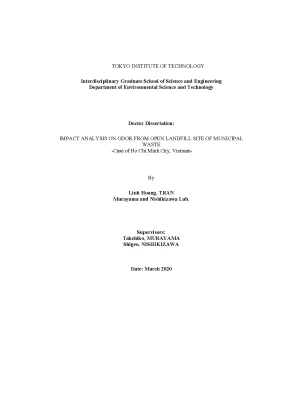
Tải xuống để đọc toàn bộTOKYO INSTITUTE OF TECHNOLOGY Interdisciplinary Graduate School of Science and Engineering Department of Environmental Science and Technology Doctor Dissertation: IMPACT ANALYSIS ON ODOR FROM OPEN LANDFILL SITE OF MUNICIPAL WASTE -Case of Ho Chi Minh City, Vietnam- By Linh Hoang, TRAN Murayama and Nishikizawa Lab. Supervisors: Takehiko, MURAYAMA Shigeo, NISHIKIZAWA Date: March 2020 ABSTRACT Airborne pollutants and odor emissions generated from landfill operations can adversely affect human health and social well-being. Consequently, these pollutants and emissions must be controlled and regulated. The dispersion of odors in the areas surrounding landfills can create public complaints regarding air quality and can increase social tension.
The distance effect from waste treatment facility on perception of odor and annoyance were examined in various approaches (e. using panelist in field survey or residents who live in the study area) however previous researches did not focus on the maximum distance of perceived odor or odor irritation reported by the community surrounding MSW management facilities. This issue was conducted in this study with a distance of 10.2 km from the landfill site. The purpose of this study was to explore the odor impact from a landfill on neighboring areas by measuring odor concentration and conducting a community survey.
The results indicated that odor impact affected not only residents living close to the landfill site but also those living more than 7 km from the site. Particularly, residents living more than 7 km felt more annoyance of odors than other areas and they tended to poorly evaluate landfill management since people 's attitudes toward landfill operation are strongly influenced their perception of odor. The main factor influencing this perception is wind direction. Additionally, four principal components have been obtained by using factor analysis.
They are identified as “nuisance,” “attitudes towards MSW treatment facility,” “reactions to deal with odor impact,” and “perception of odor intensity.” Finally, the results showed odor concentration in area 1 was higher than the acceptance level 7 times and the level of odor concentration and people 's perception of odor varied by geography. This suggests that social demographics such as education and high income are important in terms of odor perception. Because differences of demographics and lifestyle may generate changes of reactions to environmental odors except at very high or very low concentrations. This research is the first attempt to explore the impact of odor from a landfill site in Ho Chi Minh City, Vietnam.
Findings suggest that the necessity of developing a policy of odor management in Vietnam context based on Japanese Offensive Odor Control Law to regulate offensive odor emission from business activities for the protection of the living environment and human health. ii ACKNOWLEDGEMENTS I would like to express my deep gratitude to my supervisors, Prof. Takehiko Murayama and Prof. Shigeo Nishikizawa, for their dedicated support of my study.
This doctoral thesis would not be completed without them. Their patience, guidance, and motivation helped me to overcome many obstacles and finish my thesis timely. I do appreciate all the things they have done for me before and so far. I also appreciate financial supports via AUN/SEED.Net for their educational and financial support in my study.
The support really helped me to concentrate in my study without worrying about my financial while gaining invaluable skills from the program. Many thanks to Environmental Control Center Technology Co., Ltd for their support of equipment. Special thanks to Dr. Yukiko Iida for introducing me to that center.
Grateful thanks to my lab-mate, friend for providing me with good information and that helped me to accomplish this research. I would like to thank my parents for supporting me spiritually throughout the course of writing thesis. iii TABLE OF CONTENTS Table of Contents ABSTRACT. iii TABLE OF CONTENTS.
iv LIST OF TABLES. vi LIST OF FIGURES. vii Chapter 1 Introduction .1 Background of study.3 Objectives of the study .1 History and current status of MSW treatment facility in Ho Chi Minh .1 History of MSW treatment facility .2 Current status of MSW treatment facility .2 Overview of Da Phuoc MSW management facility and their environmental complaints .1 Characteristics of MSW management facility .2 Odor impact from MSW management facility .2 Case study selection .4 Background of case study.2 Da Phuoc commune .3 Nhon Duc commune .4 Phuoc Kien commune, Nha Be district .5 Phu My Hung urban area. 17 iv Chapter 3 Perception of Odor Impact from an Open Landfill Site in Ho Chi Minh City .1 Objectives of the study .3 Data collection and analysis .4 Results and discussion .3 Annoyance of Daily Life and Human Health Effects .4 Odor Reactions and Attitudes toward MSW Management Facility .5 Relationships between the Cause – Impact Structure.5 Summary of this chapter.
37 Chapter 4 Physical Condition of Odor from Open Landfill Site in Ho Chi Minh City .1 Objectives of the study .2 Climate condition of survey area .3 Data collection and processing. Results and discussion .2 Summary of community survey results .3 Comparison between physical condition of odor measurement and community survey results. Summary of this chapter. 51 Appendix A Questionnaire survey for 2018.
58 v LIST OF TABLES Table 1. MSW management facilities in HCMC. 8 Table 2 Waste composition of Da Phuoc landfill (Source: HCMC Department of Natural Resources and Environment (DONRE). 10 Table 3 Odor complaints from residents living in district 7 (DONRE, 2016).
11 Table 4 Odor reactions. 27 Table 5 Attitude towards MSW management facility. 27 Table 6 Component loadings of concerned items by factor analysis (N=197). 31 Table 7 Results of reliability analysis for 1st component.
32 Table 8 Results of reliability analysis for 2nd component. 33 Table 9 Results of reliability analysis for 3rd component. 33 Table 10 Results of reliability analysis for 4th component. 33 Table 11 Results of odor perception by studied area (source: field survey 2018).
44 Table 12 Results of community survey by studied area (source: field survey 2018). 45 vi LIST OF FIGURES Figure 1 Da Phuoc Solid Waste Management Facility (Source: Google map). 9 Figure 2 Research framework. 13 Figure 3 Windrose of survey location for 2018 (Source: https://www.com/windstatistics/ho-chi-minh-city-tan-son-nhat).
14 Figure 4 Location of study area. 15 Figure 5 Survey location (Source: Google map). 18 Figure 6 Questionnaire interview (Source: field survey 2018). 19 Figure 7 Hypothetical diagram of cause–impact structure.
20 Figure 8 Odor perception: time of the year odors become worse by distance, odor frequency by distance, factor affects odor emission by distance (Source: compile from field survey 2018). 23 Figure 9 Daily life concerns (Source: compile from field survey 2018). 25 Figure 10 Odor concern by distance (Source: compile from field survey 2018). 26 Figure 11 The relationship between questionnaire parts.
28 Figure 12 Relationship between odor frequency and residents’ annoyance of daily activity (a), odor frequency and residents’ concerns (b), residents’ concerns and residents’ annoyance (c), and relationship between residents’ annoyance of daily activity and rating of landfill (d) (Source: compile from field survey 2018). 31 Figure 13 The standard error of REGR factor scores: a) nuisance and attitude; b) nuisance and action; c) nuisance and perception; d) action and perception by distance (Source: compile from field survey 2018). 36 Figure 14 Windrose plot for study area in 2019: a) From January to March; b) From April to June; c) From July to September; d) From October to December. 38 Figure 15 Field Survey location (Source: google map).
39 Figure 16 a) Odor concentration; b) Windrose plot for area 1 of Sep 20, 2019 (source: prepared from field survey 2019). 41 Figure 17 a) Odor concentration; b) Windrose plot for area 2 of Sep 16, 2019 (source: prepared from field survey 2019). 42 Figure 18 a) Odor concentration; b) Windrose plot for area 3 of Sep 17, 2019 (source: prepared from field survey 2019). 43 Figure 19 Odor concentration in each area ((source: field survey 2019).
43 vii Figure 20 Period of time odor perceived (source: field survey 2018). 44 Figure 21 Comparison between odor concentration and odor annoyance (source: field survey 2018 and 2019). 46 Figure 22 Odor annoyance by education background. 47 Figure 23 Odor annoyance by years of living in current.
47 viii Chapter 1 Introduction This chapter introduces the background of this study. It presents the overview of odor impact from MSW management facility, environmental problems of MSW treatment centers in Ho Chi Minh City, Vietnam. Literature review of odor impacts and the effect of distance on odor annoyance are described in this chapter. It also presents the purpose of this study.1 Background of study Municipal solid waste (MSW) management centers have an adverse impact on the environment (El-Fadel et al., 1997; Lisk, 1991; Rabl et al.
They contaminate the environment in two main ways: (i) contaminated gas and metals seep into the air, water, and soil from the degradation and treatment of wastes; (ii) garbage disposal causes many problems like noise, litter, dust, vermin, odor, and damage to productive agriculture and historic sites. Therefore, evaluating the influence of MSW management on the environment is a critical task. This task is challenging as many factors such as odor dispersion on nearby landscape, meteorology, and atmosphere, the residence size and educational level of the residents, and weather per season need to be considered. Gas emissions from the MSW, such as bacteria, odor, and particles, can significantly disturb the neighboring inhabitants.
Odors have always been a social problem, but there have been public concerns recently about their potential health and wellbeing impacts. This has resulted in public opinion concern about air quality problems and complaints to municipal authorities (Brancher et al., 2019) that the key sources of complaints are waste treatment plants and farming (Keck et al., 2018; Sironi et al., 2005) to local authorities (Brancher et al. Annoyance of odors emission by waste plants (e., waste settlements and composition sites) and by animal processing activities (Blanco-Rodríguez et al., 2018) is one of the key causes of concerns among those who live near these sites (Keck et al., 2018), and has brought an increased focus on regulating the effects of air contaminants in nearby regions (Hayes et al. , 2014; Bibbiani and Russo, 2012).
Unpleasant smells may cause a variety of emotional and unwanted reactions from annoyance to reported medical consequences which result in lower quality of life (Blanes-Vidal et al., 2012; Domingo & Nadal, 2009; Palmiotto et al. Hence, researches on the odor effect of MSW centers were carried out in many territories, such as the US, Europe, Japan, and Korea. Qualitative evaluation of the odor effects on residences is often performed (Sarkar & Hobbs, 2002; Sarkar et al., 2003) by using survey questionnaires to give a standardized assessment (Hayes et al. Recently, some surveys targeted three critical points, including the odor effect on health, wellbeing, and how the odor effects are influenced by residents’ recognition.
However, such studies have not been conducted intensively in Ho Chi Minh City (HCMC), Vietnam, where the waste degradation is much faster and has a more significant impact on the environment due to the tropical weather. HCMC is the biggest city in southern Vietnam in terms of population and economy. The population of HCMC was estimated at 8.83 million people in 2018, and it has an area of 2,061. In 2016, HCMC citizens generated 8,175 tons of waste solid per day, including 6,700-7,000 tons of municipal solid waste (MSW) at a rate of 1.02 kg/capita/day (Verma et al.
The amount of MSW in HCMC has been increasing at a rate of approximately 5-6% per year (DONRE, 2018). MSW mainly came from households, schools, hotels, and restaurants. Landfills are the conventional treatment for MSW in HCMC. There are two main landfill sites in HCMC: Da Phuoc and Phuoc Hiep.
Around 86% of solid waste is landfilled in these two sites, and the remaining 14% is recycled.
Nội dung được bảo vệ bản quyền — Tải xuống đầy đủ
Trích dẫn luận án này
Tran Linh Hoang (2020). Luận án tiến sĩ khoa học và công nghệ môi trường impact anal [Luận án tiến sĩ, Tokyo Institute of Technology]. LuanAn.net. https://luanan.net/khoa-hoc-trai-dat-moi-truong/waste
Câu hỏi thường gặp
Luận án "Luận án tiến sĩ khoa học và công nghệ môi trường impact anal" nghiên cứu về vấn đề gì?
Luận án tiến sĩ khoa học công nghệ môi trường phân tích tác động môi trường. Đề xuất giải pháp giảm thiểu ô nhiễm hiệu quả.
Luận án "Luận án tiến sĩ khoa học và công nghệ môi trường impact anal" được bảo vệ tại trường nào?
Luận án này được bảo vệ tại Tokyo Institute of Technology. Năm bảo vệ: 2020.
Luận án "Luận án tiến sĩ khoa học và công nghệ môi trường impact anal" thuộc chuyên ngành gì?
Luận án "Luận án tiến sĩ khoa học và công nghệ môi trường impact anal" thuộc chuyên ngành Environmental Science and Technology. Danh mục: Khoa Học Trái Đất & Môi Trường.
Luận án "Luận án tiến sĩ khoa học và công nghệ môi trường impact anal" có bao nhiêu trang?
Luận án "Luận án tiến sĩ khoa học và công nghệ môi trường impact anal" có 70 trang. Bạn có thể xem trước một phần tài liệu ngay trên trang web trước khi tải về.
Cách tải luận án "Luận án tiến sĩ khoa học và công nghệ môi trường impact anal" về máy như thế nào?
Để tải luận án về máy, bạn nhấn nút "Tải xuống ngay" trên trang này, sau đó hoàn tất thanh toán phí lưu trữ. File sẽ được tải xuống ngay sau khi thanh toán thành công. Hỗ trợ qua Zalo: 0559 297 239.