Chương Trình Giảm Ngã Cho Người Cao Tuổi: Tập Thể Dục và Kiểm Tra An Toàn Nhà Ở
Phòng ngừa ngã cho người cao tuổi: Bí quyết tập thể dục đúng cách và tạo môi trường nhà ở an toàn để duy trì sức khỏe, độc lập.
Luan An
Luận án tiến sĩ
Năm xuất bản
Số trang
90
Thời gian đọc
14 phút
Lượt xem
0
Lượt tải
0
Phí lưu trữ
40 Point
Tổng quan nhanh
- Chủ đề:
- Giảm Ngã Người Cao Tuổi: Khẩn Cấp & Giải Pháp Chương Trình
- Số trang:
- 90 trang
- Trường:
- Walden University
- Chuyên ngành:
- Điều dưỡng (Nursing)
- Tác giả:
- Alie Theresa Massicot-Gray
- Năm:
- 2020
Tóm tắt nội dung luận án
I.Giảm Ngã Người Cao Tuổi Khẩn Cấp Giải Pháp Chương Trình
Té ngã là vấn đề sức khỏe nghiêm trọng ở người cao tuổi (OAs), bắt đầu từ tuổi 65. Thiếu kiến thức về nguyên nhân, biến chứng và các biện pháp can thiệp té ngã làm tăng đáng kể tỷ lệ té ngã cùng các chấn thương liên quan. Các chấn thương này ảnh hưởng trực tiếp đến chất lượng cuộc sống, khả năng độc lập của người già. Tỷ lệ té ngã cao gây gánh nặng cho hệ thống chăm sóc sức khỏe. Một dự án đã được phát triển nhằm mục đích giảm ngã ở người cao tuổi. Dự án tập trung nâng cao nhận thức về phòng ngừa té ngã người cao tuổi. Chương trình này giúp giảm số lần té ngã tại một trung tâm cộng đồng người cao tuổi. Đây là bước đi quan trọng trong việc cải thiện sức khỏe cộng đồng.
1.1. Thực trạng té ngã ở người cao tuổi
Té ngã là nguyên nhân hàng đầu gây thương tích và tử vong do chấn thương ở người lớn tuổi. Mỗi năm, hàng triệu người cao tuổi té ngã. Nhiều người trong số họ phải nhập viện vì chấn thương đầu hoặc gãy xương. Các chấn thương này thường nghiêm trọng, cần thời gian hồi phục dài. Sự sợ hãi té ngã cũng hạn chế hoạt động của người cao tuổi. Điều này dẫn đến suy giảm thể chất, cô lập xã hội. Việc thiếu giáo dục về phòng ngừa té ngã ở người cao tuổi góp phần vào thực trạng đáng lo ngại này. Cần có giải pháp toàn diện để giải quyết vấn đề nguyên nhân té ngã ở người cao tuổi.
1.2. Mục tiêu dự án giảm ngã
Mục đích chính của dự án là phát triển một chương trình phòng ngừa té ngã. Chương trình này bao gồm các thành phần từ thuật toán "Stopping Elderly Accidents Deaths & Injuries" (STEADI). Mục tiêu là tăng cường nhận thức về phòng ngừa té ngã. Dự án cũng hướng đến việc giảm số lượng té ngã ở người cao tuổi. Một câu hỏi thực hành đã được đặt ra: liệu việc giới thiệu chương trình phòng ngừa té ngã tập trung vào tập thể dục và kiểm tra an toàn nhà ở có thể giảm tỷ lệ té ngã hay không. Dự án tìm kiếm câu trả lời dựa trên bằng chứng thực tiễn.
II.Tập Thể Dục Kiểm Tra An Toàn Nhà Ở Giảm Nguy Cơ Ngã
Chương trình phòng ngừa té ngã được thiết kế với hai trụ cột chính: tập thể dục và kiểm tra an toàn nhà ở. Các thành phần này được coi là những can thiệp hiệu quả nhất. Tập thể dục giúp tăng cường sức mạnh cơ bắp, cải thiện khả năng giữ thăng bằng. Kiểm tra an toàn nhà ở giúp xác định và loại bỏ các mối nguy hiểm tiềm ẩn. Sự kết hợp này mang lại hiệu quả tổng thể trong việc giảm nguy cơ té ngã tại nhà. Người cao tuổi được trang bị kiến thức và kỹ năng cần thiết. Điều này giúp họ sống độc lập, an toàn hơn trong môi trường của mình.
2.1. Lợi ích tập thể dục tăng cường sức mạnh
Các bài tập giữ thăng bằng cho người già là yếu tố cốt lõi của chương trình. Chúng bao gồm các bài tập tăng cường sức mạnh, sự linh hoạt. Các bài tập này cải thiện đáng kể khả năng giữ thăng bằng, phản xạ của cơ thể. Tập thể dục thường xuyên giúp củng cố sức khỏe xương khớp người cao tuổi. Điều này làm giảm nguy cơ gãy xương khi té ngã. Các hoạt động như đi bộ, thái cực quyền, yoga nhẹ nhàng rất được khuyến khích. Vật lý trị liệu phòng ngừa ngã cũng đóng vai trò quan trọng. Nó giúp cá nhân hóa các bài tập phù hợp với từng người.
2.2. Đánh giá và cải thiện an toàn nhà ở
Môi trường sống an toàn là yếu tố then chốt để giảm nguy cơ té ngã. Chương trình bao gồm việc kiểm tra chi tiết các khu vực trong nhà. Các mối nguy hiểm như thảm trượt, dây điện chằng chịt, ánh sáng kém được xác định. Sau đó, các biện pháp cải thiện môi trường sống an toàn được đề xuất. Ví dụ, lắp đặt tay vịn trong phòng tắm, hành lang. Đảm bảo đủ ánh sáng ở mọi khu vực. Dọn dẹp lối đi gọn gàng. An toàn nhà ở cho người lớn tuổi cần được ưu tiên hàng đầu.
2.3. Thiết bị hỗ trợ người già chống ngã
Sử dụng thiết bị hỗ trợ là một phần quan trọng của an toàn nhà ở cho người lớn tuổi. Gậy, khung tập đi giúp người cao tuổi di chuyển ổn định hơn. Các loại giày dép có độ bám tốt cũng góp phần giảm trượt ngã. Lắp đặt ghế nâng trong bồn tắm hoặc nhà vệ sinh. Các cảm biến té ngã cũng có thể được cân nhắc. Những thiết bị hỗ trợ người già chống ngã này không chỉ phòng ngừa té ngã người cao tuổi mà còn tăng cường sự tự tin, độc lập cho họ.
III.Xây Dựng Chương Trình Phòng Ngừa Té Ngã Hiệu Quả
Việc xây dựng chương trình phòng ngừa té ngã đòi hỏi nền tảng lý thuyết vững chắc. Dự án này được định hướng bởi hai mô hình chính: Mô hình Thích ứng của Roy và Mô hình Niềm tin Sức khỏe. Các mô hình này cung cấp khung lý thuyết cho việc hiểu và can thiệp hành vi sức khỏe. Chúng giúp xác định các yếu tố ảnh hưởng đến sự sẵn lòng tham gia của người cao tuổi. Nguồn bằng chứng được thu thập từ cơ sở dữ liệu của Đại học Walden và trang web của Trung tâm Kiểm soát và Phòng ngừa Dịch bệnh (CDC). Điều này đảm bảo tính khoa học, đáng tin cậy của chương trình.
3.1. Các mô hình lý thuyết định hướng dự án
Mô hình Thích ứng của Roy tập trung vào khả năng thích ứng của cá nhân trước các yếu tố gây căng thẳng. Nó cung cấp một cách tiếp cận để hiểu cách người cao tuổi ứng phó với nguy cơ té ngã. Mô hình này giúp thiết kế các can thiệp hỗ trợ sự thích ứng tích cực. Mô hình Niềm tin Sức khỏe giải thích hành vi sức khỏe dựa trên nhận thức về mối đe dọa. Nó đánh giá lợi ích và rào cản của việc tham gia chương trình. Cả hai mô hình đều hỗ trợ việc phát triển chương trình. Chúng giúp tăng cường nhận thức và thay đổi hành vi để phòng ngừa té ngã người cao tuổi.
3.2. Phương pháp triển khai và thu thập dữ liệu
Chương trình được triển khai dưới dạng một buổi hội thảo giáo dục kéo dài 1 giờ. Thiết kế nghiên cứu sử dụng phương pháp tiền kiểm và hậu kiểm. Dữ liệu được thu thập từ 30 người cao tuổi tham gia. Dữ liệu là kết quả của Bảng câu hỏi Tự đánh giá Rủi ro té ngã 12 mục. Thông tin cá nhân được ẩn danh để bảo mật. Việc thu thập dữ liệu trước và sau can thiệp cho phép đánh giá hiệu quả của chương trình. Điều này cung cấp bằng chứng cụ thể về khả năng giảm nguy cơ té ngã tại nhà.
IV.Kết Quả Giảm Ngã Người Cao Tuổi Minh Chứng Thực Tiễn
Các kết quả của dự án đã được phân tích bằng thống kê mô tả. Dữ liệu cho thấy sự thay đổi rõ rệt về tỷ lệ té ngã. Điều này chứng minh hiệu quả của chương trình can thiệp. Việc giới thiệu chương trình tập thể dục và kiểm tra an toàn nhà ở mang lại kết quả tích cực. Nó cung cấp bằng chứng thực tiễn về khả năng giảm nguy cơ té ngã tại nhà. Đây là thông tin quan trọng cho các nhà hoạch định chính sách và trung tâm cộng đồng. Các kết quả này hỗ trợ việc áp dụng các biện pháp phòng ngừa té ngã người cao tuổi dựa trên bằng chứng.
4.1. Dữ liệu chứng minh hiệu quả chương trình
Trước khi thực hiện chương trình, có 15 trường hợp té ngã được ghi nhận trong một năm. Sau khi tham gia chương trình phòng ngừa té ngã, chỉ có 2 trường hợp té ngã xảy ra trong tháng tiếp theo. Sự giảm đáng kể này chỉ ra một xu hướng tích cực. Chương trình tập trung vào bài tập giữ thăng bằng cho người già và an toàn nhà ở đã cho thấy hiệu quả rõ rệt. Dữ liệu này khẳng định tầm quan trọng của giáo dục và can thiệp kịp thời để giảm nguy cơ té ngã tại nhà.
4.2. Xu hướng giảm tỷ lệ té ngã bền vững
Mặc dù kết quả ban đầu rất khả quan, việc tiếp tục theo dõi tỷ lệ té ngã trong năm tiếp theo là cần thiết. Điều này sẽ xác định hiệu quả lâu dài của chương trình giáo dục. Mục tiêu là duy trì xu hướng giảm té ngã. Đồng thời, cần đánh giá khả năng duy trì các hành vi an toàn. Việc này giúp củng cố thói quen phòng ngừa té ngã người cao tuổi. Nó cũng góp phần vào sức khỏe xương khớp người cao tuổi và chất lượng cuộc sống chung.
V.Tác Động Xã Hội Nâng Cao Chất Lượng Sống Người Cao Tuổi
Dự án này mang lại những ý nghĩa quan trọng đối với sự thay đổi xã hội. Đặc biệt, nó cung cấp một mô hình cho các trung tâm cộng đồng người cao tuổi. Các trung tâm này có thể áp dụng một chương trình phòng ngừa té ngã dựa trên bằng chứng. Việc này không chỉ giảm tỷ lệ té ngã mà còn nâng cao chất lượng cuộc sống cho người cao tuổi. Việc cải thiện môi trường sống an toàn và khuyến khích tập thể dục là chìa khóa. Cộng đồng có trách nhiệm hỗ trợ người cao tuổi duy trì sức khỏe, độc lập.
5.1. Khuyến nghị cho trung tâm cộng đồng
Các trung tâm cộng đồng nên xem xét việc triển khai các chương trình tương tự. Chương trình cần bao gồm cả yếu tố tập thể dục và kiểm tra an toàn nhà ở. Việc cung cấp giáo dục liên tục là điều cần thiết. Điều này giúp nâng cao nhận thức về phòng ngừa té ngã người cao tuổi. Các trung tâm có thể hợp tác với các chuyên gia y tế, vật lý trị liệu phòng ngừa ngã. Từ đó, xây dựng các bài tập giữ thăng bằng cho người già phù hợp.
5.2. Nâng cao chất lượng cuộc sống cho người già
Giảm nguy cơ té ngã tại nhà là yếu tố then chốt. Nó giúp người cao tuổi duy trì sự tự tin, độc lập. Họ có thể tham gia vào các hoạt động xã hội, thể chất một cách an toàn. Điều này góp phần cải thiện sức khỏe tinh thần và thể chất tổng thể. Một môi trường an toàn, cùng với việc duy trì hoạt động thể chất, hỗ trợ sức khỏe xương khớp người cao tuổi. Nó cho phép họ tận hưởng cuộc sống trọn vẹn hơn.
Tải xuống file đầy đủ để xem toàn bộ nội dung
Tải đầy đủ (90 trang)Trích đoạn nội dung luận án
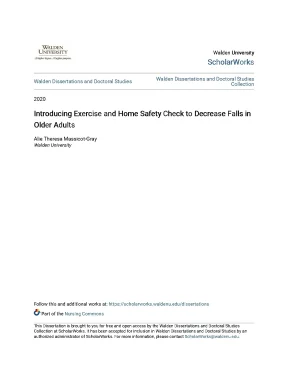
Tải xuống để đọc toàn bộWalden University ScholarWorks Walden Dissertations and Doctoral Studies Walden Dissertations and Doctoral Studies Collection 2020 Introducing Exercise and Home Safety Check to Decrease Falls in Older Adults Alie Theresa Massicot-Gray Walden University Follow this and additional works at: https://scholarworks.edu/dissertations Part of the Nursing Commons This Dissertation is brought to you for free and open access by the Walden Dissertations and Doctoral Studies Collection at ScholarWorks. It has been accepted for inclusion in Walden Dissertations and Doctoral Studies by an authorized administrator of ScholarWorks. For more information, please contact ScholarWorks@waldenu. Walden University College of Health Sciences This is to certify that the doctoral study by Alie Massicot-Gray has been found to be complete and satisfactory in all respects, and that any and all revisions required by the review committee have been made.
Review Committee Dr. Mary Verklan, Committee Chairperson, Nursing Faculty Dr. Margaret Harvey, Committee Member, Nursing Faculty Dr. Sue Bell, University Reviewer, Nursing Faculty Chief Academic Officer and Provost Sue Subocz, Ph.
Walden University 2020 Abstract Introducing Exercise and Home Safety Check to Decrease Falls in Older Adults by Alie Massicot-Gray MS, SUNY Downstate Medical Center, 2010 BS, CUNY - Medgar Evers College, 2006 Project Submitted in Partial Fulfillment of the Requirements for the Degree of Doctor of Nursing Practice Walden University November 2020 Abstract The lack of education related to causes of, complications from, and interventions for falls is associated with the high rate of falls and fall-related injuries in older adults (OAs) beginning at age 65. The purpose of this project was to develop a fall prevention program that included components of the Stopping Elderly Accidents Deaths & Injuries Algorithm to increase fall prevention awareness and reduce falls in OAs at one community senior center. The project practice question asked whether introducing a fall prevention program that focused on exercise and home safety checks to educate OAs could decrease the rate of falls. The development of the fall prevention program was guided by the Roy Adaptation Model and The Health Belief Model.
The sources of evidence were acquired from the Walden University databases and the Centers for Disease Control and Prevention website. The education workshop was held for 1-hour. The pretest and posttest design utilized the Fall Risk Self-Assessment 12-Item Questionnaire results for de-identified data collection from 30 OAs. The project results, analyzed using descriptive statistics, found that there were only 2 occurrences in the month following the fall prevention program, a decrease from 15 for the year before the program.
Results showed that a fall prevention program focused on exercise and a home safety check demonstrated a trend in decreasing the rate of falls. Continuing to monitor the fall rate over the next year will determine the long-term effectiveness of the educational program. The social change implications are for community senior centers to provide an evidence-based fall prevention program that decreases the rate of falls in OAs to enhance their quality of life. Introducing Exercise and Home Safety Check to Decrease Falls in Older Adults by Alie Massicot-Gray MS, SUNY Downstate Medical Center, 2010 BS, CUNY - Medgar Evers College, 2006 Project Submitted in Partial Fulfillment of the Requirements for the Degree of Doctor of Nursing Practice Walden University November 2020 Dedication I dedicate this quality improvement project to all my lovely grandparents and great-grandmother, who inspired me to seek a quality of life for older adults.
Acknowledgments I would like to acknowledge the entire staff of Walden University who supported me throughout my journey as a DNP student. My special thanks to my dedicated Chair, Dr. Verklan, for continuous guidance, support, and inspiration to complete my project. I would also like to thank my preceptor and the entire staff at the project site for accommodating me during my practicum rotations.
I would like to thank my husband, Dwight Gray, for believing in me and providing all the love and support that I needed to succeed. I am grateful to my children and my grandchildren, whom I drew strength from to complete my ultimate educational journey. Table of Contents List of Tables .iv List of Figures .v Section 1: Nature of the Project .3 Nature of the Doctoral Project .7 Section 2: Background and Context .9 Concepts, Models, and Theory .9 Relevance to Nursing Practice .14 Local Background and Context.15 Role of the DNP Student.16 Role of the Project Team .18 Section 3: Collection and Analysis of Evidence .20 Practice-Focused Question.21 i Sources of Evidence.21 Review of Findings. 38 Analysis and Synthesis .40 Section 4: Findings and Recommendations .42 Findings and Implications.
44 Data Outcome Report. 44 Implementation of the STEADI program. 46 Rate of Falls Post-Implementation. 49 Comparison of Pre and Post Test Scores.
54 ii Contribution of the Doctoral Project Team .54 Strengths and Limitations of the Project.59 Section 5: Dissemination Plan .61 Analysis of Self. 62 As the Practitioner. 63 As the Scholar .68 Appendix A: Fall Risk Self-Assessment Tool .75 Appendix B: Home Safety Check.77 Appendix D: Actions to Prevent Falls .78 iii List of Tables Table 1. Fall Risk Self-Assessment Tool: Rate of Falls Pre-Implementation.
Fall Risk Self-Assessment Tool: Rate of Falls Post-Implementation.50 iv List of Figures Figure 1. Fall prevention procedure. Rate of falls pre and post implementation .51 v 1 Section 1: Nature of the Project Introduction According to the Centers for Disease Control and Prevention (CDC, 2017a), a substantial number of older adults (OAs) began to experience falls beginning at 65 years of age in the United States, and lower than 50% disclosed the incident to their primary care physician. Only 1 out of 4 OAs reported falls, and 1 out of 5 falls resulted in hip and head injuries, with a reported death every 20 minutes due to injuries related to the fall (CDC, 2017a).
During the aging process, adaptation to physiological changes occurs and becomes a challenge that leads to physical decline (McEwen & Wills, 2014). The New York City Hospitals have provided emergent care to at least 21,000 OAs, with 16,000 admissions related to falls annually (New York City Department of Health and Mental Hygiene [NYCDOHMH], 2015). Older adults who have not gained the awareness of a home safety check or understand the impact of daily exercise have been at risk for falling and face deterioration in their health. Falls in older adults lead to fear of further falls, weakness, and inability to complete daily tasks (CDC, 2017a).
The nature of the DNP project was to develop a fall prevention program to educate OAs at a community-based senior center. In this section, I discuss the problem statement, purpose, nature of the doctoral project, and the significance. Problem Statement Falls have been a major public health crisis among community-residing OAs and have a detrimental impact on their health. The primary cause of disability and death in 2 OAs have been due to fall-related injuries (CDC, 2017a).
At a community-based senior center, I assessed a substantial number of OAs with gait-balance issues who required assistive devices such as walkers, canes, and wheelchairs to assist with ambulation. Some of the OAs were witnessed to experience falls and near-missed falls due to a severe gait- balance problem. The community-senior center did not have available data on the rate of falls for the OAs at the center because the issue of falls has never been addressed. Recent data were collected on 30 OAs at the center to identify their risk factors for falls.
About 50% of the OAs were at moderate risk of falls, whereas the other 50% had an elevated risk for falls. The organization did not have any program in place to prevent falls for OAs. Their risk factors included prior falls, gait-balance impairments, and environmental hazards within their home (Marcum, Caffarelli, & Seil, 2014). Because OAs who have fallen are often fearful of further falls, they may decrease their daily activities, which leads to progressive physical weakness and further falls (CDC, 2017a).
A community-based senior center was an appropriate place to conduct a fall prevention program because the OAs spend most of their time at the center. Exercise and a home safety check have significantly reduced falls and maintain the quality of life (QOL) for OAs. The direct annual medical cost used to treat fall-related injuries has been $31 billion (CDC, 2017a). Because falls have persisted in OAs, the direct medical cost could increase to $54 billion by 2020 (A.
Increased senior center involvement in fall prevention measures could reduce health care spending and 3 decrease injuries related to falls. New York City has 250 senior centers and has been providing programs and services for over 29,680 OAs daily (Stringer, 2017). Purpose As an advanced practice nurse (APN), I have embarked on relevant research findings to create a quality improvement project (QIP) that could effectively decrease falls in OAs. The goal of the doctoral project was to implement components of the Stopping Elderly Accidents, Deaths & Injuries (STEADI) algorithm to reduce falls in OAs at one community senior center.
The STEADI is an excellent tool used by the CDC (2017a) specifically to reduce falls in OAs and could be used by senior centers for all their members. The STEADI program allowed the senior center to identify their members who were at risk for falls and implement evidence-based practice (EBP) interventions to prevent falls. I assessed the OAs’ rate of falls pre- and post-implementation of the monthly use of the STEADI program to determine if the rate of falls was reduced. The senior center provided an opportunity for me to determine the rate of falls in 30 OAs before deciding the implementation of the STEADI program.
The outcome that this project was expected to provide was an opportunity for the senior center to decrease the rate of falls for its members and maintain their QOL. Nature of the Doctoral Project A QIP was implemented to address the incidences of falls in OAs. Public health agencies, such as community senior centers, who have been providing EBP activities, should become engaged in actions that prevent falls and complicated injuries in OAs. The 4 goal of the QIP project was to improve the incidence of fall rates in OAs at a senior center.
A fall prevention program was developed using a before-and-after design with components of the STEADI algorithm. The components of the STEADI program that were used included the delivery of a fall prevention class that focused on exercise and a home safety check. The OAs were given a validated Fall Risk Self-Assessment (FRSA) checklist used in the STEADI algorithm by the CDC that was developed by the VA Greater Los Angeles Healthcare System Geriatric Research Education & Clinical Center (GRECC) and Affiliates (CDC, 2017a). The FRSA checklist was used as a screening tool and contained a 12-item questionnaire that obtains information related to the OAs’ risk for falls.
The questionnaire provided a total possible score of 14 points; however, OAs who scored 4 points or over were considered at risk for falling. Because the tool was used as a pre-score analysis of the OAs’ risk for falls, it also determined which OAs would be included in the fall prevention program. The OAs were given brochures to take home to provide reinforcement on the education provided. The OAs were reevaluated within 30 days to determine the effectiveness of the program.
They completed the 12-item questionnaire that collected data on the post-score analysis of the OAs’ risk for falls. The OAs who experienced falls within the past 30 days were reevaluated and encouraged to continue in the fall prevention program. The project generated a better understanding of the incidence of falls in OAs and how exercise and a home safety check provided a positive impact. The data were analyzed by relying on comparative descriptive statistics 5 to compare the pre-fall data and the post-fall data.
Descriptive statistics provided an opportunity to gain new information to better explain a phenomenon (Grove, Burns, & Gray, 2013).
Nội dung được bảo vệ bản quyền — Tải xuống đầy đủ
Trích dẫn luận án này
Alie Theresa Massicot-Gray (2020). Giảm Ngã Ở Người Cao Tuổi: Tập Thể Dục & An Toàn Nhà Ở [Luận án tiến sĩ, Walden University]. LuanAn.net. https://luanan.net/khoa-hoc-suc-khoe/dieu-duong/giam-nga-nguoi-cao-tuoi-tap-the-duc-an-toan-nha-o
Câu hỏi thường gặp
Luận án "Giảm Ngã Ở Người Cao Tuổi: Tập Thể Dục & An Toàn Nhà Ở" nghiên cứu về vấn đề gì?
Phòng ngừa ngã cho người cao tuổi: Bí quyết tập thể dục đúng cách và tạo môi trường nhà ở an toàn để duy trì sức khỏe, độc lập.
Luận án "Giảm Ngã Ở Người Cao Tuổi: Tập Thể Dục & An Toàn Nhà Ở" được bảo vệ tại trường nào?
Luận án này được bảo vệ tại Walden University. Năm bảo vệ: 2020.
Luận án "Giảm Ngã Ở Người Cao Tuổi: Tập Thể Dục & An Toàn Nhà Ở" thuộc chuyên ngành gì?
Luận án "Giảm Ngã Ở Người Cao Tuổi: Tập Thể Dục & An Toàn Nhà Ở" thuộc chuyên ngành Điều dưỡng (Nursing). Danh mục: Điều Dưỡng.
Luận án "Giảm Ngã Ở Người Cao Tuổi: Tập Thể Dục & An Toàn Nhà Ở" có bao nhiêu trang?
Luận án "Giảm Ngã Ở Người Cao Tuổi: Tập Thể Dục & An Toàn Nhà Ở" có 90 trang. Bạn có thể xem trước một phần tài liệu ngay trên trang web trước khi tải về.
Cách tải luận án "Giảm Ngã Ở Người Cao Tuổi: Tập Thể Dục & An Toàn Nhà Ở" về máy như thế nào?
Để tải luận án về máy, bạn nhấn nút "Tải xuống ngay" trên trang này, sau đó hoàn tất thanh toán phí lưu trữ. File sẽ được tải xuống ngay sau khi thanh toán thành công. Hỗ trợ qua Zalo: 0559 297 239.