Sumner Welles: Vai trò của Ủy viên Hoa Kỳ tại Cộng hòa Dominica và Chính sách Vùng Caribe
Thesis 1976 d853s: Luận văn lịch sử và phân tích chuyên sâu về chủ đề khoa học xã hội và nhân văn. Khám phá các khía cạnh quan trọng.
Master of Arts
Luan An
Luận văn thạc sĩ
Năm xuất bản
Số trang
133
Thời gian đọc
20 phút
Lượt xem
0
Lượt tải
0
Phí lưu trữ
40 Point
Tổng quan nhanh
- Chủ đề:
- Luận văn 1976: Vai trò Sumner Welles tại Dominica
- Số trang:
- 133 trang
- Trường:
- Oklahoma State University
- Chuyên ngành:
- Master of Arts
- Tác giả:
- Gerald Frank Duerr II
- Năm:
- 1976
Tóm tắt nội dung luận án
I.Luận văn 1976 Vai trò Sumner Welles tại Dominica
Luận văn 1976 này phân tích vai trò của Sumner Welles. Nghiên cứu tập trung vào sự kết thúc chiếm đóng Cộng hòa Dominica của Hoa Kỳ. Tài liệu khoa học này do Gerald Frank Duerr II thực hiện. Đây là một đề tài tốt nghiệp Thạc sĩ tại Đại học Bang Oklahoma. Luận văn được đệ trình vào tháng 12 năm 1976, đánh dấu một cột mốc quan trọng trong Lịch sử nghiên cứu về chính sách ngoại giao Hoa Kỳ. Mục tiêu chính là làm rõ sự tham gia của Welles. Nghiên cứu xác định khái niệm của ông về chính sách Caribbean của Hoa Kỳ. Welles đã dẫn dắt Hoa Kỳ thoát khỏi chính sách chủ nghĩa đế quốc. Ông hướng đến chính sách hợp tác thân thiện với các quốc gia Caribbean. Nghiên cứu này cung cấp cái nhìn sâu sắc về bối cảnh học thuật thời kỳ đó. Nó đóng góp vào hiểu biết về các quyết định ngoại giao quan trọng. Thông qua phân tích tỉ mỉ, luận án làm nổi bật tác động của một cá nhân đối với quan hệ quốc tế.
1.1. Mục tiêu và ý nghĩa của nghiên cứu học thuật
Mục tiêu luận văn là xem xét vai trò của Sumner Welles. Luận án tìm hiểu sự liên quan của ông với Cộng hòa Dominica. Nó xác định quan điểm của ông về chính sách Mỹ tại Caribbean. Đây là một nghiên cứu học thuật quan trọng về lịch sử ngoại giao.
1.2. Bối cảnh lịch sử quan hệ Hoa Kỳ Dominica
Luận văn cung cấp cái nhìn tổng quan về quan hệ Hoa Kỳ với Cộng hòa Dominica giai đoạn 1900-1920. Bối cảnh này giải thích sự cần thiết của một chính sách mới. Nó đặt nền tảng cho sự can thiệp của Welles.
1.3. Sự thay đổi chính sách từ chủ nghĩa đế quốc
Welles đã đóng vai trò dẫn dắt trong việc thay đổi chính sách. Hoa Kỳ chuyển từ chủ nghĩa đế quốc sang hợp tác hữu nghị. Sự chuyển đổi này có ý nghĩa lớn đối với khu vực Caribbean. Nó định hình lại cách tiếp cận ngoại giao.
II.Phát triển chính sách Láng Giềng Tốt của Hoa Kỳ
Sumner Welles có sự nghiệp ngoại giao đáng nể. Sự từ chức của ông vào năm 1943 đánh dấu kết thúc một hành trình dài. Ông đã đóng góp lớn vào các mục tiêu láng giềng quốc tế và đoàn kết Tây Bán Cầu. Trong hai mươi năm làm việc tại Bộ Ngoại giao Hoa Kỳ, Welles kiên trì đấu tranh. Ông muốn loại bỏ tư tưởng chủ nghĩa đế quốc và “ngoại giao đồng đô la”. Đây là một phần quan trọng của Lịch sử nghiên cứu chính sách đối ngoại. Tuyên bố của Roosevelt về “Người Láng Giềng Tốt” trong diễn văn nhậm chức đầu tiên phần lớn nhờ ảnh hưởng của Welles. Hai người đã nhiều lần thảo luận chính sách đối ngoại. Welles đã định hình nhiều ý tưởng cốt lõi. Trong mười năm tiếp theo, các vị trí quan trọng của Bộ Ngoại giao đều theo triết lý Láng Giềng Tốt. Roosevelt chọn Welles làm Trợ lý Bộ trưởng Ngoại giao phụ trách Mỹ Latinh. Các nhà nghiên cứu học thuật nhấn mạnh Welles đã thiết kế chi tiết chương trình Láng Giềng Tốt. Bối cảnh học thuật lúc bấy giờ cũng công nhận vai trò trung tâm của ông. Bryce Wood lưu ý Welles đã chi phối các quyết định hàng ngày liên quan đến Mỹ Latinh. Ngay cả cựu Bộ trưởng Ngoại giao Charles Evans Hughes cũng chịu ảnh hưởng lớn từ Welles. Điều này khẳng định tầm quan trọng của ông trong việc định hình quan hệ Hoa Kỳ - Mỹ Latinh. Luận án này góp phần làm rõ thêm những đóng góp đó.
2.1. Nguồn gốc triết lý Người Láng Giềng Tốt
Tuyên bố của Tổng thống Roosevelt về "Người Láng Giềng Tốt" chịu ảnh hưởng sâu sắc từ Welles. Welles đã thảo luận rộng rãi về chính sách ngoại giao và bán cầu. Những ý tưởng này được thể hiện trong bài phát biểu quan trọng của Roosevelt.
2.2. Ảnh hưởng của Welles trong chính sách Mỹ Latinh
Sumner Welles, với tư cách Trợ lý Bộ trưởng Ngoại giao, đã chi phối các quyết định hàng ngày. Ông chịu trách nhiệm chính về các vấn đề Mỹ Latinh. Các nhà sử học thừa nhận vai trò then chốt của ông trong chính sách Láng Giềng Tốt.
2.3. Đóng góp của các nhà ngoại giao khác
Các nhân vật quan trọng khác, như Charles Evans Hughes, cũng chịu ảnh hưởng của Welles. Sự hợp tác này củng cố việc thiết lập một chính sách thiện chí. Nó thay đổi cách Hoa Kỳ tương tác với Mỹ Latinh.
III.Chiến lược rút quân của Hoa Kỳ khỏi Dominica
Việc chấm dứt chiếm đóng Cộng hòa Dominica bởi Hoa Kỳ là một sự kiện ngoại giao phức tạp. Luận án d853s này cung cấp một cái nhìn chi tiết. Sumner Welles được bổ nhiệm làm Ủy viên đặc biệt cho Cộng hòa Dominica. Nhiệm vụ của ông là đàm phán việc rút quân. Giai đoạn 1900-1920, quan hệ giữa hai nước đầy căng thẳng. Hoa Kỳ đã can thiệp mạnh mẽ vào các vấn đề nội bộ Dominica. Điều này tạo ra một tiền lệ cho chính sách đế quốc. Welles được giao nhiệm vụ tìm kiếm một kế hoạch rút quân. Ông cần đảm bảo quá trình chuyển giao diễn ra suôn sẻ. Đồng thời, ông phải bảo vệ lợi ích của Hoa Kỳ mà không duy trì sự chiếm đóng quân sự. Sự tinh tế trong ngoại giao của Welles được thể hiện rõ. Ông đã thành công trong việc lái chính sách Hoa Kỳ ra khỏi hướng can thiệp quân sự. Ông thay thế bằng mô hình hợp tác và tôn trọng chủ quyền. Quyết định này đặt nền móng cho mối quan hệ hữu nghị hơn. Nó góp phần vào ổn định khu vực Caribbean. Luận án này là một tài liệu khoa học quan trọng. Nó minh họa một trường hợp cụ thể về sự thay đổi chính sách đối ngoại. Đây cũng là một phần không thể thiếu của Lịch sử nghiên cứu về khu vực này.
3.1. Các nỗ lực tìm kiếm kế hoạch rút quân
Sau nhiều năm chiếm đóng, Hoa Kỳ đã tìm kiếm một kế hoạch rút quân. Việc này đòi hỏi sự cân nhắc kỹ lưỡng. Mục tiêu là chấm dứt sự hiện diện quân sự nhưng vẫn duy trì ảnh hưởng chính trị. Đây là một thách thức ngoại giao lớn.
3.2. Vai trò đàm phán của Ủy viên Welles
Sumner Welles được cử làm Ủy viên để thực hiện nhiệm vụ đàm phán. Khả năng ngoại giao của ông là chìa khóa thành công. Welles đã điều hướng các cuộc đàm phán phức tạp. Ông đạt được thỏa thuận rút quân mà không gây xáo trộn.
3.3. Hệ quả của chính sách hợp tác thân thiện
Chính sách mới nhấn mạnh hợp tác thân thiện. Nó đã giảm căng thẳng và xây dựng lòng tin. Sự thay đổi này có tác động lâu dài đến quan hệ Hoa Kỳ-Dominica. Nó cũng ảnh hưởng đến các quốc gia Caribbean khác.
IV.Nghiên cứu học thuật và nguồn tài liệu năm 1976
Luận án "Thesis 1976 d853s" đại diện cho một nghiên cứu học thuật sâu rộng. Tài liệu này tuân thủ các yêu cầu học thuật nghiêm ngặt của Đại học Bang Oklahoma. Việc thực hiện luận văn dựa trên nhiều nguồn tài liệu chính xác. Tác giả Gerald Frank Duerr II đã nhận được sự hỗ trợ đáng kể. Các thành viên ủy ban luận án, Tiến sĩ Smith và Tiến sĩ von Sauer, đã cung cấp hướng dẫn quý giá. Sự giúp đỡ của họ là không thể thiếu trong việc hoàn thiện bản thảo cuối cùng. Luận án cũng nhấn mạnh tầm quan trọng của Thư viện đại học. Thư viện Đại học Bang Oklahoma đã cung cấp hỗ trợ nghiên cứu. Chi nhánh Hồ sơ Ngoại giao, Cục Lưu trữ Quốc gia, cũng là một nguồn dữ liệu then chốt. Việc sử dụng các nguồn tư liệu gốc đảm bảo độ tin cậy của Tài liệu khoa học này. Mã tài liệu d853s thể hiện sự tổ chức trong hệ thống thư viện. Nó giúp các nhà nghiên cứu sau này dễ dàng tìm kiếm. Luận văn này là một đóng góp quan trọng vào Lịch sử nghiên cứu. Nó phản ánh bối cảnh học thuật của năm 1976. Nó cũng là một đề tài tốt nghiệp mẫu mực.
4.1. Cấu trúc và nội dung chính của luận án
Luận án được cấu trúc rõ ràng với các chương. Bao gồm giới thiệu, quan hệ Hoa Kỳ-Dominica, tìm kiếm kế hoạch rút quân, vai trò của Welles, và tóm tắt kết luận. Cấu trúc này giúp độc giả dễ dàng theo dõi lập luận.
4.2. Nguồn tài liệu và thư viện hỗ trợ
Nghiên cứu sử dụng tài liệu từ Thư viện Đại học Bang Oklahoma và Cục Lưu trữ Quốc gia. Các nguồn này cung cấp dữ liệu lịch sử phong phú. Chúng là nền tảng cho phân tích trong luận văn.
4.3. Mã tài liệu d853s và bối cảnh học thuật
Mã tài liệu d853s là định danh riêng cho luận văn này. Nó đặt luận văn vào hệ thống lưu trữ học thuật. Đây là một sản phẩm tiêu biểu của bối cảnh học thuật năm 1976. Nó phản ánh các tiêu chuẩn nghiên cứu thời đó.
Tải xuống file đầy đủ để xem toàn bộ nội dung
Tải đầy đủ (133 trang)Trích đoạn nội dung luận án
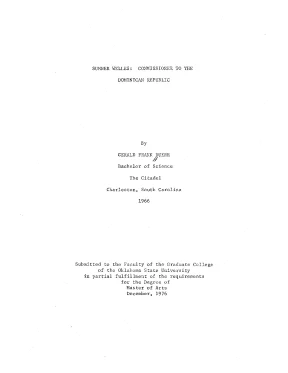
Tải xuống để đọc toàn bộSUMNER WELLES: COMMISSIONER TO THE DOMINICAN REPUBLIC By GERALD FRANK DUERR II Bachelor of Science The Citadel Charleston, South Carolina 1966 Submitted to the Faculty of the Graduate College of the Oklahoma State University in partial fulfillment of the requirements for the Degree of Master of Arts December, 1976 SUMNER WELLES: COMMISSIONER TO THE DOMINICAN REPUBLIC Thesis Approved: Thesis Advisor ____:lt_\b(J~- L. ~ Dean of Graduate College 96'/697 PREFACE This study examines the role of Swnner Helles in the termination of the United States occupation of the Dominican Republic. The primary objective is to inquire into Welles' involvement with and mission to the Dominican Republic to determine his concept of United States Caribbean policy. In negotiating the termination of the Dominican occupation, \\Telles led the United States away from a policy of imperialism and toward a policy which stressed friendly cooperation with the Caribbean nations.
The author wishes to express his appreciation to his major advisor, Dr. Smith, for his guidance and assistance in this study. Appreciation is also expressed to the other committee members, Dr. von Sauer and Dr., for their invaluable assistance in the preparation of the final manuscript.
I wish to thank the staff of the Oklahoma State University Library and the staff of the Diplomatic Records Branch, National Archives for their research assistance. Thanks also to Ms. Kathleen Allen for her assistance in typing earlier drafts of part of this study. In addition, I extend my appreciation to the United States Air Force for the opportunity to pursue this educational goal and to the Air Force Institute of Technology for its aid and assistance.
Fina~ly, to my wife, Angela, a very special thanks for her under- standing, encouragement, andmany sacrifices. iii TABLE OF CONTENTS Chapter Page I. INTRODUCTION AND LITERATURE. UNITED STATES RELATIONS WITH THE DOMINICAN REPUBLIC, 1900-1920 • • • • • •.
THE SEARCH FOR A PLAN OF WITHDRAWAL • • • • • 41 IV. SUMNER WELLES: COMMISSIONER TO THE DOl.fi l\li CAN REPUBUC • • • • • • • • • 78 V. SUMMARY AND CONCIDSIONS 110 A SELECTED BIBUOGRAPHY • • • • • 124 iv CHAPTER I INTRODUCTION AND LITERATURE The resignation of Sumner Welles as Under-Secretary of State on September 30, 1943, ended a diplomatic career that had contributed much to the realization of the goals of international good neighbor- liness and Hestern Hemispheric solidarity. During the twenty years Welles was associated with the State Department of the United States, he struggled to remove the notion of imperialism and ndollar diplomacy" from United States relations Hith other nations.
Roosevelt's statement in his first inaugural address that in the field of foreign affairs the United States would adopt the attitude of a Good Neighbor is primarily attributable to Welles' influence. Roosevelt and Welles had discussed United States foreign policy and, in particular, hemispheric policy, on numerous occasions during the months preceding the inauguration, and some of Welles' ideas were expressed by Roosevelt in his first major address on. f orelgn re 1 atlons. 1 Over the next ten years the men selected to fill the more important State Department posts sought to follow a Latin American policy based on the Good Neighbor philosophy.
Roosevelt's choice for Assistant Secretary of State with responsibility over Latin American affairs was Sumner Welles. In the only scholarly work devoted to Sumner Welles and his role i.n the Good Neighbor Policy, the author states, "Sumner Welles, hard- 1 2 working career diplomat, worked out and detailed the program of the Good Neighbor for Franklin Roosevelt." 2 Bryce Wood observes that during the development of the Good Neighbor Policy, "Welles dominated the day-to-day decisions relating to Latin America. 3 President Roosevelt was not the only person influenced by 11 • one of the wisest of American diplomats. Harry Williams, Richard N.
Current and Frank Freidel conclude in their work, !2_ History E_f the United States, that former Secretary of State Charles Evans Hughes, who tried to establish a new policy of extending American good will toward Latin America, was decided1y influenced by Sumner Welles during his first few months in office. 5 The New York Times, in praising Welles' appointment as }.JTibassador to Cuba in 1933, commented that "Secretary Hughes never hesitated to employ Sumner Welles when dif- ficult and responsible work was to be done." 6 Statements such as these indicate that a complete examination of United States policies toward Latin America during the 1920s and 1930s must take into acccunt the role of Sumner welles. Although Helles is acknmvledged as having played a major part in the development of the Good Neighbor Policy, few historians have examined his ideas concerning foreign policy or their development. This is especially interesting since autobiographies, biographies, and other studies discuss nearly all of the important men, including some \vorks on men who served in positions farther removed from the center of decision-making than was Welles, who served during the Roosevelt years.
Welles did not write an autobiography, and his biography is yet to be written. That historians have paid little attention to Welles is partly attributable to the fact that Welles' 3 personal papers have not been released for study. I In addition, Welles did not attract much public attention as a diplomat or State Department official until after 1933. As a result, he was over- shadowed by Roosevelt, Cordell Hull, and the events that erupted into '1-Jorld War II.
Historians who have inquired into American diplomatic history for the years between 1920 and 1943 generally give Welles only passing attention, choosing instead to identify presidents and secretaries of state with particular foreign policies and policy decisions. Perhaps this is as it should be, since presidents and secretaries of state do have the re5ponsibility and authority to make policy and render the major practical decisions in line with that policy. This practice, however, does not give credit to the lower level officials fer their day-to-day decisions that breathe life into the policy and decisions that others make. In Welles' case, he not only made real and tangible the Latin American policies of Presidents Harding and Roosevelt and Secretaries of State Hug~es and Hull, but he convinced these men that these were the policies that they should.
The most readily available and authoritative source of informa- tion relating to Helles' role in United States-Latin American relations are the appropriate volumes of The Papers Relating ~ the Foreign Relations~ the United States. 7 In this essentially official record of American foreign relations, the student finds the final versions of signed treaties as well as many of the letters, telegrams, and memoranda that were sent and received by the State Department. The attitudes and ideas of individual diplomats, such as Welles, are evident in many of these documents; in Welles' case, however, these 4 volumes do not contain the complete record of his involvement. In order to examine fully Welles' influence on Latin American-United States relations, especially his role in terminating the United States occupation of the Dominican Republic, it is also necessary to review the letters and memoranda that were not published in the Foreign Relations volumes.
These documents are among the public records preserved in the National Archives. Welles' speeches, delivered during his tenure as Assistant and later Under-Secretary of State, are also available for examination. Although Welles presented these speeches on behalf of the Roosevelt administration, they still reflect his own opinions and ideas. Welles had a reputation for being honest and direct, and in the area of inter-American relations his vie"lvs closely paralleled those of the administration he served.
8 Welles was the author of six books. One can find the clearest statement of his philosophy and ideas in these works. Five of the books were written after 1942 and concern the war and post-war era. 9 These vmrks do not constitute welles' memoirs; rather, he recalls the diplomatic decisions that W2re made and the effect of the policies that were adopted.
Welles minimizes his own involvement in those decisions in which he played a part, except to respond occasionally to the criticism of others and to clarify his position where disputes occurred. Written as they were at the end of his State Department career, these five books are the end result of Welles' diplomatic experiences. Welles' first book, Naboth's Vineyard: The Dominican Republic 184·~-1924, a two-volume history of that Caribbean nation published in 1928, is an early statement of his conception of what a Good Neighbor Policy should entai1. 10 Naboth's Vineyard followed 5 Welles' first major effort to end United States imperialism and re- verse the policy of intervention.
It also predates Welles' appoint- ment as Ambassador to Cuba in 1933, the first major test of the Good Neighbor Policy. The concluding chapter of Naboth's Vineyard reveals that Welles had, by 1928, formulated the basic concepts of the Good Neighbor Policy. A diplomatic biography of Welles covering the period betHeen 1933 and 1943 states that VJelles ". learned by his mistakes that the United States should not presume to dictate internal policies of independent American nations.
1111 If this was true of VJelles during the development of the Good Neighbor Policy, then the conclusions expressed in Naboth's Vineyard reveal what he learned from his ex- periences in ending the United States occupation of the Dominican Republic. In writing Naboth' s Vineyard, VJelles did not detail his mvn important activities which helped restore the Dominican Republic's sovereignty. The most complete and accurate account of VJelles' role in ending the occupation of that nation is contained in the tnird chapter of Dana G. Munro's book;·The United States and the Caribbean Republics, 1921-33.
12 Hm·Jever, Munro, who was a contemporary of Welles in the State Department in the early 1920s, did not make Welles the subject of his chapter; rather, he provided an in-depth look at the issues and problems with which Welles had dealt. The purpose of this study is to test the hypothesis that Welles' involvement with and mission to the Dominican Republic from 1920-25 were important to the development of his ideas on United States-Latin American relations. Welles' official mission to the Dominican Republic provided him an opportunity to accomplish a specific personal 6 objective and to initiate a new concept in foreign policy. His attitude and methods reflected his concept of what United States foreign policy should be and how it should be carried out.
It seems likely that Welles' experience in the Dominican Republic may have altered or at least refined his thinking in regard to the policy he believed the United States should adopt and follow. Before discussing Welles' role in ending American military intervention in the Dominican Republic, it would be of value to trace briefly his career up to 1922. Sumner Helles, a member of a prominent New York family, was born on October 14, 1892. He was named for his great-uncle, Senator Charles Sumner of Hassachusetts, and he seemed to inherit the distinguished senator's interest Jn foreign affairs.
Like his childhood acquaintance, Franklin Roosevelt, Helles attended Groton School and Harvard University, graduating from the latter in 1914 with a Bachelor of Arts degree. He joined the Department of State in July, 1915, and received a secretarial post in the Tokyo embassy. Franklin Roosevelt, who at that time was Assistant Secretary of the Navy, aided his entry into the State Department. Welles spent t~vo years in Tokyo; his efficient and precise work favorably impressed his superiors.
In August, 1917, his desire for an assignment in Latin America was realized when he assumed the post of second secretary at the embassy in Buenos Aires, Argentina. In this position Helles perfected his fluency in the Spanish language and became acquainted with the Latin American view of political affairs. Hhile in Buenos Aires Welles' ideas concerning inter- national good neighborliness and Hestern Hemispheric solidarity began to germinate.
Nội dung được bảo vệ bản quyền — Tải xuống đầy đủ
Trích dẫn luận án này
Gerald Frank Duerr II (1976). Sumner Welles: Chính sách Hoa Kỳ tại Dominica [Luận án tiến sĩ, Oklahoma State University]. LuanAn.net. https://luanan.net/giao-duc-hoc/thesis-1976-d853s
Câu hỏi thường gặp
Luận án "Sumner Welles: Chính sách Hoa Kỳ tại Dominica" nghiên cứu về vấn đề gì?
Thesis 1976 d853s: Luận văn lịch sử và phân tích chuyên sâu về chủ đề khoa học xã hội và nhân văn. Khám phá các khía cạnh quan trọng.
Luận án "Sumner Welles: Chính sách Hoa Kỳ tại Dominica" được bảo vệ tại trường nào?
Luận án này được bảo vệ tại Oklahoma State University. Năm bảo vệ: 1976.
Luận án "Sumner Welles: Chính sách Hoa Kỳ tại Dominica" thuộc chuyên ngành gì?
Luận án "Sumner Welles: Chính sách Hoa Kỳ tại Dominica" thuộc chuyên ngành Master of Arts. Danh mục: Giáo Dục Học.
Luận án "Sumner Welles: Chính sách Hoa Kỳ tại Dominica" có bao nhiêu trang?
Luận án "Sumner Welles: Chính sách Hoa Kỳ tại Dominica" có 133 trang. Bạn có thể xem trước một phần tài liệu ngay trên trang web trước khi tải về.
Cách tải luận án "Sumner Welles: Chính sách Hoa Kỳ tại Dominica" về máy như thế nào?
Để tải luận án về máy, bạn nhấn nút "Tải xuống ngay" trên trang này, sau đó hoàn tất thanh toán phí lưu trữ. File sẽ được tải xuống ngay sau khi thanh toán thành công. Hỗ trợ qua Zalo: 0559 297 239.