David Folsom và sự trỗi dậy của chủ nghĩa dân tộc Choctaw: Luận án Thạc sĩ của Barry Eugene Thorne
Thesis 1988 T511D: Nghiên cứu về kiến trúc Transformer và ứng dụng T5 cho xử lý ngôn ngữ tự nhiên. Đánh giá hiệu quả mô hình trên các tác vụ NLU.
Năm xuất bản
Số trang
148
Thời gian đọc
23 phút
Lượt xem
0
Lượt tải
0
Phí lưu trữ
40 Point
Tổng quan nhanh
- Chủ đề:
- Exploration of Choctaw Nationalism: Barry Thorne Thesis 1988
- Số trang:
- 148 trang
- Trường:
- Oklahoma State University
- Chuyên ngành:
- History
- Tác giả:
- Barry Eugene Thorne
- Năm:
- 1988
Tóm tắt nội dung luận án
I.Exploration of Choctaw Nationalism Barry Thorne Thesis 1988
This master's thesis 1988, titled "DAVID FOLSOM AND THE EMERGENCE OF CHOCTAW NATIONALISM," presents a significant academic research 1988 contribution. Authored by Barry Eugene Thorne, it was submitted to Oklahoma State University. The dissertation 1988 explores the development of Choctaw nationalism during the early nineteenth century. This scholarly publication 1988 challenges traditional historical overlooks regarding Native American nationalistic movements. It highlights a critical period for the Choctaw people in present-day Mississippi. The document identifier is t511d. This archival thesis offers deep insights into political transformation. It details the shift from a chieftaincy to a constitutional government. The research provides a unique perspective on indigenous political evolution.
1.1. Thesis Overview Choctaw Nationalism s Emergence
The graduate thesis identifier t511d marks this important historical analysis. It examines the profound shift within Choctaw society. A strong nationalistic movement is documented. This movement led to fundamental changes in governance. The thesis argues for a re-evaluation of Native American political evolution. It spotlights the institution of constitutional government.
1.2. Author and Publication Details Barry Eugene Thorne
Barry Eugene Thorne completed this research paper 1988. It fulfills requirements for a Master of Arts degree. The submission date was May 1988. Oklahoma State University hosted this university repository t511d document. The work represents a dedicated study of Choctaw history and political thought. It contributes to indigenous studies.
1.3. Unique Historical Perspective Native American Nationalism
Few historians previously applied nationalism concepts to Native Americans. This library catalog t511d entry addresses that gap. It re-evaluates early nineteenth-century Choctaw political dynamics. The thesis provides a fresh perspective. It demonstrates the existence of a robust national identity among the Choctaw. This challenges previous historical narratives.
II.David Folsom s Influence on Choctaw Self Governance
David Folsom emerged as a pivotal figure in Choctaw nationalism. His life illustrates the early growth of this movement. Folsom led a group of wealthy, bicultural mixed-bloods. They identified strongly as Choctaws. Folsom possessed a keen awareness of American society. He viewed Choctaw society as a historical entity facing destruction. This master's thesis 1988 details his internal conflict. Folsom belonged to both confronting societies. This personal struggle forged a "new man." His resolution turned him into an advocate for his people. His understanding of Choctaw identity differed from traditional views. He became a champion for Choctaw rights.
2.1. Folsom s Background Mixed Blood Leader and Visionary
Folsom was a first-generation mixed-blood. He embraced both Choctaw and American perspectives. His wealth provided influence. His bicultural outlook offered a unique vantage point. He consciously engaged with American societal progress. This academic research 1988 highlights his role as a forward-thinking leader. He represented a new generation of Choctaw leadership.
2.2. Intellectual Shift From Myth to Human Rights Concepts
Traditionally, Choctaws justified existence through myth. Folsom replaced this with Lockean concepts of "human rights." He championed the idea of inherent Choctaw rights and deserved justice. This foundational shift marked his most significant intellectual contribution. It formed the basis for a new Choctaw identity. This philosophical change was revolutionary.
2.3. Catalyst for Choctaw Solidarity His Political Career
The Anglo challenge to Choctaw rights spurred Folsom's activism. This challenge gave rise to the concept of Choctaw solidarity. Folsom built his political career on this principle. He envisioned a Choctaw Nation where nationalism replaced myth. This research paper 1988 underscores his pivotal role. His actions consolidated the Choctaw people.
III.Defining Choctaw Nationalism Academic Research 1988
The master's thesis 1988 by Barry Eugene Thorne engages with scholarly debates on nationalism. It presents a clear definition based on academic consensus. This academic research 1988 applies these criteria to the Choctaw experience. Key characteristics include a defined national territory. Shared cultural traits like language and customs are vital. A desire for sovereign government is paramount. Belief in common history and ethnic identity strengthens nationalism. Love and esteem for fellow nationals are also present. Devotion to the national entity is central. Pride in past achievements and sorrow for defeats are strong indicators. This scholarly publication 1988 shows how the Choctaws exhibited these traits, demonstrating a clear nationalistic movement.
3.1. Core Nationalistic Characteristics Academic Consensus
Academics agree on several conditions for nationalism. These include a national territory with clear boundaries. Shared cultural characteristics are essential. This encompasses language, customs, and social institutions. The nation seeks to preserve these traits. The desire for self-determination and independent government is fundamental. Loyalty to self-rule defines this aspiration.
3.2. Choctaw Manifestations Early Nineteenth Century Evidence
The early nineteenth-century Choctaws displayed all nationalistic characteristics. This archival thesis provides historical evidence. They demonstrated a strong sense of shared history. Their love for fellow Choctaws surpassed that for "foreigners." Pride in their past was evident. Disregard, and even hostility, toward threatening nations was observed. These actions signified a growing national identity.
3.3. Political Transformation From Chieftaincy to Republic
Choctaw society underwent a significant political evolution. It transitioned from a chieftaincy to a national organization. Elected officials replaced the old order. This movement instituted constitutional government. The dissertation 1988 meticulously documents this institutional shift. This demonstrated a commitment to self-governance and national identity. It marked a new era for the Choctaw people.
IV.Folsom s Strategy for Choctaw Sovereignty Preservation
David Folsom developed a comprehensive program for the Choctaw Nation. This strategy focused on preserving the "national homeland." It also emphasized self-strengthening initiatives. Education formed a critical component. Industrial development aimed to bolster economic independence. Rigid morality promoted social cohesion. Folsom envisioned transforming Choctaw society. He aimed to cultivate citizens for a modern republican state. This research paper 1988 documents his strategic vision. His methods aimed to secure Choctaw sovereignty. This proactive approach sought to fortify the Choctaw people against external threats.
4.1. Comprehensive Program Education Industry Morality
Folsom's program was multifaceted. Education was crucial for modern advancement. The development of industry would create economic stability. A strong moral framework would unite the people. These pillars supported the growth of a resilient Choctaw nation. This scholarly publication 1988 details these efforts. The program was holistic in its design.
4.2. Strategic Alliances Christian Missionaries as Partners
Christian missionaries became key allies in Folsom's plan. They assisted in transforming the Choctaw populace. By Anglo standards, many were uneducated. Missionaries helped to educate them. This partnership was vital for achieving Folsom's modernizing goals. The master's thesis 1988 highlights the effectiveness of this collaboration. It was a pragmatic alliance.
4.3. Territorial Defense Cornerstone of Choctaw Nationalism
Folsom's staunch defense of Choctaw territory was paramount. This involved land in present-day Mississippi. His efforts contributed significantly to the Christian nationalist movement's success. He offered the best strategy for preserving sovereignty. Many Choctaws supported him, even those still thinking in mythical terms. His movement provided a practical path to national survival.
V.Accessing the Archival Thesis University Repository t511d
This archival thesis holds significant value for historical researchers. It is identified as "Thesis 1988 t511d." The document is part of the university repository t511d collection at Oklahoma State University. It represents a scholarly publication 1988 detailing an under-explored aspect of Native American history. Accessing this graduate thesis identifier helps scholars. It provides a deeper understanding of Choctaw political development. The library catalog t511d entry guides interested parties. It ensures this important research paper 1988 remains discoverable. Researchers can gain valuable insights from this preserved work.
5.1. Locating the Thesis Identifier and Repository Information
The graduate thesis identifier t511d ensures precise location. This master's thesis 1988 is housed within Oklahoma State University's archives. Interested parties can consult the library catalog t511d. This will provide details for accessing physical or digital copies. It facilitates scholarly access to this historical document. The information is readily available.
5.2. Acknowledging Contributions Research Support and Editors
The author, Barry Eugene Thorne, acknowledges numerous contributors. W. David Baird provided patient direction and editing. Huston and Helga H. Harriman offered thoughtful suggestions. The History Department at Oklahoma State University provided an assistantship. Mary Jane Warde and Clyde Ellis offered editing, suggestions, and encouragement. Assistance from the author's mother was also crucial for the completion of this dissertation 1988.
5.3. Research Value A Primary Source for Choctaw History
This academic research 1988 serves as a vital primary source. It offers unique insights into David Folsom's life. It illuminates the emergence of Choctaw nationalism. Scholars studying Native American history will find it invaluable. Its detailed analysis contributes to understanding indigenous political evolution. The thesis offers a foundational text for future studies on the Choctaw Nation.
Tải xuống file đầy đủ để xem toàn bộ nội dung
Tải đầy đủ (148 trang)Trích đoạn nội dung luận án
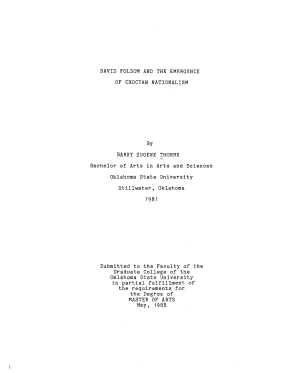
Tải xuống để đọc toàn bộDAVID FOLSOM AND THE EMERGENCE OF CHOCTAW NATIONALISM By BARRY EUGENE THORNE Jj Bachelor of Arts in Arts and Sciences Oklahoma State University Stillwater, Oklahoma 1981 Submitted to the Faculty of the Graduate College of the Oklahoma State University in partial fulfillment of the requirements for the Degree of MASTER OF ARTS May, 1988 \ I I I I I I I I I I I I I I I I ~. I I I I I I I I I I I I I I I I I I I I I I I I I I I I I I I I I I I I I I I I I I I I I DAVID FOLSOM AND THE EMERGENCE OF CHOCTAW NATIONALISM Thesis Approved: Thesis Adviser ii 1:JO~j~j03 PREFACE Few historians have used nationalism as a concept relevant to Native Americans. Because of this oversight there is a need for re-evaluation. During the early nineteenth century the Choctaw Indians of present day Mississippi displayed a strong nationalistic movement that resulted in the overthrow of the old political order and the institution of constitutional government.
In all, they passed from a chieftaincy form of organization to a national one with elected officials.1 What constitutes nationalism has generated much scholarly debate. Its definition has varied from time to time and scholar to scholar. Yet there are certain beliefs and conditions that most academicians agree point to the existence of nationalism. These can be summarized as: 1.
A national territory with clearly defined boundaries. Shared cultural characteristics such as language, customs, manners, and social institutions which the nation wants to preserve. The desire for an independent or sovereign government based on the principle of self- determination and loyalty to self-rule. A shared belief in a common history or ethnic identity.
Love and esteem for fellow nationals over and above that of "foreigners. A devotion to the national entity. A pride in the past achievements and sorrow for past defeats of the nation. A shared disregard for other nations.
This may take the form of hostility if those nations become threatening. In the early nineteenth century, the Choctaws demonstrated all these characteristics to some extent.2 One of the first Choctaw nationalists was David Folsom, and his life illustrates the development and early growth of Choctaw nationalism. He was the leader of a rising group of comparatively wealthy first generation mixed-bloods who were bicultural in outlook but considered themselves Choctaws. Folsom was more conscious of American society than most of his contemporaries.
Viewing the progress of mankind from a rational perspective, he saw Choctaw society as a historical reality which the white man threatened to destroy. Folsom belonged to both of the societies which were confronting one another and he experienced inwardly the clash between the two. Both were a part of him, and the destruction of one of them meant the symbolic annihilation of a part of himself. His resolution of this conflict turned him into a "new man." David Folsom derived his identification as a Choctaw from a new kind of understanding.
Whereas traditionally the Choctaws justified their existence through myth, Folsom replaced this with the Lockean concept of "human rights." His most significant contribution to Choctaw thought was the idea that the Choctaws inherently possessed rights and iv deserved justice because they were human beings. The Anglo challenge to their rights gave rise to the concept of Choctaw solidarity, on which he based his political career. The logical fulfillment of this mode of thought was the creation of a Choctaw Nation in which nationalism would replace myth as a means to sanctify the existence of the Choctaw people. To accomplish his goals Folsom developed a program which stressed the preservation of the "national homeland" and self-strengthening through education, the development of industry, and rigid morality.
He enlisted Christian missionaries as allies in the task of transforming a people who were uneducated, by Anglo standards, into citizens of a modern republican state. His staunch defense of the Choctaw territory in present-day Mississippi contributed most to the success of the Choctaw Christian nationalist movement. By offering the best strategy for preserving Choctaw sovereignty over their mythical homeland, he received the support of many who still thought in mythical terms despite the fact that his movement opposed such modes of thought. During the course of completing this thesis I have become indebted to many people.
Special thanks go to W. David Baird for his patient direction and editing of the manuscript. Huston and Helga H. Harriman both contributed thoughtful suggestions for improvement.
Thanks to the History Department at the Oklahoma State University for offering me an assistantship to pursue my studies. To Mary Jane Warde and Clyde Ellis v who took precious time out of their busy schedules to help edit and offer suggestions and encouragement, I offer my sincere regard and appreciation. Without the encouragement and assistence of my Mother and Father this work could not have been accomplished. Lastly, I would like to express my thanks, love, and admiration for my wife, Rouwei, who somehow managed to maintain her sanity during the tribulations of putting up with me, holding a full-time job, and attending graduate school all at the same time.
For works dealing with Native American nationalism see: William G. McLoughlin, Cherokee Renascence in the New Republic (Princeton: Princeton University Press, 1986); Robert Berkhofer, Jr., "The Political Context of a New Indian History," Pacific Historical Review 40 (August 1971): 357-382. Adapted from Boyd c. Shafer's, Nationalism: Its Nature and Interpreters, AHA Pamphlet 701 (Washington: American Historical Association, 1976), 10-11; For a discussion of Nationalism see: Anthony D.
Smith, Theories of Nationalism (New York: Harper & Row, 1971); ib1d., The Ethnic Revival (New York: Cambridge University Press, 1981). vii TABLE OF CONTENTS Chapter Page I. THE PATH TOWARD NATIONALISM, 1776-1816 • • • • • II. THE PATH TOWARD REVOLUTION, 1820-1825.
THE CHOCTAW REVOLUTION, 1825-1830. THE REMOVAL CRISIS, 1829-1830 • • • • • • • • • • 89 VI. DAVID FOLSOM AND THE CHOCTAW REPUBLIC IN THE WEST, 1830-1849 ••. • • • • • • • • • 127 viii LIST OF FIGURES Figure Page 1.
Choctaw Land Cessions, 1801-1830 • • •. The District Divisions of the Choctaw Nation Before Removal • • • • • • • •. American Board Mission Stations • • •. Choctaw District Divisions in the Indian Territory • • • • • • • • • • • • • • • 112 ix David Folsom.
(Courtesy Oklahoma Historical Society.) CHAPTER I THE PATH TOWARD NATIONALISM, 1776-1816 David Folsom was a revolutionary Choctaw thinker whose heritage and formative years were exceptionally critical to his intellectual development. He was born on 25 January 1791, to Nathaniel Folsom, a prosperous white trader, and Ai-Ne-Chi-Hoyo, who was descended from a proud and prominent "royal" family of chiefs. This mixed parentage imbued David with prestige, wealth, and the opportunity to learn of two societies. Because his father kept an inn for whites traveling through the Choctaw country, young David frequently conversed with learned white men.
He became obsessed with education and obtained a short stint of formal learning at a school on the Elk River in Tennessee. His heritage and early experiences caused David to view the relative weakness of the Choctaws as the result of historic processes--a failure on the part of the Choctaws to adapt to their changing environment. For Folsom, reason was superior to myth and this explained the white man's superiority. Wanting to preserve such historical Choctaw attributes as political independence and language, he concluded that his people must substitute the rationalism of the white man for their mythic reality.
1 At the outbreak of the American Revolution, David 2 3 Folsom's father, Nathaniel Folsom, moved with his family from Georgia into the Choctaw country. As Loyalists, they perhaps hoped to escape persecution from local revolutionaries. Having learned that land in the Choctaw country was extremely fertile and the opportunities for trade abundant, Nathaniel's father determined to make his fortune in that land where people said "money grew on bushes." But as the family entered the Choctaw country, they met some of their former neighbors from Georgia who had emigrated earlier and were leaving as a result of illness; they warned Nathaniel's father not to settle in that territory because the climate was not healthful. Unwilling to risk the lives of his family, Nathaniel's father sought a new location farther north within the Chickasaw country.
As the family prepared to depart, Nathaniel quarreled with his father and elected to stay among the Choctaws.2 Nathaniel was not alone for long. He soon entered into a joint trading venture with a man named Welsh, initiating a partnership that flourished for the next thirty years. Nathaniel then married I-Ah-Ne-Cha and Ai-Ne-Chi- Hoyo, two sisters from a "Royal" Choctaw family.3 Marriage into such a prominent family apparently brought him instant prestige among the Choctaws. The three settled at Bok tuklo, near present-day Philadelphia, Mississippi, where Nathaniel prospered and fathered a large family of mixed- blood children.4 Nathaniel held strong English Loyalist/nationalist sympathies.
When, in 1777, the British Superintendent of 4 Indian Affairs purchased from the Choctaws a tract of land along the Mississippi River as a Loyalist refuge, Nathaniel used his influence to restrain the Choctaws from attacking the Natchez settlement. In 1781, two years after the passage of British West Florida to Spain, Folsom led a band of about fifty Choctaws warriors in conjunction with a Loyalist attempt to regain control of West Florida. Nathaniel promised the Anglo rebels refuge within the Choctaw country should the enterprise fail. Such an offer demonstrated that Nathaniel was influential among the Indians.
Ultimately the revolt failed, but his spirit of nationalism would reappear later in David Folsom.5 Intermarriage to Europeans, the exceptional influence of white men, and the growing materialism of the Indians caused tremendous societal stress for the Choctaws. The accumulation of material wealth by certain individuals created distinct social classes which threatened traditional concepts of power and prestige. Contact with Europeans brought dramatic changes in the forms of economic activity. Hunting for the skin trade supplanted the old self- sufficient economic system, and the Choctaws developed a dependency upon a market they could not control.
The basis of their economy was unsound because the demand for manufactured goods constantly exceeded the supply of deer used as a medium of exchange. Generally the intermarried white population opposed the skin trade and promoted cattle herding and agriculture. This created further societal fragmentation as the Choctaws became polarized over which 5 pursuit, hunting or agriculture, was better. Even the chiefs began clamoring over the right to control trade or distribute annuities.
Indeed the Choctaws were suffering through a painful transition from which they could not retreat. Some Choctaw leaders realized, by the time of David Folsom's birth, that their people must change if they hoped to maintain their separate existence. As chief Franchimastabe explained in 1792, the era "of living and hunting by the gun was ending."6 David Folsom began life during a life-threatening period for the Choctaws. A drought which began the previous summer destroyed much of the tribe's crops, and an unknown disease killed many of their horses and cattle.
The lure of the skin trade had prompted many warriors to pursue the hunt exclusively and ignore their traditional subsistence agricultural system. Yet over-hunting reduced the native game population to such an extent that it became virtually impossible to obtain enough skins for trade with white traders. To make matters worse, the added demands of the hunting economy forced many Choctaws to abandon any form of horticulture altogether. The dearth of food caused desperate warriors to raid the Spanish country for beef, an action that prompted the Spanish to retaliate through their Creek allies.7 Aside from these natural and political disasters, the Folsom family experienced their own share of catastrophes.
David's mother, AI-Ne-Chi-Hoyo, contracted pneumonia prior to his birth.
Nội dung được bảo vệ bản quyền — Tải xuống đầy đủ
Trích dẫn luận án này
Barry Eugene Thorne (1988). David Folsom và Chủ nghĩa Dân tộc Choctaw [Luận án tiến sĩ, Oklahoma State University]. LuanAn.net. https://luanan.net/ly-luan-va-lich-su-giao-duc/triet-hoc-giao-duc/thesis-1988-t511d
Câu hỏi thường gặp
Luận án "David Folsom và Chủ nghĩa Dân tộc Choctaw" nghiên cứu về vấn đề gì?
Thesis 1988 T511D: Nghiên cứu về kiến trúc Transformer và ứng dụng T5 cho xử lý ngôn ngữ tự nhiên. Đánh giá hiệu quả mô hình trên các tác vụ NLU.
Luận án "David Folsom và Chủ nghĩa Dân tộc Choctaw" được bảo vệ tại trường nào?
Luận án này được bảo vệ tại Oklahoma State University. Năm bảo vệ: 1988.
Luận án "David Folsom và Chủ nghĩa Dân tộc Choctaw" thuộc chuyên ngành gì?
Luận án "David Folsom và Chủ nghĩa Dân tộc Choctaw" thuộc chuyên ngành History. Danh mục: Triết Học Giáo Dục.
Luận án "David Folsom và Chủ nghĩa Dân tộc Choctaw" có bao nhiêu trang?
Luận án "David Folsom và Chủ nghĩa Dân tộc Choctaw" có 148 trang. Bạn có thể xem trước một phần tài liệu ngay trên trang web trước khi tải về.
Cách tải luận án "David Folsom và Chủ nghĩa Dân tộc Choctaw" về máy như thế nào?
Để tải luận án về máy, bạn nhấn nút "Tải xuống ngay" trên trang này, sau đó hoàn tất thanh toán phí lưu trữ. File sẽ được tải xuống ngay sau khi thanh toán thành công. Hỗ trợ qua Zalo: 0559 297 239.