Phdthesis lmoura 20210907 final
Luận án Tiến sĩ lmoura, bản hoàn chỉnh ngày 07/09/2021.
Population Health Sciences
Luan An
Doctoral dissertation
Năm xuất bản
Số trang
234
Thời gian đọc
36 phút
Lượt xem
0
Lượt tải
0
Phí lưu trữ
50 Point
Tổng quan nhanh
- Chủ đề:
- An toàn & Hiệu quả Thuốc Chống Co Giật Người Cao Tuổi
- Số trang:
- 234 trang
- Trường:
- harvard university
- Chuyên ngành:
- Population Health Sciences
- Tác giả:
- Lídia Maria Veras Rocha de Moura
- Năm:
- 2021
Tóm tắt nội dung luận án
I.An toàn Hiệu quả Thuốc Chống Co Giật Người Cao Tuổi
Sử dụng thuốc chống co giật ở người lớn tuổi đã tăng đáng kể. Trong 25 năm qua, mức độ này tăng 200 lần. Một nghiên cứu trước đây ước tính cứ tám người lớn tuổi ở Mỹ thì có một người đang dùng thuốc chống co giật. Những loại thuốc này thường được chỉ định cho các tình trạng phổ biến như động kinh, mất ngủ, đau và kích động. Các tình trạng này đặc biệt hay gặp ở những bệnh nhân sống sót sau đột quỵ thiếu máu cục bộ cấp tính (AIS). Người lớn tuổi, đặc biệt những người mắc bệnh Alzheimer và sa sút trí tuệ liên quan đến Alzheimer (AD/ADRD), dễ bị tác dụng phụ. Nguy cơ biến cố bất lợi của thuốc chống co giật tiếp cận 20%. Khoảng 5% trong số này có thể đe dọa tính mạng. Các tổ chức y tế lớn khuyến nghị tránh dùng thuốc chống co giật ở người từ 65 tuổi trở lên. Tuy nhiên, bằng chứng khoa học mạnh mẽ về an toàn và hiệu quả thuốc vẫn còn thiếu. Luận án tiến sĩ này giải quyết nhu cầu cấp thiết đó.
1.1. Tăng Cường Sử Dụng Thuốc Chống Co Giật
Mức độ sử dụng thuốc chống co giật ở người lớn tuổi đã tăng vọt. Mức tăng 200 lần trong 25 năm qua cho thấy xu hướng đáng báo động. Hiện tại, một phần tám người lớn tuổi tại Hoa Kỳ đang được kê đơn. Điều này đặt ra câu hỏi lớn về an toàn và hiệu quả lâu dài của các liệu pháp này. Nhu cầu nghiên cứu sinh về lĩnh vực này trở nên thiết yếu.
1.2. Rủi Ro Tác Dụng Phụ Nghiêm Trọng
Thuốc chống co giật tiềm ẩn nhiều rủi ro. Khoảng 20% bệnh nhân gặp phải các biến cố bất lợi. Trong số đó, 5% có thể gây nguy hiểm đến tính mạng. Đặc biệt, người mắc AD/ADRD dễ bị tổn thương hơn. Công trình nghiên cứu này nhấn mạnh sự cần thiết của bằng chứng chặt chẽ.
1.3. Chỉ Định Phổ Biến Sau Đột Quỵ
Thuốc chống co giật thường được dùng cho các chỉ định khác ngoài động kinh. Các chỉ định này bao gồm dự phòng co giật, mất ngủ, đau và kích động. Đây là những tình trạng phổ biến ở bệnh nhân đột quỵ thiếu máu cục bộ cấp tính. Tại Mỹ, có hàng triệu người sống sót sau đột quỵ. Việc sử dụng thuốc trong nhóm này cần được đánh giá cẩn thận.
II.Thách Thức Nghiên Cứu Điều Trị Người Lớn Tuổi
Nghiên cứu về thuốc chống co giật ở người lớn tuổi gặp nhiều trở ngại. Thử nghiệm lâm sàng ngẫu nhiên khó thực hiện. Chi phí cao và khó tuyển dụng người lớn tuổi vào nghiên cứu là những lý do chính. Cần số lượng lớn bệnh nhân để đánh giá an toàn một cách hiệu quả. Đây là một thách thức lớn đối với công trình nghiên cứu khoa học. Các nghiên cứu quan sát trước đây cũng có những hạn chế nghiêm trọng.
2.1. Hạn Chế Từ Thử Nghiệm Ngẫu Nhiên
Thử nghiệm ngẫu nhiên kiểm soát là tiêu chuẩn vàng. Tuy nhiên, chúng không thực tế cho thuốc chống co giật ở người lớn tuổi. Chi phí nghiên cứu cao là một rào cản. Việc tuyển bệnh nhân cao tuổi cũng rất khó khăn. Nghiên cứu sinh thường đối mặt với những thách thức này.
2.2. Nhược Điểm Nghiên Cứu Quan Sát Trước Đây
Các nghiên cứu quan sát trước đây có nhiều hạn chế. Kích thước mẫu nhỏ làm giảm độ tin cậy. Dữ liệu thiếu chi tiết và độ xác thực kém. Sai lệch chọn lọc và yếu tố gây nhiễu do chỉ định điều trị cũng là vấn đề. Những nhược điểm này làm giảm giá trị của công trình nghiên cứu.
2.3. Nhu Cầu Bằng Chứng Khoa Học Khẩn Cấp
Sự thiếu hụt bằng chứng nghiêm ngặt là điều cấp bách. Các tổ chức y tế lớn khuyến nghị tránh dùng thuốc. Điều này cho thấy sự không chắc chắn về an toàn. Bằng tiến sĩ trong lĩnh vực này cần cung cấp dữ liệu đáng tin cậy.
III.Phương Pháp Nghiên Cứu Luận Án Tiến Sĩ Mới
Luận án tiến sĩ này áp dụng cách tiếp cận sáng tạo. Nó vượt qua các hạn chế của nghiên cứu trước đây. Dữ liệu từ một sổ đăng ký đột quỵ tiềm năng được liên kết. Sổ đăng ký Get-With-The-Guidelines-Stroke cung cấp thông tin. Dữ liệu này được kết nối với hồ sơ sức khỏe điện tử (EHR) toàn diện. Phương pháp nghiên cứu này cung cấp cái nhìn sâu sắc. Nó cho phép đánh giá ảnh hưởng của các chiến lược điều trị. Mục tiêu là những người trưởng thành từ 65 tuổi trở lên sống sót sau đột quỵ thiếu máu cục bộ cấp tính. Luận văn tập trung vào kết quả sức khỏe bất lợi, ban đầu là tử vong trong những tháng tiếp theo.
3.1. Liên Kết Dữ Liệu Hồ Sơ Sức Khỏe Điện Tử
Phương pháp nghiên cứu sử dụng liên kết dữ liệu. Dữ liệu từ sổ đăng ký đột quỵ được nối với EHR. Việc này cung cấp một tập dữ liệu phong phú, chi tiết. Nó giúp khắc phục vấn đề về chi tiết dữ liệu trong các nghiên cứu trước. Đây là một bước tiến quan trọng trong công trình nghiên cứu này.
3.2. Ứng Dụng Phương Pháp Thống Kê Hiện Đại
Các phương pháp thống kê mới được áp dụng. Điều này giúp đánh giá hiệu quả điều trị chính xác hơn. Nó giảm thiểu các yếu tố gây nhiễu. Phương pháp này đảm bảo tính vững chắc của kết quả nghiên cứu. Luận án này đặt trọng tâm vào phân tích dữ liệu tiên tiến.
3.3. Mục Tiêu Đánh Giá Chiến Lược Điều Trị
Mục tiêu chính là đánh giá các chiến lược điều trị. Đặc biệt, nó tập trung vào việc khởi đầu điều trị. Nhóm đối tượng là người lớn tuổi sau đột quỵ thiếu máu cục bộ cấp tính. Kết quả sức khỏe bất lợi được quan tâm. Ban đầu, nghiên cứu xem xét tỷ lệ tử vong. Đây là một đóng góp quan trọng của đề cương luận án.
IV.Đánh Giá Độ Chính Xác Chẩn Đoán AD ADRD
Một phần quan trọng của luận án là xác thực chẩn đoán. Chương 1 đánh giá độ chính xác của chẩn đoán AD/ADRD dựa trên yêu cầu bảo hiểm. Việc này được thực hiện so với kết quả đánh giá của chuyên gia lâm sàng. Một cơ sở dữ liệu mới được sử dụng. Cơ sở dữ liệu này có liên kết cấp độ cá nhân giữa hồ sơ sức khỏe điện tử (EHR) và yêu cầu bảo hiểm. Một mô hình hồi quy được phát triển. Mô hình sử dụng định nghĩa số lượng yêu cầu chẩn đoán tinh chỉnh. Tuổi và giới tính cũng được đưa vào. Mô hình này cho thấy hiệu chuẩn tuyệt vời với tiêu chuẩn tham chiếu. Độ chính xác và khả năng dự đoán của mô hình rất cao. Điều này là cần thiết để chuẩn bị cho việc sử dụng dữ liệu Medicare quốc gia. Công trình nghiên cứu này cung cấp công cụ mạnh mẽ.
4.1. Xác Thực Chẩn Đoán Dựa Trên Yêu Cầu Bảo Hiểm
Luận văn đã kiểm tra độ chính xác chẩn đoán. Chẩn đoán AD/ADRD từ yêu cầu bảo hiểm được xác thực. Chúng được so sánh với đánh giá của chuyên gia. Đây là một bước quan trọng. Nó đảm bảo dữ liệu nghiên cứu có độ tin cậy cao.
4.2. Mức Độ Chính Xác Mô Hình Tham Chiếu
Mô hình phát triển đạt hiệu chuẩn xuất sắc. Hệ số hiệu chuẩn trong tổng thể (CV CITL) nhỏ hơn 0.001. Độ dốc hiệu chuẩn là 0.77. Mô hình có giá trị dự đoán âm tính 90.5%. Giá trị dự đoán dương tính là 77.8%. Độ đặc hiệu đạt 93.1%. Đây là kết quả ấn tượng của nghiên cứu khoa học.
4.3. Liên Kết Dữ Liệu Medicare và EHR
Nghiên cứu cũng tiến hành một nghiên cứu xác thực. Dữ liệu yêu cầu bảo hiểm Medicare được liên kết với EHR. Mục tiêu là tối ưu hóa định nghĩa AD/ADRD dựa trên yêu cầu. AD/ADRD là một thước đo phân tầng quan trọng. Việc này chuẩn bị cho công việc tiếp theo trên dữ liệu Medicare quốc gia.
V.So Sánh Hiệu Quả Benzodiazepine Sau Đột Quỵ
Trong Chương 2, luận án tập trung vào benzodiazepine. Nghiên cứu đánh giá các chiến lược khởi đầu benzodiazepine. Nó cũng xem xét việc dự phòng co giật. Đối tượng là người lớn tuổi sau đột quỵ thiếu máu cục bộ cấp tính (AIS). Việc sử dụng benzodiazepine cho bệnh nhân sau đột quỵ đang gia tăng. Các chỉ định bao gồm mất ngủ, lo lắng quanh thủ thuật và mê sảng. Mê sảng thường biểu hiện bằng kích động. Các tổ chức y tế lớn khuyến nghị tránh dùng benzodiazepine ở người lớn tuổi. Luận văn này cung cấp bằng chứng cần thiết. Nó giúp định hướng thực hành lâm sàng. Đây là một phần quan trọng của công trình nghiên cứu. Nó cũng đóng góp vào đề cương luận án về hiệu quả và an toàn.
5.1. Nghiên Cứu Liệu Pháp Khởi Đầu Benzodiazepine
Chương 2 của luận án tập trung vào benzodiazepine. Nó xem xét các chiến lược khởi đầu liệu pháp. Đây là một loại thuốc thường được kê đơn cho người lớn tuổi. Nghiên cứu đánh giá cẩn thận. Việc này cung cấp bằng chứng cho việc sử dụng chúng.
5.2. An Toàn Và Hiệu Quả Thuốc Chống Co Giật
Nghiên cứu cũng mở rộng sang thuốc chống co giật. Đặc biệt là trong việc dự phòng co giật. Các tổ chức y tế đã cảnh báo về việc dùng thuốc này ở người cao tuổi. Luận văn cung cấp bằng chứng khách quan. Điều này giúp bác sĩ lâm sàng ra quyết định tốt hơn.
5.3. Nhóm Đối Tượng Bệnh Nhân Đột Quỵ Thiếu Máu Cục Bộ
Đối tượng nghiên cứu là bệnh nhân sau đột quỵ thiếu máu cục bộ cấp tính. Đây là một nhóm bệnh nhân dễ bị tổn thương. Họ thường có nhiều chỉ định cho các loại thuốc này. Nghiên cứu tập trung vào người lớn tuổi. Điều này giúp cung cấp thông tin chuyên biệt.
VI.Kết Luận Hướng Phát Triển Công Trình Nghiên Cứu
Luận án tiến sĩ này cung cấp bằng chứng quan trọng. Nó làm sáng tỏ sự an toàn và hiệu quả của thuốc chống co giật ở người lớn tuổi. Đặc biệt là sau đột quỵ thiếu máu cục bộ cấp tính. Nghiên cứu đã vượt qua những hạn chế của các công trình trước. Bằng cách liên kết dữ liệu EHR và yêu cầu bảo hiểm. Áp dụng phương pháp thống kê tiên tiến. Các phát hiện này có ý nghĩa lớn đối với thực hành lâm sàng. Nó giúp các nhà cung cấp dịch vụ chăm sóc sức khỏe đưa ra quyết định tốt hơn. Quyết định này liên quan đến việc kê đơn thuốc chống co giật và benzodiazepine. Luận văn cũng đặt nền tảng cho nghiên cứu sâu hơn. Đặc biệt là sử dụng dữ liệu Medicare quốc gia. Tóm tắt luận án này nêu bật giá trị khoa học cao.
6.1. Đóng Góp Vào Y Học Dựa Trên Bằng Chứng
Công trình nghiên cứu này đóng góp đáng kể. Nó bổ sung vào kho tàng y học dựa trên bằng chứng. Đặc biệt trong lĩnh vực sử dụng thuốc ở người cao tuổi. Nó cung cấp dữ liệu nghiêm ngặt. Dữ liệu này giúp cải thiện kết quả điều trị.
6.2. Hướng Tới Dữ Liệu Medicare Quốc Gia
Nghiên cứu đã chuẩn bị cho việc mở rộng. Mục tiêu là phân tích dữ liệu Medicare quốc gia. Việc này sẽ cho phép đánh giá quy mô lớn hơn. Nó sẽ tăng cường khả năng tổng quát hóa kết quả. Đây là một lộ trình quan trọng cho tương lai của nghiên cứu sinh.
6.3. Ý Nghĩa Thực Tiễn Của Luận Văn
Các phát hiện có ý nghĩa thực tiễn to lớn. Chúng giúp bác sĩ lâm sàng tối ưu hóa việc kê đơn thuốc. Đặc biệt là cho bệnh nhân cao tuổi sau đột quỵ. Việc này có thể giảm thiểu rủi ro. Đồng thời cải thiện an toàn cho bệnh nhân. Đây là giá trị cốt lõi của bằng tiến sĩ này.
Tải xuống file đầy đủ để xem toàn bộ nội dung
Tải đầy đủ (234 trang)Trích đoạn nội dung luận án
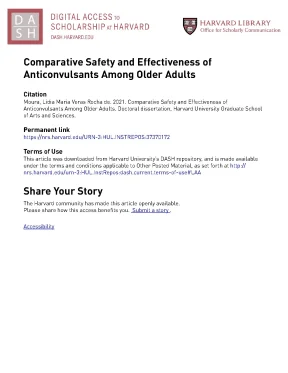
Tải xuống để đọc toàn bộComparative Safety and Effectiveness of Anticonvulsants Among Older Adults Citation Moura, Lidia Maria Veras Rocha de. Comparative Safety and Effectiveness of Anticonvulsants Among Older Adults. Doctoral dissertation, Harvard University Graduate School of Arts and Sciences. Permanent link https://nrs.edu/URN-3:HUL.INSTREPOS:37370172 Terms of Use This article was downloaded from Harvard University’s DASH repository, and is made available under the terms and conditions applicable to Other Posted Material, as set forth at http:// nrs.edu/urn-3:HUL.terms-of-use#LAA Share Your Story The Harvard community has made this article openly available.
Please share how this access benefits you. Accessibility Title Page Comparative Safety and Effectiveness of Anticonvulsants Among Older Adults A dissertation presented By Lídia Maria Veras Rocha de Moura to The Department of Epidemiology Harvard T. Chan School of Public Health in partial fulfillment of the requirements for the degree of Doctor of Philosophy in the subject of Population Health Sciences Harvard University Cambridge, Massachusetts August 2021 Copyright ã2021 Lidia Maria Veras Rocha de Moura All rights reserved Dissertation Advisor: Author: Sonia Hernández-Díaz Lídia Maria Veras Rocha de Moura Comparative Safety and Effectiveness of Anticonvulsants Among Older Adults Abstract Anticonvulsant use among older adults has increased 200-fold over the past 25 years.1 In our previous work, we estimated that one in eight older adults in the US are currently receiving anticonvulsants.2 The risk of adverse events approaches 20%, and 5% of them are potentially life- threatening.2-4 Older adults with Alzheimer’s disease and Alzheimer’s-related dementias (AD/ADRD) are more susceptible to these adverse effects.5-10 The most common indications for anticonvulsants are seizure prophylaxis, insomnia, pain, and agitation, which are all common conditions among older adults who survive an Acute Ischemic Stroke (AIS).11,12 In the US alone there are 7 million stroke survivors, and 800,000 new or recurrent stroke cases annually.11,13-15 The increasing in-hospital use of neurophysiology studies has led to greater detection of epileptiform abnormalities of uncertain clinical significance, greater perceived seizure risk, and increasing prescriptions of seizure prophylaxis with drugs like levetiracetam or phenytoin.16-19 Additionally, the rate of prescriptions of benzodiazepines for patients with post-AIS insomnia, periprocedural anxiety, and delirium (often manifested with agitation) continues to rise.2,20-23 In the meantime, major medical and psychiatric organizations suggest avoidance of anticonvulsants in those ≥65 years.2,20-28 Rigorous evidence is urgently needed about the effectiveness and safety of these drugs for older adults.5-10 However, randomized trials arguably are impractical because of large numbers needed for safety studies, the high cost of such studies, and difficulty recruiting older adults into clinical trials. Prior iii observational studies have severe limitations: small samples, poor data granularity and validity, selection bias, and confounding by indication.
Many factors may be associated with anticonvulsant initiation, including socio-demographic, clinical, and health-care utilization characteristics.29-32 To overcome these challenges, we linked data from a prospective stroke registry (Get-With-The Guidelines-Stroke) to comprehensive electronic health records (EHRs) and applied novel statistical methods to evaluate the effects of treatment initiation strategies among adults ≥65 years who are survivors of an AIS on adverse health outcomes, initially focusing on mortality in the next months. Moreover, to enable later work toward this overall goal in national Medicare data, we conducted a validation study linking Medicare claims and EHRs to optimize claims-based definitions of AD/ADRD, an important stratification measure. In Chapter 1, we examined the accuracy of claims-based diagnoses of AD/ADRD with respect to expert clinician adjudication using a novel database with individual-level linkages between electronic health record (EHR) and claims. A model that regressed reference standard dementia on a refined-count definition (i., the number of days with a qualifying diagnostic claims), and included age and sex, had excellent calibration to the reference standard with calibration-in-the-large [CV CITL] <0.001 and calibration slope of 0.
The adjudicated prevalence of dementia was 7% (n=2854, 95%CI: 6%-9%) in the target population. Using a predicted probability threshold of 0.5 to classify dementia, that model demonstrated negative predictive value of 90.5%), positive predictive value of 77.8%), and specificity of 93. Next, we linked the prospective stroke registry to EHRs and examined the comparative effectiveness and safety of benzodiazepines and seizure prophylaxis initiation strategies among older adults post-AIS. In Chapter 2, we focused on benzodiazepine prescriptions, which are typically short-term (i., one or few doses) used to treat insomnia and agitation, and may cause serious adverse effects within few hours of initiation.
In Chapter 3, we switched the focus to examine anticonvulsants given for seizure prophylaxis, which are often prescribed for 30-90 days or more, and may cause serious adverse effects within days or weeks of initiation. iv Specifically, in Chapter 2, we examined the difference in 30-day mortality risk associated with initiating benzodiazepines within seven days after an AIS compared with no benzodiazepines among patients ≥65 years. We concluded that in the overall population the excess in mortality associated with initiating benzodiazepines was largely due to confounding by indication. Excess deaths per 1,000 stratified by age ranged from 2 (95% CI -16 to 12), to 12 (95% CI -9 to 143), to 20 (95% CI -43 to 81) among patients 65-74, 75-84 years, and ≥ 85 years, respectively.
The RD was 1 (CI, -3 to 9) among patients with mild stroke (NIHSS <5) and 18 (CI, -85 to 148) among those with moderate-to-severe stroke (NIHSS 16-20). In Chapter 3, we examined the 90-day mortality risk associated with initiation of epilepsy-specific seizure prophylaxis within seven days after an AIS in patients ≥65 years. After standardization, the estimated mortality was 127 (95% CI, 64 to 256) and 65 (95% CI, 40 to 89) deaths per 1000 in the two strategies, corresponding to a risk difference (RD) of 62 (95% CI, -8 to 198) excess deaths per 1000 patients and a hazard ratio (HR) of 1. Therefore, we found evidence of a potential excess in 90-day mortality associated with initiating seizure prophylaxis within seven days post-AIS compared with not initiating seizure prophylaxis in the overall population.
However, the estimates were imprecise and residual confounding by indication remained a concern. In the prespecified subgroup analyses, the RD was 5 (CI, -8 to 10) among patients with minor and 88 (CI, -17 to 288) among those with moderate or severe AIS. Similarly, the RDs were 27 (95% CI -5 to 83) and 92 (95% CI -5 to 239) among patients aged 65-74 years and ≥ 75 years, respectively. The HR were similar across age and severity groups.
Our work highlights the urgent need to discuss whether older patients would benefit from or be harmed by initiation of anticonvulsant prophylaxis during the acute and post-acute stroke recovery periods. In future steps, we will examine the distribution of anticonvulsant specific outcomes as indicators of benefits (effectiveness) and harms (adverse reactions,), such as the incidence of seizure-like events and fall-related injuries and seizure-like events stratifying by care settings. We also will examine longer- term risks and benefits of other treatment indications and strategies including the comparative effectiveness and safety of specific anticonvulsants in the elderly. v Table of Contents Title Page.
iii Table of Contents. vi List of Tables. viii List of Figures. 1 Chapter 1 - Identifying Medicare Beneficiaries with Dementia: Validated Claims-Based Definition.
26 Chapter 2 - Short-term Mortality and Benzodiazepine Use After Acute Ischemic Stroke in Elderly. 53 Chapter 3 - Seizure Prophylaxis and Short-Term Outcomes after Acute Ischemic Stroke. Supplementary Materials for Chapter 1. Supplementary Materials for Chapter 2.
Supplementary Materials for Chapter 3. 201 vii List of Tables Table 1. Population Characteristics of Reconstructed Sample. Performance Characteristics: Logistic Model of Diagnostic Claim Count, Refined Claims-Based Definition (Model 7), Overall and by Age Group.
Description of A Target Trial and the Corresponding Observational Study. Characteristics of patients, by benzodiazepine initiator versus non-benzodiazepine initiator. Description of A Target Trial and The Corresponding Observational Study. Characteristics of patients by anticonvulsant exposure.
EHR-Adjudicated Dementia Status of Analytic Sample. ICD-10 Diagnostic Codes, removed from and Added to Refined Claims-Based Definition of Dementia (From Base Definition). Performance Characteristics: Ascertainment of EHR-Adjudicated Dementia by Base Claims- Based Definition. Logistic Regression Results: Ascertainment of EHR-Adjudicated Dementia by Refined Claims- Based Definition.
Logistic Model of Diagnostic Claim Count, Refined Claims-Based Definition. CV AUC from Models 2-7, compared with CV AUC from Model 1 (Base Model). Sensitivity Analysis; Logistic Model of Diagnostic Claim Count, Refined Claims-Based Definition, and Adjusted Reference Standard (Dementia and Mild Cognitive Impairment versus Dementia), Overall. Logistic Regression Results and Performance Characteristics, Claims-Based Definition with Removal of Nonspecific Diagnoses, Only.
Logistic Regression Results and Performance Characteristics, Claims-Based Definition with Removal of Reversible Etiologies of Altered Mental Status, Only. Logistic Model Results: Ascertainment of EHR-Adjudicated Dementia with “High or Moderate” Diagnostic Certainty by Base Claims-Based Definition. Logistic Model Results: Ascertainment of EHR-Adjudicated Dementia with “High or Moderate or Mild” Diagnostic Certainty by Base Claims-Based Definition. Logistic Model Results: Ascertainment of EHR-Adjudicated Dementia with “High or Moderate” Diagnostic Certainty by Refined Claims-Based Definition.
Logistic Model Results: Ascertainment of EHR-Adjudicated Dementia with “High or Moderate or Mild” Diagnostic Certainty by Refined Claims-Based Definition. Logistic Model Results: Ascertainment of EHR-Adjudicated Dementia by Level of Diagnostic Certainty, Count-Based Refined Claims Definition. Performance Characteristics: Logistic Model of Diagnostic Claim Count, Refined Claims-Based Definition (Model 7), Overall and by Age Group, Using only 2018 Claims. Logistic Model of Diagnostic Claim Count, Refined Claims-Based Definition, Using only 2018 Claims.
Terms used in Systematic Search. Diagnosis of Mild Cognitive Impairment (MCI) criteria. Diagnosis of dementia criteria. Dementia Severity Criteria.
Delirium diagnostic Criteria. ICD-9 and ICD-10 for Key Covariates. Characteristics of patients, by benzodiazepine initiation, after standardization. Characteristics of Patients, restricted to Minor Stroke Severity.
Characteristics of Patients, restricted to Moderate Stroke Severity. Characteristics of Patients, restricted to Moderate-to-Severe Stroke Severity. Description of Benzodiazepine Types. Pattern of Anticonvulsant Use Post-Benzodiazepine Initiation.
Mortality Distribution of the Sample Stratified by Exposure Definitions. Model Parameters for Estimating Benzodiazepine Initiation Weights. Main Estimates Aggregated from Datasets 1-5, Based on Rubin’s Rules. Main Results, Stratified by Stroke Severity.
Main Estimates, Stratified by Age Groups. The RECORD Statement. List of Epilepsy-Specific Anticonvulsants. ICD-9 and ICD-10 for Fall-Related Injuries (FRIs).
Mortality Distribution of the Eligible Sample Stratified by Exposure Definitions. Main Standardized Estimates for Stratified Sample - Stroke Severity. Main Standardized Estimates for Stratified Sample - Age Groups. The RECORD Statement.
195 x List of Figures Figure 1. Overview of Sampling Approach. Overlap of Claims-Based Definitions with EHR-Adjudicated Dementia, Overall and by Age. Area Under ROC Curve: Tradeoff Between Sensitivity and Specificity.
Selection of Eligible Patients with New Acute Ischemic Stroke (AIS) ≥65 years, 2014-2020. Crude and Standardized Survival Curves by Benzodiazepine Initiation Strategy. Standardized Survival Curves across Categories of Stroke Severity. Selection of eligible patients with new acute ischemic stroke (AIS) ≥65 years, 2014-2020.
Crude and Standardized Survival Curves by Seizure Prophylaxis Strategy during the first 90 days post stroke admission. Standardized Survival Curves by Epilepsy-Specific Anticonvulsant Initiation Strategy Across Categories of Stroke Severity. Standardized Survival Curves by Epilepsy-Specific Anticonvulsant Initiation Strategy Across Categories of Age. CV Calibration Plot: Logistic Model of Diagnostic Claim Count, Refined Claims-Based Definition.
Logistic Model of Diagnostic Claim Count, Refined Claims-Based Definition. Simplistic Representation of the Problem and Solution. Methods for Multiple Imputation. Crude Survival Curves, Overall and Stratified by Benzodiazepine Initiation.
Standardized Survival Curves, Stratified by Age, by benzodiazepine initiation. Simplistic Representation of the Problem and Solution. Crude Survival Curves, Overall and Stratified. 186 xi Acknowledgments When I was 10 years old, I saw my mom rescue a drowned kid.
At that moment, I decided to become a medical doctor so I could save lives. However, I saw too many people dying because of limited healthcare access and quality of care problems during my initial training. There were times when we would have to decide who would go to an intensive care unit among the patients in need.
Nội dung được bảo vệ bản quyền — Tải xuống đầy đủ
Trích dẫn luận án này
Lídia Maria Veras Rocha de Moura (2021). Phdthesis lmoura 20210907 final [Luận án tiến sĩ, Harvard University]. LuanAn.net. https://luanan.net/giao-duc-hoc/phdthesis-lmoura-20210907-final
Câu hỏi thường gặp
Luận án "Phdthesis lmoura 20210907 final" nghiên cứu về vấn đề gì?
Luận án Tiến sĩ lmoura, bản hoàn chỉnh ngày 07/09/2021.
Luận án "Phdthesis lmoura 20210907 final" được bảo vệ tại trường nào?
Luận án này được bảo vệ tại Harvard University. Năm bảo vệ: 2021.
Luận án "Phdthesis lmoura 20210907 final" thuộc chuyên ngành gì?
Luận án "Phdthesis lmoura 20210907 final" thuộc chuyên ngành Population Health Sciences. Danh mục: Giáo Dục Học.
Luận án "Phdthesis lmoura 20210907 final" có bao nhiêu trang?
Luận án "Phdthesis lmoura 20210907 final" có 234 trang. Bạn có thể xem trước một phần tài liệu ngay trên trang web trước khi tải về.
Cách tải luận án "Phdthesis lmoura 20210907 final" về máy như thế nào?
Để tải luận án về máy, bạn nhấn nút "Tải xuống ngay" trên trang này, sau đó hoàn tất thanh toán phí lưu trữ. File sẽ được tải xuống ngay sau khi thanh toán thành công. Hỗ trợ qua Zalo: 0559 297 239.