Dorin dissertation 2015
Luận án của Dorin năm 2015.
Năm xuất bản
Số trang
554
Thời gian đọc
1 giờ 24 phút
Lượt xem
0
Lượt tải
0
Phí lưu trữ
85 Point
Tổng quan nhanh
- Chủ đề:
- The Dorin Dissertation: Medieval Usury & Expulsion
- Số trang:
- 554 trang
- Trường:
- harvard university
- Chuyên ngành:
- History
- Tác giả:
- Rowan William Dorin
- Năm:
- 2015
Tóm tắt nội dung luận án
I.The Dorin Dissertation Medieval Usury Expulsion
This academic publication, the "Dorin dissertation 2015," presents a comprehensive doctoral research project. Titled "Banishing Usury: The Expulsion of Foreign Moneylenders in Medieval Europe, 1200-1450," it represents a significant scholarly work from Harvard University. The thesis explores the systematic banishment of foreign moneylenders. These expulsions occurred across Western Europe during a crucial historical period. The document investigates the underlying reasons and practical implementation of these decrees. It contributes significantly to understanding medieval economic and legal history. This Ph.D. thesis offers deep insights into a complex societal phenomenon.
1.1. Title and Academic Context
The dissertation, authored by Rowan William Dorin, focuses on the expulsion of usurers. It was submitted to Harvard University's Graduate School of Arts & Sciences. This major academic publication fulfilled requirements for a Doctor of Philosophy degree in History. The work is a vital contribution to medieval studies, housed within the university library's collection.
1.2. Core Subject Foreign Moneylenders
The central theme involves the banishment of foreigners lending money at interest. These individuals were predominantly Christians from northern Italy. Rulers across medieval Europe frequently ordered their expulsion. This phenomenon impacted economic life significantly. The research delves into the social and spiritual implications of these actions.
1.3. Historical Scope 1200 1450
The study spans a critical period in medieval European history. It covers developments from the early thirteenth century to the mid-fifteenth century. This timeframe witnessed significant shifts in economic practices, legal frameworks, and social attitudes towards credit. The dissertation meticulously analyzes these changes over two and a half centuries.
II.Understanding Medieval Europe s Credit Economy
Expulsions of foreign moneylenders emerged against a backdrop of increasing societal anxieties. These concerns centered on the rapidly expanding credit economy in medieval Europe. The spiritual and social consequences of lending at interest became significant issues. From 1274, these expulsions gained robust backing from canon law. The church hierarchy actively commanded rulers to remove foreign moneylenders. This support transformed local practices into a universal mandate. Standing threats of expulsion were codified into legal statutes across vast regions, from Salzburg to northern Spain. This integration into statute-books shows the depth of the issue. The doctoral research illuminates this critical intersection of economy and religion.
2.1. Credit Anxieties and Social Impact
A rapidly expanding credit economy fueled social unrest. Fears grew over its moral and spiritual ramifications. Usury was condemned, creating a climate of suspicion against moneylenders. Public sentiment often supported the banishment policies. This academic publication highlights these societal tensions.
2.2. Canon Law and Ecclesiastical Mandates
Canon law played a pivotal role in legitimizing expulsions. The church, inspired by secular precedents, issued mandates for banishment. These commands carried significant weight with rulers. Ecclesiastical decrees reinforced the legal justification for expelling usurers. This aspect is central to the thesis's argument.
2.3. Legal Framework for Banishment
Expulsion threats were systematically integrated into local and regional statute-books. This formalized the practice across Western Europe. Legal structures provided the basis for enforcement. The research methodology included examining these legal texts. They offer crucial evidence for the study of medieval law and order.
III.Research Methodology Exploring Expulsion s Dynamics
The Ph.D. thesis employs an extensive research methodology. It draws upon a wide array of evidence gathered from seventy archives and libraries. This robust approach ensures a comprehensive understanding of the topic. The dissertation explores how the idea of expelling foreign usurers emerged and spread. It examines its manifestation in practical application. The study also investigates how targets of expulsion were defined. Furthermore, it analyzes the enforcement mechanisms of these orders. Understanding whether orders were implemented or ignored is crucial. This scholarly work provides a detailed literature review of historical sources. The depth of research underpins the academic publication's findings. It offers a new perspective on medieval administrative practices.
3.1. Extensive Archival Research
Evidence was meticulously collected from numerous archival sources. Seventy different archives and libraries contributed to the data. This extensive data collection forms the backbone of the research methodology. Such thoroughness strengthens the findings of this doctoral research. It ensures a rich, detailed historical reconstruction.
3.2. Evolution of Expulsion Concepts
The dissertation traces the intellectual and legal evolution of expulsion ideas. It examines how these concepts developed and disseminated. Understanding their spread across late medieval Europe is a primary objective. This analysis reveals the changing perceptions of usury and foreignness.
3.3. Enforcement Mechanisms Examined
The study scrutinizes the practical enforcement of expulsion orders. It investigates how these decrees were either implemented or neglected. Factors influencing enforcement are identified. This provides insight into the actual impact of legal mandates on daily life and commercial practices. It highlights the complexities of medieval governance.
IV.Key Findings Impact on Society and Law
The dissertation reveals how administrative procedures, intellectual categories, and linguistic habits circulated and evolved. These elements shaped the banishment of foreign usurers. Crucially, they also influenced the expulsion of other groups, most notably the Jews. The research reconstructs these expulsions and their accompanying legal and theological debates. It sheds new light on the interpenetration of law and economic life in premodern Europe. This academic publication demonstrates the profound impact of these policies on the geography of credit. It offers a fresh perspective on historical developments. The scholarly work highlights the interconnectedness of various societal components.
4.1. Shaping Expulsion Practices
Administrative procedures and intellectual frameworks significantly influenced expulsion practices. These elements circulated and adapted across different regions. Their evolution demonstrates a dynamic process. The dissertation uncovers the mechanisms by which these practices were standardized or varied.
4.2. Impact on Jewish Communities
The banishment of foreign moneylenders had spillover effects. These effects notably extended to Jewish communities. The research shows how categories used for usurers were reinterpreted for other targets. This provides crucial context for understanding medieval anti-Jewish policies. The Ph.D. thesis offers insights into this complex historical link.
4.3. Law s Role in Economic Life
The study emphasizes the deep connection between law and economic activities. Legal frameworks profoundly shaped commercial practices in premodern Europe. Expulsion orders directly impacted the flow of credit and the structure of local economies. This doctoral research offers new insights into this dynamic interplay.
V.Broad Themes and Scholarly Contributions
This academic publication weaves together a tapestry of broad themes. It connects the circulation of merchants and manuscripts. It explores conflicting overlaps in political jurisdictions and commercial practices. The research examines the resilience of Biblical exegesis and the flexibility of legal hermeneutics. It also analyzes shifts in political thought and church doctrine. Definitions of foreignness and the limits of citizenship are critically assessed. Above all, this scholarly work frames late medieval Europe as a society where practices of expulsion reasserted themselves. These practices had largely fallen into abeyance since late antiquity. The dissertation treats expulsion as a contagious and protean phenomenon. It is a vital contribution to academic writing and historical scholarship. Its findings are essential for any academic database user studying medieval history.
5.1. Interconnected Historical Factors
The dissertation connects diverse historical factors. These include trade routes, manuscript transmission, and political authority. It examines how these elements converged to shape expulsion policies. The interplay of religious, legal, and economic forces is thoroughly analyzed. This provides a holistic view of the period.
5.2. Redefining Expulsion in Europe
The thesis argues for the re-emergence of expulsion as a significant societal practice. It highlights how medieval Europe became an 'expelling society.' This redefinition offers a novel framework for understanding social dynamics. The concept of contagious and protean expulsion is central to this interpretation.
5.3. Enduring Academic Relevance
The Dorin dissertation holds lasting academic relevance. It contributes to ongoing debates on identity, economic history, and legal history. Its insights into premodern Europe's social and legal structures remain valuable. The doctoral research enriches the understanding of historical continuity and change. It serves as a key reference in its field.
Tải xuống file đầy đủ để xem toàn bộ nội dung
Tải đầy đủ (554 trang)Trích đoạn nội dung luận án
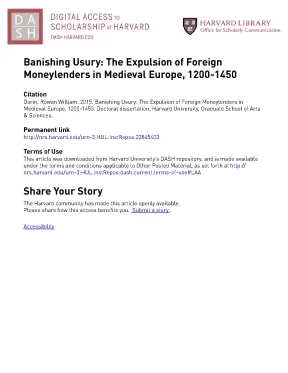
Tải xuống để đọc toàn bộBanishing Usury: The Expulsion of Foreign Moneylenders in Medieval Europe, 1200-1450 Citation Dorin, Rowan William. Banishing Usury: The Expulsion of Foreign Moneylenders in Medieval Europe, 1200-1450. Doctoral dissertation, Harvard University, Graduate School of Arts & Sciences. Permanent link http://nrs.edu/urn-3:HUL.InstRepos:23845403 Terms of Use This article was downloaded from Harvard University’s DASH repository, and is made available under the terms and conditions applicable to Other Posted Material, as set forth at http:// nrs.edu/urn-3:HUL.terms-of-use#LAA Share Your Story The Harvard community has made this article openly available.
Please share how this access benefits you. Accessibility Banishing Usury: The Expulsion of Foreign Moneylenders in Medieval Europe, 1200-1450 A dissertation presented by Rowan William Dorin to the Department of History in partial fulfillment of the requirements for the degree of Doctor of Philosophy in the subject of History Harvard University Cambridge, Massachusetts July 2015 © 2015 Rowan William Dorin All rights reserved. Banishing Usury: The Expulsion of Foreign Moneylenders in Medieval Europe, 1200-1450 Abstract Starting in the mid-thirteenth century, kings, bishops, and local rulers throughout western Europe repeatedly ordered the banishment of foreigners who were lending at interest. The expulsion of these foreigners, mostly Christians hailing from northern Italy, took place against a backdrop of rising anxieties over the social and spiritual implications of a rapidly expanding credit economy.
Moreover, from 1274 onward, such expulsions were backed by the weight of canon law, as the church hierarchy—inspired by secular precedents—commanded rulers everywhere to expel foreign moneylenders from their lands. Standing threats of expulsion were duly entered into statute-books from Salzburg to northern Spain. This dissertation explores the emergence and spread of the idea of expelling foreign usurers across the intellectual and legal landscape of late medieval Europe. Building on a wide array of evidence gathered from seventy archives and libraries, the dissertation examines how the idea of expulsion expressed itself in practice, how its targets came to be defined, and how the resulting expulsion orders were enforced—or not.
It shows how administrative procedures, intellectual categories and linguistic habits circulated and evolved to shape the banishment not only of foreign usurers, but of other targets as well, most notably the Jews. By reconstructing these expulsions and their accompanying legal and theological debates, this dissertation weaves together broad themes ranging from the circulation of merchants and manuscripts to conflicting overlaps in political jurisdictions and commercial practices; from the resilience of Biblical exegesis to the flexibility of legal hermeneutics; and from shifts in political iii thought and church doctrine to definitions of foreignness and the limits of citizenship. It reveals the impact of expulsion on the geography of credit in the later Middle Ages and sheds new light on the interpenetration of law and economic life in premodern Europe. Above all, in treating expulsion as contagious and protean, this dissertation frames late medieval Europe as a society in which practices of expulsion that had fallen into abeyance since late antiquity once again reasserted themselves in European practice and thought.
iv Table of Contents Acknowledgments. xiii List of Maps. xvi A Note on Usage. xvii Introduction: Credit, Contagion and the Rise of an Expelling Society.
1 Chapter One: Aliens, Schismatics, and Merchant-Bankers—Inventing Expulsion in Thirteenth-Century England. 39 Chapter Two: Sin and Sanctity—Modelling Expulsion in Thirteenth-Century France. 80 Chapter Three: From the Particular to the Universal—Canonizing Expulsion. 109 Chapter Four: Synods, Sermons, and Summas—Disseminating Expulsion.
150 Chapter Five: The Ignorant, the Irregular, and the Damned—Implementing Expulsion. 201 Chapter Six: From Foreigners to Jews—Reinterpreting Expulsion. 280 Epilogue: Expulsions and their Aftermath. 322 Appendix A: Expulsion and Exegesis—Late Medieval Commentary on the Cleansing of the Temple.
349 Appendix B: References to Usurarum voraginem in Ecclesiastical Legislation, 1274-1400. 374 Unpublished Manuscripts and Archival Materials. 374 Printed Primary Sources. 422 v To my grandparents vi Acknowledgments A photograph of Angeliki Laiou looks down on the desk where most of this dissertation was written.
Although she did not live to see its completion, or indeed even its beginning, her presence lingers over every page. While I was still an undergraduate, she introduced me to the economic history of the Middle Ages and, in particular, to the Italian merchants who crossed the Alps and sailed the Mediterranean. So too did she spark my interest in the history of economic thought, the interaction of legal norms and social practice, and the integration of foreigners into their host societies—all themes that loom large in this study. Were it not for her encouragement, I would never have pursued graduate studies in history.
Her incomparable example guides me still. It was at her prompting that I attended a conference in Asti, Italy, in June 2007, organized by what is now the Centro Studi “Renato Bordone” sui Lombardi, sul credito e sulla banca. The impact of that experience is clear from the topic of this dissertation, and I am grateful to the Centro’s steering committee for their generous support of my research. I am likewise indebted to the Mellon Foundation, which sponsored my dissertation research through fellowships from the Council on Library and Information Resources and the American Council of Learned Societies.
An Arthur Lehman Merit Fellowship from the Graduate School at Harvard University allowed me to make early headway on writing. Harvard’s History Department generously offset conference costs and much else beside, and I sincerely appreciate the kindness of all the staff members who have made my eleven years in Robinson Hall such happy ones, especially Janet Hatch, Ann Kaufman, Mary McConnell, and Laura Johnson. For feedback and encouragement, I am especially grateful to the participants of the Medieval History Workshop and the Graduate Workshop of the Center for History and Economics, both of vii which have been inspiring intellectual communities during my time at Harvard. In Bologna, Maria Giuseppina Muzzarelli provided me with a forum to test out some of my early ideas about expulsion in the Middle Ages; I thank her for that opportunity, and for her encouragement of this project since its inception.
I am still wrestling with many of the ideas that emerged from a conference on “Finance in Religious Law” at Harvard Law School in 2013, and particularly from the volley of searching questions posed by its organizer, Noah Feldman. I have learned much from the comments and critiques of audiences at the American Historical Association, the American Society for Legal History, the European University Institute in Fiesole, the Université Paris 1 Panthéon-Sorbonne, and Yale University. In the course of writing my dissertation, I have turned repeatedly to colleagues at Harvard and elsewhere for guidance. For sharing their expertise and experience, I would like to thank David Abulafia, Joel Anderson, Lawrin Armstrong, Christine Axen, the late John Baldwin, Thomas Bisson, Antoine Bonnivert, Martin Brett, Peggy Brown, Menachem Butler, Julie Claustre-Mayade, Cristoph Cluse, Marie Dejoux, Delphine Diaz, Laurent Feller, Carla Heelan, Peter Johanek, Elizabeth Papp Kamali, Ira Katznelson, the late Mark Kishlansky, Deanna Klepper, Sally Livingston, Stuart McManus, Joey McMullen, Paolo Ostinelli, Sylvain Piron, Charles-Marie de la Roncière, Hervé Martin, Randall Morck, the late John Munro, Cédric Quertier, Alex Rehding, Sebastian Roebert, Emmanuelle Roux, Kirsi Salonen, Karl Shoemaker, Maria Elisa Soldani, Josh Specht, Bob Stacey, Stefan Stantchev, Sita Steckel, Steve Stofferahn, Kenneth Stow, Danica Summerlin, Valérie Theis, Andrea Tilatti, Giacomo Todeschini, Francesca Trivellato, Björn Weiler, and Cornel Zwierlein.
Collectively, they have saved me from many errors; the fault for those that remain is entirely mine. viii For sustained conversations and hard questions, I am particularly grateful to Christine Desan, Chris Muller, William O’Reilly, and the undergraduates in my seminar on “Histories of Expulsion in the Premodern West.” And although it would surely come as a great surprise to them, the topic of this dissertation owes much to chance conversations with Madam Justice Rosalie Abella and Professor Quentin Skinner. Had they not been so visibly bored by my description of an earlier dissertation topic, I should never have gone hunting for a new one. Researching this dissertation led me to impose on the hospitality of colleagues and friends across Europe and elsewhere.
During my stay in Paris, François Menant graciously welcomed me into the community of the École normale supérieure and opened many other doors besides. Long days at the Bibliothèque nationale, the Archives nationales, and the Institut de recherche et d’histoire des textes were invariably brightened by the prospect of weekends with Cécile Morrisson and her family in Ville d’Avray, or evenings at the Opéra Bastille with David Belcher, Nicole Tang, and the many others whom I met in the line for standing room tickets. In Munich, Jutta and Pascale Schreier were wonderful hosts, as always. Although the following pages show few traces of the months I spent combing through Aragonese archives, the sheer delight of living with Currun Singh for three months in Barcelona handily compensated for daily archival disappointments, while motorcycle rides to monasteries with Riccardo Begelle made my stay in Catalonia all the more memorable.
In Italy, Marta Lizier, Alessia Rovelli, and Mario Turner have all made me feel so welcome over the years. I owe particular thanks to Ippolita Checcoli, whose friendship is another happy byproduct of the 2007 Asti conference, and whose knowledge of medieval history and Italian historiography saved me from countless pitfalls. Few places, moreover, are so conducive to reflection as the glorious tranquility of her family home at San Giusto, and I am grateful to the entire Checcoli family for letting me settle in for weeks on end. ix My research also relied on a network of helpful librarians and archivists at institutions across North America and Western Europe.
I would like to single out for particular thanks Isabelle le Masne de Chermont, Director of the Department of Manuscripts at the Bibliothèque nationale de France, who devoted considerable effort to locating a stray document in their collection; Marie Van Eeckenrode at the Archives écclesiastiques du Brabant in Louvain-la-Neuve, who showed similar tenacity in tracking down a charter for which I had only the sketchiest of references; all of the Special Collections staff at the Harvard Law School Library, who took an eager interest in my project from its very beginning; Scott Walker at the Harvard Map Collection; and the magic- workers at Harvard’s Interlibrary Loan services, for whom no periodical proved too obscure. I appreciate too the kind assistance of Francisco Javier Álvarez Carbajal, Joel Anderson, Matt Corriel, Regan Eby, Édouard Jeauneau, Corinna Matlis, Erika Smith, and Danica Summerlin, all of whom provided me with photographs or transcriptions of manuscripts that I was unable to consult myself. Hannah Schreier readily came to the rescue whenever I was confronted by passages of particularly impenetrable German, while Jamie McSpadden did the same for Dutch. When it came to presenting work-in-progress to audiences in Paris and Bologna, I was relieved to be able to turn to Marion Guillaume and Cécile Morrisson to correct my French, while Maria Sole Checcoli’s translation skills made me sound much better in Italian than I have ever sounded in English.
Back in Cambridge, Elliot Wilson compiled my database of Lombard activity with remarkable speed and accuracy. To all of my friends—far too many to name individually—who have put up with me over the course of graduate school, I offer my appreciation for what is past and my apologies for what is still to come. I owe particular thanks to Alison Drew, Robert Marx, Derek Erstad, and Natalie x Vokes, who have had to learn far more about history (medieval or otherwise) than they ever wanted to. Among my fellow historians, Tyler Goodspeed, Casey Lurtz, Paul Kosmin, and Caroline Spence Creson have been faithful sounding-boards and steadfast friends, and I have relied heavily on the aid and counsel of Rena Lauer.
Since our days together at the “other” Cambridge, Shane Bobrycki has been the best of friends and colleagues; I count myself impossibly lucky to have spent the last eight years traveling alongside one whose astonishing command of medieval history (and much else) is rivaled only by the generosity with which he shares it.
Nội dung được bảo vệ bản quyền — Tải xuống đầy đủ
Trích dẫn luận án này
Rowan William Dorin (2015). Dorin dissertation 2015 [Luận án tiến sĩ, Harvard University]. LuanAn.net. https://luanan.net/ly-luan-va-lich-su-giao-duc/dorin-dissertation-2015
Câu hỏi thường gặp
Luận án "Dorin dissertation 2015" nghiên cứu về vấn đề gì?
Luận án của Dorin năm 2015.
Luận án "Dorin dissertation 2015" được bảo vệ tại trường nào?
Luận án này được bảo vệ tại Harvard University. Năm bảo vệ: 2015.
Luận án "Dorin dissertation 2015" thuộc chuyên ngành gì?
Luận án "Dorin dissertation 2015" thuộc chuyên ngành History. Danh mục: Lý Luận và Lịch Sử Giáo Dục.
Luận án "Dorin dissertation 2015" có bao nhiêu trang?
Luận án "Dorin dissertation 2015" có 554 trang. Bạn có thể xem trước một phần tài liệu ngay trên trang web trước khi tải về.
Cách tải luận án "Dorin dissertation 2015" về máy như thế nào?
Để tải luận án về máy, bạn nhấn nút "Tải xuống ngay" trên trang này, sau đó hoàn tất thanh toán phí lưu trữ. File sẽ được tải xuống ngay sau khi thanh toán thành công. Hỗ trợ qua Zalo: 0559 297 239.