Trải nghiệm của phụ nữ Việt Nam với visa phụ thuộc: Nghiên cứu tại Mỹ
Nghiên cứu định tính về kinh nghiệm phụ nữ Việt Nam xin visa định cư Mỹ. Khám phá thách thức, yếu tố quyết định và chiến lược thành công trong nhập cư.
Bowling Green State University
Women’s and Gender Studies, Critical Race Studies, Postcolonial Studies, Vietnamese Studies
Luan An
Luận án tiến sĩ
Năm xuất bản
Số trang
287
Thời gian đọc
44 phút
Lượt xem
0
Lượt tải
0
Phí lưu trữ
50 Point
Tổng quan nhanh
- Chủ đề:
- Phụ nữ Việt Nam và visa định cư Mỹ: Nghiên cứu sâu
- Số trang:
- 287 trang
- Trường:
- Bowling Green State University
- Chuyên ngành:
- Women’s and Gender Studies, Critical Race Studies, Postcolonial Studies, Vietnamese Studies
- Tác giả:
- Thi Hai Ly Tran
- Năm:
- 2021
Tóm tắt nội dung luận án
I.Phụ nữ Việt Nam và visa định cư Mỹ Nghiên cứu sâu
Luận án kiểm tra trải nghiệm phụ nữ Việt Nam. Họ giữ visa vợ/chồng phụ thuộc không định cư tại Hoa Kỳ. Nghiên cứu xem xét cách chế độ visa Mỹ tương tác các khía cạnh bản sắc. Các yếu tố bao gồm chủng tộc, tầng lớp, giới tính, quốc tịch. Mục tiêu là hiểu rõ tác động tổng thể. Nghiên cứu tiến hành phỏng vấn sâu hai mươi phụ nữ Việt Nam. Họ đến Mỹ với tư cách vợ/chồng của lao động kỹ năng tạm thời. Phương pháp này giúp thu thập thông tin chi tiết. Nó khám phá những câu chuyện cá nhân. Nghiên cứu tiết lộ sự phân biệt chủng tộc, tầng lớp, giới tính. Phân biệt này nhắm vào người di cư có kỹ năng tạm thời sau năm 1990 và vợ/chồng của họ. Điều này xảy ra cả trong luật di trú Mỹ và các thực hành hàng ngày. Luận án làm rõ chế độ visa Mỹ thiên về giới tính và chủng tộc. Thái độ thực dân thấm nhuần trong xã hội Mỹ. Nó đẩy nhiều phụ nữ Việt Nam đi kèm vào phạm vi gia đình.
1.1. Mục tiêu nghiên cứu về phụ nữ Việt
Luận án kiểm tra trải nghiệm phụ nữ Việt Nam. Họ giữ visa vợ/chồng phụ thuộc không định cư tại Hoa Kỳ. Nghiên cứu xem xét cách chế độ visa Mỹ tương tác các khía cạnh bản sắc. Các yếu tố bao gồm chủng tộc, tầng lớp, giới tính, quốc tịch. Mục tiêu là hiểu rõ tác động tổng thể.
1.2. Phương pháp phỏng vấn thu thập dữ liệu
Nghiên cứu tiến hành phỏng vấn sâu hai mươi phụ nữ Việt Nam. Họ đến Mỹ với tư cách vợ/chồng của lao động kỹ năng tạm thời. Phương pháp này giúp thu thập thông tin chi tiết. Nó khám phá những câu chuyện cá nhân.
1.3. Khám phá tương tác yếu tố bản sắc
Nghiên cứu tiết lộ sự phân biệt chủng tộc, tầng lớp, giới tính. Phân biệt này nhắm vào người di cư có kỹ năng tạm thời sau năm 1990 và vợ/chồng của họ. Điều này xảy ra cả trong luật di trú Mỹ và các thực hành hàng ngày. Luận án làm rõ chế độ visa Mỹ thiên về giới tính và chủng tộc. Thái độ thực dân thấm nhuần trong xã hội Mỹ. Nó đẩy nhiều phụ nữ Việt Nam đi kèm vào phạm vi gia đình.
II.Thực trạng định cư người Việt Thách thức phân biệt
Chế độ visa Mỹ mang tính phân biệt chủng tộc và giới tính. Điều này tác động trực tiếp đến phụ nữ Việt Nam. Người vợ/chồng đi kèm bị xếp vào vai trò nội trợ. Chính sách di trú hiện hành không công bằng. Nó tạo ra rào cản lớn. Thái độ thực dân thấm nhuần trong xã hội Mỹ. Điều này góp phần hạn chế vai trò phụ nữ Việt Nam. Nhiều phụ nữ đi kèm bị đẩy vào phạm vi gia đình. Họ mất đi cơ hội tham gia các hoạt động xã hội. Việc 'nội trợ hóa' phụ nữ đi kèm mang lại hậu quả tiêu cực. Nó ảnh hưởng đến tâm lý, mối quan hệ gia đình. Việc hội nhập xã hội trở nên khó khăn. Nghiên cứu kêu gọi cải cách chính sách di trú toàn diện. Đối tượng là người di cư kỹ năng tạm thời từ các nước phía Nam bán cầu. Vợ/chồng đi kèm của họ cũng cần được quan tâm. Họ là những người 'được mong muốn nhưng không được chào đón'. Thực trạng định cư của người Việt gặp nhiều thách thức.
2.1. Phân biệt chủng tộc giới tính visa Mỹ
Chế độ visa Mỹ mang tính phân biệt chủng tộc và giới tính. Điều này tác động trực tiếp đến phụ nữ Việt Nam. Người vợ/chồng đi kèm bị xếp vào vai trò nội trợ. Chính sách di trú hiện hành không công bằng. Nó tạo ra rào cản lớn.
2.2. Phụ nữ Việt bị hạn chế trong nước Mỹ
Thái độ thực dân thấm nhuần trong xã hội Mỹ. Điều này góp phần hạn chế vai trò phụ nữ Việt Nam. Nhiều phụ nữ đi kèm bị đẩy vào phạm vi gia đình. Họ mất đi cơ hội tham gia các hoạt động xã hội.
2.3. Hậu quả chính sách thực tiễn định cư
Việc 'nội trợ hóa' phụ nữ đi kèm mang lại hậu quả tiêu cực. Nó ảnh hưởng đến tâm lý, mối quan hệ gia đình. Việc hội nhập xã hội trở nên khó khăn. Nghiên cứu kêu gọi cải cách chính sách di trú toàn diện. Đối tượng là người di cư kỹ năng tạm thời từ các nước phía Nam bán cầu. Vợ/chồng đi kèm của họ cũng cần được quan tâm. Họ là những người 'được mong muốn nhưng không được chào đón'.
III.Hội nhập xã hội Mỹ Tác động tâm lý gia đình
Việc bị 'nội trợ hóa' gây ra nhiều tác động tiêu cực. Sức khỏe tâm thần của phụ nữ Việt Nam bị ảnh hưởng. Cảm giác cô lập, mất mát bản thân xuất hiện. Họ đối mặt với căng thẳng hàng ngày. Vai trò giới trong gia đình thay đổi đáng kể. Quan hệ gia đình cũng bị ảnh hưởng tiêu cực. Áp lực kinh tế, xã hội tạo ra mâu thuẫn. Phụ nữ phải thích nghi với môi trường mới. Hội nhập xã hội trở thành thách thức lớn. Phụ nữ gặp khó khăn trong việc tạo dựng các mối quan hệ. Họ cần sự hỗ trợ từ cộng đồng người Việt ở Mỹ. Việc này giúp họ vượt qua rào cản văn hóa. Nó cũng giúp họ tìm thấy sự kết nối. Thách thức định cư này rất lớn.
3.1. Nội trợ hóa Ảnh hưởng tâm lý
Việc bị 'nội trợ hóa' gây ra nhiều tác động tiêu cực. Sức khỏe tâm thần của phụ nữ Việt Nam bị ảnh hưởng. Cảm giác cô lập, mất mát bản thân xuất hiện. Họ đối mặt với căng thẳng hàng ngày.
3.2. Thay đổi vai trò giới quan hệ gia đình
Vai trò giới trong gia đình thay đổi đáng kể. Quan hệ gia đình cũng bị ảnh hưởng tiêu cực. Áp lực kinh tế, xã hội tạo ra mâu thuẫn. Phụ nữ phải thích nghi với môi trường mới.
3.3. Xây dựng mối quan hệ xã hội tại Mỹ
Hội nhập xã hội trở thành thách thức lớn. Phụ nữ gặp khó khăn trong việc tạo dựng các mối quan hệ. Họ cần sự hỗ trợ từ cộng đồng người Việt ở Mỹ. Việc này giúp họ vượt qua rào cản văn hóa. Nó cũng giúp họ tìm thấy sự kết nối.
IV.Quyền tự chủ phụ nữ Việt Vượt qua rào cản di trú
Nghiên cứu nhấn mạnh quyền tự chủ cá nhân. Phụ nữ Việt Nam tìm nhiều cách để vượt qua khó khăn. Họ thích nghi với những thay đổi trong vai trò giới. Khả năng giải quyết vấn đề tài chính được thể hiện. Họ chủ động tìm kiếm các nguồn lực. Sự hỗ trợ từ cộng đồng người Việt ở Mỹ đóng vai trò quan trọng. Điều này giúp họ xây dựng mạng lưới xã hội. Họ tạo dựng các mối quan hệ mới tại Mỹ. Phụ nữ Việt Nam thể hiện sự kiên cường. Họ không ngừng nỗ lực để thay đổi vai trò. Họ cải thiện vị thế của mình trong xã hội Mỹ. Đây là minh chứng cho tinh thần mạnh mẽ. Cơ hội cho phụ nữ Việt tại Mỹ vẫn tồn tại dù có nhiều thách thức định cư.
4.1. Khả năng thích nghi giải quyết vấn đề
Nghiên cứu nhấn mạnh quyền tự chủ cá nhân. Phụ nữ Việt Nam tìm nhiều cách để vượt qua khó khăn. Họ thích nghi với những thay đổi trong vai trò giới. Khả năng giải quyết vấn đề tài chính được thể hiện.
4.2. Tìm kiếm nguồn lực hỗ trợ cộng đồng
Họ chủ động tìm kiếm các nguồn lực. Sự hỗ trợ từ cộng đồng người Việt ở Mỹ đóng vai trò quan trọng. Điều này giúp họ xây dựng mạng lưới xã hội. Họ tạo dựng các mối quan hệ mới tại Mỹ.
4.3. Biến đổi vai trò vị thế trong xã hội
Phụ nữ Việt Nam thể hiện sự kiên cường. Họ không ngừng nỗ lực để thay đổi vai trò. Họ cải thiện vị thế của mình trong xã hội Mỹ. Đây là minh chứng cho tinh thần mạnh mẽ. Cơ hội cho phụ nữ Việt tại Mỹ vẫn tồn tại.
V.Cải cách luật di trú Mỹ Hướng đến công bằng hơn
Nghiên cứu kêu gọi đánh giá lại chính sách di trú. Đặc biệt là đối với người di cư kỹ năng tạm thời. Vợ/chồng đi kèm cần được xem xét lại. Luật di trú Mỹ hiện chưa đủ công bằng. Đề xuất cải cách toàn diện trong chính sách nhập cư. Điều này bao gồm việc sửa đổi quy định visa. Nó nhằm tạo điều kiện tốt hơn cho người nhập cư. Cần có quy trình xin visa định cư rõ ràng hơn. Chính sách mới cần hỗ trợ người nhập cư diện phụ thuộc. Họ thường gặp nhiều thách thức. Mục tiêu là biến họ từ 'được mong muốn nhưng không được chào đón' thành thành viên tích cực. Tạo cơ hội Thẻ xanh Mỹ dễ dàng hơn cho diện visa bảo lãnh gia đình. Cần loại bỏ sự phân biệt đối xử.
5.1. Đánh giá chính sách di trú hiện hành
Nghiên cứu kêu gọi đánh giá lại chính sách di trú. Đặc biệt là đối với người di cư kỹ năng tạm thời. Vợ/chồng đi kèm cần được xem xét lại. Luật di trú Mỹ hiện chưa đủ công bằng.
5.2. Đề xuất cải cách toàn diện chính sách
Đề xuất cải cách toàn diện trong chính sách nhập cư. Điều này bao gồm việc sửa đổi quy định visa. Nó nhằm tạo điều kiện tốt hơn cho người nhập cư. Cần có quy trình xin visa định cư rõ ràng hơn.
5.3. Hướng tới hỗ trợ người nhập cư diện phụ thuộc
Chính sách mới cần hỗ trợ người nhập cư diện phụ thuộc. Họ thường gặp nhiều thách thức. Mục tiêu là biến họ từ 'được mong muốn nhưng không được chào đón' thành thành viên tích cực. Tạo cơ hội Thẻ xanh Mỹ dễ dàng hơn cho diện visa bảo lãnh gia đình. Cần loại bỏ sự phân biệt đối xử.
Mục lục chi tiết luận án
Tải xuống file đầy đủ để xem toàn bộ nội dung
Tải đầy đủ (287 trang)Trích đoạn nội dung luận án
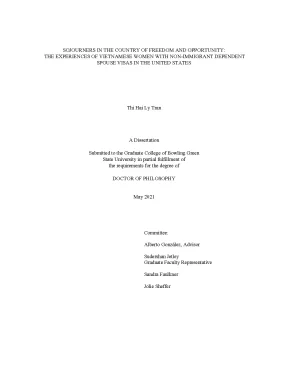
Tải xuống để đọc toàn bộSOJOURNERS IN THE COUNTRY OF FREEDOM AND OPPORTUNITY: THE EXPERIENCES OF VIETNAMESE WOMEN WITH NON-IMMIGRANT DEPENDENT SPOUSE VISAS IN THE UNITED STATES Thi Hai Ly Tran A Dissertation Submitted to the Graduate College of Bowling Green State University in partial fulfillment of the requirements for the degree of DOCTOR OF PHILOSOPHY May 2021 Committee: Alberto González, Advisor Sudershan Jetley Graduate Faculty Representative Sandra Faulkner Jolie Sheffer © 2021 Thi Hai Ly Tran All Rights Reserved iii ABSTRACT Alberto González, Advisor This dissertation examines how the U. visa regime interacted with various aspects of identity such as race, class, gender, and nationality to influence the experiences of Vietnamese women holding nonimmigrant spousal visas in the U. Through in-depth interviews with twenty Vietnamese women coming to the U. as spouses of temporary skilled migrants, my study reveals the racial, class, and gender discrimination against post-1990 Vietnamese temporary skilled migrants and their spouses in both U.
immigration laws and daily practices. In the dissertation, I clarify how the U. gendered and racialized visa regime and the permeation of colonialist attitude in American society relegated many Vietnamese accompanying women to the domestic sphere. I also discuss the negative impacts of Vietnamese accompanying women’s housewifization on their psyches, familial relationships, and social integration.
Although my study emphasizes the personal agency of Vietnamese accompanying spouses who found different ways to navigate changes in their gender roles, to solve their financial problems, and to create social bonds in the U., my study calls for a comprehensive reform in immigration policy toward temporary skilled migrants from the Global South and their accompanying spouses who are currently “wanted but not welcome” immigrants in the U. My study makes valuable contributions to various fields of critical studies such as women’s and gender studies, critical race studies, and postcolonial studies. Key terms: Skilled migration, gender and migration, accompanying spouses, visa regime, housewifization, social integration, globalization, women’s and gender studies, critical race studies, postcolonial studies, Vietnamese studies iv For Vietnam v ACKNOWLEDGMENTS When I think of my PhD journey, I get emotional because it has been a long, arduous but also rewarding journey through which I have grown both professionally and personally. I would like first to express my deep gratitude to dedicated professors and staffs at Bowling Green State University (BGSU) who provided me with enormous supports when I juggled studying and parenting during my two years of coursework.
I am particularly indebted to Dr. Alberto González, my great dissertation supervisor, without whom, I might have not been able to complete my dissertation. I always remembered the time when I was struggling to assemble my dissertation committee, Dr. González was the one who respected my thoughts, valued my research, and agreed to guide my dissertation.
González’s knowledge, professionalism, inspiration, and endless support enabled me to write an important dissertation that I could be proud of. I am also thankful to all members in my dissertation committee, Drs. Sandra Faulkner, Jolie Sheffer, and Sudershan Jetley for their valuable contributions to this dissertation. Faulkner helped me advance my understanding of feminist theories and methodologies which were used in my research.
Sheffer, despite her busy schedule, spared much time to provide me with invaluable feedback and suggestions. Jetley gave me stimulating ideas through his questions in the dissertation committee meetings. In general, my professors’ genuine commitment to students’ success has inspired me to be a dedicated teacher in the future. I am also grateful for the generous financial support from the government of Vietnam and the tremendous emotional support from my colleagues at the Banking Academy of Vietnam vi during my study in the U.
My special thanks also go to my research participants whose valuable sharing of their lived experiences has made this project possible. I truly appreciate their trust and long-lasting friendship even after my research was completed. In addition, I am blessed to have such supportive friends in Bowling Green as Mr. Jim, my kind landlord who frequently brought toys to my young children; Mr.
Leroy Josephsen and Ms. Linda Wahlie-Valentine whose beautiful friendship has made my family’s time at Bowling Green a happy memory. Moreover, words cannot adequately express how appreciative I am to my beloved extended family – my parents, parents-in-law, brothers, sisters, grandparents, aunts, uncles, and cousins whose wholehearted supports motivated me to take and complete this adventurous, tough, but full-of-love PhD journey. Finally, to my wonderful partner - Nguyen Hoang Duong, my caring daughter – Nguyen Quynh Anh, and my loving son – Nguyen Hoang Thai Minh, thank you for your unconditional love and support! I could not have obtained this achievement without you by my side.
vii TABLE OF CONTENTS Page CHAPTER I. GLOBALIZATION AND GENDERED MIGRATION: FOUNDATIONS FOR THE STUDY ON VIETNAMESE ACCOMPANYING WOMEN IN THE U. 1 Rationale and Research Questions. 9 Gender and Migration.
9 Globalization and Gendered Migration. 10 Visa Regimes and Gendered Migration. 12 Race, Class and Gendered Migration. 14 Impacts of Gendered Migration on Transnational Migrants.
15 Changes in Gender Relations. 15 Identity Negotiation among Dependent Spouse Visa Holders. 17 Vietnamese Transnational Migration to the U. 22 Theory of Intersectionality.
25 Gendered Geographies of Power. 27 Michel Foucault’s Theories of Govermentality and Power/ Knowledge. 29 viii Other Critical Theories. 31 Methodology and Procedures.
32 Overview of the Study. GLOBALIZATION AND THE GENDERING OF THE POST-1990 VIETNAMESE SKILLED MIGRATION TO THE U. 40 An Overview of Vietnamese Migration to the U. prior to the 1990s.
42 Vietnam’s Post-war Development Policies. 46 “Đổi Mới” Policy. 47 Vietnam’s Post-1995 Education Policies. 51 Vietnam’s Gendered Demand for Overseas-trained Highly Skilled Labor.
Gendered Demand for Highly Skilled Migrant Labor. 57 Gender Ideologies and Practices in Vietnam. CONSTRUCTING DEPENDENCE: STRUCTURAL AND CULTURAL BARRIERS TO VIETNAMESE ACCOMPANYING WOMEN’S PARTICIPATION IN THE U. Visa Regime and the Housewifization of Vietnamese Accompanying Women in the U.
68 The Racial, Class, and Gender Biases in the U. Immigration Policies toward Highly Skilled Temporary Migrants. 69 ix Governmentality, State Power, and the U. 74 Other Structural Barriers to Vietnamese Accompanying Women’s Employment.
77 Complicated, Lengthy, and Costly Immigration Processes. Bureaucracy and their Ignorance of Vietnamese Culture. 80 The Devaluation of Migrants’ Foreign Credentials. Employers’ Implicit Biases in Hiring process.
92 Wage Discrimination and Other Discriminatory Practices. FOR A HEALTHY MARRIAGE: VIETNAMESE ACCOMPANYING WOMEN’S NEGOTIATION OF GENDER ROLES AND FAMILIAL EXPECTATIONS IN THE U. 96 Negotiating Gender Roles and Spousal Power Relations. 99 Gender Roles in Middle-class Families in Vietnam.
101 Gender Roles and Spousal Relations among Vietnamese Nonimmigrant Married Couples in the U. 108 Handling In-law Tensions. 123 Dealing with Monetary Expectations from Natal Families. 129 Assessing Marital Satisfaction and Family Well-being.
SEARCHING FOR A COMMUNITY OF BELONGING: THE SOCIAL INTEGRATION OF VIETNAMESE NONIMMIGRANT WOMEN IN THE U. 142 Theories on Social (Dis)integration of Immigrants. 144 The (Dis)integration of Vietnamese Accompanying Women in the U. 149 Vietnamese Accompanying Women’s Cultural, Social, and Economic Integration.
154 Vietnamese Skilled Migrants’ (Dis)integration into Vietnamese American Communities. 170 The Emergence of Imagined Vietnamese Communities in the U. NAVIGATING GLOBALIZATION: VIETNAMESE ACCOMPANYING WOMEN’S STRUGGLES AGAINST SUBORDINATION IN THE U. 190 Vietnamese Accompanying Women’s Struggles against Subordination in the U.
191 Definitions of Power and Empowerment. 191 The (Dis)empowering Effects of Globalization. 193 Regaining their Lost Confidence and Social Independence: Vietnamese Accompanying Women and their Journeys to Obtain White-collar Jobs. 194 “Globalization from Below”: Vietnamese Accompanying Women and their Engagement in Globalization Processes.
202 Summary of the Study. 211 The Significance of the Study. DEMOGRAPHIC DETAILS OF THE RESEARCH PARTICIPANTS. VISA RESTRICTIONS FOR ACCOMPANYING SPOUSES OF VIETNAMESE TEMPORARY SKILLED MIGRANTS IN THE U.
ABBREVIATIONS, ACRONYMS, AND VIETNAMESE TERMS. QUESTIONS FOR OPEN-ENDED INTERVIEWS. 270 xii LIST OF FIGURES Figure Page 1 Vietnamese highly skilled migration to the U. GLOBALIZATION AND GENDERED MIGRATION: FOUNDATIONS FOR THE STUDY ON VIETNAMESE ACCOMPANYING WOMEN IN THE U.
Introduction The emergence of a global economy which resulted from centuries of expanding trade and the more recent technological revolution has led to an increased competition among countries around the world. To promote their economic competitiveness, many nation states enter the “global race for talent” – a “global competition for attaining highly skilled people” 1 to increase human capital for the development of a knowledge economy, which is defined as “an economy where knowledge-related activities such as production, creation, use, and dissemination are primary contributors to the economic growth.”2 While developing countries send their promising talents to developed countries for higher education, simultaneously creating systems of control to ensure the return of their talents, economically advanced countries implement immigration policies to both attract highly-skilled foreign workers and constrain the foreign mobile bodies. According to the Economist Intelligence Unit (2015), the U. has long been the country ranking the first, and well ahead of other countries, in producing and attracting talent.3 Since the enactments of the Immigration and Nationality Act of 1952, the U.
has placed employment- 1 Chi Hong Nguyen, “Transnational Mobilities of Australia-Educated and Domiciled Professional Migrants from Vietnam” (The University of Queensland, 2015), 1, https://espace.au/view/UQ:372322. 2 Mitt Nowshade Kabir, Knowledge-Based Social Entrepreneurship: Understanding Knowledge Economy, Innovation, and the Future of Social Entrepreneurship (London: Palgrave Macmillan US, 2019), 36. 3 Danny Kalman et al., “The Global Talent Index Report: The Outlook to 2015,” 2011, http://graphics.com/upload/eb/HeidrickGTI. 2 based preferences for aliens with economic potential, skills, and education.
The creation of various nonimmigrant visa programs such as the F-1 visas for international students, J-1 visas for exchange visitors (usually research scholars and professors), L-1 visas for intracompany transferee executives, managers, and professional employees with specialized knowledge, H-1B visas for foreign workers in specialty occupations, and O-1 visas for “individuals with extraordinary ability and achievement,” can be seen as one of the U. government’s attempts to attract and retain skilled migrants for economic growth. A report by Migration Policy Institute in 2006 points out that since the early 1970s, the “source of highly skilled foreign-born workers in the United States has shifted from Europe to Asia.”4 Especially, after the technology industry boom of the 1990s which created a thriving job market for people with technical and scientific skills, the numbers of immigrants from Asian countries, particularly from India and China to the U.5 As the country opens its door to welcome more people from previously restricted countries, William Bernard argues that the U. immigration policy has “gradually evolved from narrow and prejudiced restrictions to a system that shows growing tolerance for ethnic diversity, liberalism and generosity.”6 In addition, because a majority of the U.
public supports an immigration system 4 Neeraj Kaushal and Michael Fix, “The Contributions of High-Skilled Immigrants,” 2006, 7, https://www.org/sites/default/files/publications/TF16_Kaushal. 5 Tim Henderon, “More Educated Asians Are Coming to America,” USA Today, March 26, 2016. 6 William Bernard, “Immigration: History of U. Policy,” in The Immigration Reader: America in a Multidisciplinary Perspective, ed.
3 that favors highly skilled immigrants,7 research on skilled migration usually focuses on the impacts of skilled migration on sending and receiving countries, overlooking the challenges that highly skilled migrants and their significant others encounter in the U.8 The plight of highly skilled migrants’ accompanying spouses in the U. generally went unnoticed until Hearts Suspended, a twenty-minute autobiographical documentary film by Meghna Damani which initiated intense debates about an immigration law reform relating to H-4 visa category was released in 2007.9 The film reveals the untold story of highly educated South Asian immigrant women who came to the U. with H-4 visas and struggled to survive the serious emotional distress stemming from the denial of what they considered to be their basic right to work. As dependent spouses of highly skilled workers, H-4 visa holders were prohibited from generating any type of income in the U.S until their application for permanent U.
residency was approved.
Nội dung được bảo vệ bản quyền — Tải xuống đầy đủ
Trích dẫn luận án này
Thi Hai Ly Tran (2021). Phụ nữ Việt Nam và visa định cư tại Mỹ: Nghiên cứu định tính [Luận án tiến sĩ, Bowling Green State University]. LuanAn.net. https://luanan.net/chinh-tri-hoc/quan-he-quoc-te/kinh-nghiem-phu-nu-viet-nam-visa-phu-thuoc-my
Câu hỏi thường gặp
Luận án "Phụ nữ Việt Nam và visa định cư tại Mỹ: Nghiên cứu định tính" nghiên cứu về vấn đề gì?
Nghiên cứu định tính về kinh nghiệm phụ nữ Việt Nam xin visa định cư Mỹ. Khám phá thách thức, yếu tố quyết định và chiến lược thành công trong nhập cư.
Luận án "Phụ nữ Việt Nam và visa định cư tại Mỹ: Nghiên cứu định tính" được bảo vệ tại trường nào?
Luận án này được bảo vệ tại Bowling Green State University. Năm bảo vệ: 2021.
Luận án "Phụ nữ Việt Nam và visa định cư tại Mỹ: Nghiên cứu định tính" thuộc chuyên ngành gì?
Luận án "Phụ nữ Việt Nam và visa định cư tại Mỹ: Nghiên cứu định tính" thuộc chuyên ngành Women’s and Gender Studies, Critical Race Studies, Postcolonial Studies, Vietnamese Studies. Danh mục: Quan Hệ Quốc Tế.
Luận án "Phụ nữ Việt Nam và visa định cư tại Mỹ: Nghiên cứu định tính" có bao nhiêu trang?
Luận án "Phụ nữ Việt Nam và visa định cư tại Mỹ: Nghiên cứu định tính" có 287 trang. Bạn có thể xem trước một phần tài liệu ngay trên trang web trước khi tải về.
Cách tải luận án "Phụ nữ Việt Nam và visa định cư tại Mỹ: Nghiên cứu định tính" về máy như thế nào?
Để tải luận án về máy, bạn nhấn nút "Tải xuống ngay" trên trang này, sau đó hoàn tất thanh toán phí lưu trữ. File sẽ được tải xuống ngay sau khi thanh toán thành công. Hỗ trợ qua Zalo: 0559 297 239.