Nghĩa của việc tham gia chương trình tập thể dục và chăm sóc sức khỏe cho người tiểu đường - Nghiên cứu của Rebekkah Jane Middleton tại Đại học Wollongong
Tìm hiểu ý nghĩa chương trình tập thể dục, chăm sóc sức khỏe cho người tiểu đường: kiểm soát đường huyết, phòng biến chứng, nâng cao chất lượng sống.
University of Wollongong
Nursing
Luan An
Luận án tiến sĩ
Năm xuất bản
Số trang
364
Thời gian đọc
55 phút
Lượt xem
0
Lượt tải
0
Phí lưu trữ
60 Point
Tổng quan nhanh
- Chủ đề:
- Tầm quan trọng chương trình tập thể dục tiểu đường
- Số trang:
- 364 trang
- Trường:
- University of Wollongong
- Chuyên ngành:
- Nursing
- Tác giả:
- Rebekkah Jane Middleton
- Năm:
- 2016
Tóm tắt nội dung luận án
I.Tầm quan trọng chương trình tập thể dục tiểu đường
Diabetes là một bệnh mãn tính phổ biến toàn cầu. Bệnh ảnh hưởng đến hàng triệu người. Hoạt động thể chất mang lại nhiều lợi ích cho người bệnh tiểu đường. Tuy nhiên, việc duy trì thói quen tập luyện thường khó khăn. Nhiều người bệnh thiếu cam kết lâu dài. Việc tìm hiểu ý nghĩa đằng sau sự tham gia chương trình rất quan trọng. Nghiên cứu này khám phá điều đó. Nó giúp hiểu tại sao người bệnh chọn tham gia. Nó làm rõ giá trị họ nhận được. Sự hiểu biết này là nền tảng. Nó giúp phát triển các chương trình hiệu quả hơn. Mục tiêu là hỗ trợ người tiểu đường quản lý bệnh tốt hơn. Việc này góp phần giảm biến chứng tiểu đường. Nó cũng giúp cải thiện chất lượng cuộc sống.
1.1. Bệnh tiểu đường Thách thức sức khỏe toàn cầu.
Bệnh tiểu đường là vấn đề sức khỏe cộng đồng lớn. Tỷ lệ mắc bệnh tiếp tục gia gia tăng. Quản lý bệnh đòi hỏi sự thay đổi lối sống. Hoạt động thể chất là yếu tố then chốt. Nhiều chương trình giáo dục sức khỏe tiểu đường được triển khai. Tuy nhiên, hiệu quả duy trì chưa cao. Cần một cách tiếp cận mới. Cách tiếp cận này giúp người bệnh gắn bó hơn.
1.2. Nâng cao cam kết hoạt động thể chất.
Người bệnh tiểu đường cần hoạt động thể chất đều đặn. Điều này giúp kiểm soát đường huyết. Nó cũng giúp cải thiện độ nhạy insulin. Lợi ích tập thể dục tiểu đường được ghi nhận rõ ràng. Dù vậy, tỷ lệ bỏ cuộc còn cao. Nghiên cứu này tìm hiểu động lực tham gia. Nó khám phá ý nghĩa chương trình với người bệnh. Điều này giúp các nhà làm chương trình thiết kế tốt hơn. Mục tiêu là tạo ra sự cam kết bền vững.
II.Lợi ích vật lý khi tham gia chương trình tiểu đường
Tham gia chương trình tập thể dục mang lại nhiều lợi ích thể chất. Người bệnh tiểu đường trải nghiệm cải thiện rõ rệt. Các chỉ số sức khỏe được tối ưu hóa. Hoạt động thể chất giúp tăng cường chức năng tim mạch. Sức bền cơ bắp cũng được nâng cao. Việc tập luyện thường xuyên góp phần giảm mỡ cơ thể. Nó giúp xây dựng khối lượng cơ nạc. Các hoạt động này trực tiếp tác động tích cực đến quá trình quản lý đường huyết. Người bệnh cảm thấy khỏe khoắn hơn. Năng lượng tăng lên. Khả năng thực hiện các hoạt động hàng ngày tốt hơn. Đây là yếu tố quan trọng để duy trì chất lượng cuộc sống. Lợi ích tập thể dục tiểu đường không chỉ giới hạn ở mức đường huyết. Nó còn ảnh hưởng đến toàn bộ cơ thể.
2.1. Cải thiện sức khỏe thể chất tổng thể.
Người bệnh tiểu đường cần một cơ thể khỏe mạnh. Các chương trình tập thể dục hỗ trợ điều này. Hoạt động thể chất giúp tăng cường sức mạnh. Nó cải thiện sự linh hoạt. Khả năng giữ thăng bằng cũng được nâng cao. Điều này giảm nguy cơ té ngã. Đây là một biến chứng tiểu đường tiềm ẩn. Người bệnh có thể thực hiện nhiều hoạt động hơn. Cuộc sống hàng ngày trở nên dễ dàng.
2.2. Kiểm soát đường huyết hiệu quả.
Tập thể dục là công cụ mạnh mẽ để quản lý đường huyết. Nó giúp tăng độ nhạy insulin của cơ thể. Các tế bào hấp thụ glucose hiệu quả hơn. Mức đường huyết sau bữa ăn giảm xuống. Tập luyện còn hỗ trợ kiểm soát cân nặng tiểu đường. Giảm cân hoặc duy trì cân nặng khỏe mạnh là cần thiết. Điều này giảm gánh nặng cho tụy. Nó giúp giảm nguy cơ mắc các biến chứng nghiêm trọng.
III.Hỗ trợ tâm lý và kết nối xã hội cho người tiểu đường
Yếu tố con người đóng vai trò trung tâm trong sự thành công. Chương trình tập thể dục không chỉ là vận động thể chất. Nó còn là không gian cho sự phát triển tinh thần và xã hội. Người bệnh tìm thấy động lực từ môi trường xung quanh. Sự hỗ trợ tâm lý tiểu đường là vô cùng quan trọng. Cảm giác thuộc về một cộng đồng giúp người bệnh không cảm thấy cô đơn. Chia sẻ kinh nghiệm và thách thức với người đồng cảnh ngộ mang lại sức mạnh. Điều này giúp củng cố tinh thần. Nó khuyến khích sự kiên trì. Các lợi ích này vượt ra ngoài những cải thiện về thể chất. Nó tạo ra một nền tảng vững chắc cho việc quản lý bệnh lâu dài. Chương trình trở thành một phần ý nghĩa của cuộc sống.
3.1. Động lực duy trì thói quen tập luyện.
Động lực là yếu tố then chốt. Người bệnh cần lý do để tiếp tục. Chương trình cung cấp môi trường khuyến khích. Sự hỗ trợ từ nhóm và người hướng dẫn thúc đẩy cam kết. Người bệnh tìm thấy mục đích. Họ nhận ra giá trị của việc chăm sóc bản thân. Đây là động lực nội tại. Nó giúp vượt qua những lúc nản lòng.
3.2. Cảm giác kết nối và chia sẻ kinh nghiệm.
Chương trình tạo ra một cộng đồng. Người bệnh gặp gỡ những người có hoàn cảnh tương tự. Họ chia sẻ câu chuyện. Họ trao đổi kiến thức về giáo dục sức khỏe tiểu đường. Sự kết nối này giảm cảm giác bị cô lập. Nó tạo ra một mạng lưới hỗ trợ quý giá. Người bệnh cảm thấy được thấu hiểu. Họ không đơn độc trong hành trình của mình.
3.3. Cải thiện sức khỏe tinh thần.
Hoạt động thể chất giúp giảm căng thẳng. Nó cải thiện tâm trạng. Sự tương tác xã hội trong chương trình cũng có lợi. Nó giúp giảm triệu chứng lo âu, trầm cảm. Người bệnh cảm thấy tự tin hơn. Họ có cái nhìn tích cực hơn về cuộc sống. Điều này là một phần quan trọng của chăm sóc sức khỏe người bệnh tiểu đường toàn diện.
IV.Thiết kế chương trình sức khỏe hiệu quả cho người tiểu đường
Việc thiết kế chương trình phải dựa trên sự hiểu biết sâu sắc. Nó cần tập trung vào ý nghĩa mà người bệnh gán cho sự tham gia. Phương pháp tiếp cận hiện tượng học đã được sử dụng. Cách tiếp cận này khám phá trải nghiệm sống của người bệnh. Nó tìm hiểu động lực sâu xa của họ. Chương trình thành công không chỉ truyền đạt kiến thức. Nó cần tạo ra một trải nghiệm có giá trị cá nhân. Điều này là cốt lõi để thúc đẩy cam kết lâu dài. Các chương trình chăm sóc sức khỏe người bệnh tiểu đường cần vượt ra ngoài giáo trình tiêu chuẩn. Chúng cần chạm đến cảm xúc và nhu cầu của từng cá nhân.
4.1. Phương pháp tiếp cận lấy người bệnh làm trung tâm.
Chương trình cần được cá nhân hóa. Nó phải phản ánh nhu cầu và mong muốn của người bệnh. Việc này tạo ra cảm giác sở hữu. Người bệnh thấy chương trình phù hợp với mình. Đây là điều cần thiết để họ gắn bó. Phương pháp này giúp giáo dục sức khỏe tiểu đường hiệu quả hơn.
4.2. Hiểu rõ ý nghĩa tham gia chương trình.
Ý nghĩa của việc tham gia là đa diện. Nó bao gồm lợi ích vật lý. Nó cũng bao gồm hỗ trợ tâm lý. Điều này còn bao gồm cả sự kết nối xã hội. Nắm bắt được những ý nghĩa này giúp thiết kế chương trình mạnh mẽ hơn. Các nhà phát triển có thể tạo ra các yếu tố hấp dẫn. Chúng thúc đẩy người bệnh tham gia hoạt động thể chất cho người tiểu đường.
V.Vai trò người hướng dẫn và cấu trúc chương trình tiểu đường
Cấu trúc chương trình và vai trò người hướng dẫn là hai yếu tố cốt lõi. Chúng định hình trải nghiệm của người bệnh. Một chương trình được tổ chức tốt tạo cảm giác an toàn. Nó mang lại sự tin cậy. Người hướng dẫn là hơn cả một người chỉ dẫn. Họ là nguồn cảm hứng và hỗ trợ. Họ tạo ra một môi trường tích cực. Sự chuyên nghiệp của họ xây dựng lòng tin. Họ khuyến khích sự phát triển cá nhân. Hai yếu tố này cùng nhau tối đa hóa lợi ích. Chúng giúp người bệnh kiên trì với hoạt động thể chất cho người tiểu đường. Cấu trúc rõ ràng giúp người bệnh dễ dàng theo dõi. Nó cung cấp một lộ trình rõ ràng. Người hướng dẫn tận tâm cung cấp động lực liên tục.
5.1. Tầm quan trọng của người hướng dẫn chuyên nghiệp.
Người hướng dẫn có kiến thức chuyên môn. Họ hiểu về bệnh tiểu đường. Họ biết cách điều chỉnh bài tập. Họ cũng có kỹ năng giao tiếp tốt. Người hướng dẫn tạo ra môi trường tích cực. Họ cung cấp phản hồi mang tính xây dựng. Điều này tăng cường sự tự tin của người bệnh. Họ là yếu tố không thể thiếu trong giáo dục sức khỏe tiểu đường.
5.2. Cấu trúc chương trình rõ ràng nhất quán.
Một chương trình có cấu trúc rõ ràng rất quan trọng. Nó bao gồm lịch trình đều đặn. Nó có các mục tiêu thực tế. Các hoạt động được thiết kế khoa học. Cấu trúc này giúp người bệnh dễ dàng tích hợp tập luyện vào cuộc sống. Sự nhất quán tạo thói quen. Nó tăng khả năng duy trì lâu dài. Cấu trúc này giúp người bệnh đạt được mục tiêu kiểm soát đường huyết.
VI.Tối ưu hóa chương trình tập thể dục và chăm sóc người tiểu đường
Để tối đa hóa hiệu quả, các chương trình cần kết hợp nhiều yếu tố. Việc hiểu ý nghĩa tham gia là điều kiện tiên quyết. Các chương trình phải là sự pha trộn giữa hỗ trợ con người và cấu trúc vững chắc. Mục tiêu là tạo ra sự gắn kết bền vững. Đây là nền tảng cho việc quản lý bệnh tiểu đường hiệu quả. Các nhà làm chương trình có thể sử dụng thông tin này. Họ sẽ phát triển các can thiệp được thiết kế riêng. Điều này giúp nâng cao sức khỏe tổng thể. Nó cũng cải thiện chất lượng cuộc sống cho người bệnh tiểu đường. Việc tích hợp các yếu tố này là chìa khóa. Nó giúp chương trình thành công lâu dài.
6.1. Xây dựng chương trình cá nhân hóa.
Cần xem xét nhu cầu cá nhân. Người bệnh có các mức độ thể chất khác nhau. Họ có mục tiêu riêng. Chương trình cá nhân hóa giúp tăng cường sự tham gia. Nó thúc đẩy hiệu quả. Việc này có thể bao gồm chế độ dinh dưỡng cho người tiểu đường phù hợp. Nó cũng bao gồm các hoạt động thể chất cho người tiểu đường đa dạng.
6.2. Nâng cao hiệu quả lâu dài của chương trình.
Hiệu quả lâu dài đòi hỏi sự đánh giá liên tục. Cần có sự điều chỉnh. Chương trình nên tập trung vào việc giảm biến chứng tiểu đường. Nó cần giúp người bệnh quản lý đường huyết. Điều này cần duy trì sự hỗ trợ tâm lý tiểu đường. Nó đảm bảo người bệnh có một cuộc sống khỏe mạnh, năng động.
Mục lục chi tiết luận án
Tải xuống file đầy đủ để xem toàn bộ nội dung
Tải đầy đủ (364 trang)Trích đoạn nội dung luận án
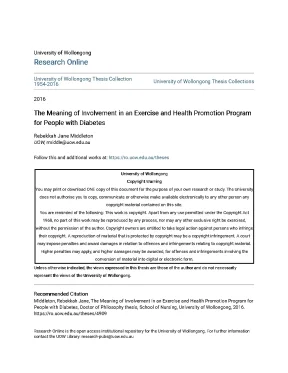
Tải xuống để đọc toàn bộUniversity of Wollongong Research Online University of Wollongong Thesis Collection University of Wollongong Thesis Collections 1954-2016 2016 The Meaning of Involvement in an Exercise and Health Promotion Program for People with Diabetes Rebekkah Jane Middleton UOW, rmiddle@uow.au Follow this and additional works at: https://ro.au/theses University of Wollongong Copyright Warning You may print or download ONE copy of this document for the purpose of your own research or study. The University does not authorise you to copy, communicate or otherwise make available electronically to any other person any copyright material contained on this site. You are reminded of the following: This work is copyright. Apart from any use permitted under the Copyright Act 1968, no part of this work may be reproduced by any process, nor may any other exclusive right be exercised, without the permission of the author.
Copyright owners are entitled to take legal action against persons who infringe their copyright. A reproduction of material that is protected by copyright may be a copyright infringement. A court may impose penalties and award damages in relation to offences and infringements relating to copyright material. Higher penalties may apply, and higher damages may be awarded, for offences and infringements involving the conversion of material into digital or electronic form.
Unless otherwise indicated, the views expressed in this thesis are those of the author and do not necessarily represent the views of the University of Wollongong. Recommended Citation Middleton, Rebekkah Jane, The Meaning of Involvement in an Exercise and Health Promotion Program for People with Diabetes, Doctor of Philosophy thesis, School of Nursing, University of Wollongong, 2016.au/theses/4909 Research Online is the open access institutional repository for the University of Wollongong. For further information contact the UOW Library: research-pubs@uow.au The Meaning of Involvement in an Exercise and Health Promotion Program for People with Diabetes A thesis submitted in fulfillment of requirements for the degree of Doctor of Philosophy from University of Wollongong by Rebekkah Jane Middleton, RN, BN, MN(Res) School of Nursing, Faculty of Science, Medicine and Health 2016 Abstract The aim of this study was to explore and understand the meaning that people with diabetes attribute to being involved in a specialised program involving exercise and health promotion. Diabetes is a prevalent and chronic disease both in Australia and internationally with known benefits and outcomes from involvement in physical activity.
However, there is still a lack of commitment and sustaining of exercise regimens by people with diabetes. In order to understand and interpret the meaning behind the reasons why the 15 participants chose to engage in an exercise and health promotion program, a phenomenological approach was used. More specifically, an approach using Heideggarian interpretive phenomenology, using van Manen’s (1990) methodological framework provided a structure and a guide to the inquiry into the lived experiences of the participants who had diabetes and were participating in a program called Beat It. The research study was designed in a way so as to answer the question: ‘What does it mean for people with diabetes to be part of a therapeutic recreation program involving exercise and health promotion?’.
Participants were invited to share their stories and uncover meanings in their experiences, and to facilitate this, data collection occurred in two phases. First, semi-structured, conversational individual interviews occurred, and then, once preliminary analysis of themes had occurred, a focus group was held to member check. Data analysis conformed to van Manen’s Six Step Methodical Structure (1990), which uses a Heideggerian hermeneutical research methodology and enabled identification of thematic statements. II Within the participants’ story-telling, the meaning of the program Beat It, for people with diabetes, emerged through methodical synthesis of participant voices in interviews and a focus group.
The meaning that participants’ ascribed to their experience was revealed in two themes: people and structure. Within the themes, elements were identified. The theme, People, entailed three elements: motivation, connectedness and psychological benefits. The theme, Structure, consisted of two elements: physical benefits and instructor.
Embedded within the participants voices and stories was the essence of their experiences – the meaning that each participant attributed to their experiences of undertaking the exercise and health promotion program. This essence was found to be person-centred program efficacy that gave meaning to the experience. Understanding the meaning that people with diabetes attribute to being involved in a specialised exercise and health promotion program, facilitates the development of more tailored programs that can better enhance health and wellbeing in this population of people. The development of person centred diabetes programs can then help to minimise preventable health conditions associated with the disease.
Implications for researchers and diabetes service providers are centred on the need for further research exploring the subjective views of people with diabetes, with a focus on partnering with and engaging those with diabetes in designing and planning programs that facilitate commitment. III Certificate of Authorship and Originality of Thesis I, Rebekkah Jane Middleton, declare that this thesis, submitted in fulfulment of the requirements for the award of Doctor of Philosophy, in the School of Nursing, University of Wollongong, is wholly my own work unless otherwise referenced or acknowledged. The document has not been submitted for qualifications at any other academic institution. Rebekkah Middleton Date: 20 March 2017 IV Copyright Statement Copyright © Rebekkah Jane Middleton 2017 All rights reserved.
V Table of Contents Abstract.II Certificate of Authorship and Originality of Thesis. IV Copyright Statement. X Publications and presentations emanating from this research. XI Manuscripts published.
XI Manuscripts submitted under review. XI Conference presentations .XII Definition of Key Terms .XIII Chapter 1 – Research Overview. 4 Rationale and significance of the research study. 5 Organisation of the thesis.
5 Conventions within the thesis. 6 Chapter 2 – Background and Context. 12 Prevalence and associated mortality. 13 Diabetes and exercise/physical activity.
16 Physiological benefits of exercise on diabetes. 18 Diabetes and required levels of exercise. 25 Diabetes management, self-management and maintaining a healthy lifestyle. 27 Psychological benefits of exercise.
36 Diabetes and engagement in exercise programs and interventions. 43 History and Definition of Therapeutic Recreation (TR). 43 The contribution of Therapeutic Recreation to diabetes health promotion. 45 Diabetes and Therapeutic Recreation.
57 Beat It and older adults. 59 Programs supported by professionals. 60 Diabetes, Therapeutic Recreation and Meaning. 70 Contributions of this research study.
73 Chapter 3 – Research Design. 76 Role of the researcher. 92 VI van Manen’s Six Steps of Methodical Structure. 93 Trustworthiness of the data.
215 Section 1 – The essence of meaning. 269 Section 2 – Theoretical links and contribution of theory to the research. 273 Diabetes related behaviour and motivation. 273 Self-Determination Theory.
289 Chapter 6 – Conclusion and Recommendations. 295 Theoretical Contribution to knowledge. 298 Recommendations for further research work. 304 Appendix 1 – Ethics approval.
335 Appendix 2 – Consent form. 339 Appendix 3 – Participant information sheet. 341 Appendix 4 – Focus group letter. 343 Appendix 5 – Focus group participant information sheet.
344 Appendix 6 – Focus group consent form. 346 VII List of Figures Figure 1: Prevalence, potential impact and associated mortality of diabetes worldwide 2005-2015 …………………………………………………………………….14 Figure 2: Prevalence, potential impact and associated mortality of diabetes in Australia 2005-2015………………………………………………………………………….15 Figure 3: The Beat It program…………………………………………………….56 Figure 4: The Illawarrra region…………………………………………………….58 Figure 5: Location of Illawarra region in NSW, Australia…………………………….……103 Figure 6: Screen shot taken from journal………………………………………………….113 Figure 7: Screen shot taken from NVivoTM…………….117 Figure 8: Funnel design of the discussion guide…………………….120 Figure 9: Essence of meaning informed by themes and elements………………….145 Figure 10: Themes and elements that emerged from the data………….150 Figure 11: Elements of People theme……………………………………………………………….151 Figure 12: Motivation as element of theme People………………………………………….152 Figure 13: Connectedness as element of theme People………………………………….171 Figure 14: Psychological benefits as element of theme People…………………….184 Figure 15: Summary of elements of theme People……………………….190 Figure 16: Elements of Structure theme……………….191 Figure 17: Physical benefits as element of theme Structure…………………………….192 Figure 18: Instructor as element of theme Structure……………….………………………200 Figure 19: Summary of elements of theme Structure…………….…………………………213 Figure 20: The meaning of the TR program Beat It for participants….214 Figure 21: People theme and elements……………………………………………………….219 Figure 22: Motivation element……………………………………………………………………….220 Figure 23: Free bus route………………………………….………………………………………………225 Figure 24: Motivation to commit to the Beat It program…………………….230 Figure 25: Connectedness element……………………………………………………………….…237 VIII Figure 26: Psychological benefits element……………………………………………………….244 Figure 27: Structure theme and elements…………………………………………………………251 Figure 28: Physical benefits element…………………………………………………………………252 Figure 29: Instructor element……………………………………………………………………………259 Figure 30: The SDT model of health behaviour change adapted from Ryan, Deci and Williams (2008)………………………….278 Figure 31: TR opportunities for people with diabetes……………………….………………286 Figure 32: Essence of meaning………………………………………………………………….296 List of Tables Table 1: Recommended physical activity guidelines for people with diabetes compared to people without diabetes……………………………………………….19 Table 2: Benefits of participation in TR services……………………………………….47 Table 3: Summary of TR model……………………………….48 Table 4: Beat It program fulfilling the requirements of a TR model………….55 Table 5: Six step methodical structure…………………….94 Table 6: Interview questions and prompts…………………………………………………….107 Table 7: Focus group questions, phrases and prompts………………………………….121 Table 8: Participant information regarding participation in interviews and focus group……………………………………………………………………………………………….148 Table 9: Payment rates for age pension…………………………………………………………222 Table 10: Similarities between SDT and person-centredness………………………….287 IX Acknowledgements I would like to thank my two supervisors, Professor Lorna Moxham and A/Prof Dominique Parrish. Their ongoing support, encouragement and guidance throughout my PhD candidature has enabled me to remain focused and keep my eye on the target ahead. The learning I have gleaned from them has helped shape me as a researcher and be committed to completing this thesis in a timely manner.
Lorna thankyou for your honesty, encouragement and realism throughout this journey – you have made this a great learning opportunity and have exemplified supervision leadership. Dominique, your eye has ensured things make sense, thankyou! Thankyou to the people who encouraged me through the more challenging times and assured me this journey would be worth the effort. I am grateful to the people who willingly shared their stories and lived experience with me, making this thesis possible. Finally I want to thank my husband Mark for being patient with me and loving me unconditionally as I went through the ups and downs of completing this research.
This would not have been possible without his support, listening ear, and love. X Publications and presentations emanating from this research Manuscripts published Middleton, R, Moxham, L & Parrish, D 2016, ‘If you can’t engage them they won’t attend’, Australian Nursing & Midwifery Journal, vol. Middleton, R, Moxham, L & Parrish, D 2016, ‘Diabetes, older people and exercise: Recommendations for health promotion programs’, Australian Nursing & Midwifery Journal, vol. Middleton, R, Moxham, L & Parrish, D ‘Committing to a health promotion program: an Australian case study’.
In press: Global Journal of Health Education and Promotion. Middleton, R, Moxham, L & Parrish, D ‘The value of health promotion programs for older people with chronic conditions in the community – an overview of the literature’. In press: Australian Nursing & Midwifery Journal. Manuscripts submitted under review Middleton, R, Moxham, L & Parrish, D ‘Motivation to engage in therapeutic recreation programs for older people with diabetes’.
Submitted to and under review: World Leisure Journal. XI Conference presentations Middleton, R, Moxham, L & Parrish, D (presenting author: Rebekkah Middleton). ‘An exercise and health promotion intervention for people with diabetes: case study of an Australian program’. Oral presentation at the World Leisure Congress, Alabama, USA.
Congress theme: Leisure – Enhancing Human Condition. Middleton, R, Moxham, L & Parrish, D (presenting author: Rebekkah Middleton). ‘An effective leisure program for older people with diabetes’. Oral presentation at the World Leisure Congress, Durban, South Africa.
Congress theme: Challenges, Choices and Consequences.
Nội dung được bảo vệ bản quyền — Tải xuống đầy đủ
Trích dẫn luận án này
Rebekkah Jane Middleton (2016). Nghĩa của việc tham gia chương trình tập thể dục và chăm sóc sức khỏe cho người tiểu đường [Luận án tiến sĩ, University of Wollongong]. LuanAn.net. https://luanan.net/y-te-cong-cong/the-meaning-of-involvement-in-an-exercise-and-health-promotion-pr
Câu hỏi thường gặp
Luận án "Nghĩa của việc tham gia chương trình tập thể dục và chăm sóc sức khỏe cho người tiểu đường" nghiên cứu về vấn đề gì?
Tìm hiểu ý nghĩa chương trình tập thể dục, chăm sóc sức khỏe cho người tiểu đường: kiểm soát đường huyết, phòng biến chứng, nâng cao chất lượng sống.
Luận án "Nghĩa của việc tham gia chương trình tập thể dục và chăm sóc sức khỏe cho người tiểu đường" được bảo vệ tại trường nào?
Luận án này được bảo vệ tại University of Wollongong. Năm bảo vệ: 2016.
Luận án "Nghĩa của việc tham gia chương trình tập thể dục và chăm sóc sức khỏe cho người tiểu đường" thuộc chuyên ngành gì?
Luận án "Nghĩa của việc tham gia chương trình tập thể dục và chăm sóc sức khỏe cho người tiểu đường" thuộc chuyên ngành Nursing. Danh mục: Y Tế Công Cộng.
Luận án "Nghĩa của việc tham gia chương trình tập thể dục và chăm sóc sức khỏe cho người tiểu đường" có bao nhiêu trang?
Luận án "Nghĩa của việc tham gia chương trình tập thể dục và chăm sóc sức khỏe cho người tiểu đường" có 364 trang. Bạn có thể xem trước một phần tài liệu ngay trên trang web trước khi tải về.
Cách tải luận án "Nghĩa của việc tham gia chương trình tập thể dục và chăm sóc sức khỏe cho người tiểu đường" về máy như thế nào?
Để tải luận án về máy, bạn nhấn nút "Tải xuống ngay" trên trang này, sau đó hoàn tất thanh toán phí lưu trữ. File sẽ được tải xuống ngay sau khi thanh toán thành công. Hỗ trợ qua Zalo: 0559 297 239.