Luận án: Mức độ hài lòng của bệnh nhân nội trú tại bệnh viện quốc gia Belize
Nghiên cứu khảo sát sự hài lòng của bệnh nhân nội trú tại Bệnh viện Quốc gia Belize. Đánh giá chất lượng dịch vụ, môi trường điều trị và các yếu tố ảnh hưởng.
Taipei Medical University
Health Care Administration
Luan An
Master's Thesis
Năm xuất bản
Số trang
84
Thời gian đọc
13 phút
Lượt xem
0
Lượt tải
0
Phí lưu trữ
40 Point
Tổng quan nhanh
- Chủ đề:
- 1. Nghiên cứu hài lòng bệnh nhân nội trú tại Belize
- Số trang:
- 84 trang
- Trường:
- Taipei Medical University
- Chuyên ngành:
- Health Care Administration
- Tác giả:
- Tisa C. Grant
- Năm:
- 2012
Tóm tắt nội dung luận án
I. Nghiên cứu hài lòng bệnh nhân nội trú tại Belize
Nghiên cứu này khám phá sự hài lòng của bệnh nhân nội trú tại bệnh viện quốc gia Belize. Mục tiêu là tìm hiểu các yếu tố ảnh hưởng đến trải nghiệm và mức độ hài lòng của họ. Bối cảnh hệ thống chăm sóc sức khỏe quốc gia đã triển khai nhiều chính sách. Các sáng kiến này nhằm nâng cao chất lượng dịch vụ y tế nội trú. Tuy nhiên, mức độ ảnh hưởng của trải nghiệm bệnh nhân đến sự hài lòng vẫn chưa rõ ràng. Đây là một vấn đề quan trọng cần được làm rõ. Nghiên cứu cung cấp cái nhìn sâu sắc về nhu cầu và kỳ vọng của người bệnh.
1.1. Bối cảnh hệ thống y tế quốc gia Belize
Hệ thống chăm sóc sức khỏe Belize đã chứng kiến nhiều nỗ lực cải thiện. Bộ Y tế Belize đã ban hành các chính sách và thỏa thuận dịch vụ. Mục đích chính là cải thiện khảo sát hài lòng bệnh nhân trên toàn quốc. Các sáng kiến này dựa vào kết quả đo lường sự hài lòng. Điều này giúp đánh giá chất lượng dịch vụ y tế nội trú. Tuy nhiên, chưa rõ mức độ trải nghiệm của bệnh nhân ảnh hưởng đến sự hài lòng tổng thể. Việc này cần được phân tích kỹ lưỡng.
1.2. Vấn đề và ý nghĩa nghiên cứu sự hài lòng
Sự đồng thuận chung về dịch vụ chăm sóc sức khỏe có thể không phản ánh đầy đủ. Một số trải nghiệm người bệnh nội trú có ảnh hưởng lớn hơn. Ảnh hưởng này định hình mức độ hài lòng tổng thể của bệnh nhân. Nghiên cứu này xác định các biến số cụ thể. Các biến số này tác động đến đánh giá chung về chăm sóc bệnh viện. Nghiên cứu cũng xem xét ý định giới thiệu bệnh viện của bệnh nhân. Đây là đóng góp quan trọng để hiểu các yếu tố ảnh hưởng hài lòng bệnh nhân.
II. Phương pháp khảo sát trải nghiệm người bệnh nội trú
Nghiên cứu đã sử dụng phương pháp khảo sát khoa học. Công cụ HCAHPS được lựa chọn để thu thập dữ liệu. Đây là một công cụ tiêu chuẩn, giúp đảm bảo tính đồng nhất và khách quan. Việc áp dụng phương pháp này cho phép thu thập thông tin trực tiếp từ bệnh nhân nội trú. Phân tích dữ liệu sau đó được thực hiện bằng các mô hình thống kê. Mục đích là xác định các yếu tố có khả năng dự báo sự hài lòng của bệnh nhân. Nghiên cứu cung cấp cơ sở dữ liệu mạnh mẽ về khảo sát hài lòng bệnh nhân.
2.1. Công cụ và phương pháp thu thập dữ liệu
Nghiên cứu áp dụng khảo sát HCAHPS. Đây là công cụ tự quản lý cho bệnh nhân nội trú. Bệnh nhân được khảo sát tại bệnh viện giới thiệu quốc gia Belize. Quá trình thu thập dữ liệu được thực hiện cẩn thận. Điều này đảm bảo tính khách quan và chính xác của thông tin. Công cụ HCAHPS giúp đo lường khảo sát hài lòng bệnh nhân một cách có hệ thống. Nó cung cấp cái nhìn sâu sắc về trải nghiệm người bệnh nội trú.
2.2. Phân tích yếu tố dự báo sự hài lòng
Các mô hình hồi quy tuyến tính đơn giản và đa bước đã được sử dụng. Phân tích xác định các yếu tố dự báo sự hài lòng của bệnh nhân. Hai biến phụ thuộc chính là 'Đánh giá tổng thể về chăm sóc bệnh viện' và 'Ý định giới thiệu bệnh viện'. Các yếu tố như tuổi, giới tính, dân tộc, trình độ học vấn, và sức khỏe cảm nhận được kiểm soát. Phương pháp này giúp làm rõ các yếu tố ảnh hưởng hài lòng bệnh nhân một cách định lượng.
III. Yếu tố chính ảnh hưởng hài lòng bệnh nhân nội trú
Kết quả nghiên cứu chỉ ra những ưu tiên hàng đầu của bệnh nhân. Giao tiếp y bác sĩ bệnh nhân và chăm sóc điều dưỡng tại bệnh viện là các yếu tố cốt lõi. Sự lịch sự, tôn trọng, giải thích rõ ràng và lắng nghe cẩn thận đều quan trọng. Từ góc độ bệnh nhân, chất lượng dịch vụ không chỉ bao gồm chuyên môn. Nó còn bao gồm chất lượng của sự quan tâm và tương tác cá nhân. Điều này nhấn mạnh tầm quan trọng của yếu tố con người trong chăm sóc sức khỏe.
3.1. Giao tiếp y bác sĩ điều dưỡng là ưu tiên hàng đầu
Kết quả nghiên cứu cho thấy ưu tiên cao nhất của bệnh nhân. Đó là giao tiếp y bác sĩ bệnh nhân và chăm sóc điều dưỡng tại bệnh viện. Các yếu tố này bao gồm sự lịch sự và tôn trọng. Y bác sĩ và điều dưỡng cần dành thời gian giải thích rõ ràng. Lắng nghe bệnh nhân cẩn thận cũng là điều thiết yếu. Điều này nhấn mạnh tầm quan trọng của tương tác cá nhân. Tương tác này ảnh hưởng trực tiếp đến trải nghiệm người bệnh nội trú.
3.2. Chất lượng chăm sóc y tế và chất lượng tương tác
Từ góc độ của bệnh nhân, chất lượng dịch vụ y tế nội trú không chỉ dừng lại ở y khoa. Nó còn bao gồm cả chất lượng của sự quan tâm và tương tác. Bệnh nhân thường trải qua những khoảnh khắc căng thẳng. Do đó, cần cung cấp dịch vụ chăm sóc lấy bệnh nhân làm trung tâm. Thái độ nhân viên y tế đóng vai trò then chốt. Sự đồng cảm và hỗ trợ giúp tăng cường đáng kể sự hài lòng.
IV. Cải thiện chất lượng dịch vụ y tế nội trú Belize
Các nhà quản lý y tế cần tập trung vào việc thực hiện các biện pháp cải thiện. Việc này bao gồm việc đào tạo và nhắc nhở nhân viên y tế. Chăm sóc bệnh nhân cần được thực hiện một cách chu đáo và lấy bệnh nhân làm trung tâm. Nâng cao kỹ năng giao tiếp và thái độ phục vụ là chìa khóa. Điều này không chỉ cải thiện chất lượng dịch vụ y tế nội trú mà còn tạo dựng niềm tin. Bệnh viện có thể xây dựng một môi trường hỗ trợ tốt hơn cho bệnh nhân. Đảm bảo an toàn người bệnh nội trú cũng là một ưu tiên.
4.1. Thực hành chăm sóc lấy bệnh nhân làm trung tâm
Các nhà quản lý y tế và các nhà hoạch định chính sách cần lưu ý. Nhân viên y tế, đặc biệt là điều dưỡng và bác sĩ, cần được nhắc nhở. Bệnh nhân đang trải qua giai đoạn nhạy cảm và căng thẳng. Cung cấp chăm sóc điều dưỡng tại bệnh viện theo hướng lấy bệnh nhân làm trung tâm là thiết yếu. Điều này bao gồm việc thấu hiểu cảm xúc bệnh nhân. Tập trung vào nhu cầu cá nhân của họ để mang lại trải nghiệm người bệnh nội trú tốt nhất.
4.2. Nâng cao kỹ năng giao tiếp và thái độ phục vụ
Cần nâng cao kỹ năng giao tiếp y bác sĩ bệnh nhân. Đào tạo về sự lịch sự, tôn trọng, giải thích rõ ràng là cần thiết. Kỹ năng lắng nghe tích cực cũng cực kỳ quan trọng. Thái độ nhân viên y tế thân thiện và chuyên nghiệp góp phần lớn vào sự hài lòng tổng thể. Đảm bảo bệnh nhân cảm thấy được lắng nghe và tôn trọng. Môi trường bệnh viện cũng cần được cải thiện để hỗ trợ quá trình này.
V. Ảnh hưởng nhân khẩu học đến hài lòng người bệnh
Nghiên cứu đã xem xét các yếu tố nhân khẩu học của bệnh nhân. Các yếu tố này bao gồm tuổi, giới tính, dân tộc và trình độ học vấn. Chúng có thể có tác động đáng kể đến cách bệnh nhân đánh giá dịch vụ. Sức khỏe cảm nhận cũng là một biến số quan trọng. Hiểu rõ những đặc điểm này giúp bệnh viện điều chỉnh dịch vụ. Điều này đảm bảo cung cấp chất lượng dịch vụ y tế nội trú phù hợp. Mỗi nhóm bệnh nhân có thể có kỳ vọng và nhu cầu khác nhau. Việc này là chìa khóa để tối ưu hóa trải nghiệm người bệnh nội trú.
5.1. Vai trò của đặc điểm bệnh nhân trong đánh giá
Nghiên cứu đã kiểm soát các yếu tố nhân khẩu học chính. Bao gồm tuổi, giới tính, dân tộc và trình độ học vấn của bệnh nhân. Các yếu tố này có thể ảnh hưởng đến cách bệnh nhân đánh giá dịch vụ. Hiểu rõ các biến số này giúp bệnh viện điều chỉnh dịch vụ. Mục tiêu là tối ưu hóa trải nghiệm người bệnh nội trú. Sự khác biệt về nhân khẩu học có thể dẫn đến những kỳ vọng khác nhau. Đây là các yếu tố ảnh hưởng hài lòng bệnh nhân cần được quan tâm.
5.2. Sức khỏe cảm nhận và tác động đến sự hài lòng
Tình trạng sức khỏe cảm nhận của bệnh nhân cũng được xem xét. Yếu tố này là một biến kiểm soát quan trọng trong nghiên cứu. Sức khỏe cảm nhận có thể tác động đến mức độ hài lòng tổng thể. Bệnh nhân với tình trạng sức khỏe tốt hơn có thể có kỳ vọng khác. So với những người có sức khỏe yếu hơn. Việc hiểu rõ tác động này giúp cung cấp chất lượng dịch vụ y tế nội trú phù hợp. Đây là một trong các yếu tố ảnh hưởng hài lòng bệnh nhân.
Tải xuống file đầy đủ để xem toàn bộ nội dung
Tải đầy đủ (84 trang)Trích đoạn nội dung luận án
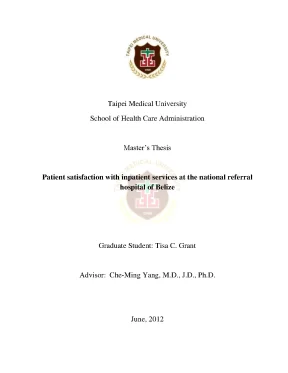
Tải xuống để đọc toàn bộTaipei Medical University School of Health Care Administration Master’s Thesis Patient satisfaction with inpatient services at the national referral hospital of Belize Graduate Student: Tisa C. Grant Advisor: Che-Ming Yang, M. June, 2012 ACKNOWLEDGEMENTS I give thanks to God for the completion of this thesis requirement, for grace, mercy, and guidance throughout my time at Taipei Medical University, and for all the people and opportunities He has placed in my path on this academic journey. I have been blessed and the names are too numerous to mention.
I can only hope that each individual knows who he/she is, the profound difference each made and that my sincere gratitude has been sufficiently and appropriately expressed to each one. To my advisor, Dr. Che-Ming Yang, and my committee members, thank you for your guidance, your patience, and for being firm but kind. To the management and staff of Karl Heusner Memorial Hospital (KHMH) and the survey respondents, without your help this simply would not have been possible and I thank you! To my family and dear friends for their support of this aspiration, their reassurances, assistance, encouragement and patience to the very end of this milestone, I give my heartfelt thank you.
I ABSTRACT Title of thesis: Patient satisfaction with inpatient services at the national referral hospital of Belize Author: Tisa C. Grant Thesis advised by: Che-Ming Yang, M. Background - The Ministry of Health in Belize has implemented several policies and service level agreements to improve patient satisfaction country wide. Although these initiatives rely on results to appropriately measure patients’ satisfaction with the quality of care, the extent to which a patient’s experience explains his or her satisfaction with the health-care system remains unclear.
Objectives - Despite what may appear to be the general consensus on health care services provided nationally, some health care experiences may very well be more influential than others to the patient in forming their overall satisfaction level. The objective of this study is to ascertain the effects that specific variables have on patients’ overall evaluation of hospital care and their intention to recommend the hospital. Methods - The HCAHPS Survey was self-administered at the national referral hospital of Belize to inpatients. Simple and multiple step-wise linear regression models were used to identify the predictor factors of patient satisfaction using, separately, the two dependent variables: “Overall evaluation of hospital care” and the “Intention to recommend the hospital”, controlling for age, gender, ethnicity, education and perceived health.
Results - It was found that patient’s highest priority was communication with nurses and doctors encompassing courtesy and respect, taking the time to explain things, and listening to the patients carefully. Discussion - From the patient’s perspective, the quality of care must include not only the quality of medical care provided but also the quality of caring associated with it. Health-care managers and other decision makers may need to remind their nurses and staff members that patients are II experiencing an intensely critical and emotional moment, and thus, they need to provide patient- centered care Keywords: Patient satisfaction, inpatient, Belize, developing country III TABLE OF CONTENT ACKNOWLEDGEMENTS. II TABLE OF CONTENT.
IV LIST OF TABLES. VI LIST OF FIGURES. VII CHAPTER 1: INTRODUCTION .2 Belize: The Healthcare System and the People .3 Statement of the Problem .4 Significance of the Study. 10 CHAPTER II: LITERATURE REVIEW .1 Definition of Patient Satisfaction .2 Development of HCAHPS Survey Instrument .3 Determinants of Patient Satisfaction .4 Clinical Staff Influence on Patient Satisfaction .5 Patient Demographic and Patient Satisfaction.
17 CHAPTER III: METHODOLOGY .2 Operational Definitions of Variables .7 Data Source and Collection. 34 IV CHAPTER 4: RESULTS .2 Descriptions of the variables .1 Categorical variables description for ‘Overall evaluation of Hospital Care’ .3 Mean age difference between “Overall Evaluation of Hospital” and “Care Intention to recommend” .3 Univariate and multivariate analysis for predicting “Overall evaluation of hospital care” .4 Univariate and multivariate analysis for predicting “Intention to recommend” .1 Hospital care factors as predictors of patient satisfaction .2 Implications of patient demographics on patient satisfaction .3 Perceived health as a predictor of satisfaction.6 Implications for further research. 63 Appendix I – HCAHPS Survey Instrument. 63 Appendix II – Ethical Approval Request Letter.
70 Appendix III – Ethical Approval Letter. 71 Appendix IV – Patient Consent Form. 72 V LIST OF TABLES Table 1: Operational definitions of variables. 20 Table 2: Reliability test results.
30 Table 3: Recoding of variables. 31 Table 4: Description of categorical variables by frequency and percentage (N=176). 37 Table 5: Description of the categorical variables for “Overall evaluation of hospital care”. 38 Table 6: Description of the categorical variables for ‘Intention to recommend’.
39 Table 7: Mean age difference between rating group for overall evaluation of hospital care (N=169). 40 Table 8: Mean age difference between rating group of ‘Intention to recommend’ (N=168). 41 Table 9: Univariate analysis of independent variables to predict overall evaluation of hospital care. 43 Table 10: Multivariate analysis of all independent variables to predict overall evaluation of Hospital Care.
44 Table 11: Univariate analysis of independent variables to predict intention to recommend. 46 Table 12: Multivariate analysis of independent variables to predict intention to recommend. 47 VI LIST OF FIGURES Figure 1 - Conceptual Framework for Patient Satisfaction at the National Referral Hospital of Belize. 18 VII CHAPTER 1: INTRODUCTION 1.1 Background Patient satisfaction (or customer satisfaction) is a term that is widely used with reference to health care.
Identified as an integral factor in the evaluation of health care, the inclusion of ‘patient satisfaction’ measurements and interpretation can easily go unquestioned. In fact, quality of care reforms and health care delivery in developed countries such as the United States of America and Europe allow for an increasingly important role of patient satisfaction as an indicator (Bleich, Ö zaltin, & Murray, 2009). However, at the hospital level, many clinicians appear unconvinced of the usefulness of satisfaction measures. Since clinicians are often more concerned about treatment outcomes, their skepticism may be attributed to the belief that other indicators of healthcare quality such as how patients feel about the cost and/or accessibility of services, the food, interpersonal relationships and overall satisfaction levels are administrative issues (Hudak & Wright, 2000).
Over the years, health care managers have utilized various methods, from complaint boxes to satisfaction surveys, to gather information that can be used to improve patient satisfaction. There have been many patient satisfaction studies that utilized patient satisfaction surveys, even if the focus may have been different than it is today. Some studies attempted to learn who, for example, would be more satisfied (Otani, Herrmann, & Kurz, 2011). Despite the increased focus on satisfaction as an outcome measure and the growing body of research to support it, satisfaction has remained difficult to compartmentalize.
Although numerous satisfaction surveys have been developed, most with acceptable psychometric properties, it remains largely unknown the factors patients use to consider themselves satisfied (Jackson, Chamberlin, & Kroenke, 2001). Patients’ satisfaction with health care in comparison to their experience is increasing in its importance. Likewise, according to Bleich et al. (2009), the continued interest in comparing people’s satisfaction with the health system across different countries and time periods suggests the need to distinguish the relationship between them.
Otani et al. (2011) suggested that it is likely that a positive experience with important factors will result in a good satisfaction overall. Conversely, if the patient had a negative experience with important factors, the overall satisfaction will be bad. The extent to which a patient’s experience explains his or her satisfaction with the health-care 1 system remains unclear.
Some experiences may very well be more influential than others to the patient in forming their overall satisfaction level.2 Belize: The Healthcare System and the People Belize is a former British Colony and the only English-speaking country in Central America, divided into six districts. It is more similar to other English–speaking Caribbean countries in culture, politics, and economy. Due to location, however, Spanish is widely spoken (Ministry of Health, 2006a). The area of Belize (mainland and cayes) is 8,867 square miles, the greatest length being 280 kilometers and its greatest width is 109 kilometers.
Considered to be a “melting pot of many races” resulting from the influx of many people of Central America, Asia, Europe and the Caribbean (Ministry of Health, 2006a), the population is now at 312,698 based on the 2010 population census (The Statistical Institute of Belize, 2011). The population census also shows that the five main ethnic groups are Mestizo, Creole, Maya, Garifuna and Mennonite. Mestizo is the largest group (50%), Creole accounted for 21%, Maya and Garifuna made up 10% and 4. Other ethnic groups in Belize are East Indian, Chinese, Arabs and Africans, among others.
The ethnic groups, however, are heavily intermixed. Although, English is the official language of Belize, English Creole is widely spoken. It remains a distinctive part of everyday conversations for most Belizeans. However, Spanish is spoken as a first language for majority of the people in the northern districts, the north of the Belize District, and the Cayo District in the west.
In the southern Districts, there are people whose first language is Garifuna or Maya. The basic structure for health care delivery is provided by a network of seven district hospitals which are divided into four regions: Northern Region (Orange Walk and Corozal Districts), Central Region (Belize District), Western Region (Cayo District) and Southern Region (Stann Creek and Toledo Districts) with the Karl Huesner Memorial Hospital (KHMH), the Central Regional Hospital, being the national referral hospital (Ministry of Health, n. In terms of population, the Central Health Region is the biggest of the four health regions of the country and therefore, provides health care services to 30.5% of the entire population of the country. The Region has three administrative areas: Belize City, Belize Rural and the Cayes.
As the commercial capital, 2 Belize City is considered the ‘bustling metropolis’ of the country and attracts local and international visitors, thus increasing the servicing population by 6% (Ministry of Health, n. As a result, the Belize District has the greatest density of health care providers relative to its population (Pan American Health Organization, 2009a) with a total of 285 staff members (Ministry of Health, n. There were 2,283 workers employed in the health system in 2009, 1279 (56%) were health care providers while the remaining 1004 (44%) were administrative and other support staff. About 43% of health care providers were employed in the Belize District.
There are approximately 30 nationalities and ethnic groups represented in the Belize health care provider workforce, Mestizo and Creole totaling 61%. Of the 1279 health care providers (i. clinical workers and health professionals) about 80% are employed in the public sector. Between 2005 and 2009, the number of registered nurses remained relatively stable while the number of specialists fell from 159 to 60.
The combined ratio of registered nurses and physicians per 10,000 population dropped from 23. Among the five, major ethnic groups in Belize, Mestizo and Mayans are not well represented in the health care provider workforce (36% combined) although together they represent 63% of the total population. Women are 68% of the health care provider workforce, outnumbering men 2. This ratio is reflective of the results of the 2010 population census which reported that “women outnumber males by a ratio of two to one at the university level” and “in terms of highest level of education completed, females outnumber males from secondary to university level” (The Statistical Institute of Belize, 2011).
It should be noted, however, that to date, most physicians and physician-specialists have been trained abroad (in the Caribbean or neighboring Central American Countries). Local training for nurses and midwives is provided at the national university. Current social indicators for the country include Infant Mortality Rate (18.
Nội dung được bảo vệ bản quyền — Tải xuống đầy đủ
Trích dẫn luận án này
Tisa C. Grant (2012). Hài lòng bệnh nhân nội trú tại bệnh viện quốc gia Belize [Luận án tiến sĩ, Taipei Medical University]. LuanAn.net. https://luanan.net/y-te-cong-cong/hai-long-benh-nhan-noi-tru-benh-vien-quoc-gia-belize
Câu hỏi thường gặp
Luận án "Hài lòng bệnh nhân nội trú tại bệnh viện quốc gia Belize" nghiên cứu về vấn đề gì?
Nghiên cứu khảo sát sự hài lòng của bệnh nhân nội trú tại Bệnh viện Quốc gia Belize. Đánh giá chất lượng dịch vụ, môi trường điều trị và các yếu tố ảnh hưởng.
Luận án "Hài lòng bệnh nhân nội trú tại bệnh viện quốc gia Belize" được bảo vệ tại trường nào?
Luận án này được bảo vệ tại Taipei Medical University. Năm bảo vệ: 2012.
Luận án "Hài lòng bệnh nhân nội trú tại bệnh viện quốc gia Belize" thuộc chuyên ngành gì?
Luận án "Hài lòng bệnh nhân nội trú tại bệnh viện quốc gia Belize" thuộc chuyên ngành Health Care Administration. Danh mục: Y Tế Công Cộng.
Luận án "Hài lòng bệnh nhân nội trú tại bệnh viện quốc gia Belize" có bao nhiêu trang?
Luận án "Hài lòng bệnh nhân nội trú tại bệnh viện quốc gia Belize" có 84 trang. Bạn có thể xem trước một phần tài liệu ngay trên trang web trước khi tải về.
Cách tải luận án "Hài lòng bệnh nhân nội trú tại bệnh viện quốc gia Belize" về máy như thế nào?
Để tải luận án về máy, bạn nhấn nút "Tải xuống ngay" trên trang này, sau đó hoàn tất thanh toán phí lưu trữ. File sẽ được tải xuống ngay sau khi thanh toán thành công. Hỗ trợ qua Zalo: 0559 297 239.