Voices from the pipeline hippensteel final4
Phát thanh từ ống dẫn dầu Hippensteel Final4: Sự kiện âm nhạc nổi bật với những giọng ca tài năng.
Higher Education Administration
Luan An
Luận án tiến sĩ
Năm xuất bản
Số trang
187
Thời gian đọc
29 phút
Lượt xem
1
Lượt tải
0
Phí lưu trữ
50 Point
Tổng quan nhanh
- Chủ đề:
- Nghiên cứu CRT về Sinh viên Thiểu số: Thấu hiểu Thăng hoa
- Số trang:
- 187 trang
- Trường:
- Kent State university
- Chuyên ngành:
- Higher Education Administration
- Tác giả:
- Holly B. Hippensteel
- Năm:
- 2016
Tóm tắt nội dung luận án
I.Nghiên cứu CRT về Sinh viên Thiểu số Thấu hiểu Thăng hoa
Nghiên cứu này khám phá trải nghiệm sống của sinh viên đại học thiểu số chưa được đại diện. Mục đích chính là làm rõ các yếu tố góp phần vào thành công học tập, quan hệ và nội tâm của họ. Nghiên cứu sử dụng khung Lý thuyết Chủng tộc Phê phán (CRT) để mang lại quan điểm phi-thiếu hụt, hướng tới sự công bằng. Nó tìm cách thách thức các giả định hiện có về nhu cầu và trải nghiệm của nhóm sinh viên này. Bằng cách lắng nghe những câu chuyện đối trọng, nghiên cứu giúp nhìn nhận lại cách các tổ chức giáo dục hỗ trợ hoặc cản trở sự thăng hoa của sinh viên. Phát hiện từ nghiên cứu cung cấp cái nhìn sâu sắc về những điều cần thiết để thúc đẩy thành công bền vững cho mọi sinh viên trong môi trường giáo dục đại học.
1.1. Mục tiêu Nghiên cứu Quan điểm phi thiếu hụt
Nghiên cứu định tính này tập trung vào sự thăng hoa của sinh viên đại học chưa được đại diện. Nó phân tích các trải nghiệm góp phần vào thành công học tập, xã hội và cá nhân. Cách tiếp cận dựa trên công bằng, không tập trung vào thiếu hụt hay rủi ro. Mục tiêu là hiểu rõ hơn về các yếu tố thúc đẩy sự phát triển toàn diện của sinh viên thiểu số, thay vì chỉ tập trung vào những khó khăn.
1.2. Nâng cao Tiếng nói Sinh viên Chống lại Giả định
Nghiên cứu ưu tiên tiếng nói của sinh viên không thuộc đa số. Nó tìm kiếm "phản truyện", là những câu chuyện cá nhân có khả năng thách thức các quan điểm phổ biến. Những quan điểm này thường mô tả sinh viên thiểu số là "có nguy cơ" hoặc "rủi ro cao". Việc lắng nghe trải nghiệm trực tiếp giúp đưa ra những hiểu biết sâu sắc hơn, bác bỏ các định kiến và cung cấp cái nhìn thực tế về student experiences.
II.Thiết kế Nghiên cứu Phỏng vấn Sâu Lý thuyết Chủng tộc
Nghiên cứu áp dụng thiết kế diễn giải cơ bản, được soi chiếu bởi Lý thuyết Chủng tộc Phê phán (CRT). Phương pháp này cho phép phân tích sâu sắc các trải nghiệm phức tạp và đa chiều. Tám sinh viên tham gia vào các cuộc phỏng vấn bán cấu trúc. Tất cả họ đều đã tham gia cùng một chương trình chuẩn bị tiền đại học. Sau đó, họ theo học tại cùng một trường đại học nghiên cứu có tính chọn lọc cao. Việc lựa chọn đối tượng này đảm bảo sự đồng nhất nhất định về bối cảnh, giúp nghiên cứu tập trung vào những tương tác và ý nghĩa sâu sắc hơn từ trải nghiệm của họ. Nghiên cứu khám phá cách các cấu trúc xã hội ảnh hưởng đến college success.
2.1. Phương pháp Định tính Thiết kế Diễn giải Cơ bản
Một thiết kế định tính, diễn giải cơ bản đã được áp dụng trong nghiên cứu này. Phương pháp này phù hợp để khám phá các trải nghiệm sống, cho phép người nghiên cứu đi sâu vào chi tiết của từng câu chuyện. Các dữ liệu được thu thập không chỉ là sự thật khách quan, mà còn là cách các sự kiện được cảm nhận, giải thích và có ý nghĩa đối với underrepresented students.
2.2. Phỏng vấn Bán cấu trúc Lắng nghe Phản truyện
Các cuộc phỏng vấn bán cấu trúc được thực hiện với các thành viên tham gia. Phương pháp này tạo điều kiện cho cuộc trò chuyện cởi mở, đồng thời vẫn đảm bảo bao quát các chủ đề chính. Các cuộc phỏng vấn tìm kiếm "phản truyện", những câu chuyện cá nhân thách thức các tường thuật thống trị và giải thích về minority student success từ một góc độ mới lạ.
2.3. Đối tượng Tham gia Chương trình Chuẩn bị Tiền Đại học
Tám cựu sinh viên đã tham gia nghiên cứu. Tất cả đều là cựu học sinh của một pre-college preparation program cụ thể. Sau đó, họ nhập học tại một trường đại học nghiên cứu uy tín. Điều này giúp tập trung vào tác động của các chương trình hỗ trợ và môi trường đại học, cung cấp cái nhìn sâu sắc về hiệu quả của student support programs.
III.Chủ đề Nổi bật Thúc đẩy Thành công Sinh viên Thiểu số
Bốn chủ đề chính đã nổi lên từ các trải nghiệm của sinh viên. Các chủ đề này cung cấp cái nhìn sâu sắc về những yếu tố thúc đẩy sự thăng hoa. Chúng bao gồm động lực thiết lập môi trường (tone setting dynamics), cảm giác thuộc về (sense of belonging), ý thức về bản thân (sense of self), và định nghĩa thành công là sự phát triển (defining success as growth). Những chủ đề này cho thấy sinh viên đại học chưa được đại diện không chỉ tồn tại mà còn thực sự phát triển mạnh mẽ. Phát hiện này bác bỏ quan niệm họ luôn "có nguy cơ" hoặc "rủi ro cao". Nghiên cứu nhấn mạnh tầm quan trọng của việc nuôi dưỡng môi trường hỗ trợ và sự phát triển cá nhân để đạt academic success.
3.1. Động lực Thiết lập Môi trường Tạo không khí tích cực
Các tương tác và tín hiệu từ môi trường ban đầu rất quan trọng. Chúng định hình cảm giác an toàn và được chào đón của sinh viên. Một môi trường tích cực, chào đón giúp sinh viên cảm thấy được hỗ trợ. Điều này là nền tảng cho sự thành công, ảnh hưởng lớn đến student well-being và quá trình hội nhập vào higher education.
3.2. Cảm giác Thuộc về Bản thân Tăng cường sự gắn kết
Sinh viên cần cảm thấy được kết nối với cộng đồng trường. Họ cũng cần phát triển ý thức mạnh mẽ về bản thân, hiểu rõ giá trị và năng lực của mình. Cảm giác thuộc về thúc đẩy sự gắn kết, trong khi ý thức về bản thân giúp họ vượt qua thử thách và phát triển personal growth, một yếu tố then chốt cho student thriving.
3.3. Định nghĩa Thành công Coi trọng Sự phát triển cá nhân
Thành công không chỉ là điểm số hoặc tốt nghiệp. Đối với sinh viên tham gia nghiên cứu, thành công được định nghĩa là quá trình phát triển liên tục. Nó bao gồm học hỏi, vượt qua khó khăn và trưởng thành về mặt cá nhân. Quan điểm này khuyến khích tư duy phát triển, nhấn mạnh tầm quan trọng của holistic development và student achievement.
IV.Hàm ý Chiến lược cho Hệ thống Giáo dục Đại học Công bằng
Các phát hiện của nghiên cứu kêu gọi một sự thay đổi đáng kể trong tư duy và thực hành giáo dục. Hệ thống giáo dục đại học cần tập trung tốt hơn vào việc phục vụ tất cả sinh viên. Nghiên cứu chỉ ra cách các tổ chức có thể vô tình duy trì sự thiểu số hóa sinh viên da màu thông qua các chính sách và văn hóa hiện có. Nó cũng nhấn mạnh sự cần thiết của việc cải thiện khả năng tiếp cận và bao trùm trong campus inclusion. Cuối cùng, nghiên cứu phê phán cuộc đối thoại hiện tại về thành công, thường chỉ tập trung vào việc sinh viên "sống sót" chứ không phải "thăng hoa". Những hàm ý này rất quan trọng cho equitable higher education.
4.1. Thực trạng Phân biệt Thiết lập Chính sách
Các tổ chức giáo dục cần nhận ra vai trò của mình trong việc vô tình tiếp tục đẩy sinh viên da màu vào tình trạng thiểu số. Điều này xảy ra thông qua các chính sách và thực hành không công bằng, cần rà soát lại cấu trúc institution perpetuation. Cần có sự thay đổi trong educational policy và quy trình để đảm bảo công bằng cho student development.
4.2. Cần cải thiện Khả năng Tiếp cận Cộng đồng
Cộng đồng trường cần trở nên dễ tiếp cận hơn với tất cả sinh viên. Điều này bao gồm cả mặt vật chất và văn hóa. Một môi trường toàn diện thúc đẩy cảm giác được chào đón và hỗ trợ sự tham gia đầy đủ của sinh viên. Campus accessibility là yếu tố then chốt để đảm bảo mọi sinh viên đều có cơ hội như nhau.
4.3. Chuyển đổi cuộc Đối thoại về Thành công
Cuộc thảo luận về thành công cần được mở rộng. Nó phải vượt ra ngoài các chỉ số truyền thống, thường chỉ đo lường sự "sống sót". Cần chuyển sang tập trung vào sự "thăng hoa" và phát triển toàn diện. Điều này đòi hỏi một non-deficit approach, nhìn nhận sinh viên với đầy đủ tiềm năng của họ.
V.Chuyển đổi Định nghĩa Thành công Từ Tồn tại đến Phát triển
Nghiên cứu này khuyến nghị một sự thay đổi quan trọng trong cách nhìn nhận sinh viên. Thay vì dán nhãn "có nguy cơ" hoặc "rủi ro cao", cần tập trung vào tiềm năng thăng hoa của họ. Các phát hiện cho thấy sinh viên đại học thiểu số không chỉ vượt qua thử thách mà còn phát triển mạnh mẽ. Điều này đòi hỏi các nhà giáo dục và các tổ chức phải áp dụng một tư duy mới, ưu tiên sự phát triển, cảm giác thuộc về và ý thức về bản thân của sinh viên. Bằng cách đó, các trường đại học có thể tạo ra môi trường thực sự hỗ trợ sự thành công bền vững, fostering student thriving và phát triển toàn diện.
5.1. Vượt qua Quan niệm Có nguy cơ Thách thức định kiến
Việc dán nhãn sinh viên là "có nguy cơ" là không chính xác và không phản ánh đầy đủ năng lực và khả năng phục hồi của họ. Nghiên cứu cung cấp bằng chứng chống lại quan điểm này. Nó kêu gọi một cách tiếp cận dựa trên điểm mạnh, tập trung vào tiềm năng và resilience của underrepresented students.
5.2. Hướng tới Sinh viên Thăng hoa Đổi mới tư duy
Tư duy hiện tại thường tập trung vào việc giúp sinh viên "sống sót". Cần có sự thay đổi rõ rệt. Mục tiêu phải là giúp sinh viên "thăng hoa", bao gồm sự phát triển toàn diện về học thuật, xã hội và cá nhân. Việc đổi mới tư duy này là cần thiết để đạt được educational equity thực sự.
5.3. Vai trò của Các Nhà Giáo dục Hỗ trợ phát triển toàn diện
Các nhà giáo dục đóng vai trò thiết yếu trong việc tạo ra các chiến lược và môi trường hỗ trợ. Điều này giúp sinh viên phát triển không chỉ về học tập, mà còn hỗ trợ phát triển các khía cạnh liên cá nhân và nội tâm. Các chương trình hỗ trợ cần được thiết kế lại để thúc đẩy student thriving và holistic development.
Tải xuống file đầy đủ để xem toàn bộ nội dung
Tải đầy đủ (187 trang)Trích đoạn nội dung luận án
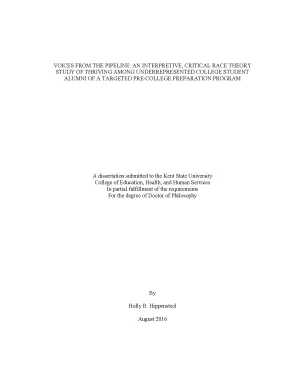
Tải xuống để đọc toàn bộVOICES FROM THE PIPELINE: AN INTERPRETIVE, CRITICAL RACE THEORY STUDY OF THRIVING AMONG UNDERREPRESENTED COLLEGE STUDENT ALUMNI OF A TARGETED PRE-COLLEGE PREPARATION PROGRAM A dissertation submitted to the Kent State University College of Education, Health, and Human Services In partial fulfillment of the requirements For the degree of Doctor of Philosophy By Holly B. Hippensteel August 2016 A dissertation written by Holly B., La Roche College, 1994 M., Indiana University of Pennsylvania, 1996 Ph., Kent State University, 2016 Approved by _________________________, Director, Doctoral Dissertation Committee Susan Iverson _________________________, Member, Doctoral Dissertation Committee Mark A. Kretovics _________________________, Member, Doctoral Dissertation Committee Janice Kroeger Accepted by _________________________, Director, School of Foundations, Leadership Kimberly S. Schimmel and Administration _________________________, Interim Dean, College of Education, Health and Human Mark A.
Kretovics Services ii ABSTRACT HIPPENSTEEL, HOLLY B., August 2016 Higher Education Administration VOICES FROM THE PIPELINE: AN INTERPRETIVE, CRITICAL RACE THEORY STUDY OF THRIVING AMONG UNDERREPRESENTED COLLEGE STUDENT ALUMNI OF A TARGETED PRE-COLLEGE PREPARATION PROGRAM (178 pp.) Director of Dissertation: Susan V. The purpose of this qualitative, Critical Race Theory (CRT) study was to better understand the lived experiences of underrepresented minority college students. Specifically, this study sought to identify themes across the students’ experiences that contributed to their academic, interpersonal and intrapersonal success from a non-deficit, equity minded perspective. I employed a basic interpretive design with a CRT lens to amplify the voices of non-majority students by conducting semi structured interviews with 8 participants who had each attended the same pre-college program and enrolled at the same highly selective, research university.
In so doing, I listened for counter narratives that challenged existing assumptions about the needs and experiences of underrepresented minority students. Four themes emerged from across the student experiences including: (a) tone setting dynamics; (b) sense of belonging; (c) sense of self; and (d) defining success as growth. The experiences highlighted in these themes illustrate the ways that the participants in this study challenge the dominant discourse description of them as at risk or high risk. The study findings call for a significant shift in thinking in order to better serve all students.
First, they call out the ways that institutions perpetuate the minoritization of students of color. Second, the findings highlight the need to attend to the accessibility of our campus communities. Finally, they acknowledge that our current success conversation actually focuses on students surviving rather than thriving. Specific implications for educators, as well as suggestions for additional areas of inquiry are also addressed.
ACKNOWLEDGEMENTS First and foremost I want to give thanks to God. I would not have persevered and finished this project without the humility, grace, and insight that came directly from Him. Secondly I must acknowledge the generosity and openness of my participants. These eight students chose to spend hours meeting and talking with me, in addition to time that they spent reading and reviewing our interview transcripts, during a very busy time of their academic year.
I am eternally grateful for their candor, kindness, and the eagerness with which they participated in my research. I am humbled by your willingness to trust me with your experiences and I thank you for your help as I sought to understand and share them with others. I am grateful for the advice and guidance of my entire committee – Dr. Kretovics, and Dr.
Kroeger - whose feedback strengthened my study as well as this document. I am especially thankful for my chair, Dr. Susan Iverson, who continued to believe in my ability to complete this process even when I had stopped believing myself. I would like to thank Dr.
Amy Burkert, Vice Provost for Education at Carnegie Mellon. I literally would not have been able to conduct this research without her willingness to serve as my institutional sponsor. I am also grateful for the many classmates and peers whose successes have served to inspire me when I have needed it most and whose advice and encouragement proved truly invaluable. This project would have been impossible without the unfaltering support of my colleagues at Carnegie Mellon University.
Richard Tucker encouraged me to iii persist and never stopped asking about my progress. A good dissertation is indeed a done dissertation Dr. Tucker and thank you for your sustaining belief in me. Thank you Ty Walton for graciously forwarding my invitation email with your endorsement.
I know that your support built trust with the students and gave validity to my research in ways that I would not have been able to accomplish on my own. Thank you to my current supervisors, Gina Casalegno and Dr. Michael Murphy, who made accommodations and gave me permission to prioritize my academic pursuits throughout the decade long process of my doctoral studies. The many colleagues who have picked up the slack for me along the way are too many to enumerate but notably Shernell Smith, Renee Camerlengo, Joanna Dickert, and Jamie Edwards have carried the biggest burden of my shifting attention and priorities and created the space necessary for me to complete my degree and this study.
Thank you ladies, I am proud to work with such amazing women. Finally and with a full heart, I thank God for my dear family who have been my continuous source of strength on this crazy, rollercoaster ride. To my beautiful children, I hope that you will understand someday why this was important for me to do, both for myself but also for you. I love you with all my heart.
Thank you to my mom who is the epitome of strength and determination and the one who taught me the value of hard work by her own example. Finally and most importantly, thank you to the love of my life, Ronette. Thank you for showing me what genuine love and support feels like. I know that I would not have been able to push through to the finish without you by my side.
You are the answer to my prayers and I look forward to all of our newly found free time! iv TABLE OF CONTENTS Page ACKNOWLEDGEMENTS .4 Understanding the Current Conversation.7 Barriers, Obstacles, and Deficiencies .9 Applying Cognitive Frames .10 Equity Minded Frame .12 Critical Race Theory .19 Diversity and Access.20 Deficits and Barriers .22 Equity through Interventions .26 Critical Race Theory Literature .28 CRT in Education .35 College Student Success .42 Pathways to Thriving .46 Thriving in Transitions .54 Critical Race Methodology .65 Data Organization and Immersion .66 Generating Categories and Coding .68 Analytic Memos and Interpretation .71 Positioning the Researcher .80 Description of Themes .80 Tone Setting Dynamics .81 Like-minded and diverse cohort .86 Aspirations and expectations .93 Sense of Belonging .94 You can do it .99 Sense of Self .101 Independence and risk taking.102 I can’t do everything on my own .104 Burden of representation .109 Defining Success as Growth .114 Not just about me .116 Academic passion and pride. DISCUSSION AND IMPLICATIONS .124 Minoritized Not Minority .125 Accessibility Not Access .129 Survival Not Success .137 vi Implications for Practice .138 Recognizing Privilege and Bias .139 Increasing Accessibility by Identifying Racism .141 Emphasizing Student Growth and Learning .143 Limitations and Future Research. INTERVIEW PROTOCOL: FIRST INTERVIEW. INTERVIEW PROTOCOL: SECOND INTERVIEW.
BASIC DEMOGRAPHIC SURVEY. PARTICIPANT RESPONSES TO DEMOGRAPHIC SURVEY .166 vii CHAPTER I INTRODUCTION There is broad acknowledgement from across the United States of a need to increase college enrollment and completion rates among racial and ethnic minority students. From President Obama to university presidents there is resounding awareness of and commitment to the need for increasing access to higher education and narrowing achievement gaps for students whose racial and ethnic minority status are underrepresented in our college and university populations. Yet the problems of access and success persist.
At first glance the access problem for minority students seems to be improving. For example, Anthony Carneval and Jeff Strohl’s (2013) analysis of IPEDS enrollment data conducted for Georgetown University’s Center on Education and the Workforce found that the absolute numbers of African American and Hispanic students entering higher education have increased markedly over the past two decades. However, their report entitled Separate and Unequal: How Higher Education Reinforces the Intergenerational Reproduction of White Racial Privilege (Carneval and Strohl, 2013) goes on to examine these enrollment trends in depth. In so doing Carnevale and Strohl (2013) reveal a number of alarming findings that illuminate the racial divide in higher education.
Carnevale and Strohl’s (2013) in depth analysis first illustrates that, despite an increase in overall enrollment, there is a notable racial divide between the types of institutions that students are entering. Specifically, they state that 1 2 “between 1995 and 2009, more than eight in ten of net new white students have gone to the 468 most selective colleges and more than seven in ten net new African American and Hispanic students have gone to the 3250 open access, two and four year colleges. Carnevale and Strohl (2013) further explain that institution type matters in enrollment because it makes a difference in degree completion. “The completion rate for the 468 most selective four year colleges is 82 percent, compared with 49 percent for open access, two and four year colleges.
These findings shine a bright light on the impact of environment on student success and reinforce the need to further interrogate the ways that race and white privilege impact students’ enrollment decisions, their college experiences and ultimately their success. The higher education community has broadly accepted the notion that the answer to increasing minority student enrollment lies in the development of a pipeline. However, as William Bowen and Derek Bok (1998), in their preface to The Shape of the River: Long Term Consequences of Considering Race in College and University Admissions, remind us the pipeline imagery that dominates descriptions of increasing access to higher education fails to account for the actual experiences of the students attempting to traverse this journey. We often hear of the importance of keeping young people moving through the pipeline from elementary school to high school to college, on through graduate and professional schools, and into jobs, family responsibilities, and civic life.
But this image is misleading, with its connotation of a 3 smooth, well-defined, and well-understood passage. It is more helpful to think of the nurturing of talent as a process akin to moving down a winding river, with rock-strewn rapids and slow channels, muddy at times and clear at others. (Bowen & Bok, 1998, pp. xlix) While imagining a smooth pipeline that creates a direct and expedient route for students is more pleasant than that of a winding river, we must concede, as Bowen and Bok (1998) suggest, that the journey for our students is not always smooth or well defined.
We are then left to ponder the rock strewn rapids, slow channels, and muddy places. In Can we talk about race? Beverly Tatum (2007) asserts that: The negative educational impact of attending high poverty schools is well documented. Whether a student comes from a poor or middle income family, academic achievement is likely to decline if the student attends a high poverty school. Tatum (2007) further adds that despite these documented differences in student achievement, students in poor districts, typically non-white districts, have no other option but to continue to receive little or no resources despite the obligation to provide a basic level of education guaranteed to every student.
Given the inequities at the secondary level, how are low income students, who are often also first generation, and typically African American or Hispanic, expected to make the leap to elite higher education institutions? College readiness is an important dynamic but enrollment and graduation differences exist even among students who seem to be the most academically prepared. 4 For example, only 57 percent of African American and Hispanic students who scored in the top quartile of the SAT and ACT completed either a certificate, Associates or Bachelor’s degree compared to 77 percent of white students (Carnevale & Strohl, 2013).
Nội dung được bảo vệ bản quyền — Tải xuống đầy đủ
Trích dẫn luận án này
Holly B. Hippensteel (2016). Voices from the pipeline hippensteel final4 [Luận án tiến sĩ, Kent State University]. LuanAn.net. https://luanan.net/tam-ly-hoc/tam-ly-hoc-xa-hoi/voices-from-the-pipeline-hippensteel-final4
Câu hỏi thường gặp
Luận án "Voices from the pipeline hippensteel final4" nghiên cứu về vấn đề gì?
Phát thanh từ ống dẫn dầu Hippensteel Final4: Sự kiện âm nhạc nổi bật với những giọng ca tài năng.
Luận án "Voices from the pipeline hippensteel final4" được bảo vệ tại trường nào?
Luận án này được bảo vệ tại Kent State University. Năm bảo vệ: 2016.
Luận án "Voices from the pipeline hippensteel final4" thuộc chuyên ngành gì?
Luận án "Voices from the pipeline hippensteel final4" thuộc chuyên ngành Higher Education Administration. Danh mục: Tâm Lý Học Xã Hội.
Luận án "Voices from the pipeline hippensteel final4" có bao nhiêu trang?
Luận án "Voices from the pipeline hippensteel final4" có 187 trang. Bạn có thể xem trước một phần tài liệu ngay trên trang web trước khi tải về.
Cách tải luận án "Voices from the pipeline hippensteel final4" về máy như thế nào?
Để tải luận án về máy, bạn nhấn nút "Tải xuống ngay" trên trang này, sau đó hoàn tất thanh toán phí lưu trữ. File sẽ được tải xuống ngay sau khi thanh toán thành công. Hỗ trợ qua Zalo: 0559 297 239.