The somatic experience of white privilege a dance movement thera
Trải nghiệm cơ thể của đặc quyền da trắng qua vũ điệu. Khám phá sự biểu hiện và tác động của nó thông qua vận động.
Năm xuất bản
Số trang
198
Thời gian đọc
30 phút
Lượt xem
0
Lượt tải
0
Phí lưu trữ
50 Point
Tổng quan nhanh
- Chủ đề:
- Somatic White Privilege: DMT for Racialized Interactions
- Số trang:
- 198 trang
- Trường:
- Lesley University
- Chuyên ngành:
- Expressive Therapies
- Tác giả:
- Wendy Allen
- Năm:
- 2019
Tóm tắt nội dung luận án
I.Somatic White Privilege DMT for Racialized Interactions
Tài liệu này khám phá trải nghiệm thân thể của đặc quyền da trắng. Nó sử dụng liệu pháp vận động/khiêu vũ (DMT) để phân tích các tương tác chủng tộc hóa. Nghiên cứu này soi sáng cách đặc quyền da trắng biểu hiện trong cơ thể. Nhận thức thân thể cung cấp một con đường để hiểu rõ hơn. Các tương tác chủng tộc thường kích hoạt phản ứng sinh lý. DMT giúp cá nhân nhận diện và xử lý những phản ứng này. Mục đích là thúc đẩy nhận thức sâu sắc hơn về chủ nghĩa phân biệt chủng tộc có hệ thống. Việc này hỗ trợ phát triển bản dạng da trắng phi phân biệt chủng tộc. Tài liệu nhấn mạnh tầm quan trọng của việc hòa nhập cơ thể vào công việc chống phân biệt chủng tộc.
1.1. Khám phá Trải nghiệm Thân thể về Đặc quyền Da trắng
Trải nghiệm thân thể của đặc quyền được xem xét sâu sắc. Các cá nhân da trắng thường không nhận thức được lợi ích không công bằng. Đặc quyền biểu hiện qua cảm giác thoải mái và an toàn. Nó liên quan đến cảm giác được thuộc về và được chấp nhận. Nghiên cứu này làm rõ somatic experience of privilege. Nó khám phá các cách thức mà đặc quyền tồn tại trong cơ thể. Các phản ứng sinh lý vô thức là trọng tâm.
1.2. Liệu pháp Vận động Tiếp cận Tương tác Chủng tộc hóa
Liệu pháp vận động/khiêu vũ (DMT) cung cấp một khung làm việc độc đáo. Nó giúp cá nhân giải nén các tương tác chủng tộc hóa. DMT tập trung vào cơ thể như một nguồn thông tin. Các chuyển động và cảm giác cơ thể được sử dụng để khám phá. Cách tiếp cận này giúp nhận diện white privilege embodiment. Nó tạo điều kiện cho sự hiểu biết sâu sắc hơn về hành vi vô thức. Dance movement therapy anti-racism là một khía cạnh cốt lõi.
1.3. Cơ chế của Định vị Thân thể trong Đặc quyền Chủng tộc
Định vị thân thể của đặc quyền chủng tộc được phân tích. Nó bao gồm các hành vi không lời và phản ứng sinh lý. Các cá nhân thường thể hiện đặc quyền thông qua ngôn ngữ cơ thể. Sự thư giãn hoặc căng thẳng có thể là dấu hiệu. Nghiên cứu này kiểm tra cách cơ thể giữ lại những kinh nghiệm này. Nó nhấn mạnh sự cần thiết của nhận thức thân thể. Đây là bước đầu tiên trong việc tháo gỡ đặc quyền.
II.Embodied Anti Racism Unpacking White Privilege
Việc giải nén đặc quyền da trắng đòi hỏi một cách tiếp cận toàn diện. Embodied anti-racism cung cấp công cụ cho sự tự phản ánh. Các phản ứng của người da trắng đối với thảo luận chủng tộc thường thể hiện qua cơ thể. Sự khó chịu hoặc chống đối là phổ biến. Nghiên cứu này làm nổi bật các dấu hiệu thân thể. Nó mô tả các giai đoạn phát triển nhận dạng. Mục tiêu là chuyển hóa các phản ứng này thành nhận thức. Nhận thức này dẫn đến hành động có ý thức. Việc đối mặt với đặc quyền đòi hỏi sự dũng cảm và kiên trì.
2.1. Phân tích Phản ứng của Người da trắng đối với Thảo luận Chủng tộc
Các phản ứng của người da trắng đối với thảo luận về chủng tộc rất đa dạng. Chúng có thể bao gồm sự khó chịu, tức giận hoặc phủ nhận. Các phản ứng này thường có gốc rễ thân thể. Cơ thể có thể căng cứng hoặc co rút. Nghiên cứu khám phá các phản ứng không lời. Nó nhấn mạnh sự quan trọng của việc nhận diện những dấu hiệu này. Đây là bước quan trọng trong privilege unpacking through movement.
2.2. Nhận diện Dấu hiệu Thân thể của Đặc quyền và Độ cứng da trắng
Các dấu hiệu thân thể của đặc quyền được xác định. Chúng bao gồm tư thế cơ thể, biểu cảm khuôn mặt, và cử chỉ. 'Độ cứng da trắng' (white sturdiness) là một khái niệm nổi bật. Nó mô tả sự kiên cố và khó lay chuyển trong phản ứng. Việc nhận diện những dấu hiệu này là cần thiết. Nó giúp người da trắng nhận thức sâu hơn về felt sense of whiteness. Thách thức nằm ở việc làm mềm những 'độ cứng' này.
2.3. Phát triển Bản dạng Da trắng Phi phân biệt chủng tộc
Mục tiêu cuối cùng là phát triển bản dạng da trắng phi phân biệt chủng tộc. Quá trình này đòi hỏi sự tự phản ánh liên tục. Nó bao gồm việc từ bỏ các đặc quyền vô thức. Cá nhân phải đối mặt với sự phức tạp của bản dạng chủng tộc. DMT cung cấp một không gian an toàn. Nơi đây hỗ trợ quá trình khám phá và thay đổi này. Đây là một hành trình hướng tới công lý xã hội toàn diện hơn.
III.Body Awareness Racial Identity in Privilege Work
Nhận thức thân thể đóng vai trò then chốt trong công việc đặc quyền. Giao cảm nội tạng (interoception) là khả năng cảm nhận bên trong cơ thể. Khả năng này hỗ trợ sự hiểu biết về bản dạng chủng tộc. Chuẩn mực chủng tộc ảnh hưởng sâu sắc đến hình ảnh bản thân. Nó cũng định hình ngôn ngữ cơ thể. Các giai đoạn phát triển bản dạng chủng tộc của người da trắng được kiểm tra. Việc tích hợp nhận thức thân thể giúp cá nhân điều hướng những phức tạp này. Nó khuyến khích sự tự khám phá và tăng trưởng.
3.1. Vai trò của Nhận thức Thân thể và Giao cảm Nội tạng
Nhận thức thân thể là nền tảng của công việc này. Giao cảm nội tạng cho phép cá nhân nhận biết cảm giác bên trong. Cảm giác căng thẳng, thư giãn, hoặc khó chịu được chú ý. Khả năng này liên quan trực tiếp đến racial identity somatic work. Nó giúp hiểu cách đặc quyền ảnh hưởng đến trạng thái cơ thể. Phát triển giao cảm nội tạng tăng cường sự tự nhận thức.
3.2. Ảnh hưởng của Chuẩn mực Chủng tộc lên Hình ảnh Bản thân
Các chuẩn mực chủng tộc ảnh hưởng đến hình ảnh bản thân của người da trắng. Chúng định hình cách cá nhân nhìn nhận giá trị của mình. Ngôn ngữ cơ thể cũng phản ánh những chuẩn mực này. Tư thế, cử chỉ và biểu cảm khuôn mặt mang ý nghĩa xã hội. Sự thiếu nhận thức về systemic racism body awareness có thể duy trì những chuẩn mực đó. Việc kiểm tra sâu sắc giúp thay đổi các khuôn mẫu.
3.3. Các trạng thái Phát triển Bản dạng Chủng tộc của Người da trắng
Quá trình phát triển bản dạng chủng tộc của người da trắng bao gồm nhiều giai đoạn. Từ sự thiếu nhận thức đến sự tái hòa nhập. Mỗi giai đoạn có những biểu hiện thân thể riêng. Việc hiểu các giai đoạn này rất quan trọng. Nó cung cấp một lộ trình cho sự phát triển. Các chiến lược xử lý thông tin cũng được phân tích. Chúng giúp cá nhân vượt qua các thách thức.
IV.DMT Social Justice Systemic Racism Body Awareness
Liệu pháp vận động/khiêu vũ (DMT) là một công cụ mạnh mẽ cho công bằng xã hội. Nó thúc đẩy systemic racism body awareness. Tài liệu này xem xét phê phán chủng tộc (Critical Race Theory). Nó cung cấp một khung lý thuyết cho DMT. Phê phán dualism thân-tâm cũng được thảo luận. Văn hóa thường tách rời cơ thể khỏi tâm trí. Việc hòa nhập cơ thể là cần thiết. Nó giúp hiểu và tháo gỡ chủ nghĩa phân biệt chủng tộc. DMT tạo không gian cho sự biểu hiện và chữa lành. Nó là một con đường dẫn đến sự thay đổi xã hội.
4.1. Liệu pháp Vận động và Công bằng Xã hội trong Chống phân biệt chủng tộc
DMT mở rộng ứng dụng của mình vào lĩnh vực công bằng xã hội. Nó cung cấp một phương pháp movement psychotherapy social justice. DMT giúp khám phá các cấu trúc quyền lực. Nó hỗ trợ nhận diện và thách thức chủ nghĩa phân biệt chủng tộc. Việc sử dụng chuyển động giúp phá vỡ các khuôn mẫu. Nó tạo điều kiện cho một cách tiếp cận toàn diện hơn. Mục tiêu là sự giải phóng và hòa nhập cho tất cả mọi người.
4.2. Nhận thức Cơ thể về Chủ nghĩa Phân biệt Chủng tộc Hệ thống
Chủ nghĩa phân biệt chủng tộc hệ thống không chỉ là một khái niệm trừu tượng. Nó có những biểu hiện cụ thể trong cơ thể. Các áp lực xã hội được nội hóa. Chúng tạo ra căng thẳng hoặc khó chịu thân thể. Systemic racism body awareness là việc nhận diện những phản ứng này. Nó là bước đầu tiên để phá vỡ chu kỳ. DMT cung cấp các kỹ thuật để giải phóng những căng thẳng đó.
4.3. Từ song hành Thân Tâm đến Hòa nhập Cơ thể trong Chữa lành
Văn hóa phương Tây thường phân tách thân và tâm. Tuy nhiên, chúng là những khía cạnh không thể tách rời. Việc hòa nhập cơ thể là rất quan trọng cho quá trình chữa lành. DMT nhấn mạnh sự kết nối này. Nó giúp cá nhân hiểu mối liên hệ giữa tư duy và cảm giác. Cách tiếp cận này thúc đẩy một cái nhìn toàn diện. Nó là cần thiết trong dance movement therapy anti-racism.
V.Felt Sense of Whiteness Privilege Unpacking Movement
Nghiên cứu này áp dụng cách tiếp cận hiện tượng học. Nó khám phá 'cảm nhận về sự da trắng' (felt sense of whiteness). Các chủ đề nổi bật từ kinh nghiệm của người tham gia được phân tích. Chúng bao gồm sự mất phương hướng và phân cực. Sự xấu hổ và tự ý thức cũng xuất hiện. Việc giải nén đặc quyền thông qua vận động là một quá trình phức tạp. Nó đòi hỏi sự dũng cảm để đối mặt với sự thật. Body politics of race cũng được thảo luận. Mục tiêu là tìm kiếm sự toàn vẹn và duy trì nhận thức. Điều này dẫn đến sự thay đổi sâu sắc ở cấp độ cá nhân.
5.1. Khái niệm Cảm nhận về Sự Da trắng và Chính trị Cơ thể
Khái niệm 'cảm nhận về sự da trắng' là trọng tâm. Nó mô tả các trải nghiệm chủ quan của việc là người da trắng. Chính trị cơ thể (body politics) cũng được khám phá. Nó xem xét cách quyền lực và đặc quyền biểu hiện trong cơ thể. Felt sense of whiteness là một trải nghiệm thân thể. Nó thường liên quan đến cảm giác an toàn và sự không bị đe dọa. Việc nhận diện điều này là bước đầu tiên.
5.2. Giải mã Đặc quyền thông qua Vận động và Biểu hiện Thân thể
DMT sử dụng vận động để giải mã đặc quyền. Các biểu hiện thân thể vô thức được đưa ra ánh sáng. Người tham gia khám phá những cảm giác bên trong. Chuyển động giúp họ diễn đạt những gì khó nói bằng lời. Privilege unpacking through movement tạo ra một con đường mới. Nó cho phép sự hiểu biết sâu sắc hơn về các hành vi chủng tộc hóa. Sự thay đổi bắt đầu từ cơ thể.
5.3. Các chủ đề Nổi bật về Kinh nghiệm Đặc quyền Da trắng
Nghiên cứu xác định một số chủ đề chính. Sự mất phương hướng, tự cấu trúc, và phân cực là phổ biến. Cảm giác xấu hổ và tự ý thức cũng được báo cáo. Người tham gia tìm kiếm sự khẳng định và toàn vẹn. Việc duy trì nhận thức là một thách thức liên tục. Những chủ đề này cung cấp cái nhìn sâu sắc. Chúng làm sáng tỏ somatic experience of privilege.
Mục lục chi tiết luận án
Tải xuống file đầy đủ để xem toàn bộ nội dung
Tải đầy đủ (198 trang)Trích đoạn nội dung luận án
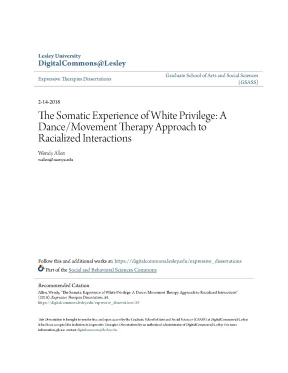
Tải xuống để đọc toàn bộLesley University DigitalCommons@Lesley Graduate School of Arts and Social Sciences Expressive Therapies Dissertations (GSASS) 2-14-2018 The Somatic Experience of White Privilege: A Dance/Movement Therapy Approach to Racialized Interactions Wendy Allen wallen@naropa.edu Follow this and additional works at: https://digitalcommons.edu/expressive_dissertations Part of the Social and Behavioral Sciences Commons Recommended Citation Allen, Wendy, "The Somatic Experience of White Privilege: A Dance/Movement Therapy Approach to Racialized Interactions" (2018). Expressive Therapies Dissertations.edu/expressive_dissertations/59 This Dissertation is brought to you for free and open access by the Graduate School of Arts and Social Sciences (GSASS) at DigitalCommons@Lesley. It has been accepted for inclusion in Expressive Therapies Dissertations by an authorized administrator of DigitalCommons@Lesley. For more information, please contact digitalcommons@lesley.
THE SOMATIC EXPERIENCE OF WHITE PRIVILEGE: A DANCE/MOVEMENT THERAPY APPROACH TO RACIALIZED INTERACTIONS A DISSERTATION (submitted by) WENDY ALLEN In partial fulfillment of the requirements for the degree of Doctor of Philosophy LESLEY UNIVERSITY February, 2019 2 3 4 ACKNOWLEDGEMENTS To Mark: Thank you for all of your love and support and for cheering me on when I was running out of steam. To Greg and Audrey: Thank you for understanding when I couldn’t be there and for listening to me talk about my work. I love you both…you inspire me to make the world you are growing into a better place. To Mom and Dad: Words cannot describe my gratitude for all you have done and given over the years.
I am so grateful for your ongoing love and support and for your willingness to consider the ideas in this paper right along with me. To the Somatic Leadership Team: Thank you for the conversations and the opportunities to learn from each of you. Carla Sherrell: Knowing you has made me a better person. Thank you for your patience and compassion and for teaching me so many things.
Your influence runs through each of these pages. To Christine and Zoe: Thank you for your mentorship and confidence in me. To Robyn: Thank you for your guidance and patience with me through this process! To my committee: Thank you for your wisdom, insight, and mentorship. 5 TABLE OF CONTENTS ABSTRACT .10 Personal Reflection: Unaware ……………………………………………………………………11 Purpose ……………………………………………………………………………………………………12 Significance ………………………………………………………………………………………………14 Definition of Key Terms and Concepts ……………………………………………………….18 White Privilege …………………………………………………………………………………18 Oppression ……………………………………………………………………………………….19 Domination ………………………………………………………………………………………21 Racialized Interactions …………………………………………………………………….21 Cultural Competence and Cultural Safety ………………………………………….22 Interoception ……………………………………………………………………………………23 Somatic Markers ……………………………………………………………………………….24 Nonracist White Identity ………………………………………………………………….28 Critical Race Theory .28 Basic Tenets of Critical Race Theory and the “Rules of Whiteness”.39 White Privilege …………………………………………………………………………………………45 Critiques of White Privilege ……………………………………………….46 The Activity of White Ignorance ……………………………………………….49 The Nonverbal Enactment of White Privilege …………………………….57 White Reactions to Discussions on Race …………………………………….59 Body-mind Dualism and a Somatophobic Culture ………………….66 Including the Body …………………………………………………………………………………….76 White Racial Identity Development and the Body ……………………………….79 Reintegration Status …………………………………………………………………79 Pseudoindependence Status …………………………………………………….81 Information Processing Strategies …………………………………………….81 Dance/Movement Therapy ……………………………………………………………….82 Foundational Theories in DMT ………………………………………………….83 DMT and White Privilege ………………………………………………………….99 Phenomenology and Embodied Inquiry ………………………………………….107 Participant Profiles …………………………………………………………………110 Interview Preparation and Researcher Reflexivity ……………………….117 Theme One: Disorientation .117 Theme Two: Self-Structuring …….121 Theme Three: Polarization ………………………………………………………….123 Feeling/Not Feeling .130 Theme Four: Description Through Contrast .135 Theme Five: Embarrassment and Self-Consciousness ….138 Theme Six: Seeking Affirmation ……………………………………………….142 Theme Seven: Maintaining Awareness …….145 Theme Eight: Seeking Wholeness …………………………………………………………….155 Research Questions and Results ……….155 Research Question One: The Experience of Skin Privilege …………………156 Research Question Two: Impact of Racial Norms on Self-Image, Body Language, and Interoception ………………………………………………….157 Self-Image ………………………………………………………………………………157 Body Language ……………………………………………………………………….160 Research Question Three: The Somatic Markers of Privilege …………….161 The Emergence of White Sturdiness ……………………………………………….165 Credibility ………………………………………………………………………………………165 Peer Debriefing …………………………………………………….167 Prior Understanding ………………………………………………………………………167 Implications ………………….168 Further Research ……………………………………………………………………………………170 Summary ……………………………………………………………………………………………….173 8 ABSTRACT This qualitative study examined the somatic experience of White privilege in participants who were committed to developing a nonracist White identity.
It postulated that there are somatic cues and expressive signatures of White privilege that, once identified, could be addressed through basic dance/movement therapy interventions used at the intrapersonal level. Awareness of these cues may help White people navigate their privilege in racialized interactions thereby reducing further enactments of racism. Using Critical Race Theory and Whiteness Studies as conceptual frameworks and building on research exploring the impact of oppression on the body, this study sought to answer the following questions: (1) How do White people experience skin privilege? (2) What is the impact of sociocultural and institutional norms around race on the self-image, body language, and interoception of those who hold racial privilege? (3) What are the somatic markers of privilege? Interviews included verbal and non-verbal prompts designed to elicit information about how participants recognize and experience White privilege through sensation and movement. The non-verbal portions of the interviews were based on theoretical approaches from the field of dance/movement therapy.
Data was analyzed using a constant comparative method with Helms’ White Racial Identity Development model as a frame of reference for sorting and coding. The eight themes that emerged were consistent with the literature on privilege while also providing additional information about its somatic components. They were: disorientation, marked by confusion and tension resulting from a 9 disrupted worldview; self-structuring, demonstrated through the creation of internal lists that appeared to re-establish equilibrium; polarization in self and in relationship to others; describing privilege through contrast; self-consciousness, marked by embarrassment and self-deprecating humor; seeking affirmation from others; maintaining awareness through regular engagement with one’s privilege; and seeking wholeness or reintegration. Findings suggest the field of dance/movement therapy has existing approaches that could support White people in developing more racial stamina by supporting: increased racial self-awareness and the ability to witness oneself; tolerance for sensate experience including strong or uncomfortable feelings; access to a range of thoughts, movements, and responses; and empathy in racialized interactions.
Potential applications include both clinical and educational settings. 10 CHAPTER 1 Introduction This dissertation explored the somatic experience of White privilege by inviting White people to reflect on their felt sense experiences in racialized interactions. Scholars from many fields including, counseling, Critical Race Theory, Whiteness studies, somatics, education, and women’s studies, have made important contributions to the literature on privilege, racism, and oppression. This study endeavored to expand on this work by broadening its focus from oppressive actions and their impact, to include the internal experience of the oppressor.
A concern in examining this topic was that attending to the experience of the person in the racially privileged location would reinforce social norms by centering Whiteness. However, because White people are frequently unaware of their privilege, the topic needs to be more centralized for them. To this end, the literature on White privilege and Whiteness often refers to the invisibility of privilege and the need to make it seen. In this dissertation it is suggested that it needs to be felt.
The descriptions provided by the participants in this study offer an initial understanding of the felt experience as well as some preliminary ideas for how to work with privilege from a somatic, dance/movement therapy informed, perspective. Such an approach has the potential to be a contribution to the existing literature on privilege, as well as to the literature on applications of dance/movement therapy. Based on an approach used in Critical Race Theory called narratives and counternarratives (Bell, 1992; Crenshaw, Gotanda, Peller, & Thomas, 1995; Delgado & Stefancic, 2013), I also include some personal experiences and reflections in an 11 effort to own my positionality and continue to make my “Whiteness” more conscious. As a White person, this means engaging in continuous self-reflection as part of my investigative process.
Personal Reflection: Unaware I hurried down the hall to get to the meeting on time. It was important that I be there…as Chair of one of the programs in the building I needed to demonstrate my support. A White student used a racial slur in class when talking to their professor, a person of Color. I needed to be at this meeting.
We needed to figure out what to do. As I sat in the meeting, I noticed that the majority of the faces were white. And I noticed that the white faces were doing a lot of the talking and planning about how to handle things. I noticed that the white voices were dominating the discussion.
I wondered what the instructor of the class thought about the plans being formed. I said, “Is this OK?” The response I got was entirely unexpected and became a starting point for my own learning about privilege and oppression. She turned toward me and, speaking emphatically, she told me questions like mine were part of the problem. She went on, speaking about White Supremacy and how ignorance like mine was functioning to keep things locked in place.
I can’t remember her exact words. I do remember being horribly embarrassed and totally confused. As the heat rose in my cheeks, I tried to speak and became more flustered and uncertain. I felt my breath catch as my chest tightened and my throat closed.
Through my abdomen there was a rushing sensation that felt chaotic and unstoppable, like flood waters crashing through a small riverbed. The sound of my own blood thundered in my ears. My thoughts became blurry and I struggled to find some familiar internal landmark I could use to orient and ground myself. I wanted to run out of the room.
Hot tears were starting to rise in my eyes. My white colleagues quickly jumped in to try to explain my intentions. I don’t really remember what happened after that. I just sort of checked out.
I have spent years trying to fully understand this incident. I have engaged in deep self-reflection and consulted with White allies and people of Color in carefully selected contexts such as affinity groups and ally groups. I believe that what I was missing that day was the understanding that, as a White professor, my experience in the classroom was not the same as my colleague’s experience. By asking if it was ok 12 to come into her classroom, I was suggesting that our experiences as professors were the same, despite the difference in our races.
I assumed her classroom was hers to run. This assumption was based on my experience as a White person with skin privilege. I did not consider the influence of institutionalized racism or even recognize its pervasive presence. I did not have daily experiences of racism where students challenged my knowledge and expertise by taking more space, asking more questions, publicly contradicting me, and requiring me to provide more evidence to legitimize my points.
I did not have to deal with more subtle expressions of bias in the form of unchecked white privilege (like mine) that fueled assumptions of shared experience and defined the baseline of normalcy with little awareness of other worldviews and the lasting impact of history. If students preached “oneness” and a “common humanity” that supposedly allowed us all to transcend difference and settle into a loving coexistence, I could belong without having to leave my racial identity behind. My obliviousness to the differences between my experience and my colleague’s experience rendered her daily reality in our institution invisible and left her and others shouldering the burden of racism when the responsibility really lay with me and my White colleagues. This experience became a catalyst for my exploration of White identity and the motivation for this study.
Purpose Making Whiteness visible to those with racial privilege, in order to counteract the centering of Whiteness and the corresponding assumption that Whiteness is “normal,” is at the core of much of the literature on racism and 13 nonracist identity development (Delgado & Stefancic, 2013; Wildman & Davis, 1997). Recognizing Whiteness exposes the invisible dynamics of privilege and marginalization that perpetuate racism and its influence on the lives of White people and people of Color. However, seeing Whiteness and examining privilege are not simple tasks.
Nội dung được bảo vệ bản quyền — Tải xuống đầy đủ
Trích dẫn luận án này
Wendy Allen (2019). The somatic experience of white privilege a dance movement t [Luận án tiến sĩ, Lesley University]. LuanAn.net. https://luanan.net/tam-ly-hoc/tam-ly-hoc-xa-hoi/the-somatic-experience-of-white-privilege-a-dance-movement-thera
Câu hỏi thường gặp
Luận án "The somatic experience of white privilege a dance movement t" nghiên cứu về vấn đề gì?
Trải nghiệm cơ thể của đặc quyền da trắng qua vũ điệu. Khám phá sự biểu hiện và tác động của nó thông qua vận động.
Luận án "The somatic experience of white privilege a dance movement t" được bảo vệ tại trường nào?
Luận án này được bảo vệ tại Lesley University. Năm bảo vệ: 2019.
Luận án "The somatic experience of white privilege a dance movement t" thuộc chuyên ngành gì?
Luận án "The somatic experience of white privilege a dance movement t" thuộc chuyên ngành Expressive Therapies. Danh mục: Tâm Lý Học Xã Hội.
Luận án "The somatic experience of white privilege a dance movement t" có bao nhiêu trang?
Luận án "The somatic experience of white privilege a dance movement t" có 198 trang. Bạn có thể xem trước một phần tài liệu ngay trên trang web trước khi tải về.
Cách tải luận án "The somatic experience of white privilege a dance movement t" về máy như thế nào?
Để tải luận án về máy, bạn nhấn nút "Tải xuống ngay" trên trang này, sau đó hoàn tất thanh toán phí lưu trữ. File sẽ được tải xuống ngay sau khi thanh toán thành công. Hỗ trợ qua Zalo: 0559 297 239.