Đánh giá việc quản lý chất lượng đào tạo của các trường đại học trực thuộc bộ cô
Phân tích, đánh giá toàn diện hệ thống quản lý chất lượng đào tạo tại các trường đại học, xác định điểm mạnh, yếu và đề xuất giải pháp nâng cao hiệu quả.
Năm xuất bản
Số trang
83
Thời gian đọc
13 phút
Lượt xem
0
Lượt tải
0
Phí lưu trữ
40 Point
Tổng quan nhanh
- Chủ đề:
- Bối cảnh & tầm quan trọng đánh giá chất lượng đào tạo
- Số trang:
- 83 trang
- Trường:
- Southern Luzon State University, Thai Nguyen University
- Chuyên ngành:
- Educational Management
- Tác giả:
- Bui Quang Chuyen
- Năm:
- 2014
Tóm tắt nội dung luận án
I.Bối cảnh tầm quan trọng đánh giá chất lượng đào tạo
Giáo dục đại học Việt Nam đạt nhiều thành tựu. Nhu cầu lao động kỹ thuật chất lượng cao đang tăng. Chất lượng đào tạo trở thành mối quan tâm hàng đầu của xã hội. Tuy nhiên, nhiều vấn đề vẫn tồn tại. Các cơ sở đào tạo trực tiếp chịu trách nhiệm về chất lượng. Hệ thống quản lý hiện tại còn nhiều điểm yếu. Chất lượng giáo dục chưa đáp ứng đầy đủ yêu cầu phát triển kinh tế-xã hội. Cơ chế quản lý nhà nước chưa tạo động lực mạnh mẽ. Đầu tư xã hội và nước ngoài cho giáo dục đại học chưa hiệu quả. Đánh giá chất lượng đào tạo là cần thiết. Nó giúp nhận diện điểm yếu và đề xuất cải tiến. Đảm bảo chất lượng giáo dục là mục tiêu cốt lõi.
1.1. Nhu cầu chất lượng đào tạo đại học ngày càng tăng
Xã hội đòi hỏi nguồn nhân lực có trình độ cao. Các ngành kinh tế, sản xuất, dịch vụ cần lao động kỹ thuật chất lượng tốt. Đào tạo ở cấp đại học đã được củng cố. Nhiều thay đổi quản lý quan trọng đã diễn ra. Nâng cao chất lượng đào tạo là ưu tiên quốc gia. Điều này đáp ứng nhu cầu phát triển đất nước trong bối cảnh hội nhập quốc tế.
1.2. Thách thức trong quản lý chất lượng giáo dục tại Việt Nam
Chất lượng giáo dục đại học nói chung còn thấp. Điều này không đáp ứng được yêu cầu phát triển kinh tế và xã hội. Cơ chế quản lý nhà nước cho hệ thống giáo dục đại học còn kéo dài. Nó chưa tạo ra động lực phát triển mạnh mẽ. Năng lực sáng tạo của giảng viên, nhà quản lý và sinh viên bị hạn chế. Nguồn vốn đầu tư xã hội và nước ngoài cho phát triển giáo dục đại học chưa được thúc đẩy hiệu quả. Hiệu quả quản lý chất lượng còn nhiều hạn chế.
1.3. Vai trò của việc đánh giá chất lượng giáo dục
Đánh giá giúp nhận diện chính xác các điểm yếu. Nó đề xuất giải pháp cải thiện chất lượng. Đánh giá chất lượng đào tạo đảm bảo chuẩn đầu ra đào tạo. Nó nâng cao hiệu quả của hệ thống quản lý chất lượng đào tạo. Quá trình kiểm định chất lượng giáo dục đại học là nền tảng. Nó góp phần vào sự phát triển bền vững của quốc gia. Đánh giá định kỳ thúc đẩy cải tiến chất lượng đào tạo liên tục.
II.Phương pháp tiêu chí đánh giá chất lượng đào tạo
Việc đánh giá chất lượng đào tạo đòi hỏi phương pháp khoa học. Nghiên cứu đã sử dụng các công cụ thu thập dữ liệu chuyên biệt. Nó áp dụng các tiêu chí đánh giá chất lượng được công nhận. Điều này nhằm thu thập thông tin khách quan. Quy trình đánh giá tập trung vào các trường đại học cụ thể. Mục tiêu là xác định mức độ tuân thủ tiêu chuẩn chất lượng đào tạo. Nó cũng đánh giá hiệu quả quản lý chất lượng hiện tại. Phương pháp này giúp đưa ra cái nhìn toàn diện. Nó là cơ sở cho các đề xuất cải tiến sau này.
2.1. Cách tiếp cận đánh giá chất lượng đào tạo được sử dụng
Nghiên cứu áp dụng cách tiếp cận định lượng và định tính. Nó sử dụng bảng hỏi và phỏng vấn chuyên sâu. Điều này thu thập ý kiến từ nhiều đối tượng. Các đối tượng bao gồm cán bộ quản lý, giảng viên và sinh viên. Mục tiêu là có cái nhìn đa chiều về hệ thống quản lý chất lượng đào tạo. Phương pháp đánh giá chất lượng này đảm bảo tính khách quan. Nó cung cấp dữ liệu đáng tin cậy cho phân tích.
2.2. Tiêu chuẩn chất lượng đào tạo và kiểm định áp dụng
Nghiên cứu tham chiếu tiêu chí đánh giá chất lượng của AUN (ASEAN University Network). Nó cũng xem xét tiêu chí của các trường đại học tại Việt Nam. Các tiêu chuẩn này bao gồm nhiều khía cạnh. Chúng gồm chương trình đào tạo, đội ngũ giảng viên, cơ sở vật chất, và chuẩn đầu ra đào tạo. Việc áp dụng các tiêu chuẩn này giúp so sánh và đánh giá một cách có hệ thống. Nó là nền tảng cho kiểm định chất lượng giáo dục đại học.
2.3. Quy trình thu thập dữ liệu và phương pháp phân tích
Dữ liệu được thu thập qua bảng hỏi chi tiết. Quy trình thu thập dữ liệu được thực hiện cẩn thận. Nó đảm bảo tính đại diện của mẫu nghiên cứu. Sau đó, dữ liệu được xử lý bằng các phương pháp thống kê. Các phương pháp như xếp hạng và bảng thống kê được sử dụng. Phân tích giúp rút ra kết luận về thực trạng. Nó chỉ ra các vấn đề trong hệ thống quản lý chất lượng đào tạo. Điều này hỗ trợ việc đề xuất giải pháp.
III.Thực trạng quản lý chất lượng đào tạo tại đại học
Việc đánh giá cho thấy thực trạng quản lý chất lượng đào tạo tại các trường đại học. Các phát hiện chỉ ra cả điểm mạnh và hạn chế. Một số trường có hệ thống quản lý chất lượng đào tạo được thiết lập. Tuy nhiên, hiệu quả vận hành còn chưa đồng đều. Việc áp dụng tiêu chuẩn chất lượng đào tạo chưa triệt để. Điều này ảnh hưởng đến việc đảm bảo chất lượng giáo dục. Kết quả đánh giá cung cấp cái nhìn sâu sắc. Nó là cơ sở để cải tiến chất lượng đào tạo trong tương lai.
3.1. Kết quả đánh giá về hệ thống quản lý chất lượng hiện tại
Nghiên cứu đã đánh giá mức độ hài lòng về quản lý chất lượng. Nó xem xét các yếu tố như giảng dạy, cơ sở vật chất, và chuẩn đầu ra đào tạo. Kết quả cho thấy sự khác biệt giữa các trường. Một số lĩnh vực quản lý hoạt động tốt. Tuy nhiên, nhiều lĩnh vực cần cải thiện đáng kể. Hiệu quả quản lý chất lượng tổng thể chưa đạt kỳ vọng. Việc này cần sự quan tâm đặc biệt từ quản lý đại học.
3.2. Điểm mạnh và hạn chế trong quản lý chất lượng đào tạo
Điểm mạnh bao gồm đội ngũ giảng viên có trình độ chuyên môn. Một số trường có cơ sở vật chất tương đối tốt. Tuy nhiên, hạn chế lớn nằm ở cơ chế quản lý chưa linh hoạt. Nó không khuyến khích sự đổi mới. Việc áp dụng các tiêu chí đánh giá chất lượng còn hình thức. Hệ thống quản lý chất lượng đào tạo chưa thực sự đi vào chiều sâu. Công tác kiểm định chất lượng giáo dục đại học cần được đẩy mạnh hơn.
3.3. So sánh với chuẩn đầu ra đào tạo và tiêu chuẩn khu vực
Phân tích cho thấy sự chênh lệch giữa chuẩn đầu ra đào tạo thực tế và kỳ vọng. Sinh viên tốt nghiệp chưa hoàn toàn đáp ứng yêu cầu thị trường. So với tiêu chuẩn chất lượng của AUN, nhiều trường còn khoảng cách. Việc đảm bảo chất lượng giáo dục đòi hỏi nhiều nỗ lực hơn. Cần có chiến lược rõ ràng để thu hẹp khoảng cách này. Tiêu chuẩn chất lượng đào tạo quốc tế cần được tham khảo thường xuyên.
IV.Giải pháp nâng cao hiệu quả quản lý chất lượng đào tạo
Dựa trên kết quả đánh giá, các giải pháp được đề xuất. Mục tiêu là nâng cao hiệu quả quản lý chất lượng đào tạo. Các giải pháp tập trung vào cải thiện hệ thống và quy trình. Chúng cũng nhấn mạnh vào việc tăng cường trách nhiệm của các bên liên quan. Việc áp dụng các phương pháp đánh giá chất lượng mới là cần thiết. Điều này nhằm đảm bảo tính toàn diện và liên tục của quá trình cải tiến chất lượng đào tạo. Các đề xuất này nhận được sự đánh giá cao từ các chuyên gia trong lĩnh vực giáo dục.
4.1. Đề xuất cải tiến hệ thống quản lý chất lượng đào tạo
Các trường cần xây dựng hệ thống quản lý chất lượng đào tạo đồng bộ. Nó phải có các quy trình rõ ràng, minh bạch. Cần tăng cường ứng dụng công nghệ thông tin vào quản lý. Điều này giúp nâng cao hiệu quả hoạt động. Việc cập nhật thường xuyên các tiêu chuẩn chất lượng đào tạo là quan trọng. Nó đảm bảo hệ thống luôn phù hợp với yêu cầu thực tiễn. Đề xuất cải tiến bao gồm cả việc đào tạo cán bộ quản lý.
4.2. Khuyến nghị nâng cao chất lượng giáo dục đại học
Khuyến nghị bao gồm việc xem xét lại chuẩn đầu ra đào tạo. Nó phải phù hợp với nhu cầu xã hội và thị trường lao động. Cần tăng cường cơ chế kiểm định chất lượng giáo dục đại học độc lập. Điều này nâng cao uy tín và trách nhiệm giải trình. Các trường nên phát triển chương trình đào tạo linh hoạt. Nó cần tích hợp kỹ năng mềm và kỹ năng số. Đảm bảo chất lượng giáo dục là quá trình liên tục và cần sự cam kết từ tất cả các cấp.
4.3. Đánh giá chuyên gia về các chương trình cải tiến
Các chuyên gia giáo dục đã đánh giá cao các chương trình cải tiến. Họ nhận định các giải pháp này có tính khả thi cao. Các đề xuất phù hợp với bối cảnh giáo dục Việt Nam. Chúng mang lại tiềm năng nâng cao hiệu quả quản lý chất lượng. Sự tham gia của chuyên gia giúp hoàn thiện các kế hoạch hành động. Điều này đảm bảo tính hiệu quả và bền vững của quá trình cải tiến chất lượng đào tạo.
V.Kết luận khuyến nghị về chất lượng giáo dục đại học
Nghiên cứu đã đưa ra những kết luận quan trọng. Nó chỉ ra bức tranh tổng thể về quản lý chất lượng đào tạo. Các phát hiện làm rõ các vấn đề cốt lõi. Nó cung cấp cơ sở vững chắc cho các khuyến nghị. Mục tiêu là cải thiện quản lý đại học và chất lượng giáo dục. Các khuyến nghị này hướng tới một hệ thống đào tạo hiệu quả hơn. Hệ thống này đáp ứng tốt hơn nhu cầu phát triển của đất nước. Việc thực hiện các khuyến nghị này sẽ thúc đẩy kiểm định chất lượng giáo dục đại học.
5.1. Tóm tắt các phát hiện chính về chất lượng đào tạo
Nghiên cứu phát hiện ra sự thiếu đồng bộ trong hệ thống quản lý chất lượng đào tạo. Chất lượng giáo dục đại học còn nhiều hạn chế so với yêu cầu xã hội. Chuẩn đầu ra đào tạo chưa thực sự tiệm cận với thị trường. Các tiêu chí đánh giá chất lượng chưa được áp dụng nhất quán. Công tác kiểm định chất lượng giáo dục đại học cần được chuyên nghiệp hóa. Các phát hiện này là căn cứ để đề xuất giải pháp.
5.2. Hướng phát triển cho hệ thống quản lý chất lượng
Hệ thống quản lý chất lượng cần được phát triển theo hướng toàn diện. Nó cần tích hợp các tiêu chuẩn quốc tế. Cần tăng cường vai trò của các đơn vị đảm bảo chất lượng nội bộ. Việc xây dựng văn hóa chất lượng trong toàn trường là trọng tâm. Quản lý đại học cần chú trọng vào việc đo lường hiệu quả. Điều này bao gồm cả hiệu quả quản lý chất lượng và cải tiến chất lượng đào tạo liên tục.
5.3. Khuyến nghị chính sách cho quản lý đại học
Chính phủ cần ban hành các chính sách hỗ trợ. Nó khuyến khích các trường đầu tư vào hệ thống quản lý chất lượng đào tạo. Cần tạo môi trường pháp lý thuận lợi cho tự chủ đại học. Điều này giúp các trường linh hoạt hơn trong việc đảm bảo chất lượng giáo dục. Các chính sách nên thúc đẩy việc hợp tác quốc tế. Nó nâng cao tiêu chuẩn chất lượng đào tạo. Mục tiêu là đưa giáo dục đại học Việt Nam hội nhập khu vực và thế giới.
Tải xuống file đầy đủ để xem toàn bộ nội dung
Tải đầy đủ (83 trang)Trích đoạn nội dung luận án
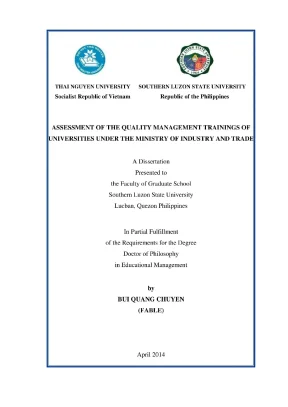
Tải xuống để đọc toàn bộTHAI NGUYEN UNIVERSITY SOUTHERN LUZON STATE UNIVERSITY Socialist Republic of Vietnam Republic of the Philippines ASSESSMENT OF THE QUALITY MANAGEMENT TRAININGS OF [UNIVERSITIES UNDER THE MINISTRY OF INDUSTRY AND TRADE A Dissertation Presented to the Faculty of Graduate School Southern Luzon State University Lucban, Quezon Philippines In Partial Fulfillment of the Requirements for the Degree Doctor of Philosophy in Educational Management by BUI QUANG CHUYEN (FABLE) April 2014 CONTENTS No Contents Page Chapter I—- INTRODUCTION 4 Background of the Study 7 Objectives of the study 8 Significance of the study 9 Scope and limitation of the study 10 Definitions of Terms 10 Chapter II - REVIEW OF LITERATURE AND STUDIES 14 2.2 | Quality management and management of training quality 15 2.4 | Quality of training 17 2.6 | Quality assessment criterions of ASEAN University Network | 19 (ANU) 2.7 | Quality assessment criterions of Universities in Vietnam 20 Research Paradigm 21 Chapter Il - RESEACH METHODOLOGY 22 3.1 Locale of the Study 22 3.3 Population and Sampling 23 3.5 Data Gathering Procedure 24 3.6 Statistical treatment of the data 24 3.7 | Questionnaire and Information collection method 24 Ranking method 26 Statistical table method 27 Chapter IV —- RESULTS AND DISCUSSIONS 28 4.1 | Result of the assessment of the quality management training of | 28 the universities under MOIT 4.2 | Solution to develop and enhance program based on the finding 41 4.3 | Evaluate the enhancement program by experts on the field 53 4.4 | Discussions 54 Chapter V —- SUMMARY, FINDINGS, CONCLUSIONS | 55 AND RECOMMENDATIONS 5. Periodical, Journal and Magazine 60 C. Electronic References 61 APPENDICES A 62 APPENDICES B 76 Chapter I INTRODUCTION In past years, Vietnam’s education and training sector has achieved significant accomplishments considering the size and quality of training which shows an increasing demand for technical labor force by economic sector, manufacturing and services. The trainings conducted at university levels had been gradually strengthened that resulted to significant management changes.
Quality training is the top concern of the whole society but it still exists many problems which need to be solved particularly in the scope of state management and school management. Training facilities have been directly created and take the responsibility for the quality of training. However, higher education sector also reveals many shortcomings and weaknesses, such as: the quality of education is generally low which is not responsive to the demands of social and economic development of the country; the management mechanism of State for higher education system and the management of universities and colleges is unreasonably prolonged and does not create a strong motivation to develop the creative capacity and responsibility among the faculty members, managers and students. It is also a fact that social and potential foreign investment for the development of higher education has not been promoted effectively.
In the international context, the world is moving toward industrial and automatic revolution, taken as a dynamic knowledge development. Level of innovation and the application of knowledge decide the level of development of each country. The development of science and technology has drastically changed the content and methods of education in schools, and requires higher education to provide highly qualified human resources for society. In domestic context, in terms of opportunities, after nearly 30 years of transition, the country enters a period of strong growth with the new position 4 and appearance.
Vietnam’s economy is more improved, national security is well-maintained. Economic structure continues to shift toward strengthening industrial and service sectors. The living standard of community is markedly improved. Vietnam is actively involved in the process of international integration with high economic growth rate and a stable political environment.
By actively integrating into international economics and joined the World Trade Organization (WTO) in 2007, it has created more favorable conditions for socio-economic development process of Vietnam. However, despite the significant growth, the Vietnam’s economy is still suffering from low-income economy. Indicators of infrastructure, human development is still lower than many countries in the world. Labor productivity is low; production is still mainly based on outdated technology, products as raw materials, high cost, low value added.
The economic structure has shifted but still slow: the ratio of services and industry in GDP is low. Economic infrastructure and social development does not meet the requirements. Quality management of the State for many areas of socio-economic, health and education sectors are limited. International cooperation is extended to facilitate investment of other countries, international organizations and foreign enterprises, increase the demand for labor recruitment through training, creating opportunities for education development.
Global integration process in the education creates favorable opportunities for Vietnam to quickly access to new trends, new knowledge, the modern model of education, taking advantage of international experience to develop and narrow the development gap between Vietnam and other countries. The contribution of the state's resources and people for the development of education is increasingly enhanced. Many economic sectors are willing to contribute to education revolution in Vietnam. The needs of learning at university level of Vietnamese (especially young people between the ages of 18-45) are enormous.
The needs of highly 5 qualified, professional skills, be able to meet the requirements of the operation and exploitation of advanced technological devices labor force are also high. Therefore, university should have a appropriate strategy to achieve both quantity and quality of training. In terms of challenges, with the strong development of the scientific revolution, the technology in the world can make the economic and knowledge gap between Vietnam and other countries increasingly larger, Vietnam is at risk of lagging further. Education management capacity of Vietnam is weak, the lack of appropriate policies and measures to guide and monitor the educational institutions with foreign elements.
Requirements of economic development in the coming years request not only the number but also request high quality of human resources. With the aim of continuing to grow over the threshold of the low-income country, Vietnam need to restructure the economy, develop value-added and high technology products and services. To do this contents, it requires Vietnam to have sufficient qualified manpower engineering and technology. Currently, Vietnam has more than 63% of working-age population, but the level of the labor force is still low compared to many countries in the region, both in knowledge and professional skills.
The country lacks highly qualified labor force in various fields, especially the field of electric, electronic and information technology. The structure of the workforce through training (university / high school / vocational training) is not reasonable. The demand of trained labor force is increasing in both quantity and quality it also puts more pressure for university education. By 2020, Vietnam will basically become a modern industrial country following the university requirements of the Ministry to train and provide technical qualified human resources for heavy industry (including: the engineering; metallurgy; exploitation, processing of minerals); light industry (including: textiles; footwear; food processing; wine, beer and beverage production.); energy (includes: electricity; electronics; petroleum); 6 economics, business administration,.
The demand of Industrial and Trade sector on high quality labor force is huge, but the universities do not meet the requirements of the quantity and quality of training. Therefore, this dissertation will research and recommend solutions on quality training of the universities under the MOIT. In fact in Vietnam, many graduates but cannot find jobs or they have to do jobs differ from subjects that they have been trained. One of the reasons is the quality of education; especially the quality of training of human resources cannot meet the employer’s desire and expectations as well as requirements of industrialization, modernization and international integration objectives.
Overall, the quality of graduates is limited, professional practice skills, information technology skills language ability and social activities of students did not meet the requirements of the employers. BACKGROUND OF THE STUDY At present, Ministry of Industry and Trade has 8 universities. They were established on the basic of the upgrade from college and are derived from the secondary schools, professional training mainly engineering, technology and economic management, direct service for businesses. In fact, through testing, evaluation, the management of the quality of university education ¡in universities under MOIT as __ follows: 1.
Advantages: Each university has built and identified goals and mission for itself. They gradually change teaching and learning methods, infrastructure investment and training facilities, consolidate construction teachers develop proficiency standards, cooperation in scientific research and technology transfer. Constraints and disadvantages : Every year, there is not a realistic assessment and report on the quality of education in general and higher education system in particular since there is no standard output of the university, not quantitative standards of teachers, programmes , facilities. - There is no correct solution to implement the identified targets.
Training programs do not fully develop in the field of study curriculum prescribed by the Ministry of Education and Training; Teaching and learning activities are not effective so the graduates do not meet the requirements of the employers, majority of producers must retrain knowledge, practical skills; The management of faculty, administrators and staff does not ensure the standards and qualifications in accordance with the Charter of the University. Besides, it’s also lack of policies and working conditions to encourage scientific research of students and lecturers. - Every year, the report does not have a realistic assessment of the quality of education in general and university education system in particular. From the Central Government (Ministry of Education and Training, the Ministry of Industry and Trade) to the base of university education is no agency in charge of quality management training; For these reasons, I choose the research title: “Assessment of the management quality trainings of universities under the MOIT” for my PhD dissertation with the hope that I can play my contribution to improve contents above to enhance the management quality training of universities under the MOIT.
OBJECTIVES OF THE STUDY This study focused on the assessment of the quality management trainings of the universities under the MOIT. Specifically, it sought answer to the following objectives: 1. Assess the quality management trainings of the universities under the MOIT in terms of : 1. Mission and goal; 1.
Management of staff and faculty; 1. Scientific research application development and_ technology transfer; 1. Learning equipment and facilities. Develop an enhancement program based from the finding.
Evaluate the enhancement program by experts on the field. SIGNIFICANCE OF THE STUDY This study will be of significance to the following: Through this research, the managers shall be assisted in assessment of the quality management trainings of the universities and at the same time will serve as the legal basis for assessment of the quality of training, based on the devised policies. University leaders: From this research, the university leaders will be able to build and design a mission of the university management in providing quality management training. Hence, the application of the solution will improve the quality of education in universities.
Faculties This study will help teachers understand the role and responsibilities in improving of assessment the quality management training. For them to know that good quality training, along with other measures, requires good teaching staff, the ability to guide and equipped with the proper knowledge and skills for the advancement of students. Students Students will also directly benefit from this study. The investment of money, effort, time - time to get the quality of knowledge, professional skills in their learning and research at the university.
Upon completion, graduate students will apply the knowledge learned to practical production-business. Head of Business enterprise production This study will help businesses to select qualified human resources (knowledge, skills, and attitudes) in their recruitment strategy. At the same time, business sectors shall be able to have a clear idea on their roles and responsibilities in financial aspects/contributions, as well as to facilitate the location and environment for students for domestic practice, thus, improving the quality of training of students.
Nội dung được bảo vệ bản quyền — Tải xuống đầy đủ
Trích dẫn luận án này
Bui Quang Chuyen (2014). Đánh giá việc quản lý chất lượng đào tạo của các trường đại [Luận án tiến sĩ, Southern Luzon State University, Thai Nguyen University]. LuanAn.net. https://luanan.net/tai-lieu-khac/danh-gia-viec-quan-ly-chat-luong-dao-tao-cua-cac-truong-dai-hoc-truc-thuoc-bo
Câu hỏi thường gặp
Luận án "Đánh giá việc quản lý chất lượng đào tạo của các trường đại" nghiên cứu về vấn đề gì?
Phân tích, đánh giá toàn diện hệ thống quản lý chất lượng đào tạo tại các trường đại học, xác định điểm mạnh, yếu và đề xuất giải pháp nâng cao hiệu quả.
Luận án "Đánh giá việc quản lý chất lượng đào tạo của các trường đại" được bảo vệ tại trường nào?
Luận án này được bảo vệ tại Southern Luzon State University, Thai Nguyen University. Năm bảo vệ: 2014.
Luận án "Đánh giá việc quản lý chất lượng đào tạo của các trường đại" thuộc chuyên ngành gì?
Luận án "Đánh giá việc quản lý chất lượng đào tạo của các trường đại" thuộc chuyên ngành Educational Management. Danh mục: Tài liệu khác.
Luận án "Đánh giá việc quản lý chất lượng đào tạo của các trường đại" có bao nhiêu trang?
Luận án "Đánh giá việc quản lý chất lượng đào tạo của các trường đại" có 83 trang. Bạn có thể xem trước một phần tài liệu ngay trên trang web trước khi tải về.
Cách tải luận án "Đánh giá việc quản lý chất lượng đào tạo của các trường đại" về máy như thế nào?
Để tải luận án về máy, bạn nhấn nút "Tải xuống ngay" trên trang này, sau đó hoàn tất thanh toán phí lưu trữ. File sẽ được tải xuống ngay sau khi thanh toán thành công. Hỗ trợ qua Zalo: 0559 297 239.