Nghiên cứu Sinh thái học Bầy Đàn Hải Ly tại Vườn Quốc gia Isle Royale: Ước tính Số lượng và Ảnh hưởng Săn mồi
Khám phá sinh thái học bầy đàn hải ly tại Vườn Quốc gia Isle Royale. Tìm hiểu hành vi, vai trò trong hệ sinh thái và bảo tồn loài.
Michigan Technological University
Applied Ecology
Luan An
Luận văn thạc sĩ
Năm xuất bản
Số trang
95
Thời gian đọc
15 phút
Lượt xem
0
Lượt tải
0
Phí lưu trữ
40 Point
Tổng quan nhanh
- Chủ đề:
- Nghiên cứu Sinh thái học Bầy Đàn Hải Ly Isle Royale
- Số trang:
- 95 trang
- Trường:
- Michigan Technological University
- Chuyên ngành:
- Applied Ecology
- Tác giả:
- Mark C. Romanski
- Năm:
- 2010
Tóm tắt nội dung luận án
I.Nghiên cứu Sinh thái học Bầy Đàn Hải Ly Isle Royale
Nghiên cứu này tập trung vào sinh thái học bầy đàn hải ly tại Vườn Quốc gia Isle Royale. Tài liệu khám phá sự phong phú của hải ly và động lực học săn mồi. Isle Royale cung cấp một hệ sinh thái độc đáo, tách biệt để nghiên cứu. Sự cô lập của nó tạo điều kiện lý tưởng cho các nghiên cứu dài hạn. Việc hiểu quần thể hải ly là rất quan trọng. Hải ly là một thành phần thiết yếu của hệ sinh thái Isle Royale. Chúng ảnh hưởng đến cấu trúc và chức năng của môi trường. Dữ liệu dài hạn là nền tảng của công việc này. Nghiên cứu này đóng góp vào sự hiểu biết về tương tác sinh thái phức tạp. Nó cũng giúp quản lý và bảo tồn động vật hoang dã. Vườn Quốc gia Isle Royale là bối cảnh tự nhiên cho việc khám phá những mối quan hệ này.
1.1. Mục tiêu Nghiên cứu tại Isle Royale
Nghiên cứu này có các mục tiêu rõ ràng tại Isle Royale. Một mục tiêu chính là ước tính mức độ phong phú của quần thể hải ly. Việc đánh giá chính xác số lượng hải ly rất cần thiết. Mục tiêu khác là phân tích động lực học săn mồi. Quan hệ vật ăn thịt-con mồi, đặc biệt là sói đối với hải ly, được kiểm tra. Nghiên cứu tìm hiểu các yếu tố điều tiết quần thể hải ly. Các yếu tố này bao gồm điều tiết từ trên xuống và từ dưới lên. Yếu tố phi sinh học cũng được xem xét. Mục tiêu cuối cùng là cung cấp cái nhìn sâu sắc về sinh thái học bầy đàn hải ly. Những hiểu biết này hỗ trợ các nỗ lực bảo tồn tại hệ sinh thái Isle Royale. Dữ liệu giúp dự đoán những thay đổi quần thể trong tương lai.
1.2. Lịch sử Dữ liệu Hải Ly Độc đáo
Nghiên cứu hải ly tại Isle Royale hưởng lợi từ bộ dữ liệu lịch sử phong phú. Dr. Phillip Shelton đã bảo tồn một bộ dữ liệu hải ly vô song. Những nỗ lực của ông đặt nền móng cho các nghiên cứu hiện tại. Rolf Peterson tiếp tục công việc thu thập dữ liệu quan trọng này. Sự cống hiến của họ đã tạo ra một kho tàng thông tin. Dữ liệu dài hạn này cho phép phân tích xu hướng quần thể. Nó cung cấp một cái nhìn sâu sắc về động lực học quần thể hải ly qua nhiều thập kỷ. Hệ sinh thái Isle Royale có một lợi thế độc đáo này. Việc duy trì dữ liệu liên tục là vô giá. Nó hỗ trợ các nghiên cứu chuyên sâu về sinh thái học bầy đàn hải ly. Dữ liệu lịch sử là công cụ để hiểu các biến động quần thể.
II.Động lực học Quần thể Hải Ly và Yếu tố Điều tiết
Quần thể hải ly trên Isle Royale thể hiện động lực học phức tạp. Nhiều yếu tố ảnh hưởng đến sự biến động số lượng của chúng. Điều tiết sinh học và phi sinh học đều đóng vai trò. Điều tiết từ trên xuống bao gồm áp lực săn mồi. Điều tiết từ dưới lên liên quan đến nguồn tài nguyên. Các yếu tố phi sinh học như thời tiết cũng có tác động. Nghiên cứu này phân tích những tương tác đó. Nó tìm cách hiểu cách các yếu tố này định hình động lực học quần thể hải ly. Môi trường sống của hải ly cũng thay đổi. Những thay đổi này ảnh hưởng đến sự sinh tồn và sinh sản. Hải ly là một phần không thể thiếu của hệ sinh thái Isle Royale. Sự hiểu biết về động lực học quần thể của chúng là cần thiết.
2.1. Đánh giá Mức độ phong phú Hải Ly
Ước tính mức độ phong phú của hải ly là một phần cốt lõi của nghiên cứu. Các khảo sát trên không được tiến hành để xác định các khu vực sinh sống. Việc phát hiện các ao hải ly và đập hải ly hoạt động là chìa khóa. Các ước tính này cung cấp một cái nhìn tổng quan về quy mô quần thể. Dữ liệu được sử dụng để theo dõi xu hướng quần thể hải ly. Độ chính xác của các ước tính là rất quan trọng. Nó ảnh hưởng đến các kết luận về động lực học quần thể hải ly. Việc đếm đếm hai lần giúp cải thiện độ tin cậy. Thách thức trong việc ước tính khả năng quan sát được giải quyết. Những phương pháp này hỗ trợ việc hiểu quần thể hải ly. Chúng cung cấp thông tin cần thiết cho việc quản lý.
2.2. Ảnh hưởng của Điều tiết Sinh học và Phi sinh học
Quần thể hải ly bị điều tiết bởi nhiều yếu tố. Điều tiết từ trên xuống bao gồm săn mồi bởi sói Isle Royale. Quan hệ vật ăn thịt-con mồi này ảnh hưởng đến tỷ lệ tử vong. Điều tiết từ dưới lên liên quan đến nguồn thức ăn. Thực vật ven sông là nguồn tài nguyên thiết yếu. Sự sẵn có và chất lượng của thực vật ảnh hưởng đến khả năng duy trì quần thể. Các yếu tố phi sinh học cũng tác động. Điều kiện khí hậu và thời tiết ảnh hưởng đến môi trường sống của hải ly. Lượng mưa và nhiệt độ có thể ảnh hưởng đến đập hải ly và ao hải ly. Việc hiểu những tương tác này là chìa khóa. Chúng định hình động lực học quần thể hải ly và sức khỏe hệ sinh thái Isle Royale.
III.Quan hệ Vật ăn thịt Con mồi Sói Hải Ly Nai
Hệ sinh thái Isle Royale là một ví dụ điển hình về quan hệ vật ăn thịt-con mồi. Sói Isle Royale là động vật ăn thịt hàng đầu. Nai sừng tấm Isle Royale là con mồi chính của chúng. Tuy nhiên, hải ly cũng là một phần quan trọng trong khẩu phần ăn của sói. Mối quan hệ này rất năng động. Sự thay đổi trong quần thể một loài ảnh hưởng đến các loài khác. Việc nghiên cứu các tương tác này cung cấp cái nhìn sâu sắc. Nó giúp hiểu sự ổn định của hệ sinh thái. Sói, hải ly và nai sừng tấm tạo thành một mạng lưới thức ăn phức tạp. Sự cân bằng giữa chúng là rất nhạy cảm.
3.1. Tương tác Sói và Hải Ly
Sói Isle Royale thường săn bắt hải ly. Hải ly cung cấp một nguồn thức ăn thay thế. Điều này đặc biệt đúng khi quần thể nai sừng tấm thấp. Các nhà nghiên cứu phân tích phân sói. Phân tích này xác định sự hiện diện của phần còn lại của hải ly. Dữ liệu từ phân chỉ ra tỷ lệ săn mồi. Tương tác này tác động đến động lực học quần thể hải ly. Áp lực săn mồi của sói có thể điều tiết số lượng hải ly. Quan hệ vật ăn thịt-con mồi này định hình hành vi của cả hai loài. Nó là một phần thiết yếu của hệ sinh thái Isle Royale.
3.2. Vai trò của Nai sừng tấm trong Hệ sinh thái
Nai sừng tấm Isle Royale là con mồi chính của sói. Quần thể nai sừng tấm có ảnh hưởng lớn đến sói. Khi số lượng nai sừng tấm giảm, sói chuyển sang các con mồi khác. Hải ly trở thành nguồn thức ăn bổ sung quan trọng. Điều này cho thấy tính linh hoạt của sói. Nó cũng làm nổi bật sự kết nối trong mạng lưới thức ăn. Sự ổn định của hệ sinh thái Isle Royale phụ thuộc vào những tương tác này. Việc hiểu vai trò của nai sừng tấm là cần thiết. Nó giúp dự đoán sự thay đổi trong quần thể sói và hải ly. Những mối quan hệ này định hình toàn bộ cảnh quan sinh thái.
IV.Hải Ly Kỹ sư Hệ sinh thái Isle Royale Quan trọng
Hải ly được biết đến là những kỹ sư hệ sinh thái. Chúng tạo ra những thay đổi đáng kể cho môi trường. Hoạt động của chúng định hình cảnh quan tại Isle Royale. Đập hải ly và ao hải ly là những đặc điểm nổi bật. Những công trình này tạo ra môi trường sống mới. Chúng ảnh hưởng đến các loài thực vật và động vật khác. Tác động của hải ly có thể là sâu rộng. Chúng thay đổi dòng chảy của nước và đất. Điều này góp phần vào sự đa dạng sinh học tổng thể. Vai trò của chúng rất quan trọng đối với sức khỏe của hệ sinh thái Isle Royale. Việc hiểu vai trò kỹ sư của hải ly là thiết yếu.
4.1. Tác động của Đập Hải Ly và Ao Hải Ly
Hải ly xây dựng đập ấn tượng. Những đập này tạo ra ao hải ly, làm ngập lụt khu vực. Các ao này biến đổi môi trường sống ven sông một cách mạnh mẽ. Chúng tạo ra các vùng đất ngập nước mới. Vùng đất ngập nước hỗ trợ nhiều loài thực vật thủy sinh. Chúng cũng cung cấp môi trường sống cho cá và côn trùng. Đập điều chỉnh dòng chảy của nước. Chúng giữ nước lại trong cảnh quan. Ao hải ly cung cấp nơi trú ẩn quan trọng. Chúng bảo vệ hải ly khỏi các loài săn mồi trên cạn. Những thay đổi này có tác động lâu dài đến hệ sinh thái Isle Royale.
4.2. Thay đổi Môi trường sống ven sông
Hoạt động của hải ly thay đổi đáng kể môi trường sống ven sông. Hải ly chặt cây và thực vật để xây đập. Việc khai thác thực vật ven sông này ảnh hưởng đến thảm thực vật. Các loài cây bị giảm, trong khi các loài khác có thể phát triển mạnh. Sự thay đổi này tác động đến các loài động vật phụ thuộc. Chim, côn trùng và động vật có vú nhỏ bị ảnh hưởng. Hải ly duy trì sự đa dạng cảnh quan. Chúng tạo ra các giai đoạn kế tiếp khác nhau. Điều này góp phần vào sức khỏe tổng thể của hệ sinh thái Isle Royale. Môi trường sống của hải ly là một khu vực năng động. Nó liên tục được định hình bởi hoạt động của hải ly.
V.Phương pháp Đánh giá Quần thể Hải Ly Chính xác
Việc đánh giá chính xác quần thể hải ly đòi hỏi phương pháp khảo sát tin cậy. Các phương pháp này được phát triển để thu thập dữ liệu đáng tin cậy. Dữ liệu chính xác là cần thiết để hiểu động lực học quần thể hải ly. Những hiểu biết sâu sắc này thông báo về các chiến lược bảo tồn. Các phương pháp bao gồm khảo sát trên không và phân tích dữ liệu. Những thách thức trong việc ước tính khả năng quan sát được giải quyết. Mục tiêu là đạt được các ước tính đáng tin cậy. Chúng phản ánh đúng mức độ phong phú của hải ly. Việc liên tục cải thiện phương pháp là rất quan trọng.
5.1. Khảo sát Đếm Đôi trên không
Khảo sát đếm đôi trên không là một kỹ thuật được sử dụng. Phương pháp này xác định các khu vực sinh sống của hải ly hoạt động. Các nhà nghiên cứu bay qua các khu vực khảo sát đã chọn. Họ ghi lại các đập hải ly và ao hải ly. Kỹ thuật đếm đôi giúp điều chỉnh các thuộc địa bị bỏ sót. Điều này cải thiện độ chính xác của ước tính. Dữ liệu từ các khảo sát này là rất quan trọng. Nó giúp theo dõi xu hướng trong động lực học quần thể hải ly. Phương pháp này cung cấp một bức tranh toàn diện. Nó là cơ sở cho các phân tích sinh thái sâu hơn.
5.2. Thách thức trong Ước tính Khả năng Quan sát
Việc ước tính khả năng quan sát có thể là một thách thức. Một số thuộc địa hải ly có thể bị bỏ sót trong các khảo sát. Điều này có thể dẫn đến ước tính sai lệch về mức độ phong phú. Khả năng quan sát bị ảnh hưởng bởi nhiều yếu tố. Chúng bao gồm điều kiện môi trường sống của hải ly. Thảm thực vật dày đặc có thể che khuất các đập và ao. Nghiên cứu giải quyết những thách thức này. Nó tìm cách cải thiện độ chính xác của các ước tính. Việc hiểu các hạn chế là quan trọng. Nó đảm bảo các kết luận về động lực học quần thể hải ly là đáng tin cậy.
Mục lục chi tiết luận án
Tải xuống file đầy đủ để xem toàn bộ nội dung
Tải đầy đủ (95 trang)Trích đoạn nội dung luận án
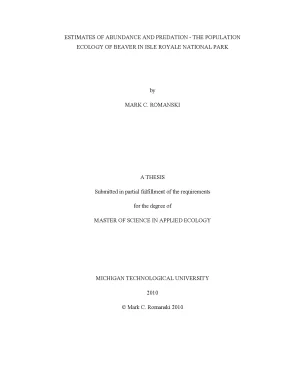
Tải xuống để đọc toàn bộESTIMATES OF ABUNDANCE AND PREDATION - THE POPULATION ECOLOGY OF BEAVER IN ISLE ROYALE NATIONAL PARK by MARK C. ROMANSKI A THESIS Submitted in partial fulfillment of the requirements for the degree of MASTER OF SCIENCE IN APPLIED ECOLOGY MICHIGAN TECHNOLOGICAL UNIVERSITY 2010 © Mark C. Romanski 2010 This thesis, “Estimates of abundance and predation - the population ecology of beaver in Isle Royale National Park,” is hereby approved in partial fulfillment of the requirements for the degree of MASTER OF SCIENCE IN APPLIED ECOLOGY. School of Forest Resources & Environmental Science Signatures: Thesis Advisor _________________________________________ Dr.
Vucetich Dean of School _________________________________________ Dr. Gale Date __________________________________ ACKNOWLEDGEMENTS I am the beneficiary of people too numerous to mention who have labored on Isle Royale to study and understand this most unique and endearing ecosystem. First and foremost are those with the vision that began only to look at, learn from, and accept what the “island” offered to teach them in its own good time. Specifically, thank you to Dr.
Duward Allen, who initiated the study of wolves and moose and who impassioned Dr. Phillip Shelton to pursue his interests in beaver ecology on the island. Shelton’s efforts and long-term commitment to his work preserved a data set that is unique and unparalleled. Rolf Peterson’s uncanny ability to always capture the right data, I am indebted.
But then again, when one pursues with tenacity and detail, good things abound. I am fortunate to have had the opportunity to work with Rolf and learn from his example. Douglas Smith, who ensured despite his own enormously busy schedule with something called the Yellowstone Wolf Project that the beaver survey continued in the years following Dr. Thank you for your commitment as well.
I would especially like to thank my advisor, Dr. His ability to comprehend and exquisitely express the natural world through research is something I will seek to emulate as I move forward from this point. To John and my committee members, Dr. Casey Huckins and Dr.
Joseph Bump, you have my gratitude for the time you have committed and the enormous amount of patience you bestowed. I also owe much appreciation to Dr. Leah Vucetich who grappled with the administrative aspects of my education. Additionally, her intimate knowledge of Isle Royale helped my efforts.
iii To the employees of Isle Royale National Park, my co-workers and friends, I am thankful for each and every one of you. Your efforts, not as National Park employees, but as dedicated men and women who strive to protect and preserve a piece of heaven, inspires me daily. Thank you for your direct efforts to this project and your support these 15 years I have worked alongside you. A few names must be singled out: Jack Oelfke, Ann Mayo-Keily, Alex Egan, Katy Goodwin, Leah Ettema, Jean Battle, Steve Windels, James Hummel, Jon-Hudson Spencer, Paul Brown, Betsy Rossini, Phyllis Green, Erin Grivicich, Kerry Martin, Buzz Brown, Steve Martin and Sue Ruddy.
Thank you all! The longevity of this project would not have been possible without the financial commitments of the Isle Royale Keweenaw Parks Association. Specifically, Jill Burkland, who always gave when asked. Thank you Jill! Additionally, financial contributions came from the National Park Service Great Lakes Inventory and Monitoring Network and were inspired by the foresight of Bill Route, its Director. To my family, Azure, Birch, Acorn and Zephyr, thank for understanding, for your sacrifices, and most importantly your love.
Without it, none of this would have been possible. I missed you plenty and I plan to get that time back. To my parents, Karen and Victor Romanski, your continued support and unconditional love has made me a better person in all that I do and continues to give me strength. To all our friends who have supported me and my family, I will await the opportunity to return your good will and love.
iv TABLE OF CONTENTS ACKNOWLEDGEMENTS .x CHAPTER 1: Double-count surveys and unexpectedly misleading estimates of sightability for beaver colonies .3 FIELD METHODS & DATA PREPARATION .17 CHAPTER 2: The fourth dimension’s influence on top-down, bottom-up and abiotic regulation of beaver population dynamics .26 FIELD METHODS & DATA PREPARATION .32 Reconciliation of predation rate and growth rate .64 APPENDIX A – Historical narrative of beaver research on Isle Royale National Park, Michigan, USA.83 vi LIST OF TABLES Table 1-1. Statistics associated with the double count method for aerial surveys of active beaver colonies between 1990 and 2008. Population trends of wolves, moose, and beaver, and measurements of beaver predation by wolves as calculated using a linear equation to interpret scat occurrences in wolf feces between 1990 and 2009. Results of regression analyses to assess the influences of abiotic processes and top-down control on beaver population dynamics between 1962 – 2009.52 vii LIST OF FIGURES Figure 1-1.
Estimated probabilities of detecting an active beaver colony under various conditions. Estimated abundances of active beaver colonies on Isle Royale, 1962-2008. Map of Isle Royale, Lake Superior, North America, showing the distribution of the distinct forested communities and a typical distribution of active beaver colonies. The abundance of active beaver colonies, wolves and calculated predation rates for the period between 1962-2009.
Inter-annual variation in water availability for use and impoundment by beavers as represented by mean annual precipitation from 1962 to 2009 and the mean annual stream flow from pooled monthly averages between 1965 and 2003. Temporal correlation, using Pearson’s product-moment correlation coefficient, of beaver colony abundance under three, distinct, forest succession trajectories: eastern boreal forest region, central 1936 burn area, and the western northern hardwoods forest region. Simple linear regression analyses relating beaver colony growth rate to water availability represented as mean annual precipitation (cm) and mean annual stream flow (cubic meters per second). Evaluations of predation as a top-down control of beaver population dynamics using regression analyses.
Regression analyses to assess the relationship between the proportion of wolf diet that was beaver, determined by macroscopic inspection of wolf feces, and beaver colony and wolf abundance, and beaver colony growth rate.59 viii PREFACE The population dynamics of the beaver (Castor sp.) are fairly well studied and beaver are predominantly thought to have a strong top-down influence on the ecosystems they inhabit (see review in Rosell et al. Despite widespread acceptance of beaver as a keystone species and ecosystem engineer, the impacts of predation on the population dynamics of beaver are almost completely ignored (for exception see Potvin et al. Myself and the co-authors identified here have taken advantage of long-term data available for both beaver colony and wolf abundance on Isle Royale National Park to initiate assessments on the top-down influences of predation, bottom-up impacts of forest succession and the importance of abiotic processes as factors contributing to beaver population dynamics. Beaver colonies are typically surveyed in the fall of the year, when their food cache is visible.
Normally aircraft are used to accomplish this work. As part of ensuring an accurate count, investigators often employ a “double-count” survey. This survey involves two independent observers, each recording observations. These observations are then compared to one another and an estimate for the entire population is obtained, including those members of the population of interest not seen by either observer.
We have completed 5 double-count surveys on Isle Royale between 1990 and 2008 to increase the accuracy of our abundance estimate for beaver colonies. In two of those surveys, 1990 and 2002, a large fixed wing aircraft housing pilot and both observers was used. Specifically, this aircraft was a DeHavilland Beaver. In the remaining counts, ix 2006-2008, we used two smaller fixed-wing aircraft (Aeronca Champ or Aviat Husky) each with its own pilot and observers.
Unexpectedly, sightability, probability of detecting a beaver colony, was lower from the smaller aircraft, whose flight speed was slower, altitude lower and flight pattern was circling as opposed to the high altitude and straight flight line of the larger aircraft. Surprisingly, overestimation of sightability in the larger aircraft only became apparent after use of the smaller aircraft. Our results are important for others who employ the double-count method, in so much as, application of the double-count method can give scientists false confidence in meeting the assumptions associated with the double-count method. Predation plays a crucial role in the biodiversity and function of ecosystems (Duffy 2002, Duffy et al.
Generally, this importance is quantified in terms of mean abundance of consumers and resources available to these consumers. Less frequently investigated are the varying time scales at which consumer (predator) and resource (prey) abundances interact with each other. We manipulate the spatial-temporal aspects of the wolf, moose and beaver colony data collected on Isle Royale between 1962 and 2009, as well as, aspects of forest succession in each of three distinct forested communities to articulate the meaningful time scales at which top-down, bottom-up and abiotic processes influence beaver population dynamics. This approach is interesting for three reasons; (i) it incorporates the role of predation in beaver population dynamics which has largely been ignored previously, (ii) it allows us to quantify the influence of predation on the population of not only beaver, but also in a novel way, assess the impacts of beaver as a bottom-up influence on wolf population dynamics, and (iii) x contemplate restoration of beaver populations, both in North America and Europe, where in much of the beaver’s former range restoration occurred in the absence of predation.
Without elucidating what role predation plays in beaver population dynamics we may be operating under misconceptions regarding exactly what ecosystem processes we have restored. The story of beaver and beaver research in Isle Royale National Park began in 1790 and does not end here, but rather will continue because dedicated people care and this story is worth telling. I have attempted to provide a brief synopsis of this story to date in Appendix A. This snapshot is intended to give context to our efforts here and hopefully give the reader perspective regarding beaver ecology and its heretofore largely overlooked role in a unique ecosystem whose wolf-moose / predator-prey interactions have drawn attention away from this “ecosystem engineer”.
The work in Chapters 1 & 2 of my thesis, although I hesitate to say “my”, is largely our efforts to compile and extract a small aspect of the work done by Phillip Shelton, Rolf Peterson, and Doug Smith. These individuals kept the interest in beaver ecology on Isle Royale alive despite already demanding workloads. With the help of John Vucetich, who clarified our thoughts and provided important insights, I hope we have initiated a good start to what undoubtedly requires more concentrated effort to address key aspects of beaver ecology that perhaps can be more fully exacted on Isle Royale than anywhere else. xi CHAPTER 1: Double-count surveys and unexpectedly misleading estimates of sightability for beaver colonies.
1 Abstract An important method for estimating the abundance of wildlife is the double-count method, which involves comparing numbers of organisms seen by two independent observers. We used the double-count method to estimate sightability and number of North American beaver (Castor canadensis) colonies in Isle Royale National Park (Lake Superior, North America). In 1990 and 2002, we used the method with two observers flying in a DeHavilland Beaver. In 2006, 2007, and 2008, we used two observers in separate, smaller aircraft that flew transects and circles at lower altitudes.
Unexpectedly, sightability was lower from the smaller aircraft. Specifically, sightability had been 0.90]) for the smaller aircraft and 0.99]) for larger aircraft. However, other evidence suggests sightability had been grossly overestimated for the larger aircraft. Sightability when flying higher and straighter, required in the larger aircraft, may have been ~0.
Overestimation arose from violating an assumption of the double-count method – the assumption that all lodges are equally sightable. Disturbingly, that violation became apparent only after surveys from the smaller aircraft. The results are an object lesson where, the double-count method gave reason to think observers had a high rate of detecting colonies, when in fact it had been much lower.
Nội dung được bảo vệ bản quyền — Tải xuống đầy đủ
Trích dẫn luận án này
Mark C. Romanski (2010). Sinh thái học Bầy Đàn Hải Ly tại Vườn Quốc gia Isle Royale [Luận án tiến sĩ, Michigan Technological University]. LuanAn.net. https://luanan.net/sinh-hoc/sinh-thai-hoc/sinh-thai-hoc-hai-ly-vuon-quoc-gia-isle-royale
Câu hỏi thường gặp
Luận án "Sinh thái học Bầy Đàn Hải Ly tại Vườn Quốc gia Isle Royale" nghiên cứu về vấn đề gì?
Khám phá sinh thái học bầy đàn hải ly tại Vườn Quốc gia Isle Royale. Tìm hiểu hành vi, vai trò trong hệ sinh thái và bảo tồn loài.
Luận án "Sinh thái học Bầy Đàn Hải Ly tại Vườn Quốc gia Isle Royale" được bảo vệ tại trường nào?
Luận án này được bảo vệ tại Michigan Technological University. Năm bảo vệ: 2010.
Luận án "Sinh thái học Bầy Đàn Hải Ly tại Vườn Quốc gia Isle Royale" thuộc chuyên ngành gì?
Luận án "Sinh thái học Bầy Đàn Hải Ly tại Vườn Quốc gia Isle Royale" thuộc chuyên ngành Applied Ecology. Danh mục: Sinh Thái Học.
Luận án "Sinh thái học Bầy Đàn Hải Ly tại Vườn Quốc gia Isle Royale" có bao nhiêu trang?
Luận án "Sinh thái học Bầy Đàn Hải Ly tại Vườn Quốc gia Isle Royale" có 95 trang. Bạn có thể xem trước một phần tài liệu ngay trên trang web trước khi tải về.
Cách tải luận án "Sinh thái học Bầy Đàn Hải Ly tại Vườn Quốc gia Isle Royale" về máy như thế nào?
Để tải luận án về máy, bạn nhấn nút "Tải xuống ngay" trên trang này, sau đó hoàn tất thanh toán phí lưu trữ. File sẽ được tải xuống ngay sau khi thanh toán thành công. Hỗ trợ qua Zalo: 0559 297 239.