Phản ứng của Cá hồi Đại Tây Dươngjuvenile với cạnh tranh và biến đổi khí hậu
Cá hồi Đại Tây Dương con: Hiểu rõ tác động cạnh tranh và biến đổi khí hậu, bảo vệ tương lai loài cá hồi.
University of Maine
Ecology and Environmental Science
Luan An
Luận án tiến sĩ
Năm xuất bản
Số trang
129
Thời gian đọc
20 phút
Lượt xem
0
Lượt tải
0
Phí lưu trữ
40 Point
Tổng quan nhanh
- Chủ đề:
- Cá hồi Đại Tây Dương juvenile: Mối đe dọa mới
- Số trang:
- 129 trang
- Trường:
- University of Maine
- Chuyên ngành:
- Ecology and Environmental Science
- Tác giả:
- Nicole Ramberg-Pihl
- Năm:
- 2020
Tóm tắt nội dung luận án
I.Cá hồi Đại Tây Dương juvenile Mối đe dọa mới
Cá hồi Đại Tây Dương non (Salmo salar juvenile) là loài đặc hữu quan trọng của các dòng suối Maine. Chúng đại diện cho quần thể hoang dã cuối cùng tại Hoa Kỳ. Lịch sử cho thấy sự phong phú của loài này đã suy giảm nghiêm trọng. Nguyên nhân bao gồm nạn phá rừng, đánh bắt quá mức, và xây dựng đập. Năm 2000, cá hồi Đại Tây Dương được Liên bang liệt kê là loài nguy cấp. Giai đoạn cá hương (parr) của cá hồi non dành 1 đến 3 năm trong môi trường sống sông. Sau đó, chúng biến đổi thành giai đoạn cá bạc (smolt) và di cư ra biển. Trong giai đoạn sống ở sông, cá hồi non đối mặt với nhiều mối đe dọa nghiêm trọng. Những mối đe dọa này đe dọa sự tồn tại và khả năng phục hồi của chúng.
1.1. Tình trạng suy giảm và tầm quan trọng loài
Cá hồi Đại Tây Dương là một biểu tượng sinh thái của New England. Sự suy giảm của chúng phản ánh sức khỏe của hệ sinh thái nước ngọt. Việc bảo tồn Salmo salar juvenile là tối quan trọng. Điều này duy trì đa dạng sinh học và chức năng sinh thái. Giai đoạn cá hương sống trong môi trường sống sông. Chúng phụ thuộc vào chất lượng nước và sự sẵn có của không gian sống. Bảo vệ loài này cũng có ý nghĩa văn hóa và kinh tế đối với khu vực.
1.2. Biến đổi khí hậu Thách thức môi trường sống sông
Khí hậu New England thay đổi nhanh hơn bất kỳ vùng nào ở lục địa Hoa Kỳ. Maine đã trải qua sự gia tăng nhiệt độ hàng năm khoảng 1.48oC trong thế kỷ qua. Lượng mưa hàng năm cũng tăng 15%. Nhiệt độ và lượng mưa đóng vai trò cốt yếu định hình sinh thái môi trường nước ngọt. Những thay đổi khí hậu này có thể làm suy yếu cấu trúc và sự ổn định của hệ thống nước ngọt Maine. Chúng ảnh hưởng trực tiếp đến môi trường sống sông của cá hồi Đại Tây Dương non.
II.Biến đổi khí hậu Tác động sinh thái cá hồi non
Sự ấm lên toàn cầu gây ra những thách thức đáng kể cho Salmo salar juvenile. Nhiệt độ nước tăng cao ảnh hưởng đến sinh lý, hành vi và khả năng cạnh tranh của chúng. Đồng thời, sự thay đổi trong mô hình lượng mưa cũng tác động đến dòng chảy, chất lượng nước và sự sẵn có của môi trường sống sông. Cá hồi Đại Tây Dương non cần một môi trường ổn định để phát triển. Bất kỳ sự xáo trộn nào cũng có thể gây ra hậu quả nghiêm trọng cho sự sống sót của chúng. Các nghiên cứu đã tìm hiểu những tác động này một cách chi tiết, nhằm dự báo và giảm thiểu rủi ro.
2.1. Nhiệt độ tăng và cạnh tranh loài xâm lấn
Nhiệt độ nước tăng có thể làm trầm trọng thêm ảnh hưởng của cạnh tranh liên loài. Thí nghiệm vi môi trường có kiểm soát nhiệt độ được thực hiện. Mục đích là điều tra điều này. Kết quả cho thấy cá vược miệng nhỏ (Micropterus dolomeiu) không phải loài bản địa. Chúng có tiềm năng vượt trội cá hồi Đại Tây Dương non. Điều này xảy ra khi nước tiếp tục ấm lên. Cá vược miệng nhỏ cạnh tranh gay gắt về nguồn thức ăn và không gian sống. Điều này gây áp lực lớn lên khả năng sinh tồn của cá hồi non.
2.2. Ảnh hưởng khí hậu đến tình trạng và sinh trưởng cá
Các mô hình hồi quy động được áp dụng để phân tích dữ liệu 16 năm. Mối quan hệ giữa tình trạng cá hồi Đại Tây Dương juvenile, nhiệt độ và lượng mưa được nghiên cứu. Phân tích thực hiện trên 9 dòng suối, 4 lưu vực. Kết quả cho thấy tác động của biến đổi khí hậu lên sinh trưởng cá hồi có thể khác nhau. Sự khác biệt tùy thuộc vào dòng suối cụ thể và quy mô không gian. Điều này nhấn mạnh sự phức tạp của hệ thống sinh thái sông.
III.Cạnh tranh loài Thử thách cho Salmo salar juvenile
Cá hồi Đại Tây Dương non đối mặt với áp lực cạnh tranh gay gắt từ nhiều loài khác nhau. Sự hiện diện của các loài du nhập hoặc xâm lấn có thể làm giảm khả năng tiếp cận tài nguyên. Chúng chiếm đoạt nguồn thức ăn và không gian sống quan trọng. Điều này ảnh hưởng trực tiếp đến hiệu suất sinh trưởng và tỷ lệ sống sót của Salmo salar juvenile. Hiểu rõ các tương tác cạnh tranh là cần thiết cho chiến lược bảo tồn hiệu quả. Đặc biệt là trong bối cảnh môi trường sống sông đang thay đổi.
3.1. Cạnh tranh liên loài Cá vược miệng nhỏ
Các loài không phải bản địa, như cá vược miệng nhỏ, là mối đe dọa lớn. Chúng cạnh tranh trực tiếp với cá hồi Đại Tây Dương non về nguồn thức ăn và không gian sống. Cá vược miệng nhỏ có thể thích nghi tốt hơn với nhiệt độ nước ấm. Điều này mang lại cho chúng lợi thế cạnh tranh. Sự hiện diện của chúng có thể làm suy giảm quần thể cá hồi non. Đặc biệt là ở những dòng suối chịu ảnh hưởng của biến đổi khí hậu.
3.2. Vai trò lưới thức ăn sông và tôm càng
Một thí nghiệm mesocosm trong suối được tiến hành. Mục đích là điều tra ý nghĩa lưới thức ăn. Tương tác giữa tôm càng ăn tạp và cá hồi Đại Tây Dương ăn thịt được nghiên cứu. Kết quả gợi ý các quá trình từ dưới lên mạnh mẽ. Điều này xảy ra khi tôm càng hiện diện. Sự tăng trưởng tảo có thể thúc đẩy sự sẵn có của động vật không xương sống lớn. Chúng là nguồn thức ăn quan trọng cho chế độ ăn của cá hồi non.
IV.Nghiên cứu sinh thái sông Thực nghiệm thực địa
Nghiên cứu đã áp dụng nhiều phương pháp tiếp cận để hiểu rõ hơn về các yếu tố ảnh hưởng đến cá hồi Đại Tây Dương non. Từ thí nghiệm trong phòng thí nghiệm đến nghiên cứu thực địa. Các nhà khoa học đã thu thập dữ liệu quan trọng. Điều này giúp đánh giá tác động của biến đổi khí hậu và cạnh tranh loài. Các kết quả này cung cấp cái nhìn sâu sắc về sinh thái sông và những thách thức mà Salmo salar juvenile phải đối mặt. Chúng là cơ sở cho các quyết định quản lý và bảo tồn trong tương lai.
4.1. Thí nghiệm vi môi trường kiểm soát nhiệt độ
Các thí nghiệm vi môi trường cung cấp môi trường kiểm soát. Chúng giúp đánh giá chính xác tác động của nhiệt độ tăng. Đặc biệt là lên cạnh tranh giữa cá hồi Đại Tây Dương non và loài ngoại lai. Kết quả khẳng định cá vược miệng nhỏ có lợi thế cạnh tranh. Đặc biệt trong điều kiện nước ấm hơn. Điều này dự báo những thay đổi tiềm năng trong môi trường sống sông của cá hồi non.
4.2. Mô hình hóa mối quan hệ khí hậu và sinh trưởng
Phân tích dữ liệu lịch sử từ các dòng suối Maine là quan trọng. Mô hình hồi quy động giúp xác định các yếu tố khí hậu. Chúng ảnh hưởng đến tình trạng và sinh trưởng của Salmo salar juvenile. Mối quan hệ phức tạp, thay đổi theo địa điểm. Điều này đòi hỏi các giải pháp quản lý linh hoạt, phù hợp với từng khu vực cụ thể.
4.3. Đánh giá tương tác lưới thức ăn trong suối
Thí nghiệm mesocosm trong suối cung cấp cái nhìn. Nó về mối quan hệ giữa các thành phần lưới thức ăn sông. Tôm càng có thể gián tiếp hỗ trợ cá hồi non. Chúng tăng cường sản xuất các loài macroinvertebrate. Chúng là nguồn thức ăn quan trọng. Điều này cho thấy mối liên hệ phức tạp giữa các loài trong môi trường sống sông.
V.Bảo tồn cá hồi Đại Tây Dương non Giải pháp tương lai
Để đảm bảo sự sống sót của cá hồi Đại Tây Dương non, cần có các chiến lược bảo tồn toàn diện. Những chiến lược này phải giải quyết cả thách thức biến đổi khí hậu và cạnh tranh loài. Việc quản lý môi trường sống sông bền vững là then chốt. Điều này bao gồm bảo vệ các khu vực có nhiệt độ ổn định, duy trì chất lượng nước và đảm bảo nguồn thức ăn dồi dào. Các giải pháp phải linh hoạt và thích ứng với điều kiện môi trường thay đổi. Mục tiêu cuối cùng là phục hồi và duy trì quần thể Salmo salar juvenile khỏe mạnh.
5.1. Quản lý môi trường sống sông bền vững
Cần có chiến lược quản lý hiệu quả. Mục tiêu là bảo vệ môi trường sống sông cho Salmo salar juvenile. Giảm thiểu tác động của biến đổi khí hậu là ưu tiên hàng đầu. Bảo vệ các khu vực có nhiệt độ nước ổn định là thiết yếu. Đảm bảo nguồn thức ăn và không gian sống dồi dào là cần thiết. Điều này hỗ trợ sự phát triển của giai đoạn cá hương và cá bạc.
5.2. Kiểm soát loài xâm lấn và giảm cạnh tranh
Giảm thiểu sự hiện diện của loài ngoại lai là cực kỳ quan trọng. Đặc biệt là những loài cạnh tranh trực tiếp với cá hồi Đại Tây Dương non. Chiến lược này bao gồm loại bỏ hoặc quản lý quần thể cá vược miệng nhỏ. Điều này giúp tăng cơ hội sống sót cho cá hồi non. Quản lý cạnh tranh liên loài là một phần không thể thiếu trong nỗ lực bảo tồn.
5.3. Chiến lược thích ứng với biến đổi khí hậu
Phát triển các kế hoạch thích ứng là cần thiết. Chúng giúp cá hồi Đại Tây Dương non đối phó với nhiệt độ tăng và thay đổi lượng mưa. Điều này có thể bao gồm khôi phục hành lang sông. Tạo bóng mát tự nhiên và nhân tạo. Đảm bảo dòng chảy ổn định. Hỗ trợ sự phát triển khỏe mạnh của giai đoạn cá hương (parr) và giai đoạn cá bạc (smolt) là mục tiêu lâu dài.
Mục lục chi tiết luận án
Tải xuống file đầy đủ để xem toàn bộ nội dung
Tải đầy đủ (129 trang)Trích đoạn nội dung luận án
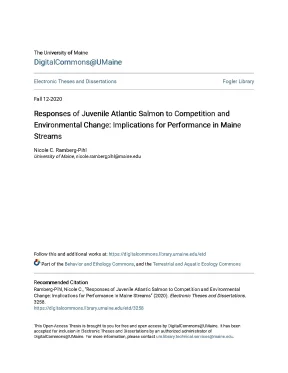
Tải xuống để đọc toàn bộThe University of Maine DigitalCommons@UMaine Electronic Theses and Dissertations Fogler Library Fall 12-2020 Responses of Juvenile Atlantic Salmon to Competition and Environmental Change: Implications for Performance in Maine Streams Nicole C. Ramberg-Pihl University of Maine, nicole.edu Follow this and additional works at: https://digitalcommons.edu/etd Part of the Behavior and Ethology Commons, and the Terrestrial and Aquatic Ecology Commons Recommended Citation Ramberg-Pihl, Nicole C., "Responses of Juvenile Atlantic Salmon to Competition and Environmental Change: Implications for Performance in Maine Streams" (2020). Electronic Theses and Dissertations.edu/etd/3258 This Open-Access Thesis is brought to you for free and open access by DigitalCommons@UMaine. It has been accepted for inclusion in Electronic Theses and Dissertations by an authorized administrator of DigitalCommons@UMaine.
For more information, please contact um. RESPONSES OF JUVENILE ATLANTIC SALMON TO COMPETITION AND ENVIRONMENTAL CHANGE: IMPLICATIONS FOR PERFORMANCE IN MAINE STREAMS By Nicole Ramberg-Pihl B. Plymouth State University, 2009 M. Plymouth State University, 2012 A DISSERTATION Submitted in Partial Fulfillment of the Requirements for the Degree of Doctor of Philosophy (in Ecology and Environmental Science) The Graduate School The University of Maine August 2020 Advisory Committee: Hamish Greig, PhD, Associate Professor of Stream Ecology, Advisor Stephen Coghlan, PhD Associate Professor of Freshwater Fisheries Ecology, Advisor Mike Kinnison, PhD, UMaine System Trustee Professor Jasmine Saros, PhD, Professor, School of Biology and Ecology Joseph Zydlewski, PhD, Maine Cooperative Fish and Wildlife Research Unit and Professor of Fisheries Science Copyright 2020 Nicole Ramberg-Pihl All Rights Reserved ii RESPONSES OF JUVENILE ATLANTIC SALMON TO COMPETITION AND ENVIRONMENTAL CHANGE: IMPLICATIONS FOR PERFORMANCE IN MAINE STREAMS By Nicole Ramberg-Pihl Dissertation Advisor: Dr.
Hamish Greig and Dr. Stephen Coghlan An Abstract of the Dissertation Presented in Partial Fulfillment of the Requirements for the Degree of Doctor of Philosophy (in Ecology and Environmental Sciences) August 2020 New England’s climate is changing faster than that of any other region in the continental United States. Over the last century, Maine has experienced an increase in annual temperature of approximately 1.48oC along with a 15 percent increase in annual precipitation. Temperature and precipitation play vital roles in shaping the ecology of freshwater environments.
Therefore, changes in regional climate could undermine the structure and stability of Maine’s freshwater systems as they currently exist. Maine currently harbors the last wild populations of Atlantic salmon (Salmo salar) in the United States. Atlantic salmon were once abundant in Maine streams, but suffered dramatic declines due to several factors including deforestation, overfishing, and the construction of dams. In 2000, Atlantic salmon were listed as a Federally Endangered species.
As juveniles, salmon spend 1 to 3 years in Maine streams before smolting. However, salmon face several threats as juveniles in Maine streams, including changes in climate as well as competition from introduced or invasive species which could outcompete salmon for resources. iii This dissertation examines these impacts on juvenile Atlantic salmon (Salmo salar) and the stream food webs in which they are embedded by (1.) Using temperature-controlled microcosm experiments to investigate the potential for climate-driven warming to exacerbate the effects of competition between native and invasive species from different thermal guilds. The results suggest that non-native smallmouth bass (Micropterus dolomeiu) have the potential to outcompete Atlantic salmon as waters continue to warm.) Running dynamic regression models to analyze the relationship between juvenile Atlantic salmon condition, temperature, and precipitation for 9 streams across 4 drainages over a 16-year period.
The results suggest that the impacts of climate change on salmon growth may vary by stream and spatial scale.) Conducting an instream mesocosm experiment to investigate the food-web implications of interactions between omnivorous crayfish and predatory Atlantic Salmon. These results suggest that strong bottom-up processes occur when crayfish are present, whereby increased algal growth could promote the availability of macroinvertebrates important to salmon diet. iv DEDICATION I dedicate this dissertation to my husband and my family, who have always encouraged me to reach for the stars. v ACKNOWLEDGEMENTS I would like to thank my advisors Hamish Greig and Steve Coghlan for their guidance in navigating the waters of my degree and their overall help while completing my research.
I have learned so much from you both. I would like to thank my committee members Joe Zydlewski, Mike Kinnison, and Jasmine Saros for their insight and support. Thank you to the combined Greig and Klemmer (Gremmer) lab for brainstorming ideas and providing feedback on my work. A special thank you to Chase Gagne for offering assistance identifying aquatic invertebrates and being a great officemate, it has been quite an excellent adventure.
Amanda Klemmer thank you for your advice in R. Dennis Anderson and Tamara Levitsky, this work would not have been possible without either of your help preparing for each field season as well as helping to complete trials by working in the lab. Thank you to the many people who worked on the salmon project in the Aquaculture Research Center, Mitch Paisker, Dan Perry, Cassidy Biggos, Tyson Porter, and Spencer Kelly. Thank you to Isaac Shepard for collaborating on preliminary experiments, Keegan Feero who worked on the Sunkhaze experiment, as well as Brad Erdman for volunteering his help in the field.
Neil Greenberg and Bobby Harrington from the Aquaculture Center, thank you for offering your expertise and time to help maintain our tanks. Thank you to Debbie Bouchard for helping assess the condition of our fish. Thank you to Zach Sheller and Kyle Winslow from the Wild Salmon Resource Center as well as Green Lake Hatchery for providing us with Atlantic salmon. Ernie Atkinson from the Department of Marine Resources, thank you for sharing your knowledge of Atlantic salmon in Maine.
Pam Wells, thank you for providing access to Sunkhaze Stream for my work. I would also like to thank the NSF IGERT Fellows and my specific IGERT cohort for their support and feedback throughout the program. Susan Elias, thank you for your advice regarding research analyzing large datasets. Thank you to the Downeast Salmon Federation.
I would also like to acknowledge my funding agencies, Maine Sea Grant, the US National Science Foundation Adaptation to Abrupt Climate Change IGERT program, the Atlantic Salmon Federation, and USDA – Hatch (MAFES) ME0-21607 to Greig and ME0-8367-0H to Coghlan. In-kind support was provided by the U. vi Geological Survey Maine Cooperative Fish and Wildlife Research Unit. Mention of trade names or commercial products does not imply endorsement by the U.
This work was conducted under the University of Maine Institutional Animal Care and Use Committee (IACUC) protocols number A2016-06-01. Lastly, I would like to thank my family for their support. Gatsby, Sparxx, Stardust, and Spyro, for always being there when I got home from a long bout in the field or lab. My husband, Brandon, for his encouragement to pursue my dreams.
My brother for taking my mind off work and reminding me to have a good time. Mom and Dad, thank you for instilling in me a sense of adventure that has led me to explore the world around me. For this I am forever grateful. vii TABLE OF CONTENTS DEDICATION.
vi LIST OF TABLES. xi LIST OF FIGURES. CHAPTER 1 General Introduction. 1 Climate Change in Freshwaters and Effects on Biota.
1 Atlantic Salmon and Threats they Face in Maine. CHAPTER 2 Unraveling the Impacts of Competition and Warming on Juvenile Atlantic Salmon (Salmo Salar) Performance in Maine Streams. CHAPTER 3 Interannual Variability in Temperature and Precipitation Have Stream-Specific Impacts on Juvenile Atlantic Salmon Condition in Maine Streams. 34 Data Acquisition and Filtering.
34 Dynamic Regression Models. 38 Annually Averaged Temperature and Precipitation. 38 Seasonally Averaged Summer Temperature and Precipitation. CHAPTER 4 Bottom-up Effects of Norther Crayfish, Faxonius virilis, Increase Atlantic Salmon, Salmo Salar, Prey in Maine Rivers.
69 Leaf Litter Decay Rate. 72 Salmon and Crayfish Stomach Contents. 74 Cobble Invertebrate Samples. 74 Leaf Pack Invertebrate Samples.
75 Salmon and Crayfish Stomach Content Samples. 75 Algal Biomass and Leaf Litter Decay Rate. 76 Responses in Cobble Substrate. 77 Responses in Leaf Packs.
CHAPTER 5 General Conclusion and Implications. 90 General Conclusion and Implications. 93 APPENDICES Mean Abundance of Invertebrates Found in Sunkhaze Samples. Mean abundance (number of individuals per family) of invertebrates found in the cobble samples by treatment.
Mean abundance (number of individuals per family) of invertebrates found in the leaf pack samples by treatment. 112 BIOGRAPHY OF THE AUTHOR. 113 x LIST OF TABLES Table 2. Results of GLM analysis examining the main and interactive effects of competition and temperature on salmon and bass feeding behavior before and after food addition to tanks.
Results of zero-inflated poisson model examining the main and interactive effects of competition and temperature on salmon and bass aggression before and after food addition to tanks. The nine streams and four drainages included in our analyses. Overview of dynamic regression models and the variables included in each model. Total count of Atlantic salmon individuals included in analyses by stream and life stage.
Range of Atlantic salmon length (cm), mass (g), and condition factor by stream. Results of dynamic regression Model 1-4 at the stream level, examining the relationship between annually averaged temperature (oC), precipitation (cm), and Atlantic salmon condition (Loge+1) between 1999 and 2015. Results of dynamic regression Models 1-4 at the drainage level as well as all streams combined, examining the relationship between annually averaged temperature (oC), precipitation (cm), and Atlantic salmon condition (Loge+1) between 1999 and 2015. Results of dynamic regression Models 1-4 at the stream level, examining the relationship between seasonally averaged summer temperature (oC), precipitation (cm), and Atlantic salmon condition (Loge+1) between 1999 and 2015.
Results of dynamic regression Models 1-4 at the drainage level as well as all streams combined, examining the relationship between seasonally averaged summer temperature (oC), precipitation (cm), and Atlantic salmon condition (Loge+1) between 1999 and 2015. Results of the partialRDA analysis examining community composition (condition on experimental block) and GLM analyses examining richness and evenness for invertebrates sampled in the cobble substrates. Results of the RDA analysis examining community composition and GLM analyses examining richness and evenness for invertebrates samples in the leaf packs. MANOVA results testing the effect of salmon presence on the percentage of Algal cells, amorphous detritus, coarse plant detritus, and invertebrate material found in crayfish stomach samples.
Mean abundance (number of individuals per family) of invertebrates found in the cobble samples by treatments. Mean abundance (number of individuals per family) of invertebrates found in the leaf pack samples by treatments. 112 xii LIST OF FIGURES Figure 2. Hypothetical performance curves of two interacting species under varying scenarios as temperatures change.
Timeline outlining the standard events of a typical trial during the microcosm experiment. Overall mean feeding for juvenile ATS and SMB over the 10 minute period pre- and post-feeding (+ 1 Standard Error). Mean feeding (+ 1 SE) observations of juvenile ATS and SMB at 18oC and 21oC. Overall mean aggressive encounters observed for juvenile ATS and SMB over the 10 minute period pre- and post-feeding (+ 1 Standard Error).
Aggressive encounters observed for juvenile ATS and SMB at 18oC and 21oC both pre- and post-feeding. Geographic location of all streams included in our dynamic regression models. Average annual temperature (Panel A) and seasonally averaged summertime (June, July, and August) temperatures (Panel B) for Bangor and State of Maine between 1999 and 2015. Histograms of juvenile Atlantic salmon length by stream for individuals included in the analyses.
Average annual temperature (oC), precipitation (cm), and Atlantic salmon condition (Loge +1) factor for Dennys River between 1999 and 2015. Average annual temperature (oC), precipitation (cm), and Atlantic salmon condition (Loge +1) factor for East Machias River between 1999 and 2015. Average annual temperature (oC), precipitation (cm), and Atlantic salmon condition (Loge +1) factor for Seavey Stream between 1999 and 2015 .
Nội dung được bảo vệ bản quyền — Tải xuống đầy đủ
Trích dẫn luận án này
Nicole Ramberg-Pihl (2020). Cá hồi Đại Tây Dươngjuvenile: Cạnh tranh và biến đổi khí hậu [Luận án tiến sĩ, University of Maine]. LuanAn.net. https://luanan.net/sinh-hoc/sinh-thai-hoc/phan-ung-ca-hoi-dai-tay-duong-canh-tranh-bien-doi-khi-hau
Câu hỏi thường gặp
Luận án "Cá hồi Đại Tây Dươngjuvenile: Cạnh tranh và biến đổi khí hậu" nghiên cứu về vấn đề gì?
Cá hồi Đại Tây Dương con: Hiểu rõ tác động cạnh tranh và biến đổi khí hậu, bảo vệ tương lai loài cá hồi.
Luận án "Cá hồi Đại Tây Dươngjuvenile: Cạnh tranh và biến đổi khí hậu" được bảo vệ tại trường nào?
Luận án này được bảo vệ tại University of Maine. Năm bảo vệ: 2020.
Luận án "Cá hồi Đại Tây Dươngjuvenile: Cạnh tranh và biến đổi khí hậu" thuộc chuyên ngành gì?
Luận án "Cá hồi Đại Tây Dươngjuvenile: Cạnh tranh và biến đổi khí hậu" thuộc chuyên ngành Ecology and Environmental Science. Danh mục: Sinh Thái Học.
Luận án "Cá hồi Đại Tây Dươngjuvenile: Cạnh tranh và biến đổi khí hậu" có bao nhiêu trang?
Luận án "Cá hồi Đại Tây Dươngjuvenile: Cạnh tranh và biến đổi khí hậu" có 129 trang. Bạn có thể xem trước một phần tài liệu ngay trên trang web trước khi tải về.
Cách tải luận án "Cá hồi Đại Tây Dươngjuvenile: Cạnh tranh và biến đổi khí hậu" về máy như thế nào?
Để tải luận án về máy, bạn nhấn nút "Tải xuống ngay" trên trang này, sau đó hoàn tất thanh toán phí lưu trữ. File sẽ được tải xuống ngay sau khi thanh toán thành công. Hỗ trợ qua Zalo: 0559 297 239.