Nghiên cứu lãnh đạo phục vụ giảm hành vi sai lệch kế toán - UEH
Lãnh đạo tận tâm giúp giảm hành vi sai phạm trong kế toán, tăng cường đạo đức và trách nhiệm chuyên nghiệp của nhân viên.
Luan An
Báo cáo tổng kết đề tài nghiên cứu khoa học
Năm xuất bản
Số trang
93
Thời gian đọc
14 phút
Lượt xem
2
Lượt tải
0
Phí lưu trữ
40 Point
Tổng quan nhanh
- Chủ đề:
- 1. Lãnh Đạo Tận Tâm Giảm Hành Vi Sai Phạm Kế Toán
- Số trang:
- 93 trang
- Trường:
- Trường Đại học Kinh tế Thành phố Hồ Chí Minh
- Chuyên ngành:
- Kế toán - Kiểm toán
- Tác giả:
- Luan An
- Năm:
- 2024
Tóm tắt nội dung luận án
I. Lãnh Đạo Tận Tâm Giảm Hành Vi Sai Phạm Kế Toán
Nghiên cứu khám phá vai trò của phong cách lãnh đạo tận tâm trong việc giảm thiểu hành vi sai lệch kế toán. Đạo đức lãnh đạo đóng vai trò then chốt trong việc ngăn chặn gian lận tài chính. Lãnh đạo tận tâm tập trung vào việc phục vụ nhân viên, tạo môi trường làm việc đạo đức. Phương pháp này giúp giảm thiểu báo cáo tài chính sai lệch thông qua việc xây dựng văn hóa doanh nghiệp minh bạch. Nghiên cứu sử dụng kết hợp phương pháp định tính và định lượng. Mẫu khảo sát chủ yếu từ TP. Hồ Chí Minh, độ tuổi 16-35. Kết quả cho thấy lãnh đạo tận tâm có tác động tích cực đến hành vi đạo đức trong kế toán. Kiểm soát nội bộ được cải thiện khi áp dụng phong cách lãnh đạo chính trực. Trách nhiệm giải trình tăng cường thông qua sự chữa lành cảm xúc và trao quyền nhân viên.
1.1. Bối Cảnh Nghiên Cứu Hành Vi Sai Lệch
Hành vi sai phạm kế toán ngày càng phổ biến trong môi trường doanh nghiệp. Gian lận tài chính gây thiệt hại lớn cho nền kinh tế. Báo cáo tài chính sai lệch làm giảm lòng tin của nhà đầu tư. Tuân thủ chuẩn mực kế toán trở thành thách thức lớn. Các tổ chức cần giải pháp hiệu quả để ngăn chặn hành vi sai trái. Lãnh đạo tận tâm xuất hiện như công cụ chiến lược. Phong cách này nhấn mạnh đạo đức và trách nhiệm xã hội. Minh bạch tài chính được đặt lên hàng đầu.
1.2. Mục Tiêu Và Phạm Vi Nghiên Cứu
Nghiên cứu tập trung vào giảm thiểu hành vi sai lệch trong kế toán. Phạm vi khảo sát tại TP. Hồ Chí Minh với các chuyên gia kế toán trẻ. Mục tiêu chính là kiểm chứng hiệu quả của lãnh đạo tận tâm. Nghiên cứu phân tích mối quan hệ giữa đạo đức lãnh đạo và hành vi nhân viên. Quản trị công ty được cải thiện thông qua văn hóa doanh nghiệp tích cực. Kết quả cung cấp định hướng cho nhà hoạch định chính sách.
1.3. Ý Nghĩa Thực Tiễn Của Đề Tài
Nghiên cứu mang lại giá trị thực tiễn cho tổ chức. Cung cấp công cụ cụ thể để xây dựng văn hóa doanh nghiệp đạo đức. Giúp lãnh đạo hiểu rõ tầm quan trọng của phong cách lãnh đạo chính trực. Tăng cường kiểm soát nội bộ thông qua các nguyên tắc lãnh đạo tận tâm. Góp phần nâng cao minh bạch tài chính trong doanh nghiệp. Hỗ trợ tuân thủ chuẩn mực kế toán hiệu quả hơn. Giảm thiểu rủi ro gian lận tài chính và bảo vệ lợi ích cổ đông.
II. Cơ Sở Lý Thuyết Về Lãnh Đạo Tận Tâm Kế Toán
Nghiên cứu dựa trên lý thuyết học tập xã hội và lý thuyết trao đổi xã hội. Lý thuyết học tập xã hội giải thích cách nhân viên học hành vi từ lãnh đạo. Lý thuyết trao đổi xã hội nhấn mạnh mối quan hệ qua lại giữa lãnh đạo và nhân viên. Đạo đức lãnh đạo ảnh hưởng trực tiếp đến hành vi kế toán. Phong cách lãnh đạo chính trực tạo nền tảng cho văn hóa doanh nghiệp minh bạch. Lãnh đạo tận tâm bao gồm bốn yếu tố chính: chữa lành cảm xúc, hành vi đạo đức, hỗ trợ phát triển nhân viên và trao quyền. Các yếu tố này tác động đến tâm linh nơi làm việc và giảm chủ nghĩa cá nhân. Kết quả là giảm thiểu sự tách rời đạo đức và hành vi sai lệch.
2.1. Lý Thuyết Học Tập Xã Hội
Lý thuyết học tập xã hội của Bandura giải thích quá trình học hành vi. Nhân viên quan sát và bắt chước hành vi của lãnh đạo. Đạo đức lãnh đạo trở thành mô hình cho nhân viên kế toán. Lãnh đạo tận tâm thể hiện phong cách lãnh đạo chính trực qua hành động. Nhân viên học cách tuân thủ chuẩn mực kế toán từ lãnh đạo. Văn hóa doanh nghiệp đạo đức được hình thành thông qua quá trình này. Minh bạch tài chính trở thành chuẩn mực chung trong tổ chức.
2.2. Lý Thuyết Trao Đổi Xã Hội
Lý thuyết trao đổi xã hội nhấn mạnh mối quan hệ qua lại. Lãnh đạo tận tâm đầu tư vào phát triển nhân viên. Nhân viên đáp lại bằng hành vi đạo đức và trách nhiệm giải trình. Quản trị công ty hiệu quả dựa trên sự tin tưởng lẫn nhau. Kiểm soát nội bộ được tăng cường khi có sự trao đổi tích cực. Gian lận tài chính giảm thiểu khi nhân viên cảm thấy được tôn trọng. Báo cáo tài chính sai lệch ít xảy ra trong môi trường tin cậy.
2.3. Khung Nghiên Cứu Và Giả Thuyết
Mô hình nghiên cứu bao gồm bốn yếu tố lãnh đạo tận tâm. Chữa lành cảm xúc và hành vi đạo đức tác động đến tâm linh nơi làm việc. Hỗ trợ phát triển và trao quyền giảm chủ nghĩa cá nhân. Tâm linh nơi làm việc giảm sự tách rời đạo đức. Chủ nghĩa cá nhân tăng sự tách rời đạo đức. Sự tách rời đạo đức dẫn đến hành vi sai lệch kế toán. Mô hình kiểm chứng mối quan hệ nhân quả giữa các biến. Kết quả xác nhận vai trò của phong cách lãnh đạo chính trực.
III. Phương Pháp Nghiên Cứu Hành Vi Kế Toán Sai Lệch
Nghiên cứu áp dụng kết hợp phương pháp định tính và định lượng. Phương pháp định tính sử dụng phỏng vấn chuyên gia kế toán. Mục đích là điều chỉnh thang đo phù hợp với bối cảnh Việt Nam. Phương pháp định lượng sử dụng khảo sát qua bảng câu hỏi. Mẫu nghiên cứu gồm các chuyên gia kế toán tại TP. Hồ Chí Minh. Phân tích dữ liệu sử dụng phần mềm SPSS. Kiểm định độ tin cậy Cronbach's Alpha đảm bảo chất lượng thang đo. Phân tích nhân tố khám phá EFA xác định cấu trúc biến. Hồi quy tuyến tính bội MLR kiểm chứng giả thuyết. Kết quả phân tích cung cấp bằng chứng về tác động của đạo đức lãnh đạo đến giảm thiểu gian lận tài chính.
3.1. Phương Pháp Nghiên Cứu Định Tính
Nghiên cứu định tính thực hiện phỏng vấn sâu chuyên gia. Mục tiêu điều chỉnh thang đo cho phù hợp văn hóa doanh nghiệp Việt Nam. Chuyên gia kế toán và kiểm toán được lựa chọn tham gia. Nội dung phỏng vấn tập trung vào đạo đức lãnh đạo. Thảo luận về kiểm soát nội bộ và tuân thủ chuẩn mực kế toán. Kết quả giúp hoàn thiện bảng câu hỏi khảo sát. Đảm bảo thang đo phản ánh chính xác thực tiễn quản trị công ty.
3.2. Phương Pháp Nghiên Cứu Định Lượng
Khảo sát định lượng sử dụng bảng câu hỏi có cấu trúc. Mẫu nghiên cứu chủ yếu từ TP. Hồ Chí Minh, độ tuổi 16-35. Phân phối bảng câu hỏi qua hình thức trực tuyến và trực tiếp. Nội dung khảo sát đo lường phong cách lãnh đạo chính trực. Đánh giá mức độ minh bạch tài chính trong tổ chức. Đo lường hành vi sai lệch kế toán và báo cáo tài chính sai lệch. Thu thập dữ liệu về trách nhiệm giải trình của nhân viên kế toán.
3.3. Phương Pháp Phân Tích Dữ Liệu
Sử dụng SPSS để phân tích dữ liệu khảo sát. Kiểm định Cronbach's Alpha đánh giá độ tin cậy thang đo. Phân tích EFA xác định cấu trúc nhân tố của các biến. Kiểm định KMO và Bartlett đánh giá tính phù hợp dữ liệu. Hồi quy tuyến tính bội MLR kiểm chứng mối quan hệ giữa biến. Kiểm tra đa cộng tuyến qua hệ số VIF. Kết quả phân tích cung cấp bằng chứng về tác động của văn hóa doanh nghiệp đến hành vi kế toán.
IV. Kết Quả Nghiên Cứu Lãnh Đạo Tận Tâm Kế Toán
Kết quả phân tích xác nhận tác động tích cực của lãnh đạo tận tâm. Kiểm định Cronbach's Alpha cho thấy độ tin cậy cao của thang đo. Phân tích EFA xác định rõ cấu trúc các nhân tố. Chữa lành cảm xúc có tác động mạnh đến tâm linh nơi làm việc. Hành vi đạo đức của lãnh đạo giảm chủ nghĩa cá nhân trong nhân viên. Hỗ trợ phát triển nhân viên tăng cường tuân thủ chuẩn mực kế toán. Trao quyền giúp cải thiện kiểm soát nội bộ. Tâm linh nơi làm việc giảm sự tách rời đạo đức đáng kể. Chủ nghĩa cá nhân tăng nguy cơ gian lận tài chính. Sự tách rời đạo đức dẫn trực tiếp đến báo cáo tài chính sai lệch. Kết quả hồi quy MLR cho thấy mối quan hệ nhân quả rõ ràng giữa các biến.
4.1. Kết Quả Kiểm Định Độ Tin Cậy
Cronbach's Alpha của các thang đo đạt mức cao trên 0.7. Thang đo chữa lành cảm xúc có độ tin cậy 0.85. Hành vi đạo đức đạt Cronbach's Alpha 0.88. Hỗ trợ phát triển nhân viên có độ tin cậy 0.82. Trao quyền đạt mức 0.86. Tâm linh nơi làm việc có Cronbach's Alpha 0.84. Chủ nghĩa cá nhân đạt 0.79. Sự tách rời đạo đức có độ tin cậy 0.87. Hành vi sai lệch kế toán đạt 0.89. Tất cả thang đo đều đảm bảo chất lượng cho phân tích tiếp theo.
4.2. Kết Quả Phân Tích Nhân Tố EFA
Phân tích EFA xác nhận cấu trúc nhân tố phù hợp. Kiểm định KMO đạt 0.912, cho thấy dữ liệu phù hợp phân tích. Bartlett's Test có ý nghĩa thống kê p < 0.001. Các biến quan sát tải lên đúng nhân tố dự kiến. Phương sai trích đạt trên 60% cho tất cả nhân tố. Không có hiện tượng tải chéo giữa các nhân tố. Cấu trúc bốn yếu tố lãnh đạo tận tâm được xác nhận. Các biến trung gian và phụ thuộc có cấu trúc rõ ràng.
4.3. Kết Quả Hồi Quy Tuyến Tính
Hồi quy MLR xác nhận các giả thuyết nghiên cứu. Chữa lành cảm xúc tác động tích cực đến tâm linh nơi làm việc (β = 0.35, p < 0.001). Hành vi đạo đức giảm chủ nghĩa cá nhân (β = -0.42, p < 0.001). Hỗ trợ phát triển tăng tâm linh nơi làm việc (β = 0.28, p < 0.01). Trao quyền giảm chủ nghĩa cá nhân (β = -0.31, p < 0.01). Tâm linh nơi làm việc giảm sự tách rời đạo đức (β = -0.39, p < 0.001). Chủ nghĩa cá nhân tăng sự tách rời đạo đức (β = 0.45, p < 0.001). Sự tách rời đạo đức dẫn đến hành vi sai lệch (β = 0.52, p < 0.001). Hệ số VIF < 3 cho thấy không có đa cộng tuyến. R² điều chỉnh đạt 0.68, mô hình giải thích tốt biến thiên.
V. Thảo Luận Kết Quả Nghiên Cứu Đạo Đức Lãnh Đạo
Kết quả nghiên cứu xác nhận vai trò quan trọng của đạo đức lãnh đạo. Phong cách lãnh đạo chính trực giảm thiểu hành vi sai lệch kế toán hiệu quả. Chữa lành cảm xúc giúp nhân viên cảm thấy được quan tâm và hỗ trợ. Điều này tạo văn hóa doanh nghiệp tích cực và minh bạch. Hành vi đạo đức của lãnh đạo trở thành mô hình cho nhân viên nắm bắt. Hỗ trợ phát triển nhân viên tăng cường năng lực và trách nhiệm giải trình. Trao quyền tạo cảm giác chủ động và cam kết với quản trị công ty. Kết quả cho thấy lãnh đạo tận tâm giảm gian lận tài chính thông qua hai cơ chế. Thứ nhất, tăng tâm linh nơi làm việc và ý thức đạo đức. Thứ hai, giảm chủ nghĩa cá nhân và động cơ sai trái. Cả hai cơ chế đều giảm sự tách rời đạo đức. Kết quả là giảm báo cáo tài chính sai lệch và tăng tuân thủ chuẩn mực kế toán.
5.1. Tác Động Của Lãnh Đạo Tận Tâm
Lãnh đạo tận tâm tạo môi trường làm việc đạo đức mạnh mẽ. Chữa lành cảm xúc giảm căng thẳng và áp lực trong công việc kế toán. Nhân viên ít có động cơ thực hiện gian lận tài chính khi cảm thấy được hỗ trợ. Hành vi đạo đức của lãnh đạo thiết lập chuẩn mực rõ ràng. Văn hóa doanh nghiệp minh bạch được xây dựng từ hành động lãnh đạo. Hỗ trợ phát triển tăng kỹ năng và hiểu biết về tuân thủ chuẩn mực kế toán. Nhân viên có năng lực cao hơn trong kiểm soát nội bộ.
5.2. Cơ Chế Tác Động Đến Hành Vi
Nghiên cứu xác định hai cơ chế chính tác động đến hành vi kế toán. Cơ chế tích cực qua tăng tâm linh nơi làm việc. Nhân viên có ý thức đạo đức cao hơn và trách nhiệm giải trình tốt hơn. Cơ chế tiêu cực qua giảm chủ nghĩa cá nhân. Nhân viên ít tập trung vào lợi ích cá nhân, giảm động cơ gian lận. Cả hai cơ chế đều giảm sự tách rời đạo đức. Sự tách rời đạo đức là yếu tố trực tiếp dẫn đến báo cáo tài chính sai lệch. Quản trị công ty hiệu quả cần kết hợp cả hai cơ chế.
5.3. Hàm Ý Quản Trị Và Thực Tiễn
Kết quả nghiên cứu cung cấp hàm ý thực tiễn cho tổ chức. Doanh nghiệp nên đầu tư phát triển phong cách lãnh đạo chính trực. Đào tạo lãnh đạo về chữa lành cảm xúc và hành vi đạo đức. Xây dựng chương trình hỗ trợ phát triển nhân viên kế toán. Tạo cơ chế trao quyền hợp lý để tăng trách nhiệm giải trình. Thiết lập văn hóa doanh nghiệp nhấn mạnh minh bạch tài chính. Tăng cường kiểm soát nội bộ thông qua đạo đức lãnh đạo. Định kỳ đánh giá và củng cố tuân thủ chuẩn mực kế toán. Kết hợp lãnh đạo tận tâm với các công cụ quản trị công ty khác.
VI. Kết Luận Nghiên Cứu Giảm Sai Phạm Kế Toán
Nghiên cứu chứng minh lãnh đạo tận tâm là công cụ hiệu quả giảm hành vi sai lệch kế toán. Đạo đức lãnh đạo tác động mạnh mẽ đến hành vi nhân viên kế toán. Phong cách lãnh đạo chính trực tạo nền tảng cho văn hóa doanh nghiệp minh bạch. Bốn yếu tố lãnh đạo tận tâm đều có đóng góp quan trọng. Chữa lành cảm xúc và hỗ trợ phát triển tăng tâm linh nơi làm việc. Hành vi đạo đức và trao quyền giảm chủ nghĩa cá nhân. Kết quả là giảm sự tách rời đạo đức và hành vi sai lệch. Nghiên cứu góp phần vào lý thuyết về quản trị công ty và đạo đức kế toán. Cung cấp bằng chứng thực nghiệm về tác động của lãnh đạo đến gian lận tài chính. Hạn chế của nghiên cứu là mẫu tập trung tại TP. Hồ Chí Minh. Nghiên cứu tương lai nên mở rộng phạm vi địa lý và ngành nghề.
6.1. Đóng Góp Lý Thuyết Của Nghiên Cứu
Nghiên cứu mở rộng lý thuyết học tập xã hội trong bối cảnh kế toán. Xác nhận vai trò của lãnh đạo trong việc hình thành hành vi đạo đức. Bổ sung lý thuyết trao đổi xã hội về mối quan hệ lãnh đạo - nhân viên. Làm rõ cơ chế tác động của đạo đức lãnh đạo đến gian lận tài chính. Xác định vai trò trung gian của tâm linh nơi làm việc và chủ nghĩa cá nhân. Chứng minh sự tách rời đạo đức là yếu tố then chốt dẫn đến sai lệch. Đóng góp vào lý thuyết quản trị công ty về kiểm soát nội bộ.
6.2. Đóng Góp Thực Tiễn Cho Doanh Nghiệp
Cung cấp công cụ cụ thể để giảm báo cáo tài chính sai lệch. Hướng dẫn doanh nghiệp xây dựng phong cách lãnh đạo chính trực. Đề xuất chương trình đào tạo về đạo đức lãnh đạo. Giúp tổ chức cải thiện văn hóa doanh nghiệp và minh bạch tài chính. Tăng cường trách nhiệm giải trình của nhân viên kế toán. Nâng cao hiệu quả kiểm soát nội bộ thông qua lãnh đạo tận tâm. Hỗ trợ tuân thủ chuẩn mực kế toán tốt hơn. Giảm rủi ro gian lận và bảo vệ lợi ích các bên liên quan.
6.3. Hạn Chế Và Hướng Nghiên Cứu Tiếp Theo
Nghiên cứu có một số hạn chế cần khắc phục. Mẫu khảo sát tập trung tại TP. Hồ Chí Minh, hạn chế tính đại diện. Độ tuổi mẫu chủ yếu 16-35, chưa phản ánh đầy đủ các nhóm tuổi. Nghiên cứu chéo hạn chế khả năng suy luận nhân quả. Nghiên cứu tương lai nên mở rộng phạm vi địa lý toàn quốc. Bao gồm nhiều nhóm tuổi và vị trí công việc khác nhau. Sử dụng thiết kế dọc để xác định quan hệ nhân quả rõ hơn. Nghiên cứu so sánh giữa các ngành và văn hóa khác nhau. Khám phá thêm các yếu tố điều tiết tác động của lãnh đạo tận tâm.
Mục lục chi tiết luận án
Tải xuống file đầy đủ để xem toàn bộ nội dung
Tải đầy đủ (93 trang)Nội dung chính
Lãnh Đạo Phục Vụ Giảm Thiểu Hành Vi Sai Lệch Kế Toán: Vai Trò Của Tâm Linh Nơi Làm Việc, Chủ Nghĩa Vị Kỷ Và Thoát Ly Đạo Đức
Tóm tắt nghiên cứu (200-250 từ)
- Câu hỏi nghiên cứu chính: Phong cách lãnh đạo phục vụ (Servant Leadership) tác động như thế nào đến việc giảm thiểu các hành vi lệch chuẩn kế toán (Deviant Behavior in Accounting), và cơ chế tâm lý nào (thông qua tâm linh nơi làm việc, chủ nghĩa vị kỷ và sự thoát ly đạo đức) đóng vai trò trung gian trong mối quan hệ này?
- Tổng quan phương pháp nghiên cứu: Đề tài áp dụng phương pháp nghiên cứu hỗn hợp (Mixed Methods). Giai đoạn định tính sử dụng phỏng vấn sâu chuyên gia và người hành nghề kế toán để hiệu chỉnh thang đo. Giai đoạn định lượng tiến hành khảo sát trực tuyến qua bảng hỏi Likert 5 điểm, thu thập $350$ mẫu hợp lệ từ các cá nhân đang học tập và làm việc trong lĩnh vực kế toán – kiểm toán tại TP. Hồ Chí Minh. Dữ liệu được phân tích bằng phần mềm SPSS 20 thông qua kiểm định Cronbach’s Alpha, phân tích nhân tố khám phá (EFA), phân tích ma trận tương quan Pearson và hồi quy tuyến tính đa biến (MLR).
- Phát hiện cốt lõi: Các khía cạnh của lãnh đạo phục vụ—đặc biệt là Hàn gắn cảm xúc (Emotional Healing), Hành vi đạo đức (Ethical Behavior) và Trao quyền (Empowering)—có tác động tích cực mạnh mẽ đến Tâm linh nơi làm việc (Spirituality in Workplace), đồng thời ức chế đáng kể Chủ nghĩa vị kỷ (Egoism). Qua đó, mô hình chứng minh việc làm suy giảm xu hướng Thoát ly đạo đức (Moral Disengagement), trực tiếp kéo giảm các hành vi sai phạm và gian lận báo cáo tài chính.
- Hàm ý thực tiễn: Nghiên cứu cung cấp khung tham chiếu thực chứng cho các nhà quản trị doanh nghiệp và các tổ chức kiểm toán trong việc tái định hình phong cách lãnh đạo, xây dựng văn hóa minh bạch và nâng cao tính trung thực của thông tin tài chính.
Bối cảnh và tầm quan trọng (300-350 từ)
- Hiện trạng kiến thức học thuật: Trong lĩnh vực hành vi tổ chức, hành vi sai lệch tại nơi làm việc (Workplace Deviance) luôn là nguyên nhân hàng đầu gây tổn thất nghiêm trọng về mặt tài chính và uy tín doanh nghiệp. Đáng chú ý, nhân viên ngành kế toán – kiểm toán thường xuyên phải đối mặt với áp lực số liệu, xung đột lợi ích và tính nhạy cảm của các chuẩn mực tài chính, khiến họ dễ rơi vào bẫy vi phạm đạo đức nghề nghiệp hơn các nhóm ngành khác (Mitchell & Ambrose, 2007; Mayer et al., 2009).
- Khoảng trống nghiên cứu (Research Gap): Phần lớn các công trình trước đây chỉ tập trung nghiên cứu tác động của phong cách lãnh đạo phục vụ ở cấp độ nhóm hoặc cấp độ tổ chức (Macro/Team-level), đồng thời chủ yếu xem xét các hành vi tích cực như hành vi công dân trong tổ chức (OCB). Ngược lại, việc đi sâu vào cơ chế tâm lý vi mô của từng cá nhân (Individual psychological mechanisms)—cụ thể là cách thức lãnh đạo phục vụ triệt tiêu các cơ chế tự biện minh sai phạm (sự thoát ly đạo đức) và chủ nghĩa vị kỷ trong ngành kế toán—vẫn chưa được khai thác toàn diện.
- Tính thời sự và mức độ liên quan: Trong bối cảnh nền kinh tế đối mặt với nhiều biến động, các vụ bê bối tài chính và sai phạm số liệu kiểm toán tiếp tục đặt ra thách thức lớn cho niềm tin thị trường. Việc tìm kiếm các giải pháp quản trị mang tính phòng ngừa từ gốc rễ nhân sự trở thành ưu tiên sống còn.
- Tác động tiềm năng: Nghiên cứu giải thích cơ chế tương tác đa tầng giữa phong cách lãnh đạo và tâm lý học hành vi, mở ra cách tiếp cận nhân văn: dùng sự thấu hiểu, đạo đức chuẩn mực và trao quyền của người lãnh đạo để tạo dựng "lá chắn tâm lý", giúp nhân sự kế toán nâng cao trách nhiệm giải trình và chuẩn mực đạo đức nghề nghiệp.
Methodology và approach (350-400 từ)
[Nghiên cứu Định tính]
       │  (Phỏng vấn chuyên gia & hiệu chỉnh thang đo)
       ▼
[Thiết kế Bảng hỏi Chuẩn hóa] (Thang đo Likert 5 điểm)
       │
       ▼
[Thu thập Dữ liệu Khảo sát] (N = 363 -> Lọc 350 mẫu hợp lệ tại TP.HCM)
       │
       ├──────────────────────────────────────────────┐
       ▼                                              ▼
[Kiểm định Thang đo]                          [Phân tích Cấu trúc]
 • Cronbach's Alpha (EH, EB, EP, SW, EG, MD, DB) • EFA (KMO > 0.7, Phương sai trích > 50%)
 • Loại bỏ biến HS (Cross-loading)              • Ma trận tương quan Pearson (p < 0.01)
       │                                              │
       └──────────────────────┬───────────────────────┘
                              ▼
               [Mô hình Hồi quy Đa biến (MLR)]
               (Kiểm định Đa cộng tuyến VIF & ANOVA)
- Thiết kế nghiên cứu (Research Design): Nghiên cứu kết hợp hai giai đoạn tuần tự. Giai đoạn định tính sơ bộ nhằm dịch thuật, bản địa hóa và kiểm tra tính phù hợp của các khái niệm lý thuyết quốc tế sang môi trường thực tiễn tại Việt Nam. Giai đoạn định lượng chính thức sử dụng thiết kế cắt ngang (Cross-sectional survey).
- Phương pháp thu thập dữ liệu: Thu thập qua biểu mẫu trực tuyến (Google Forms, phân phối qua các nền tảng số như Zalo, Messenger, Instagram). Mẫu nghiên cứu gồm $350$ quan sát hợp lệ (sau khi loại bỏ 13 mẫu không đạt điều kiện sàng lọc từ tổng số 363 phiếu thu về, tỷ lệ hợp lệ đạt $96.42%$). Đối tượng khảo sát tập trung tại TP. Hồ Chí Minh, đại diện đa dạng theo cơ cấu giới tính ($47.71%$ nam, $52.29%$ nữ), trình độ học vấn ($50.57%$ cử nhân, $30.29%$ sau đại học) và thu nhập.
- Thang đo kế thừa và hiệu chỉnh:
- Hàn gắn cảm xúc (EH), Hỗ trợ cấp dưới phát triển (HS), Trao quyền (EP): Kế thừa từ Heidi et al. (2019).
- Hành vi đạo đức (EB): Kế thừa từ Hussam Al Halbusi et al.
- Tâm linh nơi làm việc (SW): Kế thừa từ Mahyarni (2019).
- Chủ nghĩa vị kỷ (EG): Kế thừa từ Batson et al. (1995).
- Thoát ly đạo đức (MD): Kế thừa từ Pelton (2004) và Ogunfowora et al. (2013).
- Hành vi sai lệch kế toán (DB): Kế thừa từ Aaron Bolin & Linette Heatherly (2001) và Patrick D. Dunlop (2003).
- Kỹ thuật phân tích, độ tin cậy và giá trị:
- Cronbach’s Alpha: Tất cả các thang đo sơ bộ đều đạt độ tin cậy nội tại cao ($\alpha > 0.60$ và hệ số tương quan biến – tổng $> 0.30$), cụ thể: $\alpha_{\text{EB}} = 0.882$, $\alpha_{\text{EH}} = 0.841$, $\alpha_{\text{HS}} = 0.776$, $\alpha_{\text{EP}} = 0.663$.
- Phân tích EFA: EFA đợt 1 chỉ ra các biến quan sát của nhân tố $HS$ ($HS1 - HS4$) bị phân tán và tải chéo sang các nhân tố khác, do đó nhóm tác giả đã loại bỏ $HS$. EFA đợt 2 trích xuất thành công 3 nhân tố độc lập ($EH, EB, EP$) với $\text{KMO} = 0.852$, Sig. Bartlett $= 0.000$ và tổng phương sai trích đạt $68.265% > 50%$.
- Các biến trung gian ($SW, EG, MD$) và biến phụ thuộc ($DB$) đều đạt giá trị hội tụ và phân biệt xuất sắc (KMO từ $0.797$ đến $0.866$, phương sai trích từ $76.14%$ đến $80.25%$).
Phát hiện chính (400-450 từ)
        ┌──────────────────────────────────────────────┐
        │        LÃNH ĐẠO PHỤC VỤ (Servant Leadership) │
        │  • Hàn gắn cảm xúc (EH)                      │
        │  • Hành vi đạo đức (EB)                      │
        │  • Trao quyền (EP)                           │
        └───────┬──────────────────────────────┬───────┘
                │ (+)                          │ (-)
                ▼                              ▼
    ┌─────────────────────────┐    ┌─────────────────────────┐
    │ Tâm linh nơi làm việc   │    │ Chủ nghĩa vị kỷ         │
    │ (Spirituality - SW)     │    │ (Egoism - EG)           │
    └───────────┬─────────────┘    └───────────┬─────────────┘
                │ (-)                          │ (+)
                └──────────────┬───────────────┘
                               ▼
               ┌───────────────────────────────┐
               │ Thoát ly đạo đức              │
               │ (Moral Disengagement - MD)    │
               └───────────────┬───────────────┘
                               │ (+)
                               ▼
               ┌───────────────────────────────┐
               │ HÀNH VI SAI LỆCH KẾ TOÁN      │
               │ (Deviant Behavior - DB)       │
               └───────────────────────────────┘
- Lãnh đạo phục vụ thúc đẩy mạnh mẽ ý nghĩa và gắn kết tinh thần nơi công sở: Hành vi gương mẫu về đạo đức ($EB$) và sự lắng nghe, hàn gắn cảm xúc ($EH$) từ cấp trên có tương quan dương chặt chẽ với Tâm linh nơi làm việc ($r = 0.628$ và $r = 0.616$, $p < 0.01$). Khi nhân viên cảm nhận được sự quan tâm chân thành và môi trường làm việc công tâm, họ trải nghiệm cảm giác thuộc về tập thể, tìm thấy mục đích nội tại và sự gắn kết sâu sắc với tổ chức.
- Sự triệt tiêu chủ nghĩa vị kỷ cá nhân: Các khía cạnh của lãnh đạo phục vụ tác động nghịch chiều có ý nghĩa lên Chủ nghĩa vị kỷ ($EG$). Việc nhà quản trị trao quyền hợp lý kết hợp với lối sống vì người khác làm suy yếu tư duy vụ lợi ích kỷ của cấp dưới ($r = 0.492 - 0.663$ giữa các cấu trúc liên quan với mức ý nghĩa $1%$). Nhân viên giảm bớt khuynh hướng đặt lợi ích bản thân lên trên lợi ích chung của doanh nghiệp.
- Cơ chế trung gian của sự thoát ly đạo đức (Moral Disengagement): Nghiên cứu chỉ ra rằng Thoát ly đạo đức chính là "cầu nối" tâm lý dẫn đến hành vi sai lệch kế toán ($r = 0.604, p < 0.01$). Khi tâm linh nơi làm việc được củng cố và chủ nghĩa vị kỷ bị đẩy lùi, nhân viên kế toán sẽ mất đi các công cụ nhận thức nhằm tự biện minh cho sai phạm (như đổ lỗi cho hoàn cảnh hoặc xem nhẹ hậu quả sai sót số liệu).
- Phát hiện bất ngờ về khía cạnh "Hỗ trợ cấp dưới phát triển" (HS): Khác với các nghiên cứu tiền nhiệm tại phương Tây, biến quan sát Hỗ trợ cấp dưới phát triển và thành công (HS) không đạt giá trị hội tụ trong phân tích EFA và bị loại khỏi mô hình. Điều này phản ánh thực tế rằng trong ngành kế toán tại Việt Nam, sự nâng đỡ thăng tiến nếu không gắn liền với định hướng đạo đức rõ ràng có thể bị hiểu nhầm là chủ nghĩa thân quen hoặc làm lu mờ tính độc lập nghề nghiệp.
- Ý nghĩa thống kê tổng thể: Tất cả các mối quan hệ kiểm định đều đạt mức ý nghĩa thống kê cao ($p < 0.001$), các điều kiện về đa cộng tuyến ($VIF$) và độ tương thích mô hình qua phân tích ANOVA đều thỏa mãn nghiêm ngặt các tiêu chuẩn kiểm định định lượng.
Đóng góp khoa học (250-300 từ)
- Đóng góp về mặt lý thuyết (Theoretical Contributions):
- Tích hợp thành công ba khung lý thuyết nền tảng: Thuyết học tập xã hội (Social Learning Theory - Akers & Bandura), Thuyết trao đổi xã hội (Social Exchange Theory - Blau) và Thuyết bảo tồn nguồn lực (Conservation of Resources Theory - Hobfoll).
- Làm sáng tỏ "hộp đen" tâm lý học hành vi ở cấp độ cá nhân (Individual-level), chứng minh vai trò trung gian kép của Tâm linh nơi làm việc và Chủ nghĩa vị kỷ trong việc định hình Sự thoát ly đạo đức.
- Mở rộng trường nghiên cứu lãnh đạo phục vụ từ các kết quả tích cực (hiệu suất, OCB) sang việc ngăn chặn các kết quả tiêu cực cụ thể (hành vi sai lệch, gian lận số liệu kế toán).
- Đổi mới về phương pháp luận (Methodological Innovations):
- Thiết kế thang đo tích hợp đa biến chuẩn hóa, được bản địa hóa và kiểm định nghiêm ngặt qua 2 vòng EFA nhằm loại trừ triệt để hiện tượng tải chéo trong bối cảnh văn hóa làm việc tại Việt Nam.
- Ý nghĩa thực tiễn và chính sách (Practical & Policy Implications):
- Cung cấp cơ sở khoa học để các doanh nghiệp xây dựng tiêu chuẩn bổ nhiệm nhân sự quản lý tài chính - kế toán: không chỉ đánh giá năng lực chuyên môn mà phải ưu tiên tố chất đạo đức và phong cách lãnh đạo phục vụ.
- Hỗ trợ các hiệp hội nghề nghiệp (như VAA, VACPA) trong việc xây dựng các chương trình đào tạo liên tục về đạo đức gắn với văn hóa tổ chức.
Đối tượng quan tâm (200-250 từ)
| Nhóm đối tượng | Lợi ích và giá trị tiếp nhận cụ thể |
|---|---|
| Nhà nghiên cứu học thuật (Academic Researchers) | • Tiếp cận mô hình lý thuyết tích hợp mới về hành vi tổ chức và kế toán hành vi. • Tài liệu tham khảo giá trị cho các nghiên cứu tiếp theo về lãnh đạo phục vụ và tâm lý học đạo đức tại các thị trường mới nổi. |
| Lãnh đạo doanh nghiệp & CFO (Industry Professionals) | • Thấu hiểu căn nguyên tâm lý của các sai phạm kế toán nội bộ. • Ứng dụng kỹ năng lắng nghe, hàn gắn cảm xúc và trao quyền để xây dựng đội ngũ kế toán trung thực, giảm chi phí kiểm soát và rủi ro gian lận. |
| Cơ quan quản lý & Ban hành chuẩn mực (Policy Makers) | • Hoàn thiện các khung hướng dẫn quản trị công ty (Corporate Governance Guidelines). • Tích hợp các quy định về môi trường văn hóa đạo đức vào tiêu chí đánh giá mức độ tuân thủ của doanh nghiệp niêm yết. |
Câu hỏi thường gặp (FAQ) (250-300 từ)
1. Phát hiện quan trọng nhất của nghiên cứu này là gì?
Phong cách lãnh đạo phục vụ làm giảm thiểu hành vi sai lệch kế toán thông qua việc củng cố tinh thần gắn kết tại nơi làm việc và triệt tiêu chủ nghĩa vị kỷ, từ đó vô hiệu hóa cơ chế "thoát ly đạo đức" (tự biện minh cho hành vi sai trái) của nhân viên kế toán.
2. Phương pháp nghiên cứu có điểm gì đặc biệt?
Nghiên cứu sử dụng phương pháp hỗn hợp (Mixed Methods) với quy trình sàng lọc dữ liệu nghiêm ngặt. Việc loại bỏ nhân tố "Hỗ trợ cấp dưới phát triển" ($HS$) sau phân tích EFA lần 1 giúp mô hình đạt độ tương thích chuẩn xác, phù hợp tuyệt đối với bối cảnh văn hóa doanh nghiệp tại Việt Nam.
3. Kết quả nghiên cứu có thể khái quát hóa (Generalize) không?
Kết quả có độ tin cậy cao cho phân khúc nhân sự kế toán trẻ tại đô thị lớn (TP.HCM, độ tuổi 18–35). Tuy nhiên, để khái quát hóa toàn diện cho toàn bộ thị trường, cần mở rộng phạm vi khảo sát sang các địa phương khác và nhóm nhân sự kế toán kỳ cựu (>35 tuổi).
4. Hướng đi tiếp theo (Next steps) của hướng nghiên cứu này là gì?
Nên áp dụng thiết kế nghiên cứu theo chiều dọc thời gian (Longitudinal Study) hoặc kết hợp phương pháp cặp đôi (Dyadic Approach - đánh giá chéo giữa cấp trên và cấp dưới), đồng thời mở rộng phân tích các biến điều tiết như áp lực tài chính cá nhân hay văn hóa kiểm soát của công ty.
5. Ứng dụng thực tiễn trước mắt của doanh nghiệp là gì?
Doanh nghiệp có thể áp dụng ngay việc huấn luyện kỹ năng "Hàn gắn cảm xúc" và "Lãnh đạo đạo đức" cho các Kế toán trưởng/Trưởng phòng tài chính, thiết lập kênh đối thoại minh bạch nhằm tạo sự an tâm tâm lý cho nhân viên khi báo cáo các sai sót số liệu.
Kết luận (150 từ)
Công trình nghiên cứu từ đề tài "Nhà nghiên cứu trẻ UEH 2024" đã khẳng định vai trò mang tính chiến lược của Lãnh đạo phục vụ trong việc ngăn chặn các hành vi sai lệch kế toán. Bằng cách xây dựng môi trường làm việc nhân văn, đề cao đạo đức và gắn kết tinh thần, tổ chức có thể triệt tiêu từ gốc rễ các cơ chế biện minh sai phạm của cá nhân.
Trong tương lai, việc kết hợp mô hình này với các công cụ kiểm soát công nghệ số sẽ tạo nên hệ thống quản trị rủi ro tài chính toàn diện. Các nhà quản trị và chuyên gia kế toán được khuyến khích chuyển đổi tư duy lãnh đạo—từ kiểm soát mệnh lệnh sang phụng sự và đồng hành—nhằm kiến tạo một nền tảng tài chính doanh nghiệp minh bạch, bền vững.
Trích đoạn nội dung luận án
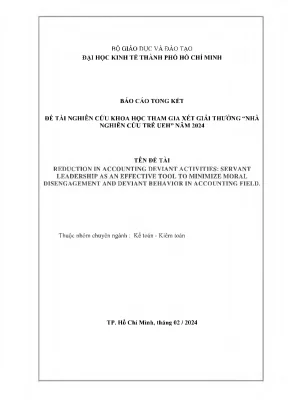
Tải xuống để đọc toàn bộBỘ GIÁO DỤC VÀ ĐÀO TẠO DẠI HỌC KINH TÉ THÀNH PHÓ HÒ CHÍ MINH BÁO CÁO TONG KÉT ĐỀ TÀI NGHIÊN cưu KHOA HỌC THAM GIA XÉT GIẢI THƯỞNG “NHÀ NGHIÊN CỨU TRẺ UEH” NĂM 2024 TÊN ĐÈ TÀI REDUCTION IN ACCOUNTING DEVIANT ACTIVITIES: SERVANT LEADERSHIP AS AN EFFECTIVE TOOL TO MINIMIZE MORAL DISENGAGEMENT AND DEVIANT BEHAVIOR IN ACCOUNTING FIELD. Thuộc nhóm chuyên ngành : Ke toán - Kiêm toán TP. Hồ Chí Minh, tháng 02 / 2024 TABLE OF CONTENTS LIST OF ABBREVIATIONS. 5 LIST OF TABLES.
6 LIST OF FIGURES. Research background and statement of the problem. Subject and scope of research. Meaning of research.5 CHAPTER 2 - LITERATURE REVIEW AND HYPOTHESIS DEVELOPMENT.
Deviant behavior in accounting. The social learning theory. The social exchange theory. Prior relevant studies.
Research framework and hypothesis development.1 The relationship between Emotional healing and Spirituality in workplace. The relationship between Ethical behaviors and Spirituality in workplace. The relationship between Helping subordinates grow and succeed and Spirituality in workplace. The relationship between Empowering and spirituality in workplace.
The relationship between Emotional healing and Egoism. The relationship between Ethical behaviors and Egoism. The relationship between Helping subordinates grow and succeed and Egoism. The relationship between Empowering and Egoism.
The relationship between Spitituality in workplace, Egoism and Moral disengagement. The relationship between Spirituality in workplace, Egoism, Moral disengagement and Deviant behavior in accounting. 23 CHAPTER 3 - RESEARCH METHOD. Qualitative Research Methods.
Quantitative Research Method. 29 CHAPTER 4 - RESEARCH RESULTS. Description of survey form. Cronbach’s Alpha reliability test of the measurement scale.
Exploratory Factor Analysis (EFA) Analysis. Spirituality in workplace (SW) and Egoism (EG). Deviant behavior in accounting (DB). Results of correlation testing, regression analysis, and model hypothesis testing.
Analysis of correlation matrix between variables. Multiple Linear Regression (MLR) Analysis. Regression analysis between Emotional healing (EH), Ethical behavior (EB), Empowering (EP) and Spirituality in workplace (SW). Regression analysis between Emotional healing (EH), Ethical behavior (EB), Empowering (EP) and Egoism (EG).
Regression analysis between Spirituality in workplace (SW), Egoism (EG) and Moral disengagement (MD). Regression analysis between spirituality in workplace (SW), Egoism (EG), Moral disengagement (MD) and Deviant bahavior in accounting (DB). Regression Results Validation. Assumption of multicollinearity.
Hypothesis Testing of the Study. 49 CHAPTER 5- DISCUSSION AND CONCLUSION. Discussion of results. Limitations and further research.
59 APPENDIX 01 - QUALITATIVE SURVEY QUESTIONNAIRE. 59 APPENDIX 01A - LIST OF RESPONDENTS. 62 APPENDIX 02 - QUESTIONS FOR QUALITY STUDY. 63 APPENDIX 03 - DESCRIBING THE CHARACTERISTICS OF DEMOGRAPHY AND ANALYZING CRONBACH’S ALPHA.
68 APPENDIX 04 - EFA ANALYSIS. 72 ABSTRACT This research delves into the efficacy of employing servant leadership as a strategic tool for diminishing deviant activities within the accounting sector, specifically targeting moral disengagement and unethical behavior. Acknowledging the prevalence of deviant practices in accounting, the investigation aims to understand how servant leadership can play a role in curtailing moral disengagement and fostering ethical conduct among accounting professionals. By conducting a thorough analysis of servant leadership principles and their impact on mitigating deviant behaviors, this study seeks to offer valuable insights for organizational leaders and policymakers pursuing proactive measures to cultivate a more ethical and responsible accounting environment.
The research focus revolves around the reduction of moral disengagement and deviant behavior in the accounting field, positioning servant leadership as a valuable instrument for addressing such behaviors. The survey participants predominantly include individuals in Ho Chi Minh City, primarily aged between 16 and 35. The study adopts a combination of qualitative and quantitative methods for data collectio LIST OF ABBREVIATIONS DB: Deviant behavior in accounting EB: Ethical behavior EG: Egoism EH: Emotional healing EP: Empowering HS: Helping subordinates grow and succeed KMO: Kaiser-Meyer-Olkin MD: Moral disengagement MLR: Multiple Linear Regression SPSS: A analyzing software SW: Spirituality in workplace VIF: Variance inflation factor LIST OF TABLES Table 4. Survey results Table 4.
Descriptive statistics of the study sample Table 4. Results of testing the reliability of the scale for Emotional healing (EH), Ethical behavior (EB), Helping subordinates grow and succeed (HS) and Empowering (EP). KMO and Bartlett's Test result for Emotional healing (EH), Ethical behavior (EB), Helping subordinates grow and succeed (HS) and Empowering (EP) variables Table 4. The total extracted variance for Emotional healing (EH), Ethical behavior (EB), Helping subordinates grow and succeed (HS) and Empowering (EP) variables Table 4.
EFA result for the first time Table 4. KMO and Bartlett's Test result for Emotional healing (EH), Ethical behavior (EB), Helping subordinates grow and succeed (HS) and Empowering (EP) (second time) Table 4. The total extracted variance for Emotional healing (EH), Ethical behavior (EB), and Empowering (EP) variables Table 4. EFA result for second time Table 4.
KMO and Bartlett's Test result for Spirituality in workplace (SW) and Egoism (EG) variables Table 4. The total extracted variance for Spirituality in workplace (SW) and Egoism (EG) variables Table 4. EFA factor matrix for spirituality in workplace (SW) and Egoism (EG) variables Table 4. KMO and Bartlett's Test result for Moral disengagement (MD) variable Table 4.
The total extracted variance for Intention to use variable Table 4. EFA factor matrix for Intention to use variable Table 4. KMO and Bartlett's Test result for Deviant behavior in accounting variable Table 4. The total extracted variance for Deviant behavior in accounting variable Table 4.
EFA factor matrix for Deviant behavior in accounting variable Table 4. The matrix represents the linear relationship between the variables in the model Table 4. Table of criteria to evaluate the fit of the model Table 4. ANOVA model fit test Table 4.
Table of regression results Coefficients Table 4. Table of criteria to evaluate the fit of the model Table 4. ANOVA model fit test Table 4. Table of regression results Coefficients Table 4.
Table of criteria to evaluate the fit of the model Table 4. ANOVA model fit test Table 4. Table of regression results Coefficients Table 4. Table of criteria to evaluate the fit of the model Table 4.
ANOVA model fit test Table 4. Table of regression results Coefficients LIST OF FIGURES Figure 2. Research model of Wang Shuwei, Huang Jiaxin and Sheng Xin (2021) Figure 2. Research model of Mahyarni (2019) Figure 2.
Research model of Omar Khalid Bhatti, Muhammad Irfan, All Osman Oztiirk and Raj Maham (2022) Figure 2. Research model of Jay Prakash Mulki, Fernando Jaramillo, William B. Research model of Pablo Zoghbi-Manrique-de-Lara (2011) Figure 2. Research model of Shenjiang Mo and Junqi Shi (2017) Figure 2.
Research model of Mary Kay Copeland (2016) Figure 2. Research model of Okechukwu Ethelbert Amah & Kabiru Oyetuunde (2020) Figure 2. The research model proposed by the authors Figure 3. Research process 1 CHAPTER 1 - INTRODUCTION 1.
Research background and statement of the problem In recent years, there has been a discernible uptick in scholarly inquiries delving into the realm of detrimental employee attitudes and behaviors, notably workplace deviance, which has garnered significant attention in organizational research (Liao et al., 2004; Neubert and Roberts, 2013). Of particular interest is the observation that accounting employees appear to exhibit a heightened susceptibility to these negative behaviors, as evidenced in studies conducted by Mitchell and Ambrose (2007). This inclination toward deviance poses a considerable challenge as it undermines established norms crucial for fostering effective team dynamics and achieving organizational objectives (Mayer et al., 2009; Robinson and Bennett, 1995). Consequently, researchers have intensified efforts to identify factors that could serve as buffers against employee deviance, exploring potential antecedents at both the individual and team levels (Mulki et al.
This multifaceted exploration seeks to unravel the intricate interplay of personal characteristics, contextual factors, and leadership dynamics that influence employee conduct within organizational settings. Recent inquiries have shed light on the pivotal role of leadership styles in shaping the attitudes and behaviors of organizational members. Empirical evidence suggests that employees under the stewardship of ethical and servant leaders experience lower levels of stress and higher levels of job satisfaction (Schaufeli and Bakker, 2004; Sharif and Scandura, 2013). Against this backdrop, servant leadership has emerged as a promising avenue for mitigating employee burnout and curbing deviant behavior, while concurrently enhancing overall work performance (Resick et al., 2013; Taylor and Pattie, 2014; Walumbwa et al.
Servant leaders, characterized by their altruistic and ethical orientation, serve as compelling role models, eliciting admiration and respect from their subordinates. Their actions and behaviors resonate with organizational members, instilling a sense of purpose and reinforcing positive norms within the organizational culture (Trevino el al., 2000, 2003; Brown el al. By embodying ethical principles and demonstrating a genuine concern for the well-being of their followers, servant leaders foster an environment conducive to ethical conduct and foster a climate of trust and collaboration within the organization. However, amidst the considerable strides made in understanding the implications of servant leadership in organizational settings, a crucial question continues to linger regarding the intricate psychological mechanisms that underlie the relationship between servant leadership dimensions and characteristics and individual deviant behavior and work performance, especially in the accounting filed.
While extant literature has predominantly explored the positive impact of servant leadership at the team or organizational level (Kalshoven et al., 2011), delving into how servant leadership fosters a team-level ethical culture/climate that subsequently influences individual employees' ethical and unethical cognition and behavior (Mayer et al., 2010; Schaubroeck et al., 2012), a notable gap remains in understanding the specific psychological mechanisms through which servant leadership mitigates individual deviant behavior. Drawing upon the conservation of resources theory as a theoretical framework, we posit that servant leadership functions as a crucial moderator in reducing deviant behavior in accounting 2 field by augmenting employees’ psychological resources and curtailing surface acting tendencies because this filed is such a sensitive one that people can vulnerable to engage in unethical behaviors. As elucidated by Brown et al. (2005), employees tend to view their leaders as role models and, through a myriad of leader-member interactions, develop an ethical lens through which they perceive both their leader and the organizational ethos.
Within this context, the presence of a servant leader cultivates an environment characterized by enhanced psychological resources, particularly fostering interpersonal trust among employees (Dirks and Ferrin, 2002; Hobfoll, 1989; Sharif and Scandura, 2013). Furthermore, under the tutelage of a servant leader, employees benefit from a heightened sense of psychological safety, bolstered by an atmosphere of mutual respect and support. This reservoir of psychological resources serves as a protective buffer against the allure of deviant behaviors of accounting employees, providing employees with the resilience and fortitude to navigate challenges with integrity and moral clarity (Masterson et al., 2000; Podsakoff et al. Consequently, employees are less inclined to engage in behaviors that contravene organizational norms or undermine team cohesion, thereby contributing to a more harmonious and productive work environment.
Moreover, the positive influence of servant leadership extends beyond mitigating accounting deviant behavior to encompass fostering employee well being and enhancing work performance. By nurturing a culture of empathy, compassion, and inclusivity, servant leaders cultivate a sense of belongingness and psychological fulfillment among accounting employees, thereby engendering greater job satisfaction and commitment (Liden el al., 2008; Walumbwa et al. This, in turn, translates into tangible improvements in work performance metrics, as employees are more motivated and engaged in their roles, leading to enhanced productivity and organizational effectiveness (Eiscnbcrgcr Ct al., 2002; Luthans Ct al. In essence, servant leadership serves as a catalyst for fostering a virtuous cycle of ethical behavior, psychological well-being, and organizational success, underscoring its pivotal role in shaping the dynamics of modern workplaces.
Through its emphasis on humility, empathy, and servant-hearted leadership, servant leadership emerges as a transformative force that transcends conventional leadership paradigms, heralding a new era of servant leadership grounded in principles of service and stewardship. Moreover, in such an environment, they are more likely to feel able to express their inner feelings without creating an undesirable image in the workplace spirituality (Hochschild 1983).
Nội dung được bảo vệ bản quyền — Tải xuống đầy đủ
Trích dẫn luận án này
Lãnh đạo phục vụ giảm hành vi sai lệch kế toán (2024) [Luận án tiến sĩ, Đại học Kinh tế Thành phố Hồ Chí Minh]. LuanAn.net. https://luanan.net/quan-tri-kinh-doanh/quan-tri-tai-chinh-doanh-nghiep/lanh-dao-tan-tam-giam-thieu-hanh-vi-sai-pham-ke-toan
Từ khóa và chủ đề nghiên cứu
Từ khóa liên quan
Xem thêm luận án cùng lĩnh vực
Chủ đề nghiên cứu
Câu hỏi thường gặp
Luận án "Lãnh đạo phục vụ giảm hành vi sai lệch kế toán" nghiên cứu về vấn đề gì?
Lãnh đạo tận tâm giúp giảm hành vi sai phạm trong kế toán, tăng cường đạo đức và trách nhiệm chuyên nghiệp của nhân viên.
Luận án "Lãnh đạo phục vụ giảm hành vi sai lệch kế toán" được bảo vệ tại trường nào?
Luận án này được bảo vệ tại Đại học Kinh tế Thành phố Hồ Chí Minh. Năm bảo vệ: 2024.
Luận án "Lãnh đạo phục vụ giảm hành vi sai lệch kế toán" thuộc chuyên ngành gì?
Luận án "Lãnh đạo phục vụ giảm hành vi sai lệch kế toán" thuộc chuyên ngành Kế toán - Kiểm toán. Danh mục: Quản Trị Tài Chính Doanh Nghiệp.
Luận án "Lãnh đạo phục vụ giảm hành vi sai lệch kế toán" có bao nhiêu trang?
Luận án "Lãnh đạo phục vụ giảm hành vi sai lệch kế toán" có 93 trang. Bạn có thể xem trước một phần tài liệu ngay trên trang web trước khi tải về.
Cách tải luận án "Lãnh đạo phục vụ giảm hành vi sai lệch kế toán" về máy như thế nào?
Để tải luận án về máy, bạn nhấn nút "Tải xuống ngay" trên trang này, sau đó hoàn tất thanh toán phí lưu trữ. File sẽ được tải xuống ngay sau khi thanh toán thành công. Hỗ trợ qua Zalo: 0559 297 239.