Luận án Tiến sĩ của Nevin Lawrence: Thích ứng với Biến đổi Khí hậu và Hệ thống Sản xuất Lúa Mì
Luận văn Nevin Lawrence khám phá khả năng thích ứng của cây lúa mì với biến đổi khí hậu, đề xuất giải pháp bền vững cho tương lai nông nghiệp.
Washington State University
Crop and Soil Sciences
Luan An
Luận án tiến sĩ
Năm xuất bản
Số trang
150
Thời gian đọc
23 phút
Lượt xem
0
Lượt tải
0
Phí lưu trữ
40 Point
Tổng quan nhanh
- Chủ đề:
- Thích ứng biến đổi khí hậu: Bromus tectorum & Lúa mì
- Số trang:
- 150 trang
- Trường:
- Washington State University
- Chuyên ngành:
- Crop and Soil Sciences
- Tác giả:
- Nevin Craig Lawrence
- Năm:
- 2015
Tóm tắt nội dung luận án
I.Thích ứng biến đổi khí hậu Bromus tectorum Lúa mì
Luận văn khám phá sự thích ứng của cỏ Bromus tectorum (cỏ đuôi chồn) với biến đổi khí hậu. Cỏ đuôi chồn là loài cỏ dại xâm lấn, đe dọa các hệ thống sản xuất ngũ cốc nhỏ tại Tây Bắc Thái Bình Dương (PNW). Nghiên cứu phân tích cách Bromus tectorum điều chỉnh chu kỳ sống của nó dưới các kịch bản khí hậu khác nhau. Mục tiêu là cung cấp thông tin cho các chiến lược quản lý hiệu quả hơn. Các phát hiện có ý nghĩa quan trọng đối với nông nghiệp, đặc biệt là sản xuất lúa mì, trong bối cảnh khí hậu toàn cầu thay đổi. An ninh lương thực của khu vực phụ thuộc vào việc kiểm soát cỏ dại cạnh tranh này.
1.1. Bromus tectorum Mối đe dọa nông nghiệp Tây Bắc
Bromus tectorum, hay cỏ đuôi chồn, là loài cỏ hàng năm mùa đông xâm lấn. Loài này đã tự nhiên hóa rộng rãi khắp miền Tây Bắc Mỹ. Trong vùng sản xuất ngũ cốc nhỏ của Tây Bắc Thái Bình Dương (PNW), cỏ đuôi chồn là một loại cỏ dại phổ biến và có tính cạnh tranh cao. Sự hiện diện của nó đe dọa nghiêm trọng năng suất lúa mì và các loại ngũ cốc khác. Nông nghiệp tại khu vực này phụ thuộc vào việc quản lý hiệu quả loài cỏ dại này.
1.2. Biến đổi khí hậu ảnh hưởng chu kỳ sống cỏ dại
Nghiên cứu trước đây đã ghi nhận sự đặc trưng theo vùng trong sự phát triển kiểu hình của cỏ đuôi chồn. Đồng thời, có sự biến đổi đáng kể trong phát triển kiểu hình giữa các vùng khác nhau. Biến đổi khí hậu đang thay đổi các yếu tố môi trường. Nhiệt độ và lượng mưa thay đổi ảnh hưởng trực tiếp đến chu kỳ sống của cỏ dại. Điều này làm phức tạp thêm công tác kiểm soát. Thích ứng biến đổi khí hậu trở thành ưu tiên.
1.3. Nhu cầu thích ứng trong sản xuất lúa mì
Sản xuất lúa mì và ngũ cốc nhỏ đối mặt với thách thức lớn. Chu kỳ phát triển của cỏ dại thay đổi do khí hậu. Điều này đòi hỏi các chiến lược quản lý mới. Khả năng chống chịu khí hậu của hệ thống canh tác cần được tăng cường. An ninh lương thực phụ thuộc vào việc kiểm soát hiệu quả các loài xâm lấn. Hiểu biết sâu sắc về sinh học cỏ dại dưới tác động khí hậu là thiết yếu.
II.Phân tích Di truyền Phát triển Cỏ Dại Xâm lấn
Nghiên cứu đã thực hiện một phân tích toàn diện về di truyền và kiểu hình của Bromus tectorum. Các mẫu cỏ đuôi chồn được thu thập từ khắp PNW. Kỹ thuật giải trình tự gen hiện đại được sử dụng để khám phá sự đa dạng di truyền. Các thí nghiệm nhà kính và vườn chung đã làm rõ cơ chế điều chỉnh thời điểm phát triển của cỏ dại. Đặc biệt, vai trò của vernalization (sự xuân hóa) được làm sáng tỏ. Việc hiểu rõ các yếu tố này giúp dự đoán hành vi của cỏ dại dưới biến đổi khí hậu và phát triển giống cây trồng chịu hạn gián tiếp thông qua việc giảm cạnh tranh từ cỏ dại.
2.1. Khảo sát di truyền các chủng Bromus tectorum
Năm 2011 và 2012, 130 mẫu cỏ đuôi chồn được thu thập. Các mẫu này đến từ khắp vùng sản xuất ngũ cốc nhỏ của PNW. Phương pháp giải trình tự gen được sử dụng để xác định dấu hiệu phân tử. Phương pháp này tạo ra thống kê di truyền quần thể. 88 trong số 130 mẫu cỏ đuôi chồn được phân loại. Các mẫu này được xếp vào các cụm di truyền tương tự. Việc phân tích gen giúp hiểu rõ sự đa dạng và phân bố của cỏ dại.
2.2. Vai trò của vernalization trong phát triển thực vật
Các cá thể được gán vào một trong sáu cụm di truyền. Điều này dựa trên 384 đa hình đơn nucleotide (SNP) và phân tích cụm thành phần chính. Các mẫu được cấy ghép vào ba địa điểm vườn thử nghiệm chung. Mục đích là ghi nhận và mô hình hóa thời điểm phát triển. Thời điểm sản xuất hạt trưởng thành dao động. Nó có thể từ ngày 18 tháng 5 đến ngày 20 tháng 6, tùy thuộc vào địa điểm. Quá trình sản xuất hạt trưởng thành sớm hơn được quan sát sau các mùa đông khắc nghiệt hơn. Điều này so với mùa đông ôn hòa. Điều này ngụ ý vai trò của vernalization (sự xuân hóa) trong việc điều chỉnh thời điểm phát triển. Vernalization là yếu tố quan trọng ảnh hưởng đến khả năng chống chịu khí hậu của loài cỏ dại này.
2.3. Xác định yếu tố phân tử kiểm soát ra hoa
Các thí nghiệm nhà kính được tiến hành. Mục tiêu là mô tả phản ứng của các mẫu cỏ đuôi chồn ra hoa sớm, trung bình và muộn. Chúng được xử lý bằng nhiều phương pháp vernalization khác nhau. Nghiên cứu cũng định lượng biểu hiện của gen vernalization 1 (BdVRN1) của Brachypodium distachyon. Sự ra hoa của cỏ đuôi chồn phản ứng với các phương pháp vernalization được liên kết. Nó liên kết với biểu hiện của BdVRN1. Điều này ngụ ý các cơ chế kiểm soát phân tử của sự ra hoa ở cỏ đuôi chồn tương tự. Chúng tương tự như các loài cỏ ôn đới khác. Việc hiểu các cơ chế này hỗ trợ phát triển giống cây trồng chịu hạn hoặc kháng cỏ dại.
III.Mô hình hóa Phát triển Cây trồng dưới Khí hậu Mới
Luận văn sử dụng mô hình khí hậu tiên tiến để dự báo sự thay đổi trong chu kỳ phát triển của Bromus tectorum. Các mô hình dự báo thời điểm phát triển của cỏ dại dựa trên tổng số ngày độ sinh trưởng tích lũy (GDD). Kết hợp với các kịch bản biến đổi khí hậu toàn cầu, nghiên cứu đưa ra dự đoán về sự thay đổi đáng kể. Điều này có những tác động trực tiếp đến việc quản lý tài nguyên nước và việc áp dụng các biện pháp kiểm soát cỏ dại, ảnh hưởng đến năng suất lúa mì và các hệ thống canh tác bền vững.
3.1. Dự báo thời điểm phát triển cỏ dại chính xác
Thời điểm phát triển các giai đoạn được mô hình hóa. Nó dựa trên tổng số ngày độ sinh trưởng tích lũy (GDD). Mục đích là phát triển ngưỡng ứng dụng thuốc diệt cỏ. Điều này nhằm hỗ trợ kiểm soát cỏ đuôi chồn trong các cánh đồng ngũ cốc nhỏ. Các mô hình khí hậu hạ tầng được kết hợp. Chúng kết hợp với các mô hình Biến đổi Khí hậu Toàn cầu. Mục tiêu là dự báo ngưỡng phát triển cỏ đuôi chồn. Điều này áp dụng cho các kịch bản khí hậu tương lai.
3.2. Ảnh hưởng của nhiệt độ tích lũy đến chu kỳ
Nghiên cứu chỉ ra rằng nhiệt độ tích lũy là yếu tố then chốt. Nó điều khiển chu kỳ phát triển của cỏ đuôi chồn. Sự thay đổi trong GDD do biến đổi khí hậu sẽ làm thay đổi lịch trình sinh học của loài cỏ này. Sự hiểu biết về mối quan hệ này rất quan trọng. Nó giúp dự đoán hành vi của cỏ dại. Dự đoán này hỗ trợ quản lý tài nguyên nước và tối ưu hóa thời gian canh tác. Khả năng chống chịu khí hậu của cây trồng chính bị ảnh hưởng.
3.3. Ngưỡng kiểm soát cỏ dại hiệu quả
Dự kiến sự phát triển của cỏ đuôi chồn sẽ tiến lên. Nó sẽ sớm hơn từ 16 đến 34 ngày. Điều này xảy ra trên toàn vùng sản xuất ngũ cốc nhỏ của PNW. Sự phát triển sớm hơn của cỏ đuôi chồn yêu cầu các biện pháp kiểm soát sớm hơn. Các biện pháp này có thể xung đột. Chúng xung đột với lượng mưa sớm hơn được dự báo. Điều này xuất hiện trong các kịch bản khí hậu tương lai. Việc xác định ngưỡng chính xác là cần thiết. Nó giúp duy trì năng suất lúa mì.
IV.Chiến lược Quản lý An ninh Lương thực Lúa mì
Các dự báo về sự phát triển sớm hơn của Bromus tectorum đặt ra những thách thức đáng kể cho nông nghiệp hiện đại. Luận văn nhấn mạnh nhu cầu về các chiến lược quản lý cỏ dại linh hoạt và đổi mới. Điều này bao gồm việc tối ưu hóa thời điểm can thiệp và xem xét lại các phương pháp canh tác truyền thống. Mục tiêu cuối cùng là xây dựng hệ thống canh tác bền vững. Điều này đảm bảo an ninh lương thực cho lúa mì và các loại ngũ cốc nhỏ khác trong bối cảnh biến đổi khí hậu. Cần có sự phối hợp để phát triển giống cây trồng chịu hạn và các kỹ thuật quản lý tài nguyên nước tiên tiến.
4.1. Thách thức kiểm soát cỏ dại trong tương lai
Biến đổi khí hậu tạo ra những thách thức mới cho nông nghiệp. Đặc biệt là trong việc kiểm soát cỏ dại. Thời điểm phát triển cỏ đuôi chồn thay đổi đòi hỏi sự điều chỉnh. Các phương pháp quản lý truyền thống có thể không còn hiệu quả. Cần có sự linh hoạt và đổi mới. Điều này nhằm đảm bảo an ninh lương thực. Các hệ thống canh tác bền vững cần được xem xét.
4.2. Tối ưu hóa thời điểm can thiệp nông nghiệp
Việc phát triển sớm hơn của cỏ dại yêu cầu đầu vào kiểm soát sớm hơn. Điều này có thể gây xung đột với các yếu tố khí hậu khác. Chẳng hạn như lượng mưa sớm hơn được dự báo. Các nhà quản lý nông nghiệp cần tối ưu hóa thời điểm. Họ cần tối ưu hóa việc sử dụng thuốc diệt cỏ. Họ cũng cần sử dụng các biện pháp canh tác khác. Mục tiêu là duy trì năng suất lúa mì. Việc quản lý tài nguyên nước cũng trở nên phức tạp hơn.
4.3. Xây dựng hệ thống canh tác bền vững
Để đối phó với những thay đổi này, cần xây dựng hệ thống canh tác bền vững. Điều này bao gồm việc phát triển giống cây trồng chịu hạn. Nó cũng bao gồm việc áp dụng các phương pháp canh tác tích hợp. Các phương pháp này giảm thiểu tác động của cỏ dại. Đồng thời, chúng tăng cường khả năng chống chịu khí hậu của toàn bộ hệ thống. An ninh lương thực lâu dài cho lúa mì và ngũ cốc nhỏ phụ thuộc vào những nỗ lực này. Nghiên cứu này cung cấp cơ sở quan trọng cho các chiến lược thích ứng biến đổi khí hậu.
Mục lục chi tiết luận án
Tải xuống file đầy đủ để xem toàn bộ nội dung
Tải đầy đủ (150 trang)Trích đoạn nội dung luận án
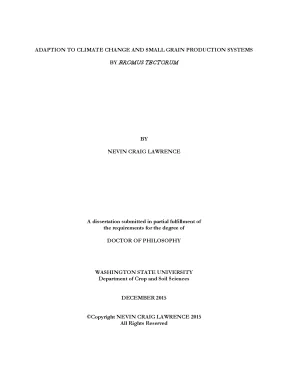
Tải xuống để đọc toàn bộADAPTION TO CLIMATE CHANGE AND SMALL GRAIN PRODUCTION SYSTEMS BY BROMUS TECTORUM BY NEVIN CRAIG LAWRENCE A dissertation submitted in partial fulfillment of the requirements for the degree of DOCTOR OF PHILOSOPHY WASHINGTON STATE UNIVERSITY Department of Crop and Soil Sciences DECEMBER 2015 ©Copyright NEVIN CRAIG LAWRENCE 2015 All Rights Reserved ©Copyright NEVIN CRAIG LAWRENCE 2015 All Rights Reserve To the Faculty of Washington State University: The members of the Committee appointed to examine the dissertation of NEVIN CRAIG LAWRENCE find it satisfactory and recommend that it be accepted. ______________________________________ Amit Dhingra, Ph. ii ACKNOWLEDGEMENTS I would like to extend my gratitude to the many people who have supported me over the course of my Ph. The REACCH project supported my research financially and allowed me to practice integrated research on a large scale.
In particular I want to thank John Abatzoglou for his support with integrating climate models with my research. My graduate committee has been enormously helpful in improving the quality of my research, writing, and scientific thinking. Through a combination of high expectations and the freedom to make my own decisions and mistakes, Ian Burke has sharpened my skills as scientist and pushed me to a higher standard of scholarship. Amber Hauvermale’s expertise and assistance with molecular biology was essential in finishing my dissertation.
Lastly, the camaraderie among fellow graduate students was a constant motivation throughout my time at Washington State University. iii DEDICATION I dedicate my dissertation to my wife Louise. I began dating Louise only a few months before moving to Pullman, proposed to her during the second year of my PhD, married her during my third year, and together we welcomed a son into the world during my fourth year. Louise has been my unfair advantage.
Not many graduate students have the benefit of a spouse possessing an advanced degree in the same field. If I needed a document proofread, a sounding board for a presentation, or a second opinion on experimental design, at any hour of the day, she was happy to help. Louise is an outstanding scientist, mother, wife, and best friend. iv ADAPTION TO CLIMATE CHANGE AND SMALL GRAIN PRODUCTION SYSTEMS BY BROMUS TECTORUM ABSTRACT by Nevin Craig Lawrence, Ph.
Washington State University December 2015 Chair: Ian C. Burke Bromus tectorum (downy brome) is an invasive winter annual grass species naturalized throughout western North America. Within the small grain production region of the Pacific Northwest (PNW) downy brome is a ubiquitous and competitive weed. Previous research has documented regional specificity of downy brome phenotypic development, while considerable variation in phenotypic development has been noted between regions.
In 2011 and 2012 130 downy brome accessions were collected from across the PNW small grain production region. A genotype- by-sequencing approach was employed to call molecular markers, generate population genetic statistics, and classify 88 of the 130 downy brome accessions into genetically similar clusters. Individuals were assigned to one of six genetic clusters using 384 single-nucleotide polymorphisms and discriminant analysis of principal components clustering approach. Accessions were transplanted to three common garden field sites to document and model the timing of development.
The timing of development stages was modeled against cumulative growing-degree-days (GDD) to develop herbicide application thresholds to aid in control of downy brome within small grain fields. The estimate for mature seed production varied from May 18th to June 20th depending upon the v location of the common garden. Earlier production of mature seed was observed following more severe winters compared to mild winters, implying a role of vernalization regulating the timing of development. Greenhouse experiments were initiated to characterize the response of early, intermediate, and late-to-flower downy brome accessions to various vernalization treatments and quantify expression of Brachypodium distachyon gene vernalization 1 (BdVRN1).
Downy brome flowering in response to vernalization treatments was linked to the expression of BdVRN1, implying the molecular controls of flowering in downy brome are similar to the controls of other temperate grass species. Downscaled climate modeling was paired with Global Climate Change models to project downy brome development thresholds under future climate scenarios. Downy brome development is anticipated to advance 16 to 34 days across the small grain production region of the PNW. The earlier development of downy brome will require earlier control inputs, which may conflict with earlier rainfall projected under future climate scenarios.
vi TABLE OF CONTENTS ACKNOWLEDGEMENTS. iv TABLE OF CONTENTS. vii LIST OF TABLES. xi LIST OF FIGURES .xiii Chapter 1: Review of the Literature .1 Climate Change in the Pacific Northwest Small Grain Production Region .2 Weed Response to Climate Change .1 Downy Brome Population Genetics.2 Variation in Downy Brome Development .4 Vernalization Genetics in Model and Crop Species .5 A Need for Applied Research on Weed Response to Climate Change.
32 Chapter 2: Population Genetics and Structure of Bromus tectorum from within the small grain production region of the Pacific Northwest.1 Previous work on downy brome population genetics .1 Small Grain Production Region of the PNW .2 Materials and Methods .1 Sampling of Plant Materials .2 Genotype-by-Sequencing.4 Analysis of Population Genetics, Spatial Structure, and Population Structure .6 Tables and Figures. 60 Chapter 3: Modeling Bromus tectorum Phenology from the PNW Small Grain Production Region.1 Downy Brome Phenology .2 Methods and Materials .2 Common Garden Experiments and Greenhouse Seed Maturity Experiments .2 Winter Survival and Timing of Development .3 Modeling Panicle Emergence.4 Modeling mature seed set .6 Tables and Figures. Characterization of Vernalization Requirements and Expression of BdVRN1 in Bromus tectorum .1 Greenhouse Vernalization Experiments .3 VRN1 Primer Design .2 RNA Extraction and RT-PCR .1 Greenhouse Vernalization Experiments .6 Tables and Figures. Projecting Bromus tectorum Development in the Pacific Northwest Small Grain Production Region using Downscaled Climate Modeling .1 Weed Management For a Changing Climate.2 Methods and Materials .1 Expanded Modeling of Development .2 Downscaled Climate Projection .2 Contemporary Climate Projections .3 Mid-Century Climate Projections.
Tables and Figures. 130 x LIST OF TABLES Table 2. Accession ID number, GPS coordinates of collection locations, year of collection, heterozygosity of each accession, and cluster membership as determined by DAPC. Pairwise Fst values of the 7 described population clusters.
Accession ID, year of collection, GPS coordinates of collection, and assigned cluster of each accession evaluated in common garden and greenhouse experiments. Growing degree accumulation by month for the three common garden studies. Growing degree days required and S. for 50% panicle emergence for each genetic cluster.
Growing degree days required and S. for 50% mature seed set for each genetic cluster. Locations of four towns in the PNW small grain production region, thirty year average (1981-2010) GDD accumulation for each town, and the 30 year average calendar date that 850, 1000 and 1500 GDD occurred. Class, accession ID, GDD estimates and calendar date of mature seed production, and calendar date of flowering from a 2013 common garden experiment.
Matrix of p-values indicating which accessions responded differently to vernalization treatments. Regression parameter estimating the weeks of vernalization required to induce flowering in 50% of individuals in each accession. Accession ID, year of collection, and GPS coordinates of collection site for the accessions of downy brome used to model development thresholds. Global climate change models from the coupled model intercomparison project phase 5 used to project downy brome development thresholds.
GDD accumulation estimates for mature seed production at three common garden locations. Average calendar days and date when 500 and 1,000 GDD were reached from 1950-2005 in the small grain production region of the PWN. Projections of calendar days required to reach 500 GDD under the RCP 4.5 scenarios from 2031-2060, compared to 1950-2005. Projections of calendar days required to reach 1,000 GDD under the RCP 4.5 scenarios from 2031-2060, compared to 1950-2005.
128 xii LIST OF FIGURES Figure 2. The small grain production region of the PNW. Observed versus expected heterozygosity across all loci and individuals. Positive and negative eigenvalues, corresponding to global and local spatial structure.
Histogram of permuted test statistics from 10,000 Monte Carlo simulations and the observed global structure. Interpolation of the global structure. Cumulative variance explained by retaining each additional Principal Component. Bayesian information criterion value for increasing values of k.
Optimal number of retained principal components for assigning cluster membership. F-statistic associated with each discriminant function. Probability of cluster membership for each individual. Individuals that were assigned to a cluster with less than 90% probability.
Distribution of individuals and clusters across the first, second, and third linear discriminates. Spatial distribution of individuals and cluster membership. The small grain production region of the PNW. Growing degree days required and S.
for 50% panicle emergence. Growing degree days required and S. for 50% mature seed set. Percent individuals flowering from each accession.
Matrix of p-values contrasting the flowering response. Expression of VRN1 in downy brome. Mean calendar date when 1,000 GDD were reached. 129 xiv Chapter 1: Review of the Literature 1.1 Climate Change in the Pacific Northwest Small Grain Production Region The Intergovernmental Panel on Climate Change (IPCC) characterized the evidence forglobal climate warming as unequivocal.
Solomon et al. (2007) attributed global climate change to an increase in radiative forcing, which has increased 1.6 W m-2 of that increase attributed to anthropogenic rather than natural sources. Radiative forcing of the climate system is predominantly due to long-lived greenhouse gases (GHGs): carbon dioxide, methane, and nitrous oxide (Solomon et al. Emissions from GHGs have increased dramatically due to human activities since 1750, with current atmospheric GHG levels exceeding the historic natural range for the past several thousand years.
In particular, atmospheric levels of carbon dioxide and methane are higher now than at any point in the last 650,000 years. Solomon et al. (2007) attribute the cause of observed global warming during the last century to anthropogenic sourced GHGs with a >90% likelihood. Between 1906 and 2005, global average surface temperature increased 0.74°C, with the rate of increase since 1956 nearly twice the rate from 1906 to 1950.
Currently, observed changes to global climate since 1850 include decreases in the frequency of cold periods and frosts, and increase in hot periods and heat waves, an increase in heavy precipitation events, and an increase in sea level rise at a global scale (Solomon et al. While climate change is often related to observed and projected increases in global mean annual temperature, the impacts of climate change to human and natural systems are expected to vary widely on a regional scale (Field et al. Experiments have demonstrated increases in photosynthesis rate and improved grain yield among many agronomic crops when carbon dioxide and temperature are increased to levels projected under climate change scenarios (Field et al. Gains in productivity are most likely to occur in mid to high latitudes where projections include 15 increased moisture along with increased carbon dioxide and temperatures.
Meanwhile, lower latitudes are projected to endure decreasing crop yields in response to decreasing total annual precipitation (Solomon et al. When the interaction between increased temperature and water requirements is factored in, models forecast moderate yield increases with moderate temperature changes (0.5°C global average increase) followed by a drop in productivity with average global temperature increases greater than 1.5°C (Kang et al. Furthermore, factors such as extreme weather events and pest pressure will also be altered by changing climate and have the potential to decrease crop productivity (Tubiello et al. The small-grain production area of the Pacific Northwest (PNW) includes central and eastern Washington, parts of northern Oregon, and northern Idaho and totals 2.2 million ha of non- irrigated cropland (Huggins et al.3 million ha of this region were planted into small grains, with around one million ha planted to winter wheat.
Annual precipitation in the region ranges from less than 300 mm to greater than 600 mm, with a west to east increasing precipitation gradient.
Nội dung được bảo vệ bản quyền — Tải xuống đầy đủ
Trích dẫn luận án này
Nevin Craig Lawrence (2015). Luận văn Nevin Lawrence: Thích ứng biến đổi khí hậu và lúa mì [Luận án tiến sĩ, Washington State University]. LuanAn.net. https://luanan.net/nong-hoc/luan-van-nevin-lawrence-thich-ung-bien-doi-khi-hau-lua-mi
Câu hỏi thường gặp
Luận án "Luận văn Nevin Lawrence: Thích ứng biến đổi khí hậu và lúa mì" nghiên cứu về vấn đề gì?
Luận văn Nevin Lawrence khám phá khả năng thích ứng của cây lúa mì với biến đổi khí hậu, đề xuất giải pháp bền vững cho tương lai nông nghiệp.
Luận án "Luận văn Nevin Lawrence: Thích ứng biến đổi khí hậu và lúa mì" được bảo vệ tại trường nào?
Luận án này được bảo vệ tại Washington State University. Năm bảo vệ: 2015.
Luận án "Luận văn Nevin Lawrence: Thích ứng biến đổi khí hậu và lúa mì" thuộc chuyên ngành gì?
Luận án "Luận văn Nevin Lawrence: Thích ứng biến đổi khí hậu và lúa mì" thuộc chuyên ngành Crop and Soil Sciences. Danh mục: Nông Học.
Luận án "Luận văn Nevin Lawrence: Thích ứng biến đổi khí hậu và lúa mì" có bao nhiêu trang?
Luận án "Luận văn Nevin Lawrence: Thích ứng biến đổi khí hậu và lúa mì" có 150 trang. Bạn có thể xem trước một phần tài liệu ngay trên trang web trước khi tải về.
Cách tải luận án "Luận văn Nevin Lawrence: Thích ứng biến đổi khí hậu và lúa mì" về máy như thế nào?
Để tải luận án về máy, bạn nhấn nút "Tải xuống ngay" trên trang này, sau đó hoàn tất thanh toán phí lưu trữ. File sẽ được tải xuống ngay sau khi thanh toán thành công. Hỗ trợ qua Zalo: 0559 297 239.