Luận án tiến sĩ: Tính cá nhân và tập thể trong quảng cáo Mỹ-Việt Nam
Luận án tiến sĩ phân tích tính cá nhân và tập thể trong quảng cáo Mỹ-Việt Nam. So sánh chủ đề, chiến lược sáng tạo và thiết bị đa phương tiện qua 254 quảng cáo tạp chí.
Vietnam National University, Hanoi University of Languages and International Studies
Luan An
Luận án
Năm xuất bản
Số trang
248
Thời gian đọc
38 phút
Lượt xem
2
Lượt tải
0
Phí lưu trữ
50 Point
Tổng quan nhanh
- Chủ đề:
- 1. Tính Cá Nhân Và Tập Thể Trong Quảng Cáo Mỹ-Việt
- Số trang:
- 248 trang
- Trường:
- Vietnam National University, Hanoi University of Languages and International Studies
- Chuyên ngành:
- English Linguistics
- Tác giả:
- Phạm Thị Tâm
- Năm:
- 2023
Tóm tắt nội dung luận án
I. Tính Cá Nhân Và Tập Thể Trong Quảng Cáo Mỹ Việt
Nghiên cứu so sánh giá trị văn hóa phương Đông phương Tây qua quảng cáo tạp chí. Phân tích 131 mẫu quảng cáo Mỹ và 123 mẫu Việt Nam. Kết quả cho thấy sự hiện diện của cả chủ nghĩa cá nhân lẫn chủ nghĩa tập thể trong cả hai nền văn hóa. Sự khác biệt giữa hai xu hướng không đáng kể như dự đoán ban đầu. Văn hóa cá nhân và văn hóa tập thể đan xen phức tạp hơn quan điểm truyền thống. Nghiên cứu áp dụng phương pháp hỗn hợp tuần tự khám phá. Phân tích đa phương thức bao gồm hình ảnh và ngôn ngữ. Kết quả khẳng định mối tương quan giữa văn hóa và ngôn ngữ trong quảng cáo xuyên văn hóa.
1.1. Mục Tiêu Nghiên Cứu Quảng Cáo Xuyên Văn Hóa
Nghiên cứu khám phá biểu hiện giá trị cá nhân và tập thể. Phân tích chủ đề, chiến thuật sáng tạo trong thông điệp quảng cáo. Xem xét thiết bị đa phương thức đại diện cho giá trị văn hóa. Áp dụng góc nhìn phi bản chất về văn hóa. Tránh quan điểm định kiến cứng nhắc về hai nền văn hóa.
1.2. Phương Pháp Phân Tích Dữ Liệu Quảng Cáo
Sử dụng khung lý thuyết đa chiều từ lý thuyết xuyên văn hóa. Kết hợp tâm lý học xuyên văn hóa và bằng chứng thực nghiệm. Áp dụng lý thuyết ký hiệu học xã hội cho phân tích hình ảnh. Phân tích phong cách giao tiếp ngữ cảnh cao-thấp. Mã hóa định tính trước, sau đó nhóm định lượng để so sánh.
1.3. Kết Quả Nghiên Cứu Chính Yếu
Kết quả phù hợp với phân tích của Hofstede về hai quốc gia. Xác nhận mối tương ứng giữa văn hóa và quan điểm ngôn ngữ. Cả hai xu hướng cá nhân và tập thể xuất hiện ở hai bộ dữ liệu. Sự khác biệt giữa hai xu hướng không đáng kể như kỳ vọng. Phản ánh sự phức tạp của giá trị văn hóa đương đại.
II. Chủ Nghĩa Cá Nhân Trong Quảng Cáo Hoa Kỳ
Quảng cáo Mỹ phản ánh mạnh mẽ giá trị cá nhân độc lập. Nhấn mạnh sự tự do, quyền tự chủ cá nhân trong lựa chọn. Thông điệp tập trung vào lợi ích và thành tựu cá nhân. Hình ảnh thường mô tả người tiêu dùng độc lập, tự tin. Chiến lược marketing quốc tế của thương hiệu Mỹ ưu tiên cá nhân hóa. Hành vi tiêu dùng được khuyến khích qua sự khác biệt cá nhân. Tuy nhiên, yếu tố tập thể vẫn xuất hiện trong một số chiến dịch. Sự pha trộn này phản ánh xu hướng toàn cầu hóa hiện đại.
2.1. Chủ Đề Cá Nhân Hóa Trong Thông Điệp
Quảng cáo nhấn mạnh quyền lựa chọn và tự do cá nhân. Thông điệp khuyến khích người tiêu dùng thể hiện bản thân. Sản phẩm được định vị như công cụ tự khẳng định. Ngôn ngữ sử dụng đại từ ngôi thứ hai trực tiếp. Tạo kết nối một-đối-một giữa thương hiệu và khách hàng.
2.2. Hình Ảnh Độc Lập Và Tự Chủ
Hình ảnh thường mô tả cá nhân đơn lẻ, tự tin. Bối cảnh nhấn mạnh không gian riêng tư, độc lập. Màu sắc tương phản cao, thu hút sự chú ý cá nhân. Bố cục tập trung vào chủ thể chính duy nhất. Biểu cảm khuôn mặt thể hiện sự tự tin, quyết đoán.
2.3. Chiến Thuật Sáng Tạo Hướng Cá Nhân
Sử dụng lời chứng thực từ chuyên gia hoặc người nổi tiếng. Nhấn mạnh tính năng độc đáo, ưu việt của sản phẩm. So sánh trực tiếp với đối thủ cạnh tranh. Kêu gọi hành động mạnh mẽ, trực tiếp. Tạo cảm giác cấp bách cho quyết định mua hàng cá nhân.
III. Chủ Nghĩa Tập Thể Trong Quảng Cáo Việt Nam
Quảng cáo Việt Nam phản ánh giá trị văn hóa tập thể truyền thống. Nhấn mạnh mối quan hệ gia đình, cộng đồng trong thông điệp. Hình ảnh thường mô tả nhóm người, tương tác xã hội. Tâm lý khách hàng Việt Nam coi trọng sự hài hòa tập thể. Thông điệp quảng cáo kết nối sản phẩm với giá trị chung. Chiến lược marketing tập trung vào lợi ích nhóm, gia đình. Tuy nhiên, xu hướng cá nhân hóa đang gia tăng. Sự thay đổi này phản ánh quá trình hiện đại hóa và hội nhập.
3.1. Chủ Đề Gia Đình Và Cộng Đồng
Quảng cáo tập trung vào giá trị gia đình, quan hệ xã hội. Sản phẩm được định vị phục vụ nhu cầu chung. Thông điệp nhấn mạnh sự chia sẻ, quan tâm lẫn nhau. Ngôn ngữ sử dụng từ ngữ gợi cảm giác thuộc về. Tạo kết nối cảm xúc qua hình ảnh tập thể.
3.2. Hình Ảnh Nhóm Và Tương Tác
Hình ảnh mô tả nhiều người trong khung cảnh chung. Bối cảnh gia đình, bữa ăn chung, hoạt động nhóm. Màu sắc ấm áp, hài hòa tạo cảm giác gần gũi. Bố cục cân bằng, không có chủ thể nổi bật duy nhất. Biểu cảm thể hiện sự hạnh phúc, gắn kết.
3.3. Chiến Thuật Hướng Tập Thể
Sử dụng chứng thực từ người dùng đại chúng. Nhấn mạnh sự phổ biến, được nhiều người tin dùng. Tránh so sánh trực tiếp, giữ thái độ khiêm tốn. Kêu gọi hành động nhẹ nhàng, gián tiếp. Tạo cảm giác trách nhiệm với gia đình, cộng đồng.
IV. So Sánh Giá Trị Văn Hóa Trong Quảng Cáo
Nghiên cứu so sánh cho thấy sự phức tạp của giá trị văn hóa. Cả hai nền văn hóa đều thể hiện yếu tố cá nhân và tập thể. Sự khác biệt không tuyệt đối như lý thuyết truyền thống. Quảng cáo Mỹ có xu hướng cá nhân mạnh hơn nhưng không tuyệt đối. Quảng cáo Việt Nam có yếu tố tập thể nổi bật nhưng cá nhân hóa tăng. Toàn cầu hóa tạo sự hội tụ trong chiến lược marketing quốc tế. Tuy nhiên, đặc trưng văn hóa địa phương vẫn được duy trì. Sự pha trộn này tạo nên phong cách quảng cáo xuyên văn hóa độc đáo.
4.1. Điểm Tương Đồng Giữa Hai Nền Văn Hóa
Cả hai đều sử dụng hình ảnh hấp dẫn thu hút khách hàng. Thông điệp đều nhấn mạnh chất lượng sản phẩm. Chiến thuật sáng tạo đa dạng, linh hoạt theo ngành hàng. Xu hướng toàn cầu hóa tạo sự hội tụ trong phong cách. Cả hai đều thích ứng với thị trường đa văn hóa.
4.2. Điểm Khác Biệt Chủ Yếu
Quảng cáo Mỹ trực tiếp, tự tin trong thông điệp. Quảng cáo Việt Nam gián tiếp, khiêm tốn hơn. Hình ảnh Mỹ tập trung cá nhân, Việt Nam tập trung nhóm. Ngôn ngữ Mỹ cá nhân hóa cao, Việt Nam tập thể hơn. Chiến thuật Mỹ cạnh tranh, Việt Nam hợp tác.
4.3. Xu Hướng Hội Tụ Văn Hóa
Toàn cầu hóa làm mờ ranh giới văn hóa cứng nhắc. Quảng cáo Việt Nam ngày càng cá nhân hóa nhiều hơn. Quảng cáo Mỹ bổ sung yếu tố cộng đồng, trách nhiệm xã hội. Thương hiệu quốc tế điều chỉnh chiến lược theo địa phương. Sự pha trộn tạo phong cách quảng cáo xuyên văn hóa mới.
V. Thiết Bị Đa Phương Thức Trong Quảng Cáo
Nghiên cứu phân tích thiết bị đa phương thức đại diện giá trị văn hóa. Bao gồm yếu tố hình ảnh và ngôn ngữ trong thông điệp quảng cáo. Lý thuyết ký hiệu học xã hội được áp dụng cho phân tích. Hình ảnh, màu sắc, bố cục mang ý nghĩa văn hóa sâu sắc. Ngôn ngữ phản ánh phong cách giao tiếp ngữ cảnh cao-thấp. Chiến lược lịch sự khác nhau giữa hai nền văn hóa. Thiết bị đa phương thức tạo sự nhất quán trong thông điệp. Sự kết hợp hài hòa tăng hiệu quả truyền thông.
5.1. Phân Tích Hình Ảnh Quảng Cáo
Hình ảnh truyền tải giá trị văn hóa qua biểu tượng. Màu sắc phản ánh cảm xúc và giá trị văn hóa. Bố cục thể hiện mối quan hệ giữa các yếu tố. Kích thước, vị trí nhân vật cho thấy tầm quan trọng. Biểu cảm khuôn mặt truyền đạt thái độ văn hóa.
5.2. Phân Tích Ngôn Ngữ Quảng Cáo
Ngôn ngữ phản ánh phong cách giao tiếp văn hóa. Văn hóa ngữ cảnh thấp sử dụng ngôn từ trực tiếp. Văn hóa ngữ cảnh cao dùng ngôn ngữ gián tiếp, hàm ý. Chiến lược lịch sự khác nhau theo văn hóa. Từ vựng, cấu trúc câu mang dấu ấn văn hóa.
5.3. Tích Hợp Đa Phương Thức
Hình ảnh và ngôn ngữ bổ trợ lẫn nhau. Tạo thông điệp nhất quán, mạch lạc cho khách hàng. Tăng cường sức thuyết phục của quảng cáo. Phản ánh giá trị văn hóa một cách toàn diện. Tối ưu hóa hiệu quả truyền thông xuyên văn hóa.
VI. Ứng Dụng Trong Marketing Quốc Tế
Nghiên cứu cung cấp hiểu biết sâu sắc cho chiến lược marketing quốc tế. Giúp thương hiệu điều chỉnh thông điệp quảng cáo theo văn hóa địa phương. Tránh áp đặt giá trị văn hóa không phù hợp. Tăng hiệu quả truyền thông với tâm lý khách hàng đa dạng. Tối ưu hành vi tiêu dùng qua thông điệp phù hợp văn hóa. Phát triển chiến lược quảng cáo xuyên văn hóa linh hoạt. Cân bằng giữa tiêu chuẩn hóa toàn cầu và địa phương hóa. Tạo lợi thế cạnh tranh trên thị trường quốc tế đa văn hóa.
6.1. Chiến Lược Địa Phương Hóa Nội Dung
Điều chỉnh thông điệp quảng cáo theo giá trị văn hóa địa phương. Sử dụng hình ảnh, biểu tượng phù hợp văn hóa đích. Chọn ngôn ngữ, phong cách giao tiếp phù hợp. Tôn trọng quy tắc xã hội, chuẩn mực văn hóa. Tránh định kiến, hiểu lầm văn hóa trong truyền thông.
6.2. Cân Bằng Toàn Cầu Địa Phương
Duy trì nhận diện thương hiệu toàn cầu nhất quán. Điều chỉnh chi tiết phù hợp thị trường địa phương. Tạo thông điệp có tính linh hoạt văn hóa cao. Tối ưu chi phí marketing qua chiến lược thông minh. Đạt hiệu quả truyền thông tối đa trên nhiều thị trường.
6.3. Đo Lường Hiệu Quả Xuyên Văn Hóa
Đánh giá phản hồi khách hàng theo từng thị trường. Phân tích hành vi tiêu dùng khác biệt văn hóa. Điều chỉnh chiến lược dựa trên dữ liệu thực tế. Liên tục cải tiến thông điệp quảng cáo. Tối ưu ROI cho chiến dịch marketing quốc tế.
Mục lục chi tiết luận án
Tải xuống file đầy đủ để xem toàn bộ nội dung
Tải đầy đủ (248 trang)Nội dung chính
Tổng quan về luận án
Nghiên cứu của tác giả Phạm Thị Tâm (2023) với đề tài "Individualism and Collectivism in American and Vietnamese Advertisements" (Tính cá nhân và tính tập thể trong quảng cáo của Mỹ và Việt Nam), thuộc chuyên ngành Ngôn ngữ học tiếng Anh (Mã số: 9220201.01) tại Trường Đại học Ngoại ngữ – Đại học Quốc gia Hà Nội, đặt nền móng tiên phong trong việc giải mã diễn ngôn quảng cáo thương mại dưới lăng kính giao thoa giữa ngôn ngữ học ứng dụng, ký hiệu học đa phương thức và tâm lý học văn hóa xuyên quốc gia.
Trong bối cảnh toàn cầu hóa và hội nhập kinh tế quốc tế sâu rộng, quảng cáo không đơn thuần là công cụ tiếp thị mà còn là một diễn ngôn xã hội mang tính thuyết phục cao, phản ánh và tái định hình các giá trị văn hóa cốt lõi của cộng đồng bản địa (Pollay, 1983; Danesi, 2015). Khoảng trống nghiên cứu (research gap) trọng tâm được luận án xác định xuất phát từ thực trạng: phần lớn các công trình tiền nhiệm trên thế giới (Albers-Miller & Gelb, 1996; Taylor, Miracle, & Wilson, 1997; Zhang & Gelb, 1996) thường tiếp cận chiều kích văn hóa Tính cá nhân – Tính tập thể (Individualism – Collectivism: I-C) theo quan điểm bản chất luận (essentialist view) xơ cứng, coi các nền văn hóa phương Tây thuần túy mang tính cá nhân và văn hóa phương Đông thuần túy mang tính tập thể. Hơn nữa, các nghiên cứu tại Việt Nam về diễn ngôn quảng cáo (như Hoa Huyền Trang, 2014; Trần Thị Huệ, 2019) chỉ giới hạn ở quy mô mẫu rất nhỏ hoặc phân tích rời rạc các yếu tố ngôn từ mà chưa thiết lập một khung phân tích đa phương thức toàn diện kết hợp chặt chẽ giữa văn bản ngôn từ (linguistic devices), hình ảnh thị giác (visual semiotics) và chiến thuật sáng tạo (creative tactics).
Để giải quyết triệt để khoảng trống học thuật này, luận án xây dựng hệ thống 04 câu hỏi nghiên cứu cụ thể:
- Những giá trị cá nhân và tập thể nào được thể hiện (manifested) trong các quảng cáo tạp chí được chọn lọc của Mỹ và Việt Nam?
- Tần suất xuất hiện của các giá trị cá nhân và tập thể trong hai tập dữ liệu quảng cáo Mỹ và Việt Nam là bao nhiêu?
- Các giá trị cá nhân và tập thể được biểu đạt (represented) như thế nào thông qua các chiến thuật sáng tạo và phương tiện đa phương thức (hình ảnh và ngôn ngữ) trong các quảng cáo này?
- Đâu là những điểm tương đồng và khác biệt trong sự thể hiện và biểu đạt các giá trị cá nhân và tập thể giữa quảng cáo tạp chí của Mỹ và Việt Nam?
Khung lý thuyết của công trình được kiến tạo trên sự tích hợp đa tầng giữa: mô hình chiều kích giá trị văn hóa của Hofstede (1980, 2001) được tái định vị dưới quan điểm phi bản chất luận (non-essentialist view) của Spencer-Oatey & Franklin (2009); khung lý thuyết đa chiều về I-C của Triandis (1995); lý thuyết ngữ cảnh giao tiếp cao/thấp của Hall (1976); lý thuyết lịch sự và hành vi đe dọa thể diện (Politeness Strategies & Face Threatening Acts) của Brown & Levinson (1987); ký hiệu học xã hội hình ảnh của Kress & van Leeuwen (2006); và cấu trúc diễn ngôn quảng cáo của Bhatia (1992).
Quy mô khảo sát bao gồm 254 quảng cáo tạp chí thương mại toàn quốc được chọn mẫu ngẫu nhiên (131 quảng cáo Mỹ và 123 quảng cáo Việt Nam) trên nhiều ngành hàng tiêu dùng đa dạng. Ý nghĩa khoa học đột phá của luận án nằm ở việc chứng minh rằng văn hóa không vận hành như các khối nhị phân cô lập mà là một chỉnh thể động, nơi các giá trị cá nhân và tập thể cùng đồng hiện và đan xen trên một phổ liên tục (continuum) trong diễn ngôn quảng cáo hiện đại.
Literature Review và Positioning
Tổng quan tài liệu của luận án được cấu trúc qua ba mạch học thuật chính:
Mạch nghiên cứu chiều kích văn hóa: Khởi nguồn từ công trình kinh điển của Hofstede (1980, 2001, 2010), chiều kích I-C đo lường mức độ các cá nhân hòa nhập vào các nhóm xã hội. Mỹ được xếp hạng cao nhất về tính cá nhân với chỉ số 91, trong khi Việt Nam thuộc nhóm văn hóa tập thể với chỉ số 20. Khung phân tích này được củng cố bởi Schwartz (1994, 1999) với các thang đo giá trị phổ quát, Trompenaars & Hampden-Turner (1997), và dự án GLOBE (House et al., 2002). Tại Việt Nam, các học giả như Trần Ngọc Thêm (2001, 2016), Đỗ Long & Phan Thị Mai Hương (2002), và Đào Thị Phượng (2015) đều khẳng định tính tập thể làng xã, tinh thần đoàn kết, sự hòa hợp và trọng thể diện là những giá trị cốt lõi chi phối tâm lý và hành vi người Việt.
Mạch nghiên cứu diễn ngôn quảng cáo và tâm lý người tiêu dùng: Diễn ngôn quảng cáo được xem xét như một đơn vị giao tiếp phức hợp gồm người truyền tin (addresser), thông điệp (message), và người nhận tin (addressee) (Goddard, 1998; Cook, 2001). Cấu trúc của quảng cáo in bao gồm bốn thành tố chính: tiêu đề (headline/subhead), thân bài (body copy), biểu trưng thương hiệu (signature lines), và khẩu hiệu (slogan) (Bhatia, 1992). Arens & Weigold (2017) và Kerr & Richards (2020) nhấn mạnh quảng cáo là hình thức truyền thông có trả phí nhằm định hình nhận thức, thái độ và kích hoạt hành vi mua sắm thông qua việc gắn kết lợi ích sản phẩm với các chuẩn mực văn hóa được thừa nhận.
Tranh luận lý thuyết cốt lõi (Theoretical Debates): Luận án làm nổi bật sự đối lập gay gắt giữa hai trường phái:
- Quan điểm bản chất luận (Essentialist stance) (Hofstede, 1980; Hofstede & Hofstede, 2005): Giả định văn hóa có tính tĩnh, đồng nhất, mang tính quy định tuyệt đối hành vi cá nhân theo biên giới quốc gia.
- Quan điểm phi bản chất luận (Non-essentialist stance) (Holliday, Hyde, & Kullman, 2004; Spencer-Oatey & Franklin, 2009; Hoffman & Verdooren, 2018): Phê phán tính giản lược của bản chất luận, khẳng định văn hóa là lực lượng xã hội động, lỏng, có biên giới mờ, luôn vận động và biến đổi khi có sự tiếp xúc và va chạm văn hóa.
So sánh với các nghiên cứu quốc tế điển hình:
- Nghiên cứu của Zhang & Gelb (1996) khi so sánh quảng cáo Mỹ và Trung Quốc đã giả định sự tương thích tuyệt đối giữa văn hóa cá nhân với các thông điệp tập trung vào cá nhân và văn hóa tập thể với các thông điệp hướng về nhóm. Luận án của Phạm Thị Tâm chứng minh cách nhìn này là phiến diện trong kỷ nguyên số.
- Nghiên cứu của Singh & Bartikowski (2009) về các chỉ dấu ngôn ngữ trong quảng cáo trực tuyến xuyên văn hóa chỉ tập trung vào cấp độ câu đơn lẻ, trong khi luận án mở rộng phân tích liên tầng từ cấp độ từ vựng, cú pháp, chiến thuật thuyết phục đến ký hiệu học thị giác tương tác.
Vị thế học thuật (positioning) của luận án được xác lập rõ ràng: Đây là công trình đầu tiên xây dựng một mô hình tích hợp toàn diện đánh giá sự biểu đạt của giá trị I-C trong diễn ngôn quảng cáo tạp chí song ngữ Anh - Việt, chứng minh sự tồn tại đồng thời của cả hai khuynh hướng văn hóa trong mỗi xã hội hiện đại.
Đóng góp lý thuyết và khung phân tích
Đóng góp cho lý thuyết
Luận án mang lại những đóng góp nền tảng cho việc mở rộng và tái định hình các lý thuyết giao tiếp xuyên văn hóa:
- Mở rộng lý thuyết I-C của Hofstede dưới lăng kính phi bản chất luận: Thay vì xem điểm số văn hóa là cố định (Mỹ = 91, Việt Nam = 20), nghiên cứu áp dụng quan điểm của Triandis (1995) và Spencer-Oatey & Franklin (2009) để chứng minh rằng tính cá nhân và tính tập thể không loại trừ lẫn nhau mà cùng tồn tại song song trong diễn ngôn quảng cáo của cả hai quốc gia.
- Chuyển dịch mô hình nhận thức (Paradigm shift): Luận án bác bỏ quan điểm nhị nguyên cực đoan, thiết lập mệnh đề rằng quảng cáo của một quốc gia cá nhân chủ nghĩa (Mỹ) vẫn tích hợp sâu sắc các giá trị tập thể (như tình cảm gia đình, sự hòa hợp xã hội), trong khi quảng cáo tại một quốc gia tập thể (Việt Nam) đang gia tăng mạnh mẽ các giá trị cá nhân (như khẳng định bản thân, sự độc đáo, hưởng thụ cá nhân).
- Hệ thống hóa các mệnh đề lý thuyết (Theoretical Propositions):
- Mệnh đề 1 (P1): Giá trị văn hóa ngầm ẩn (internal culture) được vật chất hóa thành các dấu chỉ ký hiệu học đa phương thức trong cấu trúc bề mặt của quảng cáo.
- Mệnh đề 2 (P2): Mức độ trực tiếp và gián tiếp trong diễn ngôn thuyết phục phản ánh sự dung hòa giữa chiến lược giữ thể diện (face-saving) và mục tiêu thương mại.
Khung phân tích độc đáo
Luận án thiết kế hai khung phân tích đột phá có tính ứng dụng cao:
-
Khung phân tích biểu đạt giá trị I-C qua hình ảnh thị giác (Visual Semiotics Framework): Phát triển từ mô hình của Kress & van Leeuwen (2006) và Zhang (2004), phân loại hình ảnh thành:
- Hình ảnh phi cá nhân (Impersonal images): Trưng bày sản phẩm độc lập, số liệu kỹ thuật, biểu đồ logic $\rightarrow$ Biểu đạt tính cá nhân/duy lý.
- Hình ảnh cá nhân (Personal images): Chia thành Hình ảnh không tương tác (nhân vật đơn lẻ, ánh mắt nhìn thẳng người đọc nhằm thiết lập quan hệ cá nhân) $\rightarrow$ Giá trị cá nhân; và Hình ảnh có tương tác (nhóm người, tương tác gia đình, giao lưu xã hội) $\rightarrow$ Giá trị tập thể.
-
Khung phân tích phương tiện ngôn ngữ biểu đạt I-C (Linguistic Devices Framework): Tích hợp lý thuyết của Brown & Levinson (1987), Triandis (1995), và Singh & Bartikowski (2009) trên 3 tầng bậc:
- Tầng từ vựng (Lexical level): Đại từ nhân xưng xưng hô đơn lẻ ("I/My") vs. Đại từ bao hàm nhóm ("We/Our", "chúng ta/chúng tôi"); từ ngữ phô trương vị thế (showing-off words); từ ngữ chỉ dấu khoa học, khách quan (scientific/objective markers) vs. từ ngữ biểu cảm, cảm xúc (emotional/subjective markers).
- Tầng cụm từ và câu (Phrase & Sentence level): Chiến lược đưa ra yêu cầu (Request realization strategies theo Trosborg, 1995; Abdullah, 2013); công cụ rào đón/giảm nhẹ (hedging devices theo Hyland, 1998); danh từ hóa (nominalization theo Biber, 1988); biện pháp tu từ (ẩn dụ, so sánh, chơi chữ theo Chang & Yen, 2013).
- Tầng chiến thuật sáng tạo (Creative tactics): Chiến thuật lập luận lý tính và bán hàng cứng (hard-sell, argument, comparative claims) vs. Chiến thuật mô phỏng cảm xúc và bán hàng mềm (soft-sell, imitation, social status elevation).
Điều kiện biên (boundary conditions) của khung lý thuyết được xác định rõ: áp dụng cho diễn ngôn quảng cáo in thương mại có sự kết hợp chặt chẽ giữa văn bản và hình ảnh tĩnh trong môi trường tiêu dùng đại chúng.
Phương pháp nghiên cứu tiên tiến
Thiết kế nghiên cứu
Luận án vận dụng thế giới quan thực dụng (pragmatic worldview) kết hợp phương pháp hỗn hợp tuần tự khám phá (exploratory sequential mixed methods design) theo quy trình chuẩn của Creswell (2014) và Elo & Kyngas (2008).
Sự kết hợp này mang tính tất yếu khoa học:
- Giai đoạn 1 (Định tính): Tiến hành mã hóa quy nạp và diễn dịch các thành tố diễn ngôn nhằm phát hiện các chủ đề văn hóa (cultural themes), chiến thuật sáng tạo và các phương tiện đa phương thức biểu đạt giá trị I-C.
- Giai đoạn 2 (Định lượng): Thống kê tần số xuất hiện, phân tích tỷ lệ phần trăm và đối chiếu chéo giữa hai tập ngữ liệu nhằm kiểm định mức độ phổ quát và sự khác biệt có ý nghĩa thống kê giữa hai nền văn hóa.
Quy trình nghiên cứu rigorous
Quy trình thu thập và xử lý dữ liệu trải qua các bước kiểm soát nghiêm ngặt:
- Tiêu chí chọn mẫu (Sampling criteria): Lựa chọn ngẫu nhiên các quảng cáo thương mại trên các tạp chí phát hành định kỳ toàn quốc tại Mỹ (như Reader's Digest, Women's Health) và Việt Nam (như Tiếp thị & Gia đình, Gia đình & Xã hội). Loại bỏ quảng cáo phi thương mại, quảng cáo từ thiện, và quảng cáo thuần văn bản không có hình ảnh.
- Đơn vị phân tích (Units of analysis): Phân tích đồng bộ 4 thành tố cấu trúc theo Bhatia (1992): Tiêu đề/tiêu đề phụ (Headlines/Subheads), Thân bài (Body copy), Khẩu hiệu (Slogans), và Hình ảnh trực quan (Visual images).
- Kỹ thuật tam giác hóa (Triangulation): Áp dụng tam giác hóa lý thuyết (kết hợp ký hiệu học, ngữ dụng học và xã hội học văn hóa) và tam giác hóa dữ liệu (so sánh song song hai nền văn hóa qua nhiều danh mục sản phẩm tiêu dùng).
- Độ tin cậy và giá trị (Validity & Reliability): Quy trình mã hóa nội dung (content analysis) được chuẩn hóa theo 3 pha: chuẩn bị, tổ chức và báo cáo (Elo & Kyngas, 2008), đảm bảo tính nhất quán nội tại và độ tin cậy giữa các người mã hóa (inter-coder reliability).
Data và phân tích
Đặc điểm mẫu nghiên cứu:
- Tập ngữ liệu Mỹ: $N_1 = 131$ quảng cáo tạp chí.
- Tập ngữ liệu Việt Nam: $N_2 = 123$ quảng cáo tạp chí.
- Tổng quy mô mẫu: $N = 254$ quảng cáo.
Các biến số và thang đo được phân loại chi tiết:
- Nhóm chủ đề nhận thức bản thân (Self-construal themes): Tính độc lập, tự chủ, tự khẳng định mình vs. Tính phụ thuộc, gắn kết nhóm.
- Nhóm chủ đề nhận thức xã hội (Social perception themes): Sự cạnh tranh, thành tựu cá nhân vs. Sự hòa hợp (harmony), sự tuân thủ (conformity), sự phổ biến (popularity), và địa vị xã hội (status).
- Nhóm chủ đề cảm xúc và động cơ: Cảm xúc tập trung vào cái tôi (ego-focused emotions) vs. Cảm xúc hướng về người khác (other-focused emotions); Động cơ định hướng cá nhân (self-oriented motivations) vs. Động cơ định hướng nhóm (group-oriented motivations).
Phát hiện đột phá và implications
Những phát hiện then chốt
Kết quả phân tích định tính và định lượng mang lại những phát hiện có tính bước ngoặt:
Thứ nhất, sự tương thích tổng thể nhưng không tuyệt đối với chỉ số văn hóa Hofstede: Dữ liệu xác nhận quảng cáo Mỹ thể hiện tần suất các giá trị cá nhân vượt trội, trong khi quảng cáo Việt Nam ưu tiên các giá trị tập thể. Tuy nhiên, sự khác biệt giữa hai khuynh hướng không đạt mức cực đoan như thang đo bản chất luận từng định vị. Cả hai tập dữ liệu đều ghi nhận sự hiện diện đồng thời của cả giá trị cá nhân và tập thể.
Thứ hai, sự phân hóa rõ nét trong chiến thuật sáng tạo (Creative Tactics):
- Quảng cáo Mỹ ưu tiên tuyệt đối chiến thuật bán hàng cứng (hard-sell) và chiến thuật lập luận lý tính (argument tactics), sử dụng các tuyên bố so sánh trực diện (comparative claims) nhằm chứng minh ưu thế vượt trội của sản phẩm.
- Ngược lại, quảng cáo Việt Nam chiếm ưu thế ở chiến thuật bán hàng mềm (soft-sell) và chiến thuật mô phỏng (imitation tactics), tập trung xây dựng hình ảnh phong cách sống thượng lưu, nâng tầm vị thế xã hội của người mua:
"Đẳng cấp doanh nhân - phong cách thượng lưu" (Quảng cáo tạp chí Việt Nam).
Thứ ba, sự khác biệt mang tính biểu tượng trong ký hiệu học thị giác (Visual Semiotics):
- Quảng cáo Mỹ tận dụng hình ảnh phi cá nhân hoặc hình ảnh cá nhân không tương tác (nhân vật đơn lẻ nằm ngủ một mình để nhấn mạnh sự thoải mái cá nhân):
"Whether you sleep hot, cold, achy, or stressed, we‘ve got the solutions to help you sleep better." (Bed Bath & Beyond, Women's Health, 2018).
- Quảng cáo Việt Nam ưu tiên áp đảo hình ảnh cá nhân có tương tác (gia đình nhiều thế hệ sum vầy, bạn bè chia sẻ khoảnh khắc vui vẻ):
"Hãy thư giãn và cảm nhận những giá trị yêu thương từ cuộc sống." (Quảng cáo chăn ga gối đệm, Tiếp thị & Gia đình, 2020).
Thứ tư, sự phân tầng phương tiện ngôn ngữ tinh vi (Linguistic Devices):
- Về dấu chỉ cá nhân (Personal markers): Quảng cáo Mỹ sử dụng dày đặc đại từ ngôi thứ nhất số ít ("I", "Me", "My") và xưng hô trực diện người đọc ("You"). Ngược lại, quảng cáo Việt Nam sử dụng phổ biến danh từ chung, đại từ bất định hoặc đại từ nhân xưng số nhiều mang tính bao hàm ("chúng tôi", "chúng ta").
- Về tính khách quan và cảm xúc: Quảng cáo Mỹ sử dụng các chỉ dấu khoa học, số liệu định lượng chính xác (scientific & objective markers), trong khi quảng cáo Việt Nam áp dụng dày đặc các từ ngữ giàu sắc thái cảm xúc, chủ quan (emotional, subjective, affective markers).
- Về chiến lược ngữ dụng: Quảng cáo Việt Nam áp dụng triệt để các cấu trúc giảm nhẹ (hedging devices), danh từ hóa (nominalization) và các chiến lược yêu cầu gián tiếp để tránh đe dọa thể diện (Face Threatening Acts - FTA) của khách hàng, tuân thủ triệt để chiến lược lịch sự tích cực và tiêu cực (Brown & Levinson, 1987).
Implications đa chiều
Về mặt lý thuyết (Theoretical advances): Luận án cung cấp minh chứng thực nghiệm xác thực mô hình văn hóa tảng băng (Iceberg Analogy của Weaver, 1999) và khẳng định tính ưu việt của cách tiếp cận phi bản chất luận trong nghiên cứu ngôn ngữ học tiếp xúc.
Về mặt phương pháp luận (Methodological innovations): Thiết lập một ma trận phân tích đa phương thức chuẩn hóa có thể chuyển giao và ứng dụng trực tiếp cho các nghiên cứu giải mã diễn ngôn truyền thông, mạng xã hội và quảng cáo số tại các thị trường mới nổi.
Về mặt thực tiễn và ứng dụng tiếp thị (Practical & Marketing applications):
- Cung cấp cẩm nang chiến lược cho các tập đoàn đa quốc gia khi thực hiện chiến lược "bản địa hóa toàn cầu" (glocalization): Khi thâm nhập thị trường Việt Nam, thông điệp tiếp thị cần lồng ghép các giá trị cảm xúc, gia đình, sự hòa hợp và nâng cao thể diện xã hội.
- Hỗ trợ các nhà sáng tạo nội dung và doanh nghiệp Việt Nam khi xuất khẩu sản phẩm sang thị trường Mỹ cần chuyển dịch từ lối hành văn gián tiếp, cảm xúc sang lối lập luận trực diện, minh bạch dữ liệu kỹ thuật và tôn trọng quyền tự do lựa chọn cá nhân.
Về mặt giáo dục và đào tạo: Là tài liệu tham khảo giá trị cao cho giảng dạy Tiếng Anh chuyên ngành thương mại (ESP), Ngôn ngữ học đối chiếu, Giao tiếp liên văn hóa và Quản trị tiếp thị tại các trường đại học.
Limitations và Future Research
Mặc dù đạt được những đóng góp học thuật xuất sắc, luận án thẳng thắn thừa nhận các giới hạn nghiên cứu:
- Giới hạn về loại hình phương tiện (Medium limitation): Ngữ liệu chỉ tập trung vào quảng cáo trên tạp chí in thương mại, chưa bao quát các phương tiện truyền thông mới như quảng cáo video trên truyền hình, mạng xã hội (Facebook, TikTok, YouTube) hay tiếp thị kỹ thuật số tương tác.
- Giới hạn về quy mô mẫu và lát cắt thời gian: Dữ liệu gồm 254 quảng cáo in mang tính cắt ngang (cross-sectional), chưa phản ánh toàn diện tiến trình biến đổi lịch sử lâu dài của ngôn ngữ quảng cáo qua các thập kỷ.
- Điều kiện biên về mặt tiếp nhận: Nghiên cứu tập trung vào phân tích diễn ngôn trên văn bản và hình ảnh của thông điệp (text-centric analysis), chưa tiến hành khảo sát thực nghiệm đo lường phản ứng tâm lý và hành vi thực tế của người tiêu dùng (consumer response / eye-tracking experiments).
Chương trình nghiên cứu tương lai (Future Research Agenda):
- Mở rộng đa nền tảng: Ứng dụng khung phân tích đa phương thức để nghiên cứu diễn ngôn video đa kênh và nội dung do người dùng tạo (UGC) trên không gian số.
- Nghiên cứu tiếp nhận thực nghiệm: Kết hợp phương pháp thần kinh tiếp thị (neuromarketing) và đo lường cử động mắt (eye-tracking) để đánh giá mức độ tiếp nhận thực tế của người tiêu dùng đối với các chỉ dấu I-C.
- Mở rộng không gian văn hóa: Tiến hành đối chiếu so sánh đa quốc gia giữa Việt Nam và các nền kinh tế mới nổi khác trong khu vực ASEAN hoặc Đông Á.
Tác động và ảnh hưởng
Luận án của Phạm Thị Tâm tạo ra những tác động học thuật và thực tiễn sâu rộng:
- Ảnh hưởng học thuật: Định hình một chuẩn mực mới trong nghiên cứu ngôn ngữ học ứng dụng tại Việt Nam thông qua việc kết hợp liên ngành giữa ngữ dụng học, phân tích diễn ngôn và ký hiệu học hình ảnh. Dự báo sẽ thu hút lượng trích dẫn cao trong các nghiên cứu về tiếp thị xuyên văn hóa và giao tiếp quốc tế.
- Chuyển đổi ngành công nghiệp quảng cáo: Cung cấp cơ sở khoa học giúp các giám đốc sáng tạo (Creative Directors) và chuyên viên viết lời quảng cáo (Copywriters) tối ưu hóa ngôn từ và hình ảnh, giảm thiểu rủi ro sốc văn hóa hoặc thất bại chiến dịch tiếp thị khi thâm nhập thị trường quốc tế.
- Định hướng chính sách và quản lý truyền thông: Hỗ trợ các cơ quan quản lý nhà nước về văn hóa và quảng cáo có thêm công cụ lý luận để thẩm định, kiểm duyệt và xây dựng chuẩn mực văn hóa cho các thông điệp truyền thông đại chúng.
Đối tượng hưởng lợi
- Nghiên cứu sinh và học viên cao học: Tiếp cận một mô hình mẫu mực về phương pháp nghiên cứu hỗn hợp tuần tự khám phá và kỹ thuật tích hợp khung lý thuyết đa ngành.
- Các học giả và giảng viên đại học: Sử dụng làm giáo trình chuyên sâu trong đào tạo Ngôn ngữ học ứng dụng, Ký hiệu học truyền thông, và Giao tiếp xuyên văn hóa.
- Chuyên gia Marketing, R&D và Truyền thông doanh nghiệp: Ứng dụng trực tiếp bộ tiêu chí từ vựng, ngữ pháp và chiến thuật hình ảnh để thiết kế chiến dịch quảng cáo chuẩn xác cho từng phân khúc khách hàng mục tiêu tại Mỹ và Việt Nam.
- Cơ quan hoạch định chính sách: Tham khảo để xây dựng các khung pháp lý và quy chuẩn đạo đức quảng cáo phù hợp với thuần phong mỹ tục và xu thế hội nhập toàn cầu.
Câu hỏi chuyên sâu
1. Đóng góp lý thuyết độc đáo nhất của luận án là gì và đã mở rộng lý thuyết nào?
Đóng góp độc đáo nhất là việc tái định thức lý thuyết chiều kích văn hóa của Hofstede (1980, 2001) dưới lăng kính phi bản chất luận (Spencer-Oatey & Franklin, 2009) trong diễn ngôn quảng cáo. Luận án chứng minh rằng tính cá nhân và tính tập thể không phải là hai cực nhị phân loại trừ lẫn nhau mà là một phổ liên tục tích hợp, nơi các giá trị văn hóa đối lập cùng đồng hiện và tương tác linh hoạt trong các cấu trúc ký hiệu học đa phương thức.
2. Điểm đổi mới phương pháp luận khi so sánh với các nghiên cứu trước đây là gì?
So với các nghiên cứu đơn phương thức trước đây (như Zhang & Gelb, 1996 chỉ phân tích nội dung thông điệp; Singh & Bartikowski, 2009 chỉ xem xét chỉ dấu ngôn ngữ), luận án đã thiết kế một mô hình ma trận tích hợp 3 chiều: phân tích đồng thời chủ đề văn hóa (themes), chiến thuật sáng tạo (creative tactics) và phương tiện đa phương thức (hình ảnh ký hiệu học xã hội của Kress & van Leeuwen kết hợp với hệ thống ngữ pháp - ngữ dụng của Brown & Levinson và Hyland).
3. Phát hiện nào gây bất ngờ nhất và bằng chứng dữ liệu hỗ trợ là gì?
Phát hiện bất ngờ nhất là sự trỗi dậy mạnh mẽ của các giá trị cá nhân trong quảng cáo Việt Nam và sự xuất hiện đáng kể của các giá trị tập thể trong quảng cáo Mỹ. Quảng cáo Việt Nam không còn thuần túy tập thể mà sử dụng nhiều chiến thuật định vị bản thân và nâng cao vị thế ("Đẳng cấp doanh nhân - phong cách thượng lưu"), trong khi quảng cáo Mỹ tích hợp nhiều yếu tố cảm xúc gia đình và sự hòa hợp cộng đồng hơn so với định kiến lý thuyết truyền thống.
4. Luận án có cung cấp quy trình tái lập nghiên cứu (Replication Protocol) rõ ràng không?
Có. Luận án xây dựng bảng danh mục mã hóa chi tiết (coding schemes) với định nghĩa tác nghiệp rõ ràng cho từng biến số (từ cấp độ từ vựng, danh từ hóa, rào đón, chiến lược yêu cầu đến phân loại hình ảnh tương tác/phi tương tác), kèm theo ví dụ minh họa cụ thể từ hai tập ngữ liệu ($N = 254$), cho phép các nhà nghiên cứu độc lập dễ dàng tái lập quy trình phân tích nội dung trên các tập dữ liệu khác.
5. Chương trình nghiên cứu 10 năm tiếp theo được định hình như thế nào?
Chương trình nghiên cứu mở rộng định hướng phát triển theo 3 mũi nhọn:
- Xây dựng kho ngữ liệu đa phương thức quy mô lớn (Multimodal Big Data Corpus) cho quảng cáo kỹ thuật số trên các nền tảng mạng xã hội xuyên biên giới.
- Ứng dụng trí tuệ nhân tạo (AI) và xử lý ngôn ngữ tự nhiên (NLP) kết hợp thị giác máy tính (Computer Vision) để tự động hóa việc nhận diện các chỉ dấu văn hóa trong quảng cáo.
- Kết hợp nghiên cứu thực nghiệm hành vi người tiêu dùng thông qua công nghệ quét não và theo dõi ánh mắt để đo lường tác động chuyển đổi thực tế của thông điệp đa phương thức.
Kết luận
Luận án tiến sĩ của Phạm Thị Tâm là một công trình khoa học công phu, chuẩn mực và mang tính đột phá cao với 05 đóng góp cốt lõi:
- Xác lập thành công khung lý thuyết phi bản chất luận để giải mã chiều kích Tính cá nhân – Tính tập thể trong diễn ngôn quảng cáo in.
- Xây dựng bộ khung phân tích đa phương thức toàn diện kết hợp chặt chẽ giữa ngữ dụng học văn bản và ký hiệu học thị giác.
- Cung cấp bức tranh thực nghiệm chi tiết với dữ liệu định lượng và định tính chuẩn xác từ 254 quảng cáo tạp chí của Mỹ và Việt Nam.
- Bác bỏ định kiến nhị nguyên về văn hóa, chứng minh sự đồng hiện của các giá trị cá nhân và tập thể trong cả hai xã hội hiện đại.
- Đề xuất các hàm ý ứng dụng chiến lược sâu sắc cho ngành công nghiệp tiếp thị quốc tế và công tác giảng dạy ngôn ngữ chuyên ngành.
Công trình không chỉ làm phong phú thêm kho tàng lý luận ngôn ngữ học đối chiếu mà còn mở ra những hướng tiếp cận liên ngành giàu tiềm năng, khẳng định vị thế của nghiên cứu học thuật Việt Nam trên bản đồ khoa học khu vực và quốc tế.
Trích đoạn nội dung luận án
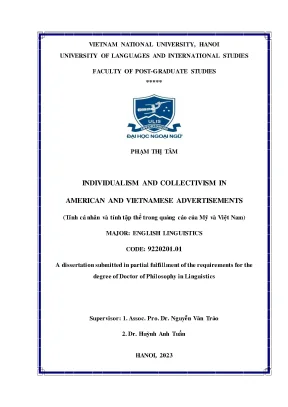
Tải xuống để đọc toàn bộVIETNAM NATIONAL UNIVERSITY, HANOI UNIVERSITY OF LANGUAGES AND INTERNATIONAL STUDIES FACULTY OF POST-GRADUATE STUDIES ***** PHẠM THỊ TÂM INDIVIDUALISM AND COLLECTIVISM IN AMERICAN AND VIETNAMESE ADVERTISEMENTS (Tính cá nhân và tính tập thể trong quảng cáo của Mỹ và Việt Nam) MAJOR: ENGLISH LINGUISTICS CODE: 9220201.01 A dissertation submitted in partial fulfillment of the requirements for the degree of Doctor of Philosophy in Linguistics Supervisor: 1. Huỳnh Anh Tuấn HANOI, 2023 STATEMENT OF AUTHORSHIP I certify my authority of the dissertation submitted entitled INDIVIDUALISM AND COLLECTIVISM IN AMERICAN AND VIETNAMESE ADVERTISEMENTS In fulfillment of the requirements for the degree of Doctor of Philosophy in Linguistics at Vietnam National University, Hanoi Except where the reference is indicated, no other person’s work has been used without due acknowledgement in the text of the dissertation. Signature Pham Thi Tam ACKNOWLEDGMENTS I would like to express my deepest gratefulness and my sincerest gratitude to many people who greatly contributed to the completion of this dissertation. First and foremost, I am greatly indebted to my supervisors, Asso c.
Nguyen Van Trao and Dr. Huynh Anh Tuan. Without their invaluable advice for the conceptualization of the study, close reading and editing of numerous drafts, and skillful guidance in conducting the various aspects of the degree-seeking process, this dissertation would not have been completed. Their warm support, steady interest, infinite patience, and generosity with their time are deeply appreciated.
My profound thanks extend to Prof. Nguyen Hoa, Assoc. Le Hung Tien, Assoc. Phan Van Hoa, Assoc.
Hoang Tuyet Minh, Assoc. Nguyen Thuy Nga, and Assoc. Nguyen Thu Hanh, Dr. Nguyen Trong Du, Dr.
Nguyen Thanh Long, Assoc. Nguyen Quang Ngoan, Assoc. Tran Ba Tien, Assoc. Kieu Thi Thu Hương, Assoc.
Phan Van Que for giving me insightful and invaluable comments in many academic seminars in their role of examiners. I particularly extend my warm thanks to all executives and staff of the faculty of post-graduate studies who have been friendly and helpful to me in any way possible. My sincere gratitude goes to the board of directors, personnel departments, and faculty of foreign languages department, and my colleagues of the Academy of Finance, for their generosity of creating all favorable conditions including time, financial supports, and permission for me to conduct the research. I am also indebted to my friends who have always been beside me since I was in great difficulties.
But for their help, I might have stopped my education journey when I was a small child. Last but not least, I wish to express my sincerest gratitude and appreciation to my parents, my parents-in- law, my relatives, my husband and my children for their support to help me overcome the obstacles and challenges during the process of accomplishing this study. Also, I would like to extend my sincerest thanks to my husband for his tolerance, endurance, patience, and support for me as well as his devoted care. Without his immense help, love, encouragement and sacrifice, this work could not have been completed.
i ABSTRACT The current study aims at investigating the manifestation and the representation of the individualist and collectivist values in American and Vietnamese advertisements under a non-essentialist view of culture through analyzing themes, creative tactics, and multimodal devices. To fulfil the aims of the study, multidimensional frameworks deriving from the individualism-collectivism cross-cultural theory and empirical evidence about their manifestation in cross-cultural psychology and advertising and a framework of multimodal devices representing these values are chosen for data analysis. These frameworks are created from three sources, namely the theory of social semiotics, in particular images, theoretical communication style, and theoretical foundation of the high-context and low-context communication, politeness strategies and empirical evidence about the multimodal devices representing individualist and collectivist values in advertisements of the I-C cultures. These frameworks are applied for analyzing data under exploratory sequential mixed methods with two datasets, one hundred thirty-one randomly selected American and one hundred and twenty-three randomly selected Vietnamese magazine advertisements.
The two datasets are firstly qualitatively coded into themes, creative tactics, images and linguistic devices and then quantitatively grouped for easy comparison and contrast between two datasets. These findings align with Hofstede‘s (1980, 2001) analysis of these two countries, and thus strongly confirm a correspondence between culture and language perspectives in exploring culture-based issues. However, both individualist and collectivist orientations are observed in both datasets with an insignificant difference between the two orientations in the American and Vietnamese dataset, indicating that American and Vietnamese cultures are not to be placed at the extremes of the individualism-collectivism continuum. The dissertation should be a useful resource for marketing policy makers, advertisers, academic researchers, and marketing teachers and students given its significant contributions with regards to the two proposed frameworks for investigating the representation of the individualist and collectivist values through images and linguistic devices.
It also merits special attention thanks to its significant theoretical, research, and practical implications. ii LIST OF ABBREVIATIONS Ad Advertisement I-C Individualism-Collectivism PS Politeness strategies FTA Face threatening act CT Collectivist themes IT Individualist themes ICT Individualist creative tactics IL Individualist linguistic device CL Collectivist linguistic device iii LIST OF FIGURES Figure 2.1: The ―iceberg Analogy‖ of culture proposed by Weaver (1999,p.2: The model of culture in this study .3: Number of publications in thousands citing Hofstede (1980, 2001) per year (1980–2019). Data taken from a Google Scholar (scholar.com) search for all publications (Eriksson & Gelfand, 2021) .4: The basic consumer decision process (Arens & Weigold, 2017, p.5: The nexus among culture, cultural values and cultural dimensions of values in this study .6: Factors influencing consumer behavior (Arens & Weigold, 2017) .1: The framework of the interconnection of worldview, design and research method adopted from Creswell, W.2: The research design used in this research to answer the first, the second, and the fourth research questions - the representation of individualist and collectivist values through creative tactics.3: The research design used in this research to answer the third research question and the fourth research question- the representation of individualist and collectivist values through multimodal devices.4: Steps in the data collection procedures .5: Preparation, organization and resulting phases in the content analysis process (Elo & Kyngas, 2008, p.6: The phases of content analysis. Analytical framework of this study.1: Individualist and collectivist values in American ads compared with Vietnamese ads through self-construal themes.2: Individualist and collectivist values manifested in American ads compared with Vietnamese ads through individualist social perception themes.3: Collectivist values manifested in American ads compared with Vietnamese ads through collectivist social perception themes.4: Themes manifested in American advertisements compared with Vietnamese advertisements.1: Individualist and collectivist values manifested in the American ads and in Vietnamese ads through creative tactics.2: Images representing individualist and collectivist values in the American ads compared with the Vietnamese ads.3: Interpersonal markers in the American ads and in the Vietnamese ads .4: The representation of the individualist values in the American ads and in the Vietnamese ads through linguistic devices at phrase and sentence levels .5: Linguistic devices at phrase and sentence levels representing collectivist values in the American ads and in the Vietnamese ads .182 v LIST OF TABLES Table 2.1: Values more typically possessed by American and Vietnamese (highlighted from Jewett, 2005; Hui & Triandis, 1986; Spence, 1985; Tran Ngoc Them, 2001; Dao Thi Phuong, 2015; Do Long and Phan Thi Mai Huong, 2002) .2: Examples to illustrate how cultural values influence advertisements.3: The classification of advertising (Arens & Weigold, 2017, p.4: An illustration of magazine advertisement components .5: I-C Dimensions and their manifestation in advertising content (Zhang, 2004, p.6: Individualist and collectivist values manifested through themes in previous studies .7: Examples of impersonal images .8: Examples of personal images with and without interaction .9: Linguistic devices adapted from high-context and low-context communication more likely representing individualist and collectivist values in advertisements (Singh & Bartikowski, 2009) .10: Interpersonal markers as linguistic devices more typically representing individualist and collectivist values (Triandis, 1995; Incelli, n.11: Linguistic devices adapted from the framework of politeness strategies (Brown & Levinson, 1987) .12: Linguistic devices more typically representing individualist and collectivist values adapted from the framework of politeness strategies vi (Brown & Levinson, 1987); rhetorical devices (Frith & Wesson, 1991) and Zhang (2004) .13: Individualism and collectivism in the research context of Vietnam .14: Linguistic devices more typically representing individualist and collectivist values in advertisements adapted from empirical research by various authors (Brown & Levinson, 1987; Incelli, n.d; Triandis, 1995; Singh & Bartikowski, 2009; & Zhang, 2004) .15: Linguistic devices more typically representing individualist and collectivist values in advertisements at lexical levels.16: Linguistic devices used in advertisements more likely representing individualist and collectivist values at phrase and sentence levels.1: Distribution of magazine advertisements .2: Distribution of sample advertisements on product categories .3: A sample analysis of an American advertisement (Readers‘ Digest, 2019) .4: A sample analysis of a Vietnamese advertisement (Marketing and Family, 2019) .5: Example of quantitative data for quantitative content analysis .1: Examples and explanations of harmony in the American ads and in the Vietnamese ads .2: Examples of conformity and explanations in American ads and Vietnamese ads.3: Examples and explanations of popularity in American ads and Vietnamese ads.4: Examples and explanations of status in American and Vietnamese ads .5: Individualist and collectivist values manifested in American ads and Vietnamese ads through themes of attribution, emotion, and motivation.6: Examples and explanations of ego-focused emotions and other- focused emotions in American ads and Vietnamese ads .7: Examples and explanations of self-oriented motivations and group- oriented motivations in American ads and Vietnamese ads .1: Examples and their explanations of arguments and hard-sell tactics in the American ads and in the Vietnamese ads.2: Examples and explanations of comparative claims in the American ads and in the Vietnamese ads .3 shows some examples to illustrate imitation and soft-sell tactics appearing in the American and Vietnamese ads.3: Examples and their explanations of imitation and soft-sell tactics in the American ads and in the Vietnamese ads .4: Examples of images with interactions and their interpretations in the American ads and in the Vietnamese ads .5: Examples of images without interactions and their interpretations in the American ads and in the Vietnamese ads .6: Examples of singular self-mention (I) in the American ads and other forms used in the Vietnamese ads.7: Examples of exclusive and inclusive plural self-mention personal markers in the American data and in Vietnamese ads .8: Examples and their explanations of common nouns or indefinite pronouns used in the Vietnamese ads .9: Common nouns and indefinite pronouns in the Vietnamese advertisements .10: Examples of showing off words used in the American ads and in the Vietnamese ads.11: Examples of scientific and objective markers in the American ads and in the Vietnamese ads .12: Examples of emotional, subjective, and affective markers in the American ads and in the Vietnamese ads .13: Taxonomy of request realization strategies (Trosborg, 1995, p.14: Examples and explanation for warning and alerting in the American ads and in the Vietnamese ads.15: Examples and explanations of disagreement or criticism found in the American ads and in the Vietnamese ads.16: The upgraded classification of strategies and structures on suggestion by Abdullah (2013) based on Li‘s (2010), Martinez-F lor‘s (2005) and Jiang‘s (2006), examples and their analysis in this study.17: Hedge devices and functions (Hyland, 1998a, p.
170) and illustrated examples in the American ads and in the Vietnamese ads.18: Impersonal linguistic forms (Biber, 1988) and other linguistic resources and examples in the American ads and in the Vietnamese ads.19: Examples of nominalization used in the American ads and in the Vietnamese ads.20: Kinds of metaphors (Chang & Yen, 2013) and examples in American ads and Vietnamese ads .21: Examples and explanations of similes in the American ads and in the Vietnamese ads .22: Examples of puns in the American ads and in the Vietnamese ads .23: Examples of promises in the American ads and in the Vietnamese ads .24: Proposed framework for representation of individualist and collectivist values through images (adpted from Zhang, 2004; and Kress & van Leeuwen, 2006).
Nội dung được bảo vệ bản quyền — Tải xuống đầy đủ
Trích dẫn luận án này
Phạm Thị Tâm (2023). Tính cá nhân và tập thể trong quảng cáo Mỹ-Việt Nam [Luận án tiến sĩ, Vietnam National University, Hanoi University of Languages and International Studies]. LuanAn.net. https://luanan.net/ngon-ngu-hoc/ngon-ngu-hoc-doi-chieu/tinh-ca-nhan-va-tap-the-trong-quang-cao-my-viet-nam
Từ khóa và chủ đề nghiên cứu
Từ khóa liên quan
Xem thêm luận án cùng lĩnh vực
Chủ đề nghiên cứu
Câu hỏi thường gặp
Luận án "Tính cá nhân và tập thể trong quảng cáo Mỹ-Việt Nam" nghiên cứu về vấn đề gì?
Luận án tiến sĩ phân tích tính cá nhân và tập thể trong quảng cáo Mỹ-Việt Nam. So sánh chủ đề, chiến lược sáng tạo và thiết bị đa phương tiện qua 254 quảng cáo tạp chí.
Luận án "Tính cá nhân và tập thể trong quảng cáo Mỹ-Việt Nam" được bảo vệ tại trường nào?
Luận án này được bảo vệ tại Vietnam National University, Hanoi University of Languages and International Studies. Năm bảo vệ: 2023.
Luận án "Tính cá nhân và tập thể trong quảng cáo Mỹ-Việt Nam" thuộc chuyên ngành gì?
Luận án "Tính cá nhân và tập thể trong quảng cáo Mỹ-Việt Nam" thuộc chuyên ngành English Linguistics. Danh mục: Ngôn Ngữ Học Đối Chiếu.
Luận án "Tính cá nhân và tập thể trong quảng cáo Mỹ-Việt Nam" có bao nhiêu trang?
Luận án "Tính cá nhân và tập thể trong quảng cáo Mỹ-Việt Nam" có 248 trang. Bạn có thể xem trước một phần tài liệu ngay trên trang web trước khi tải về.
Cách tải luận án "Tính cá nhân và tập thể trong quảng cáo Mỹ-Việt Nam" về máy như thế nào?
Để tải luận án về máy, bạn nhấn nút "Tải xuống ngay" trên trang này, sau đó hoàn tất thanh toán phí lưu trữ. File sẽ được tải xuống ngay sau khi thanh toán thành công. Hỗ trợ qua Zalo: 0559 297 239.