Luận án: Nghiên cứu so sánh biểu hiện lịch sự trong hành vi đề nghị tiếng Anh và tiếng Việt
Nghiên cứu so sánh các biểu thị lịch sự trong hành động mời trong tiếng Anh và tiếng Việt, phân tích sự khác biệt và tương đồng giữa hai ngôn ngữ.
Ngôn ngữ học (Ngữ dụng học / Ngôn ngữ học đối chiếu)
Luan An
Luận văn
Số trang
200
Thời gian đọc
30 phút
Lượt xem
0
Lượt tải
0
Phí lưu trữ
50 Point
Tổng quan nhanh
- Chủ đề:
- So sánh phép lịch sự tiếng Anh và Việt trong lời đề nghị
- Số trang:
- 200 trang
- Chuyên ngành:
- Ngôn ngữ học (Ngữ dụng học / Ngôn ngữ học đối chiếu)
- Tác giả:
- Luan An
Tóm tắt nội dung luận án
I.So sánh phép lịch sự tiếng Anh và Việt trong lời đề nghị
Tài liệu này tiến hành nghiên cứu mô tả, so sánh các chỉ tố lịch sự. Tập trung vào lời đề nghị trong tiếng Anh Úc và tiếng Việt. Phân tích chiến lược sử dụng ngôn ngữ và các danh xưng. Nghiên cứu nhằm cung cấp kiến thức sâu rộng. Giúp người đọc hiểu rõ hơn về ngữ dụng học so sánh. Hướng tới việc giao tiếp liên văn hóa hiệu quả. Tránh những hiểu lầm do khác biệt văn hóa. Nền tảng nghiên cứu dựa trên khái niệm thể diện, yếu tố văn hóa. So sánh cách sử dụng chỉ tố lịch sự của người bản xứ. Giải thích nguyên nhân của sự tương đồng, khác biệt.
1.1. Mục tiêu nghiên cứu lời đề nghị và phép lịch sự
Nghiên cứu mô tả, so sánh các chỉ tố lịch sự. Trọng tâm là lời đề nghị. Đánh giá chiến lược sử dụng ngôn ngữ. Phân tích ngữ dụng học so sánh. Khảo sát danh xưng, các hình thức trang trọng. Phạm vi nghiên cứu: tiếng Anh Úc và tiếng Việt. Mục tiêu mô tả chỉ tố lịch sự của người bản xứ. So sánh việc sử dụng chỉ tố theo mức độ trực tiếp/gián tiếp. Giải thích lý do tương đồng, khác biệt. Mang lại kiến thức về hành vi lời nói. Hữu ích cho giao tiếp liên văn hóa. Giúp tránh "sốc văn hóa".
1.2. Các yếu tố lịch sự trong giao tiếp tiếng Anh và Việt
Phép lịch sự tiếng Anh và tiếng Việt được nghiên cứu. Các yếu tố bao gồm chiến lược lịch sự. Hình thức xưng hô cũng là chỉ tố quan trọng. Các mục từ trang trọng góp phần thể hiện lịch sự. Nghiên cứu dựa trên khái niệm thể diện. Văn hóa giao tiếp Việt Nam ảnh hưởng sâu sắc. Văn hóa giao tiếp Anh cũng định hình phép lịch sự. Các yếu tố này tạo nên sắc thái lịch sự đặc trưng.
1.3. Khoảng trống nghiên cứu về lời đề nghị
Nhiều nghiên cứu đã so sánh các hành vi lời nói. Yêu cầu, phàn nàn, từ chối đã được phân tích. Lời khen, lời xin lỗi cũng thu hút sự chú ý. Tuy nhiên, hành vi đề nghị ít được nghiên cứu chuyên sâu. Lời đề nghị xuất hiện thường xuyên. Nó có thể là hành vi đe dọa hoặc nâng cao thể diện. Các nghiên cứu trước chủ yếu tập trung biểu đạt ngôn ngữ. Chúng thiếu nền tảng khái niệm thể diện. Nghiên cứu này lấp đầy khoảng trống đó.
II.Phân tích chiến lược lịch sự trong cấu trúc lời đề nghị
Nghiên cứu áp dụng khung khái niệm thể diện để giải thích phép lịch sự. Các chiến lược lịch sự được phân loại rõ ràng. Bao gồm chiến lược sử dụng ngôn ngữ và các chỉ tố lịch sự. Hình thức xưng hô đóng vai trò quan trọng trong việc thể hiện sự tôn trọng. Lời đề nghị được xem xét dưới hai góc độ: hành vi đe dọa thể diện hoặc nâng cao thể diện. Sự lựa chọn chiến lược phụ thuộc vào ngữ cảnh và mục đích người nói. Phân tích này làm rõ các cấu trúc lời đề nghị. Nó giúp hiểu sâu hơn về giao tiếp tiếng Anh và tiếng Việt.
2.1. Chiến lược lịch sự theo quan điểm ngữ dụng học
Nghiên cứu áp dụng khung khái niệm thể diện. Đây là yếu tố cốt lõi giải thích phép lịch sự. Chiến lược lịch sự được phân loại. Bao gồm chiến lược sử dụng ngôn ngữ. Các chiến lược này giúp đạt hiệu quả giao tiếp. Chúng thể hiện ý định của người nói. Cấu trúc lời đề nghị phản ánh chiến lược. Ngữ dụng học so sánh làm rõ sự khác biệt.
2.2. Các chỉ tố lịch sự và hình thức xưng hô
Chỉ tố lịch sự bao gồm các từ ngữ đặc trưng. Chúng thể hiện mức độ trang trọng. Hình thức xưng hô đóng vai trò quan trọng. 'Social Deixis' là một phần của chỉ tố lịch sự. Các danh xưng phù hợp văn hóa. Yếu tố này định hình sắc thái lịch sự. Chúng biểu thị mối quan hệ giữa các bên. Phép lịch sự tiếng Anh và tiếng Việt có sự khác biệt rõ rệt.
2.3. Lời đề nghị Hành vi đe dọa hay nâng cao thể diện
Lời đề nghị mang tính chất phức tạp. Nó có thể đe dọa thể diện người nghe. Hoặc nó có thể nâng cao thể diện người nghe. Điều này phụ thuộc vào ngữ cảnh. Nó cũng phụ thuộc vào cách biểu đạt. Mục đích của người nói là quan trọng. Nghiên cứu phân tích tính hai mặt này. Nó dựa trên sự chấp nhận của người nghe. Việc sử dụng chiến lược lịch sự quyết định.
III.Khám phá sắc thái lịch sự qua ngữ dụng học so sánh
Sắc thái lịch sự đa dạng, được giải thích qua khái niệm thể diện. Văn hóa ảnh hưởng mạnh mẽ đến quan niệm về thể diện. Mức độ trực tiếp hay gián tiếp trong lời đề nghị phản ánh chiến lược lịch sự. Giao tiếp gián tiếp thường thể hiện sự tôn trọng trong một số văn hóa. Ngữ cảnh đóng vai trò quyết định sự phù hợp của phép lịch sự. Mối quan hệ giữa người nói, người nghe và vị thế xã hội đều quan trọng. Các yếu tố phi ngôn ngữ cũng góp phần tạo nên sắc thái lịch sự. Ngữ dụng học so sánh làm rõ những điểm khác biệt này.
3.1. Sắc thái lịch sự và khái niệm thể diện face notion
Sắc thái lịch sự đa dạng. Nó được giải thích qua khái niệm thể diện. Thể diện là mong muốn được chấp nhận. Thể diện còn là mong muốn được tự chủ. Văn hóa ảnh hưởng mạnh mẽ đến khái niệm này. Mỗi cộng đồng có cách nhìn khác nhau. Điều này tạo nên sự khác biệt. Đặc biệt trong phép lịch sự tiếng Anh. Cũng như phép lịch sự tiếng Việt.
3.2. Mức độ trực tiếp gián tiếp trong lời đề nghị
Lời đề nghị có thể trực tiếp hoặc gián tiếp. Mức độ này liên quan đến lịch sự. Giao tiếp trực tiếp ít được ưa chuộng ở một số văn hóa. Giao tiếp gián tiếp thể hiện sự tôn trọng. Đặc biệt trong văn hóa giao tiếp Việt Nam. Tiếng Anh Úc có thể khác biệt. Nghiên cứu so sánh sự lựa chọn này. Nó làm rõ các chiến lược lịch sự.
3.3. Vai trò ngữ cảnh trong việc biểu đạt lịch sự
Ngữ cảnh quyết định sự phù hợp của lịch sự. Mối quan hệ giữa người nói, người nghe. Vị thế xã hội, khoảng cách xã hội đều quan trọng. Mối quan hệ xác định cách xưng hô. Ngữ cảnh ảnh hưởng đến việc chọn chiến lược lịch sự. Một lời đề nghị có thể lịch sự ở ngữ cảnh này. Nhưng lại bất lịch sự ở ngữ cảnh khác. Các yếu tố phi ngôn ngữ cũng góp phần.
IV.Tác động văn hóa giao tiếp đến phép lịch sự tiếng Anh Việt
Văn hóa giao tiếp Việt Nam và Anh có những đặc trưng riêng biệt, ảnh hưởng sâu sắc đến phép lịch sự. Văn hóa Việt Nam đề cao sự hòa hợp, sử dụng danh xưng và kính ngữ phức tạp. Lời đề nghị thường gián tiếp, thể hiện sự khiêm tốn. Ngược lại, văn hóa Anh có thể trực tiếp hơn nhưng vẫn giữ sự tế nhị. Nghiên cứu so sánh những khác biệt này. Đặc biệt, phân tích vai trò của yếu tố phi ngôn ngữ. Chúng góp phần tạo nên sắc thái lịch sự trong cả hai nền văn hóa. Từ đó, làm rõ tác động của văn hóa đến giao tiếp.
4.1. Ảnh hưởng văn hóa Việt Nam đến giao tiếp
Văn hóa giao tiếp Việt Nam nhấn mạnh sự hòa hợp. Coi trọng mối quan hệ cộng đồng. Lời đề nghị thường gián tiếp. Sự khiêm tốn được đề cao. Danh xưng, kính ngữ rất quan trọng. Thể hiện sự tôn trọng người lớn tuổi. Thể hiện sự tôn trọng người có địa vị. Các yếu tố phi ngôn ngữ cũng quan trọng. Nụ cười, cử chỉ góp phần tạo sắc thái lịch sự.
4.2. Đặc trưng văn hóa Anh trong lời đề nghị
Văn hóa giao tiếp Anh có thể khác biệt. Người Anh thường lịch sự một cách tinh tế. Sử dụng các cấu trúc câu phức tạp hơn. Giảm nhẹ yêu cầu bằng các từ như "perhaps", "might". Tránh ép buộc người nghe. Lời đề nghị có thể trực tiếp hơn một chút. Nhưng vẫn giữ sự tế nhị. Nghiên cứu so sánh chiến lược lịch sự này.
4.3. Sự khác biệt về yếu tố phi ngôn ngữ
Yếu tố phi ngôn ngữ không được nghiên cứu sâu trước đây. Tuy nhiên, chúng rất quan trọng. Nét mặt, cử chỉ, giọng điệu. Tất cả đều ảnh hưởng đến sắc thái lịch sự. Trong văn hóa Việt Nam, sự tinh tế được thể hiện. Trong văn hóa Anh, sự dè dặt cũng có mặt. Nghiên cứu ngữ dụng học so sánh có thể mở rộng. Khám phá thêm vai trò của các yếu tố này.
V.Ý nghĩa giao tiếp liên văn hóa từ nghiên cứu lời đề nghị
Nghiên cứu này mang lại những ý nghĩa thiết thực cho giao tiếp liên văn hóa. Nó cung cấp kiến thức sâu sắc về lời đề nghị trong tiếng Anh Úc và tiếng Việt. Giúp người học ngôn ngữ và các nhà ngữ dụng học hiểu rõ hơn. Từ đó, hạn chế "sốc văn hóa" do khác biệt trong phép lịch sự. Hiểu rõ các chiến lược lịch sự giúp điều chỉnh hành vi giao tiếp. Nghiên cứu cũng đóng góp vào lĩnh vực ngữ dụng học. Nó phân tích mối quan hệ giữa cấu trúc ngữ nghĩa, ngữ dụng và văn hóa. Nâng cao khả năng giao tiếp xuyên văn hóa.
5.1. Hiểu biết về lời đề nghị trong giao tiếp liên văn hóa
Nghiên cứu mang lại kiến thức giá trị. Nó về lời đề nghị trong tiếng Anh Úc và tiếng Việt. Người học ngôn ngữ có thể hiểu sâu hơn. Các nhà ngữ dụng học cũng hưởng lợi. Giao tiếp liên văn hóa trở nên hiệu quả. Tránh hiểu lầm do khác biệt văn hóa. Lời đề nghị là hành vi giao tiếp cơ bản. Cấu trúc ngữ nghĩa liên quan chặt chẽ đến văn hóa.
5.2. Hạn chế sốc văn hóa qua chiến lược lịch sự
"Sốc văn hóa" xảy ra do khác biệt. Đặc biệt là về phép lịch sự. Hiểu rõ chiến lược lịch sự của mỗi ngôn ngữ. Giúp người giao tiếp điều chỉnh hành vi. Ngăn chặn những hiểu lầm không mong muốn. Nâng cao khả năng thích nghi. Giao tiếp liên văn hóa suôn sẻ hơn.
5.3. Đóng góp cho lĩnh vực ngữ dụng học và người học ngôn ngữ
Nghiên cứu này đóng góp lớn. Nó dựa trên giả định thể diện. Khác với các nghiên cứu chỉ giới hạn biểu đạt ngôn ngữ. Nó đi sâu vào mối quan hệ ngữ nghĩa, ngữ dụng. Giữa hành vi lời nói và phép lịch sự. Người học tiếng Anh hoặc tiếng Việt có thêm hiểu biết. Họ sẽ có cái nhìn sâu sắc hơn về lời đề nghị.
Mục lục chi tiết luận án
Tải xuống file đầy đủ để xem toàn bộ nội dung
Tải đầy đủ (200 trang)Trích đoạn nội dung luận án
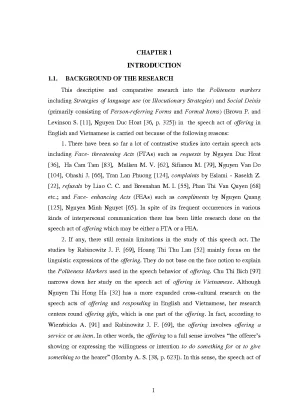
Tải xuống để đọc toàn bộbackground of THE research This descriptive and comparative research into the Politeness markers including Strategies of language use (or Illocutionary Strategies) and Social Deixis (primarily consisting of Person-referring Forms and Formal Items) (Brown P. [11], Nguyen Duc Hoat [36, p. 325]) in the speech act of offering in English and Vietnamese is carried out because of the following reasons: 1. There have been so far a lot of contrastive studies into certain speech acts including Face- threatening Acts (FTAs) such as requests by Nguyen Duc Hoat [36], Ha Cam Tam [83], Mulken M.
[66], Tran Lan Phuong [124], complaints by Eslami - Rasekh Z. [22], refusals by Liao C.; and Face- enhancing Acts (FEAs) such as compliments by Nguyen Quang [125], Nguyen Minh Nguyet [65]. In spite of its frequent occurrences in various kinds of interpersonal communication there has been little research done on the speech act of offering which may be either a FTA or a FEA. If any, there still remain limitations in the study of this speech act.
The studies by Rabinowitz J. [69], Hoang Thi Thu Lan [52] mainly focus on the linguistic expressions of the offering. They do not base on the face notion to explain the Politeness Markers used in the speech behavior of offering. Chu Thi Bich [97] narrows down her study on the speech act of offering in Vietnamese.
Although Nguyen Thi Hong Ha [32] has a more expanded cross-cultural research on the speech acts of offering and responding in English and Vietnamese, her research centers round offering gifts, which is one part of the offering. In fact, according to Wierzbicka A. [69], the offering involves offering a service or an item. In other words, the offering to a full sense involves “the offerer’s showing or expressing the willingness or intention to do something for or to give something to the hearer” (Hornby A.
In this sense, the speech act of 1 LUAN VAN CHAT LUONG download : add luanvanchat@agmail.com offering has not been thoroughly studied by Chu Thi Bich and Nguyen Thi Hong Hµ either. Generally, the above-mentioned studies on the speech act of offering are restricted to the linguistic expressions rather than based on the face assumption which may be radically influenced by the cultural features to explain the use of the Politeness Markers in this speech act. Nonetheless there exist in all languages these interrelated elements to express politeness in speech acts including the offering. aims and Scope of the research Due to the time and resource constraints, this research is restricted to the descriptive and comparative study on the Politeness Markers in the offering in Australian English and Vietnamese.
As a result, the research is intended: 1. To describe the Politeness Markers used in the speech act of offering performed by the native Australian speakers. To describe the Politeness Markers used in the speech act of offering performed by the native Vietnamese speakers. To compare their use of the Politeness Markers in the speech act of offering along the directness/indirectness dimension in various social situational contexts studied.
To explain the underlying reasons for the similarities and/or dissimilarities in their use of these Politeness Markers. Theoretical and practical implications This research could offer the following theoretical and practical implications: 1. The findings of this research could provide the knowledge of the speech act of offering in Australian English and Vietnamese, which could be necessary for the researchers of pragmatic field and for those who use it as a means of intercultural communication to avoid “culture shock”. This research based on the face assumption which may be impacted by the cultural features to explain the use of the Politeness Markers in the speech act of offering in Australian English and Vietnamese could make a significant contribution 2 LUAN VAN CHAT LUONG download : add luanvanchat@agmail.com compared to the former researches restricted to the study of the linguistic expressions of speech acts including the offering.
Truly a speech act is a basic pragmatic unit of communication (Trosborg A. [85]), whose semantic structure is closely associated with the ideology and cultural features of the community employing that speech act. The ideology and cultural features of the community in their turns determine whether or not a speech act is of politeness in the on-going verbal interaction from the interlocutors’ perception of face. In other words, there must be an entwined relationship between the semantic structure and pragmatic sense of a speech act including the offering in association with linguistic politeness, which may not have been intensively studied by the previous studies on the speech act of offering.
This research could help the pragmatists and the learners of English or Vietnamese as a foreign language have a deeper insight into speech acts including the offering in Australian English as an Indo-European inflectional language and in Vietnamese as a typical tonic and non-inflectional Austro-Asiatic language. Especially the findings of this research is useful for Vietnamese learners of English and Australian learners of Vietnamese in that they could help these learners better learn English or Vietnamese as a foreign language in a scientific and systematic way and in this way could prevent them from committing unexpected pragmatic errors. research methods The methods used in this research are descriptive and comparative. - Descriptive: the Politeness Markers in the speech act of offering in Australian English and Vietnamese are described in relation to the semantic structure and pragmatic properties.
- Comparative: The coding system for the comparison of the strategies of offering in Australian English and Vietnamese used in this thesis are modified from the coding system of strategies developed by Blum-Kulka S. [69], which cover seven strategies within the three major Strategy Categories ranking in a decreasing level of directness. 3 LUAN VAN CHAT LUONG download : add luanvanchat@agmail.com The comparative method is preferred to the contrastive method because of the following reasons. The findings from the thesis based on this comparative method (to find out the similarities and differences) could offer not only the practical implications in a foreign language teaching method of a speech act (as the contrastive method [to find out the differences] could) but also the linguistically theoretical implications concerning the semantic, structural and pragmatic aspects of a speech act including the offering in the two languages compared.
structure of the thesis From the above-mentioned issues, this thesis could be organized into the following chapters: Chapter 1 introduces the background, the aims and scope, the theoretical and practical implications, the research methods and the structure of the thesis. Chapter 2 provides a review of different approaches to linguistic politeness study and discusses my viewpoint on the appropriate approach to study linguistic politeness in Vietnamese culture. Chapter 3 discusses the methodology issues including research questions, data approach and the research method, the data collection methods, the selection of subjects, the research procedure involving the procedure for the administration of the Pilot Questionnaires (PQs) and the Discourse Completion Tests (DCTs). Chapter 4 describes and discusses the identification of the speech act of offering in Australian English and Vietnamese to highlight its distinctive features.
A further analysis of the Politeness Markers used in the speech act of offering in Australian English and Vietnamese is then carried out as a coding framework. Chapter 5 presents and discusses the findings on the use of the Politeness Markers in the offering in Australian English and Vietnamese in relation to such social variables as the Relative Power (P), the Social Distance (D) and the Imposition Rank (R) in the situational contexts studied and the underlying reasons. Chapter 6 presents the conclusion of the thesis including the summary of the major findings, the implications and the suggestions for further research. 4 LUAN VAN CHAT LUONG download : add luanvanchat@agmail.com Chapter 2 speech act theory and linguistic politeness This chapter provides an overview of different approaches to linguistic politeness study and presents my viewpoint on the appropriate approach to study linguistic politeness in the context of Vietnamese culture.
speech acts and politeness Speech acts have been studied and defined by different theorists such as Austin J. Their common point of view is that a speech act is a unit of communication. Each of these units performs a certain function such as: complimenting, apologizing, offering etc. According to Austin J.
[1], stating is only one function of language. He notes that some ordinary declarative sentences are not just to say things or describe states of affairs but also used to do things. He distinguishes constatives - statements, assertions - from performatives which are used to perform actions. According to Austin, an utterance is perceived as having three basic senses and in performing a certain act, the speaker is said to perform simultaneously three kinds of acts: - Locutionary act: the uttering of a certain sentence with certain sense and reference.
This again is roughly equivalent to “meaning” in the traditional sense; - Illocutionary act: the making of a statement, an offering, etc. in uttering a sentence by the conventional force associated with it; and - Perlocutionary act: the effect on the hearer achieved by saying something. According to Austin, the term “speech act” is actually used exclusively to refer to the illocutionary act. He also suggests that different speech acts can be classified and compared basing on the classification of speech act verbs available in a language.
Yet, he fails to show systematically the relation between illocutionary force and the explicit and implicit performatives and their felicity conditions. [73] further expands on Austin’s work and basing on the felicity conditions for different speech acts, Searle J. [74, 75] comes up with the taxonomy of speech act types: 5 LUAN VAN CHAT LUONG download : add luanvanchat@agmail.com - Representatives or assertives which commit the speaker to the truth of a proposition, for example, asserting or stating; - Directives, the point of which is to get the hearer to do something, for example, ordering, requesting; - Commissives, which commit the speaker to some future action, for example, promising, offering; - Expressives, which express certain feelings and attitudes of the speaker, for example, thanking, apologizing; and - Declaratives, acts of announcing the emergence of an event, for example, declaring, christening. Searle’s taxonomy takes the illocutionary act as the starting point in identifying speech act types but not speech act verbs as proposed by Austin J.
[77] also makes a claim that “the basic unit of human communication is the illocutionary act” and that his taxonomy has universal application. According to Searle J. [76], in everyday interactions, it is often found that the speaker may utter a sentence and mean what s/he says and also mean another illocution with a different illocutionary content. For example, the utterance (2.1) ‚May I help you?‛ can be meant not as a question with the inversion of the Modal Auxiliary Verb (MAV) May and the First Personal Subject I but as an offering to help somebody.
Utterances of this type fall under what Searle J. [76] calls “indirect speech acts” or the cases in which “… one illocutionary act is performed indirectly by performing another”. The distinction between what is meant and what is said shows that a polite utterance reveals the speaker’s true intentions only indirectly. The speaker seeks ways to modify what s/he is planning to say, thus s/he could express his/her intention indirectly enough to avoid a social conflict.
Indirectness has been associated with the levels of politeness by many Western researchers. These researchers assert indirectness is the chief motivation for politeness and indirectness and the closely associated notion of politeness operate under universal principles (Searl J. Utterances of offering in English using Interrogative forms, e.2) 6 LUAN VAN CHAT LUONG download : add luanvanchat@agmail.com ‚Can I offer some help?‛ [DCT 5] are called Conventionally Indirect offering and are considered polite in that the form seems to give the hearer the option of refusal since the “yes” or “no” alternative question allows “no” as a possible answer.
Nội dung được bảo vệ bản quyền — Tải xuống đầy đủ
Trích dẫn luận án này
So sánh biểu hiện lịch sự trong lời đề nghị tiếng Anh và tiếng Việt (n.d.) [Luận án tiến sĩ]. LuanAn.net. https://luanan.net/ngon-ngu-hoc/ngon-ngu-hoc-doi-chieu/so-sanh-bieu-hien-lich-su-loi-de-nghi-tieng-anh-tieng-viet
Câu hỏi thường gặp
Luận án "So sánh biểu hiện lịch sự trong lời đề nghị tiếng Anh và tiếng Việt" nghiên cứu về vấn đề gì?
Nghiên cứu so sánh các biểu thị lịch sự trong hành động mời trong tiếng Anh và tiếng Việt, phân tích sự khác biệt và tương đồng giữa hai ngôn ngữ.
Luận án "So sánh biểu hiện lịch sự trong lời đề nghị tiếng Anh và tiếng Việt" thuộc chuyên ngành gì?
Luận án "So sánh biểu hiện lịch sự trong lời đề nghị tiếng Anh và tiếng Việt" thuộc chuyên ngành Ngôn ngữ học (Ngữ dụng học / Ngôn ngữ học đối chiếu). Danh mục: Ngôn Ngữ Học Đối Chiếu.
Luận án "So sánh biểu hiện lịch sự trong lời đề nghị tiếng Anh và tiếng Việt" có bao nhiêu trang?
Luận án "So sánh biểu hiện lịch sự trong lời đề nghị tiếng Anh và tiếng Việt" có 200 trang. Bạn có thể xem trước một phần tài liệu ngay trên trang web trước khi tải về.
Cách tải luận án "So sánh biểu hiện lịch sự trong lời đề nghị tiếng Anh và tiếng Việt" về máy như thế nào?
Để tải luận án về máy, bạn nhấn nút "Tải xuống ngay" trên trang này, sau đó hoàn tất thanh toán phí lưu trữ. File sẽ được tải xuống ngay sau khi thanh toán thành công. Hỗ trợ qua Zalo: 0559 297 239.