Tonke groot american college campus aesthetic
Tonke groot american college campus aesthetic thể hiện phong cách kiến trúc đại học Mỹ, kết hợp giữa hiện đại và cổ điển.
Luan An
Master’s Dissertation
Năm xuất bản
Số trang
129
Thời gian đọc
20 phút
Lượt xem
0
Lượt tải
0
Phí lưu trữ
40 Point
Tổng quan nhanh
- Chủ đề:
- Tonke Groot's Campus Aesthetic Perspective Unveiled
- Số trang:
- 129 trang
- Tác giả:
- Tonke Groot
- Năm:
- 2018
Tóm tắt nội dung luận án
I.Tonke Groot s Campus Aesthetic Perspective Unveiled
Tonke Groot's dissertation meticulously examines the American college campus aesthetic. A Dutch exchange student, Groot brings a unique "outside-looking-in" perspective. Her initial fascination with campus life developed during visits to various American universities. This personal journey ignited a scholarly pursuit. Groot views the campus not merely as an educational institution but as a powerful cultural phenomenon. The dormitory, dining hall, and quad spaces captivated her. This dissertation explores the profound connection between the American campus environment and its enthusiasts. It delves into the iconic imagery deeply embedded in popular culture and individual memory. Groot's work offers insights into the American college experience through a distinct, European lens. It analyzes how this specific aesthetic transcends temporary student life, becoming a permanent lifestyle for some. This research provides a fresh look at familiar academic landscapes. The Tonke Groot style of analysis emphasizes observation and cultural interpretation.
1.1. A Dutch Gaze on US University Life
Tonke Groot, a Dutch scholar, approached American university life with particular curiosity. Her status as an exchange student provided a detached yet immersed viewpoint. She navigated the intricacies of college without the typical application stress or significant financial burdens. This freedom allowed intense observation of daily campus activities. Groot documented the non-academic quirks: Greek life, robust athletic events, and vibrant house parties. These elements became central to her study, offering a comprehensive view. The European collegiate aesthetic often differs significantly from its American counterpart. Groot's analysis bridges this cultural gap, highlighting unique distinctions. Her perspective illuminates aspects locals might overlook, fostering a deeper understanding. The research provides valuable cross-cultural comparison, underscoring the distinctiveness of the American university setting. It outlines how a Dutch preppy style observer interprets the American collegiate landscape.
1.2. Campus as Attraction An Exchange Student s View
For Tonke Groot, the American college campus functioned much like a captivating theme park. It was an explicit "attraction" to be explored with academic rigor. This unique perspective profoundly shaped her dissertation's scope and analytical tone. She deliberately immersed herself in experiencing the culture of American college life. Her hyper-awareness stemmed directly from her visitor status, encouraging keen observation. Assessing, comparing, and evaluating what it truly meant to attend college in the U.S. was inherent to her presence. This privileged position allowed critical, yet empathetic, assessment of the campus environment. The vibrant, distinct, and physically imposing character of these institutions became a primary focus. This unique viewpoint provides rich analytical depth, revealing the subtle nuances of campus culture. It highlights the performative aspects of campus life and its visual appeal.
1.3. Unpacking the American College Campus Allure
The emotional weight of the American college campus intrigued Tonke Groot. Images of campus landscapes nestled deeply into her mind. Her project seeks to understand this powerful allure. It investigates the dynamic relationship between campus and its admirers. The dissertation uncovers why the college experience becomes a lasting lifestyle for many. It moves beyond academic functions to explore cultural impact. The Tonke Groot style examines both physical spaces and emotional connections. This approach deciphers the enduring appeal of collegiate aesthetics. It explains why a vintage university look or old money aesthetic campus continues to resonate. This comprehensive study highlights the intricate layers of campus fascination.
II.Historic Principles Shaping American Campus Design
The American college campus aesthetic possesses deep historical roots. Its architectural principles often echo European traditions while developing distinct national characteristics. Understanding this historicization is crucial to appreciating its current appeal. Early American universities drew heavily on English collegiate models, particularly Oxford and Cambridge. Gothic castles and quadrangles inspired initial designs. This foundation evolved, incorporating elements that reflect American expansion and educational philosophies. The physical layout and building styles contribute significantly to the perceived Ivy League fashion and overall ambiance. Academic institutions meticulously preserved certain looks, crafting a timeless quality. This deliberate design created spaces that evoke tradition and prestige. Many modern university aesthetics still reference these foundational elements. The historical evolution shapes how campuses are experienced today.
2.1. Evolution of Collegiate Architecture Styles
American college architecture underwent significant transformations. Initial designs replicated European models, favoring Gothic Revival and Neoclassical styles. These choices conveyed authority and academic heritage. Later periods introduced more regional and functional approaches. The quad, a central green space, became a ubiquitous feature. It fostered community and represented institutional order. Brick, stone, and classical motifs dominated construction. This deliberate aesthetic contributed to the vintage university look. Campus buildings were not merely structures; they were statements. They embodied the values and aspirations of the institutions. Their design choices influenced perceptions of prestige and tradition. This architectural legacy remains a cornerstone of campus identity.
2.2. Influence of European Collegiate Aesthetic on US
European university models profoundly impacted American campus design. British institutions, with their venerable architecture, served as primary inspirations. The concept of a self-contained academic village took root. This influence extended to specific architectural elements like turrets, arched doorways, and ornate stonework. The grandeur of "gothic castles" found its way into American university planning. This cross-cultural borrowing established a strong academic visual language. It helped solidify the perception of intellectual heritage. The old money aesthetic campus often directly traces its lineage to these European precedents. This heritage continues to inform modern architectural choices, blending tradition with contemporary needs.
2.3. Iconic Structures Defining University Heritage
Specific buildings and layouts define a university's heritage. Iconic structures become symbols of institutional identity. Bell towers, grand libraries, and historic chapels contribute to the campus aesthetic. These landmarks reinforce a sense of history and permanence. They provide a backdrop for academic life and social interactions. The preservation of these structures maintains a vintage university look. Such buildings often feature prominently in marketing and alumni engagement. They are integral to the perception of quality and tradition. The physical environment communicates institutional values and fosters a sense of timelessness. These heritage sites are critical to campus character.
III.American College Campus in its Cultural Landscape
The American college campus is more than just a collection of buildings; it is a vital part of the nation's cultural landscape. It represents a distinct ecosystem where learning, social development, and community intersect. The campus shapes identity and lifestyle. Its design often reflects regional characteristics and institutional missions. From sprawling state universities to intimate liberal arts colleges, each campus presents a unique cultural expression. The Tonke Groot style of observation highlights this multifaceted nature. The physical environment fosters specific subcultures, influencing everything from daily routines to long-term aspirations. This cultural embedding makes the campus a powerful symbol in American society. It attracts individuals seeking a particular experience. The campus fabric intertwines with local communities and national narratives.
3.1. Campus Life A Distinct American Subculture
Campus life in America constitutes a distinctive subculture. It encompasses Greek life, robust athletic programs, and communal dining experiences. These elements forge a unique social environment. Students engage in activities like pick-up basketball and vibrant house parties. This communal living fosters strong bonds and a sense of belonging. The campus becomes a temporary, yet profoundly influential, home. This distinct lifestyle appeals to many. It shapes personal development and creates lasting memories. The "campus life" transcends academic pursuits, becoming a defining phase for individuals. Its rituals and traditions reinforce group identity and loyalty. This subculture is a core element of the American college experience.
3.2. Visual Identity in the Campus Environment
The visual identity of an American college campus is carefully curated. It contributes significantly to its brand and appeal. Green quadrangles, mature trees, and distinctive architecture form a coherent aesthetic. These elements evoke feelings of tradition, scholarship, and community. The Dark academia aesthetic finds its roots in these venerable surroundings. Similarly, the Light academia fashion movement draws inspiration from sunlit courtyards and neoclassical facades. The careful arrangement of buildings and natural spaces creates a particular mood. This visual language communicates institutional values and history. It helps prospective students envision their future within its walls, shaping their Tonke Groot fashion inspiration.
3.3. Landscape and Social Dynamics of College
The physical landscape of a college campus profoundly influences social dynamics. Open green spaces encourage impromptu gatherings and relaxation. Pathways dictate movement patterns and social interaction. Dormitories foster community living. Dining halls serve as central hubs for daily life. The campus design facilitates a unique rhythm of student existence. It shapes casual encounters and formal events. The thoughtful integration of buildings, nature, and recreational areas creates an immersive environment. This setting provides the backdrop for forming friendships and pursuing academic goals. The landscape becomes an active participant in the college experience, enhancing its overall appeal.
IV.Demarcating Difference in College Campus Identity
American college campuses actively demarcate their distinct identities. This differentiation is crucial in a competitive educational landscape. Each institution strives to cultivate a unique aesthetic and cultural profile. This process involves architectural choices, branding strategies, and the fostering of specific traditions. The Tonke Groot style of research observes these conscious efforts to stand apart. Campuses leverage their history, location, and academic specializations to forge a unique identity. This creates a diverse tapestry of collegiate experiences across the nation. The goal is to attract specific types of students and build a loyal alumni base. The resulting diversity allows for a broad spectrum of American college fashion trends, from formal Ivy League styles to more relaxed, regional looks. This continuous process of identity construction defines the evolving nature of the American university.
4.1. Crafting Unique University Aesthetics
Universities employ various strategies to craft unique aesthetics. They might emphasize a specific architectural style, such as Gothic, Colonial, or modern. Landscaping plays a significant role in establishing character. Regional materials and traditions are often incorporated. This deliberate design work aims to create an identifiable sense of place. The visual distinctiveness reinforces institutional pride. It also communicates the values and mission of the university. This careful aesthetic curation is integral to shaping the overall campus experience. It helps differentiate one institution from another in the minds of prospective students. This process defines the unique American college campus aesthetic.
4.2. Branding and the Collegiate Experience
Branding is paramount in defining the collegiate experience. Universities develop strong visual identities, logos, and traditions. These elements contribute to a cohesive institutional narrative. Marketing campaigns often highlight unique campus features or academic strengths. The aim is to create an emotional connection with the institution. This branding extends to how students perceive their own experience. It fosters a sense of belonging and loyalty. The "Tonke Groot fashion inspiration" might stem from analyzing how these branded environments influence student style and self-expression. Effective branding reinforces the perceived prestige and distinctiveness of a campus, from Ivy League fashion to regional styles.
4.3. Regional Variations in Campus Character
Significant regional variations exist in American campus character. Southern universities might feature grand columns and red brick, evoking a specific historical charm. Northeastern institutions often embody the classic Ivy League fashion, with centuries-old stone buildings. Western campuses frequently integrate with dramatic natural landscapes like redwood forests. These regional differences contribute to a rich diversity of campus aesthetics. They reflect local histories, climates, and cultural values. This geographical diversity offers students a wide range of collegiate environments to choose from. Each region offers a distinct backdrop for the academic journey, influencing the American college fashion trends observed.
V.The Enduring Allure of Vintage University Looks
The vintage university look maintains an enduring allure in contemporary culture. This aesthetic transcends mere nostalgia, influencing fashion, media, and lifestyle trends. It draws on the rich history and romanticized imagery of classic American campuses. Think of the Old money aesthetic campus, characterized by timeless elegance and understated sophistication. This appeal is often linked to perceived prestige, intellectualism, and a sense of tradition. Popular culture frequently romanticizes these environments, presenting them as idyllic settings for learning and personal growth. The aesthetic taps into a desire for permanence and quality in an ever-changing world. It inspires designers and artists, leading to various interpretations in fashion and interior design. This enduring fascination with the classic collegiate style remains a powerful cultural force, shaping preferences and aspirations.
5.1. From Ivy League to Modern Campus Trends
The Ivy League fashion style originated from elite Northeastern universities. It featured tailored blazers, chinos, and classic sweaters. This look set a benchmark for collegiate attire. Over time, it evolved, influencing broader American college fashion trends. Modern campuses adapt these classic elements, blending them with contemporary styles. The appeal lies in its sophisticated yet approachable nature. This evolution demonstrates the lasting impact of historical collegiate fashion. It shows how traditional styles are continuously reinterpreted. The Tonke Groot style of observation might note how these trends filter down to everyday student life, impacting Tonke Groot fashion inspiration for many.
5.2. Capturing the Old Money Aesthetic Campus
The Old money aesthetic campus exudes timeless elegance and inherited prestige. It features grand architecture, manicured grounds, and a sense of quiet luxury. This aesthetic is often associated with established institutions and a refined lifestyle. It emphasizes quality over ostentation, tradition over fleeting trends. Capturing this look involves careful attention to detail in architecture, landscaping, and even subtle fashion choices. It suggests a history of generational wealth and intellectual pursuits. This aesthetic contributes to the vintage university look, making it perpetually desirable. It represents a particular aspirational lifestyle, often seen in European collegiate aesthetic interpretations.
5.3. Fashion Inspiration from Collegiate Aesthetics
Collegiate aesthetics provide rich fashion inspiration. The Dark academia aesthetic draws from gothic architecture, libraries, and a brooding intellectualism. It favors tweed, dark colors, and vintage silhouettes. In contrast, Light academia fashion embraces brighter tones, open spaces, and a more optimistic scholarly vibe. It features lighter fabrics, pastels, and a relaxed elegance. Both aesthetics derive directly from imagined or real campus environments. They reflect different facets of academic life. These styles are not just clothing; they are expressions of a particular intellectual and social sensibility. They influence Tonke Groot fashion inspiration and broader lifestyle choices, shaping contemporary American college fashion trends.
Mục lục chi tiết luận án
Tải xuống file đầy đủ để xem toàn bộ nội dung
Tải đầy đủ (129 trang)Trích đoạn nội dung luận án
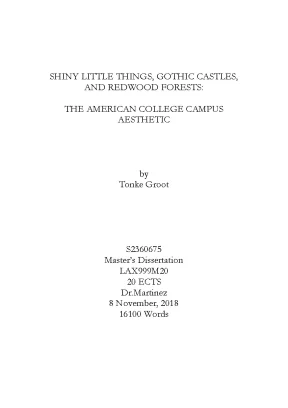
Tải xuống để đọc toàn bộSHINY LITTLE THINGS, GOTHIC CASTLES, AND REDWOOD FORESTS: THE AMERICAN COLLEGE CAMPUS AESTHETIC by Tonke Groot S2360675 Master’s Dissertation LAX999M20 20 ECTS Dr.Martinez 8 November, 2018 16100 Words I declare that this dissertation is my own work except where indicated otherwise with proper use of quotes and references. 1 The interactive components of this dissertation are most easily accessible via this project’s own Pinterest board and YouTube playlists, which are accessible via the following links: Pinterest: pin.it/erfok7psuz3rdw YouTube Playlist Chapter Two: www.com/playlist?list=PLkrCGRPUTm AEa38yX2RXRDrume0VFgRCv YouTube Playlist Movie Syllabus: https://www.com/playlist?list=PLkrCG RPUTmAH2S-ieADr0Rdc2vwtCXf_2 2 CONTENTS INTRODUCTION 5 CHAPTER ONE: 16 THE CAMPUS HISTORICIZATION PRINCIPLE CHAPTER TWO: 49 COLLEGE IN THE AMERICAN LANDSCAPE CHAPTER THREE: 76 DEMARCATION OF DIFFERENCE CONCLUSION 103 ACKNOWLEDGEMENTS 113 WORKS CITED 114 3 4 INTRODUCTION 5 Ivy Brisbin is a twenty-nine-year-old orthodontic resident at the University of North Carolina at Chapel Hill. Her car is plastered with stickers displaying her affection for the University of Michigan, the school some of her closest family members went to. Ever since she graduated from high school in 2008, she has lived a “campus life” at an American university.
Eight years later, on August 21st, 2016, she posted this photo on her Instagram account.1 In the caption, she exclaimed that she still “love[s] being on a college campus.” For Ivy, the college experience has transcended being just a temporary state; it has become more like a permanent lifestyle. For me, the idea of the American college campus carries similar emotional weight. Ever since I lived on such a campus—or perhaps even before that—the quad, dining hall, and dorm room aesthetic has intrigued me. Without being aware of the significance of my own behavior, I excitedly visited four colleges—the University of Virginia, Charleston College, UNC Asheville, and Duke University—during a two-week road trip through the American South last summer.
Only recently, I have started to realize just how powerfully the iconic images of campus landscapes 1 Bold phrases refer to images that are displayed in the photo pages after each chapter. In the digital version, they, along with all the underlined phrases, are hyperlinks. 6 have nestled into my brain. I would be remiss to ignore the significance of my personal American college experience in relation to this project.
Without my own impressions of the vibrant, distinct, and physically imposing character of the college campus and its surrounding culture, I would not have developed the curiosity to pursue a better understanding of the profound, complex, and dynamic relationship between the American college campus and its aficionados. The outside-looking-in quality of my college experience has influenced the scope, tone, and method that characterize this dissertation. After graduating from high school in the Netherlands, I received a partial “inter-cultural scholarship” through Fulbright’s Campus Scholarship Program, allowing me to spend my freshman year of college at Augustana, a small liberal arts school in Rock Island, Illinois.2 Subsequently, I spent two semesters as an exchange student at the University of North Carolina at Chapel Hill. During these exchanges, I circumvented many of the painstaking attributes of the American college experience.
The 2 Fulbright Center is a non-profit organization whose mission is to “promote mutual understanding between Dutch and American citizens by providing financial assistance for study, research, and teaching and by providing information and advice about study in the US” (Mission of the Fulbright Center). 7 stress of the application process was mostly alleviated by the decidedly temporary nature of the exchanges and the security of a guaranteed place by my home university. Even though exchange trips are expensive and Augustana College’s partial tuition was a financial challenge for my family, I did not accumulate the life-altering debt that many American college graduates grapple with. Moreover, my status as an exchange student—a visitor with the idea of pro-actively and deliberately experiencing the culture of American college life as his prerogative—encouraged me to be hyper-aware of the setting I was in.
Assessing, comparing, and evaluating what it meant to attend college in the U. was inherent to my being there. In that sense, I write this thesis about the American campus from a place of privilege. The otherness of the non- academic quirks of college life—Greek life, athletics, pick-up basketball, house parties, and endless hours of dining hall fun—was perhaps the main object of my attention during my time there.
For me, college was more explicitly an “attraction” than it was for any of my American peers, and the campus was my theme park. When Anne Martínez, my American dissertation advisor, voiced her concern that I might look at the “shiny little things” of American college life 8 through rose colored glasses, her warning rang true in ways that I could not change. Of course, the expensive American higher education system was never my only path towards a college degree. Of course, I was not part of a society in which large segments of the population grow up learning they do not belong in a university setting because of its social and economic exclusivity.
Of course, detached from normalcy, the pop cultural symbols of “college life” loomed larger in my imagination than in those of my American peers. Instead of letting my outsider status discourage me from writing about this subject, however, I realized that by zooming in on precisely that showy, outward, and visual side of the campus with a critical eye, this dissertation approaches the American college experience from a foreign, unusual, and productive angle that is unfamiliar in the current climate of U. higher education scholarship. Because I had been so aware of the novelty of my visual environment, I noticed the incredibly rich, careful, and fascinating cultivation and curation of a campus aesthetic that takes place at American universities.
The institution of higher education is responsible for—forgive me for the platitude—the future of America’s youth. Therefore, it is unsurprising and understandable that writers have primarily focused 9 on its most obvious challenges: improving the quality of education, the problem of surging tuition costs, and the inequality of access. These three enormously complex and multifaceted issues invite an infinite number of additional questions: What is the purpose of education? How important is preparation for the job market vis à vis educating young adults to become “good citizens”? How much is a college degree worth? Is a college education still the best strategy in a rapidly changing society? What role does race play in the current system of higher education? In this maze of educational challenges, the “shiny little things” of American higher education have, exactly as this somewhat condemning phrase suggests, mostly been regarded as cutesy, but superficial and extra- curricular characteristics of American higher education. This dissertation makes the case for the relevance of the visual tradition of the American college campus.
While it is hardly controversial to claim that the campus is a recognizable symbol of American culture, the specific mechanics behind the development of that symbol have been insufficiently explored. More importantly, the significant connective tissue between the seemingly trivial visual culture of the college campus and the 10 major issues facing higher education has not yet been appropriately mapped. By interpreting the aesthetic identity of the campus through a postmodern lens, I argue that the deeply flawed, yet unmistakably intriguing and rich character of the American college is the result of a very specific national history and ideology. Theoretical perspectives from Jean Baudrillard, Fredric Jameson, Herbert Marcuse, and others offer a framework that help to understand the college campus as a dynamic, complex, and ideologically divisive consumer product.
Since the early development of higher education in the United States in the late seventeenth century, I propose, the college campus has manifested itself profoundly as a hyperreal, ultra-visual, and deeply American material practice. The biggest initial challenge of this project has been to appropriately define the scope of my research. The overwhelming majority of college campus scholarship deals with the educational, functional, or architectural development of one specific campus, but my proposition is to treat “the college campus” as a universal entity in the Platonian sense of the word.3 When Paul Turner was working on a 3 See e. Moore and Russell for examples of such specific college campus scholarship.
11 comprehensive history of the architecture of the “college campus” in the 1980s, he ran into a similar scope problem. He noticed that historians “have given little attention to American college planning. Except for studies of the architecture of individual schools and portions of books written by planners on how to design colleges, almost nothing has been published on the history of the campus” (4). In this observation, Turner treats “the campus” linguistically congruously to the way I propose to write about it.
In his attempt to produce a comprehensive study of the American college campus, he realized that he needed to write about it as a singular, self-contained symbol. Although he never specifically mentions it, the fact that he discusses the overarching unity of such a large, multifaceted, and diverse subject is in large part what drove his book. In the introduction of his book American Places: In Search of the Twenty-first Century Campus, Perry M. Chapman disagrees with Turner’s proposition.
He claims that “[n]o two campuses are alike,” and argues that when we look at campuses around the country “to find tangible expressions of what it is that makes the American campus a special place, we are confronted with a staggering range of campus forms and settings” (xxvii). While the “archetypical images that people associate with the traditional American campus— 12 broad green quadrangles, Gothic archways, bell towers, grand library reading rooms—can be found in abundance in all parts of the country,” Chapman posits that “the physical forms of the country’s 4,000 college campuses follow no single formula” (xxvii). Chapman astutely highlights the enormous variety that exists in the spectrum of college campus architecture, but I object to his notion that there is no overarching sameness between campuses; even between those that are situated in a completely different climate, state, and overall setting. Instead, I maintain that American college campuses speak a common aesthetic language.
This dissertation introduces the American college campus as a complex, but uniform entity, and elaborates on the friction between inclusion and exclusion, beauty and reality, sameness and difference, uniqueness and uniformity, and between the individual and collective experience that campus discourse initiates. This dissertation has three chapters. The first chapter introduces the peculiar relationship between the college campus and “history.” Going back to the colonial college, this chapter discusses some of the historical forces that have helped to shape the visual college to what it is now. In addition to these historical connections, I introduce 13 the idea that American campus planners have often tried to add a fascinating artificial layer of “history” to the campuses they design, making the American college doubly “historical.” In chapter two, I present the college campus’ visual identity as a product of America’s specific natural-geographical, socio-economic, and cultural infrastructure.
Through an exploration of America’s physical geography and its tradition of transcendentalist philosophy, I untangle the complex relationship between the college campus and the American landscape. In the final chapter, I connect the previously established characteristics of the college campus template to the challenges of higher education in the United States today. I argue that the aesthetic environment of the college campus is a symbolically explosive, emotionally ambiguous, and highly impactful setting that feels safe, connective, and rewarding to some, but dangerous, detached, and alienating to others. 14 15 CHAPTER ONE: THE CAMPUS HISTORICIZATION PRINCIPLE 16 “There is no spell more powerful to recall the memories of college life than the word Campus.
van Dyke Jr., 1879 (The Princeton Book 375) 17 In America, his unique philosophical dissection of the U., Jean Baudrillard claims that Americans maintain a difficult relationship with the concept of history.
Nội dung được bảo vệ bản quyền — Tải xuống đầy đủ
Trích dẫn luận án này
Tonke Groot (2018). Tonke groot american college campus aesthetic [Luận án tiến sĩ]. LuanAn.net. https://luanan.net/nghien-cuu-van-hoa/tonke-groot-american-college-campus-aesthetic
Câu hỏi thường gặp
Luận án "Tonke groot american college campus aesthetic" nghiên cứu về vấn đề gì?
Tonke groot american college campus aesthetic thể hiện phong cách kiến trúc đại học Mỹ, kết hợp giữa hiện đại và cổ điển.
Luận án "Tonke groot american college campus aesthetic" có bao nhiêu trang?
Luận án "Tonke groot american college campus aesthetic" có 129 trang. Bạn có thể xem trước một phần tài liệu ngay trên trang web trước khi tải về.
Cách tải luận án "Tonke groot american college campus aesthetic" về máy như thế nào?
Để tải luận án về máy, bạn nhấn nút "Tải xuống ngay" trên trang này, sau đó hoàn tất thanh toán phí lưu trữ. File sẽ được tải xuống ngay sau khi thanh toán thành công. Hỗ trợ qua Zalo: 0559 297 239.