The southern gentleman and the idea of masculinity figures and a
Khám phá hình mẫu "quý ông miền Nam" và những định nghĩa về nam tính. Phân tích sâu sắc vai trò và ảnh hưởng của hai khái niệm này.
Georgia State University & Université Versailles St Quentin-en-Yvelines
English Language and Literature
Luan An
Luận án tiến sĩ
Năm xuất bản
Số trang
495
Thời gian đọc
1 giờ 15 phút
Lượt xem
0
Lượt tải
0
Phí lưu trữ
60 Point
Tổng quan nhanh
- Chủ đề:
- Challenging Southern Gentleman Masculinity Ideals
- Số trang:
- 495 trang
- Trường:
- Georgia State University & Université Versailles St Quentin-en-Yvelines
- Chuyên ngành:
- English Language and Literature
- Tác giả:
- Emmeline Gros
- Năm:
- 2010
Tóm tắt nội dung luận án
I.Challenging Southern Gentleman Masculinity Ideals
This study complicates the enduring image of the southern gentleman. It moves beyond the simplistic portrayals common in historical narratives. The antebellum South presented a romantic cavalier figure. This figure embodied specific cultural expectations: chivalry, good breeding, and high social standing. Yet, a deeper examination reveals internal inconsistencies within this ideal. The very idea of the gentlemanly conduct often clashed with societal realities. Challenges to traditional gender roles emerged over time. These dynamics led to a redefinition of the southern gentleman's nature and societal role. The work aims to understand the precise construction and maintenance of Old South masculine ideals. Particular attention goes to periods of crisis. Elite Southern males played a key role. They actively (re)defined, enacted, or maintained a distinctive Southern model of masculinity. Other individuals, however, resisted, modified, or outright flouted these established ideals. This research, therefore, offers a nuanced perspective on Southern masculinity.
1.1. Inconsistencies within chivalry and honor code.
The romantic cavalier legend forms a cornerstone of Southern identity. This legend found prominence in fiction by authors like John Pendleton Kennedy and Thomas Nelson Page. A man adhering to chivalric manners was a core expectation. Good breeding and a strong social position were also essential. Such figures typically possessed wealth and enjoyed leisure, defining gentlemanly conduct. However, a thorough review of the cavalier and genteel ethos of the era uncovers inherent ideological inconsistencies. The ideal southern gentleman increasingly appeared as an illusion. The honor code, while powerful, also exhibited practical limitations and internal contradictions. This study critically examines the gap between this idealized image and the lived experiences of Southern men. It highlights how the strictures of chivalry could conflict with practical realities, leading to a complex and often contradictory masculine ideal.
1.2. Redefining traditional gender stereotypes.
Traditional gender stereotypes underwent significant redefinition. The fixed nature of male and female gender roles faced scrutiny. The idealized southern gentleman needed re-evaluation amidst changing societal pressures. This study explores how the very definition of masculinity in the South evolved. It examines instances of resistance against conventional norms and expectations. The research seeks new analytical frameworks for understanding gender. It moves beyond simple, binary equations of manliness. This re-examination reveals the dynamic and often contested nature of Southern masculinity. It shows how societal shifts and individual choices continuously reshaped what it meant to be a man in Southern culture. The study acknowledges the challenges faced by both those upholding and those questioning these established gender roles.
1.3. Examining hegemonic manhood s construction.
Hegemonic manhood represents the dominant form of masculinity in a given society. This dissertation scrutinizes its specific construction within the Old South. It asks how Southern masculine ideals were precisely built. It investigates their long-term maintenance, especially during significant periods of crisis. These periods often expose the underlying mechanisms of societal power. Southern elite males actively participated in shaping this ideal. They defined, enacted, and maintained a distinctive Southern model of masculinity. Conversely, others resisted, modified, or even openly flouted these very ideals. This work aligns itself with broader masculinity studies. It centrally interrogates structures of power, domination, and hierarchy within Southern culture. Understanding this construction provides insight into cultural expectations and their impact on Southern identity.
II.Unpacking Antebellum South Gender Roles
The antebellum South established a specific framework for gender roles. The American planter figure was central. He epitomized a particular Southern masculinity, steeped in tradition. This image persisted strongly in the literary tradition. He functioned as a symbol of gentlemanly conduct and high social status. Southern culture actively reinforced these ingrained cultural expectations. A lifestyle of wealth and leisure underpinned this ideal. This study delves into these established norms, uncovering complexities often overlooked in conventional histories. The traditional ideal of the southern gentleman was not a singular, unyielding entity. It faced both internal contradictions and external pressures. The research strives to balance larger historical questions with detailed narratives of individual Southern men's lives. This approach provides a more nuanced and intricate understanding of masculinity in the antebellum South.
2.1. The planter s romantic cavalier image.
The American planter emerged as a quintessential romantic figure. He embodied the cavalier legend in its most idealized form. His public image projected refinement, authority, and inherent power. Chivalric manners were not merely preferred; they were an essential expectation of his gentlemanly conduct. Good breeding validated his social standing and heritage. Wealth and extensive leisure defined his existence, providing the foundation for his societal role. This image became pervasive in the period's fiction, shaping cultural expectations for Southern masculinity. This celebrated ideal exerted a profound influence on the formation of Southern identity. This study analyzes how this romanticized image contributed to the broader narrative of the southern gentleman.
2.2. Ideological gaps in gentlemanly ethos.
A close examination of the cavalier ethos reveals significant ideological gaps. Inherent inconsistencies existed within the very ideal of the southern gentleman. This ideal was increasingly perceived as an illusion rather than an achievable reality. Traditional portrayals of Southern masculinity often glossed over these contradictions. This dissertation brings these hidden complexities to the forefront of discussion. It questions the seamless presentation of gentlemanly conduct and its presumed perfection. The tension between public appearance and private reality becomes a central focus of analysis. These gaps highlight the constructed nature of the southern gentleman ideal and its inherent fragilities within Southern culture.
2.3. Crisis impacts on Southern masculine ideals.
Periods of profound crisis severely tested Southern masculine ideals. The ability of Southern men to adapt and redefine their roles became crucial. This study seeks to understand how these ideals were maintained or altered during such turbulent times. This applies particularly when traditional social and economic structures faced existential threats. The Civil War, for instance, profoundly impacted the antebellum South. These historical periods forced a critical re-evaluation of masculinity. They underscored the inherent fragility of established gender roles. Southern elite males were compelled to navigate these unprecedented changes, often resulting in significant shifts in their gentlemanly conduct and self-perception within Southern culture.
III.Southern Identity Gentlemanly Conduct Evolution
Southern identity was inextricably linked to the concept of gentlemanly conduct. The southern gentleman represented a distinct regional persona, embodying specific cultural expectations. This persona was not static; it evolved significantly in response to societal transformations and major historical events. This study thoroughly investigates this complex evolution. It explores the intricate ways elite Southern males shaped and redefined their masculinity. They forged a distinctive Southern model that often set them apart. This model carried unique cultural expectations regarding behavior, honor, and social responsibility. The work considers both strong adherence to and marked deviation from these norms. It challenges simplistic, monolithic notions of Southern identity, revealing its dynamic and often contested nature within Southern culture. This deeper understanding illuminates the intricate relationship between individual agency and collective social forces in shaping masculinity.
3.1. Elite males distinctive Southern masculinity.
Southern elite males actively constructed a unique masculinity. This model precisely defined gentlemanly conduct specific to the region. It emphasized a set of deeply ingrained traits: honor, mastery, and a particular form of manliness. This was not an accidental development but a deliberate cultural construction. Its primary aim was to differentiate Southern identity from other regional or national ideals. This study explores the nuances of this constructed masculinity. It rigorously examines how this distinct model was enacted in daily life. It also considers the mechanisms through which it was maintained across generations within Southern culture. The enduring legacy of this elite southern gentleman ideal profoundly shaped cultural expectations for all Southern men.
3.2. Resistance to established cultural expectations.
Not all individuals readily conformed to the prescribed ideal of the southern gentleman. Many actively resisted these deeply embedded cultural expectations. Others chose to modify or even openly flout them. This study acknowledges and analyzes these varied individual responses. It thereby complicates the notion of a uniform or monolithic southern gentleman ideal. Such acts of resistance reveal the inherent flexibility and adaptability of gender roles. They highlight the ongoing, dynamic negotiation of masculinity within Southern culture. These instances of deviation are crucial for a comprehensive understanding of Southern identity, as they underscore the internal tensions and diverse interpretations of gentlemanly conduct.
3.3. Revisiting traditional conceptualizations of gender.
This research critically revisits established conceptualizations of gender. It aims to move beyond simplistic, often binary, definitions. The ultimate goal is to open up novel analytical pathways. Masculinity is frequently perceived as the normative, default standard. It often serves as an invisible and unquestioned referent against which all others are measured. This study directly challenges that premise. It analyzes the inherent privileges and potential wounds intrinsically tied to this specific Southern masculine ideal. Historically, groups such as foreigners, women, and non-whites were often marginalized. Their identities were consistently evaluated against this dominant Southern gentleman standard, highlighting the power dynamics within Southern culture.
IV.Literary Portrayals of Southern Masculinity
The rich literary tradition of the American South provides invaluable insights. It vividly depicts various figures and aspects of the Southern beau. This study undertakes a critical examination of Southern American fiction. It explores the intricate ways Southern masculinity is represented within these narratives. Novels spanning from John Pendleton Kennedy to Thomas Nelson Page offer foundational material. These works significantly shaped societal cultural expectations and defined what constituted gentlemanly conduct. The research, however, deliberately extends beyond solely elite perspectives. It seeks a comprehensive understanding of the complexities of individual Southern men's lives. This approach offers a broader, more inclusive view of Southern identity and its multifaceted expressions across Southern culture.
4.1. Southern beau figures in fiction.
The Southern beau stands as a prominent and recurring figure in Southern literature. These compelling characters consistently embody various aspects of the southern gentleman ideal. They frequently reflect the romantic cavalier archetype, a cornerstone of Southern identity. Their literary portrayals reveal the prevailing societal ideals of the time. They also expose deep-seated internal conflicts experienced by Southern men. This study meticulously analyzes these significant figures. It connects their fictional representations to a broader, more nuanced understanding of masculinity in the American South. The literary tradition served as a powerful medium. It preserved these idealized and often contradictory images, which profoundly influenced Southern culture and cultural expectations.
4.2. Exploring Southern men s individual complexities.
Novels offer profound insights into the individual lives of Southern men. They move beyond sweeping generalizations, providing intimate details. This study thoroughly explores the complexities and personal intimacies of these Southern men's lives. It highlights the often-overlooked nuances and personal struggles. Gentlemanly conduct was rarely a straightforward or easily achievable standard. Personal challenges and societal pressures frequently arose, complicating adherence to the ideal. This research methodology balances grand historical questions with detailed individual narratives. This enriches masculinity studies of the Old South. It provides a holistic view of Southern masculinity beyond stereotypical portrayals.
4.3. Beyond elite narratives in Southern culture.
Many traditional studies of the antebellum South disproportionately focus on elite narratives. This research consciously moves beyond those narrow confines. It considers broader aspects of Southern culture and its diverse populations. The aim is to avoid a constricted or exclusive viewpoint. Masculinity was experienced, performed, and understood differently by various social groups within the South. The study actively complicates simplistic equations. It re-evaluates the relationship between honor, mastery, and manliness within varied social and economic contexts. This inclusive approach allows for a far more comprehensive understanding of Southern identity and its diverse cultural expectations.
V.Power Structures Southern Culture Expectations
Power structures formed the fundamental bedrock of Southern culture. They exerted immense influence, dictating cultural expectations for masculinity. The southern gentleman ideal was not merely an aesthetic or moral standard. It served a crucial function: to maintain the existing social hierarchy. This study firmly situates itself within the broader field of critical masculinity studies. Its central guiding principle involves the interrogation of power dynamics. Themes of domination and hierarchy are core to this analysis. This research offers a critical lens through which to examine the construction and subsequent maintenance of Southern masculine ideals. The work meticulously connects literary representations of gentlemanly conduct to larger, overarching societal forces at play in the American South.
5.1. Interrogating power domination hierarchy.
Masculinity is intrinsically linked to the exercise of power. This study rigorously interrogates the structures of power. It closely examines dynamics of domination and hierarchy inherent in Southern culture. The ideal of the southern gentleman served to reinforce an established social order. It solidified male dominance within a patriarchal framework. This comprehensive analysis unpacks these intricate power dynamics. It reveals precisely how power operated through and was expressed by Southern masculinity. This critical approach significantly contributes to a deeper understanding of gender roles and cultural expectations in the Old South. The interplay between gentlemanly conduct and societal control is central.
5.2. Masculinity as a normative unquestioned referent.
Frequently, masculinity functions as an invisible, normative standard. It often serves as an unquestioned referent. Other social groups are implicitly or explicitly measured against it. This study directly challenges this pervasive assumption. It explores the mechanisms by which Southern masculinity became an "invisible" ideal. It was largely taken for granted and rarely subjected to critical scrutiny. This perspective, however, marginalized numerous groups. Foreigners, women, and non-whites, for example, often found their identities evaluated against this dominant Southern gentleman standard. This highlights the inherent biases within cultural expectations and the power of a dominant Southern identity.
5.3. Privileges and wounds of this masculine ideal.
The southern gentleman ideal undeniably conferred significant privileges. Simultaneously, it also inflicted profound wounds. This study explores both the advantages and the costs associated with this masculine ideal. Privileges encompassed high social status, unquestioned authority, and economic power within Southern culture. Wounds, conversely, could be deeply internal or visibly external. They arose from the immense pressure to constantly conform to an often unattainable ideal. This research creates a nuanced perspective. It reveals the full human cost associated with strict cultural expectations. It moves beyond romanticizing the historical past. It shows the complexities inherent in upholding gentlemanly conduct within its social constraints.
Mục lục chi tiết luận án
Tải xuống file đầy đủ để xem toàn bộ nội dung
Tải đầy đủ (495 trang)Trích đoạn nội dung luận án
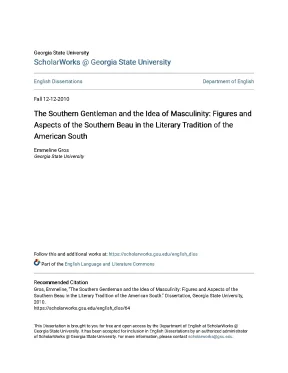
Tải xuống để đọc toàn bộGeorgia State University ScholarWorks @ Georgia State University English Dissertations Department of English Fall 12-12-2010 The Southern Gentleman and the Idea of Masculinity: Figures and Aspects of the Southern Beau in the Literary Tradition of the American South Emmeline Gros Georgia State University Follow this and additional works at: https://scholarworks.edu/english_diss Part of the English Language and Literature Commons Recommended Citation Gros, Emmeline, "The Southern Gentleman and the Idea of Masculinity: Figures and Aspects of the Southern Beau in the Literary Tradition of the American South." Dissertation, Georgia State University, 2010.edu/english_diss/64 This Dissertation is brought to you for free and open access by the Department of English at ScholarWorks @ Georgia State University. It has been accepted for inclusion in English Dissertations by an authorized administrator of ScholarWorks @ Georgia State University. For more information, please contact scholarworks@gsu. THE SOUTHERN GENTLEMAN AND THE IDEA OF MASCULINITY: FIGURES AND ASPECTS OF THE SOUTHERN BEAU IN THE LITERARY TRADITION OF THE AMERICAN SOUTH by EMMELINE GROS Under the Joint Direction of Thomas McHaney and Jacques Pothier ABSTRACT The American planter has mostly been presented as the epitome of the romantic cavalier legend that could be found in the fiction of John Pendleton Kennedy to Thomas Nelson Page: a man of chivalric manners and good breeding; a man of good social position; a man of wealth and leisure (Concise Oxford Dictionary).1 A closer scrutiny of the cavalier and genteel ethos of the time, however, reveals the inherent ideological inconsistencies with the idea of the gentleman itself, as the ideal came to be more and more perceived as an illusion and as challenges to traditional gender stereotypes came to redefine the nature and role of the Southern Gentleman.
This study hopes to complicate the traditional delineation of hegemonic manhood with the aim to better understand how precisely the Old South‘s masculine ideals were constructed and maintained over time, especially in times of crisis, and how southern elite males (re)defined, enacted, and/or maintained a distinctive Southern model of masculinity while others resisted, modified, or flouted those ideals. The work undertaken by this 1 "Planter." Concise Oxford English Dictionary. dissertation can thus be situated within the broad rubric of masculinity studies and its central axiom—the interrogation of the structures of power, domination, and hierarchy. Enriching masculinity studies of the Old South, this critical study of Southern American fiction attempts to respond to the invitation of historians like Stephen Berry or Craig Thompson Friend in striking a commendable balance between conceptualizing larger historical questions and narrating the intimacies and complexities of Southern men‘s individual lives.
Taken collectively, these novels continue to explore this fertile field by moving outside the ―confines and confidences of elites‖ (Peel 1).2 Because it complicates any simple equation between honor, mastery, and manliness, and because it seeks to revisit traditional conceptualisations of gender, I hope that this study will open new ways of thinking about the privileges and wounds of a masculinity that has been considered by most as the normative, invisible, and unquestioned referent from which to measure marginalized others—foreigners, women, or non-whites. INDEX WORDS: American South, Antebellum and Postbellum South, Civil War, Masculinity, Planter, Southern gentleman, Southern belle, Southern manhood, Gender studies, Gender performance, Gender resistance, Hegemonic masculinity, Southern beau, Elite boys. 2 Mark Peel, The Unsteady Quest for Manhood, review, Southern Masculinity, Perspectives on Manhood in the South since Reconstruction, eds. Craig Thompson Friend and Lorri Glover (Athens: University of Georgia Press, 2004) H-South (January 2006): 1-2.
THE SOUTHERN GENTLEMAN AND THE IDEA OF MASCULINITY: FIGURES AND ASPECTS OF THE SOUTHERN BEAU IN THE LITERARY TRADITION OF THE AMERICAN SOUTH by EMMELINE GROS A Dissertation Submitted in Partial Fulfillment of the Requirements for the Degree of Doctor of Philosophy in the College of Arts and Sciences Georgia State University & Université Versailles St Quentin-en-Yvelines 2010 Copyright by Emmeline Gros 2010 THE SOUTHERN GENTLEMAN AND THE IDEA OF MASCULINITY: FIGURES AND ASPECTS OF THE SOUTHERN BEAU IN THE LITERARY TRADITION OF THE AMERICAN SOUTH by EMMELINE GROS Committee Chairs: Thomas McHaney Jacques Pothier Committee: Ineke Bockting Pearl McHaney Electronic Version Approved: Office of Graduate Studies College of Arts and Sciences Georgia State University Université Versailles St Quentin-en-Yvelines December 2010 iv DEDICATION I dedicate this dissertation to my wonderful family from whom I have learned the value of patience, diligence and the pursuit of academic excellence; particularly to my understanding and patient sister, Camille, who has put up with these many years of research, sharing with me every risk and sacrifice required to complete it. I must also thank the gentleman I found along the way, Guilhem, who has given me his fullest support and has been patiently bearing with my hectic schedule. Finally, I dedicate this work to my late grandfather, Lucien Pujade and my late grandmothers, Simone Pujade and Suzanne Gros, both of whom would have loved to see this dissertation accomplished. v ACKNOWLEDGEMENTS My first, and most earnest, acknowledgment must go to my advisors, Dr.
Thomas McHaney and Dr. Nearly eight years ago, a scholarship from Rotary International, the Georgia Rotary Student Program, led me to Dr. With great difficulty, I managed to understand his Southern accent, and I remember saying ―Yes‖ to the question: What about signing up for my class? This class started me on the path I traveled at Georgia State University and later, at the University of St Quentin en Yvelines. Thomas McHaney has been instrumental in ensuring my academic, professional, and moral well being ever since.
In every sense, none of this work would have been possible without him. I am heartily thankful to my French advisor, Dr. Jacques Pothier, whose encouragement, supervision and support from the preliminary to the concluding level enabled me to develop my dissertation in its current shape. From picking me up at the train station to showing me around the University, I would never have been able to finish my dissertation without his guidance.
Many thanks also go to my committee members who have accepted to read and comment on my dissertation, to Dr. Bockting in particular who has accepted to jump in at the last minute. Especially, I want to thank Dr. Pearl McHaney who has been my instructor but also my mentor in so many ways.
From my very first year at Georgia State University, she has also been cooking most of my Thanksgiving dinners and has always greeted the international students in her house as if they were members of her own family. I remember her Eudora Welty Birthday parties with fondness. Studying abroad without her encouragement and her many valuable insights would not have been the same. Far too many people and friends to mention individually have assisted in so many ways during my work at Georgia State University.
They all have my sincere gratitude. In vi particular, I would like to thank Tammy Mills, Patricia Chapman, Dr. Paul Schmidt, Dr. Calvin Thomas, Dr.
Mathew Roudané, Dr. Reiner Smolinski of Georgia State University. I would also like to thank my fellow graduate students at Georgia State University: Steven Sams, Laura Barberan, John Lowther as well as several reviewers from Atlanta among them Patricia Lawson, for their help and comments that improved various chapters of this dissertation. To my friends, my former students (on and off-campus), and my roommate in Atanta; to my friends in France who have been patiently waiting for my return to France; to my aunt Gigi and my friend Dephine Méric who have been hosting me and feeding me whenever I was on my way to Versailles, I would also like to say that I am very grateful for all these precious moments we spent together.
The data, articles, and books necessary for this study were provided by the Georgia State University library, the Laboratoire Suds Amérique at the University of St Quentin en Yvelines, and Emory University. I am extremely grateful for the precious help provided by the library staff without whom this dissertation would not have been possible. This research was, at various times, supported by the English Departments at GSU and at UVSQ (Laboratoire Suds), l‘Ecole Doctorale at UVSQ, the Office of International Studies at Georgia State University and at Agnes Scott College, the French Department of Education and Rotary International for direct financial aid through fellowships, awards, and travel grants. A penultimate thank-you goes to my parents and my sister, Camille, who have been through the few ―eurekas!!!‖ and the many ―what am I saying?‖ stages of this dissertation.
For always being there when I needed them most, and never once complaining about the time spent reading or writing away from them, they deserve far more credit than I can ever give them. My final acknowledgment must go to the Rotary Club of East Cobb and the Rotary Club of Toulon-Le Pradet. Both clubs gave me the chance to enjoy my first schoolyear vii abroad. The support, encouragement, and companionship of many Rotarians from both clubs—among whom, Steve and Linda Jezerinac, their daughter and grandsons, and the McColl family—have turned my journey in the United States and through graduate school into a real pleasure.
For all that, for their support and for unconditionally believing in me, I want to thank them all. viii TABLE OF CONTENTS ACKNOWLEDGEMENTS. v TABLE OF CONTENTS. 28 Fashioning the Southern Gentleman as an Absolute.
The Hegemonic Model of Masculinity in the Old South. The Changes of the New South. A New (Northern) Theology of Manliness. The Veteran and the Rhetoric of Reconciliation.
The ‗Feminine Men‘ of the 1920s, 1930s and 1940s. 68 John Pendleton Kennedy‘s Swallow Barn (1832). Southern Masculinity in Crisis. What is it that Makes a Gentleman?.
122 William Faulkner‘s The Sound and the Fury (1929). William Faulkner and the Performances of Gender. The Feminine Voices. Quentin: When Nihilism Counteracts Hegemony.
Jason and the Hallmarks of Misogyny. Benjy: The Specter of White Southern Masculinity. The ―Crisis from Without‖ and the ―Crisis from Within‖. 179 Ellen Glasgow‘s The Sheltered Life (1932).
The Female Body as Collective Artifact. An Affront to Southern Wholeness. Failing the Men. 235 Margaret Mitchell, Gone with the Wind (1936).
The Gendered Discourse in Gone with the Wind. Morselizing the Masculine Imago. New Performances of Gender. The Return to Romance.
293 Tennessee Williams‘ The Glass Menagerie (1946). The Southern Male Caught in Motion and in Time. The Overwhelming Presence of Women. Jim, the Narcissistic Redeemer.
The Failure of the Epic. Tom‘s Masochistic Desire. 335 Tennessee Williams‘ A Streetcar Named Desire (1947). The Relic of the Old South vs.
The Gaudy Seed Bearer of Foreign Origin. The Myth of Evil Womanhood. What is it that Makes a Man?. Following the Script of Patriarchy.
437 1 INTRODUCTION The image of the Old South in the decades preceding the Civil-War is still indelibly etched in the minds of most Americans. In the distance, in some unblemished countryside, stands a large white mansion with Roman pillars. It is owned by a perfectly-attired Southern gentleman and his beautiful wife in her spotless dress. Elegantly clad slaves answer the door, drive the carriage pulled by immaculately groomed horses, and cook the meals.
The fields of cotton are in bloom and the field hands sing while they work in harmony. The planter receives white visitors regardless of wealth with a grace that is unmatched anywhere in the world. He also knows each slave by Greek or Roman name and greets them by asking about their families. Sunday morning, the whole family would go to church, for solemn worship, and would afterwards have a family gathering in the dining room that would be the envy of English royalty.
The children all say ―Sir‖ or ―Ma‘am.‖ The entire image is one idyllic sanctuary into which the cares of the world rarely intrude; an image of beauty, elegance, and grace. Honor, loyalty, and truth are the moral guidelines that the Old South lives by, guidelines that Yankees are unable to understand.
Nội dung được bảo vệ bản quyền — Tải xuống đầy đủ
Trích dẫn luận án này
Emmeline Gros (2010). The southern gentleman and the idea of masculinity figures a [Luận án tiến sĩ, Georgia State University & Université Versailles St Quentin-en-Yvelines]. LuanAn.net. https://luanan.net/nghien-cuu-van-hoa/the-southern-gentleman-and-the-idea-of-masculinity-figures-and-a
Câu hỏi thường gặp
Luận án "The southern gentleman and the idea of masculinity figures a" nghiên cứu về vấn đề gì?
Khám phá hình mẫu "quý ông miền Nam" và những định nghĩa về nam tính. Phân tích sâu sắc vai trò và ảnh hưởng của hai khái niệm này.
Luận án "The southern gentleman and the idea of masculinity figures a" được bảo vệ tại trường nào?
Luận án này được bảo vệ tại Georgia State University & Université Versailles St Quentin-en-Yvelines. Năm bảo vệ: 2010.
Luận án "The southern gentleman and the idea of masculinity figures a" thuộc chuyên ngành gì?
Luận án "The southern gentleman and the idea of masculinity figures a" thuộc chuyên ngành English Language and Literature. Danh mục: Nghiên Cứu Văn Hóa.
Luận án "The southern gentleman and the idea of masculinity figures a" có bao nhiêu trang?
Luận án "The southern gentleman and the idea of masculinity figures a" có 495 trang. Bạn có thể xem trước một phần tài liệu ngay trên trang web trước khi tải về.
Cách tải luận án "The southern gentleman and the idea of masculinity figures a" về máy như thế nào?
Để tải luận án về máy, bạn nhấn nút "Tải xuống ngay" trên trang này, sau đó hoàn tất thanh toán phí lưu trữ. File sẽ được tải xuống ngay sau khi thanh toán thành công. Hỗ trợ qua Zalo: 0559 297 239.