Scripture and self in origen of alexandrias exegetical practice
Khám phá Kinh thánh & cái tôi trong phương pháp diễn giải của Origen Alexandria. Phân tích sâu sắc mối liên hệ giữa văn bản thánh và trải nghiệm cá nhân.
University of Denver
Biblical Studies, Christianity
Luan An
Luận án tiến sĩ
Năm xuất bản
Số trang
269
Thời gian đọc
41 phút
Lượt xem
0
Lượt tải
0
Phí lưu trữ
50 Point
Tổng quan nhanh
- Chủ đề:
- Origen's Exegesis: Shaping Scripture, Christian Self
- Số trang:
- 269 trang
- Trường:
- University of Denver
- Chuyên ngành:
- Biblical Studies, Christianity
- Tác giả:
- Micah David Saxton
- Năm:
- 2014
Tóm tắt nội dung luận án
I.Origen s Exegesis Shaping Scripture Christian Self
This dissertation explores the intricate relationship between Christian scripture and the Christian self. Origen of Alexandria's exegetical practice forms the central focus. It asserts that both scripture and self are actively constructed through this interpretive process. Origen's work demonstrates a profound connection. Scripture cannot exist without the self, and the self cannot exist without scripture. This mutual dependence creates a "scripture-self complex." Understanding Origen's methodologies reveals fundamental aspects of Early Christian Theology. His approach to Biblical Exegesis offers insights into spiritual formation. It illuminates how ancient interpreters perceived divine truth and human identity. The study utilizes a structural theory to analyze these dynamics. This framework helps explain how interpretive practices shape both textual meaning and personal being. It highlights the active role of the exegete.
1.1. The Intertwined Nature of Scripture and Self
Origen of Alexandria's thought reveals a deeply interwoven connection. Christian scripture and the Christian self are not separate entities. Instead, they emerge together through the act of interpretation. This process is dynamic and constitutive. Scripture informs the self; the self apprehends scripture. This mutual shaping defines a unique theological space. Early Christian Theology grappled with these concepts. Origen offered a groundbreaking understanding. His hermeneutics linked textual understanding with personal transformation. The self finds its identity within scriptural narratives. Scripture finds its meaning through the self's engagement. This interplay is a cornerstone of Origen's Patristics. It profoundly influenced subsequent Christian Anthropology.
1.2. Exegetical Practice as Construction
Exegetical practice acts as a primary constructive force. It does not merely reveal pre-existing truths. Rather, it actively builds meaning for scripture. It simultaneously shapes the human person. This formative process is central to Origen's approach. Biblical Exegesis becomes a site of creation. Interpreters, through their practice, combine "resources" and "schemas." These elements, derived from William Sewell's structural theory, form meaningful wholes. The interpretive act transforms biblical texts into "scripture." It transforms individuals into the "Christian self." This dynamic interaction underscores the power of hermeneutics. Origen's methods demonstrate this constant construction. His work provides a historical example of this interpretive power.
II.Scripture Self Complex in Origen s Early Christian Theology
The concept of the "scripture-self complex" stands at the heart of Origen's understanding. It describes an inseparable bond between the sacred text and the believing individual. This complex is a direct outcome of Origen of Alexandria's exegetical practice. Scripture and self mutually structure one another. One cannot define itself without reference to the other. This dynamic relationship signifies a core principle in Early Christian Theology. The self finds its meaning and purpose by engaging with scripture. Scripture reveals its deepest truths through the self's spiritual formation. This interconnectedness transcends mere intellectual understanding. It involves a profound spiritual transformation. Origen's works, particularly On First Principles, elucidate this intricate bond. The complex shapes Christian Anthropology, defining the nature of the human soul. It emphasizes the active role of interpretation in forming identity.
2.1. Mutual Structuring Scripture and Person
Origen posits a mutual structuring process. Scripture informs the self's identity, values, and spiritual journey. Simultaneously, the self, through its interpretive lens, activates scripture's meaning. This process is not unidirectional. It is a reciprocal interplay, a constant dialogue. The divine word, or Logos, permeates this interaction. The human soul, in its quest for knowledge, engages with the divine text. This engagement shapes the self into a "scripturalized" being. It transforms scripture into an "anthropomorphized" text. Such reciprocal structuring forms the foundation of Origen's unique Patristics. It demonstrates how Biblical Exegesis becomes a transformative experience. This understanding impacts conceptions of spiritual formation.
2.2. Defining the Scripture Self Relationship
The "scripture-self complex" signifies a state of essential interdependence. Scripture is not merely a book; it becomes a living mirror reflecting the self's spiritual state. The self is not just an individual; it becomes an interpretive lens through which scripture's divine essence is perceived. This relationship defines a distinct Christian Anthropology. It places the soul's development at the forefront of exegetical endeavor. Origen of Alexandria argued for this deep connection. His works highlight how personal growth is intrinsically linked to understanding sacred texts. The boundaries between text and reader blur. A unified entity emerges through active engagement. This nuanced definition offers a deeper understanding of Origen's contributions to Early Christian Theology.
III.Biblical Interpretation Origen s Structure of Self Text
Origen's approach to Biblical Exegesis benefits from a structural analysis. The dissertation employs William Sewell's theory of "structure." This framework posits that structures comprise "resources" and "schemas." These components are paired together through human practice. The pairing creates meaningful wholes. For Origen of Alexandria, scripture and the self function as such structures. They are not static entities. They are dynamically shaped by exegetical practices. This methodology offers a robust lens. It examines how textual interpretation molds both the sacred text and the human soul. Understanding this structural interplay is crucial for grasping Origen's Patristics. It clarifies the mechanics of spiritual formation within his theological system. The theory helps unpack the complex hermeneutics at play.
3.1. Applying Structural Theory to Early Christian Theology
Sewell's structural theory offers a novel approach to Early Christian Theology. It moves beyond simply analyzing content. It scrutinizes the underlying mechanisms of meaning-making. Scripture, as a structure, consists of its textual elements (resources) and interpretive frameworks (schemas). The self, similarly, comprises individual capacities (resources) and conceptual models for identity (schemas). Origen's exegetical practice actively pairs these. This dynamic pairing results in structured understandings of divine truth and human nature. The theory provides clarity. It explains how historical agents, like Origen, both influence and are influenced by these structures. This application enriches the study of Patristics. It highlights the active, formative role of interpretation in ancient Christianity.
3.2. Resources and Schemas in Origen s Framework
Within Origen's exegetical practice, resources and schemas combine consistently. "Resources" for scripture include biblical words, narratives, and historical contexts. "Schemas" involve interpretive rules, allegorical keys, and theological doctrines. For the self, "resources" encompass the soul's faculties, experiences, and moral choices. "Schemas" include concepts of salvation, virtue, and divine likeness. The act of Biblical Exegesis links these elements. It forms coherent structures of meaning and identity. Origen of Alexandria masterfully employed this combination. His hermeneutics allowed for a multi-layered understanding of texts. It fostered profound spiritual formation in the reader. This framework illuminates the depth of Origen's theological system. It demonstrates the sophisticated nature of his interpretive methods.
IV.Spiritual Formation Origen s Exegesis Anthropology
Origen of Alexandria's exegetical practice is fundamentally geared towards spiritual formation. It transforms the human person through engagement with the Divine Word (Logos). This process involves two reciprocal actions: "anthropomorphizing of scripture" and "scripturalizing of the self." These actions represent the core of Origen's Christian Anthropology. Scripture is not merely an external text. It is internalized, becoming part of the self's spiritual constitution. The self, in turn, reflects the truths of scripture. This journey cultivates virtue and divine likeness. Origen's hermeneutics guides this transformative path. It moves beyond literal meanings to uncover deeper, spiritual realities. This understanding shapes the soul, leading to profound personal development.
4.1. Anthropomorphizing Scripture for Deeper Meaning
"Anthropomorphizing scripture" describes a key aspect of Origen's Biblical Exegesis. It involves interpreting biblical texts in a way that resonates with human experience and spiritual struggle. Scripture takes on human characteristics, reflecting the self's journey. This is not about reducing God to human terms. It is about understanding the divine message through the lens of human capacity and potential. Allegorical interpretation facilitates this process. It uncovers hidden spiritual senses relevant to the soul's ascent. The text becomes a guide for moral and intellectual development. Origen of Alexandria believed scripture actively addresses the individual. It invites personal engagement. This engagement fosters a deeper spiritual formation.
4.2. Scripturalizing the Self A Path to Transformation
The "scripturalizing of the self" represents the culmination of Origen's exegetical process. The self becomes imbued with scriptural truths, values, and narratives. It internalizes the Divine Word (Logos). This internalization leads to a radical transformation of the soul. The Christian self aligns its will and understanding with divine revelation. This is a path of Christian Anthropology where human nature is perfected. Origen emphasized this spiritual journey. It involves constant study, prayer, and moral discipline. The self reflects scripture's light. It embodies its teachings. This transformative process defines genuine spiritual formation. It exemplifies the power of Origen of Alexandria's unique hermeneutics.
V.Allegorical Interpretation Origen s Hermeneutics Logos
Origen of Alexandria stands as a pivotal figure in the development of allegorical interpretation. This method was central to his Biblical Exegesis. It allowed him to reconcile challenging biblical passages with Christian doctrine. Origen believed scripture possessed multiple layers of meaning. Beyond the literal, a deeper spiritual sense resided. This spiritual sense revealed divine truths, guiding the soul towards perfection. His hermeneutics sought to uncover the Divine Word (Logos) embedded within the text. Allegory was not merely a literary device. It was a theological necessity, a means of spiritual formation. Origen’s use of allegory significantly influenced Patristics and Early Christian Theology.
5.1. Unveiling Spiritual Truths Through Allegory
Origen employed allegorical interpretation to unveil profound spiritual truths. Literal readings sometimes presented moral or theological difficulties. Allegory provided a solution. It allowed for a sophisticated engagement with scripture. The text, seemingly simple, yielded hidden wisdom. This method highlighted the multifaceted nature of the Divine Word (Logos). It revealed Christ's presence throughout the Old and New Testaments. Origen of Alexandria taught that scripture's deeper meaning addressed the inner person, the soul. This approach fostered intellectual and spiritual growth. It was a dynamic process of discovery. Allegory thus served as a vital tool in Origen's comprehensive hermeneutics.
5.2. Origen s Role in Early Christian Hermeneutics
Origen's contributions to Early Christian Hermeneutics are immense. He systematized allegorical interpretation. He provided a framework for understanding scripture's spiritual dimensions. His methods became foundational for subsequent Patristics. Origen demonstrated how Biblical Exegesis could lead to deeper theological insights. He bridged gaps between philosophical thought and Christian revelation. The concept of the Divine Word (Logos) was central to his interpretive scheme. Origen of Alexandria emphasized the need for a spiritual disposition in the reader. This disposition enabled the apprehension of allegorical meanings. His work laid groundwork for centuries of Christian interpretive tradition.
VI.Key Texts Origen s Exegetical Practices Patristics
The dissertation's analysis of Origen of Alexandria's exegetical practice draws upon several foundational texts. These works provide primary evidence for understanding his hermeneutics. They reveal how he constructed both scripture and the self. Key among these are his extensive commentaries and theological treatises. These texts illuminate Origen's complex approach to Biblical Exegesis. They demonstrate his profound influence on Early Christian Theology and Patristics. Examining these sources allows for a detailed exploration of the "scripture-self complex." They provide concrete examples of his allegorical interpretation. The selection offers a comprehensive view of his thought.
6.1. Commentary on John and On First Principles
Origen's Commentary on the Gospel according to John offers profound insights into his hermeneutics. It showcases his detailed Biblical Exegesis, particularly concerning the Divine Word (Logos). This work explores the spiritual meanings within John's Gospel. On First Principles (De Principiis) presents Origen of Alexandria's systematic theological framework. It outlines his cosmology, Christian Anthropology, and understanding of the soul. This text is crucial for grasping the theoretical underpinnings of his exegetical practice. Both works contribute significantly to understanding the "scripture-self complex." They demonstrate the depth of Origen's contribution to Early Christian Theology.
6.2. Homilies on Jeremiah and Commentary on Song of Songs
Origen's Homilies on Jeremiah provides examples of his prophetic interpretation. It reveals his engagement with Old Testament texts. These homilies illustrate his methods of moral and allegorical interpretation. They show how he applied scripture to the practical lives of believers, fostering spiritual formation. The Commentary on the Song of Songs represents Origen of Alexandria's most celebrated allegorical work. It interprets the Song as an allegory of the soul's ascent and its union with Christ, the Divine Word. This commentary is paramount for understanding his nuanced use of allegorical interpretation. These texts, together, offer a holistic view of Origen's exegetical and theological genius. They remain vital sources for Patristics studies.
Tải xuống file đầy đủ để xem toàn bộ nội dung
Tải đầy đủ (269 trang)Trích đoạn nội dung luận án
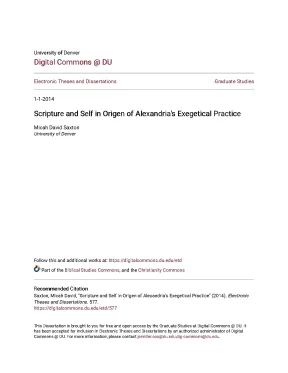
Tải xuống để đọc toàn bộUniversity of Denver Digital Commons @ DU Electronic Theses and Dissertations Graduate Studies 1-1-2014 Scripture and Self in Origen of Alexandria's Exegetical Practice Micah David Saxton University of Denver Follow this and additional works at: https://digitalcommons.edu/etd Part of the Biblical Studies Commons, and the Christianity Commons Recommended Citation Saxton, Micah David, "Scripture and Self in Origen of Alexandria's Exegetical Practice" (2014). Electronic Theses and Dissertations.edu/etd/577 This Dissertation is brought to you for free and open access by the Graduate Studies at Digital Commons @ DU. It has been accepted for inclusion in Electronic Theses and Dissertations by an authorized administrator of Digital Commons @ DU. For more information, please contact jennifer.edu,dig-commons@du.
SCRIPTURE AND SELF IN ORIGEN OF ALEXANDRIA’S EXEGETICAL PRACTICE __________ A Dissertation Presented to the Faculty of the University of Denver and the Iliff School of Theology Joint PhD Program University of Denver __________ In Partial Fulfillment of the Requirements for the Degree Doctor of Philosophy __________ by Micah David Saxton June 2014 Advisor: Gregory Robbins PhD ©Copyright by Micah David Saxton 2014 All Rights Reserved Author: Micah David Saxton Title: SCRIPTURE AND SELF IN ORIGEN OF ALEXANDRIA’S EXEGETICAL PRACTICE Advisor: Gregory Robbins PhD Degree Date: June 2014 ABSTRACT In this dissertation I examine the nature of scripture and the self as presented by Origen of Alexandria. I argue that Christian scripture and the Christian self are constructed by exegetical practice; furthermore, in the case of Origen, I will demonstrate that Christian scripture and the Christian self are so closely related that it is best to speak of a scripture-self complex emerging out of his exegetical practice. I use a theory of structure as developed by William Sewell as a means to discuss both scripture and the self. As “structures,” scripture and the self are composed of “resources” and “schemas” that are paired together into meaningful wholes.
That whole is a structure, which in turn structures other aspects of culture. However, resources and schemas are not automatically paired together. Rather, they are paired together by practices of historical agents who both shape structures and are shaped by them. With this framework in mind, I discuss the ways in which exegetical practices pair resources and schemas together into meaningful wholes.
There are two initial processes, the becoming scripture of biblical texts and the becoming the self of a human person, which I trace in Heracleon, Irenaeus, and Origen. I then argue that in the case of Origen, scripture and self mutually structure one another. I call these processes “the anthropomorphizing of scripture” and “the scripturalizing of the self.” These processes result in what I call a scripture-self complex, by this term I mean that scripture cannot be what scripture is without the self being what the self is and the self cannot be what the ii self is without scripture being what scripture is. Key texts for my study of Origen’s exegetical practices are his Commentary on the Gospel according to John, On First Principles, Homilies on Jeremiah, and finally, Commentary on the Song of Songs.
iii ACKNOWLEDGEMENTS There is a hackneyed proverb that claims, “It takes a village to raise a child.” I have never raised a child, but I have now completed a dissertation and I know that it takes a village to complete a dissertation. I would like to acknowledge that village. First and foremost I am grateful to my dissertation advisor Gregory Robbins who will always know more about this topic than I will. I am also grateful to Pamela Eisenbaum and Sarah Pessin who served on my dissertation committee.
I could not have asked for better committee members, they each pushed me to think through many issues from angles I would not have anticipated. Katherine Turpin has graciously volunteered her time to chair my dissertation defense; I am pleased that my defense was in such capable hands. There are others who were also a part of my dissertation’s village. Notably, my intrepid writing group: Eric Smith and Erica Ferg Muhaisen.
My early chapters benefited greatly from Erica’s input and Eric’s keen eye has saved me from many embarrassing errors; to say nothing of his intellectual contributions. Finally, I would also like to acknowledge Mark George and Michael Hemeneway, both of whom have helped me to be a more careful thinker. I am grateful to this village for helping raise my dissertation. Any errors contained herein are, however, my own and for them I am responsible.
iv TABLE OF CONTENTS CHAPTER ONE: INTRODUCTION. 1 Introduction and Thesis. 1 Questioning Scripture and the Self. 9 Methodological Tools: Structure, Discourse, and Practice.
34 Outline of Chapters. 36 CHAPTER TWO: SCRIPTURE AND SELF BEFORE ORIGEN. 40 The Structure of Scripture in Heracleon. 45 The Structure of the Self in Heracleon.
62 The Structure of Scripture in Irenaeus’s Against Heresies. 64 The Structure of the Self in Irenaeus’s Against Heresies. 89 CHAPTER THREE: STRUCTURING SCRIPTURE IN ORIGEN. 99 Exegetical Practices that Construct Scripture.
102 The Greco-Roman School. 103 The Use of Books. 107 Commentary as a Practice. 114 The Practice of Grammar.
137 CHAPTER FOUR: STRUCTURING THE SELF IN ORIGEN. 140 Origen’s Structure of the Self. 141 Resources of the Self. 142 The Schema of the Self.
152 Liturgical Practices that Construct the Self. 169 Homiletical Practices that Construct the Self. 172 v Addressing the Text to the Hearer. 180 Constructing the Other.
192 CHAPTER FIVE: THE SELF STRUCTURES SCRIPTURE AND SCRIPTURE STRUCTURES THE SELF: ORIGEN’S SCRIPTURE-SELF COMPLEX. 194 Self Structures Scripture: Anthropomorphizing of Scripture. 196 Allegorical Reading: Terms and Historical Background. 198 Allegorical Reading in Origen.
205 Scripture Structures Self: The Scripturalizing of the Self. 250 vi CHAPTER ONE: INTRODUCTION Introduction and Thesis Origen of Alexandria (c. 185-254) was the most influential thinker in the Christian tradition between Paul and Augustine. During his lifetime Origen was called upon to settle significant theological debates, he traveled internationally to combat various heresies, and, for better or worse, Origen’s theological legacy was to have significant influence on all sides of the theological debates of the fourth and fifth centuries.1 It would be difficult to overestimate his theological influence on the early church.
Yet, for all that, Origen is best known as the most prolific exegete in the early Christian tradition. Indeed, most of modern scholarship that focuses its attention on Origen does so in order to say something about his exegetical practice, this dissertation is no exception. It is no surprise that the most commonly quoted lines from Origen’s extant 1 For Origen’s general influence see Joseph W. Trigg, Origen: The Bible and Philosophy in the Third-Century Church (London: SCM, 1985).
For his theological legacy in the major debates of the fourth and fifth centuries see Elizabeth A. Clark, The Origenist Controversy: The Cultural Construction of an Early Christain Debate (Princeton, N.: Princeton University Press, 1992). Origen’s influence was felt soon after his death; even authors hostile to Christianity were aware of his influences. Eusebius records a fragment from Porphyry who says of Origen “But this kind of absurdity [allegorical interpretation of the Bible] must be traced to a man whom I met when I was still quite young, who had a great reputation, and still holds it, because of the writings he has left behind him, I mean Origen whose fame has been widespread among the teachers of this kind of learning.
1 corpus come from On First Principles where he discusses the theoretical background of his exegetical practice: “For just as man consists of body, soul, and spirit, so in the same way does the scripture, which has been prepared by God to be given for man’s salvation.”2 Origen speaks of scripture in terms of a human person. Scripture is conceptualized anthropologically. In a less-cited passage from a homily on Genesis, Origen likens a person’s heart to a library; in other words he conceptualizes a person bibliographically.3 There is a close connection between scripture and the human person, or better, the self in the theoretical background of Origen’s exegetical practice that is directly related to his understanding of salvation.4 However, Christian scripture and the Christian self are not “natural categories.” In this dissertation I will argue that Christian scripture and the Christian self are constructed by exegetical practice; furthermore, in the case of Origen, I will demonstrate that Christian scripture and the Christian self are so closely related that it is 2 ὥσπερ γὰρ ὁ ἄνθρωπος συνέστηκεν ἐκ σώµατος καὶ ψυχῆς καὶ πνεύµατος, τὸν αὐτὸν τρόπον καὶ ἡ οἰκονοµηθεῖσα ὑπὸ θεοῦ εἰς ἀνθρώπων σωτηρίαν δοθῆναι γραφή. Butterworth, Origen: On First Principles (Gloucester, Mass.
The entirety of this dissertation could be construed as a commentary on this passage in so far as I am concerned with what it means to say that a self consists of body soul and spirit and what sort of thing is scripture that it can also consist of the same elements. 3 Si quis est.conuertere se potest a rebus fluxis ac pereuntibus et caducis et audire uerbum Dei ac praecepta caelestia, hic intra cor suum arcam alutis aedificat et bibliothecam, ut ita dicam, intra se diuini consercrat uerbi. Heine, Origen: Homilies on Genesis and Exodus, The Fathers of the Church, vol.: The Catholic University of America Press, 1982), 86. 4 I prefer the term “self” over the term “person” because the former seems to me to be more general and therefore constrains interpretation less.
Furthermore, “self” is widely used in secondary literature, which allows my project to be put in conversation with others. 2 best to speak of a scripture-self complex emerging out of his exegetical practice. Toward this end I will discuss four processes: (1) the becoming scripture of biblical texts, (2) the becoming self of a human person, (3) the anthropomorphizing of scripture, and (4) the scripturalizing of the self. I turn now to question the nature of scripture and self.
Questioning Scripture and the Self The above claim that scripture and self are not natural categories needs clarification: I simply mean that there are no naturally occurring objects that can be identified as scripture or self. This may seem self-evident in the case of scripture but less so in the case of self. I am not denying the reality of biological entities that are called, for example, human beings. But what the human being may be—in addition to or exclusive of a biological entity—is entirely constructed by culture.5 It may seem that what scripture and self finally are is obvious, but if so this is only because both have been constructed in generally homogenous ways in modern western communities.
It is useful to question each of these categories, especially in the context of antiquity. I begin with scripture. Scripture For the sake of clarity I would like to make a distinction between “scripture” and two other terms with which it is closely associated: “text” and “canon.” I use the term “text” to refer to a material written document. Important in this notion of text is that it is material and not conceptual.
Texts are documents that can be produced, used, and 5 Catherine Belsey makes a helpful distinction using the terms “organisms” and “subjects.” “We are born organisms (of course), and we become subjects. How? By internalizing our culture, which is inscribed in the signifying practices that surround us from the moment we come into the world.” Catherine Belsey, Poststructuralism: A Very Short Introduction (New York: Oxford University Press, 2002), 57. 3 destroyed; they are bound up with the materials out of which they are composed.6 “Canon,” as is well known, comes from the Greek term (κανών) that literally refers to a straight rod but has metaphorically come to mean a standard of measure or a standard of excellence.
Nội dung được bảo vệ bản quyền — Tải xuống đầy đủ
Trích dẫn luận án này
Micah David Saxton (2014). Scripture and self in origen of alexandrias exegetical pract [Luận án tiến sĩ, University of Denver]. LuanAn.net. https://luanan.net/nghien-cuu-van-hoa/scripture-and-self-in-origen-of-alexandrias-exegetical-practice
Câu hỏi thường gặp
Luận án "Scripture and self in origen of alexandrias exegetical pract" nghiên cứu về vấn đề gì?
Khám phá Kinh thánh & cái tôi trong phương pháp diễn giải của Origen Alexandria. Phân tích sâu sắc mối liên hệ giữa văn bản thánh và trải nghiệm cá nhân.
Luận án "Scripture and self in origen of alexandrias exegetical pract" được bảo vệ tại trường nào?
Luận án này được bảo vệ tại University of Denver. Năm bảo vệ: 2014.
Luận án "Scripture and self in origen of alexandrias exegetical pract" thuộc chuyên ngành gì?
Luận án "Scripture and self in origen of alexandrias exegetical pract" thuộc chuyên ngành Biblical Studies, Christianity. Danh mục: Nghiên Cứu Văn Hóa.
Luận án "Scripture and self in origen of alexandrias exegetical pract" có bao nhiêu trang?
Luận án "Scripture and self in origen of alexandrias exegetical pract" có 269 trang. Bạn có thể xem trước một phần tài liệu ngay trên trang web trước khi tải về.
Cách tải luận án "Scripture and self in origen of alexandrias exegetical pract" về máy như thế nào?
Để tải luận án về máy, bạn nhấn nút "Tải xuống ngay" trên trang này, sau đó hoàn tất thanh toán phí lưu trữ. File sẽ được tải xuống ngay sau khi thanh toán thành công. Hỗ trợ qua Zalo: 0559 297 239.