Luận án: Sắc tộc, Tôn giáo, Chủng tộc của người Đức Luther ở Ontario và Missouri (1939-1970)
Khám phá vai trò của chủng tộc, tôn giáo và sắc tộc tại Ontario & Missouri (1939-1970). Phân tích lịch sử, xã hội và tác động.
The University of Western Ontario
Luan An
Luận án tiến sĩ
Năm xuất bản
Số trang
431
Thời gian đọc
1 giờ 5 phút
Lượt xem
0
Lượt tải
0
Phí lưu trữ
60 Point
Tổng quan nhanh
- Chủ đề:
- 1. Sắc tộc Luther & Bản sắc Lai ghép: Đức Luther 1939-1970
- Số trang:
- 431 trang
- Trường:
- The University of Western Ontario
- Chuyên ngành:
- History
- Tác giả:
- Elliot Worsfold
- Năm:
- 2018
Tóm tắt nội dung luận án
I. Sắc tộc Luther Bản sắc Lai ghép Đức Luther 1939 1970
Tài liệu này khám phá sâu sắc cách người Đức Luther ở St. Louis, Missouri, và Hạt Waterloo, Ontario, đã xây dựng bản sắc sắc tộc của họ. Thời kỳ từ năm 1939 đến 1970 là một giai đoạn đầy thách thức. Người Đức Luther phải đối mặt với câu hỏi liệu bản sắc sắc tộc là thứ cần vượt qua hay đáng bảo tồn. Nghiên cứu lập luận rằng họ đã phát triển một bản sắc lai ghép, cân bằng các yếu tố sắc tộc, tôn giáo, chủng tộc và quốc gia. Bản sắc này không bị loại bỏ trong thế kỷ XX mà tiếp tục được thực hành mạnh mẽ trong các không gian của nhà thờ. Các yếu tố chính định hình bản sắc bao gồm cuộc đấu tranh chống phân biệt đối xử trong Thế chiến II, nỗ lực vận động chính sách nhập cư, và sự kiên cường trước áp lực đồng hóa. Giáo hội Luther Missouri Synod và Giáo hội Luther Canada đóng vai trò trung tâm trong việc định hình và duy trì bản sắc này, đồng thời tạo ra một Lịch sử Giáo hội Luther độc đáo.
1.1. Kiến tạo bản sắc Đức Luther
Nghiên cứu khám phá cách người Đức Luther định hình bản sắc sắc tộc. Tập trung vào St. Louis, Missouri và Hạt Waterloo, Ontario từ năm 1939 đến 1970. Câu hỏi chính: bản sắc sắc tộc là thứ cần vượt qua hay đáng bảo tồn? Tài liệu phân tích sâu sắc các yếu tố tôn giáo, chủng tộc và sắc tộc. Người Đức Luther phải đối mặt với áp lực duy trì hoặc thay đổi bản sắc trong bối cảnh biến động toàn cầu.
1.2. Cân bằng bản sắc đa diện
Người Đức Luther đã xây dựng một bản sắc lai ghép. Bản sắc này cân bằng giữa các yếu tố sắc tộc, tôn giáo, chủng tộc và quốc gia cạnh tranh. Họ không từ bỏ bản sắc sắc tộc trong thế kỷ XX. Thay vào đó, họ tiếp tục thực hành bản sắc Đức trong phạm vi nhà thờ của mình. Đây là một điểm khác biệt so với các giả định phổ biến. Giáo hội Luther Missouri Synod và Giáo hội Luther Canada đóng vai trò quan trọng.
1.3. Bảo tồn truyền thống sắc tộc
Việc nói tiếng Đức được biện minh là một sự cần thiết về thần học. Các liên minh được hình thành với những người tị nạn Đức mới. Mục tiêu là duy trì truyền thống sắc tộc. Người Đức Luther cũng chống lại chủ nghĩa dân tộc Anglo-Canada và Mỹ mang tính loại trừ. Họ ủng hộ sự hiểu biết đa nguyên về quá khứ của mình. Các sự kiện văn hóa và kỷ niệm củng cố điều này. Lịch sử Giáo hội Luther cho thấy sự kiên cường đáng kể.
II. Chủng tộc Luther Đặc quyền Da trắng Tác động xã hội
Yếu tố "đặc quyền da trắng" đóng vai trò trung tâm trong việc hiểu bản sắc của người Đức Luther. Bất chấp sự kỳ thị khi công khai là người Đức trong và sau Thế chiến II, họ đã sử dụng đặc quyền da trắng để giảm thiểu những stigma này. Việc hình thành liên minh với các quan chức chính phủ da trắng đã giúp họ duy trì vị thế. Một khía cạnh gây tranh cãi là cách họ duy trì bản sắc "Đức" bằng cách giữ các nhà thờ của mình "trắng." Điều này bao gồm việc loại trừ những người nhập cư khác và người Bắc Mỹ bị phân biệt chủng tộc thông qua việc ủng hộ sự phân biệt Jim Crow. Nghiên cứu này thách thức quan điểm cho rằng quyền da trắng và sắc tộc thay thế nhau, thay vào đó, chúng thường củng cố lẫn nhau trong thế kỷ XX đối với cộng đồng Sắc tộc Luther.
2.1. Quyền Da trắng định hình bản sắc
Lý thuyết chủng tộc phê phán và nghiên cứu về quyền da trắng được sử dụng. Quyền da trắng là yếu tố thiết yếu. Nó giúp hiểu cách người Đức Luther xây dựng bản sắc sắc tộc. Việc công khai nhận dạng là người Đức gây tranh cãi. Điều này diễn ra trong và sau Chiến tranh thế giới thứ hai. Tuy nhiên, đặc quyền da trắng đã giúp giảm thiểu sự kỳ thị. Người Đức Luther có thể hình thành liên minh chính trị. Các quan chức chính phủ da trắng đã hỗ trợ họ.
2.2. Chiến lược giảm thiểu kỳ thị
Người Đức Luther sử dụng đặc quyền da trắng. Đặc quyền này giúp họ vượt qua những định kiến tiêu cực. Việc liên kết với quan chức da trắng tạo ra lợi thế. Điều này cho phép họ duy trì vị thế xã hội. Đồng thời, họ bảo vệ bản sắc sắc tộc của mình. Bối cảnh lịch sử cho thấy sự linh hoạt trong thích nghi. Bản sắc chủng tộc trắng giúp họ điều hướng xã hội.
2.3. Loại trừ chủng tộc trong hội thánh
Người Đức Luther duy trì bản sắc sắc tộc. Họ loại trừ những người nhập cư khác. Họ cũng loại trừ người Bắc Mỹ bị phân biệt chủng tộc. Việc này ngăn cản họ tham dự các hội thánh. Họ ủng hộ sự phân biệt Jim Crow. Việc giữ nhà thờ "trắng" đồng nghĩa với việc giữ nhà thờ "Đức". Nghiên cứu này nhấn mạnh: quyền da trắng và sắc tộc củng cố lẫn nhau. Chúng không thay thế nhau trong thế kỷ XX.
III. Tôn giáo Luther Ngôn ngữ Lòng trung thành thời chiến
Trong giai đoạn Chiến tranh thế giới thứ hai, cộng đồng Tôn giáo Luther phải đối mặt với áp lực lớn. Việc duy trì ngôn ngữ Đức trở thành một hành động biểu tượng và thần học. Người Đức Luther ở cả Ontario và Missouri đã bảo vệ việc sử dụng tiếng Đức, coi đó là một sự cần thiết về mặt thần học và là yếu tố cốt lõi của bản sắc của họ. Các nhà thờ Luther trở thành những không gian quan trọng để duy trì văn hóa và truyền thống. Mặc dù phải đối mặt với sự nghi ngờ về lòng trung thành, họ đã tìm cách khẳng định lòng yêu nước của mình trong khi vẫn giữ vững di sản Đức. Sự đối phó với chủ nghĩa dân tộc Anglo-Canada và Mỹ đã định hình cách họ thể hiện bản sắc sắc tộc của mình, tạo nên một chương đặc biệt trong Lịch sử Giáo hội Luther.
3.1. Ngôn ngữ Đức như điều cần thiết thần học
Trong Chiến tranh thế giới thứ hai, tiếng Đức đối mặt với áp lực. Người Đức Luther bảo vệ việc sử dụng ngôn ngữ này. Họ lập luận tiếng Đức là cần thiết về mặt thần học. Đây là một phần quan trọng của bản sắc tôn giáo và sắc tộc. Các nhà thờ Luther trở thành không gian bảo tồn văn hóa. Việc duy trì tiếng Đức là hành động kháng cự văn hóa. Nó cũng thể hiện lòng trung thành với di sản.
3.2. Chống lại định kiến trong chiến tranh
Người Đức ở Bắc Mỹ phải đối mặt với sự phân biệt đối xử. Họ bị nghi ngờ về lòng trung thành trong chiến tranh. Cộng đồng Đức Luther đã đấu tranh chống lại định kiến này. Họ khẳng định lòng yêu nước của mình. Tuy nhiên, họ vẫn giữ vững bản sắc Đức. Cuộc đấu tranh này diễn ra ở cả St. Louis, Missouri và Hạt Waterloo, Ontario. Nó định hình Lịch sử Giáo hội Luther.
3.3. Các phản ứng với chủ nghĩa dân tộc
Người Đức Luther ở cả hai khu vực phải điều hướng chủ nghĩa dân tộc. Chủ nghĩa dân tộc Anglo-Canada và Mỹ gây áp lực đồng hóa. Họ đã phản đối việc áp đặt không gian yêu nước. Thay vào đó, họ thúc đẩy một hình thức yêu nước kết hợp di sản Đức. Các mối quan hệ giữa St. Louis và Waterloo County cũng được khám phá. Chúng cho thấy một phản ứng xuyên quốc gia đối với áp lực. Điều này củng cố bản sắc Người Đức Luther.
IV. Người Đức Luther Nhập cư Chống lại Đồng hóa
Sau Chiến tranh thế giới thứ hai, người Đức Luther đã thể hiện cam kết mạnh mẽ trong việc duy trì và củng cố bản sắc của mình thông qua các nỗ lực nhập cư. Họ vận động chính phủ để thay đổi chính sách, tạo điều kiện thuận lợi cho Người nhập cư Đức đến Bắc Mỹ. Những nỗ lực này không chỉ nhằm tái thiết cộng đồng mà còn để duy trì các truyền thống sắc tộc. Việc hình thành liên minh với người tị nạn và người di cư Đức mới là một chiến lược quan trọng, mang lại sức sống mới cho bản sắc Đức. Trong thời kỳ hậu chiến, áp lực đồng hóa rất lớn, nhưng cộng đồng này đã kiên cường chống lại. Họ tổ chức các sự kiện văn hóa và kỷ niệm, ủng hộ một quan điểm đa nguyên về quá khứ và tương lai. Cả Giáo hội Luther Missouri Synod và Giáo hội Luther Canada đều đóng vai trò chủ chốt trong việc bảo vệ Sắc tộc Luther khỏi sự xói mòn.
4.1. Nỗ lực vận động chính sách nhập cư
Sau Chiến tranh thế giới thứ hai, người Đức Luther hoạt động tích cực. Họ vận động để thay đổi chính sách nhập cư. Mục tiêu là đưa người nhập cư Đức đến Bắc Mỹ. Các tổ chức như Giáo hội Luther Missouri Synod đóng vai trò then chốt. Nỗ lực này thể hiện cam kết mạnh mẽ với cộng đồng sắc tộc của họ. Nó cũng giúp tái thiết các cộng đồng sau chiến tranh. Việc này ảnh hưởng lớn đến Người nhập cư Đức.
4.2. Liên minh với người tị nạn Đức
Người Đức Luther hình thành liên minh với người tị nạn và người di cư Đức. Những liên minh này rất quan trọng. Chúng giúp tiếp tục các truyền thống sắc tộc. Người nhập cư mới mang theo văn hóa và ngôn ngữ. Cộng đồng Luther chào đón họ. Điều này củng cố di sản Đức. Nó cũng cung cấp sự hỗ trợ cần thiết cho những người đến.
4.3. Giữ gìn bản sắc trong bối cảnh hậu chiến
Áp lực đồng hóa rất lớn trong thời kỳ hậu chiến. Người Đức Luther đã chống lại những áp lực này. Họ duy trì bản sắc riêng của mình. Các hoạt động văn hóa và kỷ niệm được tổ chức. Chúng giúp củng cố bản sắc Đức. Điều này cũng thúc đẩy sự hiểu biết đa nguyên về lịch sử. Giáo hội Luther Canada cũng tham gia vào những nỗ lực này. Bản sắc Sắc tộc Luther được bảo vệ cẩn thận.
V. Lịch sử Giáo hội Luther Ontario Missouri 1939 1970
Nghiên cứu này cung cấp một cái nhìn toàn diện về Lịch sử Giáo hội Luther tại hai khu vực địa lý quan trọng: St. Louis, Missouri (Hoa Kỳ) và Hạt Waterloo, Ontario (Canada). Giai đoạn từ năm 1939 đến 1970 là một thời kỳ đầy biến động, đòi hỏi người Đức Luther phải điều chỉnh và bảo vệ bản sắc của họ. Tài liệu so sánh kinh nghiệm của các cộng đồng này, làm nổi bật cả sự tương đồng trong thách thức và sự khác biệt trong phản ứng do bối cảnh quốc gia khác nhau. Giáo hội Luther Missouri Synod ở Mỹ và Giáo hội Luther Canada ở Canada đều đóng vai trò không thể thiếu trong việc hỗ trợ và định hình các cộng đồng Người Đức Luther. Sự phân tích này làm rõ cách các yếu tố xã hội, chính trị và chủng tộc đã ảnh hưởng đến việc duy trì một bản sắc sắc tộc trong một môi trường thay đổi nhanh chóng.
5.1. Bối cảnh lịch sử của người Đức Luther
Nghiên cứu đặt trải nghiệm của người Đức Luther vào bối cảnh rộng hơn. Nó xem xét lịch sử từ năm 1939 đến 1970. Đây là giai đoạn đầy biến động. Nó bao gồm Chiến tranh thế giới thứ hai và thời kỳ hậu chiến. Bối cảnh này bao gồm các cuộc tranh luận về đồng hóa và bản sắc lai ghép. Hiểu biết về lịch sử giúp nhìn rõ cách bản sắc được định hình. Cộng đồng Luther đóng vai trò trung tâm trong bối cảnh này.
5.2. Cộng đồng Luther ở St. Louis
St. Louis, Missouri, là một trung tâm quan trọng. Cộng đồng người Đức Luther ở đây rất đông đúc. Họ đối mặt với những thách thức riêng. Các yếu tố như chủng tộc và chính trị địa phương ảnh hưởng đến họ. Giáo hội Luther Missouri Synod có ảnh hưởng lớn. Nghiên cứu phân tích các kinh nghiệm đặc thù ở khu vực này. Nó cho thấy cách họ cân bằng giữa bản sắc Đức và Mỹ.
5.3. Trải nghiệm ở Waterloo County
Hạt Waterloo, Ontario, đại diện cho bối cảnh Canada. Người Đức Luther ở đây cũng có những thách thức tương tự. Tuy nhiên, họ cũng có những điểm khác biệt. Chính sách của Canada và bối cảnh xã hội ảnh hưởng đến họ. Giáo hội Luther Canada giữ vai trò quan trọng. Nghiên cứu so sánh trải nghiệm ở hai khu vực. Nó làm nổi bật các điểm tương đồng và khác biệt trong việc định hình bản sắc.
Tải xuống file đầy đủ để xem toàn bộ nội dung
Tải đầy đủ (431 trang)Trích đoạn nội dung luận án
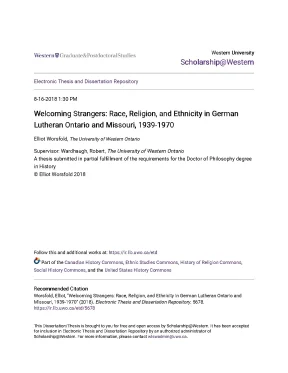
Tải xuống để đọc toàn bộWestern University Scholarship@Western Electronic Thesis and Dissertation Repository 8-16-2018 1:30 PM Welcoming Strangers: Race, Religion, and Ethnicity in German Lutheran Ontario and Missouri, 1939-1970 Elliot Worsfold, The University of Western Ontario Supervisor: Wardhaugh, Robert, The University of Western Ontario A thesis submitted in partial fulfillment of the requirements for the Doctor of Philosophy degree in History © Elliot Worsfold 2018 Follow this and additional works at: https://ir.ca/etd Part of the Canadian History Commons, Ethnic Studies Commons, History of Religion Commons, Social History Commons, and the United States History Commons Recommended Citation Worsfold, Elliot, "Welcoming Strangers: Race, Religion, and Ethnicity in German Lutheran Ontario and Missouri, 1939-1970" (2018). Electronic Thesis and Dissertation Repository.ca/etd/5678 This Dissertation/Thesis is brought to you for free and open access by Scholarship@Western. It has been accepted for inclusion in Electronic Thesis and Dissertation Repository by an authorized administrator of Scholarship@Western. For more information, please contact wlswadmin@uwo.
i Abstract: This dissertation examines how German-American and German-Canadian Lutherans in St. Louis, Missouri, and Waterloo County, Ontario, constructed their ethnic identities from the outbreak of the Second World War in 1939 to 1970. Did German Lutherans understand their ethnicity as an identity to overcome, or as an identity worth preserving? What role did religion and race play in how they constructed their ethnic identities? It argues that German Lutherans in the Missouri and Canada Synods constructed a hybrid identity that sought to balance their competing ethnic, religious, racial, and national identities. It charts their experiences negotiating discrimination during the Second World War, their efforts to bring German immigrants to North America through lobbying for immigration policy changes, and their struggles to resist pressures to assimilate throughout the postwar period.
Contrary to popular assumptions, German Lutherans did not abandon their ethnic identities during the twentieth century, but rather continued to practice a German ethnic identity within the ethnic boundary zones of their churches. They continued to justify speaking German as a theological necessity, formed alliances with new German refugees and displaced persons to continue their ethnic traditions, and resisted exclusionary mainstream Anglo-Canadian and American nationalisms by advocating for a pluralistic understanding of their past through cultural and commemorative events. By drawing on developments in critical race theory and whiteness studies, this dissertation argues that “whiteness” or a white racial identity is essential for understanding how German Lutherans constructed an ethnic identity. While it was controversial during and after the Second World War to openly identify as German, German Lutherans successfully mitigated these stigmas through their white privilege and ability to form political alliances with white government officials.
Moreover, German Lutherans maintained an ethnic identity because they excluded other immigrants and racialized North Americans from attending their congregations by supporting Jim Crow segregation. By keeping their churches white, they were also able to keep their churches “German.” This study urges immigration historians to look more closely at how whiteness and ethnicity in the twentieth century reinforce, rather than replace, one another. Keywords: German Canadians, German Americans, St. Louis, Waterloo County, Whiteness, Race, Lutheran Church Missouri Synod, Canada Synod, North American Lutheranism, Transnationalism, Second World War, Cold War Immigration, Displaced Persons ii Table of Contents Acknowledgements………………………………………………………………………iv List of Abbreviations………………………………………………………………….
vi A Note on Terminology…………………………………………………………………vii Introduction: Race, Religion, and Ethnicity in St. Louis and Waterloo County, 1939- 1970………………………………………………………………………………1 Debating Assimilation, Hybridity, and the German Ethnic Identity…….3 Transnational Histories of St. Louis and Waterloo County………….18 Lutheranism as a “Lived Religion”…………………………………….25 The Importance of Whiteness……………………………….…30 Organization and Format……………………………………….41 Chapter 1: The Language of Loyalty: Lutheran Churches as Ethnic and Patriotic Spaces during the Second World War………………………………….46 Anti-War Sentiment and the Response to Another Conflict…………….48 Fighting for the German Language…………………………………….56 Protesting Patriotic Space……………………………………………….65 Relations Between St. Louis and Waterloo County…………………….84 Chapter 2: Between Church and State: Race and Religion during the Second World War …………………………………………………………………………….87 The Protestant Appeal………………………………………………….91 The People Come First Controversy…………………………….………97 Whiteness and Race Relations in St.104 Whiteness and the Pioneer Myth in Waterloo County………………….125 Chapter 3: “I Was A Stranger”: Confronting Europe’s Refugee Crisis Through Transnational Ties…………………………………………………….129 Ethnic and Religious Motivations for Assisting Germany………………133 Creating an Infrastructure for Relief Work…………………………….141 Transnational Ties and Early Immigration Schemes, 1946-1950……….148 Race, Religion, and Confronting the Volksdeutsche Problem………….160 Gender Relations and Immigration Work……………………………….168 Old and New Directions in Immigration, 1951-1960……………………180 Conclusion……………………………………………………………….191 Chapter 4: Returning to the Land of Luther: The Campaign to Rebuild West Germany, 1945-1960………………………………………………………….194 Creating a Policy for Providing Relief to West Germany……………….197 Missionary Work as an Ethnic Experience………………………….…205 Ethnicity, Nationality, and Denazification at the Bad Boll Conferences.209 iii Gendering Missionary Work…………………………………………….218 A New Strategy……………………………………………………………229 Conclusion……………………………………………………………….235 Chapter 5: German Space as White Space: Race and Ethnicity during the “Ethnic Reverie” of the 1950s and 1960s………………………………………….238 The Lutheran Church as an Ethnic Boundary Zone………………….243 Gatekeeping in German Lutheran Communities………………….………248 Upholding White Privilege and Supremacy……………………….262 White Flight and Segregation in the Missouri Synod…………….272 German Ethnicity in the Core and on the Peripheries……………….304 Chapter 6: A Church of Many Nations: The Arrival of Lutheran Displaced Persons, 1948-1965………………………………………………………………………….307 The “New Canadian” and “DP” Problem………………………………….309 The Arrival of DP Pastors, 1947-1950……………………………….314 The Skrodelis Controversy………………………………………….325 Jacobi’s Finnish Experiment…………………………………………….336 Conclusion…………………………………………………………………351 Chapter 7: Pioneers and Prophets: German Lutheran Participation in Cultural and Commemorative Events in the Postwar Era……….……353 Addressing Ethnic Divisions and Anti-War Sentiment………………….355 Theology and Rewriting the Past………………………………………….364 The Limits of the White Imagination………………………………….374 Expo 67 and Engagement with Mainstream Nationalisms………….389 Conclusion: Welcoming Strangers……………………………….422 iv Acknowledgements Although my name is listed as the only author of this dissertation, countless individuals made significant contributions to this project.
I am particularly indebted to Geoffrey Hayes for his mentorship, friendship, and supervision during my early years as a graduate student. Many of the questions he posed and suggestions he made significantly informed the early chapters of this dissertation. Jocelyn Hunt, Geoff Keelan, and Vanessa Pritchard also played integral roles in helping me navigate my early academic life. They have my sincere thanks as this process comes to an end.
Sherrill Calder from Tavistock, Ontario, has my overwhelming appreciation for her support over the years. Her passion and belief in my work remained undaunted and I am truly grateful for her support. I could not have asked for a better mentor, supervisor, and friend than Robert Wardhaugh. Rob’s ability to balance humour with critical feedback made him an excellent supervisor that I count myself incredibly lucky to have worked alongside.
Rob was always willing to sit down and talk about this dissertation and, more importantly, how it could always evolve and improve. Rob’s mentorship extended beyond writing and researching this project. He also taught me how to be an effective lecturer, a compassionate teacher, and provided an exemplary model of friendship. I can’t thank him enough.
Laurel Shire also went above and beyond her role as a second reader and committee member. Laurel’s feedback enhanced the clarity of this dissertation and helped broaden its appeal significantly. Laurel also offered support at every stage in the writing and research process, as well as demonstrating her commitment to improving graduate student mental health and wellbeing. I am rare to have found two mentors that I also count as two friends.
Numerous colleagues in the Department of History made writing and researching this dissertation an enjoyable experience. Tim Compeau willingly gave valuable professional and personal advice, and I was fortunate to be in Western’s graduate program at the same time as Rachael Bell, Hayley Caldwell, Carla Joubert, and Daniel Murchison. Kieran Boyko, Michael Chee, and Scott Johns deserve particular praise for causing many memorable Friday nights and foggy Saturday mornings. My fellow graduate student Nolan Brown also deserves special recognition for providing feedback on numerous dissertation chapters as a member of my writing group.
Nolan’s feedback was always much appreciated, as were our post-meeting chats at the Grad Club. I also owe a great deal to several mentors, including Keith Fleming, Alan MacEachern, Francine Mckenzie, Royden Loewen, and Robert Ventresca for their constant support, advice, and friendship. I have also benefitted from the expertise and generosity of numerous archivists. Andre Furlong, Julia Hendry, and Cindy Preece of Laurier Archives are already aware of my eternal gratitude for their tireless cooperation and hospitality over the years.
This dissertation would have been a very different project without their help. Cindy’s constant support and advice turned vague references into full-fledged chapters that resulted in a stronger and more innovative dissertation. Words cannot describe how fortunate I was to share the joys, laughter, and frustrations of archival research with Julia, Cindy, and v Andre. This was truly a collaborative project with the Laurier Archives team.
Mark Bliese, Laura Marrs, and their summer students at the Concordia Historical Institute also proved immensely helpful navigating records relating to the Lutheran Church-Missouri Synod. Their patience was greatly appreciated, as was their ability to make this Canadian feel at home in St. I am fortunate that several groups helped fund this dissertation. Several Ontario Graduate Scholarships and a Joseph-Armand Bombardier CGS Doctoral Scholarship from the Social Sciences and Humanities Research Council quite frankly changed my life.
Not only did these awards help fund numerous research trips, they provided a level financial stability previously unknown to me. Thank you to Western’s Department of History and its donors for sponsoring the Eleta Britton Graduate Scholarship in History and Hilborn Doctoral Completion Award. I was also lucky to receive an Edna Staebler Research Fellowship from the Schneider Haus and the Joan Mitchell Travel Award from Laurier Archives. These funding opportunities ensured I could complete researching and writing this dissertation, and they have my thanks.
Robyn Schwarz, above all others, has more of my appreciation and gratitude than I can express on this page. Nobody has read as many drafts of this dissertation as her, and nobody has spent so many waking hours discussing it. She provided feedback with the kind of precision and care that one typically applies to their own project, and greatly enhanced its coherency and structure as a result. Robyn became this work’s greatest champion, which meant the world to me on days when I couldn’t muster the same enthusiasm.
It is impossible for me to read this work without each page provoking memories of office meetings, drinking coffee downtown, and evening chats. Robyn provided a rescuing spark that saw this project through its final stages. Thank you, Robyn. vi List of Abbreviations BAM: Board of American Missions CCCRR: Canadian Christian Council for the Resettlement of Refugees CLC: Canadian Lutheran Council CLWR: Canadian Lutheran World Relief CWS: Commission for War Services EPC: Emergency Planning Council HMC: Home Missions Committee HMB: Home Missions Board IISTL: International Institute of Metropolitan St.
Louis IRO: International Refugee Organization KWCF: Kitchener-Waterloo Council for Friendship LWA: Lutheran World Action LWF: Lutheran World Federation LWML: Lutheran Women’s Missionary League NLC: National Lutheran Council OWI: Office of War Information ULCA: United Lutheran Church in America vii A Note on Terminology Scholarly terms used to define ethnicity and race are often problematic due to the imprecise and subjective nature of both identities. Many racial and ethnic labels fail to capture the fluidity of each of these identities. This study discusses German-speaking Lutherans in Canada, the United States, and Germany. Generally, I use the term “German Lutherans” as an all-encompassing and less cumbersome term to refer to the German- American and German-Canadian Lutherans that lived in St.
Louis and Waterloo County. When referring to only one of these communities, I specify their nationality with the hyphenated term. “German Lutherans” does not refer to people living in Europe unless otherwise specified in the text. Critical race theorists employ a wide swath of terms to refer to the different “races” they study.
In his critical examination of white culture, Richard Dyer describes how many of these terms, such as “nonwhite” or “people of colour,” are problematic because they reinforce troubling power relations wherein “white” is normalized and those outside of this category are othered.i As a result, I use the term “racialized” Canadians and Americans to refer to nonwhite people, out of recognition that white people are not yet racialized in North American society.
Nội dung được bảo vệ bản quyền — Tải xuống đầy đủ
Trích dẫn luận án này
Elliot Worsfold (2018). Sắc tộc, Tôn giáo, Chủng tộc: Đức Luther Ontario & Missouri 1939-1970 [Luận án tiến sĩ, The University of Western Ontario]. LuanAn.net. https://luanan.net/nghien-cuu-van-hoa/sac-toc-ton-giao-chung-toc-duc-luther-ontario-missouri-1939-1970
Câu hỏi thường gặp
Luận án "Sắc tộc, Tôn giáo, Chủng tộc: Đức Luther Ontario & Missouri 1939-1970" nghiên cứu về vấn đề gì?
Khám phá vai trò của chủng tộc, tôn giáo và sắc tộc tại Ontario & Missouri (1939-1970). Phân tích lịch sử, xã hội và tác động.
Luận án "Sắc tộc, Tôn giáo, Chủng tộc: Đức Luther Ontario & Missouri 1939-1970" được bảo vệ tại trường nào?
Luận án này được bảo vệ tại The University of Western Ontario. Năm bảo vệ: 2018.
Luận án "Sắc tộc, Tôn giáo, Chủng tộc: Đức Luther Ontario & Missouri 1939-1970" thuộc chuyên ngành gì?
Luận án "Sắc tộc, Tôn giáo, Chủng tộc: Đức Luther Ontario & Missouri 1939-1970" thuộc chuyên ngành History. Danh mục: Nghiên Cứu Văn Hóa.
Luận án "Sắc tộc, Tôn giáo, Chủng tộc: Đức Luther Ontario & Missouri 1939-1970" có bao nhiêu trang?
Luận án "Sắc tộc, Tôn giáo, Chủng tộc: Đức Luther Ontario & Missouri 1939-1970" có 431 trang. Bạn có thể xem trước một phần tài liệu ngay trên trang web trước khi tải về.
Cách tải luận án "Sắc tộc, Tôn giáo, Chủng tộc: Đức Luther Ontario & Missouri 1939-1970" về máy như thế nào?
Để tải luận án về máy, bạn nhấn nút "Tải xuống ngay" trên trang này, sau đó hoàn tất thanh toán phí lưu trữ. File sẽ được tải xuống ngay sau khi thanh toán thành công. Hỗ trợ qua Zalo: 0559 297 239.