Kasserian injera and how are the children the lived experiences
Nghiên cứu thực tiễn về Kasserian injera và trải nghiệm của trẻ em trong cộng đồng Ethiopia.
Arkansas Tech University
School Leadership
Luan An
Luận án tiến sĩ
Năm xuất bản
Số trang
126
Thời gian đọc
19 phút
Lượt xem
0
Lượt tải
0
Phí lưu trữ
40 Point
Tổng quan nhanh
- Chủ đề:
- 1. Kasserian Injera
- Số trang:
- 126 trang
- Trường:
- Arkansas Tech University
- Chuyên ngành:
- School Leadership
- Tác giả:
- Sherman Whitfield
- Năm:
- 2019
Tóm tắt nội dung luận án
I. Kasserian Injera
Kasserian Injera là một cụm từ được sử dụng trong bộ phim Black Panther, liên quan đến văn hóa và truyền thống của người châu Phi. Cụm từ này cũng được sử dụng trong một số nghiên cứu về giáo dục và xã hội.
1.1. Wakanda Greeting
Wakanda greeting là một phần quan trọng của văn hóa Wakanda, thể hiện sự tôn trọng và đoàn kết trong cộng đồng.
1.2. Black Panther Quotes
Black Panther quotes là những câu nói nổi tiếng từ bộ phim Black Panther, thường liên quan đến chủ đề về sự tự cường, đoàn kết và bảo vệ cộng đồng.
II. Afrofuturism
Afrofuturism là một phong trào nghệ thuật và văn hóa, kết hợp giữa công nghệ và truyền thống châu Phi. Phong trào này nhằm mục đích tạo ra một tương lai tốt đẹp hơn cho người châu Phi và cộng đồng toàn cầu.
2.1. Cultural Significance
Cultural significance là tầm quan trọng của văn hóa trong việc định hình bản sắc và giá trị của một cộng đồng.
2.2. Community Well being
Community well-being là sức khỏe và hạnh phúc của một cộng đồng, thường được đo lường bằng các chỉ số như giáo dục, sức khỏe và kinh tế.
III. African Diaspora Culture
African diaspora culture là văn hóa của người châu Phi sống bên ngoài châu Phi, thường được hình thành bởi sự kết hợp giữa truyền thống châu Phi và văn hóa địa phương.
3.1. Fictional Language
Fictional language là ngôn ngữ được tạo ra cho mục đích giải trí, thường được sử dụng trong phim, sách và trò chơi.
3.2. Film Representation
Film representation là việc thể hiện các nhóm thiểu số trong phim, thường nhằm mục đích tăng cường đa dạng và hòa nhập.
IV. Ubuntu Philosophy
Ubuntu philosophy là một triết lý của người châu Phi, nhấn mạnh tầm quan trọng của sự đoàn kết và tôn trọng trong cộng đồng.
4.1. Symbolic Meaning
Symbolic meaning là ý nghĩa biểu tượng của một đối tượng hoặc hành động, thường được sử dụng để truyền tải thông điệp hoặc giá trị.
4.2. Community Building
Community building là việc xây dựng và phát triển một cộng đồng, thường thông qua các hoạt động và dự án nhằm tăng cường đoàn kết và hợp tác.
Mục lục chi tiết luận án
Tải xuống file đầy đủ để xem toàn bộ nội dung
Tải đầy đủ (126 trang)Trích đoạn nội dung luận án
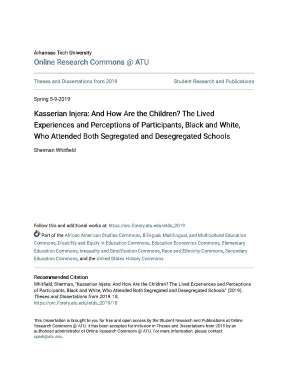
Tải xuống để đọc toàn bộArkansas Tech University Online Research Commons @ ATU Theses and Dissertations from 2019 Student Research and Publications Spring 5-9-2019 Kasserian Injera: And How Are the Children? The Lived Experiences and Perceptions of Participants, Black and White, Who Attended Both Segregated and Desegregated Schools Sherman Whitfield Follow this and additional works at: https://orc.edu/etds_2019 Part of the African American Studies Commons, Bilingual, Multilingual, and Multicultural Education Commons, Disability and Equity in Education Commons, Education Economics Commons, Elementary Education Commons, Inequality and Stratification Commons, Race and Ethnicity Commons, Secondary Education Commons, and the United States History Commons Recommended Citation Whitfield, Sherman, "Kasserian Injera: And How Are the Children? The Lived Experiences and Perceptions of Participants, Black and White, Who Attended Both Segregated and Desegregated Schools" (2019). Theses and Dissertations from 2019.edu/etds_2019/18 This Dissertation is brought to you for free and open access by the Student Research and Publications at Online Research Commons @ ATU. It has been accepted for inclusion in Theses and Dissertations from 2019 by an authorized administrator of Online Research Commons @ ATU. For more information, please contact cpark@atu.
Kasserian Injera: And How Are the Children? The Lived Experiences and Perceptions of Participants, Black and White, Who Attended Both Segregated and Desegregated Schools A Dissertation Submitted to the Graduate College Arkansas Tech University in partial fulfillment of requirements for the degree of DOCTOR OF EDUCATION in School Leadership in the Center for Leadership and Learning of the College of Education May 2019 Sherman Whitfield Bachelor of Science, University of Arkansas Pine Bluff, 1995 Master of Science, University of Central Arkansas, 2002 Specialist in Education, University of Central Arkansas, 2013 © 2019 Sherman Whitfield iii Acknowledgements Sam and Johnnie Mae Whitfield are my beloved, deceased parents. Their union produced thirteen children (I am #13). We honor and cherish their memory. We miss them dearly! In between the cotton fields and sharecropping, they possessed a third and sixth grade education, respectfully; however, they taught each of us to “value an education.” Like so many other Americans of African descent, I can clearly hear Ma and Da Da say, “they cannot take that away from you.” My brothers and sisters {Jean, Betty Rose, Sam Jr., Mary Lou, Doris Jean, Sandra Faye, Johnny, Ivan, Carol, Michael, George, and Rickey} were great role models for me.
They led the way, and in doing so made it possible for me to follow their “north star.” Some of you took me to live with you each summer and purchased school clothes for me every year; while others financed my undergraduate education. I am in debt to you all. To each of you I say--Thank You. I have been influenced by some powerful and amazing educators while on this journey: Dr.
Buford Satcher, and Attorney Dana Mazique from University of Arkansas Pine Bluff who persuaded me to study and analyze the “Black Experience” in America. Ralph Calhoun and Dr. Lloyd Hervey who “cornered” me while walking to class at University Central Arkansas and stated, “You could have done better than that” on a test that I had scored one of the highest scores in the classroom. They had high and clear expectations and they garnered my utmost respect as men of honor and integrity.
I had the opportunity to work under some amazing school administrators in administrative leadership to include: Ms. Laura Shirley, Mr. Donald Booth, and Dr. I will never forget the trust and mentorship given to me by Dr.
iv Brenda Bowles at the central office level. John McCraney always took care of me and was not only a friend but also a confidant. I will always appreciate and cherish Dr. Janice Warren who trusted me as Interim Assistant Superintendent for Equity and Pupil Services when she was appointed Interim Superintendent—your trust meant the world to me.
Honorable mention to Dr. Charles McNulty, PCSSD Superintendent of Schools, who truly possesses and exemplifies the rarity of a legitimate “Equity Lens.” This dissertation was made possible because of some incredible staff and faculty I encountered while at Arkansas Tech University. Christopher Trombly at the beginning of my doctoral studies. I instantly knew that I wanted him to be on my dissertation committee.
However, toward the end of my studies he accepted a position at Southern Connecticut State University. Nevertheless, he graciously agreed to stay on my committee. Trombly provided me with timely feedback and answered my every call to meet regarding my dissertation. I will never take what you have done for me for granted.
I am in your debt sir, Thank You! Dr. Freeman, your guidance and assistance always made me feel calm and reassured. I believe such a person is needed when going through this type of program. Thanks for always responding and keeping the focus on the end product.
I believe much of the success of this program is attributable to your hard work and your dedication. Thank you Dr. Gordon for agreeing to serve on my committee. Your recommendations and suggestions were greatly appreciated.
You are appreciated. To my children, Morgan and Kyra, if I have been one-fifth the parent to you my parents were to me then I would consider myself successful in parenting. If I have failed, I failed while trying. I love you both, and pray for you daily a continued life of blessings v and health.
Always remember --to whom much is given, much is required. You were given much! Spring Valley Missionary Baptist Church showed me great patience and kindness as I embarked upon this doctoral pursuit. They prayed for me! I thank each and every one of you for being there for me and allowing me to lean on you when I needed someone to lean on. Because of you, I am richly blessed.
Last, but in no way least, I want to thank my wife Sonya. We have been on a very amazing journey both personally and professionally. We created a family, raised two beautiful, well-adapted children, and continued our education by attaining our master’s degree, specialist degree and now the doctoral degree—“together.” We supported each other throughout this process. I would like to think that I pulled you through all of this, but the reality is that you probably pulled me through and challenged me more.
I have loved you from the moment I first met you and nothing has changed since that time. We have been, and continue to be, blessed in an awesome and most powerful way! We wait to see where He leads. vi Dedication I remember my Great Grandma Ella who was blind and died at the age of 107 years old. I remembering sitting on her lap.
She would revisit and recount her life, in a gabbled voice, with her family. Her grandparents were slaves, born in America to the lash and the whip. Grandma Ella, Grand-MaMa Julie, my father Sam Whitfield Sr., and myself represents the sixth generation removed from chattel slavery. Grandma Ella’s grandparents represents the sixth generation that exited in human bondage.
This moment of educational attainment is foremost in my mind in recognition of generations past. This work is dedicated foremost to the memory of those who had the ability, but not the opportunity of intellectual pursuit. To every individual who champions the clarion call of liberty and freedom for all people without regard to race, creed, color, religion, gender or sexual orientation, I dedicate this work. I am truly the product of such struggle, commitment, perseverance and sacrifice that was privileged, to me, long before I could ever understand and/or appreciate it.
To those who sacrificially paved my way, I am thankful, forever grateful, and humbled. My debts of gratitude to those who sacrificed for me cannot be contained in this narrow and limited work. However, I am committed to continue the work. vii Explanation of the Title: Kassserian Ingera The title Kasserian Ingera is taken from the mighty Masai tribe of the African continent.
Historically, the Masai were considered fierce warriors. Upon greeting one another including strangers, the Masai would state Kasserian Ingera which translated to “and how are the children?” This was one of several questions one may be asked even today when encountering a member of the Masai tribe. It is the intentional acknowledgement of value and significance being placed on one of the most vulnerable within their society, as well as our society. It is my opinion that this research asked the same question relative to the phenomenological experience of segregation and desegregation within the public-school system, by using the actual voices of a small sample of former students who lived it; and, how are the children? viii Abstract This study was guided by the following research question: What are the perceptions and experiences of participants, Black and White, who attended both segregated and desegregated schools? This phenomenological research study was conducted using two focus groups divided homogenously into one Black focus group and one White focus group.
The Black focus group consisted of three Black females and two Black males. The White focus group consisted of six White females. The findings related to the research revealed that the Black focus group and the White focus group looked at this phenomenon differently along racial lines. These former students actually lived this experience and the effect, according to this research, lingers even today.
The research study provided important sociological data about this crucial moment in the history of Arkansas, and in the United States. If we are to create a more equitable society, it is imperative that we understand historic events and phenomena, not only through the perspectives of the majority, but also—just as importantly—from the perspectives of those who lacked such privilege. ix Table of Contents Page ABSTRACT. ix CHAPTER I: INTRODUCTION.1 Background of the Problem .2 Statement of the Problem .4 Significance of the Study .8 Assumptions, Limitations, and Scope.9 Definition of Key Terms .10 CHAPTER II: LITERATURE REVIEW .12 The Historical Legacy of Segregate School Systems .12 Assimilation Assistance: Freedman’s Bureau and Others .13 The Case of Plessy v.14 Cases between Plessy and Brown .15 The Landmark Case of Brown v.
the Board of Education .16 The Challenges to Desegregation Initiatives .18 “All Deliberate Speed” .19 Little Rock Central High School.20 Anti-Busing and Housing Problems .21 The Impact of Segregation on African American Students .23 x The Impact of Segregation on White American Students .26 The Case Against Integration.28 Re-segregation Today .30 School Desegregation: Arkansas Style .32 Pulaski County Desegregation Mandates (Plan 2000).35 CHAPTER III: RESEARCH METHODOLOGY .47 CHAPTER IV: ANALYSIS OF DATA .49 Review of the Research Question .54 Overview of Findings .74 Presentation of Findings .74 Summary of the Research Question .74 xi Review of the Literature and the Findings .75 The White Focus Group .80 Where the White and Black Focus Group Converged .85 Analysis, Finding(s), and Explanations of Research .90 Recommendations for Future Research .111 xii Chapter I: Introduction America has a long and difficult history regarding race, and the educational arena is not exempt. The struggle for Blacks to receive education has endured through slavery, Reconstruction, and Jim Crow Laws; in addition, it has persisted through “separate but equal” and court-mandated desegregation. Today, despite hard-won advances through the decades, school districts across the country are re-segregating. This growing trend threatens to undo progress gained and reverse the clock to a time when the color of your skin determined the quality of your school system (Garland, 2012).
There is no one more qualified to speak on the potential issues of re-segregation than the students who lived during the days before Brown v. the Board (1954) was a staple in the history books. As a small piece of America, Arkansas is no stranger to racial problems. For generations, many Black citizens labored in the cotton fields and other low-level employment opportunities because little else was afforded to them.
Blacks were further confronted by rules and codes used to keep them within confined and pre-determined social spaces in the society. At its core, life was hard, very hard.
Nội dung được bảo vệ bản quyền — Tải xuống đầy đủ
Trích dẫn luận án này
Sherman Whitfield (2019). Kasserian injera and how are the children the lived experien [Luận án tiến sĩ, Arkansas Tech University]. LuanAn.net. https://luanan.net/nghien-cuu-van-hoa/kasserian-injera-and-how-are-the-children-the-lived-experiences
Câu hỏi thường gặp
Luận án "Kasserian injera and how are the children the lived experien" nghiên cứu về vấn đề gì?
Nghiên cứu thực tiễn về Kasserian injera và trải nghiệm của trẻ em trong cộng đồng Ethiopia.
Luận án "Kasserian injera and how are the children the lived experien" được bảo vệ tại trường nào?
Luận án này được bảo vệ tại Arkansas Tech University. Năm bảo vệ: 2019.
Luận án "Kasserian injera and how are the children the lived experien" thuộc chuyên ngành gì?
Luận án "Kasserian injera and how are the children the lived experien" thuộc chuyên ngành School Leadership. Danh mục: Nghiên Cứu Văn Hóa.
Luận án "Kasserian injera and how are the children the lived experien" có bao nhiêu trang?
Luận án "Kasserian injera and how are the children the lived experien" có 126 trang. Bạn có thể xem trước một phần tài liệu ngay trên trang web trước khi tải về.
Cách tải luận án "Kasserian injera and how are the children the lived experien" về máy như thế nào?
Để tải luận án về máy, bạn nhấn nút "Tải xuống ngay" trên trang này, sau đó hoàn tất thanh toán phí lưu trữ. File sẽ được tải xuống ngay sau khi thanh toán thành công. Hỗ trợ qua Zalo: 0559 297 239.