Thiết kế khái niệm trang trại gió thông qua tối ưu hóa bầy đàn đa mục tiêu - Weiyang Tong, Syracuse University
Tối ưu hóa thiết kế trang trại gió bằng thuật toán bầy đàn đa mục tiêu, nâng cao hiệu suất năng lượng tái tạo.
Năm xuất bản
Số trang
191
Thời gian đọc
29 phút
Lượt xem
1
Lượt tải
0
Phí lưu trữ
50 Point
Tổng quan nhanh
- Chủ đề:
- 1. Thiết kế trang trại gió qua tối ưu hóa bầy đàn mới
- Số trang:
- 191 trang
- Trường:
- Syracuse University
- Chuyên ngành:
- Engineering
- Tác giả:
- Weiyang Tong
- Năm:
- 2015
Tóm tắt nội dung luận án
I. Thiết kế trang trại gió qua tối ưu hóa bầy đàn mới
Năng lượng gió là nguồn năng lượng tái tạo phát triển nhanh chóng trên quy mô toàn cầu. Tốc độ tăng trưởng hàng năm đạt hơn 20% trong thập kỷ qua. Tuy nhiên, nhiều dự án gặp trở ngại lớn về hiệu suất vận hành và tiến độ thi công. Thiết kế trang trại gió qua tối ưu hóa bầy đàn đa mục tiêu mang đến giải pháp toàn diện cho bài toán này. Phương pháp này phân tích đồng thời các yếu tố kinh tế, kỹ thuật và môi trường. Sự kết hợp giữa các biến số thực địa giúp nâng cao tính khả thi của dự án. Phương pháp MOWFD tích hợp các mô hình toán học nhằm giải quyết xung đột mục tiêu. Quy trình này định hình cấu trúc trang trại gió hiện đại, bền vững và đạt hiệu quả sinh lời cao.
1.1. Thách thức tương tác đa yếu tố trong bố trí mặt bằng
Quá trình quy hoạch trang trại gió chịu ảnh hưởng từ nhiều điều kiện tự nhiên phức tạp. Vận tốc gió đầu vào và độ nhiễu động không khí thay đổi liên tục theo không gian. Các yếu tố này tác động trực tiếp đến tối ưu hóa vị trí tuabin gió. Việc bố trí các tuabin quá gần nhau tạo ra vùng bóng khí quyển bất lợi. Hiện tượng này dẫn đến suy hao công suất vệt gió đáng kể ở các tuabin phía sau. Hiệu suất khai thác của toàn bộ hệ thống bị sụt giảm nghiêm trọng. Ngoài ra, việc sử dụng đất đai và chi phí đầu tư hạ tầng cũng tạo thêm rào cản lớn. Một mô hình quy hoạch hiệu quả cần xử lý đồng bộ các mối quan hệ phi tuyến tính này.
1.2. Ứng dụng phân bố tốc độ gió Weibull trong tính toán
Dữ liệu gió tại thực địa là cơ sở then chốt để xác định tiềm năng phát điện. Việc mô phỏng phân bố tốc độ gió Weibull giúp nắm bắt chính xác quy luật gió theo từng mùa và hướng gió. Hàm mật độ xác suất này cung cấp thông số đầu vào đáng tin cậy cho bài toán mô phỏng. Sự biến thiên của dải vận tốc gió tác động trực tiếp đến sản lượng năng lượng hàng năm. Khi áp dụng các kỹ thuật tính toán hiện đại, dữ liệu gió được số hóa thành các kịch bản vận hành chi tiết. Nhờ đó, việc đánh giá tải trọng cơ học và khả năng phát điện của từng tuabin trở nên chuẩn xác. Đây là bước đệm quan trọng giúp loại bỏ rủi ro sai lệch công suất trong giai đoạn thiết kế sơ bộ.
II. Đột phá từ giải thuật bầy đàn đa mục tiêu MOPSO mới
Các bài toán quy hoạch trang trại gió có không gian tìm kiếm rộng lớn và phi tuyến tính cao. Sự xuất hiện của giải thuật bầy đàn đa mục tiêu mở ra hướng tiếp cận đột phá. Thuật toán tối ưu hóa bầy đàn truyền thống được nâng cấp thành biến thể MO-MDPSO chuyên sâu. Thuật toán MOPSO cải tiến này có khả năng xử lý đồng thời biến liên tục và biến rời rạc. Cơ chế bảo toàn tính đa dạng đa miền giúp quần thể hạt tránh rơi vào các cực trị cục bộ. Thuật toán phân bổ các phần tử tìm kiếm một cách thông minh trên toàn bộ không gian thiết kế. Nhờ đó, chất lượng nghiệm số được cải thiện rõ rệt so với các thuật toán tiến hóa thông thường.
2.1. Cải tiến giải thuật MO MDPSO cho biến số hỗn hợp
Hệ thống trang trại gió bao gồm cả biến số liên tục như tọa độ vị trí và biến số rời rạc như chủng loại tuabin. Thuật toán MOPSO tiêu chuẩn thường gặp khó khăn khi xử lý các ràng buộc hỗn hợp này. Phiên bản MO-MDPSO giải quyết triệt để vấn đề bằng cách tích hợp các toán tử lai ghép đặc biệt. Tọa độ của từng hạt đại diện cho một phương án bố trí mặt bằng cụ thể. Giải thuật bầy đàn đa mục tiêu liên tục cập nhật vận tốc và vị trí của từng hạt dựa trên kinh nghiệm cá nhân và toàn bầy. Quá trình hội tụ diễn ra nhanh chóng nhưng vẫn duy trì độ phủ rộng trên không gian nghiệm. Kết quả thử nghiệm trên các bộ dữ liệu chuẩn chứng minh năng lực vượt trội của thuật toán.
2.2. Xây dựng và kiểm soát tập nghiệm mặt trước Pareto
Trong bài toán đa mục tiêu, không tồn tại một nghiệm đơn lẻ tối ưu cho mọi tiêu chí. Mục tiêu tối đa hóa sản lượng luôn xung đột với mục tiêu tiết kiệm chi phí và diện tích. Thuật toán xây dựng tập nghiệm mặt trước Pareto để mô tả ranh giới đánh đổi tối ưu. Việc tham số hóa mặt trước Pareto cung cấp cái nhìn định lượng về mối quan hệ giữa công suất lắp đặt và diện tích đất. Các phương án không bị chi phối được lưu trữ trong một kho lưu trữ ngoài chuyên biệt. Cơ chế mật độ hạt giúp phân bố đều các giải pháp dọc theo đường biên hiệu quả. Người ra quyết định có thể dễ dàng lựa chọn cấu hình phù hợp với nguồn lực tài chính sẵn có.
III. Tối ưu hóa vị trí tuabin gió giảm hiệu ứng vệt gió
Sự tương tác khí động học giữa các tuabin là nguyên nhân hàng đầu gây thất thoát năng lượng. Khi gió đi qua cánh quạt, vận tốc gió suy giảm và độ nhiễu động tăng cao phía sau tháp. Quá trình tối ưu hóa vị trí tuabin gió đóng vai trò quyết định trong việc hạn chế tổn thất này. Việc áp dụng mô hình toán học chính xác cho phép dự báo phạm vi lan tỏa của dòng khí hỗn loạn. Các vị trí đặt tuabin được tính toán linh hoạt mà không bị gò bó bởi ranh giới hình học cứng nhắc. Sự dịch chuyển thông minh của các tọa độ giúp triệt tiêu tương tác tiêu cực giữa các hàng tuabin. Nhờ đó, hiệu ứng vệt gió được kiểm soát chặt chẽ trên toàn bộ diện tích trang trại.
3.1. Phân tích độ nhạy với mô hình vệt gió Jensen chuẩn
Việc lựa chọn mô hình dòng khí tác động lớn đến độ chính xác của bài toán mô phỏng. Nghiên cứu thực hiện phân tích độ nhạy toàn diện với mô hình vệt gió Jensen và các mô hình nâng cao. Đối với các trang trại dạng mảng thẳng hàng truyền thống, sai số giữa các mô hình có thể lên tới 70%. Ngược lại, khi mặt bằng được tối ưu hóa tự do, sự khác biệt giữa các mô hình giảm xuống mức không đáng kể. Mô hình vệt gió Jensen thể hiện tính hiệu quả cao nhờ tốc độ tính toán nhanh và độ tin cậy thực tế. Việc tích hợp mô hình này giúp xác định chính xác mức độ suy hao công suất vệt gió qua từng cụm tuabin.
3.2. Khắc phục suy hao công suất vệt gió trên sơ đồ mở
Bố trí dạng lưới truyền thống thường khiến các hàng tuabin sau hứng trọn luồng khí suy giảm. Điều này làm tăng độ rung lắc cơ học và gây suy giảm nghiêm trọng lượng điện phát ra. Kỹ thuật tối ưu hóa vị trí tuabin gió theo sơ đồ mở giúp phá vỡ các cấu trúc thẳng hàng gò bó. Tọa độ tuabin được phân tán so le dựa trên các hướng gió thịnh hành trong năm. Hiệu ứng vệt gió được giải tỏa nhanh chóng nhờ khoảng cách đệm không khí hợp lý. Các tuabin phía hạ lưu tiếp nhận luồng gió có vận tốc phục hồi cao hơn. Giải pháp này giúp trang trại đạt hiệu suất phát điện đồng đều và kéo dài tuổi thọ thiết bị.
IV. Nâng cao sản lượng năng lượng hàng năm tối đa nhất
Mục tiêu cốt lõi của mọi dự án điện gió là đạt mức phát điện cao nhất trong suốt vòng đời dự án. Chỉ số sản lượng năng lượng hàng năm phản ánh trực tiếp năng lực khai thác tài nguyên gió tại địa điểm xây dựng. Quá trình tối ưu hóa không chỉ điều chỉnh tọa độ mà còn lựa chọn kích thước cánh quạt và chiều cao tháp phù hợp. Sự tương thích giữa thiết bị và đặc tính gió giúp tận dụng tối đa động năng khí quyển. Phương pháp thiết kế mới cho phép tăng công suất lắp đặt mà không làm gia tăng tỷ lệ tổn thất năng lượng. Toàn bộ chuỗi vận hành được mô phỏng chi tiết dưới các kịch bản thời tiết khắc nghiệt.
4.1. Tối ưu công suất lắp đặt theo điều kiện địa hình
Địa hình và hướng gió cục bộ quyết định mật độ bố trí tuabin tối ưu trên từng hecta. Kết hợp phân bố tốc độ gió Weibull với bản đồ độ nhám bề mặt giúp xác định các vị trí đón gió thuận lợi nhất. Quy trình thiết kế tiến hành lựa chọn công suất lắp đặt phù hợp với khả năng chịu tải của lưới điện. Các tuabin công suất lớn được ưu tiên đặt tại các cao điểm có vận tốc gió ổn định. Việc phân bổ công suất hợp lý góp phần nâng cao sản lượng năng lượng hàng năm cho toàn dự án. Đồng thời, cấu hình này giúp giảm thiểu hiện tượng quá tải cục bộ khi gió giật mạnh. Kế hoạch vận hành nhờ đó đạt được tính ổn định và an toàn dài hạn.
4.2. Cải thiện hiệu suất vận hành toàn diện cho dự án
Hiệu suất vận hành trang trại gió phụ thuộc vào sự đồng bộ giữa thiết bị cơ khí và thuật toán điều khiển. Bố trí tối ưu giúp giảm số giờ dừng máy do quá tải nhiệt và mỏi cơ học. Việc hạn chế suy hao công suất vệt gió giúp duy trì sản lượng điện liên tục ngay cả trong điều kiện gió yếu. Sản lượng năng lượng hàng năm tăng trưởng ổn định tạo nguồn thu vững chắc cho chủ đầu tư. Các công cụ giám sát hiện đại kết hợp với mô hình dự báo dòng khí giúp tối ưu hóa lịch bảo dưỡng định kỳ. Toàn bộ hệ thống duy trì được hệ số khả dụng cao trong suốt 20 đến 25 năm vận hành tiêu chuẩn.
V. Tối ưu chi phí năng lượng quy dẫn qua mặt Pareto
Hiệu quả tài chính của dự án năng lượng gió được đo lường chính xác qua chi phí năng lượng quy dẫn. Chỉ số này phản ánh tổng chi phí đầu tư, vận hành và bảo dưỡng trên mỗi kilowatt giờ điện tạo ra. Phương pháp tối ưu hóa hiện đại cân bằng giữa chi phí vốn ban đầu và doanh thu dài hạn. Bằng cách thiết lập mặt trước Pareto, các nhà phát triển có thể xác định các cấu hình tối ưu chi phí. Quá trình này loại bỏ các phương án lãng phí đất đai hoặc đầu tư thiết bị không tương xứng. Sự cân đối tài chính giúp dự án nâng cao sức cạnh tranh trên thị trường điện tái tạo.
5.1. Cắt giảm chi phí năng lượng quy dẫn trên diện tích đất
Chi phí thuê đất và giải phóng mặt bằng chiếm tỷ trọng đáng kể trong tổng mức đầu tư trang trại gió. Tối ưu hóa việc sử dụng đất giúp giảm chiều dài tuyến cáp ngầm nội bộ và đường giao thông vận hành. Khi diện tích chiếm dụng được thu gọn hợp lý, chi phí năng lượng quy dẫn giảm xuống mức tối thiểu. Các thuật toán định tuyến tính toán vị trí tuabin sao cho mật độ công suất đạt mức cao nhất. Quy trình này vừa đảm bảo khoảng cách an toàn khí động học vừa tiết kiệm chi phí xây lắp móng trụ. Hiệu quả kinh tế tổng thể của dự án được nâng cao rõ rệt mà không ảnh hưởng đến môi trường sinh thái xung quanh.
5.2. Lựa chọn phương án đầu tư tối ưu từ mặt trước Pareto
Tập hợp các giải pháp trên mặt trước Pareto mang lại sự linh hoạt tối đa cho các nhà quản lý dự án. Tùy thuộc vào chiến lược vốn và thỏa thuận mua bán điện, chủ đầu tư có thể chọn điểm làm việc phù hợp. Sự hỗ trợ từ giải thuật bầy đàn đa mục tiêu giúp lượng hóa chính xác mức đánh đổi giữa chi phí và sản lượng. Việc ra quyết định không còn dựa trên cảm tính mà căn cứ vào các chỉ số kỹ thuật vững chắc. Mô hình thiết kế tổng thể giúp rút ngắn thời gian chuẩn bị dự án từ khâu khảo sát đến khi cấp phép. Đây là công cụ đắc lực thúc đẩy quá trình chuyển dịch năng lượng xanh hiệu quả.
Mục lục chi tiết luận án
Tải xuống file đầy đủ để xem toàn bộ nội dung
Tải đầy đủ (191 trang)Trích đoạn nội dung luận án
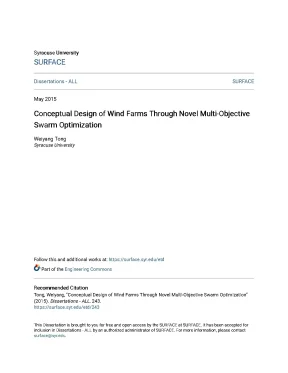
Tải xuống để đọc toàn bộSyracuse University SURFACE Dissertations - ALL SURFACE May 2015 Conceptual Design of Wind Farms Through Novel Multi-Objective Swarm Optimization Weiyang Tong Syracuse University Follow this and additional works at: https://surface.edu/etd Part of the Engineering Commons Recommended Citation Tong, Weiyang, "Conceptual Design of Wind Farms Through Novel Multi-Objective Swarm Optimization" (2015).edu/etd/243 This Dissertation is brought to you for free and open access by the SURFACE at SURFACE. It has been accepted for inclusion in Dissertations - ALL by an authorized administrator of SURFACE. For more information, please contact surface@syr. ABSTRACT Wind is one of the major sources of clean and renewable energy, and global wind energy has been experiencing a steady annual growth rate of more than 20% over the past decade.
energy market, although wind energy is one of the fastest increasing sources of electricity generation (by annual installed capacity addition), and is expected to play an important role in the future energy demographics of this country, it has also been plagued by project underperformance and concept-to-installation delays. There are various factors affecting the quality of a wind energy project, and most of these factors are strongly coupled in their influence on the socio-economic, production, and environmental objectives of a wind energy project. To develop wind farms that are profitable, reliable, and meet community acceptance, it is critical to accomplish balance between these objectives, and therefore a clean understanding of how different design and natural factors jointly impact these objectives is much needed. In this research, a Multi-objective Wind Farm Design (MOWFD) methodology is de- veloped, which analyzes and integrates the impact of various factors on the conceptual design of wind farms.
This methodology contributes three major advancements to the wind farm design paradigm: (I) provides a new understanding of the impact of key factors on the wind farm performance under the use of different wake models; (II) explores the crucial tradeoffs between energy production, cost of energy, and the quantitative role of land usage in wind farm layout optimization (WFLO); and (III) makes novel advancements on mixed-discrete particle swarm optimization algorithm through a multi-domain diversity preservation con- cept, to solve complex multi-objective optimization (MOO) problems. A comprehensive sensitivity analysis of the wind farm power generation is performed to understand and compare the impact of land configuration, installed capacity decisions, incoming wind speed, and ambient turbulence on the performance of conventional array layouts and optimized wind farm layouts. For array-like wind farms, the relative importance of each factor was found to vary significantly with the choice of wake models, i., appreciable differences in the sensitivity indices (of up to 70%) were observed across the different wake models. In contrast, for optimized wind farm layouts, the choice of wake models was observed to have no significant impact on the sensitivity indices.
The MOWFD methodology is designed to explore the tradeoffs between the concerned performance objectives and simultaneously optimize the location of turbines, the type of turbines, and the land usage. More importantly, it facilitates WFLO without prescribed conditions (e., fixed wind farm boundaries and number of turbines), thereby allowing a more flexible exploration of the feasible layout solutions than is possible with other existing WFLO methodologies. In addition, a novel parameterization of the Pareto is performed to quantitatively explore how the best tradeoffs between energy production and land usage vary with the installed capacity decisions. The key to the various complex MO-WFLOs performed here is the unique set of capabilities offered by the new Multi-Objective Mixed-Discrete Particle Swarm Optimization (MO-MDPSO) algorithm, developed, tested and extensively used in this dissertation.
The MO-MDPSO algorithm is capable of dealing with a plethora of problem com- plexities, namely: multiple highly nonlinear objectives, constraints, high design space di- mensionality, and a mixture of continuous and discrete design variables. Prior to applying MO-MDPSO to effectively solve complex WFLO problems, this new algorithm was tested on a large and diverse suite of popular benchmark problems; the convergence and Pareto cov- erage offered by this algorithm was found to be competitive with some of the most popular MOO algorithms (e. The unique potential of the MO-MDPSO algorithm is further established through application to the following complex practical engineering problems: (I) a disc brake design problem, (II) a multi-objective wind farm layout optimization problem, simultaneously optimizing the location of turbines, the selection of turbine types, and the site orientation, and (III) simultaneously minimizing land usage and maximizing capacity factors under varying land plot availability. CONCEPTUAL DESIGN OF WIND FARMS THROUGH NOVEL MULTI-OBJECTIVE SWARM OPTIMIZATION By Weiyang Tong B., Syracuse University, 2011 Dissertation Submitted in Partial Fulfillment of the Requirements for the Degree of Doctor of Philosophy in Mechanical Engineering in the Graduate School of Syracuse University Syracuse University Syracuse, New York May, 2015 c Copyright 2015 by Weiyang Tong All Rights Reserved DEDICATION I dedicate this thesis to my maternal grandmother, Yushan Wang, who raised me, loved me, and always believed in me.
I also dedicate this thesis to my paternal grandmother, Anqi Yang, who was a great woman of endless patience, eternal kindness, and boundless love. vi ACKNOWLEDGMENT I would like to express my deepest appreciation towards my advisor, Prof. Achille Messac, for his immense help throughout my doctoral studies. Messac provided me with invaluable advice and technical supervision that formed the foundation of the research presented in this dissertation and in the several well regarded journal articles that I have authored/co-authored thereof.
He also inculcated in me a spirit of professionalism that greatly contributed to my professional growth. I am thankful for his devotion to my future. Without his guidance, and persistent support, this dissertation would not have been possible. I would also like also to thank my co-advisor, Dr.
Souma has been a tremendous mentor, an excellent colleague, and a great friend. I am thankful for the superb example he set as an outstanding scholar and former student of Prof. The enthusiasm, inspiration, and sharp insights he has on research will always remain an excellent source of motivation for me in my future career. I would like to thank my doctoral committee members, Prof.
Utpal Roy, Prof. John Dannenhoffer, Prof. Jeongmin Ahn, Prof. Benjamin Akih-Kumgeh, and my committee chair Prof.
Can Isik, for their valuable advice and comments, as well as their willingness to serve on my committee. Special thanks to Prof. Roy and Prof. Dannenhoffer, who have been supportive in many ways within the MAE department in Syracuse University.
I wish to extend my warmest thanks to my former and present colleagues, Dr. Jie Zhang, Dr. Junqiang Zhang, Samuel Notaro, and my dear friend Ali Mehmani, who have helped me in many different ways at the Multidisciplinary Design and Optimization Labo- ratory. I greatly appreciate their friendship, and their contributions to my research and this vii dissertation.
I am also grateful to my closest friends, Xiaomeng Li, Ang Gao, Jia Li, Xu Meng, Zi Wang, Bensong Yu, and Zhen Liu, who cheered me up even in the worst of times and made my life (far away from home) fun. Special thanks to “Fly Empire” and “Starkville Soccer Group”, you gave me a lot of happiness and helped through the tough times. Sponsorship of this work by the National Science Foundation awards CMMI-1100948, and CMMI-1437746 is also gratefully acknowledged. These acknowledgements would not be complete without thanking the wonderful staff at Syracuse University, including Kathleen Datthyn-Madigan, Kimberly Drumm-Underwood, Kristin Shapiro, Linda Manzano, and Deborah Brown at the MAE department, and Cathy Mentor at the Sluztker Center, for all their efforts.
Finally, my deepest thanks go to my family; I would like to express my sincere gratitude to my parents, Lian Yu and Jun Tong, whose love and encouragement have always been my greatest strength; and I am also grateful to my uncle Fu Tong and my aunt Xiulian Zheng, who have always been supportive of all my academic endeavors. viii CONTENTS DEDICATION. vii LIST OF TABLES. xiii LIST OF FIGURES.
xiv LIST OF ACRONYMS. xvi I Technical Preliminaries xviii 1. Research Motivation and Objective .1 Overview of Wind Farm Development .2 Conceptual Design of Wind Farms .1 Wind Farm Development Process .2 Role of Land Resource .3 Multi-Objective Mixed-Discrete Optimization Problems .1 Swarm-based Algorithms .4 Research Goals and Impact .1 Analyzing the Sensitivity of Wind Farm Power Output to Key Factors .2 Multi-Objective Wind Farm Design Framework .3 Land Use Related Considerations .4 Multi-Objective Mixed-Discrete Particle Swarm Optimization 18 1.1 The Wake Effects .1 The Role of Wake Effects in Wind Farm Power Estimation .2 Analytical Wake Models .2 The State of the Art in Wind Farm Layout Optimization .1 Overview of Wind Farm Layout Optimization Frameworks .2 Performance Criteria in WFLO .3 Optimization Algorithms in WFLO .2 Particle Swarm Optimization Algorithms .3 Simulated Annealing Algorithm .3 Multi-Objective Particle Swarm Optimization (MOPSO) .1 Overview of MOPSO .2 Search Strategies in MOPSO .4 Research Observations and Needs .1 Research Needs in Wind Farm Power Estimation .2 Research Needs in Wind Farm Design .3 Research Needs in the Multi-Objective Optimization Solver 45 II A Novel Approach to the Conceptual Design of Wind Farms 46 3. Primary Performance Objectives in Wind Farm Design .1 Annual Energy Production .2 Wind Farm Cost of Energy.
Identifying Key Factors Influencing Wind Farm Performance .1 Impact of Different Analytical Wake Models on Wind Farm Power Estimation 56 4.2 Single Wake Analysis .3 Wind Farm Power Generation Analysis .1 Power Variation with the Land Area per Turbine .2 Power Variation with the Incoming Wind Speed .2 Sensitivity Analysis of Wind Farm Power Output .1 Overview of the Extended Fourier Amplitude Sensitivity Test .2 Upper and Lower Bounds of Input Parameters .3 Numerical Experiment I: Sensitivity Analysis of the Power Output of Wind Farms with Array-Like Layouts .4 Numerical Experiment II: Sensitivity Analysis on Maximized Farm Output with Optimal Layouts. Developing the Multi-Objective Wind Farm Design Methodology .1 Implementation of MOWFD Methodology .2 Case Study: Multi-Objective Wind Farm Design .1 Pareto Shifting Technique .2 Result and Discussion. Multi-Objective Wind Farm Design Considering Land Usage .1 Developing a Consolidated Visualization Platform for Co-operative Decision- Making in Wind Farm planning .1 Description and Settings .2 Results and Discussion. 95 III Development of Multi-objective Mixed-Discrete Optimiza- tion Solver 98 7.
Development of the Multi-Objective Mixed-Discrete Particle Swarm Optimization Algorithm .1 Overview of the Single-Objective Mixed-Discrete Particle Swarm Optimiza- tion Algorithm .1 Overview of Single Objective MDPSO .2 Introducing the Multi-Objective Capability to Mixed-Discrete PSO .3 The Multi-domain Diversity Preservation in Multi-Objective Mixed- Discrete Particle Swarm Optimization (MO-MDPSO) .4 Roles of Diversity Preservation Coefficients .1 Numerical Experiments with Continuous Benchmark Problems .3 Results and Discussion .1 Class I: Unconstrained Continuous Bi-objective Optimization Problems .2 Class II: Constrained Continuous Bi-objective Optimization Problems .3 Numerical Experiment with Mixed Integer and Practical Multi-Objective Op- timization (MOO) Problems .1 Results of Mixed-Integer MOO Problems. Practical Application using the Multi-Objective Mixed-Discrete Particle Swarm Optimization Algorithm .1 Disc Brake Design .2 Multi-Objective Wind Farm Layout Optimization .3 Multi-Objective Wind Farm Optimization Considering Different Land Plot Availability. Conclusion and Future Work .1 Multi-Objective Wind Farm Design .2 Consideration of Land Configuration .3 Parameterization of Key Tradeoffs in Wind Farm Design .4 Multi-Objective Mixed-Discrete Particle Swarm Optimization .1 Quantification of Wind Farm Performance .2 Implementation of Parameterization of Tradeoffs .3 Multi-Domain Diversity Preservation in MO-MDPSO. 148 xii LIST OF TABLES 1.1 Capital Cost Breakdown for Typical Onshore/Offshor Wind Energy Projects in 2011 [11] .1 Comparison of computation time of wake simulation for two turbines in line [32] 25 4.1 Analytical wake model inputs .2 Specifications of “GE 1.5 MW xle” turbine [122] .3 Upper and lower bounds of natural factors .4 Upper and lower bounds of design factors .1 User-defined parameters in MDPSO .2 Parameterization of CF-LAMI Tradeoff .5 MW xle Turbine [122] .1 User-defined parameters in MO-MDPSO .2 Continuous unconstrained bi-objective optimization problems .3 Continuous constrained bi-objective optimization problems .4 Accuracy (Γ) metric for test problems in Class I .5 Uniformity (∆) metric for test problems in Class I .6 Performance indicators for Class II .
Nội dung được bảo vệ bản quyền — Tải xuống đầy đủ
Trích dẫn luận án này
Weiyang Tong (2015). Thiết kế trang trại gió qua tối ưu hóa bầy đàn đa mục tiêu [Luận án tiến sĩ, Syracuse University]. LuanAn.net. https://luanan.net/nang-luong-moi-truong/nang-luong-tai-tao/thiet-ke-trang-trai-gio-qua-toi-uu-hoa-bay-dan-da-muc-tieu
Câu hỏi thường gặp
Luận án "Thiết kế trang trại gió qua tối ưu hóa bầy đàn đa mục tiêu" nghiên cứu về vấn đề gì?
Tối ưu hóa thiết kế trang trại gió bằng thuật toán bầy đàn đa mục tiêu, nâng cao hiệu suất năng lượng tái tạo.
Luận án "Thiết kế trang trại gió qua tối ưu hóa bầy đàn đa mục tiêu" được bảo vệ tại trường nào?
Luận án này được bảo vệ tại Syracuse University. Năm bảo vệ: 2015.
Luận án "Thiết kế trang trại gió qua tối ưu hóa bầy đàn đa mục tiêu" thuộc chuyên ngành gì?
Luận án "Thiết kế trang trại gió qua tối ưu hóa bầy đàn đa mục tiêu" thuộc chuyên ngành Engineering. Danh mục: Năng Lượng Tái Tạo.
Luận án "Thiết kế trang trại gió qua tối ưu hóa bầy đàn đa mục tiêu" có bao nhiêu trang?
Luận án "Thiết kế trang trại gió qua tối ưu hóa bầy đàn đa mục tiêu" có 191 trang. Bạn có thể xem trước một phần tài liệu ngay trên trang web trước khi tải về.
Cách tải luận án "Thiết kế trang trại gió qua tối ưu hóa bầy đàn đa mục tiêu" về máy như thế nào?
Để tải luận án về máy, bạn nhấn nút "Tải xuống ngay" trên trang này, sau đó hoàn tất thanh toán phí lưu trữ. File sẽ được tải xuống ngay sau khi thanh toán thành công. Hỗ trợ qua Zalo: 0559 297 239.