Petelski torsten tino 2005
Petelski Torsten Tino 2005: Khám phá các bài viết và nghiên cứu của Torsten Tino Petelski, tập trung vào các chủ đề khoa học và học thuật năm 2005.
Université Pierre et Marie Curie & Università degli Studi di Firenze
Quantum Optics / Atomic Physics
Luan An
Luận án tiến sĩ
Năm xuất bản
Số trang
209
Thời gian đọc
32 phút
Lượt xem
1
Lượt tải
0
Phí lưu trữ
50 Point
Tổng quan nhanh
- Chủ đề:
- 1. Torsten Petelski 2005: Tiêu Điểm Luận Án Vật Lý Lượng Tử
- Số trang:
- 209 trang
- Trường:
- Université Pierre et Marie Curie & Università degli Studi di Firenze
- Chuyên ngành:
- Quantum Optics / Atomic Physics
- Tác giả:
- Torsten Petelski
- Năm:
- 2005
Tóm tắt nội dung luận án
I. Torsten Petelski 2005 Tiêu Điểm Luận Án Vật Lý Lượng Tử
Luận án của Torsten Tino Petelski năm 2005 là một đóng góp quan trọng cho lĩnh vực vật lý. Torsten Petelski trình bày công trình này tại Trường Tiến sĩ Châu Âu. Chuyên ngành chính là Quang học Lượng tử. Luận án mang tên “Atom Interferometers for Precision Gravity Measurements”. Nghiên cứu này được thực hiện bởi Petelski tại Université Paris 6 và Università degli Studi di Firenze. Đây là một cột mốc trong sự nghiệp học thuật của Petelski. Luận án đặt nền móng cho các ứng dụng thực tế của giao thoa nguyên tử. Các kết quả nghiên cứu mở ra hướng đi mới. Torsten Tino Petelski đã thể hiện năng lực nghiên cứu xuất sắc vào năm 2005.
1.1. Luận án Tiến sĩ của Torsten Tino Petelski
Torsten Petelski trình bày luận án Tiến sĩ vật lý năm 2005. Tino Petelski bảo vệ công trình tại Trường Tiến sĩ Châu Âu, Chu kỳ XVII. Luận án tập trung vào lĩnh vực Quang học Lượng tử. Công trình này được thực hiện tại Université Paris 6 và Università degli Studi di Firenze. Nó đánh dấu một đóng góp quan trọng của Torsten Tino Petelski vào nghiên cứu khoa học. Luận án mang tên "Atom Interferometers for Precision Gravity Measurements".
1.2. Chuyên ngành Quang học Lượng tử 2005
Luận án Petelski thuộc chuyên ngành Quang học Lượng tử. Đây là một lĩnh vực nghiên cứu tiên tiến vào năm 2005. Công trình khám phá các ứng dụng của giao thoa nguyên tử. Torsten Petelski nghiên cứu các phép đo trọng lực chính xác. Các kỹ thuật tiên tiến được áp dụng. Luận án được đệ trình vào ngày 4 tháng 2 năm 2005. Công việc này có sự hướng dẫn của Guglielmo Tino và Christophe Salomon.
II. Công Nghệ Giao Thoa Nguyên Tử Phương Pháp Chính
Công nghệ giao thoa nguyên tử là trọng tâm luận án của Torsten Petelski. Phương pháp này khai thác tính chất sóng của nguyên tử. Nó cho phép các phép đo vật lý chính xác. Các nguyên tử được chia thành các đường đi khác nhau. Sau đó, chúng được hợp nhất lại để tạo ra các dải giao thoa. Các dải này mang thông tin về các trường lực. Kỹ thuật này là nền tảng cho các thí nghiệm đo trọng lực. Torsten Tino Petelski đã áp dụng kỹ thuật này một cách hiệu quả. Đây là một trong những thành tựu khoa học quan trọng của năm 2005.
2.1. Nguyên lý Giao Thoa Nguyên tử
Công nghệ giao thoa nguyên tử là trọng tâm luận án của Torsten Petelski. Phương pháp này sử dụng tính chất sóng của nguyên tử. Nguyên tử được chia thành các đường đi riêng biệt. Sau đó, nguyên tử được kết hợp lại. Sự giao thoa tạo ra các dải. Các dải này mang thông tin về môi trường. Giao thoa nguyên tử cho phép đo lường cực kỳ chính xác. Kỹ thuật này có ứng dụng rộng rãi.
2.2. Kỹ thuật Nguyên tử Lạnh 87Rb
Các thí nghiệm sử dụng mẫu nguyên tử Rubidium-87 (87Rb) lạnh. Các nguyên tử này rơi tự do. Một chuỗi ba xung ánh sáng Raman được áp dụng. Chúng tạo ra các hiệu ứng giao thoa. Việc làm lạnh nguyên tử giúp tăng thời gian tương tác. Điều này cải thiện độ nhạy của phép đo. Kỹ thuật này là cốt lõi của các giao thoa kế nguyên tử. Tino Petelski đã phát triển kỹ thuật này.
III. Đo Lường Trọng Lực Chính Xác Ứng Dụng Nổi Bật 2005
Nghiên cứu của Petelski tập trung vào ứng dụng đo trọng lực chính xác. Luận án Petelski trình bày hai thí nghiệm chính. Một là gravimeter để đo gia tốc trọng trường g. Thí nghiệm còn lại là gradiometer để xác định hằng số hấp dẫn G. Các ứng dụng này thể hiện tiềm năng của giao thoa nguyên tử. Torsten Petelski đã tiên phong trong lĩnh vực này vào năm 2005. Các kết quả có ý nghĩa lớn cho vật lý cơ bản. Công trình này tiếp tục là nguồn cảm hứng cho nhiều dự án sau này.
3.1. Dự án Gravimeter đo gia tốc trọng trường g
Một phần công việc của Petelski liên quan đến gravimeter. Thiết bị này đo gia tốc trọng trường Trái đất (g). Mục tiêu đạt độ chính xác tuyệt đối 10^-9. Gravimeter được phát triển trong khuôn khổ một dự án cân Watt mới. Nó góp phần vào các phép đo cơ bản. Nghiên cứu này chứng tỏ tiềm năng của giao thoa nguyên tử. Nó mang lại những tiến bộ quan trọng vào năm 2005.
3.2. Gradiometer và Hằng số hấp dẫn G
Trọng tâm chính của luận án là gradiometer. Thiết bị này dùng để xác định hằng số hấp dẫn (G). Mục tiêu độ chính xác là 10^-4. Hằng số G là một trong những hằng số vật lý cơ bản nhất. Việc đo lường chính xác G là thách thức lớn. Thí nghiệm này của Torsten Tino Petelski đóng góp đáng kể. Nó cải thiện hiểu biết về lực hấp dẫn.
IV. Thí Nghiệm Gradiometer Định Hằng Số Hấp Dẫn G
Thí nghiệm gradiometer là trọng tâm chính của luận án Petelski 2005. Mục tiêu là xác định hằng số hấp dẫn G với độ chính xác cao. Gradiometer đo sự khác biệt trọng lực giữa hai điểm. Nó sử dụng kỹ thuật giao thoa nguyên tử. Các dải giao thoa đầu tiên đã được quan sát. Điều này chứng minh tính khả thi của phương pháp. Độ phân giải đạt 10^-5 m/s^2 mỗi lần bắn. Torsten Petelski đã áp dụng phương pháp đo vi sai kép. Điều này giúp loại bỏ nhiễu và tăng độ tin cậy. Công trình này là một thành tựu nổi bật trong sự nghiệp của Tino Petelski.
4.1. Mục tiêu và độ chính xác của Gradiometer
Thí nghiệm gradiometer hướng tới việc đo G. Độ chính xác 10^-4 là mục tiêu đầy tham vọng. Gradiometer sử dụng hai giao thoa kế nguyên tử song song. Thiết bị đo sự khác biệt nhỏ về trường trọng lực. Nó giảm thiểu nhiễu loạn môi trường. Đây là một phương pháp tiên tiến của Torsten Petelski năm 2005. Gradiometer cung cấp dữ liệu quan trọng cho vật lý cơ bản.
4.2. Quan sát dải giao thoa đầu tiên
Các dải giao thoa đầu tiên đã được quan sát. Điều này xác nhận hoạt động của gradiometer. Độ phân giải đạt 10^-5 m/s^2 mỗi lần bắn. Đây là một thành tựu quan trọng. Nó mở ra triển vọng cho các phép đo G chính xác hơn. Quan sát này đánh dấu bước tiến lớn cho Tino Petelski. Công việc này là một cột mốc trong nghiên cứu năm 2005.
4.3. Phương pháp đo vi sai kép cho G
Gradiometer áp dụng phương pháp đo vi sai kép. Các khối nguồn được sử dụng. Phương pháp này giúp loại bỏ lỗi hệ thống. Nó tăng cường độ tin cậy của phép đo. Đo vi sai kép là cần thiết cho độ chính xác cao. Petelski đã triển khai kỹ thuật phức tạp này. Nó đảm bảo kết quả mạnh mẽ.
V. Thiết Kế Hệ Thống Cải Tiến Kỹ Thuật Giao Thoa Atom
Luận án của Torsten Petelski cũng mô tả chi tiết thiết kế hệ thống. Các cải tiến kỹ thuật được áp dụng cho giao thoa kế nguyên tử. Một nguồn nguyên tử lạnh cường độ cao đã được phát triển. Việc ổn định tần số và pha của laser là rất quan trọng. Nó đảm bảo độ chính xác của các xung Raman. Các vấn đề liên quan đến khối nguồn cũng được xử lý. Điều này cần thiết cho phép đo vi sai kép của G. Công việc này của Tino Petelski thể hiện sự hiểu biết sâu sắc về kỹ thuật thực nghiệm. Các giải pháp sáng tạo đã được Petelski đưa ra để vượt qua thách thức.
5.1. Nguồn nguyên tử lạnh cường độ cao
Một nguồn nguyên tử lạnh cường độ cao được phát triển. Nguồn này tạo ra dòng nguyên tử Rubidium-87 dồi dào. Nguyên tử lạnh là yếu tố then chốt. Nó cho phép thời gian tương tác dài hơn. Thời gian này cần thiết cho giao thoa kế. Việc cải tiến nguồn này là một đóng góp của Torsten Petelski. Nó nâng cao hiệu suất tổng thể của hệ thống.
5.2. Ổn định tần số và pha Laser
Tần số và pha của laser phải được ổn định. Điều này đảm bảo sự chính xác của các xung Raman. Sự ổn định laser là rất quan trọng. Nó ảnh hưởng trực tiếp đến chất lượng dải giao thoa. Các kỹ thuật tiên tiến được sử dụng. Các kỹ thuật này duy trì điều kiện thí nghiệm tối ưu. Công việc của Tino Petelski đã giải quyết thách thức này.
5.3. Vấn đề khối nguồn trong đo lường
Các khối nguồn gây ra vấn đề trong đo lường. Chúng được dùng cho phép đo vi sai kép của G. Việc kiểm soát vị trí và khối lượng chính xác là cần thiết. Bất kỳ sai lệch nào cũng ảnh hưởng đến kết quả. Petelski đã nghiên cứu các vấn đề này. Các giải pháp được phát triển để giảm thiểu lỗi.
VI. Thành Tựu Quan Trọng 2005 Tiềm Năng Nghiên Cứu Mới
Luận án năm 2005 của Torsten Petelski đã đạt được nhiều thành tựu quan trọng. Việc quan sát các dải giao thoa đầu tiên với độ phân giải cao là một cột mốc. Nó cho thấy tiềm năng to lớn của giao thoa kế nguyên tử. Thành công này mở ra hướng nghiên cứu mới. Các phép đo trọng lực chính xác hơn có thể thực hiện được. Nghiên cứu của Torsten Tino Petelski góp phần vào sự phát triển của vật lý cơ bản. Luận án này là một tài liệu tham khảo giá trị. Nó tiếp tục thúc đẩy các dự án khoa học khác.
6.1. Độ phân giải cao trong đo trọng lực
Gradiometer đạt độ phân giải ấn tượng. Độ phân giải 10^-5 m/s^2 mỗi lần bắn. Con số này cao đối với phép đo trọng lực. Nó là bằng chứng về sự thành công của công nghệ. Độ chính xác này mở ra các khả năng mới. Nó cho phép khám phá sâu hơn. Đây là một thành tựu quan trọng của Petelski.
6.2. Mở ra hướng nghiên cứu mới năm 2005
Luận án Petelski tạo tiền đề cho nghiên cứu tương lai. Công việc này thúc đẩy lĩnh vực giao thoa nguyên tử. Nó cung cấp nền tảng vững chắc. Các nhà khoa học có thể phát triển thêm các ứng dụng. Việc đo hằng số G được cải thiện. Nghiên cứu này đóng góp vào sự hiểu biết cơ bản. Nó là một dấu mốc quan trọng năm 2005.
Tải xuống file đầy đủ để xem toàn bộ nội dung
Tải đầy đủ (209 trang)Trích đoạn nội dung luận án
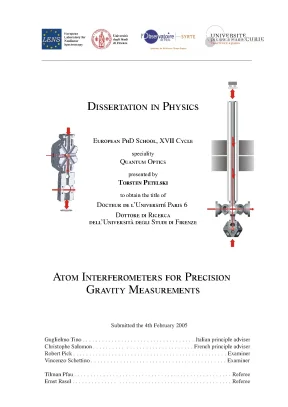
Tải xuống để đọc toàn bộD P E PD S, XVII C speciality Q O presented by T P to obtain the title of D ’Ú P 6 D R ’Ù S F A I P G M Submitted the 4th February 2005 Guglielmo Tino. Italian principle adviser Christophe Salomon. French principle adviser Robert Pick. Examiner Vincenzo Schettino.
Examiner Tilman Pfau. Referee Ernst Rasel. Referee European Laboratory for Non-linear Spectroscopy (LENS) & Università degli studi di Firenze, Dipartimento di Fisica Polo Scientifico di Sesto Fiorentino Via Sansone 1, 50019 Sesto Fiorentino - Firenze, Italy Bureau Nationale de Métrologie - Systèmes de Référence Temps - Espace (BNM-SYRTE), Observatoire de Paris 61, avenue de l’Observatoire, 75014 Paris, France Université Pierre et Marie Curie 4 place Jussieu, 75252 Paris Cedex 05, France A I P G M Í̀ A Ḿ Ṕ G I A M P G Abstract The subject of this work is two separate atom-interferometry experiments. The first is a gravimeter in the frame of a new Watt-balance to measure the Earth acceleration g with an absolute precision of 10−9 , whereas the emphasis is placed on the second experiment, a gradiometer for the determination of the gravitational constant G with a precision of 10−4.
Both experiments perform interferometry on a freely falling sample of cold 87 Rb atoms by the application of a sequence of three Raman light-pulses. We describe the idea of the two experiments and report on the details of the apparatus, including a source of an intense flux of cold atoms, frequency and phase stabilization of the lasers and problems related to the source masses that we use for a double- differential measurement of G. Here again, the main weight lies on the gradiometer experiment, where we observed first interference fringes recently with a resolution of the order of 10−5 m/s2 per shot. Key-words: Atom Interferometer, Atomic fountain, Gravity, Gravitational Constant Résumé Nous décrivons dans cette thèse deux expériences d’interférométrie atomique.
La pre- mière est un gravimètre qui mesurera l’accélération de la pesanteur terrestre g avec une exactitude relative de 10−9 , et qui est développé dans le cadre d’un projet de réalisation d’une Balance du Watt. La deuxième, sur laquelle l’essentiel du travail de cette thèse a porté, est un gradiomètre pour la détermination de la constante de la gravitation univer- selle G avec une exactitude relative de 10−4. Dans ces deux expériences, des atomes froids de 87 Rb en chute libre sont soumis à une séquence de trois impulsions laser Raman, afin de réaliser un interféromètre atomique. Nous décrivons d’abord le prin- cipe de ces expériences, puis le dispositif expérimental que nous avons mis au point.
Nous présenterons notamment la réalisation d’une source intense d’atomes froids, les méthodes de stabilisation en fréquence et en phase des lasers ainsi que les problèmes liés aux masses sources utilisées pour la mesure doublement différentielle de G. On porte ici l’accent sur le gradiomètre, avec lequel nous avons observé des premières franges d’interférence récemment, avec une resolution sur la mesure de l’accélération de l’ordre de 10−5 m/s2 par coup. Mots-clés : Interférométrie Atomique, Fontaine Atomique, Pésanteur terrestre, Constante de la Gravitation i Riassunto Nella presente tesi viene illustrato il lavoro effettuato su due distinti esperimenti di interferometria atomica. Il primo è un gravimetro inserito nel contesto di una nuova bilancia di Watt per misurare l’accelerazione di gravità terrestre g con una precisione assoluta di 10−9 , ma maggiore enfasi viene riservata per il secondo esperimento, un gradiometro per la determinazione della costante di gravitazione universale G con una precisione di 10−4.
Entrambe gli esperimenti si basano su tecniche interferometriche su un campione di atomi freddi di 87 Rb in caduta libera mediante l’interazione con una sequenza di tre impulsi Raman. Viene descritta l’idea alla base di tali esperi- menti e vengono riportati i dettagli dei singoli apparati, con particolare riferimento alla sorgente di un flusso intenso di atomi freddi, al sistema per la stabilizzazione in fase e frequenza dei laser ed ai problemi relativi alle masse sorgenti utilizzate per una misura doppio-differenziale di G. Ribadisco che nel lavoro di tesi viene data maggior rilevanza al gradiometro, con il quale si sono di recente osservate le prime frange di interferenza con una risoluzione sull’accelerazione dell’ordine di 10−5 m/s2 per lancio. Parole chiave: Interferometria Atomica, Fontana Atomica, Gravità terrestre, Costante di Gravitazione iii Contents Abstract, Résumé, Riassunto i Introduction 1 Organization of thesis.
4 1 The Paris gravimeter and Florence gradiometer 5 1.1 Past and present devices .2 Future developments and applications .2 A gravimeter for a new Watt Balance .1 New definition of the Kilogram .3 Atom interferometer or falling corner cube .3 A gradiometer for the determination of G .1 Significance of the Gravitational Constant G .3 G measurement with atom interferometry .4 Intuitive explanation of gravimeter and gradiometer. 20 2 Theory of Raman light pulse interferometry 27 2.1 Atoms and Light .1 Two level atom in a light-field .2 External degrees of freedom .5 Comments on plane-wave approximation .2 Raman light pulse interferometer .2 Phase contribution of Raman pulses .4 The Bordé method .5 Interferometer phase shift for certain potentials .3 Sensitivity to noise .3 Exact calculation of the weighting function .4 Comparison of rough and exact result for the weighting function 58 2.1 Description of MAGIA apparatus .3 Sealing with lead and glue .1 Extended cavity diode lasers .2 Laser setup of gradiometer .3 Laser setup of gravimeter .4 Summary and new laser system gradiometer: .1 Double differential measurement .4 Characteristics of Masses. 98 4 Laser frequency and phase control 103 4.1 Frequency modulation spectroscopy .3 Doppler free DAVLL lock .4 Further modulation-free locking techniques .5 Frequency Lock with f-to-V converter .1 Phase-locked-loop .2 Analog Phase Detector .3 Digital Phase and Frequency Detector .4 Digital Phase Difference Counter .5 Locking bandwidth and capture range .3 Frequency control for gravimeter .1 Lock Reference Laser on rubidium transition .2 Lock Repumper on Reference .3 Lock Cooling Laser on Repumper .4 Frequency control for gradiometer .1 Lock Repumper on rubidium transition .2 Lock Reference Laser on rubidium transition .3 Lock Master Raman laser .4 Phase-Lock Slave Raman laser .5 Noise on phase-lock. 127 5 Experimental procedure and first results 133 5.2 Tools to describe a 2D-MOT .3 Characterization of 2D-MOT .4 2D-MOT for gradiometer .2 Sample preparation and analysis gradiometer .1 Velocity insensitive Interferometer .2 Velocity selective Interferometer .1 Summary of work on gravimeter experiment .2 Summary of work on gradiometer experiment .3 Milestones of gravimeter .4 Milestones of gradiometer .1 Rubidium spectroscopy signals .3 Temperature dependence of pressure .4 Further useful numbers on 87 Rb.
177 B Geophysical determination of gravity 179 B.1 Predicted value of g .2 Predicted value of γ, γ0 and γ00. 181 Bibliography 183 Men and machine 193 Introduction ”Gravity is a contributing factor in nearly 73 percent of all accidents involving falling objects. The photo shows a rather unusual example of an accident; but also here the contribution of gravity can hardly be denied. One of the most obvious things in the world is that if you hold a stone in your hand and release it, then the stone falls., Aristotle concludes in his book ’on the heavens’ [1] that a stone falls, because it is driven to its natural place, which is the center of the Earth: .It (a moving body) could not move infinitely; for to traverse an infinite is impossible, and impossibilities do not happen.
So the moving thing must stop somewhere, and there rest not by constraint but naturally. But a natural rest proves a natural movement to the place of rest. For if the natural motion is upward, it will be fire or air, and if downward, water or earth. Hence air and water each have both lightness and weight, and water sinks to the bottom of all things except earth, while air rises to the surface of all things except fire.
1 2 Introduction Natural motion of the heavenly bodies, according to Aristotle, is circular. The ideas of Aristotle imply further that heavy objects fall faster than light things, because their consistence determines the degree of their desire to return to their natural position, the center of the Earth1. Since this ’natural desire’ of objects to fall is the only manifes- tation of gravitation in daily life, we understand that the ideas of Aristotle – although completely wrong – survived for almost 2000 years. In 1632 Galileo published his text ’Dialogo dei massimi sistemi’ [3] and proved those ideas to be wrong.
His experiments together with the celestial mechanics of Kepler [2] delivered a stunningly new description of the motion of objects on Earth as well as of planets, but could not deliver a philosophical description of the origin of the forces that determine this motion. Figure 1: In the so-called ’Principia’ of 1687 [5], Newton published his studies about the gravitational force that he developed during the plague in 1665/66 at the age of 23. This hole was filled for a certain time by the ether theory of Descartes [4] until New- ton in his ’Philosophiae naturalis principia mathematica’ delivered strong arguments against the ether. Newton proposed universal gravitation and the inverse square law of attraction between any two bodies even separated in a vacuum [5]:.
all matter attracts all other matter with a force proportional to the product of their masses and inversely proportional to the square of the distance between them. Newton’s law of gravitation received its definitive analytic form from Euler and is expressed as Mm F =G 2 , r 1 Aristotle concluded a reasoning about the question about the form of the Earth: Its shape must necessarily be spherical. Introduction 3 where F is the absolute value of the force between two bodies of masses m and M at a distance r. G is the universal gravitational constant.
The Earth acceleration g 2 can be written as G · MEarth /rEarth. Newton realized that it is precisely the same force that keeps planets on its orbit that make a stone fall to Earth. Despite the enormous potential of his theory to explain effects of gravitation, it nevertheless did not explain the origin of this attractive force; worse, it is based on some ’magic power’ that attract objects to each other. In the following decades, Newton’s theory became commonly accepted and is fully valid until nowadays, except in the presence of very large gravitational fields, in which case Einstein’s general relativity theory must be applied – that nowadays also fills the philosophical gap by delivering an explanation for the nature of gravity.
Within the past 300 years, Earth gravity acceleration g and the gravitational constant G have been measured to always higher precision. The up-to-date most precise instru- ments for the determination of g use the powerful technique of laser-interferometry to read out changes in the position of a freely falling test mass that are provoked by the Earth acceleration g. The identical technique has been applied for the determination of G, but could not compete with the more precise angular measurements on suspended test masses. Interference of matter waves can offer a much higher sensitivity in the detection of accelerations and the past decade has seen impressive progress in the field of atom interferometry, whose range of applications changed from pure fundamental physics to precision measurements and metrology.
Atom interferometers have already proved their superiority on a g-measurement and they could compete when used to determine G. In my lab, we’ve surpassed the sensitivity of the best absolute-measurement gravimeter, which measures the acceleration due to gravity. So you think that’s kind of crazy, that by dropping atoms you can make the most sensi- tive measurement of gravity, but it’s true. Steven Chu in [6] This thesis contains work on two recently started atom-interferometry experiments for an accurate measurement of g and G, respectively.
Nội dung được bảo vệ bản quyền — Tải xuống đầy đủ
Trích dẫn luận án này
Torsten Petelski (2005). Petelski torsten tino 2005 [Luận án tiến sĩ, Université Pierre et Marie Curie & Università degli Studi di Firenze]. LuanAn.net. https://luanan.net/ly-luan-va-lich-su-giao-duc/giao-duc-so-sanh/petelski-torsten-tino-2005
Câu hỏi thường gặp
Luận án "Petelski torsten tino 2005" nghiên cứu về vấn đề gì?
Petelski Torsten Tino 2005: Khám phá các bài viết và nghiên cứu của Torsten Tino Petelski, tập trung vào các chủ đề khoa học và học thuật năm 2005.
Luận án "Petelski torsten tino 2005" được bảo vệ tại trường nào?
Luận án này được bảo vệ tại Université Pierre et Marie Curie & Università degli Studi di Firenze. Năm bảo vệ: 2005.
Luận án "Petelski torsten tino 2005" thuộc chuyên ngành gì?
Luận án "Petelski torsten tino 2005" thuộc chuyên ngành Quantum Optics / Atomic Physics. Danh mục: Giáo Dục So Sánh.
Luận án "Petelski torsten tino 2005" có bao nhiêu trang?
Luận án "Petelski torsten tino 2005" có 209 trang. Bạn có thể xem trước một phần tài liệu ngay trên trang web trước khi tải về.
Cách tải luận án "Petelski torsten tino 2005" về máy như thế nào?
Để tải luận án về máy, bạn nhấn nút "Tải xuống ngay" trên trang này, sau đó hoàn tất thanh toán phí lưu trữ. File sẽ được tải xuống ngay sau khi thanh toán thành công. Hỗ trợ qua Zalo: 0559 297 239.