Quá trình ra quyết định sau THPT của học sinh có nguy cơ ở Ontario - Luận án của Rod Missaghian
Khám phá "Missaghian rod" - Vật liệu tiên tiến với ứng dụng đa dạng. Tìm hiểu cấu tạo, tính năng vượt trội và tiềm năng đột phá trong kỹ thuật.
Năm xuất bản
Số trang
188
Thời gian đọc
29 phút
Lượt xem
0
Lượt tải
0
Phí lưu trữ
50 Point
Tổng quan nhanh
- Chủ đề:
- Phân Tích Quyết Định Học Tập Sau Trung Học
- Số trang:
- 188 trang
- Trường:
- University of Waterloo
- Chuyên ngành:
- Sociology
- Tác giả:
- Rod Missaghian
- Năm:
- 2020
Tóm tắt nội dung luận án
I.Phân Tích Quyết Định Học Tập Sau Trung Học
Nghiên cứu này xem xét quá trình ra quyết định của học sinh. Trọng tâm là sự phân tầng và chuyển tiếp sau trung học. Học sinh đối mặt với nhiều lựa chọn mở rộng. Quyết định sáng suốt là điều cần thiết. Các lựa chọn phải phù hợp với nền tảng học thuật và sở thích cá nhân. Đây là yếu tố then chốt cho lộ trình giáo dục. Việc hiểu rõ các yếu tố này giúp định hình chính sách hỗ trợ học sinh hiệu quả hơn. Luận án này cung cấp cái nhìn sâu sắc về động lực phức tạp đằng sau những lựa chọn quan trọng này.
1.1. Giải Quyết Thách Thức Học Sinh Có Nguy Cơ
Học sinh từ các hộ gia đình và khu dân cư thu nhập thấp đối mặt nhiều khó khăn hơn. Họ thiếu tiếp cận các mối quan hệ xã hội cao cấp. Vốn văn hóa cũng thường không có. Điều này cản trở việc tận dụng các tương tác. Khả năng đưa ra quyết định đúng đắn bị ảnh hưởng. Nghiên cứu xác định các rào cản cụ thể. Cần có chiến lược hỗ trợ học sinh có nguy cơ vượt qua chúng. Việc này thúc đẩy công bằng giáo dục.
1.2. Nắm Bắt Vai Trò Vốn Xã Hội Văn Hóa
Luận án này kiểm tra vai trò vốn xã hội và văn hóa. Chúng ảnh hưởng đến quá trình ra quyết định. Học sinh có nguy cơ là đối tượng chính. Lý thuyết sắp xếp giúp đánh giá các loại quyết định. Lý thuyết này theo dõi sự thay đổi quyết định theo thời gian. Sự tương tác giữa các loại vốn và quyết định được làm rõ. Điều này cho thấy tầm quan trọng của các nguồn lực không chính thức.
II.Hỗ Trợ Sinh Viên Có Nguy Cơ Trong Chuyển Tiếp Ontario
Nghiên cứu tập trung vào sinh viên tại Ontario. Quy trình ra quyết định được khảo sát theo chiều dọc. Sinh viên được phỏng vấn tại ba thời điểm khác nhau. Mục tiêu là khám phá cách các loại vốn tương tác với việc ra quyết định của họ. Chương đầu tiên phân tích vốn xã hội. Đặc biệt là vai trò của các tác nhân thể chế. Họ giúp sinh viên sắp xếp quyết định. Thời điểm khảo sát là trước hạn nộp đơn đại học và cao đẳng ở Ontario. Việc này làm nổi bật tầm quan trọng của sự hỗ trợ kịp thời.
2.1. Vai Trò Tác Nhân Thể Chế Trong Hỗ Trợ Quyết Định
Các tác nhân thể chế đóng vai trò quan trọng. Họ cung cấp hướng dẫn và thông tin. Sự can thiệp của họ giúp sinh viên đưa ra lựa chọn sáng suốt. Đặc biệt, đối với các mốc thời gian quan trọng. Mối quan hệ này có thể định hình đáng kể lộ trình giáo dục. Tác động của họ ảnh hưởng đến sự liên kết quyết định sớm. Điều này nhấn mạnh nhu cầu về cố vấn hiệu quả.
2.2. Đánh Giá Hướng Dẫn Trước Hạn Nộp Đơn
Quá trình đánh giá tập trung vào sự hỗ trợ trước hạn nộp đơn. Đây là giai đoạn căng thẳng cho nhiều sinh viên. Đặc biệt là những người có nguy cơ. Hướng dẫn kịp thời giúp giảm bớt áp lực. Nó cũng đảm bảo các quyết định được cân nhắc kỹ lưỡng. Sự hỗ trợ trong giai đoạn này là yếu tố quyết định. Nó ảnh hưởng đến việc liệu sinh viên có thể nộp đơn thành công hay không.
III.Vốn Xã Hội Văn Hóa Ảnh Hưởng Lựa Chọn Sinh Viên
Chương thứ hai nghiên cứu các cuộc phỏng vấn sau khi sinh viên đã đưa ra quyết định cho mùa thu. Chương này xem xét cách định hướng habitus cá nhân tương tác với habitus thể chế của nhân viên trường học. Sự thay đổi trong các quyết định từ các cuộc phỏng vấn đầu tiên cũng được khám phá. Sự phức tạp của các yếu tố ảnh hưởng đến lựa chọn cuối cùng được làm rõ. Điều này cung cấp một cái nhìn toàn diện về quá trình chuyển đổi. Vai trò của môi trường học đường cũng được nhấn mạnh.
3.1. Tương Tác Giữa Habitus Cá Nhân Thể Chế
Habitus cá nhân của sinh viên định hình quan điểm và lựa chọn. Habitus thể chế của trường học cũng ảnh hưởng đến họ. Sự tương tác này tạo ra những kết quả khác nhau. Có thể có sự phù hợp hoặc xung đột. Sự hiểu biết về mối quan hệ này là rất quan trọng. Nó giúp giải thích sự đa dạng trong quyết định của sinh viên. Nghiên cứu cung cấp phân tích sâu về khía cạnh này.
3.2. Phân Tích Thay Đổi Quyết Định Sau Phỏng Vấn
Sự thay đổi quyết định của sinh viên được theo dõi. Các lý do đằng sau những thay đổi này được khám phá. Điều này cung cấp cái nhìn động về quá trình ra quyết định. Nó cho thấy sự linh hoạt và các yếu tố ảnh hưởng mới. Việc này giúp xác định các điểm can thiệp hiệu quả. Mục tiêu là hỗ trợ sinh viên khi họ điều chỉnh lựa chọn của mình.
IV.Nghiên Cứu Dọc Về Lộ Trình Giáo Dục Sinh Viên
Chương cuối cùng khám phá mối quan hệ lý thuyết giữa lý thuyết hành động hợp lý và habitus. Sử dụng sắp xếp như một lý thuyết cầu nối. Mục tiêu là đánh giá việc ra quyết định và chuyển tiếp của sinh viên trong khoảng thời gian 15 tháng. Phương pháp nghiên cứu dọc này cung cấp một cái nhìn sâu sắc. Nó theo dõi sự phát triển và thay đổi trong lựa chọn của sinh viên. Cách tiếp cận này giúp nắm bắt sự phức tạp của quá trình thực tế.
4.1. Cầu Nối Lý Thuyết Hành Động Hợp Lý Habitus
Lý thuyết hành động hợp lý và habitus là hai khung lý thuyết quan trọng. Sắp xếp đóng vai trò cầu nối giữa chúng. Nó giúp hiểu cách sinh viên đưa ra quyết định. Sự kết hợp này mang lại phân tích toàn diện hơn. Nó xem xét cả lý trí và yếu tố xã hội. Việc này cung cấp một mô hình mạnh mẽ để giải thích các lựa chọn giáo dục.
4.2. Đánh Giá Quyết Định Trong Khoảng Thời Gian 15 Tháng
Việc đánh giá quyết định của sinh viên diễn ra trong 15 tháng. Khoảng thời gian này đủ dài để quan sát sự phát triển. Nó ghi lại sự thay đổi và ổn định. Kết quả cung cấp bằng chứng thực nghiệm mạnh mẽ. Nó làm rõ các yếu tố ảnh hưởng đến các lựa chọn giáo dục. Phương pháp tiếp cận dọc này tăng cường độ tin cậy của phát hiện.
V.Kết Quả Chính Về Thành Công Chính Sách Giáo Dục
Các tác nhân thể chế giúp sinh viên đưa ra quyết định sáng suốt. Điều này diễn ra tại nhiều thời điểm khác nhau. Tuy nhiên, chất lượng và thời gian của các mối quan hệ đó là rất quan trọng. Sự hình thành nguyện vọng sớm của sinh viên cũng vậy. Nền tảng học vấn cũng là một yếu tố then chốt. Tất cả đều rất quan trọng cho sự sắp xếp sớm. Chúng cần thiết cho quá trình chuyển tiếp sau trung học thành công. Các phát hiện này có ý nghĩa quan trọng đối với chính sách giáo dục.
5.1. Tầm Quan Trọng Chất Lượng Thời Gian Mối Quan Hệ
Chất lượng và thời gian của mối quan hệ là yếu tố quyết định. Điều này bao gồm mối quan hệ với các tác nhân thể chế. Chúng ảnh hưởng đến hiệu quả của sự hỗ trợ. Mối quan hệ bền vững và chất lượng cao mang lại lợi ích lớn hơn. Nó giúp sinh viên đưa ra quyết định tốt hơn. Các chính sách nên tập trung vào việc xây dựng những mối quan hệ này.
5.2. Ảnh Hưởng Nguyện Vọng Sớm Nền Tảng Học Vấn
Nguyện vọng sớm của sinh viên là rất quan trọng. Nền tảng học vấn cũng đóng vai trò lớn. Chúng là những yếu tố dự báo mạnh mẽ về thành công. Cần có sự hỗ trợ để nuôi dưỡng nguyện vọng. Cải thiện nền tảng học vấn từ sớm cũng quan trọng. Điều này tạo điều kiện thuận lợi cho chuyển tiếp thành công.
5.3. Hàm Ý Chính Sách Giáo Dục Tại Ontario
Các phát hiện có ý nghĩa chính sách sâu rộng. Cần tăng cường hỗ trợ cho học sinh có nguy cơ. Cải thiện chất lượng cố vấn là cần thiết. Phát triển vốn xã hội và văn hóa cho sinh viên là ưu tiên. Chính sách giáo dục ở Ontario có thể sử dụng những kết quả này. Mục tiêu là tạo ra lộ trình rõ ràng hơn cho tất cả học sinh.
Tải xuống file đầy đủ để xem toàn bộ nội dung
Tải đầy đủ (188 trang)Trích đoạn nội dung luận án
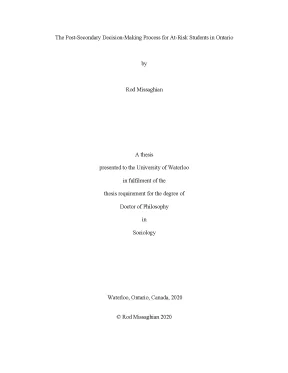
Tải xuống để đọc toàn bộThe Post-Secondary Decision-Making Process for At-Risk Students in Ontario by Rod Missaghian A thesis presented to the University of Waterloo in fulfilment of the thesis requirement for the degree of Doctor of Philosophy in Sociology Waterloo, Ontario, Canada, 2020 © Rod Missaghian 2020 Examining Committee Membership The following served on the Examining Committee for this thesis. The decision of the Examining Committee is by majority vote. Supervisor Janice Aurini, Associate Professor Department of Sociology & Legal Studies Reader John McLevey, Associate Professor Department of Sociology & Legal Studies Reader Linda Quirke, Associate Professor Department of Sociology & Legal Studies Internal-External Examiner Kristina R. Llewellyn, Associate Professor Department of Social Development Studies External Examiner Wolfgang Lehmann, Professor ii Authors Declaration I hereby declare that I am the sole author of this thesis.
This is a true copy of the thesis, including any required final revisions, as accepted by my examiners. I understand that my thesis may be made electronically available to the public. iii Abstract An important body of research examines the role of student decision-making on stratification and post-secondary transitions. In an era of expanded options, students often have to draw on personal, family and institutional resources to make informed decisions that fit with their academic background and personal interests.
For students from low income households and neighbourhoods, the difficulty of making sound decisions is compounded by their lack of access to high status ties and cultural capital which can help them capitalize on such interactions. This sandwich dissertation examines the role of social and cultural capital in the decision-making process for at-risk students, using alignment theory to help evaluate the types of decisions students make over time. Using a longitudinal qualitative framework, students are interviewed at three time points to explore how these various types of capital interact with their decision- making. The first chapter focuses on the role of social capital, particularly institutional agents in helping students align their decision-making, prior to the college and university application deadlines in Ontario.
The second chapter focuses on interviews with students after they have made their decisions for the fall, examining how their individual habitus orientations interact with the institutional habitus of school personnel; changes to decisions from their first interviews are also explored. The last chapter explores the theoretical affinity between rational actor theory and habitus, using alignment as a bridging theory to assess student decision-making and transitions over a 15 month period. While institutional agents were found to help students make informed decisions at various time points, the quality and duration of those ties, as well students’ early aspiration formation and academic background, were all critical for early alignment and successful post-secondary transitions. iv Acknowledgements I would like to express my sincere gratitude, first, to Janice Aurini, who has supported me throughout this process, and provided me with opportunities to become a better researcher.
Thank you for your confidence in me, and for always pushing me to do better. I could not have dreamed of a better supervisor. I would also like to thank the other members of my committee, John McLevey and Linda Quirke, who have been like co-supervisors, providing me with productive feedback, and supporting me throughout the journey in graduate school. It has truly been a pleasure to spend quality time with all of you.
Thanks to Scott Davies, Jessica Rizk, and other anonymous reviewers for also reading advanced drafts of my chapters. I also owe a great deal of my academic development to my time spent with Roger Pizarro Milian, who I have collaborated with on several projects. He has taught me so much about how to navigate graduate school and academia; his mentorship has been invaluable. To the department of Sociology and Legal Studies: thank you for accepting me into your program and providing me with great support throughout.
I would also like to thank the staff and students at Eastgate Secondary School (Pseudonym), for without you, there would be no research to write about. To my family, thank you for the moral support, commiseration, and advice. To my lovely wife Angela, thank you for everything. There are no words to express my gratitude.
Raising a family and completing a PhD seemed insurmountable at times, but you gave me the strength to keep climbing. I would also like to thank the government of Ontario, and the University of Waterloo for helping to support my education with their generous OGS awards. v Table of Contents LIST OF TABLES……………………………………………………………………………….12 Decision-Making Alignment………………………………………………………….13 Social Class and Stratification……………………………………………………….14 Social and Cultural Capital………………………………………………………….15 Rational Choice in Education……………………………………………………….2 Methods- Qualitative Longitudinal Research…………………………………………….3 Structure of Dissertation…………………………………………………………………. PREFACE TO THE FIRST PAPER…………………………………………………………20 3.
PAPER 1: UNIVERSITY DREAMS ARE MADE OF THESE: SOCIAL CAPITAL IN THE POSTSECONDARY DECISION-MAKING PROCESS OF AT-RISK STUDENTS…….11 Decision-Making Alignment……………………………………………………….12 Bonding Social Capital…………………………………………………………….13 Bridging Social Capital…………………………………………………………….31 Bonding Social Capital…………………………………………………………….32 Bridging Social Capital: Ties to Institutional Agents………………………………. PREFACE TO THE SECOND PAPER………………………………………………………53 5. PAPER 2: “SHE JUST TOLD ME THAT’S WHY:” SURVIVAL HABITUS, INSITUTIONAL HABITUS AND HIDDEN STRATIFICATION IN THE POSTSECONDARY CHOICE PROCESS OF AT-RISK STUDENTS……………………………………………………….1 HABITUS AND DECISION MAKING…………………………………………………57 5.11 The “college for all” ethos and hidden stratification……………………………….21 Research site and sample……………………………………………………………61 5.32 Institutional Habitus and Decision Making…………………………………………73 5. PREFACE TO THE THIRD PAPER……………………………………………………….
PAPER 3: HABITUS, RATIONAL CHOICE AND ALIGNED AMBITION: A LONGITUDINAL PANEL STUDY OF AT-RISK STUDENT DECISION-MAKING……….1 BRIDGING RAT AND HABITUS IN DECISION-MAKING STUDIES………………….31 Rational Decision-Making……………………………………………………….32 Habitus and Decision-Making…………………………………………………….33 Bridging RAT and Habitus: The role of Aligned Ambition……………………….127 BIBLIOGRAPHY………………………………………………………………………………137 APPENDICES Paper 1………………………………………………………………………………….153 Appendix C Interview Guides Student Interviews………………………………………………………………………156 Interview 2…………………………………………………………………….162 Teachers and Guidance Counselors…………………………………………………….164 Appendix D Consent and Assent Forms Students…………………………………………………………………………………166 Parental Consent Form…………………………………………………………………171 School Principal……………………………………………………………………….172 Guidance Counselors and Teachers…………………………………………………….175 viii List of Tables PAPER 1 TABLE 1 Type of Social Capital and Decision Making Alignment- Crosstabulation……….36 TABLE 2 Decision-Making Alignment and Uncertainty- Crosstabulation………………….41 TABLE A1 Parental Education and Occupation……………………………………….146 TABLE A2 Student Grades, Level of Study…………………………………………….147 TABLE A3 Descriptive Statistics……………………………………………………………148 PAPER 2 TABLE A4 Descriptive Statistics…………………………………………………………….149 TABLE A5 Eastgate Student Decision-Making Time A and B…………………………….150 TABLE A6 Student Grades, Level of Study…………………………………………….151 PAPER 3 TABLE 1 Interview Schedule…………………………………………………………………91 TABLE 2 Student Expectations and Outcomes………………………………………………109 TABLE A7 Typology of Different Students at Eastgate…………………………………….152 ix Introduction The rapid expansion of the postsecondary sector in Canada has seen the number of university enrolments almost double in the last thirty years, rising from 550,000 students in 1980 to 994,000 in 2010 (AUCC 2011). The overall participation rates for university have increased significantly for students aged 18 to 20, from 54% in 1999 to 79% in 2005 (Shaienks et al. Recent national post-secondary enrolment figures, show a 3.04% increase from 2013-14 to 2017-18 (Statistics Canada). However, in 2010 there were about three percent fewer youth in the key 18- to-24 age range compared with 1980 (AUCC 2011).
Thus, as the Canadian population continues to age, other explanations besides population growth should help to account for the rise in postsecondary enrolments over the past three decades. One possible explanation is understanding how students conceptualize success. Some scholars argue, that the increased rates of postsecondary enrolment have coincided with a cultural shift in thinking about the primacy of a university education for life-course success (Davies 2005; Lehmann 2012). Davies and Hammack (2005) argue that even without any clear links between education and defined pathways in the North- American labour market, parents and students continue to think that more education is required to access better jobs.
However, despite any uncertainties of what a post-secondary credential can offer with regards to labour market outcomes, several Canadian studies have demonstrated the potential economic gains (Frank and Walters 2012; Walters 2002). However, researchers are still unsure about how much education, and in which academic programs and disciplines students are mostly likely to get the most immediate and sustainable labour market returns (Frenette and Frank 2016). As individual post-secondary choice is often conceptualized as separate from the effects of educational attainment (Coleman 1993), researchers continue to be fascinated with how choices are influenced by social class background (Gabay Egozi et al 2013; Goldthorpe 1998) as well as 1 the quality of information available to students at the time of decision-making. Much of the research on educational decision-making focuses on cross-sectional data; there is a shortage of longitudinal and specifically, qualitative data that looks at the experience of student decision-making as it takes place within the context of the school, where many of the decisions are made (McDonough 1997).
In addition, there is a shortage of research which focuses on students from the poorest neighbourhoods; rather, the focus has generally been on middle and working class black and white students (see Calarco 2014; Hardie 2015; Lareau 2000). Much of the existing research on student decision-making has not focused on the transition between the last year of high school and the first year of university. There is insufficient data to help us understand how high school decisions contribute to students’ first year experiences. This is a critical time in an undergraduate career, where at-risk students have been argued to be less capable of coping with university pressures (Evans 2012).
Student choice can be a stratifying mechanism, creating further differentiation between students from more privileged backgrounds and those more at-risk for poorer educational outcomes (Gabay-Egozi, Shavit and Yaish 2013; Goldthorpe 1998). This dissertation explores the decision-making processes of grade 12 students who plan to attend post- secondary, as well as their early experiences transitioning. My primary goal is to explore how decision-making processes are shaped by social stratification. Each chapter will explore different theoretical approaches integral to understanding how students learn about various post-secondary options, who they interact with, and how those interactions influence both the types and quality of decisions they make.
This constitutes the first Canadian qualitative study of educational decision-making that tracks students at multiple time points, to explore the processes leading up to postsecondary enrolment, and the influence of those decisions on students’ post-graduation experiences. Unlike 2 previous studies of educational decision-making that have depended on rational-choice models (Gabay-Egozi et al. 2010; Breen, Van De Werfhorst, and Jaeger 2014; Bridge and Wilson 2015; Dollmann 2016), this study will conceptualize decision-making as an interactive process (Bridge and Wilson 2015), shaped in-part by the institutional context, the students’ understanding of their available choices and their class-based access to resources. This research makes valuable contributions to several existing literatures.
First, it complements recent research which has explored the postsecondary experiences of working-class, and lower-SES students (Finnegan and Merrill 2017; Lehmann 2007, 2013). By conducting our research in a lower-SES neighbourhood, we interviewed students who are disadvantaged financially, and whose parents’ occupational statuses make it difficult for them to be heavily involved in their children’s lives (Hamilton 2016; Stephan 2013). While lower SES parents may make great efforts to support their children’s educational dreams, Lareau and Cox (2011) argue that such efforts are not always successful. Second, it provides an additional study for the growing literature on the interaction between rational choice and habitus in student decision-making (Glaesser and Cooper 2014; Maier and Robson 2020).
Finally, and perhaps most importantly, it employs a qualitative longitudinal method to decision-making, allowing for richer student descriptions which permit greater examination of structure versus agency, and allows for a deeper and more nuanced exploration of social processes. The following literature review will highlight the major theoretical approaches central to this dissertation. LITERATURE REVIEW Research examining higher education has focused extensively on the influence of socioeconomic status on postsecondary success. Canadian research demonstrates the importance of providing 3 additional supports for lower SES students when they enter university (Lehmann 2012).
Lower SES students entering university are less-endowed financially (Goldrick-Rab 2016), and are less likely to receive the same level of support from their parents as do students from higher SES backgrounds (Hamilton, Roksa, and Nielsen 2018). Armstrong and Hamilton (2013) argue that having to work while studying can affect grades in college, but lower SES students can encounter other forms of ‘struggle’ besides poor academic performance.
Nội dung được bảo vệ bản quyền — Tải xuống đầy đủ
Trích dẫn luận án này
Rod Missaghian (2020). Quyết định sau THPT của học sinh có nguy cơ ở Ontario [Luận án tiến sĩ, University of Waterloo]. LuanAn.net. https://luanan.net/lich-su/lich-su-viet-nam/missaghian-rod
Câu hỏi thường gặp
Luận án "Quyết định sau THPT của học sinh có nguy cơ ở Ontario" nghiên cứu về vấn đề gì?
Khám phá "Missaghian rod" - Vật liệu tiên tiến với ứng dụng đa dạng. Tìm hiểu cấu tạo, tính năng vượt trội và tiềm năng đột phá trong kỹ thuật.
Luận án "Quyết định sau THPT của học sinh có nguy cơ ở Ontario" được bảo vệ tại trường nào?
Luận án này được bảo vệ tại University of Waterloo. Năm bảo vệ: 2020.
Luận án "Quyết định sau THPT của học sinh có nguy cơ ở Ontario" thuộc chuyên ngành gì?
Luận án "Quyết định sau THPT của học sinh có nguy cơ ở Ontario" thuộc chuyên ngành Sociology. Danh mục: Lịch Sử Việt Nam.
Luận án "Quyết định sau THPT của học sinh có nguy cơ ở Ontario" có bao nhiêu trang?
Luận án "Quyết định sau THPT của học sinh có nguy cơ ở Ontario" có 188 trang. Bạn có thể xem trước một phần tài liệu ngay trên trang web trước khi tải về.
Cách tải luận án "Quyết định sau THPT của học sinh có nguy cơ ở Ontario" về máy như thế nào?
Để tải luận án về máy, bạn nhấn nút "Tải xuống ngay" trên trang này, sau đó hoàn tất thanh toán phí lưu trữ. File sẽ được tải xuống ngay sau khi thanh toán thành công. Hỗ trợ qua Zalo: 0559 297 239.