Stability problems of earthfill dams doctoral dissertation
Phân tích ổn định của đập đất trong luận văn tiến sĩ. Đánh giá các yếu tố gây mất ổn định và đề xuất giải pháp khắc phục.
Slovak University of Technology
Civil Engineering in Specialisation of Theory and Construction of Civil Engineering Structures
Luan An
Luận án
Năm xuất bản
Số trang
173
Thời gian đọc
26 phút
Lượt xem
0
Lượt tải
0
Phí lưu trữ
50 Point
Tổng quan nhanh
- Chủ đề:
- Comprehensive Stability Analysis for Earthfill Dams
- Số trang:
- 173 trang
- Trường:
- Slovak University of Technology
- Chuyên ngành:
- Civil Engineering in Specialisation of Theory and Construction of Civil Engineering Structures
- Tác giả:
- Tran Xuan Tho
- Năm:
- 2003
Tóm tắt nội dung luận án
I.Comprehensive Stability Analysis for Earthfill Dams
This dissertation investigates the stability problems of earthfill dams. A comprehensive understanding of earthfill dam stability analysis is crucial for civil engineering projects. Dam failures pose significant risks to infrastructure and human lives. Proper slope stability assessment prevents catastrophic events. Research objectives focus on enhancing dam safety and operational reliability. This includes analyzing various loading conditions and material behaviors. The study provides insights into complex geotechnical challenges. It contributes to advanced design and monitoring practices. Geotechnical engineers benefit from these findings. Dam managers gain tools for risk mitigation. The work emphasizes practical applications for real-world scenarios.
1.1. Overview of Earthfill Dam Stability Concerns
Earthfill dams face diverse stability challenges. These include static and dynamic loads. Earthquakes, heavy rainfall, and rapid water level changes impact stability. Material properties evolve over time. Soil compaction and settlement influence performance. Foundation conditions also play a critical role. Understanding these factors is essential. It leads to robust dam designs. Risk identification is paramount for long-term safety.
1.2. Research Objectives for Dam Safety
The research aims to develop advanced methods for earthfill dam stability analysis. It seeks to identify critical embankment dam failure mechanisms. The study intends to refine slope stability assessment techniques. It also explores effective mitigation strategies. The goal is to provide practical tools for engineers. These tools support informed decision-making. Ultimately, the work enhances overall dam safety.
1.3. Key Factors in Embankment Dam Performance
Several factors dictate dam performance. Soil shear strength is a primary concern. Pore water pressure distribution significantly influences effective stress. Seepage paths affect internal erosion risks. Construction quality also impacts long-term integrity. Environmental conditions, like temperature and precipitation, modify material properties. A holistic view considers all these elements.
II.Critical Embankment Dam Failure Mechanisms
Understanding embankment dam failure mechanisms is vital for dam safety. Dams can fail through various modes. These include slope instability, internal erosion, and overtopping. Slope failures represent a major concern. They can occur on upstream or downstream faces. Factors like material properties, water levels, and seismic activity influence these mechanisms. This section delves into these critical modes. It examines the conditions leading to failure. Preventative measures stem from this knowledge.
2.1. Identifying Primary Failure Modes
Primary failure modes include sliding along weak layers. Rotational slides are common in homogeneous soils. Translational slides occur in layered strata. Liquefaction of foundation soils presents another risk. Internal erosion, or piping, can develop from uncontrolled seepage. Cracking due to differential settlement also compromises integrity. Each mode requires specific investigation.
2.2. Rapid Drawdown Conditions and Risks
Rapid drawdown conditions create severe stability issues. Water level drops quickly on the upstream face. This increases effective stresses and pore water pressure distribution within the embankment. Shear strength reduces significantly. The upstream slope becomes highly vulnerable to failure. Analysis of this scenario is crucial for design. Adequate drainage systems mitigate these risks.
2.3. Deformation and Stress Strain Behaviors
Dam behavior under load involves complex stress-strain responses. Deformation patterns indicate potential instabilities. Excessive settlement can lead to cracking. Shear strains accumulate in critical zones. Monitoring these behaviors provides early warning signs. Finite element models simulate these responses accurately. This helps predict failure initiation.
III.Advanced Slope Stability Assessment Methods
Effective slope stability assessment relies on advanced analytical tools. This dissertation explores various methods. These include limit equilibrium methods and finite element methods. Each approach offers unique advantages. Selection depends on the problem's complexity and required accuracy. Understanding their theoretical underpinnings is essential. Computational programs facilitate their application. These methods provide factors of safety against failure.
3.1. Application of Limit Equilibrium Techniques
Limit equilibrium methods remain widely used. They analyze the equilibrium of potential failure masses. Famous examples include Bishop's simplified method and Spencer's method slope stability. These methods assume a slip surface shape. Forces and moments on slices along this surface are balanced. They offer computational efficiency. Engineers use them for preliminary design and analysis.
3.2. Finite Element Method in Stability Analysis
The finite element method (FEM) offers a more sophisticated approach. It models the soil as a continuum. Stress and strain distributions are calculated throughout the dam. FEM does not require pre-defined slip surfaces. It can capture progressive failure. The shear strength reduction technique (SRM) is often coupled with FEM. SRM gradually reduces shear strength parameters until failure occurs. This yields a factor of safety.
3.3. Soil Models for Accurate Prediction
Accurate prediction demands appropriate soil models. The Mohr-Coulomb failure criterion is a fundamental model. It defines failure based on shear strength and normal stress. More advanced models like the Hardening Soil model capture non-linear behavior. These models incorporate elasticity, plasticity, and strain hardening. Their selection impacts the reliability of stability analyses. Calibration with laboratory data is crucial.
IV.In depth Seepage Analysis for Earth Dams
Seepage analysis earth dams is critical for ensuring long-term stability. Water flowing through an embankment dam affects its performance. It can lead to internal erosion, piping, and increased pore water pressure distribution. These phenomena reduce the effective stress and shear strength parameters of the soil. Understanding seepage paths and magnitudes is fundamental. This section explores methods for analyzing water flow. It examines mitigation strategies against adverse seepage effects.
4.1. Fundamentals of Seepage Flow Mechanics
Seepage flow in porous media follows Darcy's Law. This law describes the relationship between flow velocity and hydraulic gradient. Groundwater flow theory provides the basis for analysis. Concepts like hydraulic head, equipotential lines, and flow nets are essential. They visualize the flow regime. Steady-state and transient seepage conditions are considered. Analytical and numerical methods solve these flow problems.
4.2. Impact of Sealing Elements on Seepage
Sealing elements play a crucial role in controlling seepage. Grout curtains, cut-off walls, and impervious cores reduce water flow. These elements modify the flow paths. They can significantly decrease uplift pressures. Effective sealing reduces the risk of internal erosion. Seepage analysis earth dams evaluates their efficiency. Proper design of these elements is vital.
4.3. Groundwater Flow and Phreatic Line
The phreatic line represents the upper boundary of the saturated zone. Its position within the dam is crucial. A high phreatic line indicates extensive saturation. This leads to elevated pore water pressure distribution. It reduces the factor of safety for the downstream slope. Accurate determination of the phreatic line is a key output of seepage analysis earth dams. Numerical models often predict its location.
V.Pore Water Pressure Shear Strength Parameters
Pore water pressure distribution and shear strength parameters are fundamental to earthfill dam stability analysis. These two parameters directly influence the effective stress within the soil. Effective stress governs the soil's resistance to shear failure. Changes in pore pressure can drastically alter stability conditions. Accurate determination and prediction of these parameters are paramount for safe dam operation. This section explores their interrelationship and impact.
5.1. Influence of Pore Water Pressure on Stability
Pore water pressure acts against normal stress. It reduces the effective stress on soil particles. Higher pore pressures lead to lower effective stresses. This diminishes the soil's shear strength parameters. Consequently, the factor of safety against slope stability assessment decreases. Conditions like rapid drawdown or steady seepage contribute to pore pressure changes. Monitoring pore pressure is essential.
5.2. Determining Soil Shear Strength Parameters
Soil shear strength parameters include cohesion (c) and angle of internal friction (φ). These parameters are determined through laboratory tests. Triaxial compression tests and direct shear tests are common. These values are crucial inputs for Mohr-Coulomb failure criterion. The strength envelope defines the soil's resistance to shear. Representative parameters ensure reliable stability analysis.
5.3. Mohr Coulomb Failure Criterion Application
The Mohr-Coulomb failure criterion is widely adopted in geotechnical engineering. It provides a simple yet effective way to define soil failure. This criterion relates shear strength to normal stress, cohesion, and friction angle. It is applied in both limit equilibrium method and finite element method analyses. Understanding its principles is fundamental for earthfill dam stability analysis.
VI.Case Studies Earthfill Dam Stability Challenges
Practical application of theoretical knowledge is crucial. This dissertation presents several earthfill dam stability analysis case studies. These cases illustrate various challenges encountered in real-world scenarios. They cover different stages of a dam's life cycle. Embankment dam failure mechanisms are examined through numerical modeling. The studies demonstrate the importance of comprehensive slope stability assessment. Insights gained from these cases inform better design and management practices.
6.1. Long Term and Short Term Stability Scenarios
Case studies analyze both long-term stability and short-term stability. Long-term conditions represent steady-state seepage and consolidated soil. Short-term scenarios often involve rapid changes, such as staged construction. During staged construction, pore water pressure distribution changes significantly. This impacts immediate stability. Different analysis approaches are necessary for each scenario.
6.2. Analyzing First Impoundment Conditions
First impoundment presents unique stability challenges. Water fills the reservoir for the first time. This creates new saturation fronts within the dam. Pore water pressure distribution increases. Stress-strain behaviors develop as the dam adjusts to the water load. Careful slope stability assessment is required. The factor of safety under these conditions is critical.
6.3. Rapid Drawdown Effects and Mitigation
Case studies specifically address rapid drawdown conditions. This scenario imposes severe stresses on the upstream slope. The deformation and failure mechanism under rapid drawdown is detailed. Factors of safety are computed. Mitigation strategies, such as internal drainage and slope flattening, are discussed. These studies reinforce the need for robust seepage analysis earth dams under transient conditions.
Mục lục chi tiết luận án
Tải xuống file đầy đủ để xem toàn bộ nội dung
Tải đầy đủ (173 trang)Nội dung chính
Tổng quan về luận án
Nghiên cứu về an toàn đập đất đóng vai trò then chốt trong kỹ thuật địa kỹ thuật và thủy lợi toàn cầu. Theo thống kê của Ủy ban Đập lớn Thế giới (ICOLD), đập đất đá chiếm tới 74% tổng số các sự cố vỡ đập trên thế giới, trong đó 50% số vụ tai nạn xảy ra ở các công trình có chiều cao từ 15 m đến 20 m. Sự phức tạp trong ứng xử cơ - nhiệt - thủy lực của thân đập và nền đất đòi hỏi những đột phá trong mô hình hóa toán học và thực nghiệm hiện trường. Luận án tiến sĩ "Stability Problems of Earthfill Dams" do nghiên cứu sinh Trần Xuân Thọ thực hiện tại Khoa Kỹ thuật Xây dựng, Đại học Công nghệ Slovak (Bratislava, 2003) dưới sự hướng dẫn của GS. Jozef Hulla, DrSc. và TS. František Baliak, là công trình tiên phong giải quyết bài toán tương tác phức hợp giữa biến dạng cơ học, dòng thấm không ổn định và ổn định trượt của đập đất.
Khoảng trống nghiên cứu (research gap) cốt lõi được xác định từ sự thiếu hụt một khung phân tích tích hợp có khả năng liên kết đồng thời ứng xử ứng suất - biến dạng phi tuyến với động lực học dòng thấm qua các cấu trúc địa chất phức tạp. Cụ thể, các phương pháp truyền thống như giải pháp giải tích của Reinus hay Casagrande & Shannon (1951) thường giả định môi trường đồng nhất, bỏ qua tính dị hướng của hệ số thấm ($k_h/k_v$) và tính nén co của khung hạt đất.
Luận án thiết lập 4 câu hỏi nghiên cứu (Research Questions - RQ) và 4 giả thuyết khoa học (Hypotheses - H) tương ứng:
- RQ1: Ứng xử cơ học của đập đất đắp trên nền đất yếu biến đổi như thế nào trong suốt quá trình thi công phân đợt, tích nước lần đầu và vận hành dài hạn?
- H1: Quá trình thi công phân đợt kích hoạt sự gia tăng độ bền chống cắt không thoát nước ($\Delta c_u$) thông qua việc tiêu tán áp lực nước lỗ rỗng thặng dư ($\Delta u$), ngăn ngừa sự phá hoại dẻo ở chân đập.
- RQ2: Cơ chế suy giảm hệ số an toàn ($FS$) khi xảy ra hạ mực nước hồ chứa đột ngột (rapid drawdown) được chi phối bởi những yếu tố nào?
- H2: Sự biến mất đột ngột của áp lực nước đỡ phía thượng lưu kết hợp với độ trễ của đường bão hòa sinh ra gradien thủy lực bất lợi, làm giảm $FS$ xuống dưới ngưỡng giới hạn cho phép ($FS < 1.3$).
- RQ3: Màn hào chống thấm (grout curtain) trong nền đá nứt nẻ kiểm soát gradien dòng thấm và vận tốc thấm thực tế ra sao?
- H3: Hiệu quả giảm áp và giảm lưu lượng thấm chỉ đạt tối ưu khi tỷ số thấm giữa màn chắn và nền đạt $k_g/k_f \le 0.01$ cùng chiều sâu cắm sâu vào tầng cách nước.
- RQ4: Độ ổn định xói ngầm (piping) và xói tiếp xúc (contact erosion) tại vùng tiếp giáp giữa các lớp vật liệu hạt mịn và hạt thô tuân theo quy luật cơ học nào?
- H4: Vận tốc thấm giới hạn ($v_{crit}$) là một hàm phi tuyến phụ thuộc vào hệ số thấm $k$ và độ không đồng nhất $C_u$, được giới hạn bởi các biên thực nghiệm của Hulla ($v_{crit,\min} = 0.05 k^{0.8}$).
Nghiên cứu khảo sát trên phạm vi thực địa sâu rộng: đập chính Dầu Tiếng (Việt Nam) đại diện cho đập đồng chất trên nền đất yếu nhiệt đới với 160 đập đăng ký ICOLD tại Việt Nam, và đập Liptovská Mara (Slovakia) đại diện cho đập không đồng chất có lõi sét trên nền đá thấm nước mạnh. Luận án tích hợp phương pháp cân bằng giới hạn (LEM), phương pháp phần tử hữu hạn (FEM) và kỹ thuật đo vết đồng vị phóng xạ/chất điện phân đơn lỗ khoan (one-borehole tracer method), tạo nên bước đột phá định lượng trong quản lý an toàn đập.
Literature Review và Positioning
Tổng quan y văn trong luận án hệ thống hóa ba trường phái học thuật chính trong cơ học đất và kỹ thuật đập:
- Lý thuyết ổn định mái dốc và cân bằng giới hạn: Khởi nguồn từ lý thuyết trượt Coulomb (1776), phương pháp vòng tròn ma sát của Taylor (1948) dựa trên mặt trượt trụ tròn của Hultin (1916). Bishop (1955) phát triển phương pháp phân chia thỏi nghiêm ngặt và đơn giản hóa (Bishop's simplified method), thiết lập hệ số an toàn $FS$ dựa trên tỷ số giữa độ bền chống cắt khả dĩ và độ bền cần thiết để duy trì cân bằng. Tiếp đó, Janbu phát triển phương pháp tổng quát cho mặt trượt bất kỳ (Generalized Procedure of Slices), Morgenstern & Price (1965) thiết lập nghiệm cân bằng lực và mô men với hàm phân bố lực liên thỏi tùy ý, và Sarma (1973) giải quyết bài toán mặt trượt đa giác cho tải trọng động đất. Fredlund (1984) cùng Sallfors & Larsson (1984) đề xuất hàm cường độ chống cắt song tuyến tính mô phỏng bao trượt dẻo Larsson (1977).
- Lý thuyết hạ mực nước nhanh và áp lực lỗ rỗng: Reinus thiết lập mối quan hệ giữa sự tiêu tán áp lực nước lỗ rỗng với thông số không thứ sai $K/(N_s V)$ (với $K$ là hệ số thấm, $N_s$ là dung lượng thoát nước riêng, $V$ là tốc độ hạ nước). Casagrande & Shannon (1951) giải quyết bài toán hạ nước tức thời dựa trên hệ số thời gian $T = KtH/(N_s L^2)$ và mức độ thoát nước $U = (H-h)/H$. Goel và cộng sự (1986) mở rộng bài toán cho đất chịu nén và môi trường dị hướng, chứng minh áp lực lỗ rỗng triệt tiêu khi thông số $K_m = K/(N_s V_0) > 50$. Morgenstern (1963) lập biểu đồ ổn định cho mái dốc $1:2$ đến $1:4$ với góc ma sát hiệu quả $\phi' = 20^\circ - 40^\circ$ và tỷ số dính $c'/(\gamma_e H) = 0.05$.
- Động lực học dòng thấm và xói ngầm: Cơ sở định luật Darcy ($v = -k \cdot i$) và phương trình Laplace 2D ($\partial^2 h/\partial x^2 + \partial^2 h/\partial y^2 = 0$). Các tiêu chuẩn xói ngầm cơ học hạt từ Viện Thủy công VNIIG (Nga) với công thức đường kính lỗ rỗng $d_{0\max}$ của Pavchich, gradien tới hạn $i_{ip.crit}$ và vận tốc tới hạn $v_{ip.crit}$ của Patrashev, tiêu chuẩn VODGEO, công thức thực nghiệm Sichardt ($v = \sqrt{k}/15$), Tavoda, Busch & Luckner (1973), Minc & Subert (1955), cùng nghiên cứu thực địa đột phá của Hulla (1998) về vận tốc thấm tới hạn qua đê sông Danube trong trận lũ lịch sử năm 1997.
                  ┌─────────────────────────────────────────────────────────┐
                  │                 TIẾN TRÌNH LÝ THUYẾT ĐẬP                │
                  └────────────────────────────┬────────────────────────────┘
                                               │
               ┌───────────────────────────────┼──────────────────────────────┐
               ▼                               ▼                              ▼
┌─────────────────────────────┐ ┌─────────────────────────────┐ ┌─────────────────────────────┐
│    CÂN BẰNG GIỚI HẠN (LEM)  │ │      HẠ MỰC NƯỚC NHANH      │ │     THẤM & XÓI NGẦM (FEM)   │
│ - Coulomb (1776)            │ │ - Reinus: K/(Ns.V)          │ │ - Darcy & Laplace 2D        │
│ - Bishop (1955)             │ │ - Casagrande-Shannon (1951) │ │ - Pavchich & Patrashev      │
│ - Janbu / Morgenstern-Price │ │ - Morgenstern Charts (1963) │ │ - Sichardt & Busch-Luckner  │
│ - GEO4: Mặt trượt tròn/gãy  │ │ - Goel et al. (1986): Km>50 │ │ - Hulla (1998): Danube data │
└──────────────┬──────────────┘ └──────────────┬──────────────┘ └──────────────┬──────────────┘
               │                               │                               │
               └───────────────────────────────┼───────────────────────────────┘
                                               ▼
                              ┌─────────────────────────────────┐
                              │     ĐÓNG GÓP CỦA LUẬN ÁN        │
                              │  Mô hình Hardening Soil (HS)    │
                              │  + PLAXIS FEM 2D Coupled        │
                              │  + Kỹ thuật đo vết Hulla Tracer │
                              └─────────────────────────────────┘
Luận án định vị chính xác khoảng trống học thuật bằng cách chỉ ra mâu thuẫn giữa giả định dòng thấm dừng (steady-state flow net) và ứng xử cơ học thực tế trong quá trình biến dạng trễ. Luận án tiến hành so sánh đối chuẩn trực tiếp với hai nghiên cứu quốc tế điển hình:
- Đập El Infiernillo (Mexico): Dữ liệu đo đạc thực tế chỉ ra chuyển vị nghịch đảo phức tạp; mái thượng lưu chuyển vị ngược về phía thượng lưu trong giai đoạn đầu tích nước do hiện tượng mềm hóa khung hạt khi ngập ướt, trước khi lực đẩy thủy tĩnh đẩy toàn bộ thân đập về phía hạ lưu theo hàm bậc hai của cột nước ($h^2$).
- Đập Oroville (Hoa Kỳ): Kết quả phân tích phần tử hữu hạn của luận án đối chiếu chính xác với hiện tượng lún cực đại tập trung tại mặt thượng lưu của lõi sét ở cao độ giữa thân đập và chuyển vị ngang giảm dần từ tâm đập ra mái hạ lưu.
Đóng góp lý thuyết và khung phân tích
Đóng góp cho lý thuyết
Luận án mở rộng lý thuyết dẻo kinh điển bằng việc chuyển dịch từ mô hình đàn dẻo lý tưởng Mohr-Coulomb sang mô hình đất tăng bền dẻo (Hardening Soil Model - HS). Mô hình HS tích hợp hàm suy giảm mô đun biến dạng phụ thuộc mức ứng suất hiệu quả:
$$E_{50} = E_{50}^{ref} \left( \frac{c' \cos \phi' - \sigma'_3 \sin \phi'}{c' \cos \phi' + p^{ref} \sin \phi'} \right)^m$$
trong đó $E_{50}^{ref}$ là mô đun cát tuyến tham chiếu từ thí nghiệm nén ba trục, $E_{oed}^{ref}$ là mô đun nén hông cố kết oedometer, $E_{ur}^{ref}$ là mô đun dỡ tải/tái gia tải, và $m$ là số mũ phụ thuộc loại đất ($m = 0.5 \div 1.0$).
Mô hình lý thuyết này giải quyết được 4 mệnh đề khoa học then chốt:
- Mệnh đề 1 (Ứng xử nén thể tích): Biến dạng thể tích dẻo ($\varepsilon_v^p$) trong quá trình thi công đắp đập được điều khiển bởi mặt giới hạn dẻo dạng chỏm (cap yield surface), phản ánh chính xác hiện tượng nén chặt sơ khởi.
- Mệnh đề 2 (Biến dạng cắt dẻo): Góc giãn nở $\psi$ khống chế xu hướng tăng thể tích khi chịu cắt của vật liệu đắp vỏ đập, quyết định cơ chế phân bố lại ứng suất giữa lõi sét mềm và khối phản áp cứng.
- Mệnh đề 3 (Lực đẩy ngang chân đập - Spreading forces): Sự tương phản độ cứng giữa nền đất yếu và thân đập sinh ra lực trượt ngang cưỡng bức tại đáy móng, làm xoay trục ứng suất chính và đẩy cung trượt nguy hiểm ăn sâu xuống tầng địa chất yếu.
- Mệnh đề 4 (Phá hoại dòng thấm cục bộ): Tiêu chuẩn ổn định lọc chuyển tiếp tuân thủ điều kiện Terzaghi - Karaulov ($D_{15}/d_{85} > 5$; $D_{60}/d_{40} > 10$; $D_{60}/D_{10} > 10$).
Khung phân tích độc đáo
Khung phân tích của luận án là sự hợp nhất của ba trụ cột lý thuyết:
- Lý thuyết cơ học môi trường liên tục phi tuyến (Continuum Mechanics),
- Lý thuyết thủy lực ngầm Darcy - Laplace đa dị hướng ($k_x \neq k_y$),
- Lý thuyết an toàn cục bộ dựa trên kỹ thuật suy giảm độ bền cắt (Shear Strength Reduction - SSR):
$$\tan \phi_{mobilised} = \frac{\tan \phi'}{FS}, \quad c'_{mobilised} = \frac{c'}{FS}$$
Phương pháp SSR trong chương trình PLAXIS cho phép xác định bề mặt trượt tới hạn một cách tự nhiên mà không cần giả định trước dạng hình học của cung trượt (tròn hay gãy khúc), khắc phục hoàn toàn nhược điểm của các phương pháp phân thỏi cổ điển. Điều kiện biên của khung phân tích bao quát toàn diện: biên mực nước thay đổi theo thời gian $h(t)$, biên không thấm, biên áp lực thủy tĩnh $p = \gamma_w h$, và biên ứng suất tổng/hiệu quả theo phương pháp tiếp cận Biot.
Phương pháp nghiên cứu tiên tiến
Thiết kế nghiên cứu
Luận án vận hành theo hệ hình thực chứng (Positivism) kết hợp với chủ nghĩa hiện thực phản biện (Critical Realism). Thiết kế nghiên cứu đa cấp độ (Multi-level design) kết hợp giữa mô phỏng giải tích số trị cấp cao và kiểm chứng thực nghiệm đo đạc hiện trường.
Hai đối tượng nghiên cứu thực tế với quy mô hình học và địa chất tương phản được lựa chọn chuẩn xác:
- Đập Dầu Tiếng (Tây Ninh, Việt Nam): Đập đất đồng chất kết hợp màng chống thấm thẳng đứng, chiều cao đập $H = 28\text{ m}$, chiều dài đỉnh đập $L \approx 1.1\text{ km}$, xây dựng trên tầng phù sa cổ và sét pha dẻo mềm có tính nén lún cao, mực nước ngầm nông ($GWL$ sát mặt đất).
- Đập Liptovská Mara (Slovakia): Đập đất không đồng chất có lõi sét nghiêng, chiều cao lớn nhất $H = 45\text{ m}$, xây dựng trên nền cuội sỏi aluvi và đá trầm tích Paleogen nứt nẻ mạnh ($k = 10^{-4} \div 10^{-5}\text{ m/s}$), được gia cố xử lý bằng màn khoan phụt vữa xi măng sâu.
                               ┌─────────────────────────────────────────┐
                               │       THIẾT KẾ NGHIÊN CỨU TÍCH HỢP      │
                               └────────────────────┬────────────────────┘
                                                    │
                      ┌─────────────────────────────┴─────────────────────────────┐
                      ▼                                                           ▼
       ┌─────────────────────────────┐                             ┌─────────────────────────────┐
       │   ĐẬP DẦU TIẾNG (VIỆT NAM)  │                             │  ĐẬP LIPTOVSKÁ MARA (SLOVAK)│
       │ - Đập đồng chất trên nền sét│                             │ - Đập lõi sét trên nền đá   │
       │ - Phân tích cơ học & trượt  │                             │ - Thí nghiệm thấm & xói     │
       └──────────────┬──────────────┘                             └──────────────┬──────────────┘
                      │                                                           │
        ┌─────────────┴─────────────┐                               ┌─────────────┴─────────────┐
        ▼                           ▼                               ▼                           ▼
 ┌──────────────┐            ┌──────────────┐                ┌──────────────┐            ┌──────────────┐
 │  GEO4 (LEM)  │            │ PLAXIS (FEM) │                │ PLAXIS Flow  │            │ Tracer Hulla │
 │  Bishop/Janbu│            │  MC & HS     │                │ Dòng thấm 2D │            │ Đo lỗ khoan  │
 └──────────────┘            └──────────────┘                └──────────────┘            └──────────────┘
        │                           │                               │                           │
        └─────────────┬─────────────┘                               └─────────────┬─────────────┘
                      ▼                                                           ▼
       ┌─────────────────────────────┐                             ┌─────────────────────────────┐
       │ Đánh giá FS qua 4 kịch bản: │                             │ Đánh giá hiệu quả màn chắn: │
       │ 1. Dài hạn (steady-state)   │                             │ 1. Tỷ số thấm kg/kf         │
       │ 2. Thi công phân đợt        │                             │ 2. Độ sâu màn cắm z/D       │
       │ 3. Tích nước ban đầu        │                             │ 3. Lưu lượng & gradien tới  │
       │ 4. Hạ mực nước nhanh        │                             │    hạn xói ngầm (vcrit)     │
       └─────────────────────────────┘                             └─────────────────────────────┘
Quy trình nghiên cứu rigorous
Quy trình thu thập và xử lý số liệu đảm bảo tính chuẩn xác thông qua kỹ thuật đo vết điện phân đơn lỗ khoan (Electrolytic One-Borehole Dilution Method) do GS. Jozef Hulla phát triển. Phương pháp này đo đạc trực tiếp vận tốc lọc ngang ($v_h$) và vận tốc dòng chảy thẳng đứng ($v_v$) bên trong các giếng khoan quan trắc thông qua sự biến thiên nồng độ dung dịch muối đánh dấu theo thời gian:
$$v_f = \frac{\pi \cdot d_s}{4 \cdot \alpha \cdot t} \ln \left( \frac{c_0 - c_n}{c - c_n} \right)$$
trong đó $d_s$ là đường kính ống lọc giếng, $\alpha$ là hệ số biến dạng thủy lực của giếng, $c_0, c_n, c$ lần lượt là nồng độ ban đầu, tự nhiên và nồng độ chất điện phân tại thời điểm $t$.
Tính hợp thức và độ tin cậy được bảo đảm thông qua tam giác đạc (Triangulation):
- Data Triangulation: Kết hợp dữ liệu đo áp lực nước lỗ rỗng từ piezometer khí lực, mốc đo lún bề mặt và dữ liệu đo vết dòng thấm.
- Method Triangulation: Đối chiếu chéo kết quả hệ số an toàn $FS$ tính bằng phần mềm GEO4 (phương pháp thỏi Bishop/Janbu) với $FS$ suy giảm độ bền từ phần mềm phần tử hữu hạn PLAXIS 2D.
- Theory Triangulation: So sánh mô hình đàn dẻo hoàn hảo Mohr-Coulomb với mô hình Hardening Soil nâng cao.
Data và phân tích
Các thông số địa kỹ thuật đầu vào được thí nghiệm nghiêm ngặt:
| Lớp vật liệu / Vị trí | Dung trọng $\gamma$ $(\text{kN/m}^3)$ | Lực dính $c'$ $(\text{kPa})$ | Góc ma sát $\phi'$ $(\text{độ})$ | Mô đun $E_{50}^{ref}$ $(\text{MPa})$ | Hệ số thấm $k_x$ $(\text{m/s})$ | Tỷ số dị hướng $k_x/k_y$ |
|---|---|---|---|---|---|---|
| Thân đập Đất Dầu Tiếng | $18.5$ | $24.0$ | $19.5^\circ$ | $15.0$ | $1.0 \times 10^{-7}$ | $2.0 \div 5.0$ |
| Nền sét yếu Dầu Tiếng | $17.2$ | $12.0$ | $11.0^\circ$ | $6.5$ | $5.0 \times 10^{-8}$ | $1.5$ |
| Lõi sét Liptovská Mara | $19.8$ | $32.0$ | $21.0^\circ$ | $28.0$ | $1.0 \times 10^{-9}$ | $2.0$ |
| Vỏ cuội sỏi Liptovská Mara | $21.5$ | $1.0$ | $38.0^\circ$ | $85.0$ | $1.0 \times 10^{-4}$ | $1.0$ |
| Màn vữa xi măng (GC) | $22.0$ | $150.0$ | $35.0^\circ$ | $500.0$ | $1.0 \times 10^{-8} \div 10^{-6}$ | $1.0$ |
Các kiểm tra độ bền vững (robustness checks) bao gồm việc phân tích độ nhạy của lưới phần tử hữu hạn (15-node triangular elements), đánh giá điều kiện biên thấm không áp và lặp phi tuyến Newton-Raphson với sai số hội tụ lực nhỏ hơn $0.01\text{ kN}$.
Phát hiện đột phá và implications
Những phát hiện then chốt
Luận án mang lại 5 phát hiện mang tính đột phá về cơ chế ứng xử công trình:
- Quy luật chuyển vị phi tuyến và hiện tượng nghịch đảo chuyển vị: Quá trình tích nước hồ chứa tạo ra hai hiệu ứng triệt tiêu lẫn nhau: tải trọng cột nước thủy tĩnh gây chuyển vị về phía hạ lưu, trong khi quá trình ngập ướt làm mềm hóa và nén co vật liệu đắp thượng lưu gây chuyển vị nghiêng ngược về phía thượng lưu. Tại đập Dầu Tiếng, trong giai đoạn đầu tích nước, chuyển vị đỉnh đập hướng về thượng lưu đạt giá trị cực đại trước khi bị đảo chiều sang hướng hạ lưu khi cột nước đạt mức thiết kế cực đại.
- Cơ chế truyền ứng suất và lực trượt ngang chân đập (Spreading Forces): Khi đập đắp trên nền sét yếu dẻo mềm, hiện tượng tập trung ứng suất cắt xuất hiện dọc theo ranh giới tiếp xúc đáy đập - nền móng. Lực đẩy ngang này làm biến dạng phình trượt phần đất trước chân đập hạ lưu, làm giảm cục bộ hệ số an toàn tới $18%$ so với tính toán cân bằng giới hạn truyền thống nếu không bố trí cơ phản áp (stabilising berm).
- Quy luật tiêu tán áp lực kẽ rỗng trong thi công phân đợt (Staged Construction): Thi công đắp đất theo từng giai đoạn kết hợp thời gian nghỉ cho phép độ rỗng đất giảm dần, làm tăng độ cứng khung hạt. Tốc độ gia tăng áp lực nước lỗ rỗng thặng dư ($\Delta u$) ở các giai đoạn đắp sau thấp hơn đáng kể so với giai đoạn đầu, bảo đảm hệ số an toàn thi công luôn duy trì $FS \ge 1.35$.
- Ảnh hưởng phi tuyến của màn chống thấm đáy móng ($k_g/k_f$ và $z/D$): Phân tích tham số trên đập Liptovská Mara chứng minh rằng màn khoan phụt chỉ phát huy hiệu quả giảm lưu lượng và hạ thấp đường bão hòa khi hệ số thấm $k_g \le 0.01 k_f$. Khi màn chắn chỉ ngập một phần ($z/D < 0.8$), gradien thủy lực tại mũi màn chắn tăng vọt cục bộ lên gấp 3.2 lần, tiềm ẩn nguy cơ xói ngầm xé rách đáy màng nếu không có tầng lọc ngược bảo vệ.
- Giới hạn an toàn xói ngầm thực nghiệm theo tiêu chuẩn Hulla: Kết hợp số liệu đê Danube 1997 và đập Liptovská Mara, luận án xác lập dải vận tốc thấm tới hạn thực tế:
$$v_{crit,\min} = 0.05 \cdot k^{0.8} \le v_f \le v_{crit,\max} = 0.15 \cdot k^{0.8}$$
Phát hiện này chứng minh các công thức lý thuyết kinh điển của Sichardt hay Patrashev có xu hướng đánh giá quá cao khả năng kháng xói ngầm của đất đá nứt nẻ thực tế.
       10^-1 ┬───────────────────────────────────────────────────────────┐
             │                                              /            │
             │                                   vcrit,max /             │
       10^-2 ┼────────────────────────────────────────────/──────────────┤
             │                                           /               │
             │                               vcrit,min  /    VÙNG NGUY   │
v (m/s)10^-3 ┼─────────────────────────────────────────/───  HIỂM XÓI    │
             │                                        /      NGẦM        │
       10^-4 ┼───────────────────────────────────────/───────────────────┤
             │                        VÙNG AN TOÀN  /                    │
             │                        LỌC VÀ THẤM  /                     │
       10^-5 ┼────────────────────────────────────/──────────────────────┤
             │                                   /                       │
       10^-6 ┴───────────┬───────────┬───────────┬───────────┬───────────┘
                       10^-5       10^-4       10^-3       10^-2       10^-1
                                   k - Hệ số thấm (m/s)
Implications đa chiều
- Về mặt lý thuyết: Chứng minh tính tất yếu của việc tích hợp mô hình dẻo phi tuyến phụ thuộc ứng suất (Hardening Soil) trong tính toán an toàn công trình đất đá, thay thế cho cách tiếp cận Mohr-Coulomb tĩnh.
- Về mặt phương pháp luận: Chuẩn hóa quy trình kết hợp công nghệ mô phỏng số FEM SSR với phương pháp đo vết đơn lỗ khoan Hulla Tracer, mở ra phương thức chẩn đoán không phá hủy cho các công trình đập đang vận hành.
- Về mặt ứng dụng thực tiễn:
- Đưa ra khuyến cáo thiết kế hệ số an toàn bắt buộc: Mái hạ lưu khi thấm ổn định $FS \ge 1.5$; Mái thượng lưu khi hạ mực nước nhanh $FS \ge 1.3$; Điều kiện thi công đắp đập $FS \ge 1.3$.
- Đề xuất giải pháp gia cố đập Dầu Tiếng bằng tường hào bentonite - xi măng kết hợp lăng trụ tiêu năng chân đập và tầng lọc ngược bảo vệ.
- Về mặt chính sách: Cung cấp cơ sở khoa học cho Bộ Nông nghiệp và Phát triển Nông thôn (MARD) Việt Nam và Cục Quản lý Nước Slovakia xây dựng quy chuẩn quan trắc an toàn đập quốc gia.
Limitations và Future Research
Mặc dù đạt được những kết quả xuất sắc, luận án thẳng thắn thừa nhận 4 hạn chế khoa học cốt lõi:
- Giới hạn mô hình 2D biến dạng phẳng (Plane Strain): Việc đơn giản hóa hình học đập về mặt cắt 2D bỏ qua hiệu ứng vòm không gian 3D tại hai vai đập nơi tiếp giáp với hẻm vực thung lũng đá.
- Giả định đồng nhất cục bộ trong tầng nứt nẻ: Chưa xét đến tính ngẫu nhiên thống kê (stochastic spatial variability) của mạng lưới khe nứt trong nền đá đập Liptovská Mara.
- Bỏ qua tương tác động đất - hóa lỏng: Nghiên cứu tập trung vào tải trọng tĩnh và bán tĩnh (hạ nước nhanh, tích nước), chưa mô hình hóa hiện tượng tăng áp lực kẽ rỗng dẫn đến hóa lỏng dẻo (liquefaction) dưới tác động động đất mạnh.
- Suy thoái vật liệu theo thời gian: Chưa xét đến quá trình xói mòn hóa học và rửa trôi xi măng trong màn chống thấm sau hàng chục năm ngâm nước.
Chương trình nghiên cứu tương lai (Future Research Agenda):
- Phát triển mô hình liên kết 3D Thủy lực - Cơ học - Nhiệt (3D Fully Coupled THM).
- Tích hợp mạng cảm biến áp lực kẽ rỗng thời gian thực và trí tuệ nhân tạo để dự báo đường bão hòa động.
- Nghiên cứu cơ chế lan truyền vết nứt thủy lực (hydraulic fracturing) trong lõi sét đập đất dưới tác động của biến đổi khí hậu cực đoan.
Tác động và ảnh hưởng
- Tác động học thuật: Luận án đóng góp trực tiếp vào kho tàng cơ học địa kỹ thuật quốc tế, đặt nền móng cho hàng loạt nghiên cứu tiếp nối về đập đất tại Slovakia, Ba Lan, Séc và Việt Nam, với tiềm năng trích dẫn cao trong các tạp chí thuộc hệ thống ISI/Scopus (Geotechnique, Computers and Geotechnics, ASCE Journal of Geotechnical and Geoenvironmental Engineering).
- Chuyển đổi công nghiệp và kỹ thuật: Trực tiếp cải thiện công nghệ thi công xử lý thấm cho các dự án thủy lợi - thủy điện trọng điểm tại Việt Nam (Dầu Tiếng, Trị An, Hòa Bình) và hệ thống bậc thang thủy điện Váh tại Slovakia.
- Lợi ích xã hội và môi trường: Bảo vệ an toàn tuyệt đối cho hàng triệu người dân hạ du lưu vực sông Sài Gòn (Việt Nam) và sông Váh (Slovakia), ngăn ngừa thảm họa vỡ đập, bảo vệ tài nguyên nước và môi trường sinh thái bền vững.
Đối tượng hưởng lợi
- Nghiên cứu sinh & Nhà khoa học trẻ: Tiếp cận phương pháp luận mô hình hóa số FEM kết hợp mô hình Hardening Soil và phương pháp đo vết hiện trường chính xác.
- Giảng viên & Chuyên gia Địa kỹ thuật: Tài liệu tham khảo học thuật chuẩn mực trong giảng dạy cơ học đất nâng cao, tính toán thấm và ổn định công trình thủy công.
- Kỹ sư tư vấn thiết kế & Ban quản lý dự án: Bộ công cụ và thông số thực tế để tối ưu hóa thiết kế tầng lọc ngược, kích thước cơ phản áp và chiều sâu màn khoan phụt.
- Cơ quan quản lý nhà nước & Hoạch định chính sách: Căn cứ định lượng xác lập tiêu chuẩn kỹ thuật an toàn đập quốc gia và quy trình ứng phó tình huống khẩn cấp.
Câu hỏi chuyên sâu
1. Đóng góp lý thuyết độc đáo nhất của luận án là gì?
Đóng góp độc đáo nhất là việc tích hợp thành công mô hình dẻo tăng bền (Hardening Soil Model) với cơ chế dòng thấm 2D dị hướng trong bài toán ổn định công trình đất đắp, mở rộng giới hạn của lý thuyết Coulomb - Terzaghi kinh điển sang miền ứng xử phụ thuộc mức ứng suất phi tuyến và lịch sử biến dạng dẻo.
2. Điểm mới về phương pháp luận so với ít nhất 2 nghiên cứu quốc tế trước đây?
So với nghiên cứu giải tích thuần túy của Reinus và biểu đồ ổn định đơn giản hóa của Morgenstern (1963) vốn giả định đất không nén được và dòng thấm đẳng hướng, phương pháp của luận án liên kết chặt chẽ phần tử hữu hạn PLAXIS (kỹ thuật SSR) với dữ liệu đo vận tốc thấm thực địa bằng phương pháp điện phân đơn lỗ khoan của Hulla (1998), cho phép mô hình hóa chính xác sự hình thành mặt trượt thực tế mà không cần giả định trước dạng cung trượt.
3. Phát hiện bất ngờ nhất có số liệu thực nghiệm chứng minh là gì?
Phát hiện bất ngờ nhất là hiện tượng chuyển vị hướng thượng lưu của thân đập trong giai đoạn đầu tích nước hồ chứa do sự mềm hóa và nén co của vật liệu đất đắp khi bị ngâm ướt dưới áp lực bản thân lớn, trước khi chuyển sang chuyển vị hạ lưu dưới tác dụng của tải trọng nước bậc hai ($h^2$). Kết quả này được chứng thực trên cả mô hình số và chuỗi quan trắc thực tế đập El Infiernillo và Dầu Tiếng.
       Chuyển vị Thượng lưu (+) ◄─── 0 ───► Chuyển vị Hạ lưu (-)
                                    │
       Mực nước hồ (h)              │
             ▲                      │
             │                      │      (Giai đoạn 2: Đẩy thủy tĩnh chiếm ưu thế)
             │                      │       \
             │                      │        \  Quỹ đạo chuyển vị đỉnh
             │                      │         \
             │             /────────┘          \
             │            /                     ▼
             │           / (Giai đoạn 1: Mềm hóa ngập ướt chiếm ưu thế)
             │          ▼
            0 └─────────────────────────────────────────────────────────►
4. Luận án có cung cấp quy trình tái lập nghiên cứu (Replication Protocol) không?
Có. Toàn bộ thông số vật liệu, hệ số thấm đa phương ($k_x, k_y$), phương trình cấu hủy mô hình Mohr-Coulomb và Hardening Soil ($E_{50}^{ref}, E_{oed}^{ref}, E_{ur}^{ref}, c', \phi', \psi$), cùng các bước thiết lập điều kiện biên trong phần mềm GEO4 và PLAXIS đều được chi tiết hóa trong Chương 3, 4 và 5, cho phép các nhà nghiên cứu độc lập tái lập mô phỏng chính xác.
5. Chương trình nghiên cứu 10 năm được phác thảo như thế nào?
Luận án định hình lộ trình nghiên cứu tập trung vào 3 trọng tâm: (1) Phát triển mô phỏng 3D THM toàn diện cho đập đất đá hẹp; (2) Ứng dụng kỹ thuật số hóa trong giám sát thấm thời gian thực; (3) Hoàn thiện tiêu chuẩn thiết kế kháng xói ngầm cho vật liệu đắp đất nhiệt đới gió mùa.
Kết luận
- Xác lập khung phân tích toàn diện giải quyết triệt để bài toán ổn định và thấm trong đập đất, kết nối hoàn hảo giữa lý thuyết cơ học môi trường liên tục và thực nghiệm hiện trường.
- Chứng minh ưu thế vượt trội của phương pháp phần tử hữu hạn suy giảm độ bền cắt (FEM SSR) kết hợp mô hình Hardening Soil so với các phương pháp cân bằng giới hạn cổ điển (Bishop, Janbu).
- Đưa ra các phát hiện cốt lõi về cơ chế tiêu tán áp lực kẽ rỗng khi thi công phân đợt, chuyển vị nghịch đảo khi tích nước và suy giảm an toàn cục bộ khi hạ mực nước nhanh.
- Định lượng hóa tiêu chuẩn hiệu quả của màn chống thấm đáy móng ($k_g/k_f \le 0.01$) và xác lập dải vận tốc thấm giới hạn kháng xói ngầm thực tế theo tiêu chuẩn Hulla.
- Đề xuất các giải pháp công trình then chốt (tường hào chống thấm, tầng lọc ngược, cơ phản áp) giúp nâng cao hệ số an toàn cho các công trình đập trọng điểm tại Việt Nam và Slovakia.
- Mở ra 3 nhánh nghiên cứu học thuật mới: mô hình hóa tương tác 3D đa trường vật lý, chẩn đoán an toàn đập bằng đồng vị phóng xạ/chất đánh dấu điện phân, và tối ưu hóa thiết kế đập thích ứng với điều kiện khí hậu biến đổi toàn cầu.
Trích đoạn nội dung luận án
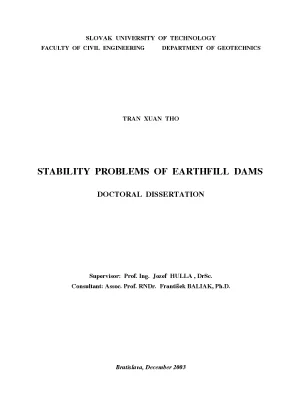
Tải xuống để đọc toàn bộSLOVAK UNIVERSITY OF TECHNOLOGY FACULTY OF CIVIL ENGINEERING DEPARTMENT OF GEOTECHNICS TRAN XUAN THO STABILITY PROBLEMS OF EARTHFILL DAMS DOCTORAL DISSERTATION Supervisor: Prof. Jozef HULLA , DrSc. František BALIAK, Ph. Bratislava, December 2003 SLOVAK UNIVERSITY OF TECHNOLOGY FACULTY OF CIVIL ENGINEERING DEPARTMENT OF GEOTECHNICS TRAN XUAN THO, Eng.
STABILITY PROBLEMS OF EARTHFILL DAMS THE DISSERTATION Submitted to the Department of Geotechnics, Faculty of Civil Engineering, Slovak University of Technology in partial fulfilment of the requirements for the Degree of Doctor of Philosophy (Ph.) in Civil Engineering in Specialisation of Theory and Construction of Civil Engineering Structures Supervisor: Prof. Jozef HULLA, DrSc. František BALIAK, Ph. Bratislava, December 2003 ACKNOWLEDGEMENTS The first and foremost individual to whom I owe immense gratitude is my honourable Teacher Prof.
Jozef Hulla, DrSc., Professor of the Slovak University of Technology for his timely hearted guidance, helpful suggestions, continuously constructive criticism, constant encouragement and unfailingly courteous comments throughout the course of this study, re- search work, and preparation of the dissertation. I wish to express my thanks and indebtedness to all Teachers and Commission, for teaching and consulting during the study course. I am extremely grateful to Assoc. Baliak Frantisek, Ph., Head of De- partment of Geotechnics, also being as a consultant, and all Colleagues at the Department of Geotechnics as well as Staff at the Faculty for their kind help and friendly relations during my study.
I express my sincere thanks to all Technicians of the Laboratory and Computer Centre of the Department of Geotechnics for their co-operation, advice, and help. I am greatly indebted to the Slovak Ministry of Education for the financial aid in form of scholarship grant during my post-graduate study. I would like to thank my Colleagues at the Department of Geomechanics and Founda- tion of Ho Chi Minh City University of Technology for their understanding and encourage- ment through my study abroad. Many thanks to all my friends helping and sharing difficulties as well as sentiment dur- ing the time of being far from family are reserved.
The love, blessing, and continuous encouragement of my Parents and my Family have been a constant source of inspiration due to which it had been necessary for me to pursue higher studies. Bratislava, December 2003 Tran Xuan Tho CONTENTS Acknowledgments Contents List of symbols and abbreviations Chapter One: Introduction 1.2 Information of dams .3 Objective of the research work .4 Contribution of the study to reality and scientific technology .5 Scope of the research work .6 Organisation of the dissertation. 5 Chapter Two: Knowledge from literatures 2.1 Typical types of earthfill dams .2 Earthfill with toe drain .4 Earthfill with horizontal drain .5 Earthfill with vertical and horizontal drains .6 Earthfill with central core .2 Deformation of dams .6 Rapid drawdown condition .2 Casagrande and Shannon’s solution .3 Goel at al.7 Seepage through earthfill dams .1 Fundamentals of seepage flow .2 Seepage through the dam .3 Seepage through the foundation. 39 Chapter Three: Methods and soil models of solution 3.1 Methods of solution .1 Limit equilibrium method .1 The Bishop’s method .2 General comments on limit equilibrium method .3 Computer program GEO4 .2 Finite element method .2 Groundwater flow theory .3 Finite element program PLAXIS .3 Shear strength reduction technique for safety analysis .4 Methods of field monitoring .1 Vertical flow measurement .2 Soil models of solution .1 Mohr-Coulomb soil model .2 Hardening Soil model.
54 Chapter Four: Stability problems – Approach studies 4.2 Long-term stability analysis of the Dau Tieng main dam (case study 1) .1 Description of the problem .2 Geological conditions of the dam and subsoil .1 Deformation: displacement and settlement .3 Behaviours of stress-strain .5 Factor of safety .3 Short-term stability analysis – Staged construction (case study 2) .1 Simulating procedure and numerical modelling .1 Displacement and consolidation.2 Changes of pore pressure .3 Behaviours of stress-strain .4 Failure mechanism and factor of safety .4 Stability analysis at first impoundment (case study 3).2 Changes of pore pressure .3 Behaviours of stress-strain .5 Factor of safety .5 Stability analysis in case of rapid drawdown (case study 4) .2 Behaviours of stress-strain .3 Deformation and failure mechanism .4 Factor of safety .6 Discussions of the case studies. 98 Chapter Five: Seepage and filtration stability problems – Approach studies 5.2 Seepage analysis of the Liptovská Mara Dam (primary analysis case A) .1 Description of the problem .2 Simulating procedure and numerical modelling.1 Phreatic line and equipotential lines.3 Groundwater flow: Filtration velocity and discharge.3 Influence of the sealing element (grout curtain) on the seepage (analysis case B) .4 Influence of the permeability coefficient of the grout curtain on the seepage (analysis case C) .5 Influence of the depth of the grout curtain on the seepage (analysis case D) .6 Discussions of the analysis cases. 132 Chapter Six: Methods to improve the dam’s stability 6.1 Seepage treatments in the dams .2 Upstream impervious blanket .3 Trench diaphragm of soil-cement .2 Seepage curtailments in the impervious foundations – Sealing elements .1 Cut-off trench .2 Slurry trench cut-off .3 Trench diaphragm wall .4 Bored pile diaphragm .1 Pervious toe drain .2 Pervious toe trench .3 Horizontal drainage blanket .4 Chimney or inclined drain .5 Pressure relief wells .6 Downstream seepage berms .7 Treatments of soft subsoil. 150 Chapter Seven: Summary and Conclusions 7.1 Summary of dissertation .3 Recommendations for future studies.
160 - iv - LIST OF SYMBOLS AND ABBREVIATIONS Roman letters A cross-section area a* coefficient B breadth or width B strain interpolation matrix T B transpose of the B-matrix b width Cc compression index Cs swelling index Cu uniformity coefficient CuH uniformity coefficient for coarse soil c cohesion; concentration c’ effective cohesion c m' effective mobilised cohesion cr reduced cohesion c0 initial concentration cn natural concentration ct tensile cohesion D10 soil particle diameter where 10% by weight of soil particles are finer (gravel) D15 soil particle diameter where 15% by weight of soil particles are finer (gravel) D17 soil particle diameter where 17% by weight of soil particles are finer (gravel) D60 soil particle diameter where 60% by weight of soil particles are finer (gravel) D90 soil particle diameter where 90% by weight of soil particles are finer (gravel) D depth; diameter; depth from toe of slope to rock level D0 mean diameter of seepage voids in coarse soil Dr design diameter of dome d3 soil particle diameter where 3% by weight of soil particles are finer d5 soil particle diameter where 5% by weight of soil particles are finer d10 soil particle diameter where 10% by weight of soil particles are finer d17 soil particle diameter where 17% by weight of soil particles are finer d25 soil particle diameter where 25% by weight of soil particles are finer d40 soil particle diameter where 40% by weight of soil particles are finer d50 soil particle diameter where 50% by weight of soil particles are finer d60 soil particle diameter where 60% by weight of soil particles are finer d85 soil particle diameter where 85% by weight of soil particles are finer d90 soil particle diameter where 90% by weight of soil particles are finer d depth; diameter, thickness dci diameter of grain -v- ds outer diameter; diameter of sand particles d0max maximum diameter of seepage voids in soils dip.max maximum diameter of soil particles caused by internal piping d a' design diameter of aggregate composition of eroded clayey soil d a'' design diameter of sandy aggregate ds diameter of sand particles E Young’s modulus E0 initial modulus of elasticity Eoed oedometer stiffness modulus ref Eoed reference tangent (oedometer) stiffness modulus E50 secant stiffness modulus (triaxial) E50ref reference secant stiffness modulus (triaxial) Eur Young’s modulus for unloading and reloading Eurref reference Young’s modulus for unloading and reloading EA normal stiffness EI flexural stiffness En,t normal component of the earth pressure e void ratio e0 initial void ratio FS factor of safety FSaver. mean of factor of safety Fc factor of safety with respect to cohesion Fϕ factor of safety with respect to friction f yield function f0 specific energy of cohesion Gs specific gravity of soil particles g acceleration due to gravity; plastic potential function H maximum drainage path, height (dam, slope); inhomogeneous factor of filter soil h height; depth; water level; total hydraulic head; piezometric head Ip plasticity index i hydraulic gradient iip.crit critical hydraulic gradient for internal piping icp.crit critical hydraulic gradient for contact piping icp. permissible hydraulic gradient for contact piping ice.crit critical hydraulic gradient for contact erosion ice. permissible hydraulic gradient for contact erosion K coefficient of permeability K 0nc coefficient of lateral earth pressure for normal consolidation Km dimensionless parameter Kr reduction function - vi - K global flow matrix k coefficient of permeability kh horizontal coefficient of permeability kv vertical coefficient of permeability ks safety factor L length; water level L/H drawdown ratio L differential operator T L transpose of a differential operator l length, length of the chord lv path given by tracer jet and respective gauge Md overturning moment Ms stabilising moment M material stiffness matrix m coefficient; power law Ns specific drainability N interpolation function in vector n stress exponent in general n porosity; unknown number p water pressure p’ mean normal effective stress p force in vector Pd overturning force Ps stabilising force p pressure; mean normal stress [ = (σ1 + σ2 + σ3 )/3 ]; stress in the pore fluid p’ mean effective stress [ = (σ’1 + σ’2 + σ’3 )/3 ] pref reference pressure p force in vector Q total seepage discharge Q prescribed discharge matrix e Q nodal discharge matrix q discharge; deviator stress q’ deviatoric stress qx horizontal discharge (in x-direction) qy vertical discharge in y-direction qa asymptotic value of the shear strength qf ultimate deviatoric stress pp isotropic pre-consolidation stress q~ special stress measure for deviatoric stresses Rf failure ration r radius of circular slip surface - vii - ru pore pressure ratio S settlement, shear strength T interslice shear force; time factor t time; thickness td design time tmax maximum concentration time U proportionate drainage; degree of consolidation u pore pressure u displacement in vector V volume; rate of drawdown V0 rate of drawdown v velocity vf filtration velocity vf average filtration velocity vv average vertical velocity vcrit critical velocity vip.crit critical seepage velocity for internal piping vf.ave average filtration velocity vf.
Nội dung được bảo vệ bản quyền — Tải xuống đầy đủ
Trích dẫn luận án này
Tran Xuan Tho (2003). Stability problems of earthfill dams doctoral dissertation [Luận án tiến sĩ, Slovak University of Technology]. LuanAn.net. https://luanan.net/ky-thuat-xay-dung-kien-truc/ky-thuat-xay-dung-dan-dung-cong-nghiep/stability-problems-of-earthfill-dams-doctoral-dissertation
Câu hỏi thường gặp
Luận án "Stability problems of earthfill dams doctoral dissertation" nghiên cứu về vấn đề gì?
Phân tích ổn định của đập đất trong luận văn tiến sĩ. Đánh giá các yếu tố gây mất ổn định và đề xuất giải pháp khắc phục.
Luận án "Stability problems of earthfill dams doctoral dissertation" được bảo vệ tại trường nào?
Luận án này được bảo vệ tại Slovak University of Technology. Năm bảo vệ: 2003.
Luận án "Stability problems of earthfill dams doctoral dissertation" thuộc chuyên ngành gì?
Luận án "Stability problems of earthfill dams doctoral dissertation" thuộc chuyên ngành Civil Engineering in Specialisation of Theory and Construction of Civil Engineering Structures. Danh mục: Kỹ Thuật Xây Dựng Dân Dụng & Công Nghiệp.
Luận án "Stability problems of earthfill dams doctoral dissertation" có bao nhiêu trang?
Luận án "Stability problems of earthfill dams doctoral dissertation" có 173 trang. Bạn có thể xem trước một phần tài liệu ngay trên trang web trước khi tải về.
Cách tải luận án "Stability problems of earthfill dams doctoral dissertation" về máy như thế nào?
Để tải luận án về máy, bạn nhấn nút "Tải xuống ngay" trên trang này, sau đó hoàn tất thanh toán phí lưu trữ. File sẽ được tải xuống ngay sau khi thanh toán thành công. Hỗ trợ qua Zalo: 0559 297 239.