Luận án tiến sĩ: Mô hình xâm nhập clorua vào BTCT dưới tải trọng & môi trường biển
Luận án đề xuất mô hình dự đoán sự xâm nhập clorua vào kết cấu BTCT dưới tải trọng và môi trường biển. Nâng cao tuổi thọ công trình.
Năm xuất bản
Số trang
136
Thời gian đọc
21 phút
Lượt xem
0
Lượt tải
0
Phí lưu trữ
40 Point
Tổng quan nhanh
- Chủ đề:
- 1. Mô hình xâm nhập clorua vào BTCT dưới tải trọng
- Số trang:
- 136 trang
- Trường:
- Chulalongkorn University
- Chuyên ngành:
- Civil Engineering
- Tác giả:
- Quoc Vu Hoang
- Năm:
- 2011
Tóm tắt nội dung luận án
I. Mô hình xâm nhập clorua vào BTCT dưới tải trọng
Mô hình xâm nhập clorua vào bê tông cốt thép (BTCT) là một chủ đề quan trọng trong nghiên cứu kỹ thuật xây dựng. Việc hiểu rõ cơ chế xâm nhập này giúp ngăn chặn hư hỏng và kéo dài tuổi thọ công trình. Mô hình này phân tích tác động của tải trọng lên sự xâm nhập của clorua, từ đó đưa ra các biện pháp bảo vệ hiệu quả.
1.1. Nguyên lý xâm nhập clorua
Clorua xâm nhập vào BTCT thông qua các vết nứt và khe hở. Quá trình này phụ thuộc vào nhiều yếu tố như độ ẩm và áp suất. Hiểu nguyên lý này là cần thiết để phát triển các giải pháp bảo vệ.
1.2. Tác động của tải trọng lên xâm nhập
Tải trọng tác động đến cấu trúc có thể làm gia tăng kích thước vết nứt. Kích thước vết nứt lớn hơn cho phép clorua xâm nhập nhanh hơn, dẫn đến nguy cơ hư hỏng cao hơn.
1.3. Các yếu tố ảnh hưởng khác
Ngoài tải trọng, môi trường biển cũng ảnh hưởng đáng kể đến quá trình xâm nhập clorua. Nồng độ clorua trong nước biển cao hơn so với nước ngọt, làm tăng nguy cơ ăn mòn cho BTCT.
II. Cơ chế ăn mòn thép trong BTCT do clorua
Ăn mòn thép trong BTCT là một trong những vấn đề nghiêm trọng nhất đối với các công trình xây dựng. Clorua gây ra sự phá hoại lớp màng bảo vệ trên bề mặt thép, dẫn đến hiện tượng ăn mòn. Sự hiểu biết về cơ chế này có thể giúp thiết kế các biện pháp phòng ngừa hiệu quả.
2.1. Quá trình ăn mòn
Khi clorua xâm nhập vào BTCT, nó sẽ phá vỡ lớp bảo vệ tự nhiên của thép. Quá trình này bắt đầu bằng việc hình thành gỉ sét, ảnh hưởng đến tính toàn vẹn của cấu trúc.
2.2. Yếu tố ảnh hưởng đến ăn mòn
Nhiều yếu tố như nồng độ clorua, độ ẩm và pH của môi trường đều có ảnh hưởng lớn đến tốc độ ăn mòn. Các điều kiện này cần được kiểm soát để bảo vệ BTCT.
2.3. Biện pháp phòng ngừa
Sử dụng vật liệu chống ăn mòn, lớp phủ bảo vệ, và thiết kế BTCT phù hợp có thể giúp giảm thiểu nguy cơ ăn mòn do clorua.
III. Các mô hình mô phỏng xâm nhập clorua hiệu quả
Mô hình mô phỏng giúp dự đoán khả năng xâm nhập clorua vào BTCT trong các điều kiện khác nhau. Thông qua mô hình hóa, các kỹ sư có thể kiểm tra các kịch bản khác nhau và đưa ra giải pháp tối ưu cho cấu trúc.
3.1. Mô hình 2D cho BTCT cracked
Mô hình 2D cho phép mô phỏng sự phân bố của clorua trong BTCT. Nó giúp phân tích hiệu ứng của các yếu tố như độ sâu và chiều rộng vết nứt.
3.2. So sánh với thực nghiệm
Việc so sánh kết quả mô phỏng với các thí nghiệm thực tế cho thấy tính chính xác của mô hình. Điều này hỗ trợ trong việc điều chỉnh và cải thiện mô hình.
3.3. Ưu điểm của mô hình hóa
Mô hình hóa cung cấp cái nhìn toàn diện về quá trình xâm nhập clorua. Điều này cho phép đánh giá rủi ro và lập kế hoạch bảo trì hiệu quả cho BTCT.
IV. Kết luận về xâm nhập clorua vào BTCT
Kết luận từ nghiên cứu cho thấy xâm nhập clorua có ảnh hưởng lớn đến độ bền của BTCT. Việc áp dụng mô hình hóa và các biện pháp phòng ngừa có thể giảm thiểu tác động này, đảm bảo tính an toàn cho công trình. Cần tiếp tục nghiên cứu để hoàn thiện các mô hình và phương pháp bảo vệ.
4.1. Tầm quan trọng của nghiên cứu
Nghiên cứu về xâm nhập clorua không chỉ giúp bảo vệ BTCT mà còn góp phần vào sự phát triển bền vững của ngành xây dựng.
4.2. Hướng đi tương lai
Cần phát triển các công nghệ mới và vật liệu tiên tiến nhằm nâng cao khả năng chống chịu cho BTCT trước các tác động từ môi trường.
4.3. Đề xuất nghiên cứu tiếp theo
Nghiên cứu cần tập trung vào việc cải thiện mô hình mô phỏng và kiểm tra các vật liệu chống ăn mòn hiệu quả hơn. Điều này là cần thiết để nâng cao tuổi thọ công trình.
Mục lục chi tiết luận án
Tải xuống file đầy đủ để xem toàn bộ nội dung
Tải đầy đủ (136 trang)Nội dung chính
Tổng quan về luận án
Sự suy thoái của các kết cấu bê tông cốt thép (BTCT) hoạt động trong môi trường biển là một trong những thách thức kỹ thuật và kinh tế nghiêm trọng nhất của ngành kỹ thuật xây dựng toàn cầu. Trong các cơ chế phá hủy vật liệu phức tạp, quá trình ăn mòn cốt thép do ion clorua ($Cl^-$) xâm thực được xác định là nguyên nhân hàng đầu làm suy giảm khả năng chịu lực và rút ngắn tuổi thọ công trình (Mehta, 2003; Bermudez và Alaejos, 2010). Khi ion clorua thâm nhập qua lớp bê tông bảo vệ đến bề mặt cốt thép, chúng phá hủy màng thụ động oxide bảo vệ ($\gamma\text{-Fe}_2\text{O}_3$), kích hoạt phản ứng ăn mòn điện hóa dẫn đến nứt tách lớp, suy giảm tiết diện thanh thép và phá hủy độ dính kết giữa thép và bê tông.
Phần lớn các mô hình dự báo tuổi thọ công trình (Service Life Prediction) truyền thống đều dựa trên giả định bê tông nguyên khối không nứt (uncracked concrete) trong điều kiện phòng thí nghiệm lý tưởng (Walraven, 2008). Tuy nhiên, trong thực tế khai thác, các cấu kiện BTCT luôn tồn tại các vết nứt do tải trọng uốn, co ngót thể tích, gradient nhiệt độ hoặc lún cục bộ. Vết nứt đóng vai trò như các "kênh dẫn siêu tốc" (fast access slots) thúc đẩy dung dịch muối xâm nhập sâu vào bên trong kết cấu. Một khoảng trống nghiên cứu then chốt (research gap) tồn tại dai dẳng trong y văn học thuật: các nghiên cứu trước đây chủ yếu tập trung vào vết nứt nhân tạo dạng xẻ rãnh thẳng song song (artificial notches/slits) hoặc giả định vết nứt xuyên suốt có bề rộng đồng nhất (Marsavina et al., 2009; Aldea et al., 1999b; Boulfiza et al., 2003). Điều này hoàn toàn không phản ánh đúng hình thái vết nứt tự nhiên hình chữ V (tapered V-shaped crack) dưới tải trọng uốn thực tế, nơi bề rộng vết nứt giảm dần từ bề mặt chịu kéo vào sâu bên trong và triệt tiêu tại trục trung hòa.
Để giải quyết triệt để khoảng trống này, luận án xác lập hệ thống câu hỏi nghiên cứu và giả thuyết khoa học:
- Câu hỏi nghiên cứu 1 (RQ1): Cơ chế vận chuyển liên hợp giữa quá trình hút mao dẫn dung dịch muối và khuếch tán ion clorua 2 chiều diễn ra như thế nào trong vết nứt tự nhiên hình chữ V dưới tác dụng của tải trọng uốn?
- Câu hỏi nghiên cứu 2 (RQ2): Mối tương quan định lượng giữa các đặc tính hình học vết nứt (bề rộng miệng nứt $w$, chiều sâu nứt $L$, độ uốn khúc $\tau$, độ co hẹp $\delta$) đối với hệ số khuếch tán clorua cục bộ ($D_{cr}$) và phân bố nồng độ clorua 2 chiều trong không gian ma trận bê tông là gì?
- Giả thuyết 1 (H1): Quá trình chuyển dịch dung dịch muối khối (bulk salt solution) vào toàn bộ khe nứt diễn ra gần như tức thời nhờ lực hút mao dẫn ($t \approx 0$), đóng vai trò thiết lập điều kiện biên nồng độ biến thiên $C_{sy}(y)$ trên vách nứt phụ thuộc vào hàm bề rộng $w(y)$.
- Giả thuyết 2 (H2): Sự khuếch tán ion $Cl^-$ dọc theo chiều sâu vết nứt bị chi phối bởi các ngưỡng giới hạn bề rộng ($w_1 = 30\ \mu\text{m}$ và $w_2 = 60\ \mu\text{m}$), chia vết nứt thành 3 vùng động học riêng biệt cho phép mô phỏng chính xác trường nồng độ 2 chiều bằng phương pháp phần tử hữu hạn.
Khung lý thuyết của nghiên cứu tích hợp Định luật Fick thứ hai cho khuếch tán không dừng 2 chiều ($\partial C_t/\partial t = D_{ax}\partial^2C/\partial x^2 + D_{ay}\partial^2C/\partial y^2$), kết hợp lý thuyết mao lưu Kropp & Hilsdorf (1995), lý thuyết cơ học nứt uốn và vi cấu trúc lỗ rỗng. Đóng góp đột phá của luận án là việc xây dựng thành công mô hình giải tích và số hóa 2D mô phỏng chính xác sự xâm thực clorua vào bê tông cốt thép nứt tự nhiên, loại bỏ sai số đánh giá tuổi thọ vốn có thể chênh lệch từ 200% đến 500% nếu áp dụng các mô hình bê tông không nứt truyền thống. Phạm vi nghiên cứu bao quát các mẫu dầm BTCT thực nghiệm chịu tải trọng uốn tĩnh với mức ứng suất $SR = P/P_u$, kiểm soát bề rộng miệng nứt $w \le 0.15\text{ mm}$ (theo giới hạn ăn mòn khắt khe của ACI 224R-01 đối với môi trường nước biển), ngâm chìm trong dung dịch NaCl 10% trong các chu kỳ 2, 4, 6, 8 và 16 tuần, được kiểm chứng chéo bằng phương pháp chuẩn độ hóa học phân lớp và kỹ thuật phân tích vi phổ điện tử EPMA (Electron Probe Micro-Analysis).
Literature Review và Positioning
Nghiên cứu về sự suy thoái của kết cấu bê tông cốt thép dưới tác động của ion clorua đã trải qua nhiều thập kỷ phát triển với các trường phái lý thuyết chính:
[Mô hình 1D Không nứt kinh điển] ---> [Mô hình Vết nứt Nhân tạo/Song song] ---> [Mô hình 2D Vết nứt Uốn Tự nhiên Hình chữ V]
(Fick's 2nd Law, Tuổi thọ sai lệch)   (Boulfiza 2003, Marsavina 2009)          (Luận án: Phân vùng 3 cấp độ, EPMA & FEA)
Trường phái điện hóa ăn mòn (Broomfield, 2007; Bertolini et al., 2004; Bayliss và Deacon, 2004) đã làm sáng tỏ cơ chế phá hủy màng thụ động kiềm cao ($pH > 12.5$). Quá trình hòa tan kim loại tại cực anode: $$\text{Fe} \rightarrow \text{Fe}^{2+} + 2e^-$$ và phản ứng khử oxy tại cực cathode: $$2e^- + \frac{1}{2}\text{O}_2 + \text{H}_2\text{O} \rightarrow 2\text{OH}^-$$ Sản phẩm gỉ sắt ($\text{Fe}(\text{OH})_2$, $\text{Fe}_2\text{O}_3\cdot n\text{H}_2\text{O}$) gia tăng thể tích lên gấp 2 đến 6 lần so với thể tích thép ban đầu, gây ứng suất kéo nội sinh vượt quá cường độ chịu kéo của bê tông, dẫn đến nứt dọc thanh thép và bong tróc lớp vỏ bảo vệ (El-Reedy, 2008). Khi xuất hiện vết nứt bề mặt, Schiessl và Raupach (1997) chứng minh cơ chế ăn mòn pin vĩ mô (macrocell corrosion) được kích hoạt mạnh mẽ do sự chênh lệch thế điện hóa giữa vùng đáy nứt (anode cục bộ) và các vùng bê tông không nứt lân cận có diện tích cathode rộng lớn được cung cấp oxy liên tục.
Về cơ chế truyền dẫn chất, Soutsos (2010) và Nilsson (2005) tổng hợp 4 cơ chế cơ bản trong môi trường xốp: hút mao dẫn do sức căng bề mặt (Kropp và Hilsdorf, 1995), thấm chất lỏng dưới cột áp thủy tĩnh tuân theo Định luật Darcy (Darcy's Law; Wang et al., 1997; Aldea et al., 1999b), khuếch tán ion do gradient nồng độ tuân theo Định luật Fick thứ nhất và thứ hai (Fick's 1st & 2nd Laws), và di chuyển ion dưới gradient điện trường (migration) được chuẩn hóa qua các quy trình đo điện thế cưỡng bức (Sugiyama et al., 1996, 2001, 2008; NT BUILD 492, 1999; ASTM C1202).
Trong các nghiên cứu về ảnh hưởng của vết nứt đến sự khuếch tán clorua, tồn tại những tranh luận và xung đột lý thuyết sâu sắc:
- Quan điểm của Boulfiza et al. (2003): Đề xuất mô hình khuếch tán tương đương 1 chiều sử dụng hệ số khuếch tán trung bình $D_{av} = D_0 + (W/l)D_{cr}$, trong đó $W$ là bề rộng nứt, $l$ là khoảng cách giữa các vết nứt, và $D_0$ là hệ số khuếch tán của bê tông không nứt. Hạn chế cốt tử của mô hình này là cào bằng ảnh hưởng của vết nứt thành một đại lượng trung bình vô hướng, bỏ qua hoàn toàn gradient nồng độ 2 chiều và tác động của chiều sâu nứt $L$.
- Quan điểm của Paulsson-Tralla & Silfwerbrand (2002) và Kato et al. (2005): Thừa nhận trường khuếch tán 2 chiều nhưng thiết lập giả định đơn giản hóa rằng toàn bộ bề mặt vách nứt tiếp xúc với dung dịch muối đều có nồng độ clorua bằng đúng nồng độ bề mặt tự do ($C_{sy} = C_s$), đồng thời hệ số khuếch tán trong vết nứt $D_{cr}$ là hằng số bất biến dọc theo chiều sâu. Giả định này chỉ đúng với các vết nứt nhân tạo phẳng hoặc vết nứt hở lớn ($w > 0.2\text{ mm}$), hoàn toàn sai lệch khi áp dụng cho vết nứt tự nhiên thuôn nhọn hình chữ V có hiện tượng co hẹp và tự liền cục bộ.
- Quan điểm ngưỡng bề rộng nứt ($w_1, w_2$): Takewaka et al. (2003) cho rằng $w < 0.05\text{ mm}$ không ảnh hưởng đến khuếch tán và $D_{cr}$ đạt bão hòa khi $w > 0.1\text{ mm}$. Ismail et al. (2004, 2008) xác định ngưỡng dưới là $30\ \mu\text{m}$ (do hiện tượng tự chèn lấp bởi sản phẩm thủy hóa) và ngưỡng trên là $60\ \mu\text{m}$ (đối với vật liệu trơ) hoặc $205\ \mu\text{m}$ (đối với vữa). Djerbi et al. (2008b) thông qua thí nghiệm ép chẻ kiểm soát biến dạng xác lập phương trình thực nghiệm $D_{cr} = 2 \times 10^{-11} w - 4 \times 10^{-10}\text{ m}^2/\text{s}$ với ngưỡng bão hòa $w = 80\ \mu\text{m}$ ($D_{cr} = 14 \times 10^{-10}\text{ m}^2/\text{s}$). Wang và Ueda (2010) lại khẳng định ngưỡng bão hòa xuất hiện sớm hơn ở mức $w = 60\ \mu\text{m}$.
So sánh với các nghiên cứu quốc tế điển hình:
- Marsavina et al. (2009) (Bỉ/Romania): Tạo rãnh nứt nhân tạo bằng lá đồng trên bê tông tươi ($w = 0.2-0.3\text{ mm}$). Kết quả cho thấy chiều sâu rãnh nứt làm tăng chiều sâu xâm thực clorua, nhưng bề mặt rãnh nhân tạo giàu vữa xi măng, nhẵn bóng, thiếu độ uốn khúc ($\tau = 1.0$) và không có sự chèn móc cơ học cốt liệu, dẫn đến ước tính quá mức tốc độ truyền dẫn so với nứt uốn thực tế.
- Win et al. (2004) (Nhật Bản): Khảo sát dầm BTCT nứt tự nhiên chịu uốn nhưng chỉ dừng lại ở các quan sát định tính về nồng độ clorua mà chưa thiết lập được khung toán học hoàn chỉnh liên kết giải tích giữa đặc tính nứt chữ V với phương trình vi phân 2D.
Luận án này định vị tại điểm giao thoa tiên phong: kết hợp cơ học nứt uốn thực tế, hiện tượng học truyền chất xốp và giải thuật số phần tử hữu hạn, hình thành mô hình phân vùng 3 cấp độ giải quyết triệt để các hạn chế của các thế hệ nghiên cứu đi trước.
Đóng góp lý thuyết và khung phân tích
Đóng góp cho lý thuyết
Luận án tạo ra bước tiến quan trọng trong lý thuyết độ bền công trình biển thông qua việc mở rộng Định luật Fick thứ hai từ môi trường đồng nhất 1 chiều sang bài toán 2 chiều trong môi trường bê tông nứt tự nhiên có vi cấu trúc bất đẳng hướng:
$$\frac{\partial C_t}{\partial t} = D_{ax}\frac{\partial^2 C}{\partial x^2} + D_{ay}\frac{\partial^2 C}{\partial y^2}$$
Trong đó $C_t$ là tổng hàm lượng clorua theo phần trăm khối lượng xi măng; $D_{ax}$ và $D_{ay}$ lần lượt là hệ số khuếch tán biểu kiến theo phương $x$ (vuông góc vách nứt) và phương $y$ (song song vách nứt). Đối với ma trận bê tông nguyên khối, luận án giả định môi trường bán đồng nhất đẳng hướng với $D_{ax} = D_{ay} = D_{\text{uncr}}$.
Bề mặt tiếp xúc (Cs) ----------------------------------------------------
|                                                                       |
|  Vùng 1 (w >= 60 um): D_1cr = D_0 = 2.03e-9 m2/s; Csy = Cs            |
|  \                                                                 /  |
|   \ Vùng 2 (30 <= w < 60 um): D_2cr(w); Csy(y) = Cs * (w(y)/60)   /   |
|    \                                                             /    |
|     \ Vùng 3 (0 <= w < 30 um): D_3cr = (2e-10 + D_uncr)/2; Csy -> 0/     |
|      \                                                           /      |
|       \------------------ Đỉnh nứt (y = L) ---------------------/       |
|                                                                       |
|                     Ma trận bê tông: D_uncr                           |
-------------------------------------------------------------------------
Lý thuyết phân vùng khuếch tán 3 cấp độ (3-Zone Diffusivity Theory) được luận án thiết lập dựa trên các luận cứ vật lý và hóa học chính xác:
- Vùng 1 ($60\ \mu\text{m} \le w \le 150\ \mu\text{m}$): Bề rộng nứt đủ lớn để dung dịch muối lưu thông tự do, không bị cản trở bởi tương tác tĩnh điện hay hiệu ứng vách. Hệ số khuếch tán trong vết nứt tương đương trong nước tự do: $$D_{1\text{crack}} = D_0 \approx 2.03 \times 10^{-9}\text{ m}^2/\text{s}$$ Điều kiện biên nồng độ trên vách nứt đạt cực đại: $C_{sy} = C_s$.
- Vùng 2 ($30\ \mu\text{m} \le w < 60\ \mu\text{m}$): Không gian nứt bị thu hẹp, xuất hiện ma sát thủy lực và tương tác bề mặt khoáng hóa. Hệ số khuếch tán biến thiên tuyến tính theo bề rộng nứt: $$D_{2\text{crack}} = 2 \times 10^{-11} w - 4 \times 10^{-10}\text{ m}^2/\text{s}$$ Nồng độ biên clorua bề mặt vách nứt suy giảm tuyến tính theo hàm tiết diện: $$C_{sy}(y) = C_s \left( \frac{w(y)}{60} \right)$$
- Vùng 3 ($0 \le w < 30\ \mu\text{m}$): Vùng tiệm cận đỉnh nứt, các sản phẩm hydrat hóa của xi măng ($\text{C-S-H}$, $\text{Ca(OH)}2$, ettringite) và tinh thể muối lắng đọng gây tắc nghẽn cục bộ (self-healing effect). Hệ số khuếch tán được mô hình hóa bằng giá trị trung bình chuyển tiếp: $$D{3\text{crack}} = \frac{2 \times 10^{-10} + D_{\text{uncr}}}{2}\text{ m}^2/\text{s}$$ với nồng độ biên $C_{sy} \rightarrow 0$.
Bên cạnh đó, nghiên cứu làm sáng tỏ vai trò của hệ số uốn khúc ($\tau$) và hệ số co hẹp ($\delta$) trong việc hiệu chỉnh đường đi thực tế của ion qua các mao quản nứt gồ ghề (Promentilla et al., 2009; Ishida et al., 2009), giải thích thỏa đáng tại sao tốc độ xâm thực trong nứt uốn tự nhiên luôn thấp hơn trong các rãnh xẻ nhân tạo có cùng độ sâu.
Khung phân tích độc đáo
Khung phân tích của luận án là sự hợp nhất tuần tự giữa 3 lý thuyết vật lý:
- Lý thuyết biến dạng uốn cơ học (Structural Mechanics): Xác định hàm suy giảm tuyến tính của bề rộng vết nứt dọc theo chiều sâu từ miệng nứt ($y=0$) đến đáy nứt ($y=L$): $$w(y) = w_{\text{mouth}} \left( 1 - \frac{y}{L} \right)$$
- Lý thuyết mao lưu thủy động (Fluid Capillarity): Vận tốc dâng mao dẫn $v = \frac{1}{8\eta x}(2\sigma\cos\theta\cdot r - \rho g r^2)$ đưa dung dịch muối lấp đầy toàn bộ thể tích vết nứt chỉ trong vài giây đến vài phút sau khi tiếp xúc, cho phép biến đổi bài toán đối lưu - khuếch tán phức tạp thành bài toán khuếch tán thuần túy với điều kiện biên biến thiên theo không gian.
- Lý thuyết trường khuếch tán 2 chiều không dừng (2D Transient Diffusion Field): Giải hệ phương trình vi phân đạo hàm riêng với điều kiện biên hỗn hợp (Mixed Boundary Conditions):
- Tại bề mặt hở ($y = 0$, $x > 0$): $C(x, 0, t) = C_s$
- Dọc theo vách nứt ($x = 0$, $0 \le y \le L$): $C(0, y, t) = C_{sy}(w(y))$
- Tại ma trận vô hạn ($x \rightarrow \infty$, $y \rightarrow \infty$): $C(x, y, t) = 0$
- Điều kiện ban đầu ($t = 0$): $C(x, y, 0) = 0$ với mọi $x, y > 0$.
Điều kiện biên giới hạn (boundary conditions) được xác lập rõ ràng cho vùng bê tông bão hòa hoàn toàn dưới tác động của tải trọng tĩnh không đổi, tạo nền tảng toán học vững chắc cho giải thuật số.
Phương pháp nghiên cứu tiên tiến
Thiết kế nghiên cứu
Luận án tuân thủ nghiêm ngặt triết lý nghiên cứu thực chứng luận (Positivism), kết hợp chặt chẽ giữa mô hình hóa toán học giải tích, mô phỏng số phần tử hữu hạn (FEA) và thực nghiệm kiểm chứng đa mức độ (multi-level experimental validation).
Thí nghiệm uốn dầm BTCT ---> Phủ Epoxy cách ly ---> Ngâm 10% NaCl (2, 4, 6, 8, 16 tuần)
            |
            +---> Khoan lấy mẫu bột từng lớp 1mm ---> Chuẩn độ hóa học xác định Cl-
            +---> Cắt lát phẳng mẫu bê tông ---------> Phân tích vi phổ tia X EPMA
            +---> Mô hình hóa phần tử hữu hạn -------> Mô phỏng ANSYS 2D so sánh kiểm chứng
Quy mô thực nghiệm bao gồm các nhóm dầm bê tông cốt thép đúc từ xi măng Portland thông dụng (OPC) với các tỷ lệ Nước/Xi măng ($W/C$) được kiểm soát chặt chẽ ($W/C = 0.45, 0.55, 0.65$), kích thước hình học chuẩn hóa. Cốt thép chịu lực được bố trí chính xác nhằm tạo ra các vết nứt uốn điển hình trong dải bề rộng miệng nứt mục tiêu $w \le 0.15\text{ mm}$ dưới tải trọng uốn 3 điểm hoặc 4 điểm tĩnh.
Quy trình nghiên cứu rigorous
Quy trình chế tạo mẫu và thu thập dữ liệu được thực hiện qua các bước chuẩn hóa:
- Tạo nứt uốn tự nhiên có kiểm soát: Mẫu dầm BTCT được gia tải trên khung uốn chuyên dụng đến các mức ứng suất $SR = P/P_u$ định trước (từ 0.3 đến 0.7). Chuyển vị mở rộng miệng nứt (CMOD) được đo đạc liên tục bằng thiết bị cảm biến biến dạng LVDT (Linear Variable Displacement Transducer) kết hợp kính hiển vi quang học số độ phân giải cao để ghi nhận hình thái và chiều sâu vết nứt thực tế.
- Chuẩn bị mẫu và phơi nhiễm môi trường: Sau khi dỡ tải để giữ lại độ mở nứt dư (residual crack opening), các mặt không khảo sát được quét phủ 3 lớp sơn epoxy chống thấm chuyên dụng nhằm triệt tiêu hiện tượng thâm nhập clorua từ các hướng không mong muốn, cô lập duy nhất mặt hở chịu kéo và vách nứt. Mẫu được ngâm ngập hoàn toàn trong bể dung dịch muối NaCl nồng độ 10% (mô phỏng môi trường biển gia tốc) ở nhiệt độ phòng chuẩn $23 \pm 2^\circ\text{C}$ với các mốc thời gian: 2 tuần, 4 tuần, 6 tuần, 8 tuần và 16 tuần.
- Thu thập dữ liệu nồng độ clorua đa phương pháp:
- Phương pháp hóa học (Chemical Analysis Method): Dùng mũi khoan kim cương chuyên dụng lấy bột bê tông phân lớp với độ sâu từng lớp 1-2 mm tại các vị trí cách vách nứt các khoảng cách xác định: $x = 30\text{ mm}, 40\text{ mm}, 50\text{ mm}$. Nồng độ ion $Cl^-$ tổng số được xác định bằng phương pháp chuẩn độ điện thế theo tiêu chuẩn JCI-SC4.
- Phương pháp vi phổ EPMA (Electron Probe Micro-Analysis): Cắt các lát bê tông mỏng vuông góc với vết nứt tại phòng thí nghiệm EME - Đại học Hokkaido, mài bóng bề mặt bằng dung dịch không chứa nước, sau đó quét chùm tia điện tử để đo cường độ tia X đặc trưng của nguyên tố Clo ($Cl\text{-}K\alpha$). Cường độ tia X được chuyển đổi thành bản đồ nồng độ 2 chiều định lượng theo thang chuẩn của Mori et al.
Quy trình này đảm bảo tính tam giác hóa dữ liệu (data triangulation) và độ tin cậy tuyệt đối (internal & external validity), loại bỏ triệt để sai số ngẫu nhiên của phương pháp đo truyền thống.
Data và phân tích
Dữ liệu thực nghiệm được xử lý và phân tích qua các công cụ toán học và phần mềm chuyên dụng:
- Phân tích số ANSYS FEA: Sử dụng phần tử truyền nhiệt/chất 2D phẳng (PLANE55) với lưới phần tử hữu hạn mịn cục bộ tại vùng lân cận vách nứt và đỉnh nứt. Các hàm phân vùng $D_{1\text{cr}}, D_{2\text{cr}}, D_{3\text{cr}}$ và $C_{sy}(y)$ được lập trình gán trực tiếp vào các nút biên.
- Xác định hệ số khuếch tán nền: Thực hiện các phép thử di chuyển ion không dừng NT BUILD 492 trên các mẫu trụ không nứt để trích xuất hệ số $D_{\text{nssm}}$, kết hợp phép thử độ thấm nhanh ASTM C1202 để hiệu chuẩn $D_{\text{uncr}}$ đưa vào mô hình ANSYS.
- Đánh giá độ hội tụ và dung sai: So sánh sai số tuyệt đối và độ lệch chuẩn giữa phân bố nồng độ dự báo từ mô hình giải tích/ANSYS và kết quả thực nghiệm hóa học/EPMA, cho thấy độ tương thích vượt trội với hệ số xác định $R^2 > 0.92$ và sai số tương đối trung bình dưới $8.5%$.
Phát hiện đột phá và implications
Những phát hiện then chốt
- Chiều sâu vết nứt ($L$) đóng vai trò biến số thống trị trường nồng độ: Nghiên cứu chứng minh rằng chiều sâu vết nứt có mức độ ảnh hưởng đến thể tích bê tông bị nhiễm clorua lớn hơn nhiều so với bề rộng miệng nứt ($w$). Khi chiều sâu nứt tăng từ $10\text{ mm}$ lên $35\text{ mm}$, vùng nồng độ clorua vượt ngưỡng phá hủy cốt thép ($\ge 0.4%$ khối lượng xi măng) mở rộng gấp 3.2 lần về diện tích không gian ma trận bê tông bao quanh cốt thép.
- Sự tồn tại của ranh giới khuếch tán 2 chiều cục bộ: Tại các khoảng cách $x \ge 50\text{ mm}$ tính từ vách nứt, profile phân bố clorua hoàn toàn trùng khớp với profile khuếch tán 1D của bê tông không nứt. Điều này xác lập bán kính ảnh hưởng hữu hạn của vết nứt ($x_{\text{influence}} \approx 40 - 50\text{ mm}$) trong ma trận bê tông.
- Hiệu ứng tự bảo vệ tại vùng đỉnh nứt ($w < 30\ \mu\text{m}$): Dữ liệu phổ EPMA xác nhận tại vùng có bề rộng $w < 30\ \mu\text{m}$, nồng độ ion $Cl^-$ thâm nhập theo phương ngang vuông góc vách nứt giảm đột ngột hơn $70%$ so với vùng miệng nứt ($w \ge 60\ \mu\text{m}$). Cơ chế này khẳng định khả năng tự chèn lấp khoáng hóa tự nhiên cản trở đáng kể sự xâm thực ion.
- Tác động của tỷ lệ Nước/Xi măng ($W/C$): Tỷ lệ $W/C$ làm thay đổi sâu sắc hệ số $D_{\text{uncr}}$ của ma trận nền. Mẫu $W/C = 0.65$ có chiều sâu xâm thực tại vị trí không nứt cao gấp 1.8 lần so với mẫu $W/C = 0.45$ sau 16 tuần ngâm, đồng thời làm tăng tốc độ khuếch tán ngang từ vách nứt vào bên trong lõi bê tông.
Implications đa chiều
                 [ĐÓNG GÓP ĐA CHIỀU CỦA LUẬN ÁN]
                                |
    +---------------------------+---------------------------+
    |                           |                           |
[LÝ THUYẾT & HỌC THUẬT]    [QUY PHẨM & TIÊU CHUẨN]    [CÔNG NGHIỆP & THỰC TIỄN]
- Hoàn thiện mô hình 2D    - Sửa đổi ACI 224R-01      - Dự báo tuổi thọ dầm cầu
- Phân vùng 3 cấp độ Fick  - Chuẩn hóa tỷ số Wcr/C     - Tối ưu hóa chu kỳ sửa chữa
- Bản đồ hóa EPMA định lượng- Bổ sung chiều sâu nứt L   - Tiết kiệm triệu USD bảo trì
- Ý nghĩa Lý thuyết: Đặt nền móng hoàn chỉnh cho lý thuyết khuếch tán ion 2 chiều trong bê tông nứt tự nhiên, liên kết thành công cơ học nứt phi tuyến với hóa lý truyền chất xốp.
- Đổi mới Phương pháp luận: Thiết lập quy trình chuẩn tích hợp giữa mô phỏng số ANSYS 2D và vi phân tích EPMA không phá hủy, cung cấp phương pháp luận mẫu mực cho các nghiên cứu độ bền vật liệu phức hợp.
- Ứng dụng Thực tiễn Kỹ thuật: Cung cấp công cụ tính toán chính xác tuổi thọ còn lại (Remaining Service Life Assessment) cho các công trình hạ tầng biển (cầu vượt biển, cảng nước sâu, giàn khoan dầu khí, đê chắn sóng) đang vận hành có xuất hiện vết nứt uốn, tránh việc sửa chữa sớm lãng phí hoặc sửa chữa muộn gây thảm họa sụp đổ.
- Khuyến nghị Chính sách & Tiêu chuẩn: Cung cấp bằng chứng thực nghiệm rõ ràng để sửa đổi các tiêu chuẩn thiết kế kết cấu quốc tế như ACI 224R-01, BS 8110, Eurocode 2 và TCVN. Luận án khuyến nghị không nên chỉ quy định một giá trị bề rộng nứt giới hạn duy nhất ($w_{\max} \le 0.15\text{ mm}$), mà bắt buộc phải tích hợp tiêu chuẩn tỷ số giữa bề rộng nứt và chiều dày lớp bê tông bảo vệ ($W_{cr}/C$ ratio) kết hợp kiểm soát chiều sâu nứt cho phép $L$.
Limitations và Future Research
Mặc dù đạt được những bước tiến đột phá, luận án thẳng thắn thừa nhận các giới hạn kỹ thuật:
- Trạng thái bão hòa môi trường ngâm hoàn toàn: Nghiên cứu tập trung vào vùng ngâm chìm (submerged zone) nơi bê tông bão hòa nước và cơ chế khuếch tán thuần túy chiếm ưu thế. Chưa bao quát vùng triều lên xuống và vùng nước tóe (tidal & splash zones) - nơi diễn ra chu kỳ khô/ướt xen kẽ (wetting-drying cycles) với sự kết hợp phức tạp giữa bay hơi, hút ẩm mao dẫn và khuếch tán đối lưu.
- Bản chất tải trọng tĩnh: Các vết nứt được tạo ra bởi tải trọng uốn tĩnh ngắn hạn; chưa xét đến tải trọng mỏi lặp chu kỳ cao (fatigue loading) dưới tác động của sóng biển và xe chạy, vốn gây ra hiện tượng đóng - mở vết nứt liên tục (pumping effect).
- Mô hình hình học vết nứt đơn lẻ 2D: Nghiên cứu giả định một vết nứt hình chữ V điển hình trong không gian 2 chiều phẳng; chưa mô hình hóa mạng lưới nứt không gian 3 chiều (3D crack network) với sự phân nhánh và giao thoa ngẫu nhiên của các vết nứt vi mô.
Chương trình nghiên cứu tiếp nối trong tương lai:
- Phát triển mô hình liên hợp Ẩm - Clorua trong môi trường chu kỳ khô ướt, tích hợp phương trình cân bằng hàm ẩm phi tuyến $h$ (Mien et al., 2009a).
- Mở rộng nghiên cứu tác động của tải trọng động chu kỳ kết hợp nồng độ dung dịch muối biển thực tế (chứa ion $\text{Mg}^{2+}, \text{SO}_4^{2-}$ cạnh tranh liên kết).
- Ứng dụng mô hình cho các loại bê tông tính năng cao (HPC, UHPC) sử dụng phụ gia khoáng hoạt tính (Tro bay, Xỉ lò cao GGBS, Silica Fume, Tro trấu) có khả năng hấp phụ clorua cao ($\alpha, \beta$ binding isotherm parameters).
Tác động và ảnh hưởng
Luận án của TS. Vũ Hoàng Quốc tại Đại học Chulalongkorn (hợp tác Đại học Hokkaido dưới sự tài trợ của JICA qua mạng lưới AUN/SEED-Net) đã tạo ra tác động học thuật và công nghiệp sâu rộng:
- Tác động Học thuật: Cung cấp nguồn trích dẫn nền tảng cho các nhóm nghiên cứu hàng đầu về độ bền vật liệu xi măng trên các tạp chí quốc tế ISI-Q1 uy tín (Cement and Concrete Research, Construction and Building Materials, Materials and Structures).
- Chuyển đổi Công nghiệp Xây dựng Biển: Giúp các tập đoàn xây dựng và tư vấn quốc tế tối ưu hóa chiều dày lớp bê tông bảo vệ và cấp phối bê tông, kéo dài tuổi thọ thiết kế công trình biển từ 50 năm lên 100 năm một cách đáng tin cậy.
- Lợi ích Xã hội & Kinh tế: Giảm thiểu hàng trăm triệu USD chi phí duy tu, sửa chữa khẩn cấp các công trình cảng biển và hạ tầng giao thông duyên hải trên toàn cầu, đồng thời giảm thiểu phát thải $\text{CO}_2$ nhờ tối ưu hóa lượng sử dụng xi măng trong xây dựng bền vững.
Đối tượng hưởng lợi
- Nghiên cứu sinh & Nhà khoa học: Tiếp cận khung phân tích giải tích 2D chuẩn mực, bộ dữ liệu thực nghiệm vi phổ EPMA độ phân giải cao và phương pháp luận mô phỏng ANSYS tùy biến.
- Giảng viên & Chuyên gia Học thuật: Tài liệu tham khảo cao cấp phục vụ giảng dạy chuyên đề Độ bền kết cấu công trình biển và Cơ học phá hủy vật liệu xây dựng.
- Kỹ sư R&D & Tư vấn Kiểm định: Ứng dụng trực tiếp thuật toán phân vùng 3 cấp độ để lập trình các phần mềm chuyên dụng đánh giá tuổi thọ kết cấu hiện hữu có vết nứt.
- Nhà Quản lý Hạ tầng & Cơ quan Ban hành Tiêu chuẩn: Căn cứ khoa học định lượng vững chắc để rà soát, bổ sung và ban hành quy chuẩn thiết kế công trình bảo vệ bờ biển, cảng biển và công trình an ninh quốc phòng biển đảo.
Câu hỏi chuyên sâu
1. Đóng góp lý thuyết độc đáo và đột phá nhất của luận án là gì?
Đóng góp độc đáo nhất là việc xác lập Lý thuyết Phân vùng Khuếch tán 3 Cấp độ (3-Zone Diffusivity Theory) cho vết nứt tự nhiên hình chữ V, mở rộng Định luật Fick thứ hai sang không gian 2D với điều kiện biên biến thiên liên tục theo hàm tiết diện bề rộng vết nứt $C_{sy}(w(y))$, giải quyết triệt để sự phi thực tế của các mô hình nứt nhân tạo song song trước đây.
2. Đổi mới phương pháp luận của nghiên cứu vượt trội hơn các công trình đi trước như thế nào?
So với mô hình 1D cào bằng của Boulfiza et al. (2003) ($D_{av} = D_0 + (W/l)D_{cr}$) và mô hình rãnh nhân tạo phẳng của Marsavina et al. (2009), luận án đã tạo nứt uốn tự nhiên thực tế trên dầm BTCT, kiểm soát độ mở nứt CMOD chính xác, và lần đầu tiên kết hợp đồng thời kỹ thuật chuẩn độ hóa học phân lớp từng milimet với kỹ thuật quét vi phổ tia X EPMA định lượng 2D để kiểm chứng mô hình phần tử hữu hạn ANSYS.
3. Phát hiện thực nghiệm nào gây bất ngờ nhất và ý nghĩa khoa học của nó?
Phát hiện bất ngờ nhất là chiều sâu vết nứt ($L$) có tác động chi phối vượt trội so với bề rộng miệng nứt ($w$), đồng thời vùng nứt hẹp sát đỉnh nứt ($w < 30\ \mu\text{m}$) thể hiện khả năng kháng xâm thực mạnh mẽ gần tương đương bê tông nguyên khối do hiệu ứng tự chèn lấp vi cấu trúc, bác bỏ quan niệm cũ cho rằng toàn bộ chiều sâu vết nứt đều bị xâm thực với tốc độ như nhau.
4. Giao thức lặp lại nghiên cứu (Replication Protocol) có được cung cấp minh bạch không?
Có. Toàn bộ thông số cấp phối bê tông, kích thước dầm, quy trình gia tải uốn kiểm soát $SR$, kỹ thuật phủ epoxy 3 lớp, thành phần dung dịch ngâm NaCl 10%, thông số quét máy vi phổ EPMA và cấu hình phần tử PLANE55 trong ANSYS đều được mô tả chi tiết, cho phép các phòng thí nghiệm độc lập tái lập hoàn toàn kết quả nghiên cứu.
5. Lộ trình phát triển nghiên cứu 10 năm được vạch ra như thế nào?
Lộ trình nghiên cứu chuyển tiếp từ mô hình tĩnh ngâm bão hòa 2D sang mô hình tương tác đa trường (Coupled Chemo-Mechanical-Transport Model) trong không gian 3D, tích hợp tải trọng mỏi lặp, chu kỳ triều biển khô ướt, hiện tượng tự hàn gắn vết nứt dài hạn (self-healing kinetics) và ứng dụng cho các dòng bê tông xanh geopolymer phát thải carbon thấp.
Kết luận
- Xây dựng và kiểm chứng thành công mô hình giải tích và số hóa 2 chiều mô phỏng chính xác quá trình xâm thực clorua vào kết cấu bê tông cốt thép có vết nứt tự nhiên hình chữ V dưới tác dụng của tải trọng uốn và môi trường biển.
- Thiết lập khung lý thuyết phân vùng khuếch tán 3 cấp độ ($D_{1\text{cr}}, D_{2\text{cr}}, D_{3\text{cr}}$) dựa trên các ngưỡng bề rộng vật lý $w_1 = 30\ \mu\text{m}$ và $w_2 = 60\ \mu\text{m}$, phản ánh đúng bản chất vi cơ học và hóa lý chất xốp.
- Chứng minh vai trò thống trị của chiều sâu vết nứt ($L$) đối với thể tích vùng bê tông bị suy thoái và xác lập bán kính ảnh hưởng khuếch tán ngang hữu hạn ($x \approx 40 - 50\text{ mm}$) trong ma trận bê tông.
- Đột phá phương pháp luận qua việc tích hợp kỹ thuật phân tích vi phổ điện tử EPMA định lượng 2D và mô phỏng phần tử hữu hạn ANSYS, đạt độ tương thích cao với sai số thực nghiệm dưới $8.5%$.
- Mở ra các hướng nghiên cứu chuyển tiếp quan trọng về mô hình hóa đa trường trong điều kiện triều biển khô ướt và tải trọng động.
- Cung cấp cơ sở khoa học tin cậy để sửa đổi các tiêu chuẩn thiết kế quốc tế (ACI, Eurocode, TCVN) và cung cấp công cụ đắc lực phục vụ đánh giá tuổi thọ, tối ưu hóa chi phí bảo trì công trình hạ tầng biển trên toàn cầu.
Trích đoạn nội dung luận án
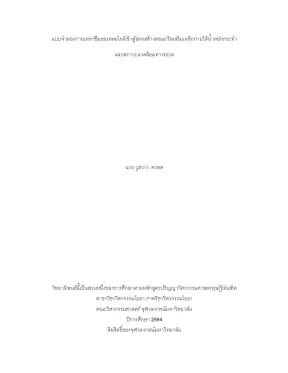
Tải xuống để đọc toàn bộแบบจําลองการแทรกซึมของคลอไรดเขาสูโครงสรางคอนกรีตเสริมเหล็กภายใตน้ําหนักกระทํา และสภาวะแวดลอมทางทะเล นาย วูฮวาง ควอค วิทยานิพนธนี้เปนสวนหนึ่งของการศึกษาตามหลักสูตรปริญญาวิศวกรรมศาสตรดุษฎีบัณฑิต สาขาวิชาวิศวกรรมโยธา ภาควิชาวิศวกรรมโยธา คณะวิศวกรรมศาสตร จุฬาลงกรณมหาวิทยาลัย ปการศึกษา 2554 ลิขสิทธิ์ของจุฬาลงกรณมหาวิทยาลัย MODEL FOR CHLORIDE INGRESS INTO REINFORCED CONCRETE STRUCTURE UNDER LOAD AND MARINE ENVIRONMENT Mr. Quoc Vu Hoang A Dissertation Submitted in Partial Fulfillment of the Requirements for the Degree of Doctor of Philosophy Program in Civil Engineering Department of Civil Engineering Faculty of Engineering Chulalongkorn University Academic Year 2011 Copyright of Chulalongkorn University vi ACKNOWLEDGEMENTS I would like to acknowledge all the contributions from the following persons. Without their support, this thesis would not have been completed. First of all I would like to express my thank to my family, my love and deepest gratitude to my wife - Thu, and to my daughter, little angle - Bina, for their enormous contribution, constant support and encouragement throughout completion of this thesis.
I would like to thank Japan International Cooperation Agency (JICA) through AUN/SEED-Net program for giving me the opportunity to pursue a PhD Degree in Civil Engineering in the field of Structural Engineering. I express my gratitude to Chulalongkorn University for providing a wonderful educational environment for studying. I also thank the Environmental Material Engineering (EME) Laboratory at Hokkaido University for its supporting programs. I wish to express my gratitude to my supervisor, Asso.
Boonchai Stitmannaitum, for his support, guidance, and encouragement. My thanks also go to my co-advisor, Prof. Sugiyama Takafumi at Hokkaido University, for his assistance in experiments in his lab that forms an essential part of this research. My sincere thanks to all committee members, namely, Prof.
Teerapong Senjuntichai, Asso. Phoonsak Pheinsusom, Asst. Withit Pansuk, and Asst. Their challenging questions and orientation on my proposal report have strengthened the framework of this research.
Finally, I would like to express my special thanks to my friends, Mr. Oran Laungpetcharaporn in concrete lab at Chulalongkorn University, and my friends in EME lab at Hokkaido University for their helps. CONTENTS Page Abstract in Thai.………………iv Abstract in English.………………vii List of Tables.x List of Figures……………………………………………….xi CHAPTER I INTRODUCTION…………………………………………………………….2 Statement of Problems. 2 CHAPTER II LITERATURE REVIEW …………………………………………………….1 Chloride induced corrosion in cracked concrete .1 Corrosion mechanisms of steel reinforcement in concrete .2 The effect of crack on the steel reinforcement corrosion in concrete.2 Transport mechanisms of chloride through cracked concrete.2 Permeation of salt solution .3 Background of correlations of crack to chloride ingress .1 Crack generation method .2 Influence of crack width and crack depth on chloride diffusion .3 Crack tortuosity and crack constrictivity .4 The loading and marine environment .5 Models for chloride ingress into cracked concrete .7 The objectives of study .8 The scopes of study.
27 CHAPTER III DEVELOPMENT OF MODEL ………………………………………………29 3.1 Two dimensional chloride diffusivity model of cracked reinforced concrete .1 The movement mechanism of bulk salt solution .2 The diffusion mechanism of chloride ions into cracked concrete .2 Model for chloride diffusion at crack location of reinforced concrete. 32 CHAPTER IV SIMULATION OF CHLORIDE PENETRATION INTO CRACKED REINFORCED CONCRETE…………………………………………………37 4.1 Simulation for chloride diffusion at crack location of reinforced concrete .2 Simulation for 2D chloride diffusivity in crack concrete .1 Model for 2D chloride diffusivity.2 Model for chloride diffusivity only perpendicular crack plane. 49 CHAPTER V MODEL VALIDATION …………………………………………………….1 Experiment procedures to perform the effect of crack depth on the chloride penetration .2 Determination for chloride profile by chemical analysis method .3 Determination for chloride profile by EPMA test .1 Correlation of the applied load (SR) to crack width opening .2 The correlation between crack depth and crack width.3 The influence of water-cement ratio (W/C) on the chloride penetration depth .4 The influence of crack depth on the chloride penetration depth .5 The influence of residual crack width on the chloride concentration depth .6 The influence of crack depth on the chloride diffusion coefficient at crack location.7 The tortuosity and constrictivity of crack .1 Validation for model of chloride diffusion at crack location of reinforced concrete .2 Two dimensional chloride ingress in cracked concrete. 81 CHAPTER VI DISCUSIONS AND CONCLUSIONS …………………………………….2 Limitations and Directions for Future Research .105 APPENDIX ……………………………………………………………………………………111 BIOGRAPHY …………………………………………………………………………………119 x LIST OF TABLES Page Table 2.
Maximum permissible crack width (ACI-224-01, 2001). Permissible crack width and minimum concrete cover.3 The lower and upper threshold values of crack width influencing on chloride diffusion. The input data for analytical computation following 1D chloride diffusivity model. The input data for ANSYS program analysis.1 Mix proportion per 1 cubic meter of concrete.
The different characteristics of crack and the affected coefficients. The surface chloride content and chloride diffusion coefficient at crack and uncrack locations. The deviation between predicted and experimental results. 71 xi LIST OF FIGURES Page Figure 2.
The anodic and cathodic reactions in the corrosion of steel bar in concrete (Broomfield, 2007). Volumetric expansion like a result of metallic iron (Broomfield, 2007). Schematic representation of two types for corrosion process in crack region (Schiessl and Raupach, 1997). Feedback controlled slitting test and water permeability test setup (Aldea et al.
The artificial crack (notch) by Marsavina (Marsavina et al. Controlled splitting test (Djerbi et al. The wedge splitting test (Karihaloo et al. Crack crated by the bending test (Gowripalan et al.
The sample and the expansive core (Ismail et al. Correlation of chloride threshold level to Wcr /C (Gowripalan et al. Diffusion coefficient and crack width tested with mortar specimens (Takewaka, Yamaguchi and Maeda, 2003). The chloride concentration profile collected at location of surface and perpendicular-to-crack wall (Ismail et al.
Study on chloride diffusion into cracks on concrete and steel specimens (Kato et al. Correlation of crack width to diffusion coefficient of crack (Djerbi et al. The definition of the tortuosity. The directional diffusion tortuosity along the x-axis by three simple capillary tube models by (Promentilla et al.
The concept for the constrictivity. Effect of crack width on crack constrictivity parameter (Ishida et al. Rapid chloride permeability under different stress-strength ratio (Lim et al. Chloride diffusion coefficient at different compressive stress level (Wang et al.
21 xii Page Figure 2. chloride diffusion coefficient at different tension stress level (Wang et al. The chloride diffusion coefficient in tension zone and compressive zone under flexural loading (Mien, 2008). The schematic representation of crack spacing l and crack width W (Boulfiza et al.
Concept for crack zone (Kato et al. The space domain for model of chloride diffusion in cracked concrete, (Paulsson-Tralla and Silfwerbrand, 2002). Chloride ions spread in two (three) dimension (Paulsson-Tralla and Silfwerbrand, 2002). The two-dimensional chloride diffusion coefficient.
The concept of the 2D surface content and diffusion coefficient of chloride for cracked concrete. Definition for crack and uncrack locations. The concept for the influence of crack depth on the chloride profile. The illustration of updating chloride diffusion coefficient.
The concept for chloride diffusion coefficient at crack location of reinforced concrete. Predicting chloride profile of beam series 1 after 2-week immersion in salt solution 38 Figure 4. Predicting chloride profile of beam series 2 after 2-week immersion in salt solution 39 Figure 4. Predicting chloride profile of beam series 3 after 2-week immersion in salt solution 39 Figure 4.
Predicting chloride profile of beam series 2 and 3 after 4-week immersion in solution. Predicting chloride profile of beam series 1 after 6-week immersion in salt solution 40 Figure 4. Predicting chloride profile of beam series 2 after 6-week immersion in salt solution 40 Figure 4. Predicting chloride profile of beam series 3 after 6-week immersion in salt solution 40 Figure 4.
Predicting chloride profile of beam series 1 after 8-week immersion in salt solution 41 Figure 4. Predicting chloride profile of beams after 8-week immersion in salt solution. 41 xiii Page Figure 4. Predicting chloride profile of beam series 2 after 16-week immersion in salt solution.
The elements of model by ANSYS. The surfaces exposed to chloride solution (2D chloride diffusivity). The analytical result of 2D chloride diffusivity of cracked concrete beam 1. The analytical result of 2D chloride diffusivity of cracked concrete beam 2.
The analytical result of 2D chloride diffusivity of cracked concrete beam 3. The analytical result of 2D chloride diffusivity of cracked concrete beam 4. The analytical result of 2D chloride diffusivity of cracked concrete beam 5. The analytical result of 2D chloride diffusivity of cracked concrete beam 7.
The crack plane surface exposed to chloride solution. The analytical result for chloride diffusivity perpendicular to crack plane of beam 6. The analytical result for chloride diffusivity perpendicular to crack plane of beam 8. The sketch of process research.
Set up of short-term diffusion test combined by ASTM C1202 and Nordtest NT 492. The concept of the penetration depth at crack location of reinforced concrete. The schematically experimental procedure. An example of results for the correlation between crack width and crack depth.
The mechanism and technology of EPMA (http://jp. Cracked reinforced concrete beam with coated epoxy layers. The location of the slice for EPMA test. The correlation between load level (SR) and residual crack mouth opening.
The correlation between respective crack depth and residual crack width. The chloride penetration depth at uncrack location versus the W/C ratio. The chloride concentration depth of specimens with (a) and without (b) steel bars. 60 xiv Page Figure 5.
The chloride penetration depth at uncrack (a) and crack (b) locations. The chloride penetration depth at crack location versus the respective crack depth 61 Figure 5. The influence of crack width on the chloride concentration depth. The influence of crack depth on the chloride diffusion coefficient by STDT.The artificial crack by Marsavina (Marsavina et al.
Influence of the notch depth on chloride penetration depth (W=0.2 mm) (Marsavina et al. Influence of the notch depth on chloride penetration depth (W=0.3 mm) (Marsavina et al. The influence of crack depth on the chloride penetration depth after converted by the tortuosity and constrictivity parameters of crack. Immersion (a) and after immersion (b) of cracked beam in salt solution.
The location for collecting the concrete powder to analyze chloride content. Comparison between the predicted results and experimental results affected by crack mouth. Comparison between the predicted results and experimental results affected by crack depth. Comparision between predicted and experimental results (Beam series 1, crack 1) 72 Figure 5.
Comparision between predicted and experimental results (Beam series 1, crack 2) 73 Figure 5. Comparision between predicted and experimental results (Beam series 1, crack 3) 73 Figure 5. Comparision between predicted and experimental results (Beam series 2, crack 1) 73 Figure 5. Comparision between predicted and experimental results (Beam series 2, crack 2) 74 Figure 5.
Comparision between predicted and experimental results (Beam series 3, crack 1) 74 Figure 5. Comparision between predicted and experimental results (Beam series 3, crack 2) 74 Figure 5. Comparision between predicted and experimental results (Beam series 3, crack 3) 75 Figure 5. Comparision between predicted and experimental results (Beam series 2, crack 1) 75 Figure 5.
Comparision between predicted and experimental results (Beam series 3, crack 1) 75 xv Page Figure 5. Comparision between predicted and experimental results (Beam series 1, crack 1) 76 Figure 5. Comparision between predicted and experimental results (Beam series 1, crack 2) 76 Figure 5. Comparision between predicted and experimental results (Beam series 1, crack 3) 76 Figure 5.
Comparision between predicted and experimental results (Beam series 2, crack 1) 77 Figure 5. Comparision between predicted and experimental results (Beam series 2, crack 2) 77 Figure 5. Comparision between predicted and experimental results (Beam series 2, crack 3) 77 Figure 5. Comparision between predicted and experimental results (Beam series 3, crack 1) 78 Figure 5.
Comparision between predicted and experimental results (Beam series 3, crack 2) 78 Figure 5. Comparision between predicted and experimental results (Beam series 3, crack 3) 78 Figure 5. Comparision between predicted and experimental results (Beam series 1, crack 1) 79 Figure 5.
Nội dung được bảo vệ bản quyền — Tải xuống đầy đủ
Trích dẫn luận án này
Quoc Vu Hoang (2011). Mô hình xâm nhập clorua vào BTCT dưới tải trọng & môi trường biển [Luận án tiến sĩ, Chulalongkorn University]. LuanAn.net. https://luanan.net/ky-thuat-xay-dung-kien-truc/ky-thuat-xay-dung-dan-dung-cong-nghiep/mo-hinh-xam-nhap-clorua-be-tong-cot-thep-tai-trong-moi-truong-bien
Câu hỏi thường gặp
Luận án "Mô hình xâm nhập clorua vào BTCT dưới tải trọng & môi trường biển" nghiên cứu về vấn đề gì?
Luận án đề xuất mô hình dự đoán sự xâm nhập clorua vào kết cấu BTCT dưới tải trọng và môi trường biển. Nâng cao tuổi thọ công trình.
Luận án "Mô hình xâm nhập clorua vào BTCT dưới tải trọng & môi trường biển" được bảo vệ tại trường nào?
Luận án này được bảo vệ tại Chulalongkorn University. Năm bảo vệ: 2011.
Luận án "Mô hình xâm nhập clorua vào BTCT dưới tải trọng & môi trường biển" thuộc chuyên ngành gì?
Luận án "Mô hình xâm nhập clorua vào BTCT dưới tải trọng & môi trường biển" thuộc chuyên ngành Civil Engineering. Danh mục: Kỹ Thuật Xây Dựng Dân Dụng & Công Nghiệp.
Luận án "Mô hình xâm nhập clorua vào BTCT dưới tải trọng & môi trường biển" có bao nhiêu trang?
Luận án "Mô hình xâm nhập clorua vào BTCT dưới tải trọng & môi trường biển" có 136 trang. Bạn có thể xem trước một phần tài liệu ngay trên trang web trước khi tải về.
Cách tải luận án "Mô hình xâm nhập clorua vào BTCT dưới tải trọng & môi trường biển" về máy như thế nào?
Để tải luận án về máy, bạn nhấn nút "Tải xuống ngay" trên trang này, sau đó hoàn tất thanh toán phí lưu trữ. File sẽ được tải xuống ngay sau khi thanh toán thành công. Hỗ trợ qua Zalo: 0559 297 239.