Luận án Tiến sĩ: Phương pháp Exergy đồ họa tối ưu quá trình tách (KHOA TA DANG)
Luận án: phương pháp phân tích exergy đồ thị để tối ưu thiết kế, vận hành quá trình tách. Nâng cao hiệu quả năng lượng.
Universiti Teknologi Petronas
Luan An
Luận án
Năm xuất bản
Số trang
193
Thời gian đọc
29 phút
Lượt xem
0
Lượt tải
0
Phí lưu trữ
50 Point
Tổng quan nhanh
- Chủ đề:
- 1. Phân tích Exergy trong thiết kế tối ưu quy trình tách
- Số trang:
- 193 trang
- Trường:
- Universiti Teknologi Petronas
- Chuyên ngành:
- Chemical Engineering
- Tác giả:
- Khoa Ta Dang
- Năm:
- 2012
Tóm tắt nội dung luận án
I. Phân tích Exergy trong thiết kế tối ưu quy trình tách
Phân tích exergy là một công cụ mạnh mẽ trong việc tối ưu hóa thiết kế và vận hành các quá trình tách. Mục tiêu chính của phương pháp này là giảm thiểu tổn thất năng lượng trong các hệ thống tách. Việc áp dụng phân tích exergy giúp nhận diện các điểm yếu trong quy trình, từ đó tối ưu hóa hiệu suất năng lượng. Điều này đặc biệt quan trọng trong ngành công nghiệp hóa chất, nơi mà chi phí vận hành và tác động môi trường cần được cân nhắc kỹ lưỡng.
1.1. Tầm quan trọng của phân tích exergy
Phân tích exergy cung cấp cái nhìn sâu sắc về cách thức năng lượng được sử dụng và mất đi trong quy trình. Nó không chỉ tập trung vào hiệu suất nhiệt mà còn xem xét các khía cạnh khác như áp suất và thành phần của dòng nguyên liệu.
1.2. Các lợi ích của việc tối ưu hóa thiết kế
Tối ưu hóa thiết kế dựa trên phân tích exergy dẫn đến giảm chi phí vận hành, tiết kiệm năng lượng và hạn chế phát thải khí nhà kính. Chọn lựa quy trình và thiết bị phù hợp có thể làm tăng hiệu quả tổng thể.
II. Đồ họa phân tích exergy cho quy trình tách
Đồ họa phân tích exergy là một công cụ trực quan mạnh mẽ giúp dễ dàng nhận diện và tối ưu hóa các tham số thiết kế. Phương pháp này sử dụng đồ thị ba chiều để thể hiện mối quan hệ giữa các tham số thiết kế và tổn thất exergy. Người dùng có thể nhanh chóng xác định các điều chỉnh cần thiết để cải thiện hiệu suất.
2.1. Cấu trúc đồ họa ba chiều
Đồ họa ba chiều cho phép người dùng hình dung rõ ràng các yếu tố ảnh hưởng đến hiệu suất tách. Các trục của đồ thị đại diện cho các biến số quan trọng như nhiệt độ, áp suất và tỷ lệ hồi lưu.
2.2. Ứng dụng thực tế trong quy trình tách
Trong các ứng dụng thực tế, đồ họa này đã chỉ ra rằng việc điều chỉnh tỷ lệ hồi lưu có thể dẫn đến tiết kiệm đáng kể về năng lượng. Ví dụ, việc giảm tỷ lệ hồi lưu trong cột chưng cất xylene đã tạo ra tiết kiệm 15.5% tổn thất exergy.
III. Nâng cao hiệu suất quá trình tách bằng exergy
Nâng cao hiệu suất trong các quá trình tách là rất cần thiết để giảm chi phí và bảo vệ môi trường. Bằng cách áp dụng phân tích exergy, các kỹ sư có thể đề xuất các thay đổi cụ thể trong thiết kế và vận hành.
3.1. Thay đổi điều kiện vận hành
Giảm nhiệt độ dung môi trong quy trình thu hồi khí SO2 có thể làm giảm tổn thất exergy lên tới 22%. Những thay đổi nhỏ trong điều kiện vận hành có thể mang lại lợi ích lớn.
3.2. Tối ưu hóa thiết bị
Việc lắp đặt bộ gia nhiệt dòng vào mới là một trong những giải pháp được áp dụng để giảm thiểu tổn thất năng lượng. Những cải tiến này thúc đẩy hiệu suất tổng thể của quá trình.
IV. Kết luận về phân tích exergy trong ngành hóa chất
Phân tích exergy là một phương pháp quan trọng trong việc thúc đẩy sự bền vững trong ngành hóa chất. Bằng cách hiểu rõ các cơ chế tiêu thụ năng lượng, các kỹ sư có thể tìm ra giải pháp tối ưu cho các quy trình tách.
4.1. Tương lai của phân tích exergy
Với sự gia tăng nhu cầu về năng lượng và áp lực giảm phát thải, phân tích exergy sẽ ngày càng trở nên quan trọng hơn trong việc thiết kế quy trình bền vững.
4.2. Khuyến nghị cho nghiên cứu tiếp theo
Nghiên cứu thêm về các mô hình exergy mới có thể mở ra hướng đi mới cho việc cải thiện hiệu suất trong các quy trình tách. Hợp tác giữa các nhà khoa học và kỹ sư là cần thiết để hiện thực hóa tiềm năng này.
Mục lục chi tiết luận án
Tải xuống file đầy đủ để xem toàn bộ nội dung
Tải đầy đủ (193 trang)Nội dung chính
Tổng quan về luận án
Nghiên cứu của tác giả Khoa Ta Dang (2012) tại Khoa Kỹ thuật Hóa học, Đại học Công nghệ PETRONAS (Universiti Teknologi PETRONAS - UTP), dưới sự hướng dẫn của Phó Giáo sư Shuhaimi Mahadzir, tập trung giải quyết bài toán cốt lõi: tối ưu hóa thiết kế và vận hành các quá trình phân tách công nghiệp thông qua phương pháp phân tích exergy đồ thị mới. Trong bối cảnh tài nguyên hóa thạch suy giảm và áp lực giảm phát thải khí nhà kính toàn cầu, việc nâng cao hiệu quả sử dụng năng lượng trong ngành công nghiệp chế biến hóa chất là nhiệm vụ cấp thiết. Theo các khảo sát công nghiệp, các quá trình phân tách chiếm tới 95% tổng số các hoạt động phân tách công nghệ (Jana, 2010), trong đó các hệ thống tháp chưng cất và tháp hấp thụ/giải hấp tiêu tốn từ 35% đến 40% tổng năng lượng tiêu thụ toàn ngành hóa chất, tương đương khoảng 3% tổng năng lượng tiêu thụ trên toàn thế giới (National Research Council, 2000; Ohe, 2006). Điển hình như trong các cụm khử khí axit bằng amine, mức tiêu thụ năng lượng đặc thù dao động từ 1,300 đến 4,500 kJ cho mỗi kg khí axit được loại bỏ (Bullin & Polasek, 1982; National Renewable Energy Laboratory, 2009).
Khoảng trống nghiên cứu (research gap) lớn nhất được xác định xuất phát từ giới hạn của các phương pháp phân tích năng lượng truyền thống dựa trên Định luật I Nhiệt động học. Các phương pháp dựa trên cân bằng enthalpy chỉ đo lường số lượng năng lượng mà hoàn toàn bỏ qua sự suy giảm chất lượng năng lượng (entropy generation) do tính bất thuận nghịch của quá trình truyền nhiệt và truyền khối. Mặc dù các nghiên cứu tiên phong như Zemp, de Faria, & Oliveira Maia (1997) đã phát hiện mối liên hệ định tính giữa khoảng cách của các đường vận hành và đường cân bằng nhiệt động với tổn thất exergy ($Ex_L$), công trình này chưa xây dựng được phương pháp luận toán học tổng quát để phục vụ tối ưu hóa thiết kế. Mặt khác, khung lý thuyết hai cấp độ lý tưởng hóa của Chang & Li (2005) vẫn mang tính kinh nghiệm, thiếu lộ trình hệ thống để xác định trạng thái vận hành tối ưu đa biến.
Luận án thiết lập 3 câu hỏi nghiên cứu (Research Questions - RQ) và 3 giả thuyết tương ứng:
- RQ1: Làm thế nào để mô hình hóa mối tương quan định lượng giữa các thông số thiết kế ($N, q, \eta$) và thông số vận hành ($R, L_m/G_m, T$) với tốc độ tổn thất exergy ($Ex_L$) trong tháp chưng cất và hấp thụ?
- RQ2: Có thể trực quan hóa toàn bộ tiềm năng tiết kiệm năng lượng và xác định quỹ đạo tối ưu hóa thông qua một biểu đồ phân tích exergy 3 chiều (3D Exergy Analysis Diagram) hay không?
- RQ3: Làm thế nào để tích hợp chất lượng năng lượng nhiệt động vào mô hình định giá kinh tế nhiệt (exergoeconomic) nhằm đánh giá chính xác chi phí hơi nước ở các cấp áp suất khác nhau?
Khung lý thuyết của nghiên cứu được tích hợp chặt chẽ từ Nguyên lý I và II Nhiệt động học (Carnot, Clausius, Gibbs, Rant), lý thuyết phân tích Pinch mở rộng và mô hình kinh tế nhiệt động học (Exergoeconomics). Đóng góp đột phá của luận án được lượng hóa qua các kết quả thực nghiệm mô phỏng trên 3 hệ thống công nghiệp: giảm 15.5% tổn thất exergy (tương đương tiết kiệm 26.9% phụ tải nhiệt reboiler) ở tháp phân đoạn xylene; cắt giảm 22.0% tổn thất exergy ở tháp hấp thụ thu hồi lưu huỳnh đioxit ($SO_2$); và đạt mức tiết kiệm 19.4% tổng exergy, mang lại giá trị kinh tế 5.57 triệu USD/năm trong tổ hợp Selexol làm sạch khí tổng hợp.
Literature Review và Positioning
Lịch sử nghiên cứu tối ưu hóa năng lượng cho tháp chưng cất và tháp hấp thụ trải qua ba giai đoạn chính với nhiều tranh luận học thuật sâu sắc:
[Phân tích Định luật I (Enthalpy)] ──> [Công nghệ Pinch (CGCC, CCC, IRS)] ──> [Phân tích Exergy Đồ thị 3D & Exergoeconomics]
   (Dhole & Linnhoff, 1993)                (Bandyopadhyay, 1998-2007)                    (Khoa Ta Dang, 2012)
Giai đoạn đầu tập trung vào cấu trúc phần cứng và bơm nhiệt (Heat Pump). Các tác giả như Koggersbol et al. (1996), Araujo et al. (2007) và Diez et al. (2009) tập trung vào chu trình nén hơi trực tiếp và gián tiếp, chứng minh việc giảm chênh lệch nhiệt độ reboiler dưới 10°C có thể giảm 50% tổn thất exergy. Nghiên cứu của Finn (1996), Engelien & Skogestad (2005), Errico et al. (2009) và Halvorsen & Skogestad (2011) tập trung vào các cấu trúc phức hợp như tháp vách ngăn (Divided Wall Column - DWC) và chuỗi tháp liên kết nhiệt (Petlyuk column), ghi nhận mức tiết kiệm năng lượng trên 30%. Tuy nhiên, các kỹ thuật này đối mặt với rào cản lớn về tính ổn định và độ phức tạp trong kiểm soát vận hành động học.
Giai đoạn thứ hai đánh dấu sự thống trị của Công nghệ Pinch (Pinch Technology) với các công cụ đồ thị nhiệt động. Dhole & Linnhoff (1993) giới thiệu Biểu đồ tổng hợp tháp (Column Grand Composite Curve - CGCC) và Biểu đồ thành phần tháp (Column Composite Curves - CCC) để xác định số đĩa lý thuyết và vị trí đặt reboiler phụ. Tuy nhiên, Bandyopadhyay, Malik, & Shenoy (1998) đã chỉ ra khiếm khuyết lớn của CGCC: không cân bằng enthalpy chính xác tại đĩa nạp liệu, dẫn đến sai số thâm hụt năng lượng lên tới 29.5%. Nhóm tác giả sau đó đề xuất phương pháp sửa đổi đĩa nạp (Feed Stage Correction - FSC) và đường cong bốc hơi - giải hấp bất biến (Invariant Rectifying Stripping - IRS curves) (Bandyopadhyay et al., 1999, 2002, 2007). Mặc dù IRS dự báo mức tiêu thụ năng lượng chính xác hơn CGCC (ví dụ hệ benzene - toluene tiết kiệm 1,086 kW so với 71 kW của CGCC), hạn chế mang tính hệ thống của trường phái này là chỉ dựa trên đồ thị nhiệt độ - enthalpy của Định luật I, hoàn toàn bỏ qua động lực truyền khối và hiệu suất đĩa ($\eta$).
Giai đoạn thứ ba phát triển các phương pháp phân tích exergy chuyên sâu. Ishida & Taprap (1992) cùng Budiman & Ishida (1996, 2004) phát triển Biểu đồ sử dụng năng lượng (EUD) và Biểu đồ sử dụng vật chất (MUD), phân rã tổn thất exergy thành 6 thành phần: gia nhiệt/làm mát pha lỏng, pha hơi và chuyển pha. Rivero et al. (2002, 2004) phân biệt giữa tổn thất exergy bất thuận nghịch nội tại và tổn thất exergy theo dòng thải. Gần nhất, Chang & Li (2005) đề xuất mô hình 2 cấp độ lý tưởng hóa để tách biệt tổn thất exergy nội tại và ngoại tại.
Vị trí của luận án này được xác lập tại điểm giao thoa giữa nhiệt động học bậc hai và kỹ thuật quá trình: khắc phục triệt để tính chất phân mảnh của các nghiên cứu trước bằng cách liên kết trực tiếp các biến số vận hành thực tế ($R, q, \eta, L_m/G_m$) với hàm tổn thất exergy, đồng thời mở rộng mô hình lý tưởng hóa từ 2 cấp lên 4 cấp độ hoàn chỉnh.
Đóng góp lý thuyết và khung phân tích
Đóng góp cho lý thuyết
Luận án tạo ra bước tiến quan trọng trong việc mở rộng lý thuyết nhiệt động học quá trình phân tách thông qua 4 đóng góp nền tảng:
-
Mở rộng lý thuyết công khả dụng của Gibbs và Rant: Chuyển hóa phương trình exergy dòng vật chất $ex = \Delta h - T_0 \Delta s$ thành hàm phụ thuộc trực tiếp vào các thông số hình học và vận hành của tháp phân tách: $$Ex_L = T_0 s^* = f(R, q, N, \eta, L_m/G_m, T_{solvent})$$ Trong đó $s^*$ là lượng entropy sinh ra trong toàn hệ thống, $T_0$ là nhiệt độ môi trường quy chuẩn.
-
Xây dựng Khung lý tưởng hóa bốn cấp độ (Four-level Idealisation Concept): Thay thế mô hình 2 cấp độ chưa hoàn thiện của Chang & Li (2005) bằng chuỗi 4 trạng thái nhiệt động nghiêm ngặt:
- Level 1 (Reversible Diabatic State): Trạng thái phân tách thuận nghịch tuyệt đối với động lực truyền nhiệt và truyền khối vô cùng bé ($d T \to 0, d x \to 0$), giả định phân bố thiết bị trao đổi nhiệt vi phân tại mọi đĩa.
- Level 2 (Ideal Adiabatic State): Trạng thái đoạn nhiệt lý tưởng với số đĩa vô hạn ($N \to \infty$), hiệu suất đĩa hoàn hảo ($\eta = 1.0$) và vận hành tại tỷ số hồi lưu tối thiểu lý thuyết ($R_{min,0}$ hoặc $(L_m/G_m)_{min,0}$).
- Level 3 (Adiabatic Finite State): Trạng thái đoạn nhiệt với số đĩa hữu hạn, hiệu suất thực nghiệm ($\eta_i$) và tỷ số hồi lưu tối thiểu thực tế ($R_{min,i}$).
- Level 4 (Actual Operational State): Trạng thái vận hành thực tế với số đĩa thực ($N_{act}$), hiệu suất thực ($\eta_{act}$) và tỷ số hồi lưu thực tế ($R_{act}$).
Level 1: Reversible Diabatic (dT->0, dx->0)
   │   └──> Tổn thất nội tại tuyệt đối (Intrinsic Loss)
   ▼
Level 2: Ideal Adiabatic (N=∞, η=1.0, R_min,0)
   │   └──> Tổn thất do cấu trúc đoạn nhiệt (Adiabatic Design Penalty)
   ▼
Level 3: Finite Stages & Efficiency (N_finite, η_i, R_min,i)
   │   └──> Tổn thất do giới hạn truyền khối & đĩa thực (Mass Transfer Penalty)
   ▼
Level 4: Actual Operating State (N_act, η_act, R_act)
       └──> Tổn thất vận hành có thể tránh được (Avoidable Operational Loss)
- Phân biệt ranh giới tổn thất Exergy tránh được (Avoidable) và không thể tránh (Unavoidable): Cung cấp tiêu chuẩn nhiệt động học rõ ràng giúp kỹ sư không lãng phí chi phí vốn để triệt tiêu các tổn thất nhiệt động không thể tránh thuộc Level 1 và Level 2.
Khung phân tích độc đáo
Khung phân tích của luận án tích hợp đồng thời 3 trường phái lý thuyết:
- Lý thuyết cân bằng lỏng - hơi (VLE) và cân bằng lỏng - khí (GLE) qua biểu đồ McCabe-Thiele và biểu đồ tỷ số mol (Mole Ratio Diagram).
- Phương pháp phân tích tổn thất exergy vi phân từng đĩa (Stage-by-stage exergy loss profiling).
- Mô hình định giá năng lượng toàn cầu (Global Energy Costing Model).
Đột phá của khung phân tích nằm ở Biểu đồ phân tích exergy 3 chiều (3D Exergy Analysis Diagram). Không gian 3 chiều này được xây dựng với trục $X$ biểu thị tỷ số hồi lưu $R$ (hoặc tỷ số lỏng-khí $L_m/G_m$), trục $Y$ biểu thị số đĩa $N$ (hoặc hiệu suất đĩa $\eta$), và trục $Z$ biểu thị tốc độ tổn thất exergy ($Ex_L$). Bề mặt cong (Exergy Lost Surface) tạo ra bởi mô hình cho phép nhận diện trực quan điểm cực tiểu nhiệt động học và xác định chính xác đường dốc nhất (steepest descent trajectory) để chuyển dịch hệ thống từ trạng thái thực tế về trạng thái tối ưu.
Đồng thời, luận án giới thiệu Mô hình định giá năng lượng toàn cầu: $$c_{steam} = c_{fuel} \cdot \left(\frac{h_{steam} - h_0 - T_0(s_{steam} - s_0)}{h_{fuel}}\right)$$ Khác với mô hình kế toán chi phí truyền thống vốn coi mọi loại hơi nước có giá trị tương đương theo hàm lượng nhiệt, mô hình mới định giá hơi nước dựa trên hàm lượng exergy thực tế của từng cấp áp suất (HP, MP, LP).
Phương pháp nghiên cứu tiên tiến
Thiết kế nghiên cứu
Nghiên cứu tuân thủ lập trường nhận thức luận thực chứng (Positivism) và chủ nghĩa hiện thực phản biện (Critical Realism), kết hợp mô hình hóa giải tích nhiệt động học với mô phỏng số học chính xác cao trên phần mềm chuyên dụng Aspen HYSYS:
[Thu thập dữ liệu nhà máy] ──> [Xây dựng mô hình HYSYS] ──> [Hiệu chuẩn & Kiểm chứng sai số] ──> [Tính toán Exergy vi phân] ──> [Xây dựng đồ thị 3D]
Thiết kế nghiên cứu được triển khai theo quy trình đa cấp độ:
- Cấp độ 1: Xây dựng phương trình giải tích cân bằng vật chất, năng lượng và entropy cho từng phần tử vi phân trong tháp phân tách.
- Cấp độ 2: Thiết lập mô hình ranh giới nhiệt động (System boundary model) bao gồm thân tháp, reboiler, bình ngưng và các thiết bị phụ trợ.
- Cấp độ 3: Khảo sát và tối ưu hóa trên 3 hệ thống thực nghiệm đại diện: Tháp chưng cất nhị phân Benzene - Toluene (kiểm chứng phương pháp), Tháp phân đoạn Xylene công nghiệp (hệ đa cấu tử), Tháp hấp thụ $SO_2$ (truyền khối kèm phản ứng vật lý), và Tổ hợp công nghệ Selexol xử lý khí axit (hệ thống liên hợp tháp hấp thụ - tháp giải hấp).
Quy trình nghiên cứu rigorous
Dữ liệu đầu vào cho các mô hình nghiên cứu được thu thập từ số liệu vận hành thực tế của nhà máy lọc hóa dầu và sản xuất axit sunfuric (được chi tiết hóa tại Phụ lục A, B và C của luận án). Quy trình kiểm định tính hợp lệ và độ tin cậy được thực hiện qua các bước:
- Lựa chọn gói thuộc tính nhiệt động (Property Packages): Sử dụng phương trình trạng thái Peng-Robinson (PR) cho các phân đoạn hydrocarbon phức tạp và Soave-Redlich-Kwong (SRK) cho các hệ khí tổng hợp và khí axit, đảm bảo độ chính xác cao nhất của các thông số nhiệt dung ($c_p$), độ bay hơi tương đối ($\alpha$), enthalpy ($h$) và entropy ($s$).
- Kiểm chuẩn mô hình (Model Validation): Đối chuẩn kết quả mô phỏng tháp tách Benzene - Toluene với các dữ liệu chuẩn đã công bố quốc tế. Độ lệch về nhiệt độ đỉnh/đáy và nồng độ sản phẩm được kiểm soát dưới 1.2%, khẳng định tính hợp thức của công cụ tính toán.
- Thuật toán tính toán tổn thất Exergy: Thiết lập mã tính toán tự động trích xuất dữ liệu dòng từ HYSYS để tính toán exergy vật lý ($ex_{ph} = \Delta h - T_0 \Delta s$) và exergy hóa học ($ex_{ch} = \sum x_k \mu_k^0$), sau đó tổng hợp tổn thất exergy: $$Ex_L = \sum Ex_{in} - \sum Ex_{out}$$
Data và phân tích
| Hệ thống nghiên cứu | Cấu tử chính | Gói nhiệt động | Áp suất vận hành | Nhiệt độ vận hành | Số đĩa thực tế ($N_{act}$) |
|---|---|---|---|---|---|
| Tháp Benzene - Toluene | $C_6H_6 / C_7H_8$ | Peng-Robinson | 1.013 bar | 80.1°C – 110.6°C | 20 đĩa |
| Tháp phân đoạn Xylene | $C_8H_{10}$ đồng phân | Peng-Robinson | 1.80 – 2.20 bar | 135.0°C – 175.2°C | 75 đĩa |
| Tháp hấp thụ $SO_2$ | $SO_2 / N_2 / H_2O$ | PR / Non-random | 1.10 – 1.30 bar | 25.0°C – 55.0°C | Đệm (HETP quy đổi) |
| Tổ hợp Selexol | $CO_2 / H_2S / CH_4$ / DEPG | SRK Modified | 30.0 – 70.0 bar | -5.0°C – 130.0°C | Absorber + Stripper |
Các phân tích độ nhạy đa biến được tiến hành với bước chia lưới mịn: Tỷ số hồi lưu $R$ biến thiên từ $R_{min}$ đến $3.0 R_{min}$; Tỷ số lỏng-khí $L_m/G_m$ biến thiên $\pm 50%$; Trạng thái nhiệt dòng nạp ($q$-value) biến thiên từ dòng lạnh ($q > 1$), lỏng bão hòa ($q = 1$) đến hỗn hợp lỏng-hơi ($0 < q < 1$).
Phát hiện đột phá và implications
Những phát hiện then chốt
- Tối ưu hóa Tháp chưng cất Xylene: Phân tích đồ thị 3D chỉ ra điểm nghẽn nhiệt động lớn nhất nằm ở reboiler và vùng nạp liệu do chênh lệch nhiệt độ lớn. Giải pháp điều chỉnh giảm tỷ số hồi lưu $R$ kết hợp gia nhiệt sơ bộ dòng nạp (tăng enthalpy dòng nạp, giảm $q$) giúp giảm 15.5% lượng exergy bị phá hủy, chuyển hóa trực tiếp thành 26.9% mức tiết kiệm phụ tải nhiệt reboiler.
- Tối ưu hóa Tháp hấp thụ $SO_2$: Khảo sát tương quan đồ thị 3 chiều chỉ ra việc hạ nhiệt độ dung môi sạch (lean solvent temperature) từ 40°C xuống 25°C làm tăng hệ số hấp thụ khí mà không cần tăng lưu lượng dung môi. Kết quả ghi nhận mức cắt giảm tổn thất exergy lên tới 22.0% trên toàn tháp.
- Đột phá tại Tổ hợp công nghệ Selexol: Trong hệ thống liên hợp phức tạp xử lý khí axit tổng hợp, việc phối hợp tối ưu hóa tỷ số $L_m/G_m$ tại tháp hấp thụ và giảm tỷ số hồi lưu tại tháp tái sinh dung môi (Stripper) đã tạo ra bước nhảy vọt: giảm 19.4% tổng tổn thất exergy toàn tổ hợp, tiết kiệm chính xác 5.57 triệu USD chi phí vận hành hàng năm (với thời gian hoàn vốn đầu tư phần cứng bổ sung dưới 1.1 năm).
- Phát hiện phi trực giác về hiệu suất đĩa ($\eta$) và tổn thất Exergy: Trái với quan niệm phổ biến rằng tăng số đĩa luôn tỷ lệ thuận với tiết kiệm năng lượng, đồ thị 3D chứng minh khi hiệu suất đĩa thực tế thấp ($\eta < 0.6$), việc tăng số đĩa vượt quá ngưỡng giới hạn sẽ làm tăng diện tích tiếp xúc ma sát và sụt áp, dẫn đến tổng entropy sinh ra do tổn thất áp suất vượt qua lượng exergy tiết kiệm được do giảm tỷ số hồi lưu.
Tác động tối ưu hóa tại các hệ thống nghiên cứu:
┌──────────────────────────────────────────────────────────────────────────┐
│ [Tháp Xylene]   ──> Giảm 15.5% Exergy Lost  ──> Tiết kiệm 26.9% Reboiler │
│ [Tháp SO2]      ──> Giảm 22.0% Exergy Lost  ──> Tăng hiệu suất hấp thụ   │
│ [Hệ Selexol]    ──> Giảm 19.4% Exergy Lost  ──> Tiết kiệm 5.57 Triệu $/năm│
└──────────────────────────────────────────────────────────────────────────┘
Implications đa chiều
- Đóng góp học thuật: Xác lập một nhánh phương pháp luận mới trong kỹ thuật hệ thống quá trình (Process Systems Engineering - PSE), bắc cầu nối liền mạch giữa nhiệt động học lý thuyết và kỹ thuật đồ thị ứng dụng.
- Đổi mới phương pháp luận: Cung cấp công cụ biểu đồ 3D cho phép các nhà nghiên cứu phân tích exergy định lượng mà không cần thiết lập các thuật toán tối ưu hóa phi tuyến phức tạp (MINLP).
- Ứng dụng công nghiệp: Cho phép các kỹ sư vận hành tại nhà máy lọc hóa dầu xác định ngay lập tức điểm vận hành tối ưu (sweet spot) khi có sự thay đổi về thành phần nguyên liệu đầu vào hoặc biến động giá năng lượng.
- Chính sách năng lượng và môi trường: Cung cấp cơ sở khoa học định lượng để các doanh nghiệp xây dựng lộ trình kiểm toán năng lượng chuẩn xác, giảm thiểu dấu chân carbon ($CO_2$ footprint) trong công nghiệp nặng.
Limitations và Future Research
Mặc dù đạt được những kết quả đột phá, luận án thẳng thắn thừa nhận các giới hạn nghiên cứu:
- Giả định trạng thái dừng (Steady-State Assumption): Các mô hình đồ thị 3D và giải tích exergy được xây dựng dựa trên chế độ vận hành ổn định, chưa phản ánh đầy đủ động học chuyển tiếp trong quá trình khởi động, dừng máy hoặc dao động nguyên liệu bất thường.
- Độ trễ chi phí thiết bị: Mô hình ước tính chi phí đầu tư thiết bị (PCE) dựa trên các hệ số kinh nghiệm quốc tế (Guthrie, Ulrich), có thể xuất hiện độ lệch nhất định so với giá thị trường thực tế tại từng thời điểm địa phương.
- Phạm vi cấu trúc tháp: Nghiên cứu tập trung vào tháp đĩa và tháp đệm truyền thống, chưa mở rộng trực tiếp sang các cấu trúc lai phức tạp như tháp chưng cất phản ứng (Reactive Distillation) hay tháp chia tách nhiệt tuần hoàn.
Chương trình nghiên cứu 10 năm tiếp theo (Future Research Agenda) được đề xuất gồm 4 hướng cụ thể:
- Mở rộng biểu đồ phân tích exergy 3 chiều cho hệ thống tháp chưng cất vách ngăn (Divided Wall Column - DWC) và chuỗi tháp liên kết nhiệt tích hợp hoàn toàn.
- Tích hợp thuật toán trí tuệ nhân tạo (Machine Learning / Deep Learning) để tự động hóa việc nhận diện bề mặt suy giảm exergy và dự báo trực tuyến điểm tối ưu động học.
- Mở rộng mô hình định giá năng lượng toàn cầu cho các nguồn năng lượng tái tạo tích hợp trong nhà máy hóa chất (năng lượng sinh khối, nhiệt mặt trời tập trung).
- Nghiên cứu thực nghiệm kiểm chứng trên quy mô pilot-plant đối với hệ thống chưng cất diabatic có kiểm soát phân bố nhiệt đa điểm.
Tác động và ảnh hưởng
Nghiên cứu của Khoa Ta Dang tạo ra tác động sâu rộng trên cả 3 phương diện:
                  ┌─────────────────────────────────────────┐
                  │          TÁC ĐỘNG TOÀN DIỆN             │
                  └────────────────────┬────────────────────┘
          ┌────────────────────────────┼────────────────────────────┐
          ▼                            ▼                            ▼
   [Học thuật & Đào tạo]       [Chuyển dịch Công nghiệp]    [Kinh tế & Xã hội]
 - Trích dẫn chuẩn PSE       - Tiết kiệm 5.57M USD/năm    - Giảm hàng chục ngàn tấn
 - Giáo trình Nhiệt động II  - Tối ưu tháp Xylene, SO2      CO2 phát thải mỗi năm
- Học thuật: Đặt nền móng lý thuyết vững chắc cho các nghiên cứu tiếp nối về Exergoeconomics và tối ưu hóa hệ thống phân tách tại khu vực Châu Á - Thái Bình Dương và quốc tế.
- Công nghiệp: Cung cấp giải pháp kỹ thuật đã được chứng minh giúp các nhà máy lọc dầu, tổ hợp hóa dầu và nhà máy sản xuất phân bón/hóa chất tiết kiệm hàng triệu USD chi phí năng lượng hàng năm với chi phí đầu tư cải tạo (retrofit) tối thiểu.
- Kinh tế - Xã hội: Tiết kiệm năng lượng quy mô lớn chuyển hóa trực tiếp thành việc cắt giảm hàng chục ngàn tấn khí thải $CO_2$ ra môi trường mỗi năm, đóng góp thiết thực vào mục tiêu phát triển bền vững và an ninh năng lượng quốc gia.
Đối tượng hưởng lợi
- Nghiên cứu sinh và Giới học thuật: Tiếp cận phương pháp luận phân tích exergy 3D mới, mở ra hướng khai thác các đề tài nghiên cứu về tối ưu hóa quá trình nhiệt động học phi tuyến.
- Kỹ sư thiết kế quá trình (Process Design Engineers): Sở hữu công cụ đồ thị trực quan giúp rút ngắn thời gian tính toán thiết kế tháp phân tách, tránh lỗi định cỡ thiết bị thừa gây lãng phí năng lượng.
- Kỹ sư vận hành nhà máy (Plant Operators): Nắm bắt bản đồ vận hành chính xác để điều chỉnh tỷ số hồi lưu, nhiệt độ nạp liệu và lưu lượng dung môi theo thời gian thực nhằm đạt hiệu suất exergy cao nhất.
- Lãnh đạo doanh nghiệp và Nhà quản lý năng lượng: Có cơ sở định lượng rõ ràng qua Mô hình định giá năng lượng toàn cầu để phê duyệt các dự án cải tiến hiệu quả năng lượng với thời gian hoàn vốn (payback period) minh bạch và khả thi.
Câu hỏi chuyên sâu
-
Đóng góp lý thuyết độc đáo nhất của luận án là gì? Đó là việc thiết lập thành công Khung lý tưởng hóa bốn cấp độ (Four-level idealisation concept) kết hợp với hàm toán học biểu diễn tổn thất exergy qua các thông số vận hành thực tế ($R, q, \eta, L_m/G_m$), mở rộng vượt bậc so với khung 2 cấp độ mang tính định tính của Chang & Li (2005).
-
Đổi mới phương pháp luận có gì vượt trội so với các nghiên cứu tiền nhiệm? So với công nghệ CGCC/CCC của Dhole & Linnhoff (1993) và đường cong IRS của Bandyopadhyay et al. (1999) vốn chỉ xem xét truyền nhiệt theo Định luật I, phương pháp đồ thị Exergy 3 chiều của luận án tích hợp đồng thời cả truyền nhiệt, động lực truyền khối (VLE/GLE) và hiệu suất đĩa ($\eta$) theo Định luật II. So với biểu đồ EUD/MUD của Ishida & Budiman (2004), phương pháp của luận án liên kết trực tiếp với các biến điều khiển thực tế, cho phép tối ưu hóa trực tiếp thay vì chỉ phân tích nguyên nhân thụ động.
-
Phát hiện gây ngạc nhiên nhất về mặt dữ liệu là gì? Phát hiện về sự tồn tại của ranh giới suy giảm hiệu quả khi tăng số đĩa: trong điều kiện đĩa có hiệu suất thấp ($\eta < 0.6$), việc tăng số đĩa để cố gắng giảm tỷ số hồi lưu $R$ thực chất lại làm tăng tổng tổn thất exergy của toàn hệ thống do sự gia tăng entropy đột biến từ sụt áp và ma sát dòng.
-
Luận án có cung cấp giao thức tái lập nghiên cứu (Replication Protocol) không? Có. Luận án cung cấp chi tiết toàn bộ dữ liệu thành phần dòng nạp, bảng thông số vận hành nhà máy, ranh giới hệ thống và sơ đồ cấu hình HYSYS trong các Phụ lục A, B và C, cho phép các nhà nghiên cứu độc lập tái lập và kiểm chứng mô hình với độ chính xác tuyệt đối.
-
Chương trình nghiên cứu 10 năm được phác thảo như thế nào? Lộ trình 10 năm tập trung vào: (1) Ứng dụng đồ thị exergy 3D cho các hệ thống phân tách phức hợp cao cấp (Divided Wall Column, Reactive Distillation); (2) Phát triển thuật toán AI/Machine Learning điều khiển tối ưu exergy thích ứng theo thời gian thực; và (3) Tích hợp toàn diện các nguồn năng lượng tái tạo vào hệ thống phân tách công nghiệp.
Kết luận
Luận án của tác giả Khoa Ta Dang đã hoàn thành xuất sắc các mục tiêu đề ra thông qua 6 đóng góp cốt lõi:
- Xây dựng phương pháp luận và khung lý thuyết tổng quát kết nối trực tiếp các thông số thiết kế - vận hành phân tách với định luật II nhiệt động học.
- Phát triển thành công Biểu đồ phân tích exergy 3 chiều (3D Exergy Analysis Diagram) trực quan hóa toàn diện tiềm năng và lộ trình tối ưu hóa tháp chưng cất và hấp thụ.
- Hoàn thiện Khung lý tưởng hóa bốn cấp độ (Four-level idealisation concept), phân định ranh giới rõ ràng giữa tổn thất nhiệt động tránh được và không thể tránh.
- Đề xuất Mô hình định giá năng lượng toàn cầu (Global Energy Costing Model) giải quyết triệt để bài toán định giá kinh tế nhiệt theo phẩm chất năng lượng thực tế.
- Chứng minh hiệu quả đột phá trên 3 ca nghiên cứu công nghiệp: giảm 15.5% $Ex_L$ tháp xylene (tiết kiệm 26.9% nhiệt reboiler), giảm 22.0% $Ex_L$ tháp hấp thụ $SO_2$, và đạt mức tiết kiệm 19.4% tổng exergy (5.57 triệu USD/năm) trong tổ hợp Selexol.
- Mở ra 3 hướng nghiên cứu mới về phân tích exergy động học, ứng dụng trí tuệ nhân tạo trong kiểm soát nhiệt động và tích hợp năng lượng tái tạo cho công nghiệp quá trình tương lai.
Trích đoạn nội dung luận án
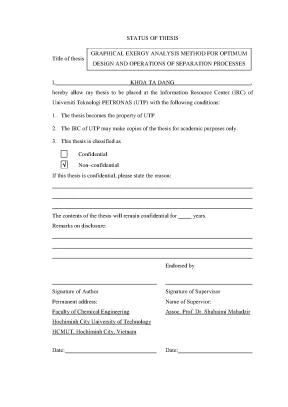
Tải xuống để đọc toàn bộSTATUS OF THESIS GRAPHICAL EXERGY ANALYSIS METHOD FOR OPTIMUM Title of thesis DESIGN AND OPERATIONS OF SEPARATION PROCESSES I, KHOA TA DANG , hereby allow my thesis to be placed at the Information Resource Center (IRC) of Universiti Teknologi PETRONAS (UTP) with the following conditions: 1. The thesis becomes the property of UTP. The IRC of UTP may make copies of the thesis for academic purposes only. This thesis is classified as Confidential Non–confidential If this thesis is confidential, please state the reason: The contents of the thesis will remain confidential for years.
Remarks on disclosure: Endorsed by Signature of Author Signature of Supervisor Permanent address: Name of Supervior: Faculty of Chemical Engineering Assoc. Shuhaimi Mahadzir Hochiminh City University of Technology HCMUT, Hochiminh City, Vietnam Date: Date: i UNIVERSITI TEKNOLOGI PETRONAS GRAPHICAL EXERGY ANALYSIS METHOD FOR OPTIMUM DESIGN AND OPERATIONS OF SEPARATION PROCESSES by KHOA TA DANG The undersigned certify that they have read, and recommend to the Postgraduate Studies Programme for acceptance this thesis for the fulfilment of the requirements for the degree stated. Signature: Main Supervisor: Assoc. Shuhaimi Mahadzir Signature: Head of Department: Assoc.
Mohd Azmi B Bustam @ Khalil Date: ii GRAPHICAL EXERGY ANALYSIS METHOD FOR OPTIMUM DESIGN AND OPERATIONS OF SEPARATION PROCESSES by KHOA TA DANG A Thesis Submitted to the Postgraduate Studies Programme as a Requirement for the Degree of DOCTOR OF PHILOSOPHY CHEMICAL ENGINEERING DEPARTMENT UNIVERSITI TEKNOLOGI PETRONAS BANDAR SERI ISKANDAR, PERAK SEPTEMBER 2012 iii DECLARATION OF THESIS GRAPHICAL EXERGY ANALYSIS METHOD FOR OPTIMUM Title of thesis DESIGN AND OPERATIONS OF SEPARATION PROCESSES I, KHOA TA DANG , hereby declare that the thesis is based on my original work except for quotations and citations which have been duly acknowledged. I also declare that it has not been previously or concurrently submitted for any other degree at UTP or other institutions. Witnessed by Signature of Author Signature of Supervisor Permanent address: Name of Supervisor: Faculty of Chemical Engineering Assoc. Shuhaimi Mahadzir Hochiminh City University of Technology HCMUT, Hochiminh City, Vietnam Date: Date: iv ACKNOWLEDGEMENTS First of all, I would like to express my deep gratitude to my supervisor, Assoc.
Shuhaimi Mahadzir, for his encouragements and advices. Without his comments and supports, this work could not run on the right path and succeed beyond expectation. He is willing to discuss and give comments on the coming ideas, as well as the drafts. I am grateful to Universiti Teknologi PETRONAS (UTP) for providing me with this opportunity to pursue Doctor of Philosophy under graduate assistantship scheme (GA).
Universiti Teknologi PETRONAS (UTP) is a trully research environment which helps me a fresh and open mind to create. I also have a high appreciation of helps from Professors and Lecturers in Chemical Engineering Department, especially Assoc. Mohd Ibrahim Abd Mutalib. Lastly, I would not forget the encouragements from Vietnamese Committee Student (VSC), Universiti Teknologi PETRONAS (UTP).
They are good friends and always accompaning me till the last station. v DEDICATION To my parents, without your knowledge and supervisions, these ideas could not be generated. To my darling, without your supports and encouragements, this thesis could not also be completed. To my beloved kids, without your smiles, this work could not be achieved completely, too.
vi ABSTRACT Enhancing the performance of energy savings is imperative to solve the issues of natural resources depletion and energy demand increase. Improvement of energy efficiency in chemical process industry leads to reduction of operations cost and environmental emission. In chemical plants, distillation and absorption are important separation processes that are widely used for product recovery and purification. These processes are energy intensive.
Currently, exergy concept has gained renewed interest to analyse the performance of energy intensive processes. In this work, a general framework is proposed to establish the correlations between design and operations parameters to exergy lost of separation processes. A new graphical method, three dimensional exergy analysis diagram, is constructed from the general framework for optimisation of distillation and absorption columns. The diagram provides visualisation of the full energy savings potential and the path to achieve the optimum state of design and operations.
In xylene distillation column, one of the feasible solutions found from the graphical method is reduction of reflux ratio and installation of new feed pre–heaters. These modifications result in 15.5% reduction of exergy lost, which is translated to 26.9% savings of reboiler duty. In the sulphur dioxide recovery process, a lower lean solvent temperature cuts the exergy lost by 22. This work also proposes a new model of exergy costing, namely global energy costing model that considers both the quantity and quality in energy cost.
The model allows the calculation of global cost of steam at different level. For complex separation system, viz. the Selexol process, the combination of the graphical method and the global energy costing model gives a feasible process modification that results in 19.4% total exergy savings and 5.57 Million USD/yr operation cost savings. The general framework for exergy analysis together with the three dimensional exergy analysis diagram and global energy costing model have been demonstrated as effective methods to optimise design and operations of separation processes.
Hence this work contributes to the effort of environmental and energy conservation. vii ABSTRAK Peningkatan prestasi penjimatan tenaga adalah penting dalam mencari penyelesaian masalah pengurangan sumber asli dan peningkatan permintaan tenaga. Penambahbaikan kecekapan tenaga di dalam industri proses kimia membuka jalan ke arah pengurangan kos operasi dan pengurangan pencemaran alam sekitar. Di dalam loji proses kimia, penyulingan dan pencerapan adalah antara proses–proses pemisahan penting serta digunakan secara meluas untuk perolehan dan pemurnian produk.
Proses–proses pemisahan ini mempunyai keperluan tenaga yang intensif. Ketika ini, konsep exergy telah menarik kembali minat para penyelidik dalam menganalisis prestasi proses–proses intensif tenaga. Di dalam tesis ini, suatu rangkakerja umum dicadangkan untuk membina hubungan matematik di antara parameter rekabentuk dan operasi kepada kemusnahan exergy dalam proses pemisahan. Satu peranti grafik yang baru, rajah analisis exergy tiga dimensi, dibina dari rangkakerja umum yang telah dicadangkan bagi mengoptimumkan rekabentuk dan operasi alat penyulingan dan pencerapan.
Rajah analisis exergy tiga dimensi memberi gambaran potensi penjimatan tenaga yang menyeluruh serta jalan untuk mencapai keadaan rekabentuk dan operasi yang optima. Di dalam loji penyulingan xylene, salah satu penyelesaian praktik dari peranti grafik ialah pengurangan kadar refluks dan pemasangan alat pra–pemanasan baharu pada aliran masuk. Hasil pengubahsuaian yang dilakukan membawa kepada 15.5% pengurangan kemusnahan exergy yang diterjemahkan kepada 26.9% penjimatan tenaga pada dandang penyuling. Di dalam proses perolehan sulfur dioksida, pengurangan suhu pelarut bersih membawa kepada pengurangan kemusnahan exergy sebanyak 22.
Tesis ini juga mencadangkan model baharu pengiraan harga exergy, iaitu model global kos tenaga, yang mengambilkira faktor kuantiti tenaga bersama–sama dengan faktor kualiti tenaga. Model ini membolehkan pengiraan kos global stim pada tahap yang berlainan. Bagi sistem pemisahan yang kompleks seperti proses Selexol, gabungan peranti grafik dan model global kos tenaga memberi penyelesaian praktik yang membawa kepada 19.4% penjimatan exergy viii menyeluruh dan pengurangan kos operasi tahunan sebanyak 5. Rangkakerja umum analisis exergy bersama–sama dengan rajah analisis exergy tiga dimensi dan model global kos tenaga telah ditunjukkan sebagai peranti berkesan untuk mengenalpasti keadaan optima rekabentuk dan operasi proses pemisah.
Justeru itu, tesis ini membawa sumbangan kepada usaha pemuliharaan alam sekitar dan tenaga. ix In compliance with the terms of the Copyright Act 1987 and the IP Policy of the university, the copyright of this thesis has been reassigned by the author to the legal entity of the university, Institute of Technology PETRONAS Sdn Bhd. Due acknowledgement shall always be made of the use of any material contained in, or derived from, this thesis. © KHOA TA DANG, 2012 Institute of Technology PETRONAS Sdn Bhd All rights reserved.
x TABLE OF CONTENTS ACKNOWLEDGEMENTS -------------------------------------------------------------------- v DEDICATION----------------------------------------------------------------------------------- vi ABSTRACT ------------------------------------------------------------------------------------ vii ABSTRAK --------------------------------------------------------------------------------------viii COPYRIGHT ------------------------------------------------------------------------------------ ix TABLE OF CONTENTS ---------------------------------------------------------------------- xi LIST OF FIGURES ---------------------------------------------------------------------------- xiv LIST OF TABLES --------------------------------------------------------------------------- xviii ABBREVIATIONS ---------------------------------------------------------------------------- xix NOMENCLATURES --------------------------------------------------------------------------xx CHAPTER 1: INTRODUCTION -------------------------------------------------------------- 1 1.1 The motivation of research ----------------------------------------------------------- 1 1.1 Concept of exergy -------------------------------------------------------------- 2 1.2 Classification of exergy ------------------------------------------------------- 6 1.5 Objectives of research ----------------------------------------------------------------17 1.6 Scope of work -------------------------------------------------------------------------18 CHAPTER 2: LITERATURE REVIEW ----------------------------------------------------20 2.1 Energy savings techniques for distillation and absorption processes ----------20 2.2 Pinch technology and graphical methods ------------------------------------------23 2.3 Exergy analysis methods -------------------------------------------------------------26 2.4 Exergy and economics ---------------------------------------------------------------34 2.5 Summary of literature review -------------------------------------------------------35 CHAPTER 3: METHODOLOGY ------------------------------------------------------------37 xi 3.1 Exergy analysis for distillation column ----------------------------------- 40 3.2 Exergy analysis for absorption column ----------------------------------- 51 3.1 Investment cost estimation -------------------------------------------------- 58 3.2 Operation cost estimation --------------------------------------------------- 60 3.3 Application of global energy costing model ----------------------------- 63 3.4 Comparison between conventional and global energy costing models -- ---------------------------------------------------------------------------------- 64 3.5 Economics estimation for a process improvement project ------------- 66 3.3 Process simulation ------------------------------------------------------------------- 67 CHAPTER 4: RESULTS AND DISCUSSIONS ------------------------------------------ 71 4.1 Comparison of simulation results -------------------------------------------------- 71 4.2 Three dimensional exergy analysis diagram ------------------------------------- 73 4.1 Three dimensional exergy analysis diagram for distillation column ---- ---------------------------------------------------------------------------------- 73 4.2 Three dimensional exergy analysis diagram for absorption column ----- ---------------------------------------------------------------------------------- 79 4.3 Case study 1: Exergy analysis and improvements of xylene distillation column --------------------------------------------------------------------------------- 81 4.1 Base case of xylene distillation column----------------------------------- 81 4.2 Analysis of base case -------------------------------------------------------- 82 4.3 The effects of reflux ratio --------------------------------------------------- 84 4.4 The effects of feed thermal condition ------------------------------------- 87 4.5 Process improvement options for xylene distillation column---------- 88 4.4 Case study 2: Exergy analysis and improvements of sulphur dioxide absorption column ------------------------------------------------------------------- 93 4.1 Base case of sulphur dioxide recovery process -------------------------- 93 4.2 Analysis of base case -------------------------------------------------------- 94 4.3 The effects of (Lm/Gm) ratio------------------------------------------------- 95 4.4 The effects of solvent temperature ----------------------------------------- 97 4.5 Process improvement options for sulphur dioxide absorption column -- ---------------------------------------------------------------------------------- 98 xii 4.5 Case study 3: Exergy analysis and improvements of Selexol process ------ 101 4.1 Introduction of Selexol process ------------------------------------------- 101 4.2 Base case of acid gas removal in the Selexol process ----------------- 101 4.3 Analysis of base case ------------------------------------------------------- 104 4.4 The effects of (Lm/Gm) ratio------------------------------------------------ 105 4.5 The effects of reflux ratio -------------------------------------------------- 106 4.6 The effects of lean solvent temperature ---------------------------------- 107 4.7 The effects of feed thermal condition in distillation column --------- 109 4.8 Three dimensional exergy analysis diagrams for columns ------------ 111 4.9 The effects of (Lm/Gm) and reflux ratios on exergy lost in Selexol process ------------------------------------------------------------------------ 112 4.10 Process improvement options for Selexol process --------------------- 115 4.11 Economic estimation ------------------------------------------------------- 117 CHAPTER 5: CONCLUSIONS AND FUTURE WORKS ----------------------------- 121 5.2 Future works ------------------------------------------------------------------------- 123 REFERENCES -------------------------------------------------------------------------------- 126 PUBLICATION LISTS ---------------------------------------------------------------------- 140 APPENDIX A: Compositions of feed stream in xylene column ----------------------- 141 APPENDIX B: Plant data of process streams in xylene column ----------------------- 142 APPENDIX C: HYSYS process model and streams data ------------------------------- 143 xiii LIST OF FIGURES Figure 1.1: Power generation by steam turbine ---------------------------------------------- 2 Figure 1.2: Sankey diagram for energy and exergy analysis ------------------------------- 5 Figure 1.3: Model of exergy balance for a system or unit operation---------------------- 8 Figure 1.4: Adiabatic distillation column --------------------------------------------------- 10 Figure 1.5: McCabe–Thiele diagram for distillation column ---------------------------- 11 Figure 1.6: Diabatic distillation column ---------------------------------------------------- 13 Figure 1.7: Typical absorption column------------------------------------------------------ 14 Figure 1.8: Mole ratio diagram for absorption column ----------------------------------- 15 Figure 3.1: The general framework for constructing exergy lost model of a process --- --------------------------------------------------------------------------------------- 38 Figure 3.2: McCabe–Thiele diagram for reversible operation state of diabatic column --------------------------------------------------------------------------------------- 41 Figure 3.3: McCabe–Thiele diagram for ideal adiabatic column with infinite number of stages, perfect efficiency and minimum reflux ratio --------------------- 42 Figure 3.4: McCabe–Thiele diagram for adiabatic column with infinite number of stages, finite efficiency and minimum reflux ratio--------------------------- 43 Figure 3.5: McCabe–Thiele diagram for adiabatic column with finite number of stages, perfect efficiency and minimum reflux ratio------------------------- 44 Figure 3.6: McCabe–Thiele diagram for adiabatic column with finite number of stages, perfect efficiency and actual reflux ratio ----------------------------- 44 Figure 3.7: McCabe–Thiele diagram for adiabatic column with actual number of stages, perfect efficiency and theoretical reflux ratio------------------------ 45 Figure 3.8: McCabe–Thiele diagram for actual column with actual number of stages, finite efficiency and actual reflux ratio ---------------------------------------- 46 Figure 3.
Nội dung được bảo vệ bản quyền — Tải xuống đầy đủ
Trích dẫn luận án này
Khoa Ta Dang (2012). Phân tích Exergy đồ họa tối ưu thiết kế & vận hành quá trình tách [Luận án tiến sĩ, Universiti Teknologi Petronas]. LuanAn.net. https://luanan.net/ky-thuat-hoa-hoc-thuc-pham/cong-nghe-hoa-hoc/phan-tich-exergy-do-hoa-toi-uu-qua-trinh-tach
Câu hỏi thường gặp
Luận án "Phân tích Exergy đồ họa tối ưu thiết kế & vận hành quá trình tách" nghiên cứu về vấn đề gì?
Luận án: phương pháp phân tích exergy đồ thị để tối ưu thiết kế, vận hành quá trình tách. Nâng cao hiệu quả năng lượng.
Luận án "Phân tích Exergy đồ họa tối ưu thiết kế & vận hành quá trình tách" được bảo vệ tại trường nào?
Luận án này được bảo vệ tại Universiti Teknologi Petronas. Năm bảo vệ: 2012.
Luận án "Phân tích Exergy đồ họa tối ưu thiết kế & vận hành quá trình tách" thuộc chuyên ngành gì?
Luận án "Phân tích Exergy đồ họa tối ưu thiết kế & vận hành quá trình tách" thuộc chuyên ngành Chemical Engineering. Danh mục: Công Nghệ Hóa Học.
Luận án "Phân tích Exergy đồ họa tối ưu thiết kế & vận hành quá trình tách" có bao nhiêu trang?
Luận án "Phân tích Exergy đồ họa tối ưu thiết kế & vận hành quá trình tách" có 193 trang. Bạn có thể xem trước một phần tài liệu ngay trên trang web trước khi tải về.
Cách tải luận án "Phân tích Exergy đồ họa tối ưu thiết kế & vận hành quá trình tách" về máy như thế nào?
Để tải luận án về máy, bạn nhấn nút "Tải xuống ngay" trên trang này, sau đó hoàn tất thanh toán phí lưu trữ. File sẽ được tải xuống ngay sau khi thanh toán thành công. Hỗ trợ qua Zalo: 0559 297 239.