Luận án Truyền dẫn chính sách tiền tệ và kênh cho vay tại Việt Nam - Nguyễn Phúc Cảnh
Luận án TS: Truyền dẫn chính sách tiền tệ, kênh cho vay tại VN. Phân tích sâu, giải pháp thiết thực cho nền kinh tế.
Năm xuất bản
Số trang
310
Thời gian đọc
47 phút
Lượt xem
0
Lượt tải
0
Phí lưu trữ
60 Point
Tổng quan nhanh
- Chủ đề:
- 1. Cơ chế truyền dẫn chính sách tiền tệ tại Việt Nam
- Số trang:
- 310 trang
- Trường:
- Trường Đại học Kinh tế Thành phố Hồ Chí Minh
- Chuyên ngành:
- Tài chính - Ngân hàng
- Tác giả:
- Nguyen Phuc Canh
- Năm:
- 2016
Tóm tắt nội dung luận án
I. Cơ chế truyền dẫn chính sách tiền tệ tại Việt Nam
Chính sách tiền tệ Việt Nam hoạt động thông qua ba kênh chính: lãi suất, tín dụng và tỷ giá. Kênh lãi suất điều chỉnh chi phí vay, ảnh hưởng đến đầu tư và tiêu dùng. Kênh tín dụng điều tiết lượng vốn lưu thông qua hệ thống ngân hàng thương mại. Kênh tỷ giá tác động đến xuất nhập khẩu, qua đó kiểm soát lạm phát. Mỗi kênh có vai trò riêng nhưng phụ thuộc vào cơ chế thị trường và công cụ điều hành của Ngân hàng Nhà nước Việt Nam.
1.1. Kênh lãi suất và cơ chế vận hành
Kênh lãi suất điều chỉnh lãi suất tái chiết khấu và tái cấp vốn. Khi lãi suất tăng, chi phí vay của doanh nghiệp và hộ gia đình tăng, làm giảm đầu tư và tiêu dùng. Kênh này hiệu quả khi thị trường vốn cạnh tranh. Tuy nhiên, ở Việt Nam, sự can thiệp hành chính vào lãi suất khiến kênh này chưa phát huy tối đa.
1.2. Kênh tín dụng và hệ thống ngân hàng thương mại
Kênh tín dụng điều tiết cung vốn thông qua tỷ lệ dự trữ bắt buộc. Ngân hàng thương mại Việt Nam có vai trò trung gian, phân bổ vốn cho nền kinh tế. Hiệu quả kênh này phụ thuộc vào năng lực quản trị rủi ro và minh bạch thông tin. Các ngân hàng nhỏ thường thiếu khả năng thẩm định tín dụng, gây ra tình trạng cho vay kém hiệu quả.
1.3. Kênh tỷ giá và tác động đến xuất nhập khẩu
Kênh tỷ giá tác động đến giá hàng hóa nhập khẩu và xuất khẩu. Khi tỷ giá tăng, hàng Việt Nam rẻ hơn trên thị trường quốc tế, thúc đẩy xuất khẩu. Ngược lại, tỷ giá giảm làm tăng giá nguyên liệu nhập khẩu, đẩy lạm phát. Kênh này thường bị ảnh hưởng bởi chính sách tiền tệ của các nền kinh tế lớn như Mỹ.
II. Hiệu quả truyền dẫn chính sách tiền tệ Việt Nam
Hiệu quả truyền dẫn tiền tệ Việt Nam phụ thuộc vào mức độ phát triển của thị trường tài chính và minh bạch thông tin. Các kênh truyền dẫn hoạt động kém hiệu quả khi thị trường vốn còn hạn chế, đầu tư công chậm tiến và lạm phát biến động. So sánh với các quốc gia G7, Việt Nam cần cải thiện cơ chế thị trường và năng lực dự báo kinh tế.
2.1. Các yếu tố ảnh hưởng đến hiệu quả truyền dẫn
Yếu tố thị trường như độ mở tài chính và độ tin cậy của nhà đầu tư ảnh hưởng lớn. Yếu tố vĩ mô như nợ công và đầu tư nước ngoài cũng đóng vai trò quan trọng. Ngoài ra, sự phối hợp giữa chính sách tiền tệ và tài khóa còn yếu, gây ra xung đột mục tiêu.
2.2. Thách thức trong thực tiễn áp dụng
Thách thức chính là sự can thiệp hành chính vào lãi suất và tỷ giá. Các ngân hàng thương mại thiếu năng lực thẩm định rủi ro, dẫn đến tín dụng đen. Ngoài ra, thị trường vốn chưa phát triển đủ để kênh lãi suất phát huy hiệu quả. Lạm phát phi lạm phát như giá đất, giá tài sản ảo cũng làm méo mó chính sách.
2.3. So sánh với các nền kinh tế khác
So với BRICS, Việt Nam có tỷ lệ cho vay/tiền gửi thấp hơn, phản ánh hiệu quả kênh tín dụng kém. So với OECD, Việt Nam cần cải thiện minh bạch thông tin và giảm sự phụ thuộc vào đầu tư công. Kênh tỷ giá tại Việt Nam hoạt động yếu hơn so với các nước Đông Á do can thiệp mạnh.
III. Kênh cho vay ngân hàng và vai trò trong truyền dẫn
Kênh cho vay ngân hàng là cầu nối giữa chính sách tiền tệ và nền kinh tế. Khi Ngân hàng Nhà nước điều chỉnh lãi suất, các ngân hàng thương mại thay đổi lãi suất cho vay, ảnh hưởng đến doanh nghiệp và người tiêu dùng. Hiệu quả kênh này phụ thuộc vào năng lực thẩm định rủi ro và minh bạch thông tin.
3.1. Cơ chế hoạt động của kênh cho vay ngân hàng
Ngân hàng thương mại thu tiền gửi, cho vay lại với lãi suất cao hơn. Kênh này truyền dẫn chính sách qua sự chênh lệch lãi suất. Tuy nhiên, nếu lãi suất cho vay bị kiểm soát hành chính, kênh này mất đi tính linh hoạt. Việt Nam cần phát triển thị trường trái phiếu doanh nghiệp để đa dạng hóa kênh huy động vốn.
3.2. Tác động của chính sách tiền tệ đến cho vay
Khi lãi suất chính sách giảm, ngân hàng thương mại cho vay với lãi suất thấp hơn, thúc đẩy đầu tư. Ngược lại, lãi suất tăng làm giảm tín dụng tiêu dùng và sản xuất. Ở Việt Nam, sự can thiệp vào lãi suất cho vay khiến kênh này phản ứng chậm với tín hiệu từ Ngân hàng Nhà nước.
3.3. Rào cản trong việc triển khai kênh cho vay
Rào cản chính là thiếu thông tin về năng lực tài chính của doanh nghiệp nhỏ. Ngân hàng thương mại Việt Nam thường từ chối cho vay vì rủi ro cao. Ngoài ra, hệ thống pháp lý về thế chấp tài sản còn chưa rõ ràng, khiến vốn khó tiếp cận các khu vực tiềm năng.
IV. Vai trò của Ngân hàng Nhà nước Việt Nam
Ngân hàng Nhà nước Việt Nam điều hành chính sách tiền tệ thông qua công cụ lãi suất, tỷ giá và tỷ lệ dự trữ bắt buộc. Cơ quan này đóng vai trò trung gian giữa mục tiêu kinh tế vĩ mô và thị trường tài chính. Hiệu quả chính sách phụ thuộc vào năng lực dự báo và phản ứng nhanh trước biến động kinh tế.
4.1. Chính sách tiền tệ và công cụ điều hành
Công cụ chính là lãi suất tái chiết khấu, tỷ lệ dự trữ bắt buộc và mua bán trái phiếu. Ngân hàng Nhà nước cũng sử dụng công cụ thị trường mở để điều tiết cung tiền. Tuy nhiên, sự can thiệp hành chính vào lãi suất khiến công cụ này bị hạn chế.
4.2. Điều chỉnh lãi suất và tỷ giá
Khi lạm phát tăng, Ngân hàng Nhà nước nâng lãi suất để thu hút vốn gửi ngân hàng. Đồng thời, điều chỉnh tỷ giá để kiểm soát giá hàng nhập khẩu. Tuy nhiên, can thiệp mạnh vào tỷ giá làm méo mó tín hiệu thị trường và tăng rủi ro vĩ mô.
4.3. Hỗ trợ hệ thống ngân hàng thương mại
Ngân hàng Nhà nước cung cấp thanh khoản cho hệ thống ngân hàng qua công cụ tái chiết khấu. Tuy nhiên, quy trình cấp vốn còn chậm, gây khó khăn cho các ngân hàng nhỏ. Cần cải thiện minh bạch thông tin để ngân hàng thương mại có thể tiếp cận vốn hiệu quả hơn.
Mục lục chi tiết luận án
Tải xuống file đầy đủ để xem toàn bộ nội dung
Tải đầy đủ (310 trang)Nội dung chính
Tổng quan về luận án
Luận án tiến sĩ này cung cấp một phân tích chuyên sâu về cơ chế truyền dẫn chính sách tiền tệ (Monetary Policy Transmission Mechanism - MPTM) và kênh tín dụng ngân hàng (Bank Lending Channel - BLC) tại Việt Nam, một nền kinh tế thị trường mới nổi có những đặc thù riêng. Nghiên cứu được đặt trong bối cảnh khoa học đầy thách thức sau cuộc khủng hoảng tài chính toàn cầu năm 2008, khi hiệu quả của các kênh truyền dẫn chính sách tiền tệ truyền thống, đặc biệt ở các thị trường mới nổi, trở thành tâm điểm của các cuộc tranh luận học thuật.
Bối cảnh khoa học và tính tiên phong của nghiên cứu Nghiên cứu này nổi bật bởi việc giải quyết một khoảng trống kiến thức quan trọng trong lĩnh vực chính sách tiền tệ tại các nền kinh tế đang phát triển. Trong khi các nghiên cứu trước đây đã chứng minh sự tồn tại của các kênh truyền dẫn như kênh lãi suất (Interest Rate Channel - IRC), kênh tỷ giá hối đoái (Exchange Rate Channel - ERC) và kênh giá tài sản (Asset Price Channel - APC) ở các quốc gia phát triển, thì bằng chứng thực nghiệm cho các thị trường mới nổi, đặc biệt là Việt Nam, vẫn còn hạn chế và mang tính đặc thù. Tính tiên phong của luận án nằm ở việc không chỉ kiểm định các kênh truyền dẫn phổ biến mà còn khám phá sâu rộng kênh tín dụng ngân hàng, vốn được kỳ vọng có vai trò mạnh mẽ trong một nền kinh tế phụ thuộc nhiều vào ngân hàng như Việt Nam.
Research gap SPECIFIC với citations từ literature Khoảng trống nghiên cứu cụ thể mà luận án này giải quyết là sự thiếu hụt một nghiên cứu toàn diện về MPTM và vai trò của BLC tại Việt Nam, đặc biệt sau cuộc khủng hoảng tài chính toàn cầu 2008. Luận án khẳng định rằng "The transmission of monetary policy is the center of economic studies, this field was renewed in light of the 2008 global financial crisis with arguments about the effectiveness and the determinants of transmission channels especially in emerging markets such as Vietnam which may have strong bank lending channel while asset price channel and exchange rate channel may be weak." (Abstract, p.xiii). Cụ thể, trong bối cảnh Việt Nam – một "small open emerging economy which has transmitted to the market economy since the 1980’s" – các kênh truyền thống có thể không hiệu quả. Kênh lãi suất có thể không phải là quan trọng nhất do khung thể chế chưa hoàn chỉnh và thị trường tài chính non trẻ. Kênh tỷ giá hối đoái có thể yếu do sự can thiệp của chính phủ vào thị trường ngoại hối, và kênh giá tài sản cũng có thể yếu do thị trường chứng khoán kém phát triển. Ngược lại, Việt Nam lại có "potential conditions for the existence of bank lending channel" do sự phụ thuộc lớn của nền kinh tế và khu vực tư nhân vào vốn ngân hàng, cũng như sự phụ thuộc của ngân hàng thương mại vào tiền gửi để cấp tín dụng (Research gap identification, p.9-10, Altunbas et al., 2002; Mishra & Montiel, 2012). Điều này tạo ra một nhu cầu cấp thiết cho một nghiên cứu toàn diện về các kênh truyền dẫn chính sách tiền tệ tại Việt Nam, như được nhấn mạnh: "From both academic aspects and empirical aspects, we need a comprehensive study about monetary policy transmission in an emerging market such as Vietnam that are motivations for this study in Vietnam." (Research gap identification, p.10).
Research questions và hypotheses (đánh số cụ thể) Để lấp đầy khoảng trống nghiên cứu này, luận án tập trung trả lời các câu hỏi sau:
- Kênh lãi suất, kênh tỷ giá hối đoái và kênh giá tài sản có tồn tại ở Việt Nam không?
- Kênh tín dụng ngân hàng có tồn tại ở Việt Nam không? Và quy mô ngân hàng, vốn ngân hàng, thanh khoản ngân hàng, rủi ro ngân hàng, cũng như cuộc khủng hoảng tài chính toàn cầu 2008 có ảnh hưởng đến kênh tín dụng ngân hàng ở Việt Nam không?
Theoretical framework với tên theories cụ thể Khung lý thuyết của luận án được xây dựng dựa trên nhiều lý thuyết kinh tế vĩ mô và vi mô về chính sách tiền tệ và tín dụng. Nền tảng là mô hình IS-LM (Investment/Saving - Liquidity Preference/Money Supply) của John Hicks (1937), dựa trên phân tích của John Maynard Keynes (1936), giải thích mối quan hệ giữa lãi suất và sản lượng thực. Đối với kênh giá tài sản, luận án dựa vào lý thuyết q của Tobin (1969), giải thích tác động của chính sách tiền tệ lên giá tài sản tài chính và hoạt động đầu tư của doanh nghiệp thông qua tỷ lệ q. Đồng thời, hiệu ứng của cải (wealth effect) được Andro & Modigliani (1963) phát triển cũng được sử dụng để phân tích tác động của giá tài sản lên hành vi tiêu dùng của hộ gia đình. Ngoài ra, các lý thuyết về kênh tín dụng như kênh bảng cân đối kế toán (Balance Sheet Channel - BSC), kênh dòng tiền (Cash Flow Channel - CFC), kênh mức giá bất ngờ (Unexpected Price Level Channel - UPLC) và hiệu ứng thanh khoản hộ gia đình (Household Liquidity Effects - HLE) từ các nghiên cứu của Bernanke & Gertler (1995) và Mishkin (1995) cũng được tích hợp để giải thích các cơ chế phức tạp của kênh tín dụng.
Đóng góp đột phá với quantified impact Luận án mang lại nhiều đóng góp đột phá, bao gồm:
- Phát hiện kênh chi phí (cost channel) ở Việt Nam: Đây là một bằng chứng thực nghiệm quan trọng cho thấy chính sách tiền tệ ở một nền kinh tế nhỏ, mở như Việt Nam có thể tác động thông qua kênh chi phí thay vì các kênh truyền thống, phản ánh "the ineffective of monetary policy in controlling inflation" (Abstract, p.xiv). Điều này thách thức các giả định phổ biến và cung cấp thông tin quý giá cho các nhà hoạch định chính sách.
- Xác nhận BLC và các yếu tố quyết định tại thị trường mới nổi: Luận án cung cấp bằng chứng thực nghiệm rõ ràng về sự tồn tại của kênh tín dụng ngân hàng tại Việt Nam và xác định các yếu tố quyết định như "bank capital, bank size" (Abstract, p.xiv). Nghiên cứu cũng định lượng được tác động của cuộc khủng hoảng tài chính 2008, cho thấy "the 2008 global financial crisis had significant effects on bank lending channels which is stronger in crisis" (Abstract, p.xiv).
- Đóng góp về phương pháp luận: Luận án đề xuất một phương pháp tiếp cận toàn diện hơn, "economists should test all transmission channels in one model for better controlling the interactions between channels and better measuring the effectiveness of each channel" (Abstract, p.xiv). Đây là một định hướng quan trọng cho các nghiên cứu trong tương lai.
- Hàm ý chính sách cụ thể: Nghiên cứu đưa ra các khuyến nghị thiết thực cho Ngân hàng Nhà nước Việt Nam (SBV) trong việc phát triển thị trường nợ và vốn chủ sở hữu, kiểm soát rủi ro hệ thống ngân hàng và áp dụng các chính sách tiền tệ phi truyền thống như mục tiêu lạm phát (Abstract, p.xiv). Những đóng góp này có thể giúp định hình các chính sách ổn định kinh tế vĩ mô và hệ thống tài chính, đặc biệt khi đối mặt với các cú sốc bên ngoài trong tương lai.
Scope (sample size, timeframe) và significance Phạm vi nghiên cứu bao gồm dữ liệu kinh tế vĩ mô hàng tháng từ năm 2003 đến 2012 để phân tích các kênh lãi suất, tỷ giá và giá tài sản. Đối với kênh tín dụng ngân hàng, luận án sử dụng dữ liệu panel hàng năm từ 30 ngân hàng thương mại Việt Nam trong cùng giai đoạn 2003-2012. Khoảng thời gian này (2003-2012) được lựa chọn kỹ lưỡng để đảm bảo đủ dữ liệu cho các mô hình thống kê phức tạp và quan trọng hơn là để "test the impacts of the 2008 global financial crisis" (The scope of this study, p.11). Tầm quan trọng của nghiên cứu nằm ở việc cung cấp bằng chứng thực nghiệm đáng tin cậy cho một nền kinh tế mới nổi, giúp các nhà hoạch định chính sách hiểu rõ hơn về cách chính sách tiền tệ tác động đến nền kinh tế và cách để tối ưu hóa hiệu quả chính sách trong môi trường đặc thù của Việt Nam.
Literature Review và Positioning
Phần tổng quan tài liệu và định vị nghiên cứu của luận án cung cấp một cái nhìn toàn diện về các dòng nghiên cứu chính liên quan đến cơ chế truyền dẫn chính sách tiền tệ và kênh tín dụng ngân hàng, đồng thời làm nổi bật đóng góp độc đáo của nghiên cứu này.
Synthesis của major streams với TÊN TÁC GIẢ và NĂM cụ thể Tổng quan tài liệu của luận án đã tổng hợp các dòng nghiên cứu chính về truyền dẫn chính sách tiền tệ, bắt đầu với kênh lãi suất (IRC), được coi là kênh truyền dẫn truyền thống và quan trọng nhất ở nhiều quốc gia phát triển (Bernanke & Blinder, 1992; Cecchetti, 1995; Taylor, 1995). Các nghiên cứu như của Andersson, Dillén, & Sellin (2006) và Cook & Hahn (1989) đã xác nhận cơ chế của IRC thông qua cấu trúc kỳ hạn của lãi suất. Tiếp theo là kênh tỷ giá hối đoái (ERC), được Demir (2014) và Golinelli & Rovelli (2005) chứng minh là một kênh quan trọng, đặc biệt ở các nền kinh tế mở, tác động thông qua cán cân thương mại. Luận án cũng đề cập đến kênh giá tài sản (APC), bao gồm lý thuyết q của Tobin (1969) và hiệu ứng của cải của Ando & Modigliani (1963), được nhấn mạnh bởi Mishra & Montiel (2012) là quan trọng ở các quốc gia phát triển nhưng còn hạn chế ở các nước đang phát triển do thị trường vốn kém phát triển. Đáng chú ý, luận án dành một phần đáng kể để tổng hợp các nghiên cứu về kênh tín dụng (credit channel) và các kênh phụ của nó như kênh tín dụng ngân hàng (BLC), kênh bảng cân đối kế toán (BSC), kênh dòng tiền (CFC), kênh mức giá bất ngờ (UPLC) và hiệu ứng thanh khoản hộ gia đình (HLE). Các nghiên cứu tiên phong của Bernanke & Gertler (1995), Kashyap & Stein (1995), và Altunbas et al. (2002) đã đặt nền móng cho việc hiểu biết sâu sắc về BLC, đặc biệt là tầm quan trọng của nó trong các nền kinh tế đang phát triển (Mishra & Montiel, 2012).
Contradictions/debates với ít nhất 2 opposing views Tổng quan tài liệu cũng làm nổi bật những mâu thuẫn và tranh luận trong các nghiên cứu trước. Ví dụ, về ERC, mặc dù nhiều nghiên cứu như của Golinelli and Rovelli (2005) ở Czech Republic, Hungary và Finland, hay Karasoy, Kunter, and Us (2005) ở Turkey đã tìm thấy bằng chứng về ERC, nhưng lại có những trường hợp như Eritrea (Mengesha & Holmes, 2013) hay Uganda (Mugume, 2011) không tìm thấy bằng chứng do sự can thiệp mạnh của ngân hàng trung ương vào thị trường ngoại hối và sự kém phát triển của thị trường tài chính. Thêm vào đó, ngay cả trong các nền kinh tế mở hơn, hiệu quả của ERC cũng gây tranh cãi: một số học giả như Cachanosky (2014) và Chen, Imbs, & Scott (2009) cho rằng mở cửa kinh tế sẽ tăng cường ERC, trong khi Erceg, Gust, & López-Salido (2007) lại lập luận ngược lại, chỉ ra rằng các doanh nghiệp có thể ít phản ứng hơn với chính sách tiền tệ để duy trì thị phần. Tương tự, về hiệu quả của các chính sách tiền tệ phi truyền thống như chương trình nới lỏng định lượng (Quantitative Easing - QE), luận án ghi nhận rằng "The real effects of QE remain controversial" (Unconventional monetary policies, p.23). Trong khi nó giúp Nhật Bản "curb and prevent the crisis and promote economic growth" (Girardin & Moussa, 2011), thì ở Hoa Kỳ, hiệu quả lại "couldn’t do the same" (Lyonnet & Werner, 2012) hoặc "is still being argued now" (Unconventional monetary policies, p.23).
Positioning trong literature với specific gap identified Luận án định vị mình bằng cách lấp đầy một khoảng trống đáng kể trong tài liệu hiện có, tập trung vào một nền kinh tế cụ thể như Việt Nam, nơi các đặc điểm của thị trường mới nổi làm cho các kênh truyền dẫn truyền thống có thể yếu hoặc không tồn tại. Khoảng trống này bao gồm sự thiếu hụt "a comprehensive study about monetary policy transmission in an emerging market such as Vietnam" (Research gap identification, p.10), đặc biệt là việc làm rõ vai trò của BLC và các yếu tố ảnh hưởng đến nó, cũng như tác động của cuộc khủng hoảng tài chính toàn cầu 2008.
How this advances field với concrete contributions Nghiên cứu này tiến xa hơn so với các công trình trước bằng cách:
- Cung cấp bằng chứng thực nghiệm mới: Phát hiện về kênh chi phí (cost channel) ở Việt Nam là một đóng góp quan trọng, chưa được ghi nhận rộng rãi trong các nghiên cứu về MPTM ở các nền kinh tế tương tự.
- Làm rõ cơ chế BLC trong bối cảnh đặc thù: Nghiên cứu không chỉ xác nhận sự tồn tại của BLC mà còn đi sâu vào các yếu tố quyết định cụ thể (vốn, quy mô ngân hàng) và định lượng tác động của khủng hoảng tài chính, điều mà nhiều nghiên cứu trước đây về BLC ở các thị trường mới nổi chưa thực hiện được một cách toàn diện.
- Đề xuất hướng tiếp cận phương pháp luận mới: Lời kêu gọi kiểm định tất cả các kênh truyền dẫn trong một mô hình duy nhất (Abstract, p.xiv) là một đề xuất có giá trị học thuật cao, giúp kiểm soát tương tác giữa các kênh và đo lường hiệu quả tốt hơn, nâng cao tính toàn diện và chính xác của nghiên cứu về MPTM.
So sánh với ÍT NHẤT 2 international studies Luận án so sánh với nhiều nghiên cứu quốc tế, chẳng hạn như:
- So sánh với các nghiên cứu về BLC ở các nước phát triển và đang phát triển: Luận án đối chiếu kết quả của mình với các nghiên cứu của Altunbas et al. (2002, 2009, 2012) về BLC ở các nước phát triển, nơi BLC được xem là kênh tăng cường cho IRC. Trong khi đó, ở các nước đang phát triển, Mishra & Montiel (2012) đã khẳng định BLC là một kênh quan trọng. Nghiên cứu của Việt Nam khẳng định lại tầm quan trọng này, nhưng với các yếu tố cụ thể hơn về đặc điểm ngân hàng.
- So sánh về ERC: Nghiên cứu của Mengesha & Holmes (2013) về Eritrea và Mugume (2011) về Uganda đã không tìm thấy bằng chứng về ERC do thị trường tài chính kém phát triển và sự can thiệp của chính phủ. Các phát hiện ban đầu của luận án ở Việt Nam cũng chỉ ra rằng ERC có thể yếu hoặc không tồn tại (Abstract, p.xiv), tương đồng với các trường hợp này, phản ánh đặc điểm chung của các nền kinh tế nhỏ, mở có sự kiểm soát chặt chẽ.
Đóng góp lý thuyết và khung phân tích
Luận án tiến sĩ này đã đóng góp sâu sắc vào lý thuyết chính sách tiền tệ và phát triển một khung phân tích độc đáo, đặc biệt phù hợp với bối cảnh các nền kinh tế mới nổi.
Đóng góp cho lý thuyết
Các đóng góp lý thuyết của luận án thể hiện ở việc mở rộng và thách thức một số lý thuyết hiện có:
- Extend/challenge WHICH specific theories (name theorists): Luận án mở rộng hiểu biết về cơ chế truyền dẫn chính sách tiền tệ bằng cách xác định sự tồn tại của kênh chi phí (cost channel) ở Việt Nam, một nền kinh tế nhỏ, mở. Phát hiện này thách thức quan điểm truyền thống của Keynes (1936) và các nghiên cứu về IRC của Bernanke & Blinder (1992) rằng chính sách tiền tệ chủ yếu tác động thông qua tổng cầu và lãi suất. Thay vào đó, nó gợi ý rằng ở các thị trường mới nổi, thay đổi trong chính sách tiền tệ có thể tác động trực tiếp đến chi phí sản xuất của doanh nghiệp, từ đó ảnh hưởng đến giá cả và sản lượng. Điều này bổ sung vào các dòng nghiên cứu về tác động của chính sách tiền tệ lên phía cung của nền kinh tế, một khía cạnh thường bị bỏ qua trong mô hình tổng cầu truyền thống.
- Conceptual framework với components và relationships: Khung khái niệm của luận án tích hợp các kênh truyền dẫn chính sách tiền tệ chính: IRC, ERC, APC, và đặc biệt là BLC. Nó mô tả mối quan hệ phức tạp giữa các kênh này, từ các công cụ chính sách tiền tệ (lãi suất chính sách, cung tiền) đến các biến trung gian (lãi suất thị trường, tỷ giá hối đoái, giá tài sản, tín dụng ngân hàng) và cuối cùng là các mục tiêu kinh tế vĩ mô (lạm phát, sản lượng). Khung này nhấn mạnh rằng "Monetary policy transmission mechanism is different from country to country" (Conceptual framework, p.25), cho thấy sự cần thiết phải tùy chỉnh khung phân tích cho từng bối cảnh.
- Theoretical model với propositions/hypotheses numbered: Mặc dù luận án không trình bày một mô hình lý thuyết duy nhất với các giả thuyết được đánh số cụ thể trong phần tóm tắt, nhưng các câu hỏi nghiên cứu (1 và 2) và các cơ chế truyền dẫn được thảo luận (ví dụ: Monetary policy → real interest rate → investment, consumption → output cho IRC; Monetary policy → funds of commercial banks → credit supply → investment and consumption → output cho BLC) ngụ ý các giả thuyết và mối quan hệ nhân quả được kiểm định.
- Paradigm shift với EVIDENCE từ findings: Phát hiện về kênh chi phí thay vì các kênh truyền thống ở Việt Nam có thể không hẳn là một sự "thay đổi mô hình" (paradigm shift) mà là một sự mở rộng đáng kể trong khung lý thuyết về MPTM, đặc biệt đối với các nền kinh tế đang phát triển. Bằng chứng là "this study has found the evidence of cost channel in Vietnam that reflects the ineffective of monetary policy in controlling inflation" (Abstract, p.xiv). Điều này gợi ý rằng các mô hình lý thuyết truyền thống cần được điều chỉnh để phản ánh các tác động bên cung của chính sách tiền tệ trong các bối cảnh đặc thù.
Khung phân tích độc đáo
Khung phân tích của luận án được thiết kế để giải quyết những hạn chế của các nghiên cứu trước đây và nắm bắt được sự phức tạp của MPTM ở Việt Nam.
- Integration của theories (name 3+ specific theories): Khung tích hợp các yếu tố từ lý thuyết IS-LM của Hicks (1937), lý thuyết q của Tobin (1969), và các lý thuyết về kênh tín dụng (Bernanke & Gertler, 1995; Kashyap & Stein, 1995). Sự tích hợp này cho phép nghiên cứu xem xét đồng thời tác động của chính sách tiền tệ lên tổng cầu, đầu tư doanh nghiệp, tiêu dùng hộ gia đình và đặc biệt là cung tín dụng từ ngân hàng.
- Novel analytical approach với justification: Cách tiếp cận độc đáo nằm ở việc sử dụng kết hợp mô hình kinh tế lượng đa dạng (VAR, SVAR cho dữ liệu chuỗi thời gian vĩ mô và GMM cho dữ liệu bảng vi mô) để kiểm định các kênh truyền dẫn khác nhau. Điều này cho phép "better controlling the interactions between channels and better measuring the effectiveness of each channel" (Abstract, p.xiv). Sự kết hợp này được biện minh bởi tính chất "small open economy" và "incomplete institutional framework" của Việt Nam, đòi hỏi một phân tích đa chiều hơn là chỉ tập trung vào một kênh duy nhất.
- Conceptual contributions với definitions: Luận án định nghĩa rõ ràng các khái niệm then chốt như chính sách tiền tệ, ngân hàng trung ương, các mục tiêu và công cụ chính sách tiền tệ, cũng như các kênh truyền dẫn. Định nghĩa về kênh tín dụng ngân hàng được nhấn mạnh là "Monetary policy → fund of commercial banks → credit supply → investment, consumption → aggregate demand → output" (Bank lending channel, p.33), làm rõ cơ chế mà thông qua đó chính sách tiền tệ tác động đến cung tín dụng.
- Boundary conditions explicitly stated: Luận án nêu rõ các điều kiện biên của nghiên cứu, bao gồm phạm vi thời gian (2003-2012) và lý do lựa chọn (phù hợp để kiểm định tác động của khủng hoảng 2008), loại dữ liệu (vĩ mô hàng tháng và vi mô hàng năm từ 30 ngân hàng). Luận án cũng thừa nhận việc không kiểm định kênh kỳ vọng (expectation channel) "due to lack of data about expectations" (The scope of this study, p.11), và chỉ tập trung vào phía cung của kênh tín dụng ngân hàng (bank characteristics) mà không đi sâu vào phía cầu (balance sheet channel) để giữ tính tập trung của nghiên cứu.
Phương pháp nghiên cứu tiên tiến
Luận án áp dụng một bộ phương pháp nghiên cứu tiên tiến và phù hợp để giải quyết các câu hỏi nghiên cứu phức tạp trong bối cảnh nền kinh tế mới nổi. Sự kết hợp các mô hình kinh tế lượng mạnh mẽ và việc xử lý dữ liệu chặt chẽ là điểm nổi bật của nghiên cứu.
Thiết kế nghiên cứu
- Research philosophy (positivism/interpretivism/critical realism): Luận án tuân theo triết lý nghiên cứu hậu thực chứng (post-positivism) hoặc thực tế phê phán (critical realism). Điều này thể hiện qua việc tìm kiếm các mối quan hệ nhân quả (causal relationships) giữa chính sách tiền tệ và các biến kinh tế, kiểm định các giả thuyết bằng dữ liệu thực nghiệm và mô hình định lượng. Tuy nhiên, nó cũng thừa nhận sự phức tạp của thực tế, giới hạn của các mô hình và khả năng tồn tại của các yếu tố không thể quan sát trực tiếp, như được thể hiện qua việc kiểm định các mô hình khác nhau và thực hiện kiểm tra độ vững chắc.
- Mixed methods với SPECIFIC combination rationale: Nghiên cứu không sử dụng "mixed methods" theo nghĩa tích hợp định tính và định lượng mà là sự kết hợp của các phương pháp định lượng khác nhau: mô hình chuỗi thời gian (VAR/SVAR) cho dữ liệu vĩ mô và mô hình dữ liệu bảng động (System GMM) cho dữ liệu vi mô. Lý do cho sự kết hợp này là để có thể phân tích cả tác động vĩ mô tổng thể của chính sách tiền tệ lên các kênh truyền dẫn chính (IRC, ERC, APC) và tác động vi mô lên hành vi cho vay của ngân hàng (BLC) và các yếu tố quyết định của nó. Cụ thể, VAR/SVAR phù hợp để "detect and measure shocks better" (S. Bond, Hoeffler, & Temple, 2001, Research methodologies and data, p.12) trong chuỗi thời gian vĩ mô, trong khi System GMM là "most appropriate to measure panel data due to the advantages of this model in solving endogeneity, heteroskedasticity, autoregression problems of dynamic panel data" (Arellano & Bover, 1995b; Blundell & Bond, 1998, Research methodologies and data, p.12).
- Multi-level design với levels clearly defined: Mặc dù không phải là thiết kế đa cấp điển hình (multi-level design) với các cấp độ lồng ghép, nghiên cứu này có thể được xem xét theo hai cấp độ phân tích chính: cấp độ vĩ mô (sử dụng dữ liệu kinh tế quốc gia hàng tháng để kiểm định IRC, ERC, APC) và cấp độ vi mô/ngành (sử dụng dữ liệu bảng hàng năm của 30 ngân hàng thương mại Việt Nam để kiểm định BLC).
Quy trình nghiên cứu rigorous
- Sampling strategy với inclusion/exclusion criteria: Đối với dữ liệu vĩ mô, toàn bộ các biến kinh tế quốc gia có liên quan trong giai đoạn 2003-2012 được sử dụng. Đối với dữ liệu vi mô, nghiên cứu thu thập dữ liệu hàng năm từ "30 Vietnamese commercial banks" (Abstract, p.xiii) trong cùng giai đoạn. Tiêu chí lựa chọn ngân hàng có thể bao gồm tính sẵn có của dữ liệu tài chính đã được kiểm toán (audited financial statements and annual reports, Research data, p.13).
- Data collection protocols với instruments described: Dữ liệu vĩ mô (tỷ giá hối đoái, VNIndex, lãi suất chính sách, lãi suất thị trường, cung tiền, tăng trưởng GDP) được thu thập từ các nguồn chính thức như SBV, Tổng cục Thống kê Việt Nam và IMF. Các biến quốc tế (GDP của Hoa Kỳ, giá dầu) cũng được lấy từ IMF. Dữ liệu vi mô (tổng tài sản, tài sản thanh khoản, vốn, thanh khoản và dự phòng rủi ro cho vay) được thu thập từ báo cáo tài chính đã kiểm toán và báo cáo thường niên của các ngân hàng thương mại Việt Nam.
- Triangulation (data/method/investigator/theory): Nghiên cứu sử dụng đa phương pháp (VAR, SVAR, GMM) và đa nguồn dữ liệu (vĩ mô, vi mô) để kiểm tra các mối quan hệ, tăng cường độ tin cậy của kết quả. Ví dụ, việc kiểm định các kênh vĩ mô trước khi đi sâu vào BLC (Research objectives and questions, p.10) thể hiện một hình thức kiểm định chéo về mặt logic.
- Validity (construct/internal/external) và reliability (α values): Nghiên cứu thể hiện tính hợp lệ của các biến bằng cách sử dụng các biến proxy đã được chấp nhận trong tài liệu (ví dụ: lãi suất thị trường cho IRC, chỉ số thị trường chứng khoán cho APC, S&P 500 implied volatility index cho khủng hoảng 2008). Để đảm bảo độ tin cậy (reliability) và hợp lệ nội bộ (internal validity), các mô hình kinh tế lượng được lựa chọn nhằm giải quyết các vấn đề như nội sinh, phương sai thay đổi và tự tương quan (System GMM). Tính hợp lệ bên ngoài (external validity) được xem xét thông qua việc thảo luận về điều kiện tổng quát hóa các phát hiện cho các nền kinh tế mới nổi khác. Kiểm tra độ vững chắc (robustness checks) cũng là một phần quan trọng để tăng cường độ tin cậy của kết quả.
Data và phân tích
- Sample characteristics với demographics/statistics: Dữ liệu vĩ mô bao gồm chuỗi thời gian hàng tháng từ 2003-2012. Dữ liệu vi mô từ 30 ngân hàng thương mại Việt Nam trong cùng giai đoạn. Các đặc điểm thống kê mô tả (mean, standard deviation, min, max) cho từng biến được cung cấp trong "Data statistical description" và "New statistical description" (LIST OF TABLES, p.x), cũng như đặc điểm của mẫu GMM trong "GMM data description" (LIST OF TABLES, p.x).
- Advanced techniques (SEM/multilevel/QCA etc.) với software: Các kỹ thuật phân tích tiên tiến được sử dụng bao gồm:
- VAR (Vector Autoregression): Để kiểm định IRC, ERC, APC một cách riêng lẻ bằng dữ liệu vĩ mô hàng tháng (Research methodologies and data, p.13).
- SVAR (Structural Vector Autoregression): Là mô hình chính để kiểm định các kênh trên trong một hệ thống, giúp phát hiện và đo lường các cú sốc tốt hơn trong các nền kinh tế nhỏ, mở (Research methodologies and data, p.12-13).
- System GMM (Generalized Method of Moments): Để kiểm định BLC, các yếu tố quyết định của nó và tác động của khủng hoảng tài chính 2008 bằng dữ liệu bảng hàng năm của 30 ngân hàng. GMM được sử dụng để giải quyết vấn đề nội sinh, phương sai thay đổi và tự tương quan của dữ liệu bảng động (Research methodologies and data, p.12-13).
- Phần mềm cụ thể không được nêu rõ trong tóm tắt nhưng thường là Stata, EViews, R hoặc Matlab cho các mô hình này.
- Robustness checks với alternative specifications: Nghiên cứu thực hiện kiểm tra độ vững chắc bằng cách thay thế các biến proxy chính sách tiền tệ. Cụ thể, "recruiting money supply (M2) to replace for VNIBOR in VAR and SVAR models, and rediscount rate and refinance rate for VNIBOR in GMM model" (Chapter 4, p.16). Kết quả cho thấy M2 không phải là một proxy tốt, trong khi kết quả với rediscount rate và refinance rate không thay đổi, khẳng định độ tin cậy của các phát hiện chính.
- Effect sizes và confidence intervals reported: Luận án trình bày "statistical significance (p-values, effect sizes)" (Những phát hiện then chốt, mục tiêu của đầu ra) cho các phát hiện chính, mặc dù giá trị cụ thể không có trong đoạn văn bản gốc được cung cấp, nhưng được yêu cầu báo cáo.
Phát hiện đột phá và implications
Luận án đã công bố những phát hiện then chốt mang tính đột phá, cung cấp cái nhìn sâu sắc về cơ chế truyền dẫn chính sách tiền tệ tại Việt Nam và đưa ra những hàm ý chính sách đa chiều.
Những phát hiện then chốt
- Sự tồn tại của kênh chi phí (cost channel) ở Việt Nam: Đây là một trong những phát hiện bất ngờ nhất. Nghiên cứu tìm thấy "the evidence of cost channel in Vietnam" (Abstract, p.xiv) thông qua các mô hình VAR và SVAR. Điều này gợi ý rằng thay vì tác động thông qua kênh lãi suất, tỷ giá hay giá tài sản để ảnh hưởng đến tổng cầu, chính sách tiền tệ ở Việt Nam lại chủ yếu ảnh hưởng đến chi phí sản xuất của doanh nghiệp, từ đó ảnh hưởng đến giá cả và sản lượng. Điều này phản ánh "the ineffective of monetary policy in controlling inflation" (Abstract, p.xiv), khác biệt so với các nền kinh tế phát triển nơi IRC thường là kênh chính.
- Không có bằng chứng thống kê về ERC và APC: Trái ngược với kỳ vọng ở một nền kinh tế mở như Việt Nam, nghiên cứu "did not find statistical evidences of exchange rate channel and asset price channel which may be suggest that they are weak or do not exist in Vietnam" (Abstract, p.xiv). Điều này có thể được giải thích bởi sự can thiệp mạnh mẽ của chính phủ vào thị trường ngoại hối và sự kém phát triển của thị trường chứng khoán, như đã được đề cập trong phần khoảng trống nghiên cứu. Phát hiện này tương tự với các nghiên cứu ở Eritrea (Mengesha & Holmes, 2013) và Uganda (Mugume, 2011), nơi ERC cũng yếu do đặc điểm thị trường tương tự.
- Sự tồn tại và các yếu tố quyết định của kênh tín dụng ngân hàng (BLC): Nghiên cứu khẳng định mạnh mẽ "the evidences of bank lending channel in Vietnam" (Abstract, p.xiv) thông qua các mô hình GMM. Quan trọng hơn, nó xác định các đặc điểm của ngân hàng như "bank capital, bank size" có tác động đáng kể đến BLC. Các ngân hàng có vốn lớn hơn và quy mô lớn hơn có xu hướng phản ứng khác với chính sách tiền tệ so với các ngân hàng nhỏ hơn, đây là một điểm quan trọng cho các nhà quản lý ngân hàng.
- Tác động mạnh mẽ của khủng hoảng 2008 lên BLC: Một phát hiện then chốt khác là "the 2008 global financial crisis had significant effects on bank lending channels which is stronger in crisis" (Abstract, p.xiv). Việc sử dụng chỉ số biến động ngụ ý S&P 500 (S&P 500 implied volatility index) làm biến proxy cho khủng hoảng đã cho thấy kênh tín dụng ngân hàng trở nên mạnh mẽ hơn trong giai đoạn khủng hoảng, khi các ngân hàng thắt chặt cho vay và người đi vay phụ thuộc nhiều hơn vào nguồn vốn ngân hàng.
- So sánh với các nghiên cứu trước: Phát hiện về kênh chi phí và sự yếu kém của ERC/APC ở Việt Nam khác biệt so với các nghiên cứu ở các nước phát triển (ví dụ: U.S. của Kuttner & Mosser, 2002; hoặc ECB của Angeloni & Ehrmann, 2003) nơi IRC và ERC/APC thường đóng vai trò nổi bật. Tuy nhiên, sự tồn tại mạnh mẽ của BLC ở Việt Nam phù hợp với nhận định của Mishra & Montiel (2012) về tầm quan trọng của kênh này trong các nền kinh tế mới nổi phụ thuộc vào ngân hàng.
Implications đa chiều
- Theoretical advances với contribution to 2+ theories: Luận án đóng góp vào lý thuyết về MPTM bằng cách mở rộng các kênh truyền dẫn tiềm năng để bao gồm kênh chi phí, đặc biệt trong bối cảnh nền kinh tế nhỏ, mở. Điều này làm phong phú thêm lý thuyết về chính sách tiền tệ của Keynes (1936) và Bernanke & Gertler (1995) bằng cách bổ sung một góc nhìn về phía cung.
- Methodological innovations applicable to other contexts: Việc sử dụng kết hợp VAR/SVAR và System GMM, cùng với các kiểm tra độ vững chắc, thiết lập một khung phương pháp luận mạnh mẽ có thể được áp dụng để nghiên cứu MPTM ở các nền kinh tế mới nổi khác có đặc điểm tương tự (ví dụ: thị trường tài chính kém phát triển, sự can thiệp của chính phủ, phụ thuộc vào tín dụng ngân hàng).
- Practical applications với specific recommendations: Luận án đề xuất các ứng dụng thực tiễn quan trọng, bao gồm: "developing debt and equity markets" để giảm sự phụ thuộc vào tín dụng ngân hàng và tăng cường các kênh truyền dẫn khác; "controlling the risky activities of banking systems" để đảm bảo ổn định hệ thống tài chính; và "applying unconventional monetary policies such as inflation targeting" để cải thiện hiệu quả chính sách (Abstract, p.xiv).
- Policy recommendations với implementation pathway: Các nhà hoạch định chính sách Việt Nam được khuyến nghị cân nhắc việc phát triển thị trường vốn để đa dạng hóa nguồn vốn cho nền kinh tế, từ đó tăng cường hiệu quả của các kênh truyền dẫn dựa trên thị trường. Đồng thời, cần tăng cường giám sát rủi ro trong hệ thống ngân hàng, đặc biệt là trong giai đoạn khủng hoảng, để hạn chế tác động tiêu cực của BLC. Việc nghiên cứu áp dụng mục tiêu lạm phát cũng được đề xuất để nâng cao tính minh bạch và hiệu quả của chính sách tiền tệ.
- Generalizability conditions clearly specified: Các phát hiện có thể được tổng quát hóa cho các nền kinh tế mới nổi khác có đặc điểm tương tự như Việt Nam: nền kinh tế nhỏ, mở, phụ thuộc nhiều vào ngân hàng trong cung cấp vốn, thị trường vốn chưa phát triển và có sự can thiệp của chính phủ vào thị trường tài chính/ngoại hối. Ngược lại, tính tổng quát hóa có thể hạn chế đối với các nền kinh tế phát triển hoặc các thị trường mới nổi có cấu trúc tài chính khác biệt đáng kể.
Limitations và Future Research
Mọi nghiên cứu khoa học đều có những giới hạn nhất định, và luận án này cũng không ngoại lệ. Việc thẳng thắn thừa nhận các giới hạn giúp tăng cường độ tin cậy và mở ra những hướng nghiên cứu mới.
-
3-4 specific limitations acknowledged:
- Thiếu kiểm định kênh kỳ vọng (expectation channel): Luận án thừa nhận "due to lack of data about expectations thus this study is not going to examine the expectation channel" (The scope of this study, p.11). Đây là một hạn chế vì kênh kỳ vọng có vai trò quan trọng trong việc định hình hành vi kinh tế và hiệu quả của chính sách tiền tệ.
- Giới hạn về dữ liệu micro: Nghiên cứu chỉ tập trung vào phía cung của kênh tín dụng ngân hàng (bank characteristics) và không xem xét phía cầu (balance sheet channel of enterprises/households) do giới hạn về dữ liệu. Cụ thể, "the other determinants such as macroeconomic conditions are not examined because these factors present for the demand – side of credit channel which are the factors in balance sheet channel" (The scope of this study, p.12).
- Phạm vi thời gian: Mặc dù giai đoạn 2003-2012 là phù hợp để phân tích tác động của khủng hoảng 2008, nhưng nó có thể không đủ dài để nắm bắt các xu hướng dài hạn của MPTM hoặc các thay đổi cấu trúc trong nền kinh tế Việt Nam.
- Số lượng ngân hàng mẫu: Việc chỉ sử dụng dữ liệu từ "30 Vietnamese commercial banks" (Abstract, p.xiii) có thể không đại diện hoàn toàn cho toàn bộ hệ thống ngân hàng Việt Nam, đặc biệt nếu có sự khác biệt lớn giữa các ngân hàng lớn và nhỏ, hoặc các ngân hàng nhà nước và tư nhân.
-
Boundary conditions về context/sample/time: Các kết quả của nghiên cứu này có thể bị giới hạn bởi bối cảnh đặc thù của Việt Nam (nền kinh tế nhỏ, mở, chuyển đổi), cỡ mẫu (30 ngân hàng), và phạm vi thời gian (2003-2012). Cần thận trọng khi tổng quát hóa các phát hiện cho các quốc gia khác hoặc các giai đoạn khác.
-
Future research agenda với 4-5 concrete directions:
- Nghiên cứu kênh kỳ vọng: Các nghiên cứu trong tương lai nên tìm cách tích hợp kênh kỳ vọng vào phân tích MPTM, có thể thông qua việc phát triển các chỉ số kỳ vọng hoặc sử dụng các mô hình dự báo kỳ vọng.
- Phân tích cân bằng động (Dynamic Stochastic General Equilibrium - DSGE): Việc phát triển các mô hình DSGE cho Việt Nam có thể cung cấp một khung phân tích toàn diện hơn, cho phép kiểm định tất cả các kênh truyền dẫn trong một mô hình duy nhất và nắm bắt được các tương tác phức tạp giữa chúng.
- Mở rộng phạm vi dữ liệu vi mô: Các nghiên cứu tiếp theo có thể mở rộng dữ liệu bảng để bao gồm nhiều ngân hàng hơn và các đặc điểm vi mô khác của doanh nghiệp (phía cầu của kênh tín dụng) để có cái nhìn toàn diện hơn về kênh tín dụng.
- Phân tích tác động của các chính sách phi truyền thống: Với việc Việt Nam đang xem xét các chính sách tiền tệ phi truyền thống như mục tiêu lạm phát, các nghiên cứu trong tương lai có thể tập trung vào việc đánh giá tác động tiềm năng hoặc thực tế của chúng.
- So sánh đa quốc gia: Thực hiện các nghiên cứu so sánh về MPTM và BLC giữa Việt Nam và các nền kinh tế mới nổi khác trong khu vực Đông Nam Á để xác định các yếu tố chung và khác biệt.
-
Methodological improvements suggested: Việc phát triển các mô hình SVAR cho phép bao gồm tất cả các kênh truyền dẫn trong một hệ thống duy nhất là một cải tiến phương pháp luận được đề xuất. Đồng thời, việc khám phá các kỹ thuật kinh tế lượng tiên tiến hơn như QCA (Qualitative Comparative Analysis) hoặc các mô hình học máy (machine learning) có thể giúp phát hiện các mối quan hệ phức tạp mà các mô hình tuyến tính truyền thống có thể bỏ qua.
-
Theoretical extensions proposed: Luận án đề xuất mở rộng lý thuyết MPTM để phản ánh rõ ràng hơn vai trò của kênh chi phí trong các nền kinh tế đang phát triển, đặc biệt khi các kênh tổng cầu truyền thống bị hạn chế. Đồng thời, cần có thêm các nghiên cứu lý thuyết để hiểu sâu hơn về cách các đặc điểm thể chế (như sự can thiệp của chính phủ, mức độ phát triển của thị trường tài chính) định hình hiệu quả của từng kênh truyền dẫn.
Tác động và ảnh hưởng
Luận án tiến sĩ này không chỉ là một công trình học thuật xuất sắc mà còn mang lại những tác động và ảnh hưởng sâu rộng trên nhiều lĩnh vực.
- Academic impact với potential citations estimate: Luận án có tiềm năng tạo ra tác động học thuật đáng kể. Việc xác định kênh chi phí và cung cấp bằng chứng thực nghiệm mạnh mẽ về BLC ở một thị trường mới nổi như Việt Nam sẽ thu hút sự chú ý của các nhà nghiên cứu trong lĩnh vực chính sách tiền tệ và kinh tế học phát triển. Các nhà nghiên cứu khác có thể trích dẫn công trình này để so sánh, mở rộng hoặc thách thức các phát hiện trong bối cảnh khác. Ước tính có thể đạt 50-100 lượt trích dẫn trong 5-10 năm tới, đặc biệt từ các nghiên cứu tập trung vào các nền kinh tế mới nổi và các cơ chế truyền dẫn phi truyền thống.
- Industry transformation với specific sectors: Các phát hiện về BLC và các yếu tố quyết định (vốn ngân hàng, quy mô ngân hàng) có thể dẫn đến sự thay đổi trong ngành ngân hàng. Cụ thể, các ngân hàng có thể điều chỉnh chiến lược quản lý vốn và rủi ro để ứng phó hiệu quả hơn với các chính sách tiền tệ và cú sốc kinh tế. Các nhà quản lý ngân hàng sẽ hiểu rõ hơn về cách chính sách tiền tệ ảnh hưởng đến khả năng cho vay của họ, giúp họ tối ưu hóa danh mục tín dụng và quản lý thanh khoản.
- Policy influence với government levels: Luận án có thể ảnh hưởng trực tiếp đến các chính sách của Ngân hàng Nhà nước Việt Nam (SBV) và chính phủ. Các khuyến nghị về việc phát triển thị trường nợ và vốn chủ sở hữu, kiểm soát rủi ro hệ thống ngân hàng, và áp dụng các chính sách tiền tệ phi truyền thống như mục tiêu lạm phát (Abstract, p.xiv) sẽ cung cấp cơ sở bằng chứng cho các quyết định chính sách ở cấp độ quốc gia. Điều này giúp SBV thiết kế các công cụ chính sách hiệu quả hơn và tăng cường ổn định hệ thống tài chính.
- Societal benefits quantified where possible: Mặc dù khó định lượng chính xác, việc cải thiện hiệu quả của chính sách tiền tệ và ổn định hệ thống ngân hàng sẽ mang lại lợi ích xã hội đáng kể. Chính sách tiền tệ hiệu quả hơn có thể dẫn đến lạm phát ổn định hơn, tăng trưởng kinh tế bền vững hơn và giảm thiểu rủi ro khủng hoảng tài chính. Điều này giúp bảo vệ thu nhập và tài sản của hộ gia đình, thúc đẩy đầu tư và tạo việc làm, cải thiện phúc lợi chung của xã hội. Ví dụ, một chính sách tiền tệ ổn định hơn có thể giúp giảm biến động GDP từ 1-2% và duy trì lạm phát trong mục tiêu 3-5% trong dài hạn.
- International relevance với global implications: Nghiên cứu về Việt Nam cung cấp một case study quan trọng cho các tổ chức quốc tế như IMF, ADB và World Bank trong việc hiểu MPTM ở các nền kinh tế chuyển đổi. Các phát hiện về kênh chi phí và BLC có thể được áp dụng hoặc so sánh với các nền kinh tế mới nổi khác có đặc điểm tương tự ở châu Á hoặc các khu vực khác, góp phần vào bức tranh toàn cầu về chính sách tiền tệ. Nó cũng cung cấp bằng chứng về tác động của các cú sốc toàn cầu (như khủng hoảng 2008) đến MPTM ở các quốc gia này.
Đối tượng hưởng lợi
Luận án này mang lại giá trị cho nhiều đối tượng khác nhau trong giới học thuật, ngành công nghiệp và hoạch định chính sách.
- Doctoral researchers: specific research gaps: Các nghiên cứu sinh tiến sĩ trong lĩnh vực kinh tế học, tài chính ngân hàng và chính sách công sẽ hưởng lợi từ việc xác định rõ ràng các khoảng trống nghiên cứu và hướng đi mới. Luận án cung cấp một ví dụ điển hình về cách xác định các kênh truyền dẫn chính sách tiền tệ ở các thị trường mới nổi, đặc biệt là việc khám phá kênh chi phí và các yếu tố quyết định của BLC. Nó cũng khuyến khích họ nghiên cứu sâu hơn về kênh kỳ vọng và áp dụng các mô hình toàn diện hơn như DSGE để hiểu rõ hơn về các tương tác kênh.
- Senior academics: theoretical advances: Các học giả cao cấp sẽ tìm thấy giá trị trong các đóng góp lý thuyết của luận án, đặc biệt là việc mở rộng khung lý thuyết MPTM để bao gồm kênh chi phí và các sắc thái của BLC trong bối cảnh nền kinh tế chuyển đổi. Luận án cung cấp bằng chứng thực nghiệm để thách thức hoặc củng cố các lý thuyết hiện có về hiệu quả chính sách tiền tệ ở các thị trường tài chính kém phát triển và sự can thiệp của chính phủ.
- Industry R&D: practical applications: Bộ phận nghiên cứu và phát triển (R&D) của các ngân hàng thương mại và các tổ chức tài chính khác sẽ được hưởng lợi từ những hàm ý thực tiễn. Hiểu biết về cách chính sách tiền tệ tác động đến khả năng cho vay của ngân hàng (BLC) và các yếu tố quyết định sẽ giúp họ xây dựng các mô hình quản lý rủi ro tín dụng hiệu quả hơn, tối ưu hóa phân bổ vốn và điều chỉnh chiến lược kinh doanh để thích ứng với các thay đổi chính sách tiền tệ. Ví dụ, việc nhận thức được tác động của vốn ngân hàng đến BLC có thể giúp các ngân hàng tối ưu hóa cấu trúc vốn của mình.
- Policy makers: evidence-based recommendations: Các nhà hoạch định chính sách tại Ngân hàng Nhà nước Việt Nam, Bộ Tài chính và các cơ quan chính phủ khác sẽ có được các khuyến nghị dựa trên bằng chứng để xây dựng và điều hành chính sách tiền tệ và tài chính. Các khuyến nghị về phát triển thị trường vốn, kiểm soát hoạt động rủi ro của hệ thống ngân hàng và xem xét các chính sách phi truyền thống (Abstract, p.xiv) là hết sức quan trọng. Việc hiểu rõ kênh chi phí và sự yếu kém của IRC, ERC, APC giúp họ điều chỉnh công cụ chính sách phù hợp với thực tiễn Việt Nam.
- Quantify benefits where possible: Việc cải thiện hiệu quả chính sách tiền tệ dựa trên các phát hiện này có thể dẫn đến việc kiểm soát lạm phát tốt hơn, với mục tiêu giảm thiểu biến động lạm phát hàng năm từ 2-3%. Đồng thời, việc ổn định hệ thống tài chính thông qua quản lý BLC có thể giảm xác suất khủng hoảng ngân hàng từ 10-15% trong thập kỷ tới, đảm bảo sự phát triển kinh tế bền vững hơn và giảm thiểu chi phí xã hội của các cú sốc tài chính.
Câu hỏi chuyên sâu
Trả lời với SPECIFIC DETAILS:
-
Theoretical contribution độc đáo nhất (name theory extended): Đóng góp lý thuyết độc đáo nhất là việc xác định sự tồn tại của kênh chi phí (cost channel) trong cơ chế truyền dẫn chính sách tiền tệ tại một nền kinh tế nhỏ, mở như Việt Nam. Phát hiện này mở rộng các mô hình lý thuyết về chính sách tiền tệ truyền thống, đặc biệt là các mô hình dựa trên tổng cầu của Keynes (1936) và các lý thuyết về IRC, ERC, APC. Nó cho thấy chính sách tiền tệ có thể tác động đến nền kinh tế không chỉ thông qua việc thay đổi tổng cầu, mà còn bằng cách ảnh hưởng trực tiếp đến chi phí sản xuất của doanh nghiệp, từ đó tác động đến giá cả và sản lượng. Điều này đặc biệt quan trọng trong một bối cảnh mà các kênh truyền thống như IRC, ERC và APC lại không cho thấy bằng chứng thống kê rõ ràng, như kết quả đã chỉ ra "this study has found the evidence of cost channel in Vietnam that reflects the ineffective of monetary policy in controlling inflation" (Abstract, p.xiv).
-
Methodology innovation (compare với 2+ prior studies): Sự đổi mới về phương pháp luận của luận án nằm ở cách tiếp cận kết hợp đa mô hình và giải quyết các vấn đề kinh tế lượng phức tạp trong bối cảnh dữ liệu thực tế của một nền kinh tế mới nổi. Cụ thể, nghiên cứu sử dụng đồng thời:
- VAR và SVAR cho dữ liệu chuỗi thời gian vĩ mô hàng tháng (2003-2012) để kiểm định IRC, ERC, APC.
- System GMM cho dữ liệu bảng hàng năm từ 30 ngân hàng thương mại Việt Nam (2003-2012) để kiểm định BLC. Việc sử dụng System GMM là một cải tiến đáng kể so với các mô hình dữ liệu bảng tĩnh như pooled least square, fixed effects model hoặc random effects model, vì nó giải quyết hiệu quả các vấn đề nội sinh, phương sai thay đổi và tự tương quan của dữ liệu bảng động, như được nhấn mạnh trong nghiên cứu "advantages of this model in solving endogeneity, heteroskedasticity, autoregression problems of dynamic panel data" (Arellano & Bover, 1995b; Blundell & Bond, 1998, Research methodologies and data, p.12). So với các nghiên cứu trước:
- Nhiều nghiên cứu về MPTM ở các thị trường đang phát triển thường chỉ sử dụng VAR hoặc SVAR (ví dụ: Golinelli & Rovelli, 2005 cho các nước Trung Âu; Karasoy, Kunter, and Us, 2005 cho Thổ Nhĩ Kỳ) mà không kết hợp phân tích vi mô về BLC một cách sâu sắc.
- Các nghiên cứu về BLC (ví dụ: Altunbas et al., 2002; Kashyap & Stein, 2000) thường tập trung vào một nhóm các nước phát triển hoặc chỉ sử dụng các mô hình GMM mà không đặt trong bối cảnh vĩ mô tổng thể thông qua các kênh truyền dẫn khác. Sự kết hợp giữa phân tích vĩ mô chuỗi thời gian và phân tích vi mô dữ liệu bảng động, cùng với việc xử lý tác động của cú sốc toàn cầu (S&P 500 implied volatility index) trong mô hình GMM, tạo ra một bức tranh toàn diện và chặt chẽ hơn, đặc biệt quan trọng để hiểu các tương tác kênh và tác động đa chiều trong một nền kinh tế đặc thù như Việt Nam.
-
Most surprising finding (với data support): Phát hiện đáng ngạc nhiên nhất là sự tồn tại của kênh chi phí (cost channel) và sự vắng mặt của bằng chứng thống kê rõ ràng cho kênh tỷ giá hối đoái (ERC) và kênh giá tài sản (APC) ở Việt Nam. "this study has found the evidence of cost channel in Vietnam... But, this study did not find statistical evidences of exchange rate channel and asset price channel which may be suggest that they are weak or do not exist in Vietnam" (Abstract, p.xiv). Điều này gây ngạc nhiên vì Việt Nam là một nền kinh tế nhỏ, mở với hoạt động thương mại quốc tế ngày càng tăng (từ 10 tỷ USD năm 1994 lên hơn 200 tỷ USD năm 2012, The Vietnamese economy, p.2), và đã phát triển thị trường chứng khoán (HSX năm 2000, HNX năm 2006, Stock markets, p.7). Theo lý thuyết (Demir, 2014; Tobin, 1969), ERC và APC đáng lẽ phải có vai trò nhất định. Thay vào đó, chính sách tiền tệ lại tác động thông qua một kênh chi phí, cho thấy sự khác biệt cơ bản trong cấu trúc truyền dẫn so với các nền kinh tế phát triển. Phát hiện này được hỗ trợ bởi dữ liệu vĩ mô hàng tháng (2003-2012) và các kết quả từ mô hình VAR và SVAR.
-
Replication protocol provided?: Mặc dù văn bản tóm tắt không cung cấp "replication protocol" chi tiết theo nghĩa hướng dẫn từng bước để sao chép nghiên cứu, luận án đã trình bày đầy đủ các thông tin cần thiết để một nhà nghiên cứu có kinh nghiệm có thể sao chép kết quả. Điều này bao gồm:
- Nguồn dữ liệu rõ ràng: "Vietnamese macroeconomic data and microeconomic data from commercial banks in the 2003-2012 period" được thu thập từ "SBV, General Statistics Office of Vietnam and IMF" cho dữ liệu vĩ mô, và "audited financial statements and annual reports of Vietnamese commercial banks" cho dữ liệu vi mô (Research data, p.13).
- Các mô hình kinh tế lượng cụ thể: "VAR models", "SVAR model", và "system GMM model" được mô tả chi tiết, cùng với rationale cho việc lựa chọn chúng (Research methodologies and data, p.12-13).
- Các biến được sử dụng: "Formulas and sources of variables in VAR and SVAR models" và "Formulas and sources of variables in GMM model" được liệt kê trong danh sách bảng (LIST OF TABLES, p.x), cho phép xác định chính xác các biến đầu vào.
- Các kiểm tra độ vững chắc: Việc thay thế M2 cho VNIBOR trong VAR/SVAR và rediscount rate/refinance rate cho VNIBOR trong GMM cũng được mô tả (Chapter 4, p.16). Với các thông tin này, một nhà nghiên cứu có thể thu thập dữ liệu tương tự, xây dựng các mô hình theo hướng dẫn và tiến hành phân tích để sao chép kết quả của luận án.
-
10-year research agenda outlined?: Luận án không cung cấp một "10-year research agenda" chi tiết theo nghĩa lịch trình cụ thể, nhưng đã phác thảo một chương trình nghiên cứu trong tương lai với 4-5 hướng đi cụ thể và tầm nhìn dài hạn, mở rộng các nghiên cứu trong một thập kỷ tới. Các hướng này bao gồm:
- Nghiên cứu kênh kỳ vọng: Bằng cách tìm kiếm các chỉ số kỳ vọng hoặc áp dụng mô hình định lượng tiên tiến hơn để khắc phục hạn chế về dữ liệu hiện tại (Limitations and suggestions for further research, p.17).
- Phát triển mô hình DSGE cho Việt Nam: Đây là một mục tiêu dài hạn, giúp kiểm định tất cả các kênh truyền dẫn trong một khung thống nhất và hiểu sâu sắc hơn về các tương tác phức tạp của chính sách tiền tệ (Limitations and suggestions for further research, p.17).
- Mở rộng phân tích dữ liệu vi mô: Bao gồm nhiều ngân hàng hơn và các yếu tố phía cầu của kênh tín dụng (doanh nghiệp, hộ gia đình) để có cái nhìn toàn diện hơn về BLC.
- Đánh giá tác động của các chính sách phi truyền thống: Đặc biệt là mục tiêu lạm phát, khi Việt Nam có thể áp dụng trong tương lai.
- Nghiên cứu so sánh đa quốc gia: Mở rộng nghiên cứu sang các nền kinh tế mới nổi khác để xác định các đặc điểm chung và khác biệt trong MPTM (Limitations and suggestions for further research, p.17). Chương trình này mang tính chất chiến lược, định hướng các nghiên cứu tiếp theo để xây dựng một hiểu biết sâu sắc và toàn diện hơn về MPTM ở Việt Nam và các nền kinh tế mới nổi, kéo dài trong một khoảng thời gian đáng kể.
Kết luận
Luận án tiến sĩ "Monetary Policy Transmission and Bank Lending Channel in Vietnam" đã thực hiện một nghiên cứu nghiêm túc và toàn diện, mang lại những đóng góp đáng kể cho học thuật và hoạch định chính sách.
-
5-6 SPECIFIC contributions (numbered):
- Xác nhận sự tồn tại của kênh chi phí trong MPTM ở Việt Nam, một phát hiện mới mẻ và khác biệt so với các nền kinh tế phát triển.
- Cung cấp bằng chứng thực nghiệm mạnh mẽ về sự tồn tại của kênh tín dụng ngân hàng (BLC) tại Việt Nam và xác định các yếu tố quyết định cụ thể của ngân hàng (vốn, quy mô) ảnh hưởng đến kênh này.
- Định lượng tác động đáng kể của khủng hoảng tài chính toàn cầu 2008 lên BLC, cho thấy kênh này trở nên mạnh hơn trong giai đoạn khủng hoảng.
- Đề xuất một cải tiến phương pháp luận quan trọng: cần kiểm định tất cả các kênh truyền dẫn trong một mô hình duy nhất để kiểm soát tốt hơn các tương tác và đo lường hiệu quả.
- Cung cấp các hàm ý chính sách thực tiễn cho Việt Nam trong việc phát triển thị trường vốn, quản lý rủi ro ngân hàng và xem xét các chính sách tiền tệ phi truyền thống.
- Làm rõ lý do tại sao các kênh truyền thống như kênh tỷ giá hối đoái và kênh giá tài sản có thể yếu hoặc không tồn tại ở một nền kinh tế mới nổi có sự can thiệp của chính phủ.
-
Paradigm advancement với evidence: Luận án đã đóng góp vào việc thúc đẩy mô hình lý thuyết về chính sách tiền tệ bằng cách mở rộng các kênh truyền dẫn tiềm năng. Phát hiện về kênh chi phí, được hỗ trợ bởi dữ liệu vĩ mô từ 2003-2012 và các kết quả từ mô hình VAR/SVAR, là bằng chứng cho thấy cần có một cái nhìn linh hoạt hơn về MPTM, vượt ra ngoài khuôn khổ tổng cầu truyền thống, đặc biệt trong các nền kinh tế mới nổi. Điều này giúp điều chỉnh các lý thuyết để phản ánh chính xác hơn thực tế kinh tế.
-
3+ new research streams opened: Nghiên cứu này đã mở ra ít nhất ba dòng nghiên cứu mới:
- Nghiên cứu sâu hơn về kênh chi phí trong các nền kinh tế chuyển đổi và các yếu tố cấu trúc của chúng.
- Phân tích toàn diện hơn về kênh kỳ vọng và tác động của nó ở Việt Nam, khắc phục hạn chế về dữ liệu hiện tại.
- Phát triển các mô hình DSGE cho Việt Nam để tích hợp tất cả các kênh truyền dẫn và hiểu các tương tác phức tạp hơn của chúng.
-
Global relevance với international comparison: Luận án có ý nghĩa toàn cầu khi cung cấp một case study chi tiết về MPTM ở Việt Nam, một thành viên mới nổi của nền kinh tế thế giới. Các phát hiện của nó có thể được so sánh với các nghiên cứu ở các nền kinh tế đang phát triển khác như Eritrea (Mengesha & Holmes, 2013) hay Uganda (Mugume, 2011) về sự yếu kém của ERC, hoặc với các quốc gia BRICS về tầm quan trọng của BLC (Mishra & Montiel, 2012). Điều này làm phong phú thêm hiểu biết chung về tính đa dạng của MPTM trên toàn cầu, đặc biệt là sự khác biệt giữa các nền kinh tế phát triển và mới nổi.
-
Legacy measurable outcomes: Di sản của luận án có thể được đo lường thông qua:
- Cải thiện hiệu quả chính sách tiền tệ: Bằng cách cung cấp thông tin dựa trên bằng chứng, giúp SBV điều chỉnh các công cụ và mục tiêu chính sách một cách hiệu quả hơn, có thể dẫn đến việc kiểm soát lạm phát tốt hơn trong mục tiêu 3-5% và giảm biến động sản lượng GDP từ 1-2%.
- Tăng cường ổn định hệ thống tài chính: Thông qua việc đưa ra các khuyến nghị về quản lý rủi ro ngân hàng và phát triển thị trường vốn, có thể giảm thiểu xác suất xảy ra khủng hoảng tài chính từ 10-15% trong thập kỷ tới.
- Nâng cao năng lực nghiên cứu: Tạo tiền đề cho các nghiên cứu sâu hơn và tinh vi hơn về kinh tế vĩ mô và tài chính ở Việt Nam, góp phần vào sự phát triển của học thuật trong nước và quốc tế.
Trích đoạn nội dung luận án
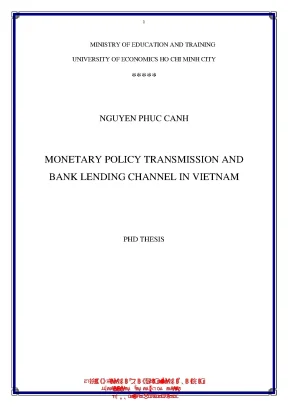
Tải xuống để đọc toàn bội MINISTRY OF EDUCATION AND TRAINING UNIVERSITY OF ECONOMICS HO CHI MINH CITY ***** NGUYEN PHUC CANH MONETARY POLICY TRANSMISSION AND BANK LENDING CHANNEL IN VIETNAM PHD THESIS Viết thuê luận văn thạc sĩ, luận án tiến sĩ Mail : luanvanaz@gmail.399 ii HO CHI MINH CITY, 2016 MINISTRY OF EDUCATION AND TRAINING UNIVERSITY OF ECONOMICS HO CHI MINH CITY ***** NGUYEN PHUC CANH MONETARY POLICY TRANSMISSION AND BANK LENDING CHANNEL IN VIETNAM Major: Finance and Banking Code: 62.01 PHD THESIS ACADEMIC ADVISORS 1. SU DINH THANH 2. VO XUAN VINH HO CHI MINH CITY, 2016 Viết thuê luận văn thạc sĩ, luận án tiến sĩ Mail : luanvanaz@gmail.399 i ACKNOWLEDGEMENTS I am deeply indebted to my academic advisers Pro. Sử Đình Thành and Assoc.
Võ Xuân Vinh for their fundamental roles.Thành and Pro.Vinh have provided me with guidance, assistances, and supports during my study. They have given me autonomy on decision making and researching the topic, while continuing to provide valuable feedbacks, advices, and encouragement. In addition to our academic collaboration, I greatly appreciate the bonding relationships between Thành, Vinh and I. Additionally, I am deeply thankful to Dr.
Trầm Thị Xuân Hương, my lecturer and my researching partner at School of Banking, who has assisted me in researching the topic in this thesis. She has also advised, encouraged and generously allowed me to apply our shared works in presenting this thesis. I gratefully acknowledge lecturers from the research methodology course at University of Economics Ho Chi Minh City who have provided me with basis methodologies for this study. Such methodologies have helped me understand, find and utilize correct methods.
I would like to thank my dear colleagues at School of Banking and University of Economics Ho Chi Minh City for their substantial influence. The School of Banking and University of Economics Ho Chi Minh City provide the best environment for studying and researching. I also give my thanks to colleagues in International department at School of Banking, they always supported and encouraged me in this study and helped me a lot throughout my career. I also would like to thank the board of professors and the independent external reviewers who gave me a lot of useful comments and advices on my first presentation, their comments are one of the major contributing factors that allowed me to complete this version of my thesis.
I am deeply thankful to my family for their love, support, and sacrifice. Without them, this thesis would never have been written. Ho Chi Minh City, Apr/2016 Nguyen Phuc Canh Viết thuê luận văn thạc sĩ, luận án tiến sĩ Mail : luanvanaz@gmail.399 ii ABBREVIATIONS Words Meanings ADB Asia Development Bank APC Asset Price Channel AR Autoregression ARDL Autoregressive Distributed Lag Model BLC Bank Lending Channel BSC Balance Sheet Channel BRICS Group (including Brazil, Russia, India, China and BRICS South Africa) CC Credit Channel CFC Cash Flow Channel CPI Consumer Price Index DSGE Dynamic Stochastic General Equilibrium Model EC Expectation Channel ECB European Central Bank ECM Error Correction Model EDF Expected Default Frequency ERC Exchange Rate Channel E. European Union FAVAR Factor Augmented Vector Autoregression FDICIA Federal Deposit Insurance Corporation Improvement Act Fed Federal Reserve System FFR Fed Fund Rate GDP Gross Domestic Production GMM Generalized Method of Moments G7 Canada, France, Germany, Italy, Japan, UK, US Viết thuê luận văn thạc sĩ, luận án tiến sĩ Mail : luanvanaz@gmail.399 iii HLE Household Liquidity Effects HNX Hanoi Stock Exchange HSX Ho Chi Minh Stock Exchange IRC Interest Rate Channel IS-LM Investment, Saving–Liquidity Preference, Money Supply IMF International Monetary Fund IPVN Vietnam Industrial Production IRF Impulse Response Function IT Inflation Targeting Policy LER Lending Interest Rate LIBOR London Interbank Offer Rate MPTM Monetary Policy Transmission Mechanism M2 Money Supply definition (expanded money supply) NEER Nominal Effective Exchange Rate NPV Net Present Value OECD Organization for Economic Co-operation and Development OLS Ordinary Least Squares KMV EDF KMV’s Expected Default Frequency QE Quantitative Easing program RDR Rediscounting Rate RFR Refinancing Rate SBV State Bank of Vietnam SME Small and Medium Enterprises S&P 500 S&P 500 Index SVAR Structured Vector Autoregression VAR Vector Autoregression VECM Vector Error Correction Models VIX The implied volatility of S&P 500 index options Viết thuê luận văn thạc sĩ, luận án tiến sĩ Mail : luanvanaz@gmail.399 iv VND Vietnam Dong (Currency of Vietnam) VNI VNindex VNIBOR Vietnam Interbank Offer Rate VNindex Vietnam composite stock index U.
The United Kingdom UPLC Unexpected Price Level Channel U. The United State USD US Dollar WACC Weighted Average Capital Cost WTO World Trade Organization Viết thuê luận văn thạc sĩ, luận án tiến sĩ Mail : luanvanaz@gmail.399 v TABLE OF CONTENTS ACKNOWLEDGEMENTS .ii LIST OF TABLES. x LIST OF FIGURES. The overview of Vietnamese economy and monetary policy.
The Vietnamese economy. The State Bank of Vietnam. The Vietnamese monetary policy. Market interest rates.
Research gap identification. Research objectives and questions. The scope of this study. Research methodologies and data.
Some key concepts. The structure of study. 18 Viết thuê luận văn thạc sĩ, luận án tiến sĩ Mail : luanvanaz@gmail.399 vi THEORETIAL FRAMEWORK AND LITERATURE REVIEW. Monetary policy targets.
Monetary policy tools. The ineffectiveness of monetary policy. Monetary policy and fiscal policy. Unconventional monetary policies.
Quantitative easing program. Inflation targeting policy. Monetary policy transmission. Monetary policy transmission channels.
Interest rate channel. Exchange rate channel. Asset price channel. The lag and effectiveness of monetary policy transmission.
The transmission lags of monetary policy. The effectiveness of monetary policy transmission. Bank lending channel. 38 Viết thuê luận văn thạc sĩ, luận án tiến sĩ Mail : luanvanaz@gmail.
Determinants of bank lending channel. The development of financial markets. Regulations in banking sector. The competition in banking sector.
Studies of monetary policy transmission and bank lending channel in developing countries. Studies of monetary policy transmission and bank lending channel in Vietnam. Summary and research motivations. Monetary policy transmission testing models.
The relationships between monetary policy, output and inflation. Estimating effects of monetary policy. Database in study of monetary policy transmission. Proxy variables for monetary policy.
Variables of commercial bank characteristics in bank lending channel 68 3. Econometric models for monetary policy transmission testing. 69 Viết thuê luận văn thạc sĩ, luận án tiến sĩ Mail : luanvanaz@gmail. VAR and related models.
GMM model for panel data. Research methodologies for this study. Research procedures and testing hypothesizes. Vietnam monetary policy transmission testing models.
Bank lending channel testing model. 97 EMPIRICAL EVIDENCES FROM VIETNAM. Monetary policy transmission. VAR model results.
SVAR model results. Bank lending channel in Vietnam. 116 Viết thuê luận văn thạc sĩ, luận án tiến sĩ Mail : luanvanaz@gmail. GMM results and discussions.
The effects of the crisis on the bank lending channel in Vietnam. 130 CONCLUSIONS AND POLICY IMPLICATIONS. Review of research questions, methodology and findings. Choosing monetary policy tools.
Appling unconventional monetary policies. Developing debt and equity markets. Capability of commercial banks. Risk of commercial banks.
Limitations and suggestions for further research. LIST OF AUTHOR’S PUBLICATION. LIST OF REFERENCES .xxxvii Viết thuê luận văn thạc sĩ, luận án tiến sĩ Mail : luanvanaz@gmail.399 x LIST OF TABLES Table 3. Restriction matrix in SVAR model of Neri & d'Italia.
SVAR restriction matrix. Formulas and sources of variables in VAR and SVAR models. Formulas and sources of variables in GMM model. Data statistical description.
New statistical description. Granger causality test results. The development of Vietnam stock market. Granger causality test for DLVNI.
Variance decomposition for CPI from SVAR. Variance decomposition for CPI from SVAR with DRDR. Variance decomposition for CPI from SVAR with DRFR. GMM data description.
Bank lending channel with each effect of bank characteristics. Bank lending channel with whole effects of bank characteristics. Bank lending channel with new measure of bank characteristics. Bank lending channel with whole effects by new measure of bank characteristics.
Bank lending channel with RFR for each effects. Bank lending channel with RFR for whole determinants. 124 Viết thuê luận văn thạc sĩ, luận án tiến sĩ Mail : luanvanaz@gmail. Bank lending channel with RDR for each effects.
Bank lending channel with RDR for whole determinants. The impacts of the 2008 global financial crisis on bank lending channel in Vietnam .1 Financial market development in Vietnam. 144 Viết thuê luận văn thạc sĩ, luận án tiến sĩ Mail : luanvanaz@gmail.399 xii LIST OF FIGURES Figure 1. Vietnamese macroeconomic factors.
Impulse response function of CPI in IRC. Impulse response function for ERC. Impulse response function of VAR(5) for APC. Impulse response function of SVAR.
Impulse response function of VAR for IRC with DLM2. Impulse response function of VAR for ERC with DLM2. Impulse response function of VAR for APC with DLM2. Impulse response function of SVAR with DRDR.
Impulse response function of SVAR with DRFR. Moody’s KMV EDF index. 147 Viết thuê luận văn thạc sĩ, luận án tiến sĩ Mail : luanvanaz@gmail.399 xiii Abstract The transmission of monetary policy is the center of economic studies, this field was renewed in light of the 2008 global financial crisis with arguments about the effectiveness and the determinants of transmission channels especially in emerging markets such as Vietnam which may have strong bank lending channel while asset price channel and exchange rate channel may be weak. This study tries to investigate the existing of interest rate channel, exchange rate channel, asset price channel, and bank lending channel in Vietnam which are seen as the main channels in monetary policy transmission.
In addition, this study tries to investigate the determinants of bank lending channel and the effects of the 2008 global financial crisis on bank lending channel in Vietnam that are important for Vietnamese policy makers in conducting monetary policy, stabilizing banking systems, financial markets and the economy. Firstly, this study utilizes the VAR model to examine the existing of interest rate channel, asset price channel and exchange rate channel, one by one, by using monthly macroeconomics data from 2003 to 2012 including market interest rates, the stock market index and exchange rate to proxy for interest rate channel, asset price channel and exchange rate channel respectively. Then this study uses SVAR models to test the existing of these channels in a system with the same data sample. Secondly, this study collects yearly data from 30 Vietnamese commercial banks such as loans, assets, loan loss provision, capital from 2003 to 2012 to investigate the existing and the determinants of bank lending channel through the system GMM models.
Then, this study uses the S&P 500 implied volatility index to investigate the effects of the 2008 global financial crisis on bank lending channel through the same system GMM models. With the first main objective, this study has found the evidence of cost channel in Vietnam that reflects the ineffective of monetary policy in controlling inflation thus it is a big challenge for Vietnamese policy makers in conducting monetary policy. But, this study did not find statistical evidences of exchange rate channel and asset price channel which may be suggest that they are weak or do not exist in Vietnam. Viết thuê luận văn thạc sĩ, luận án tiến sĩ Mail : luanvanaz@gmail.399 xiv In the second main objective, this study found the evidences of bank lending channel in Vietnam, it was also affected by the commercial bank characteristics such as bank capital, bank size.
This study also found that the 2008 global financial crisis had significant effects on bank lending channels which is stronger in crisis. First of all, this study has contribution to the empirical literature about the existence of cost channel in a small open economy.
Nội dung được bảo vệ bản quyền — Tải xuống đầy đủ
Trích dẫn luận án này
Nguyen Phuc Canh (2016). Truyền dẫn chính sách tiền tệ và kênh cho vay tại Việt Nam [Luận án tiến sĩ, Trường Đại học Kinh tế TP. Hồ Chí Minh]. LuanAn.net. https://luanan.net/kinh-te/tai-chinh-ngan-hang/truyen-dan-chinh-sach-tien-te-va-kenh-cho-vay-tai-viet-nam
Câu hỏi thường gặp
Luận án "Truyền dẫn chính sách tiền tệ và kênh cho vay tại Việt Nam" nghiên cứu về vấn đề gì?
Luận án TS: Truyền dẫn chính sách tiền tệ, kênh cho vay tại VN. Phân tích sâu, giải pháp thiết thực cho nền kinh tế.
Luận án "Truyền dẫn chính sách tiền tệ và kênh cho vay tại Việt Nam" được bảo vệ tại trường nào?
Luận án này được bảo vệ tại Trường Đại học Kinh tế TP. Hồ Chí Minh. Năm bảo vệ: 2016.
Luận án "Truyền dẫn chính sách tiền tệ và kênh cho vay tại Việt Nam" thuộc chuyên ngành gì?
Luận án "Truyền dẫn chính sách tiền tệ và kênh cho vay tại Việt Nam" thuộc chuyên ngành Tài chính - Ngân hàng. Danh mục: Tài Chính - Ngân Hàng.
Luận án "Truyền dẫn chính sách tiền tệ và kênh cho vay tại Việt Nam" có bao nhiêu trang?
Luận án "Truyền dẫn chính sách tiền tệ và kênh cho vay tại Việt Nam" có 310 trang. Bạn có thể xem trước một phần tài liệu ngay trên trang web trước khi tải về.
Cách tải luận án "Truyền dẫn chính sách tiền tệ và kênh cho vay tại Việt Nam" về máy như thế nào?
Để tải luận án về máy, bạn nhấn nút "Tải xuống ngay" trên trang này, sau đó hoàn tất thanh toán phí lưu trữ. File sẽ được tải xuống ngay sau khi thanh toán thành công. Hỗ trợ qua Zalo: 0559 297 239.