Luận án Shahar Hameiri: Quản lý rủi ro & chuyển đổi nhà nước hậu Chiến tranh Lạnh
Quản lý rủi ro trong chuyển đổi sở hữu nhà nước: Nghiên cứu luận án tiến sĩ chuyên sâu.
Murdoch University
Khoa học chính trị / Quan hệ quốc tế
Luan An
Luận án tiến sĩ
Năm xuất bản
Số trang
301
Thời gian đọc
46 phút
Lượt xem
0
Lượt tải
0
Phí lưu trữ
60 Point
Tổng quan nhanh
- Chủ đề:
- Quản lý Rủi ro & Chuyển đổi Nhà nước: Khuôn khổ Mới
- Số trang:
- 301 trang
- Trường:
- Murdoch University
- Chuyên ngành:
- Khoa học chính trị / Quan hệ quốc tế
- Tác giả:
- Shahar Hameiri
- Năm:
- 2009
Tóm tắt nội dung luận án
I.Quản lý Rủi ro Chuyển đổi Nhà nước Khuôn khổ Mới
Luận án phát triển một khuôn khổ mới. Khuôn khổ này giải thích tác động của các can thiệp xây dựng nhà nước. Mục tiêu là kiểm tra các can thiệp cụ thể. Đồng thời, nghiên cứu bản chất của trật tự toàn cầu hậu Chiến tranh Lạnh. Khuôn khổ này phân tích cách quyền lực phân bố, thực thi, bị hạn chế và thách thức. Sau sự kiện 11 tháng 9 năm 2001, các “quốc gia thất bại” trở thành mối lo an ninh. Quan tâm học thuật và thực tiễn vào “xây dựng nhà nước” quốc tế gia tăng. Các phương pháp tiếp cận hiện hành thường dựa trên quan niệm tĩnh về nhà nước. Luận án bác bỏ quan niệm này. Phương pháp tiếp cận mới này cải thiện năng lực quản trị nhà nước và đưa ra giải pháp cho rủi ro chính sách công.
1.1. Phân tích tác động của các can thiệp xây dựng nhà nước
Các can thiệp xây dựng nhà nước tạo ra hiệu ứng phức tạp. Nghiên cứu đánh giá các quỹ đạo có thể có. Luận án nhìn nhận can thiệp không chỉ là việc tạo ra “nhiều” hay “ít” nhà nước. Thay vào đó, đó là quá trình chuyển đổi sâu rộng. Nó ảnh hưởng đến cả nhà nước can thiệp và nhà nước bị can thiệp. Quản lý rủi ro công là trọng tâm của quá trình này.
1.2. Khái niệm nhà nước tĩnh và sự hạn chế trong đánh giá
Các cách tiếp cận phổ biến đánh giá can thiệp dựa trên quan niệm tĩnh. Quan niệm này coi nhà nước là thực thể cố định. Điều này dẫn đến hạn chế trong việc hiểu các biến đổi thực tế. Nó bỏ qua động lực chuyển đổi bên trong và xuyên quốc gia. Đánh giá rủi ro thể chế không toàn diện theo cách tiếp cận này.
1.3. Mô hình quản trị mới Nhà nước xuyên quốc gia
Luận án xem xét can thiệp như một phương thức quản trị mới. Phương thức này hoạt động trong nền kinh tế chính trị toàn cầu. Nó dẫn đến hình thái nhà nước xuyên quốc gia. Nhà nước này được điều tiết xuyên quốc gia. Quản lý rủi ro công trở thành cốt lõi của mô hình này, hỗ trợ chuyển đổi nhà nước hiệu quả hơn.
II.Can thiệp Xây dựng Nhà nước Quản trị Đa cấp Quyền lực
Luận án khái niệm hóa nhà nước như một địa điểm đấu tranh xã hội và chính trị. Các can thiệp xây dựng nhà nước (SBIs) ảnh hưởng đến việc phân phối quyền lực. Nó cũng tác động đến sản xuất và tái sản xuất quyền lực chính trị. SBIs mở ra một địa hình quản trị phức tạp. Các mối quan hệ xã hội, chính trị, thể chế và ý tưởng cùng tồn tại. Chúng đồng thời nằm trong và ngoài nhà nước bị can thiệp. Đây là cơ chế quản lý rủi ro công mới. Hiệu quả hoạt động khu vực công phụ thuộc vào cách quản trị này.
2.1. Can thiệp như các thể chế đa cấp Cơ chế vận hành
SBIs được khái niệm hóa là các thể chế đa cấp. Các thể chế này thiết lập để định hình kết quả chính trị. Chúng giới hạn các lựa chọn chính trị sẵn có cho các nhà lãnh đạo trong nước. Điều này hoạt động bằng cách mở rộng và chuyển quyền lực. Quyền lực chuyển đến các không gian quản trị đa cấp trong bộ máy quốc gia. Đánh giá rủi ro thể chế là cần thiết.
2.2. Phân phối quyền lực chính trị Ai cai trị và bằng cách nào
Nghiên cứu đặt câu hỏi: Ai thực sự cai trị và cai trị như thế nào? SBIs thay đổi cấu trúc quyền lực hiện có. Các nhóm và liên minh mới có thể xuất hiện. Điều này ảnh hưởng đến năng lực quản trị nhà nước. Rủi ro chính sách công có thể phát sinh từ sự thay đổi này. Minh bạch và trách nhiệm giải trình là thiết yếu.
2.3. Quản lý xung đột xã hội và chính trị phát sinh
Các can thiệp thường gây ra hoặc làm trầm trọng thêm xung đột. Luận án tìm hiểu cách các xung đột này được quản lý. Nó xem xét các liên minh và liên minh ủng hộ việc tái sản xuất quan hệ quyền lực. Điều này liên quan đến các SBIs. Quản lý khủng hoảng nhà nước trở thành trọng tâm, nhằm duy trì hiệu quả hoạt động khu vực công.
III.Rủi ro Chính sách Công Tác động đến Chủ quyền Quốc gia
Can thiệp xây dựng nhà nước (SBIs) mang theo rủi ro chính sách công đáng kể. Chúng tác động trực tiếp đến chủ quyền của các quốc gia bị can thiệp. Mặc dù bảo toàn chủ quyền hình thức, các thể chế này hạn chế lựa chọn chính trị nội bộ. Điều này tạo ra một mô hình mới của mối quan hệ quốc tế. Quản lý rủi ro trong bối cảnh này đòi hỏi sự hiểu biết sâu sắc về quyền lực. Cải cách hành chính cần được xem xét cẩn thận để tránh các rủi ro này.
3.1. Rủi ro chính sách công trong can thiệp nhà nước
Các quyết định và chính sách được đưa ra trong SBIs có thể gây ra hậu quả không lường trước. Điều này tạo ra rủi ro cho sự ổn định và phát triển của nhà nước. Nó ảnh hưởng đến năng lực quản trị nhà nước trong việc tự định đoạt. Cải cách hành chính có thể bị chi phối bởi các ưu tiên bên ngoài. Đánh giá rủi ro thể chế giúp nhận diện những nguy cơ này.
3.2. Bảo toàn chủ quyền hình thức và giới hạn lựa chọn chính trị
SBIs duy trì vẻ bề ngoài của chủ quyền quốc gia. Tuy nhiên, chúng lại giới hạn nghiêm trọng các lựa chọn chính trị. Điều này áp đặt lên các nhà lãnh đạo địa phương. Quyền lực được dịch chuyển đến các không gian quản trị đa cấp. Các không gian này hoạt động cả bên trong và bên ngoài bộ máy nhà nước. Chuyển đổi nhà nước diễn ra theo hướng này.
3.3. Toàn cầu hóa rủi ro và quản lý cục bộ hóa
Sự nổi lên của các SBIs liên quan đến toàn cầu hóa rủi ro. Các mối đe dọa an ninh xuyên quốc gia đòi hỏi phản ứng đa cấp. Quản lý rủi ro trở nên cục bộ hóa. Điều này đặt gánh nặng lên các quốc gia yếu hơn. Đồng thời, nó tăng cường vai trò của các tác nhân bên ngoài. Quản lý khủng hoảng nhà nước ngày càng phức tạp.
IV.Năng lực Quản trị Nhà nước Xu hướng Chuyển đổi Toàn cầu
Luận án phân tích sự nổi lên của các can thiệp xây dựng nhà nước. Điều này gắn liền với các cuộc khủng hoảng nhân đạo đầu những năm 1990. Sau đó là sự trở lại của khái niệm nhà nước trong lý thuyết và chính sách phát triển. Các SBIs là biểu hiện của chuyển đổi nhà nước. Sự chuyển đổi này liên quan đến toàn cầu hóa rủi ro. Các tác nhân công và tư đều đóng vai trò quan trọng. Năng lực quản trị nhà nước bị ảnh hưởng bởi những yếu tố này, tác động đến phát triển bền vững khu vực công.
4.1. Sự trỗi dậy của can thiệp xây dựng nhà nước sau Chiến tranh lạnh
Sau Chiến tranh lạnh, các can thiệp nhân đạo thất bại. Nhu cầu về một phương pháp tiếp cận mới xuất hiện. “Quốc gia thất bại” trở thành mối lo ngại an ninh toàn cầu. Điều này thúc đẩy sự phát triển của các chiến lược can thiệp xây dựng nhà nước. Mục tiêu là quản lý rủi ro và duy trì trật tự. Quản trị rủi ro công trở thành ưu tiên.
4.2. Vai trò của các tác nhân công và tư trong can thiệp
Các SBIs liên quan đến nhiều loại tác nhân. Bao gồm các tổ chức công, tư nhân và phi chính phủ. Ví dụ, Cảnh sát Liên bang Úc, các công ty quân sự tư nhân. Sự tham gia của họ định hình cách quyền lực được thực thi. Điều này ảnh hưởng đến cải cách hành chính và hiệu quả hoạt động khu vực công. Rủi ro chính sách công cần được kiểm soát.
4.3. Xu hướng quản trị độc đoán và phân cấp quyền lực
Luận án kết luận các SBIs thường dẫn đến các hình thức cai trị độc đoán. Chúng có tính phân cấp và chống cạnh tranh. Điều này xảy ra cả trong và giữa các quốc gia. Điều này ảnh hưởng tiêu cực đến phát triển bền vững khu vực công. Quản lý rủi ro cần xem xét hậu quả này, nhằm nâng cao năng lực quản trị nhà nước.
V.Đánh giá Rủi ro Thể chế Minh bạch Trách nhiệm Giải trình
Luận án nhấn mạnh tầm quan trọng của việc đánh giá rủi ro thể chế. Các can thiệp xây dựng nhà nước (SBIs) tạo ra cấu trúc quản trị phức tạp. Việc này đòi hỏi sự minh bạch và trách nhiệm giải trình cao hơn. Sự thiếu vắng các yếu tố này có thể làm suy yếu hiệu quả hoạt động khu vực công. Nó cũng đe dọa phát triển bền vững khu vực công. Quản trị rủi ro công cần phải tích hợp các nguyên tắc này.
5.1. Khung đánh giá rủi ro thể chế phức tạp
Các SBIs thiết lập các thể chế đa cấp. Những thể chế này hoạt động cả bên trong và bên ngoài nhà nước. Việc đánh giá rủi ro thể chế đòi hỏi một khung phân tích toàn diện. Khung này cần hiểu các mối quan hệ quyền lực động. Nó cũng cần nhận diện các điểm yếu có thể dẫn đến rủi ro chính sách công. Năng lực quản trị nhà nước phụ thuộc vào đánh giá này.
5.2. Yêu cầu minh bạch và trách nhiệm giải trình trong quản trị công
Sự hiện diện của các tác nhân bên ngoài trong SBIs làm phức tạp trách nhiệm giải trình. Cần có các cơ chế rõ ràng để đảm bảo minh bạch. Điều này giúp ngăn chặn lạm dụng quyền lực. Nó cũng đảm bảo các quyết định phục vụ lợi ích công. Cải cách hành chính cần thúc đẩy các yếu tố này để tăng hiệu quả hoạt động khu vực công.
5.3. Bài học từ các nghiên cứu điển hình Úc Solomon Campuchia
Các nghiên cứu điển hình từ Úc, Quần đảo Solomon và Campuchia cung cấp bằng chứng thực nghiệm. Chúng cho thấy cách các SBIs hoạt động trong thực tế. Các trường hợp này minh họa hậu quả của việc thiếu minh bạch. Chúng cũng cho thấy tầm quan trọng của trách nhiệm giải trình. Điều này giúp cải thiện hiệu quả hoạt động khu vực công và hướng tới phát triển bền vững khu vực công.
Mục lục chi tiết luận án
Tải xuống file đầy đủ để xem toàn bộ nội dung
Tải đầy đủ (301 trang)Nội dung chính
Tổng quan về luận án
Bối cảnh địa chính trị toàn cầu sau Chiến tranh Lạnh, đặc biệt sau sự kiện ngày 11 tháng 9 năm 2001, chứng kiến sự tái định hình căn bản trong tư duy an ninh quốc tế. Các thực thể được gọi là "nhà nước thất bại" (failed states) hoặc "nhà nước mong manh" (fragile states) không còn bị nhìn nhận thuần túy dưới lăng kính khủng hoảng nhân đạo cục bộ, mà trở thành nguồn rủi ro an ninh xuyên quốc gia hiện hữu đe dọa các trung tâm quyền lực phương Tây. Như Chiến lược An ninh Quốc gia Hoa Kỳ (White House, 2002, p. 1) tuyên bố: "America is now threatened less by conquering states than we are by failing ones" (Nước Mỹ giờ đây ít bị đe dọa bởi các quốc gia đi xâm lược hơn là bởi các quốc gia đang sụp đổ). Đồng thuận này được củng cố bởi nhận định của Francis Fukuyama (2005, p. 1) rằng: "state-building is one of the most important issues for the world community because weak or failed states are the source of many of the world’s most serious problems, from poverty to AIDS to drugs to terrorism". Luận án tiến sĩ của Shahar Hameiri (2009) tại Đại học Murdoch, dưới sự bảo trợ học thuật của Asia Research Centre cùng các giáo sư Garry Rodan và Kanishka Jayasuriya, đã tạo ra một bước đột phá tiên phong khi thách thức trực diện các cách tiếp cận chính thống về can thiệp xây dựng nhà nước (State Building Interventions - SBIs).
Khoảng trống nghiên cứu (research gap) trọng tâm mà công trình giải quyết là sự thiếu vắng một khung phân tích chính trị - xã hội có khả năng giải thích tác động thực chất của SBIs vượt ra ngoài các chỉ dấu kỹ trị về năng lực hay tính pháp lý của chủ quyền. Các tài liệu hiện tồn bị giam cầm trong khuynh hướng "chủ nghĩa dân tộc phương pháp luận" (methodological nationalism), giả định nhà nước là một khối thống nhất, trung lập và chỉ đánh giá SBIs dựa trên việc tạo ra "nhiều nhà nước hơn" hay "ít nhà nước hơn". Luận án xác lập 4 câu hỏi nghiên cứu cốt lõi:
- SBIs tái cấu trúc sự phân bổ, sản sinh và tái sản sinh quyền lực chính trị tại các quốc gia bị can thiệp như thế nào: Ai cai trị và cai trị bằng phương thức nào?
- Những xung đột chính trị - xã hội nào nảy sinh hoặc trầm trọng hóa do SBIs, và chúng được quản trị ra sao?
- Những liên minh, mạng lưới quyền lực nào ủng hộ hoặc kháng cự các quan hệ quyền lực do SBIs thiết lập?
- Tác động mang tính cấu trúc của các chế độ can thiệp đa cấp độ (multilevel regimes) đối với sự chuyển hóa bản chất nhà nước đương đại là gì?
Khung lý thuyết của công trình xuất phát từ tiền đề rằng nhà nước không phải là một tập hợp trung lập của các thể chế cai trị trên một lãnh thổ, mà là một "site of social and political conflict" (địa hạt của xung đột chính trị và xã hội) (Poulantzas, 1973; Jessop, 1990). Luận án chứng minh rằng SBIs về bản chất không đơn thuần là "xây dựng năng lực" (capacity building), mà là sự chuyển hóa nhà nước (state transformation) – một phương thức quản trị mới nhằm phi chính trị hóa (depoliticisation) quá trình hoạch định chính sách, chuyển dịch quyền lực sang các không gian quản trị kỹ trị không phải chịu trách nhiệm giải trình trước công chúng.
Phạm vi nghiên cứu thực địa bao quát các mạng lưới quản trị khu vực thông qua 5 chuyến điền dã chuyên sâu từ tháng 9/2007 đến tháng 3/2008 tại Canberra (Úc), Honiara (Quần đảo Solomon) và Phnom Penh (Campuchia). Đóng góp mang tính cách mạng của công trình nằm ở kết luận sắc bén: Bất kể SBIs thành công hay thất bại theo các mục tiêu tự đề ra, chúng đều thúc đẩy sự xuất hiện của các hình thái cai trị chính trị ngày càng độc đoán, tôn ti trật tự và phản cạnh tranh (authoritarian, hierarchical, and anti-competitive political rule) ở cả cấp độ quốc gia lẫn trật tự toàn cầu.
Literature Review và Positioning
Tổng quan tài liệu học thuật về can thiệp quốc tế và xây dựng nhà nước được phân tách thành hai dòng tranh luận chủ đạo nhưng đều bộc lộ những giới hạn căn bản:
Dòng tranh luận thứ nhất xoay quanh vấn đề "Năng lực nhà nước" (Capacity Building Debate). Tiếp cận thống trị là Thể chế luận Tân tự do (Neoliberal Institutionalism), được đại diện bởi Ngân hàng Thế giới (World Bank, 2003) thông qua khung đánh giá Country Policy and Institutional Assessment (CPIA) chấm điểm từ 1 đến 6, Douglass North (1981, 1995), và Paul Collier (2000). Trường phái này đồng nhất năng lực nhà nước với việc thiết lập các thể chế thị trường tự do, bảo vệ quyền sở hữu tư nhân và triệt tiêu "chủ nghĩa trục lợi" (rent-seeking). Đối trọng với tiếp cận này là Thể chế luận Tân Weber (Neo-Weberian Institutionalism) với các học giả như Theda Skocpol (1985), Robert Rotberg (2003, 2004), Jennifer Milliken và Keith Krause (2003), và I. William Zartman (1995), nhấn mạnh vào quyền tự chủ của nhà nước, độc quyền sử dụng bạo lực hợp pháp và khả năng cung cấp các "hàng hóa chính trị" (political goods). Mặc dù có bất đồng, cả hai trường phái đều xem năng lực là một thước đo kỹ thuật phi lịch sử, phi chính trị, che giấu các xung đột giai cấp và xã hội tất yếu trong quá trình tích lũy tư bản.
Dòng tranh luận thứ hai tập trung vào "Chủ quyền quốc gia" (Sovereignty Debate). Robert Jackson (1990) phân định ranh giới giữa "chủ quyền tiêu cực" (negative sovereignty - quyền không bị can thiệp) và "chủ quyền tích cực" (positive sovereignty - năng lực thực tế để quản trị). Trong khi các nhà pháp lý học như Anne-Marie Slaughter (1997, 2004) hay Abram Chayes và Antonia Chayes (1995) lập luận về "chủ quyền bị phân tách" (disaggregated sovereignty) trong mạng lưới quản trị toàn cầu, các nhà lý thuyết hiện thực/duy lý như Stephen Krasner (2004, 2005) đề xuất mô hình "chủ quyền chia sẻ" (shared sovereignty), và Ashraf Ghani cùng Clare Lockhart (2008) đưa ra khái niệm "hiệp ước kép" (double compacts). Ngược lại, các nhà phê bình cấp tiến như David Chandler (2006) trong Empire in Denial, Christopher Bickerton (2007), và Alejandro Bendaña (2004) vạch trần việc tái định nghĩa chủ quyền thành "trách nhiệm bảo vệ" (ICISS, 2001) thực chất đã tước đoạt quyền tự quyết chính trị của các quốc gia hậu thuộc địa, tạo nên các nền "dân chủ không có lựa chọn" (choiceless democracies) (Mkandawire, 1999) hay "nhà nước quản trị" (governance states) (Harrison, 2004).
                  ┌─────────────────────────────────────────────────────────┐
                  │          CÁC TIẾP CẬN TRUYỀN THỐNG VỀ SBIs              │
                  │   - Neoliberal Institutionalism (World Bank, CPIA)      │
                  │   - Neo-Weberian Institutionalism (Skocpol, Rotberg)    │
                  │   - Sovereignty Frameworks (Krasner, Jackson, Chandler) │
                  │   -> Giới hạn: Kỹ trị, tĩnh tại, Methodological         │
                  │      Nationalism, đo lường "nhiều/ít nhà nước"          │
                  └────────────────────────────┬────────────────────────────┘
                                               │
                                               ▼ (Phê phán & Vượt gộp)
                  ┌─────────────────────────────────────────────────────────┐
                  │            KHUNG PHÂN TÍCH SHAHAR HAMEIRI (2009)        │
                  │   - Strategic-Relational State Theory (Jessop,          │
                  │     Poulantzas)                                         │
                  │   - Global State of Exception & Risk Mgt (Jayasuriya)   │
                  │   - Inside-Out Multilevel Regimes & Meta-Governance     │
                  │   -> Bản chất: Chuyển hóa nhà nước (State Transformation)│
                  │      thành cấu trúc quản trị kỹ trị, phi chính trị hóa   │
                  └─────────────────────────────────────────────────────────┘
Luận án định vị vượt trội bằng cách từ bỏ hoàn toàn lối tiếp cận "từ ngoài vào trong" (outside-in) vốn áp đặt các mô hình toàn cầu trừu tượng. Thay vào đó, Hameiri xây dựng phương pháp "từ trong ra ngoài" (inside-out), kiểm chứng thực tế can thiệp thông qua sự cọ xát giữa các chế độ can thiệp đa cấp độ và các cấu trúc quyền lực bản địa. Bằng việc so sánh trường hợp Phái bộ Hỗ trợ Khu vực tại Quần đảo Solomon (RAMSI) và tiến trình can thiệp quốc tế tại Campuchia với các nghiên cứu quốc tế điển hình như Bosnia & Herzegovina (Chandler, 2005) và Đông Timor (Hughes, 2009), công trình chứng minh SBIs không hề phục hồi chủ quyền Westphalia mà tạo ra các không gian ngoại lệ pháp lý (legal exceptionalism) phục vụ quản trị rủi ro.
Đóng góp lý thuyết và khung phân tích
Đóng góp cho lý thuyết
Luận án tạo ra một bước chuyển dịch hệ hình (paradigm shift) sâu sắc đối với lý thuyết quan hệ quốc tế và kinh tế chính trị phát triển thông qua việc tích hợp và mở rộng các lý thuyết nền tảng:
- Thách thức và tái định hình Thuyết Nhà nước Chiến lược - Quan hệ (Strategic-Relational Approach): Kế thừa Nicos Poulantzas (1973) và Bob Jessop (1990), luận án mở rộng khái niệm nhà nước từ một thực thể đóng kín về mặt lãnh thổ sang một không gian kết nối đa tầng, nơi quyền lực nhà nước bị biến đổi bởi các lực lượng xuyên quốc gia lồng ghép trực tiếp vào bộ máy hành chính nội địa.
- Khái niệm hóa Chế độ Can thiệp Đa cấp độ (Multilevel Regimes): SBIs không vận hành như các phái bộ ngoại giao truyền thống mà thiết lập các tập hợp quan hệ xã hội, chính trị, thể chế và tư tưởng tồn tại đồng thời bên trong và bên ngoài nhà nước bị can thiệp.
- Bổ khuyết Lý thuyết Quản trị Rủi ro Toàn cầu (Risk Management) và Ngoại lệ Pháp lý (Legal Exceptionalism): Kết hợp với luận điểm của Kanishka Jayasuriya (2005) và Mark Duffield (2003), luận án chứng minh rủi ro từ vùng "rìa" (fringes) đã thúc đẩy các nhà nước phương Tây can thiệp phòng ngừa từ xa thông qua việc tái cấu trúc các thể chế hành pháp, tư pháp và an ninh nội địa của nước sở tại.
┌───────────────────────────────────────────────────────────────────────────────────────────┐
│                       MÔ HÌNH CHẾ ĐỘ QUẢN TRỊ ĐA CẤP ĐỘ (SBIs)                             │
├───────────────────────────────────────────────────────────────────────────────────────────┤
│                                                                                           │
│  [TRUNG TÂM PHƯƠNG TÂY / ĐƠN VỊ META-GOVERNANCE] (AusAID, Core Executive, IFIs)           │
│         │                                                                                 │
│         │ Thiết lập khung quy tắc, quản trị rủi ro từ xa                                  │
│         ▼                                                                                 │
│  [KHÔNG GIAN QUẢN TRỊ XUYÊN QUỐC GIA HÓA NỘI ĐỘ] (IDG/AFP, Cố vấn Bộ Tài chính MoFT)     │
│         │                                                                                 │
│         │ Chuyển dịch chính sách sang kỹ trị / Phi chính trị hóa xung đột                 │
│         ▼                                                                                 │
│  [BỘ MÁY NHÀ NƯỚC BẢN ĐỊA & CẤU TRÚC XÃ HỘI] (Mạng lưới Phe cánh Hun Sen / Tộc trưởng)   │
│         │                                                                                 │
│         └─► TÁC ĐỘNG THỰC CHẾ: Xung đột ngầm, củng cố chuyên chế & triệt tiêu đối lập    │
│                                                                                           │
└───────────────────────────────────────────────────────────────────────────────────────────┘
Khung phân tích độc đáo
Khung phân tích của luận án tích hợp chặt chẽ ba trụ cột lý thuyết: (1) Thuyết Nhà nước mác-xít mới về sự ngưng kết quyền lực giai cấp; (2) Lý thuyết Quản trị cấp cao (Meta-Governance) giải thích cách các tác nhân điều phối (như ban thư ký nội các, các bộ ngoại giao) điều tiết mạng lưới công - tư phân tán; và (3) Lý thuyết "Phi chính trị" (Antipolitics) (Jayasuriya & Hewison, 2004; Ferguson, 1990). Cách tiếp cận này bóc trần giả định ngây thơ rằng thể chế là giải pháp trung tính cho sự bất ổn, chứng minh rằng chuyển hóa nhà nước thông qua kỹ trị hóa thực chất là phương thức tước bỏ quyền quyết định của các cơ quan dân cử và phong trào quần chúng.
Các điều kiện biên (boundary conditions) của khung phân tích được xác định rõ ràng: Mô hình giải thích tối ưu các can thiệp thời kỳ hậu Chiến tranh Lạnh tại các quốc gia không diễn ra chiến tranh quy mô lớn toàn diện nhưng có sự hiện diện sâu của các cấu trúc viện trợ quốc tế và cải cách an ninh - tư pháp.
Phương pháp nghiên cứu tiên tiến
Thiết kế nghiên cứu
Nghiên cứu vận hành trên nền tảng triết học Hiện thực Phê phán (Critical Realism) kết hợp Kinh tế Chính trị Lịch sử Cụ thể. Thiết kế nghiên cứu định tính so sánh đa trường hợp (comparative qualitative case study) được cấu trúc theo chiều dọc đa cấp độ (multi-level vertical design):
- Cấp độ 1: Tác nhân can thiệp và sự tái cấu trúc bộ máy nhà nước phương Tây (nghiên cứu Cảnh sát Liên bang Úc - AFP và Đội Triển khai Quốc tế - IDG).
- Cấp độ 2: Chế độ can thiệp trực tiếp tại thực địa (nghiên cứu Phái bộ RAMSI tại Quần đảo Solomon).
- Cấp độ 3: Nhà nước tiếp nhận can thiệp có lịch sử chuyển hóa lâu dài (nghiên cứu chế độ bảo trợ và quản trị tại Campuchia từ thời UNTAC đến thời kỳ bùng nổ viện trợ 2008).
Quy trình nghiên cứu rigorous
Chiến lược chọn mẫu chiến lược (purposive sampling) tập trung vào các mắt xích quyền lực then chốt. Quy trình thu thập dữ liệu sơ cấp bao gồm 5 đợt điền dã chuyên sâu (September 2007 – March 2008), tiến hành phỏng vấn bán cấu trúc với hàng chục đối tượng tinh hoa (elite interviews): các quan chức cấp cao của RAMSI, sĩ quan chỉ huy AFP/IDG, quan chức cơ quan phát triển quốc tế AusAID, UNDP, đại diện các tổ chức phi chính phủ (NGOs), chính khách nội địa, lãnh đạo công đoàn, và các nhà báo điều tra tại Úc, Solomon và Campuchia.
┌───────────────────────────────────────────────────────────────────────────────────────────┐
│                           MA TRẬN TAM GIÁC HÓA DỮ LIỆU                                    │
├───────────────────────────────┬─────────────────────────────┬─────────────────────────────┤
│      Nguồn Dữ liệu Sơ cấp     │    Nguồn Dữ liệu Thứ cấp    │     Đối tượng Phỏng vấn     │
├───────────────────────────────┼─────────────────────────────┼─────────────────────────────┤
│ - Văn kiện lập pháp & hiệp định│ - Báo cáo thường niên OECD/ │ - Sĩ quan chỉ huy AFP &     │
│   (Facilitation Act 2003)     │   DAC, World Bank, IMF      │   điều phối viên RAMSI      │
│ - Báo cáo điều tra nội bộ     │ - Dữ liệu CPIA, GAP, JMI    │ - Quan chức Bộ Tài chính,   │
│   (PAC, NAA, CDCF)            │ - Tài liệu học thuật quốc tế│   Bộ Nội vụ Solomon/CPC     │
│ - Biên bản điều trần quốc hội │ - Phân tích báo chí điều tra│ - Đại diện NGOs, lãnh đạo   │
│   (Canberra, Honiara, PhnomP) │   địa phương và quốc tế     │   công đoàn, học giả        │
└───────────────────────────────┴─────────────────────────────┴─────────────────────────────┘
Quy trình tam giác hóa (triangulation) được thực hiện nghiêm ngặt giữa dữ liệu phỏng vấn, tài liệu chính sách nội bộ không công khai và dữ liệu lưu trữ pháp lý nhằm triệt tiêu độ lệch chủ quan (subjective bias). Độ tin cậy và tính hợp lệ cấu trúc (construct validity) được đảm bảo thông qua việc đối chiếu chéo liên tục giữa lời khai của các tác nhân can thiệp và các nhóm phản kháng bản địa.
Data và phân tích
Phân tích định tính áp dụng kỹ thuật theo vết tiến trình thể chế (institutional process tracing) kết hợp giải cấu trúc văn bản chính sách. Luận án kiểm tra chi tiết các cơ chế điều phối như Whole of Government (WofG), các cơ chế giám sát như Joint Monitoring Indicators (JMIs), và các cấu trúc tài chính như Technical Working Groups (TWGs). Việc phân tích không dừng lại ở câu chữ hành chính mà đi sâu vào việc giải mã xem các quy trình này đóng/mở không gian tham gia chính trị của các nhóm lợi ích nào trong xã hội.
Phát hiện đột phá và implications
Những phát hiện then chốt
Công trình cung cấp 4 phát hiện mang tính đột phá với bằng chứng thực nghiệm vững chắc:
-
Sự tái cấu trúc xuyên quốc gia của nhà nước can thiệp (Trường hợp AFP/IDG): Luận án chứng minh rằng thông qua đơn vị IDG thành lập năm 2004, Cảnh sát Liên bang Úc đã chuyển mình từ một cơ quan thực thi pháp luật nội địa thành một lực lượng bán quân sự (quasi-gendarmerie) vận hành trên "biên giới khu vực" mới của nhà nước Úc. Bằng cách định hình vấn đề quản trị yếu kém tại các đảo quốc Thái Bình Dương thành sự suy sụp "luật pháp và trật tự", AFP đã hợp thức hóa quyền lực can thiệp tùy nghi (discretionary ordering powers) tách rời khỏi sự ràng buộc của cả luật pháp quốc tế lẫn luật pháp quốc gia sở tại, tạo ra các vùng ngoại lệ pháp lý.
-
Bản chất phi chính trị và liên minh bất ổn của RAMSI tại Quần đảo Solomon: Trái ngược với các ca ngợi từ OECD/DAC xem RAMSI là "hình mẫu thành công", luận án chứng minh thành công ban đầu của RAMSI thực chất dựa trên một liên minh chính trị cực kỳ bấp bênh:
"RAMSI's achievements to date are established upon an unstable political coalition that has emerged due to the unsustainable availability of high levels of foreign investment in logging and fishing and a housing and services boom in the capital, Honiara, created by the arrival of many well-paid RAMSI employees and contractors, as well as upon the capacity of RAMSI's leaders to mobilise superior coercive force when necessary." Bằng cách xem xung đột sắc tộc và bất ổn chính trị là "rủi ro" cần dập tắt thông qua quản trị kỹ trị (anti-politics as risk management), RAMSI chỉ đóng vai trò "chữa cháy cục bộ" (putting out spot-fires) mà không giải quyết được xung đột cơ bản về quyền lực và đất đai.
-
Sự cộng sinh nghịch lý giữa Chế độ Xây dựng Nhà nước và Mạng lưới Bảo trợ tại Campuchia: Tại Campuchia, thay vì làm xói mòn quyền lực chuyên chế, chương trình quản trị tốt (Good Governance) của các nhà tài trợ quốc tế đã bị Thủ tướng Hun Sen và Đảng Nhân dân Campuchia (CPP) lợi dụng triệt để. Chế độ can thiệp quốc tế và chế độ bảo trợ (patronage regime) đã tích hợp vào nhau: Các yêu cầu cải cách hành chính được chuyển hóa thành các kênh kỹ trị nhằm vô hiệu hóa sự cạnh tranh từ các đảng đối lập (như FUNCINPEC và Sam Rainsy Party), củng cố vững chắc quyền lực độc tài của chế độ cầm quyền dưới vỏ bọc "ổn định thể chế".
-
Xu hướng toàn cầu hóa của hình thái cai trị phản dân chủ: Luận án khẳng định quy luật phổ quát:
"contemporary state building – whether successful or otherwise in achieving its stated objectives – is associated with the emergence of increasingly authoritarian, hierarchical and anti-competitive forms of political rule, both within and between states."
┌───────────────────────────────────────────────────────────────────────────────────────────┐
│                    MA TRẬN ĐỐI CHIẾU CÁC TRƯỜNG HỢP NGHIÊN CỨU                            │
├───────────────────┬───────────────────────────────┬───────────────────────────────────────┤
│ Trường hợp        │ Cơ chế Can thiệp / Quản trị   │ Kết quả Chuyển hóa Quyền lực          │
├───────────────────┼───────────────────────────────┼───────────────────────────────────────┤
│ AFP / IDG         │ - Toàn bộ chính phủ (WofG)    │ Thiết lập biên giới quản trị khu vực; │
│ (Úc - Thái Bình D)│ - Ngoại lệ pháp lý xuyên QG   │ cảnh sát hóa chính trị đối ngoại.     │
├───────────────────┼───────────────────────────────┼───────────────────────────────────────┤
│ RAMSI             │ - Kỹ trị hóa bộ máy tài chính │ Tạo liên minh kinh tế bong bóng;      │
│ (Quần đảo Solomon)│ - Phi chính trị hóa xung đột  │ triệt tiêu đối thoại chính trị nội bộ.│
├───────────────────┼───────────────────────────────┼───────────────────────────────────────┤
│ UNTAC / Donors    │ - Quản trị tốt (Good Gov/GAP) │ Tích hợp viện trợ vào mạng lưới bảo   │
│ (Campuchia)       │ - Điều phối viện trợ kỹ trị   │ trợ; củng cố chế độ độc quyền Hun Sen.│
└───────────────────┴───────────────────────────────┴───────────────────────────────────────┘
Implications đa chiều
- Về mặt lý thuyết: Bác bỏ các giả định tuyến tính của Thuyết Hiện đại hóa và Thể chế luận Tân tự do, cung cấp công cụ phân tích quyền lực thực chất trong các thể chế xuyên quốc gia.
- Về mặt phương pháp luận: Mở ra hướng tiếp cận "inside-out process tracing" để nghiên cứu can thiệp quốc tế, liên kết cấu trúc vĩ mô toàn cầu với các mạng lưới chính trị vi mô bản địa.
- Về mặt chính sách và thực tiễn: Cảnh báo các cơ quan viện trợ quốc tế (như DFID, USAID, AusAID) rằng việc né tránh thỏa hiệp chính trị thực chất bằng các giải pháp kỹ thuật chỉ dẫn đến việc củng cố các cấu trúc quyền lực áp bức bản địa.
Limitations và Future Research
- Hạn chế về bối cảnh địa lý và cấu trúc quyền lực: Các nghiên cứu điển hình tập trung chủ yếu vào khu vực Châu Á - Thái Bình Dương (Úc, Melanesia, Đông Nam Á). Dù các phân tích có giá trị khái quát hóa cao, các khu vực có mức độ quân sự hóa khốc liệt hơn như Trung Đông (Iraq, Afghanistan) hay Châu Phi Hạ Sahara (Congo, Somalia) đòi hỏi những điều chỉnh bổ sung về biến số bạo lực vũ trang quy mô lớn.
- Khung thời gian nghiên cứu: Luận án phản ánh giai đoạn cao điểm của can thiệp quốc tế thập niên 2000 (hậu 11/9). Sự trỗi dậy của các cường quốc mới nổi phi phương Tây (như Trung Quốc với Sáng kiến Vành đai và Con đường) trong các thập kỷ tiếp theo tạo ra những cực quyền lực đối trọng làm biến đổi cấu trúc meta-governance.
- Chương trình nghiên cứu tương lai: Cần mở rộng phân tích vai trò của các công ty an ninh tư nhân (PMCs/PSCs), sự trỗi dậy của công nghệ giám sát kỹ thuật số trong quản trị rủi ro xuyên quốc gia, và cách thức các phong trào xã hội cấp cơ sở tổ chức kháng cự lại các chế độ can thiệp kỹ trị.
Tác động và ảnh hưởng
- Tác động học thuật: Luận án đặt nền móng cho trường phái phê phán về chuyển hóa nhà nước (State Transformation School), định hình các cuộc thảo luận học thuật trên các tạp chí hàng đầu như Millennium: Journal of International Studies, Third World Quarterly, và Review of International Political Economy.
- Tác động chính sách: Cung cấp một bản cáo trạng khoa học đanh thép, buộc các nhà hoạch định chính sách tại AusAID, OECD và Liên Hợp Quốc phải tái thẩm định các chương trình "Cải cách Lĩnh vực An ninh" (SSR) và "Quản trị Toàn bộ Chính phủ" (Whole of Government).
- Tác động xã hội và quốc tế: Cung cấp cơ sở lý luận cho các tổ chức xã hội dân sự tại các nước tiếp nhận can thiệp để bảo vệ không gian chính trị dân chủ trước sự áp đặt kỹ trị quốc tế.
Đối tượng hưởng lợi
- Nghiên cứu sinh và Giới học giả cao cấp: Tiếp cận một khung lý thuyết vượt trội kết hợp giữa lý thuyết nhà nước Mác-xít và kinh tế chính trị quốc tế để giải mã các hiện tượng can thiệp đương đại.
- Chuyên gia Phân tích Chính sách và Viện trợ Phát triển: Nhận diện được cạm bẫy của việc "phi chính trị hóa", từ đó thiết kế các chương trình can thiệp tôn trọng các tiến trình thương lượng quyền lực thực chất tại địa phương.
- Các Nhà hoạt động Xã hội và Lãnh đạo Bản địa: Có được công cụ phân tích sắc bén để vạch trần các cơ chế can thiệp kỹ trị làm suy yếu quyền tự quyết dân tộc.
Câu hỏi chuyên sâu
-
Đóng góp lý thuyết độc đáo nhất của luận án là gì? Đó là việc tái định nghĩa bản chất của SBIs: Không phải là việc xây dựng "năng lực" hay phục hồi "chủ quyền", mà là sự chuyển hóa nhà nước (state transformation) thông qua việc thiết lập các chế độ đa cấp độ (multilevel regimes). Luận án đã mở rộng xuất sắc Thuyết Nhà nước Chiến lược - Quan hệ của Bob Jessop sang không gian xuyên quốc gia.
-
Đột phá phương pháp luận so với các nghiên cứu trước đây thể hiện ra sao? So với cách tiếp cận tĩnh tại của Fukuyama (2004) hay mô hình đánh giá từ xa của Rotberg (2003), luận án áp dụng phương pháp tiếp cận "inside-out" kết hợp giải cấu trúc thể chế vi mô và phỏng vấn tinh hoa sâu tại 3 quốc gia, liên kết trực tiếp sự chuyển hóa nội bộ của nhà nước can thiệp (Úc) với tác động cấu trúc tại nước tiếp nhận (Solomon, Campuchia).
-
Phát hiện gây bất ngờ nhất có sự hỗ trợ của dữ liệu thực nghiệm là gì? Chính là sự cộng sinh hoàn hảo giữa chương trình "quản trị tốt" của phương Tây và chế độ độc tài bảo trợ của Hun Sen tại Campuchia. Viện trợ kỹ trị không hề thúc đẩy dân chủ hóa mà cung cấp vỏ bọc thể chế để triệt tiêu đối lập chính trị hợp pháp.
-
Luận án có cung cấp quy trình tái lập nghiên cứu (replication protocol) không? Có. Khung phân tích chế độ đa cấp độ, bảng câu hỏi phỏng vấn bán cấu trúc và phương pháp truy vết tiến trình thể chế được văn bản hóa chi tiết, cho phép áp dụng trực tiếp để phân tích các can thiệp quốc tế khác tại Châu Phi hoặc Trung Đông.
-
Chương trình nghiên cứu 10 năm được vạch ra như thế nào? Tập trung vào sự tiến hóa của an ninh hóa xuyên quốc gia, sự can dự của các tác nhân an ninh tư nhân, và sự phân rã của trật tự can thiệp tự do trước sự cạnh tranh địa chính trị đa cực.
Kết luận
- Khẳng định SBIs là phương thức quản trị rủi ro mới trong nền kinh tế chính trị toàn cầu, chuyển hóa căn bản bản chất nhà nước ở cả phía can thiệp lẫn bị can thiệp.
- Bác bỏ các huyền thoại kỹ trị của Thể chế luận Tân tự do và Tân Weber về "năng lực nhà nước" và "chủ quyền chia sẻ".
- Chứng minh rằng sự can thiệp quốc tế chuyển dịch hoạch định chính sách vào các không gian kỹ trị phi dân chủ, tước bỏ trách nhiệm giải trình trước xã hội.
- Làm sáng tỏ cơ chế hình thành liên minh bấp bênh tại Quần đảo Solomon và sự củng cố quyền lực chuyên chế tại Campuchia dưới tác động của SBIs.
- Mở ra hệ hình nghiên cứu mới về Kinh tế Chính trị của Chuyển hóa Nhà nước, tạo di sản học thuật bền vững trong nghiên cứu quan hệ quốc tế và phát triển toàn cầu.
Trích đoạn nội dung luận án
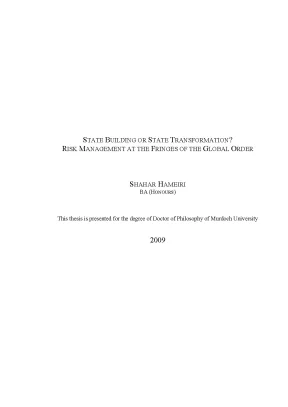
Tải xuống để đọc toàn bộSTATE BUILDING OR STATE TRANSFORMATION? RISK MANAGEMENT AT THE FRINGES OF THE GLOBAL ORDER SHAHAR HAMEIRI BA (HONOURS) This thesis is presented for the degree of Doctor of Philosophy of Murdoch University 2009 Abstract This thesis develops a new framework for explaining the effects and possible trajectories of state building interventions (SBIs). This is for both examining specific interventions and learning about the precise nature of the post-Cold War global order – how power is distributed, exercised, constrained and challenged within and between states. In the post-Cold War years, but particularly since the September 11 2001 terrorist attacks, so-called failed states have become a central security concern for policymakers. In tandem, there has been an influx of practitioner and scholarly interest in international ‘state building’.
Prevalent approaches to state building are premised on a static conception of the state and therefore seek to evaluate SBIs in terms of whether they help create ‘more’ or ‘less’ state. In contrast, this thesis examines SBIs as a new mode of governance in the global political economy that is transformative of both intervened and intervening states, leading to the creation of a transnationalising and transnationally regulated form of statehood. Based on a conception of the state as a site of social and political struggle this study examines the ways in which SBIs affect the distribution, production and reproduction of political power in intervened states: Who rules and how? What social and political conflicts are engendered or exacerbated by SBIs, and how are they managed? What alliances and coalitions support the production/reproduction of power relationships associated with SBIs? The thesis provides a conceptual framework for understanding the complex governance terrain SBIs open up. SBIs are conceptualised as multilevel regimes – sets of social and political relationships, institutions and ideas – that exist simultaneously within and outside intervened states.
While preserving the formal sovereignty of intervened states, these regimes are nevertheless established to shape political outcomes by limiting the political choices available to domestic leaders. This is operationalised by opening up and shifting power to multilevel spaces of governance within the apparatus of these countries. Through case studies from Australia, Solomon Islands and Cambodia, the thesis analyses the politics of SBIs and their broader implications for contemporary statehood. Ultimately it establishes that regardless of whether SBIs are successful or otherwise in achieving their stated objectives they are associated with the emergence of increasingly authoritarian, hierarchical and anti-competitive forms of political rule, both within and between states.
v Table of Contents Abstract. v Table of Contents. 1 Case study selection and approach .8 Chapter One Contemporary Approaches to State Building and Their Limitations: Towards a New Framework. 13 Evaluating the effects of state building interventions: Current debates and their limitations.
15 The capacity building debate. 16 The sovereignty debate. 31 State building interventions: towards a new approach. 45 Chapter Two State Building Interventions as Risk Management: State Transformation and Multilevel Regimes.
47 Risk management and state transformation. 49 State building interventions as multilevel regimes: conceptual and theoretical issues. 57 State building and legal exceptionalism: the ever-changing demands of risk management. 74 Chapter Three The Emergence of State Building: State Transformation and the Globalisation of Risk.
77 The failure of the humanitarian interventions of the early 1990s. 81 The return to the state in development theory and policy. 88 Neoliberalism and the transformation of Western states. 96 The globalisation of risk and the localisation of risk management.
110 Chapter Four Who Intervenes and Why? State Transformation and Meta- Governance. 113 Actors and multilevel regimes. 117 Public actors in state building interventions. 124 Private actors in state building interventions.
127 vi Nongovernmental organisations. 135 Private Military Companies and the Privatisation of Security. 141 Chapter Five The Australian Federal Police and the (Meta) Governance of Disorder in the Australian State’s New Regional Frontier. 143 The Australian state and the Australian Federal Police.
146 The neoliberalisation of the Australian state: disaggregation and new modes of coordination. 147 Whole of government and the Australian national security apparatus. 151 The AFP’s new policy role and accountability requirements. 153 The International Deployment Group and the Australian state’s new frontiers.
159 The contours of the Australian state’s regionalisation. 160 The AFP and Australian regionalisation. 168 IDG operations and the limits to regulatory regionalisation in practice. 175 Chapter Six The Regional Assistance Mission to Solomon Islands: State Transformation and Its Limitations.
179 RAMSI and its critics. 182 State transformation and RAMSI: politics as risk, anti-politics as risk management. 194 The limits to RAMSI’s state transformation: bringing politics back in. 216 Chapter Seven One State, Two Regimes, No Conflict? Patronage, State Building, and the Anti-Pluralist Politics of Stability in Cambodia.
219 Cambodia’s regime of ‘transformed’ patronage. 223 International intervention and political liberalisation in Cambodia. 232 State building in Cambodia: good governance, coordination and the consolidation of Hun Sen’s rule. 261 vii Abbreviations ADB Asian Development Bank ADF Australian Defence Force AFP Australian Federal Police ANU Australian National University ASEAN Association of Southeast Asian Nations ASIO Australian Security Intelligence Organisation ASOSAI Asian Association of Supreme Audit Institutions AusAID Australian Agency for International Development BiH Bosnia and Herzegovina CDC Council for the Development of Cambodia CDCF Cambodia Development Cooperation Board CG Consultative Group CGDK Coalition Government of Democratic Kampuchea CIVPOL Civilian Police COAG Council of Australian Governments CPIA Country Policy and Institutional Assessment CPP Cambodian People’s Party CPR Conflict Prevention and Reconstruction Unit CRDB Cambodia Rehabilitation and Development Board DAC Development Assistance Committee Danida Danish International Development Agency DFAT Department of Foreign Affairs and Trade DfID Department for International Development ECP Enhanced Cooperation Program EPG Eminent Persons Group ERU Economic Reform Unit EU European Union FIA Facilitation of International Assistance FUNCINPEC Front Uni National pour un Cambodge Indépendent, Neutre, Pacifique et Coopératif HNP Haiti National Police GAP Governance Action Plan viii GDCC Government-Donor Coordination Committee GDP Gross domestic product GEMAP Governance and Economic Management Assistance Program GTZ German Technical Cooperation ICC International consultancy company ICISS International Commission on Intervention and State Sovereignty ICRC International Committee of the Red Cross IDC Interdepartmental committee IDG International Deployment Group IFI International financial institution IFM Isatabu Freedom Movement IMF International Monetary Fund INGO International nongovernmental organisation INTOSAI International Organisation of Supreme Audit Institutions JMI Joint monitoring indicators KPNLF Khmer People’s National Liberation Front LICUS Low-income countries under stress MEF Malaita Eagle Force MINUSTAH United Nations Stabilisation Mission in Haiti MoFT Ministry of Finance and Treasury NAA National Audit Authority NIE New Institutional Economics NGO Nongovernmental organisation NPM New public management NSC National Security Committee of Cabinet NSS National Security Strategy NT Northern Territory OAG Office of the Auditor-General ODA Official development assistance OECD Organisation for Economic Cooperation and Development PAC Public Accounts Committee PGSP Pacific Governance Support Program PIF Pacific Islands Forum PIU Project implementation unit ix PM&C Department of the Prime Minister and Cabinet PMC Private military company PNG Papua New Guinea PPF Participating Police Force PRAN Pacific Regional Assistance to Nauru PRPK People’s Revolutionary Party of Kampuchea PSC Private security company PSRP Public Sector Restructuring Program PWC Post-Washington Consensus RAMSI Regional Assistance Mission to Solomon Islands RCAF Royal Cambodian Armed Forces RSIP Royal Solomon Islands Police SAP Structural adjustment program SBI State building intervention SCNS Secretaries Committee on National Security S/CRS Coordinator for Reconstruction and Stabilization SOE State-owned enterprise SPASAI South Pacific Association of Supreme Audit Institutions SRP Sam Rainsy Party SSR Security sector reform TNC Transnational corporation TPA Townsville Peace Agreement TWF Technical Working Group UN United Nations UNDP United Nations Development Programme UNSC United Nations Security Council UNTAC United Nations Transitional Authority in Cambodia US United States USAID United States Agency for International Development WofG Whole of government x Acknowledgements When I submit this thesis only one name will be printed under the (admittedly long) title.
However, it would not have come about without the support, knowledge and energy of the people mentioned below. It is often said that writing a thesis is a lonely task, but I am glad to say that my experience has been a different one. The past three years have been exceptionally eventful. In February 2007 my wife, Meggan, and I celebrated the birth of our firstborn son, Joshua, while in July 2008, we were overjoyed at the arrival of his brother, Theo.
Somehow, between dirty nappies and sleepless nights I managed to write a thesis and a few articles, and have some fun in the process too! It is difficult to overestimate the importance of academic supervisors to thesis- writing. I feel that I have been particularly fortunate to have on my side two fantastic supervisors, Professor Garry Rodan and Dr Kanishka Jayasuriya. For Garry and Kanishka academic work is not a job, but a vocation. Their genuine intellectual curiosity and rigour have been truly inspirational to this young(ish) would-be academic.
Garry and Kanishka did more then help me write a thesis – they welcomed me into an intellectual community and made me feel part of the team from day one. I cannot count the number of times we chatted casually in the corridor about work-related and other issues. Few postgraduates have had a similar relationship with their academic supervisors. For all they have done to make this thesis happen and make me the researcher I am today, I am deeply grateful.
There are numerous colleagues that I would like to thank for their help in preparing the thesis and, perhaps more importantly, for their friendship. At the Asia Research Centre, my intellectual home for the past four years (I also wrote my honours thesis under the supervision of Professor Rodan and worked as a research assistant in the Centre), I would like to acknowledge Dr Toby Carroll, Dr Ian Wilson, Dr Sid Adams, Dr Jane Hutchison, Dr Caroline Hughes, Professor Richard Robison, Dr Carolin Liss, Stuart Latter, Dr Miyume Tanji, Martin Gwyn-Fawke and David Flynn. A special mention is reserved to the Centre’s administrative officer, Tamara Dent, for her commitment to making the university’s impenetrable bureaucracy more manageable to postgrads. Most importantly, however, Tamara has helped me keep my sanity in the final days by assisting with thesis layout and formatting.
Outside the Asia Research Centre, I would like to acknowledge fellow Murdoch University postgraduate students and good friends William Clapton, Katie Atwell and Dave Mickler. Beyond Murdoch xi University I would like to mention Dr Marcos Berger, Dr Andrew Rosser, Jan Bachmann, Grant Walton and Dr Sinclair Dinnen. I apologise to numerous other colleagues from around the world who could not be mentioned in name due to the scarcity of space. In the course of my fieldwork trips to Solomon Islands, Canberra and Cambodia, many people – too many to mention here – went out of their way to help me develop my research.
I am indebted to the RAMSI officials, AFP officers, NGO workers, bureaucrats, journalists, politicians, development practitioners and many others, who took time to talk to me – without whom this thesis would have been impossible to write. I would particularly like to mention my dear friend Willie Atu, from Naha, Solomon Islands, who graciously welcomed me into his wonderful family and community. Finally, I would not be where I am today without my family. My Ima and Aba, Sara and Ze’ev Hameiri, from Netanya, Israel, instilled in me a love of knowledge and learning from a very young age and have always supported me in all my endeavours.
My brother, Boaz, too, has always been there for me. I am also greatly indebted to my father- and mother-in-law, John and Kathleen Colley, who have helped me in so many ways I could not possibly hope to ever repay.
Nội dung được bảo vệ bản quyền — Tải xuống đầy đủ
Trích dẫn luận án này
Shahar Hameiri (2009). Quản lý rủi ro & chuyển đổi nhà nước: Luận án tiến sĩ [Luận án tiến sĩ, Murdoch University]. LuanAn.net. https://luanan.net/kinh-te/tai-chinh-ngan-hang/quan-ly-rui-ro-chuyen-doi-nha-nuoc-luan-an-ts
Câu hỏi thường gặp
Luận án "Quản lý rủi ro & chuyển đổi nhà nước: Luận án tiến sĩ" nghiên cứu về vấn đề gì?
Quản lý rủi ro trong chuyển đổi sở hữu nhà nước: Nghiên cứu luận án tiến sĩ chuyên sâu.
Luận án "Quản lý rủi ro & chuyển đổi nhà nước: Luận án tiến sĩ" được bảo vệ tại trường nào?
Luận án này được bảo vệ tại Murdoch University. Năm bảo vệ: 2009.
Luận án "Quản lý rủi ro & chuyển đổi nhà nước: Luận án tiến sĩ" thuộc chuyên ngành gì?
Luận án "Quản lý rủi ro & chuyển đổi nhà nước: Luận án tiến sĩ" thuộc chuyên ngành Khoa học chính trị / Quan hệ quốc tế. Danh mục: Tài Chính - Ngân Hàng.
Luận án "Quản lý rủi ro & chuyển đổi nhà nước: Luận án tiến sĩ" có bao nhiêu trang?
Luận án "Quản lý rủi ro & chuyển đổi nhà nước: Luận án tiến sĩ" có 301 trang. Bạn có thể xem trước một phần tài liệu ngay trên trang web trước khi tải về.
Cách tải luận án "Quản lý rủi ro & chuyển đổi nhà nước: Luận án tiến sĩ" về máy như thế nào?
Để tải luận án về máy, bạn nhấn nút "Tải xuống ngay" trên trang này, sau đó hoàn tất thanh toán phí lưu trữ. File sẽ được tải xuống ngay sau khi thanh toán thành công. Hỗ trợ qua Zalo: 0559 297 239.