Luận án: Cấu trúc và Ngữ nghĩa Giáo trình Địa chất (Anh-Việt) - Đỗ Kim Phượng
Cấu trúc & Ngữ nghĩa Địa chất Anh-Việt: Từ điển chuyên ngành, thuật ngữ khoa học. Nguồn tài liệu quý giá cho sinh viên, nhà nghiên cứu địa chất.
Trường Đại học Ngoại ngữ – Đại học Quốc gia Hà Nội
Ngôn ngữ học tiếng Anh
Luan An
Luận án tiến sĩ
Năm xuất bản
Số trang
661
Thời gian đọc
1 giờ 40 phút
Lượt xem
0
Lượt tải
0
Phí lưu trữ
85 Point
Tổng quan nhanh
- Chủ đề:
- Phân tích Cấu trúc Giáo trình Địa chất Anh-Việt
- Số trang:
- 661 trang
- Trường:
- Trường Đại học Ngoại ngữ – Đại học Quốc gia Hà Nội
- Chuyên ngành:
- Ngôn ngữ học tiếng Anh
- Tác giả:
- Đỗ Kim Phượng
- Năm:
- 2012
Tóm tắt nội dung luận án
I.Phân tích Cấu trúc Giáo trình Địa chất Anh Việt
Phần này kiểm tra cấu trúc chung của các giáo trình địa chất. Nó điều tra cách các giáo trình địa chất Anh và Việt được tổ chức. Nghiên cứu khám phá các thành phần điển hình và sự sắp xếp của chúng. Một phân tích chi tiết xác định các mô hình cấu trúc phổ biến. Điều này bao gồm phần giới thiệu, nội dung chính và kết luận. Hiểu cấu trúc địa chất là cơ sở để học tập hiệu quả. Tài liệu này cung cấp cái nhìn sâu sắc về bố cục giáo trình địa chất song ngữ. Nó làm rõ cách các chủ đề kiến tạo địa chất, đứt gãy địa chất, và nếp uốn địa chất được trình bày một cách có hệ thống.
1.1. Cấu trúc chung tài liệu địa chất
Tài liệu địa chất thường tuân theo một cấu trúc tiêu chuẩn. Phần giới thiệu đặt nền tảng cho chủ đề nghiên cứu. Nội dung chính trình bày các khái niệm chi tiết. Các chương thường được phân loại rõ ràng. Mục tiêu học tập được định nghĩa cụ thể. Nghiên cứu này phân tích cách các phần được sắp xếp. Nó xem xét cách tài liệu học tập địa chất truyền tải thông tin. Cấu trúc này hỗ trợ người đọc tiếp cận kiến thức khoa học một cách có trật tự.
1.2. Đặc điểm thể loại giáo trình
Giáo trình địa chất thuộc một thể loại học thuật đặc biệt. Nó có những đặc điểm riêng về bố cục và cách diễn đạt. Nghiên cứu này xem xét các đặc điểm thể loại của giáo trình địa chất Anh-Việt. Nó tìm hiểu cách các thuật ngữ và khái niệm được định nghĩa. Sự nhất quán trong trình bày là rất quan trọng. Điều này giúp sinh viên dễ dàng nắm bắt từ vựng địa chất chuyên ngành. Thể loại này đòi hỏi sự chính xác và rõ ràng.
II.Ngữ nghĩa Chuyên ngành Địa chất Anh Việt
Phần này tập trung vào khía cạnh ngữ nghĩa địa chất trong các giáo trình. Nghiên cứu sâu về cách ngôn ngữ truyền tải ý nghĩa khoa học. Nó phân tích các hệ thống ngữ pháp được sử dụng. Cụ thể là hệ thống Transitivity, Mood và Theme. Những hệ thống này giúp hiểu rõ chức năng ngôn ngữ. Các thuật ngữ địa chất Anh-Việt được phân tích kỹ lưỡng. Sự khác biệt trong cách diễn đạt giữa hai ngôn ngữ được chỉ ra. Điều này quan trọng cho việc phiên dịch thuật ngữ địa chất chính xác. Mục tiêu là làm sáng tỏ cách các ý nghĩa khoa học được mã hóa hiệu quả.
2.1. Phân tích ngữ pháp giáo trình địa chất
Phân tích ngữ pháp được thực hiện trên cả phần giới thiệu và phần nội dung. Hệ thống Transitivity tiết lộ các quy trình và tham dự viên. Hệ thống Mood cho biết loại câu và mục đích giao tiếp. Hệ thống Theme nghiên cứu cách thông tin được tổ chức và nhấn mạnh. Các kết quả cung cấp bằng chứng cụ thể. Chúng cho thấy cách các ý tưởng về cấu trúc địa chất được trình bày. Phân tích này là chìa khóa để hiểu phong cách viết khoa học chuyên nghiệp.
2.2. Hệ thống thuật ngữ địa chất
Thuật ngữ địa chất chuyên ngành đóng vai trò trung tâm. Các thuật ngữ này cần được hiểu đúng ngữ cảnh. Nghiên cứu này so sánh việc sử dụng từ vựng địa chất chuyên ngành trong tiếng Anh và tiếng Việt. Nó chỉ ra sự tương đồng và khác biệt về mặt từ vựng. Việc này hỗ trợ cho việc học thuật ngữ địa chất Anh-Việt. Nắm vững hệ thống này cải thiện kỹ năng đọc hiểu. Nó cũng giúp giao tiếp hiệu quả hơn trong lĩnh vực địa chất.
III.Điểm tương đồng khác biệt giáo trình địa chất
Nghiên cứu tiến hành so sánh toàn diện các giáo trình. Nó chỉ ra các điểm tương đồng và khác biệt đáng chú ý. Cả cấu trúc địa chất và ngữ nghĩa địa chất đều được xem xét kỹ lưỡng. Mục tiêu là hiểu rõ hơn về văn hóa học thuật trong hai ngôn ngữ. So sánh bao gồm cấu trúc tổng thể và các phần cụ thể. Ví dụ, cách phần giới thiệu và phần thân bài được tổ chức. Các khác biệt về ngôn ngữ cũng được làm rõ. Điều này cung cấp cái nhìn sâu sắc. Nó giúp cải thiện chất lượng giáo trình địa chất song ngữ trong tương lai.
3.1. So sánh cấu trúc giới thiệu và nội dung chính
Phần giới thiệu của giáo trình Anh-Việt có thể có cấu trúc tương tự. Chúng thường nêu mục đích và phạm vi nghiên cứu. Tuy nhiên, cách trình bày chi tiết nội dung chính khác nhau. Có sự khác biệt trong việc phân loại và sắp xếp các chủ đề. Các khái niệm như đứt gãy địa chất hay nếp uốn địa chất được giảng giải. Cách tiếp cận sư phạm có thể không đồng nhất. Điều này ảnh hưởng đến trải nghiệm học tập của sinh viên.
3.2. Sự khác biệt về cách diễn đạt
Sự khác biệt về ngữ pháp và từ vựng là đáng kể. Cấu trúc câu và cách sử dụng Theme trong tiếng Anh và tiếng Việt khác nhau. Các đặc điểm ngôn ngữ ảnh hưởng đến cách thông tin được truyền đạt. Ví dụ, việc sử dụng thể bị động hay chủ động. Các cách diễn đạt này cần được nhận biết. Chúng rất quan trọng cho phiên dịch thuật ngữ địa chất hiệu quả. Sự hiểu biết này giúp học viên vượt qua rào cản ngôn ngữ chuyên ngành.
IV.Tối ưu hóa học tập thuật ngữ địa chất song ngữ
Nghiên cứu này cung cấp những hiểu biết quý giá. Chúng có thể được áp dụng vào giảng dạy và học tập. Mục tiêu là cải thiện việc tiếp thu thuật ngữ địa chất Anh-Việt. Các phát hiện về cấu trúc địa chất và ngữ nghĩa địa chất được sử dụng. Chúng giúp phát triển phương pháp giảng dạy hiệu quả. Giáo viên có thể tùy chỉnh tài liệu giảng dạy. Sinh viên có thể học tập hiệu quả hơn rất nhiều. Đây là một bước tiến quan trọng. Nó giúp nâng cao chất lượng đào tạo nhân lực địa chất có trình độ cao.
4.1. Ứng dụng nghiên cứu vào giảng dạy
Kết quả nghiên cứu có thể định hướng giáo viên. Họ có thể thiết kế bài giảng phù hợp và hiệu quả. Việc nhấn mạnh các điểm tương đồng và khác biệt giúp sinh viên. Đặc biệt là trong việc học từ vựng địa chất chuyên ngành. Áp dụng các phương pháp giảng dạy dựa trên ngữ nghĩa địa chất là cần thiết. Điều này giúp học viên hiểu sâu hơn. Nó cũng cải thiện khả năng phiên dịch thuật ngữ địa chất trong môi trường học thuật và chuyên môn.
4.2. Phát triển tài liệu học tập địa chất
Các nhà biên soạn giáo trình có thể sử dụng thông tin này. Họ có thể tạo ra tài liệu học tập địa chất chất lượng cao. Việc xây dựng giáo trình địa chất song ngữ hiệu quả hơn. Cần chú ý đến cấu trúc và cách diễn đạt ngôn ngữ. Điều này đảm bảo tính rõ ràng và chính xác của thông tin. Các tài liệu này sẽ hỗ trợ sinh viên rất nhiều. Đặc biệt trong việc nắm vững các khái niệm kiến tạo địa chất và đứt gãy địa chất phức tạp.
Mục lục chi tiết luận án
Tải xuống file đầy đủ để xem toàn bộ nội dung
Tải đầy đủ (661 trang)Trích đoạn nội dung luận án
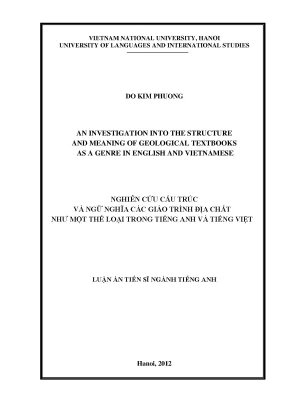
Tải xuống để đọc toàn bộVIETNAM NATIONAL UNIVERSITY, HANOI UNIVERSITY OF LANGUAGES AND INTERNATIONAL STUDIES DO KIM PHUONG AN INVESTIGATION INTO THE STRUCTURE AND MEANING OF GEOLOGICAL TEXTBOOKS AS A GENRE IN ENGLISH AND VIETNAMESE NGHIÊN CỨU CẤU TRÚC VÀ NGỮ NGHĨA CÁC GIÁO TRÌNH ĐỊA CHẤT NHƯ MỘT THỂ LOẠI TRONG TIẾNG ANH VÀ TIẾNG VIỆT LUẬN ÁN TIẾN SĨ NGÀNH TIẾNG ANH Hanoi, 2012 LUAN VAN CHAT LUONG download : add luanvanchat@agmail.com VIETNAM NATIONAL UNIVERSITY, HANOI UNIVERSITY OF LANGUAGES AND INTERNATIONAL STUDIES DO KIM PHUONG AN INVESTIGATION INTO THE STRUCTURE AND MEANING OF GEOLOGICAL TEXTBOOKS AS A GENRE IN ENGLISH AND VIETNAMESE NGHIÊN CỨU CẤU TRÚC VÀ NGỮ NGHĨA CÁC GIÁO TRÌNH ĐỊA CHẤT NHƯ MỘT THỂ LOẠI TRONG TIẾNG ANH VÀ TIẾNG VIỆT Field: English Linguistics Code: 62.01 DOCTORAL DISSERTATION OF ENGLISH Supervisor: Prof. HOANG VAN VAN Hanoi, 2012 LUAN VAN CHAT LUONG download : add luanvanchat@agmail.com TABLE OF CONTENTS Acknowledgements…………………………………………………………….…vi List of tables and figures………………………………………….viii PART I: INTRODUCTION 1. Rationale of the study………………………………………………………. Aim and Scope of the study……………………………………………….
Design of the study……………………………………………………….9 PART II: DEVELOPMENT CHAPTER 1: THEORETICAL BACKGROUNDS 1. Genre and genre analysis……………………………………………. The notion of genre………………………………………………. Genre in folklore studies……………………………………………….
Genre in linguistics…………………………………………. Genre in rhetoric……………………………………………………. Approaches to genre…………………………………………………………. Genre and language study…………………………………………………….
Systemic- functional approach to language study……………………. The Transitivity system…………………………………. The Mood system…………………………………. The Theme system……………………………………….……52 CHAPTER 2: GENERIC STRUCTURE AND LINGUISTIC FEATURES OF ENGLISH GEOLOGICAL TEXTBOOKS 2.
Generic structure of English geological textbooks………………….53 II LUAN VAN CHAT LUONG download : add luanvanchat@agmail. The organization of English geological textbooks…………. Generic features of English geological textbooks………………………. Generic structure of the Introduction Parts…………………………….
Generic structure of the Body Parts…………………………………. Classifying or decomposing……………………………………………. The organization of the Body Parts………………………………. Linguistic features of English geological textbooks……………………….
Transitivity analysis of Introduction Parts and Body Parts………………. Transitivity analysis of the Introduction Parts…………………. Transitivity analysis of the Body Parts………………………. Mood analysis of Introduction Parts and Body Parts…………….
Mood analysis of the Introduction Parts………………. Mood analysis of the Body Parts……………. Thematic analysis of Introduction Parts and Body Parts…………. Thematic analysis of the Introduction Parts…………………………….
Thematic analysis of the Body Parts……………………….96 CHAPTER 3: GENERIC STRUCTURE AND LINGUISTIC FEATURES OF VIETNAMESE GEOLOGICAL TEXTBOOKS 3. Generic structure of Vietnamese geological textbooks……………………. The organization of Vietnamese geological textbooks…………………. Generic features of Vietnamese geological textbooks…………………….
Generic structure of the Introduction Parts………………………………101 3. Generic structure of the Body Parts…………………………………. Classifying or decomposing…………………………………….105 III LUAN VAN CHAT LUONG download : add luanvanchat@agmail. The organization of the Body Parts…………………………….
Linguistic features of Vietnamese geological textbooks………………. Transitivity analysis of the Introduction Parts and the Body Parts……. Transitivity analysis of the Introduction Parts…………………………. Transitivity analysis of the Body Parts…………………………….
Mood analysis of the Introduction Parts and the Body Parts…………. Mood analysis of the Introduction Parts……………………………. Mood analysis of the Body Parts………………………………. Thematic analysis of the Introduction Parts and the Body Parts …….
Thematic analysis of the Introduction Parts……………………………. Thematic analysis of the Body Parts………………………………….130 CHAPTER 4: COMPARISON BETWEEN ENGLISH GEOLOGICAL TEXTBOOKS AND VIETNAMESE GEOLOGICAL TEXTBBOOKS 4. The overall generic structure of English and Vietnamese geological textbooks………………………………………………. Comparison of the Introduction Parts …………………………….
Comparison of the Body Parts …………………………………………. Comparison of thematic structure of English and Vietnamese geological Introduction Parts and Body Parts…………………………. Comparison of thematic structure in English and Vietnamese clauses in different metafunctions……………………………………………………. The boundary between Theme and Rheme in English and Vietnamese clauses………………………………………………………………………….144 IV LUAN VAN CHAT LUONG download : add luanvanchat@agmail.
Comparison of thematic structure. Comparison of thematic structure in terms of markedness…………. Comparison of thematic structure in terms of realization……………. Discussion of the similarities and differences between English and Vietnamese geological textbooks…………………………………………………………….
Generic and linguistic similarities……………………………. Generic and linguistic differences……………………………………….174 PART III: CONCLUSION…………………………………………………….……183 V LUAN VAN CHAT LUONG download : add luanvanchat@agmail.com FIGURES AND TABLES CHAPTER 1: THEORETICAL BACKGROUND Figure 1. The relationship between text and context 22 Figure 1. Genre and register in relation to language 23 Figure 1.
A simplified model of the English Process System, with major 37 Participant roles Figure 1. Mood system 42 Figure 1. Theme in English 51 CHAPTER 2: GENERIC STRUCTURE AND LINGUISTIC FEATURES OF ENGLISH GEOLOGICAL TEXTBOOKS Table 2. Distribution of moves in the five English Introduction Parts 58 Table 2.
Combination of four-move introduction structure and the 69 process type Table 2. The Transitivity analysis of the Introduction Parts (illustrated by 71 clause) Table 2. The Transitivity analysis of the Introduction Parts (illustrated by 72 percentage) Table 2.The Transitivity analysis of the Body Parts (illustrated by clause) 79 Table 2. The Transitivity analysis of the Body Parts (illustrated by 79 percentage) Table 2.
The Mood analysis of the Introduction Parts (illustrated by 82 clause) Table 2. The Mood analysis of the Introduction Parts (illustrated by 83 percentage) Table 2. The Mood analysis of the Body Parts (illustrated by clause) 85 Table 2. The Mood analysis of the Body Parts (illustrated by 85 percentage) Table 2.
The Thematic analysis of the Introduction Parts (illustrated by 89 VIII LUAN VAN CHAT LUONG download : add luanvanchat@agmail.com clause) Table 2. The Thematic analysis of the Introduction Parts (illustrated by 90 percentage) Table 2. The Thematic analysis of the Body Parts (illustrated by clause) 95 Table 2. The Thematic analysis of the Body Parts (illustrated by 95 percentage) CHAPTER 3: GENERIC STRUCTURE AND LINGUISTIC FEATURES OF VIETNAMESE GEOLOGICAL TEXTBOOKS Table 3.
Distribution of moves in the English Introduction Parts 101 Table 3. Combination of four-move introduction structure and the 110 process type Table 3. The Transitivity analysis of the Introduction Parts (illustrated by 112 clause). The Transitivity analysis of the Introduction Parts (illustrated by 112 percentage) Table 3.
The Transitivity analysis of the Body Parts (illustrated by 117 clause) Table 3. The Transitivity analysis of the Body Parts (illustrated by 117 percentage) Table 3. The Mood analysis of the Introduction Parts (illustrated by 119 clause) Table 3. The Mood analysis of the Introduction Parts (illustrated by 120 percentage) Table 3.
The Mood analysis of the Body Parts (illustrated by clause) 121 Table 3. The Mood analysis of the Body Parts (illustrated by 122 percentage) Table 3. The Thematic analysis of the Introduction Parts (illustrated by 124 clause) Table 3. The Thematic analysis of the Introduction Parts (illustrated by 125 percentage) IX LUAN VAN CHAT LUONG download : add luanvanchat@agmail.
The Thematic analysis of the Body Parts (illustrated by clause) 129 Table 3. The Thematic analysis of the Body Parts (illustrated by 130 percentage) CHAPTER 4: COMPARISON BETWEEN ENGLISH AND VIETNAMESE GEOLOGICAL TEXTBOOKS Table 4. Total number of clauses in English and Vietnamese Introduction 134 Parts Table 4. Comparison of frequency of Processes in the English and 134 Vietnamese Introduction Parts Table 4.
Linguistic features of the English and Vietnamese Introduction 136 Parts Table 4. Total number of clauses in English and Vietnamese Body Parts 138 Table 4. Linguistic features of the English and Vietnamese Body Parts 140 Table 4. Examples of Theme-Rheme structure in English and Vietnamese 143 Table 4.
Most common Modal Adjuncts functioned as interpersonal 146 Themes in English geological textbooks Table 4. Most common Modal Adjuncts functioned as interpersonal 148 Themes in Vietnamese geological textbooks Table 4. Most common Conjunctive Adjuncts functioned as textual 149 Themes in English geological textbooks Table 4. Most common Conjunctions functioned as textual Themes in 151 Vietnamese geological textbooks Table 4.
Combination of textual and interpersonal Themes in English 153 geological textbooks Table 4. Combination of textual and interpersonal Themes in 153 Vietnamese geological textbooks Table 4. Similarities and differences between types of Themes in 154 English and Vietnamese clauses as of different metafunctions Table 4. Unmarked Themes in English and Vietnamese geological 157 textbooks X LUAN VAN CHAT LUONG download : add luanvanchat@agmail.
Marked Themes in English and Vietnamese geological 157 textbooks Table 4. Fronted Predicators function as the unmarked Themes in 158 Vietnamese declarative clauses Table 4. Realization of Subject Themes in English and Vietnamese 159 geological textbooks Table 4. Realization of Complement Themes in English and Vietnamese 161 geological textbooks Table 4.
Types of Themes and their realizations in English and 164 Vietnamese geological declarative clauses XI LUAN VAN CHAT LUONG download : add luanvanchat@agmail.com PART I: INTRODUCTION 1. RATIONALE OF THE STUDY Geology is the science of the history of Earth‘s evolution. It is based, first, on observations of the Earth itself and other planetary bodies, but the application of such sciences as biology, chemistry, physics, and materials sciences is also required to understand the processes we observe. Geology differs from these other sciences in at least three ways.
First, geology is fundamentally a historically oriented science dealing with processes that for the most part occur on a time scale that is immense compared with human lives. Thus, it is impossible to observe an entire process directly; we can see only what is happening at a single geological instant in time. Because of this constraint, the inference of geologic processes relies heavily upon the fundamental assumption that spatial variation can be interpreted as temporal evolution. In other words, we assume that the same process can be found in various stages of advancement in different places and that therefore we can piece together observations made in different places to infer a temporal evolution of that process.
Second, geology deals with large-scale and complex systems for which controlled experiments are difficult if not impossible to construct. Thus, the observation and description of natural features acquire proportionately more importance than they have in most other sciences. Third, the fact that geologic evidence is fragmentary and incomplete makes any of the inferences drawn from the data non-unique and highly dependent upon our intuition and experience. Despite these differences, the methods employed by geologists to investigate the Earth are philosophically much the same as those used in other realms of science.
1 LUAN VAN CHAT LUONG download : add luanvanchat@agmail.com Concerning the discourse of geology, it remains a separate subject area, with a focus on natural geological phenomena and events. For the most part its discourse is indistinguishable from that used in science, the main difference being the absence of experiments to illustrate the scientific world view constructed in introductory textbooks. Geology as explained to students is very explicit about its goals. The three stages geologists have to deal with are: to observe, order and explain the experiential world.
From the point of view of ESP teaching and learning, geological textbooks in English and Vietnamese have never been exploited by any Vietnamese linguists so far. It is presumably clear that to be effective, such an adaptation must be firmly based on understanding of the specific genre in the target language, in terms not only of the surface linguistic features but also of the discourse conventions, and the underlying scientific values, which must certainly be dependent on an empirical investigation. Given the necessity with ESP teaching and learning, this study sets out to investigate the structure and meaning of geological textbooks as a genre in English and Vietnamese using the theories of systemic – functional grammar as theoretical framework. The theory of systemic functional linguistics was originally formulated by M.
Halliday in the early 1960s. From its very beginning, systemic functional linguistics has been marked by its recognition that all languages take place in the context of a social situation, that the situation has an impact on the nature and the meaning of the language used and that any account of language must therefore include reference to that context of use. With the increasing international interest in the functional nature of language and in the linguistic analysis of texts much of work about the systemic functional model, both from practical and theoretical perspective has been done by systemicists such as Berry (1975); Fawcett (1980); Halliday (1994); Martin (1985, 1992); Morley (1985); Ventura (1991); Downing and Locke (1992); Bloor, T & M. Bloor (1995); 2 LUAN VAN CHAT LUONG download : add luanvanchat@agmail.Van (1997, 2002) and many others.
The research I have undertaken is an attempt to investigate the structure and meaning of geological textbooks in English and Vietnamese as a subgenre of scientific textbooks.
Nội dung được bảo vệ bản quyền — Tải xuống đầy đủ
Trích dẫn luận án này
Đỗ Kim Phượng (2012). Cấu trúc & Ngữ nghĩa Giáo trình Địa chất Anh-Việt [Luận án tiến sĩ, Trường Đại học Ngoại ngữ – Đại học Quốc gia Hà Nội]. LuanAn.net. https://luanan.net/khoa-hoc-trai-dat-moi-truong/dia-chat/nghien-cuu-cau-truc-va-ngu-nghia-giao-trinh-dia-chat-anh-viet
Câu hỏi thường gặp
Luận án "Cấu trúc & Ngữ nghĩa Giáo trình Địa chất Anh-Việt" nghiên cứu về vấn đề gì?
Cấu trúc & Ngữ nghĩa Địa chất Anh-Việt: Từ điển chuyên ngành, thuật ngữ khoa học. Nguồn tài liệu quý giá cho sinh viên, nhà nghiên cứu địa chất.
Luận án "Cấu trúc & Ngữ nghĩa Giáo trình Địa chất Anh-Việt" được bảo vệ tại trường nào?
Luận án này được bảo vệ tại Trường Đại học Ngoại ngữ – Đại học Quốc gia Hà Nội. Năm bảo vệ: 2012.
Luận án "Cấu trúc & Ngữ nghĩa Giáo trình Địa chất Anh-Việt" thuộc chuyên ngành gì?
Luận án "Cấu trúc & Ngữ nghĩa Giáo trình Địa chất Anh-Việt" thuộc chuyên ngành Ngôn ngữ học tiếng Anh. Danh mục: Địa Chất.
Luận án "Cấu trúc & Ngữ nghĩa Giáo trình Địa chất Anh-Việt" có bao nhiêu trang?
Luận án "Cấu trúc & Ngữ nghĩa Giáo trình Địa chất Anh-Việt" có 661 trang. Bạn có thể xem trước một phần tài liệu ngay trên trang web trước khi tải về.
Cách tải luận án "Cấu trúc & Ngữ nghĩa Giáo trình Địa chất Anh-Việt" về máy như thế nào?
Để tải luận án về máy, bạn nhấn nút "Tải xuống ngay" trên trang này, sau đó hoàn tất thanh toán phí lưu trữ. File sẽ được tải xuống ngay sau khi thanh toán thành công. Hỗ trợ qua Zalo: 0559 297 239.