What are you teaching curriculums expectations and experiences
Khảo sát giáo dục: Dự kiến chương trình giảng dạy, kỳ vọng và trải nghiệm học tập.
Năm xuất bản
Số trang
165
Thời gian đọc
25 phút
Lượt xem
0
Lượt tải
0
Phí lưu trữ
50 Point
Tổng quan nhanh
- Chủ đề:
- Nội dung giảng dạy: Khám phá chương trình viết cấp 3 & đại học
- Số trang:
- 165 trang
- Trường:
- Hamline University
- Chuyên ngành:
- Education
- Tác giả:
- Kathryn Elizabeth Fullmer
- Năm:
- 2016
Tóm tắt nội dung luận án
I.Nội dung giảng dạy Khám phá chương trình viết cấp 3 đại học
Tài liệu này đi sâu vào nghiên cứu chương trình giảng dạy viết tại trường phổ thông và đại học năm nhất. Nó làm rõ sự khác biệt trong nội dung giảng dạy và các bài tập được giao. Một số chương trình cấp ba tập trung vào các dạng bài viết mẫu. Ví dụ, bài luận năm đoạn văn vẫn còn phổ biến. Điều này có thể hạn chế sự phát triển tư duy phản biện. Mục tiêu chính ở cấp ba thường là đạt điểm cao trong các kỳ thi chuẩn hóa. Việc này đôi khi dẫn đến các hoạt động mở rộng không liên quan đến mục tiêu học tập cốt lõi. Sự nhấn mạnh vào các quy ước hoặc nội dung cũng là một điểm khác biệt. Trường phổ thông thường chú trọng các quy tắc ngữ pháp hơn. Trong khi đó, đại học mong đợi sinh viên thể hiện tư duy phức tạp hơn. Việc nhận diện những khác biệt này là bước đầu tiên để cải thiện trải nghiệm học tập của sinh viên.
1.1. Thiết kế chương trình giảng dạy phổ thông
Chương trình giảng dạy viết ở trường phổ thông thường xoay quanh các bài tập theo công thức. Các bài luận năm đoạn văn là ví dụ điển hình. Những phương pháp này có thể giúp học sinh cấu trúc ý tưởng ban đầu. Tuy nhiên, chúng cũng giới hạn khả năng sáng tạo và phân tích sâu. Mục tiêu thường là chuẩn bị cho kỳ thi đầu vào đại học. Điều này khiến nội dung giảng dạy đôi khi bị bó hẹp. Cần có một thiết kế chương trình giảng dạy linh hoạt hơn.
1.2. Mục tiêu học tập viết đại học
Các khóa học viết năm nhất đại học có mục tiêu học tập cao hơn. Chúng kỳ vọng sinh viên thoát ly khỏi các công thức cứng nhắc. Sinh viên cần phát triển khả năng lập luận sắc bén. Việc viết phải thể hiện tư duy phản biện và phân tích sâu. Mục tiêu này đòi hỏi kỹ năng tư duy phức tạp. Sự khác biệt này tạo ra thách thức lớn cho học sinh chuyển cấp. Cần có sự liên kết rõ ràng giữa hai cấp học.
1.3. Nội dung giảng dạy và các bài tập mẫu
Nội dung giảng dạy ở mỗi cấp có trọng tâm khác nhau. Trường phổ thông ưu tiên việc tuân thủ các quy tắc ngữ pháp và cấu trúc. Đại học tập trung vào phát triển ý tưởng, lập luận và giọng văn cá nhân. Các bài tập mẫu cũng phản ánh sự khác biệt này. Sự không nhất quán này gây khó khăn cho việc phát triển kỹ năng viết liên tục. Cần có sự thống nhất về các yêu cầu cốt lõi.
II.Kỳ vọng học tập Chuẩn bị cho kỹ năng viết sinh viên
Tài liệu khám phá các kỳ vọng về kỹ năng viết từ cả giáo viên phổ thông và đại học. Có sự khác biệt đáng kể giữa hai nhóm. Giáo viên cấp ba có thể nhấn mạnh việc tuân thủ các quy tắc hình thức. Giáo viên đại học kỳ vọng khả năng tư duy và phân tích sâu sắc hơn. Lớp học viết năm nhất đại học thường phải đối mặt với sĩ số lớn. Các nguồn lực sẵn có và trình độ của giảng viên cũng ảnh hưởng. Nhiều trường cao đẳng thiếu giảng viên viết có trình độ. Điều này ảnh hưởng đến chất lượng hướng dẫn và kết quả giáo dục. Việc làm rõ kỳ vọng giúp sinh viên chuẩn bị tốt hơn. Nó cũng định hướng cho việc phát triển kỹ năng viết cần thiết.
2.1. Kỳ vọng của học sinh và giảng viên
Kỳ vọng của học sinh và giảng viên thường không đồng nhất. Học sinh phổ thông có thể nghĩ viết chỉ là việc đúng ngữ pháp. Giảng viên đại học lại kỳ vọng nhiều hơn về tư duy và lập luận. Sự chênh lệch này cần được giải quyết. Việc trao đổi rõ ràng về kỳ vọng có thể cải thiện quá trình học tập. Nó giúp học sinh biết họ cần phát triển kỹ năng nào.
2.2. Kết quả giáo dục mong muốn
Mục tiêu là đạt được kết quả giáo dục cao hơn trong môn viết. Sinh viên cần thành thạo kỹ năng viết học thuật đa dạng. Khả năng viết rõ ràng, mạch lạc và có lập luận chặt chẽ là điều thiết yếu. Kết quả này đòi hỏi một quá trình học tập liên tục. Cần có sự nhất quán trong các chuẩn mực đánh giá. Việc này sẽ đảm bảo sự phát triển toàn diện.
2.3. Phát triển kỹ năng viết cơ bản
Phát triển kỹ năng viết cơ bản đòi hỏi sự hướng dẫn chuyên sâu. Nhiều giáo viên viết thiếu đào tạo chuyên biệt. Điều này ảnh hưởng trực tiếp đến chất lượng giảng dạy. Cần trang bị cho giáo viên các phương pháp giảng dạy viết hiệu quả. Từ đó, nâng cao năng lực viết của học sinh. Việc này đóng góp vào sự thành công học thuật lâu dài.
III.Trải nghiệm giáo viên Phương pháp giảng dạy hiệu quả
Phần này tập trung vào trải nghiệm và quan điểm của giáo viên viết. Nhiều giáo viên viết ở cả cấp phổ thông và đại học thiếu đào tạo chuyên sâu về giảng dạy viết. Một số người thậm chí ít khi tự viết. Điều này ảnh hưởng đến phương pháp giảng dạy và sự tự tin của họ. Lịch trình bận rộn ở trường phổ thông cũng là một rào cản. Thời gian dành cho việc dạy ngữ pháp và dấu câu thường chiếm ưu thế. Giao tiếp giữa giáo viên phổ thông và đại học còn hạn chế. Điều này tạo ra sự ngắt kết nối trong trải nghiệm học tập của học sinh. Văn hóa lớp học viết cũng đóng vai trò quan trọng. Một môi trường khuyến khích thử nghiệm và phản hồi là cần thiết. Sự khác biệt về trọng tâm của các khoa cũng ảnh hưởng đến việc giảng dạy.
3.1. Phương pháp giảng dạy và đào tạo
Giáo viên viết thường thiếu đào tạo chuyên sâu về các phương pháp giảng dạy viết hiện đại. Nhiều người chưa từng có trải nghiệm viết cá nhân rộng rãi. Điều này ảnh hưởng đến khả năng hướng dẫn và phản hồi. Lịch trình ở trường phổ thông cũng hạn chế thời gian dành cho các kỹ thuật viết sâu. Cần tăng cường đào tạo và phát triển chuyên môn cho giáo viên. Điều này sẽ cải thiện chất lượng giảng dạy.
3.2. Trải nghiệm học tập trong lớp viết
Trải nghiệm học tập của học sinh bị ảnh hưởng bởi năng lực và quan điểm của giáo viên. Một lớp học thiếu hướng dẫn rõ ràng sẽ gây khó khăn. Văn hóa lớp học viết khuyến khích sự thử nghiệm và chấp nhận lỗi là rất quan trọng. Môi trường hỗ trợ thúc đẩy sự phát triển kỹ năng. Cần tạo ra một không gian an toàn cho học sinh thực hành và học hỏi.
3.3. Ảnh hưởng của văn hóa lớp học
Văn hóa lớp học viết định hình thái độ của học sinh đối với việc viết. Sự thiếu giao tiếp giữa giáo viên các cấp tạo ra khoảng cách. Mỗi bộ phận có trọng tâm riêng. Điều này làm cho việc xây dựng trải nghiệm học tập liên tục trở nên khó khăn. Cần thúc đẩy giao tiếp và hợp tác giữa các giáo viên. Điều này giúp tạo ra một lộ trình học tập gắn kết hơn.
IV.Chiến lược đánh giá Nâng cao cấu trúc khóa học viết
Tài liệu này cũng xem xét các chiến lược đánh giá được sử dụng. Việc đánh giá kỹ năng viết thường tập trung quá mức vào ngữ pháp. Điều này có thể bỏ qua các khía cạnh quan trọng khác như ý tưởng và lập luận. Vai trò của ngữ pháp trong đánh giá cần được cân nhắc cẩn thận. Ngữ pháp quan trọng, nhưng không phải là mục tiêu duy nhất. Các đánh giá cần được căn chỉnh với nội dung giảng dạy. Cần có sự nhất quán giữa những gì được dạy và những gì được kỳ vọng ở học sinh. Một cấu trúc khóa học viết hiệu quả nên tích hợp ngữ pháp một cách có ý nghĩa. Nó cần hướng tới việc phát triển toàn diện kỹ năng viết. Các phương pháp đánh giá sáng tạo hơn có thể giúp đo lường sự tiến bộ thực sự. Điều này sẽ đóng góp vào kết quả giáo dục tích cực.
4.1. Chiến lược đánh giá hiệu quả
Đánh giá là một phần cốt lõi của quá trình giảng dạy viết. Cần áp dụng các chiến lược đánh giá minh bạch và công bằng. Việc tập trung quá nhiều vào các lỗi ngữ pháp nhỏ có thể làm lu mờ ý tưởng chính. Cần khuyến khích các phương pháp đánh giá toàn diện hơn. Điều này giúp học sinh phát triển kỹ năng viết một cách cân bằng.
4.2. Cấu trúc khóa học và ngữ pháp
Vai trò của ngữ pháp trong đánh giá cần được nhìn nhận đúng mức. Ngữ pháp là công cụ hỗ trợ cho việc truyền đạt ý tưởng. Cấu trúc khóa học nên tích hợp ngữ pháp một cách hữu ích. Nó không nên là một mục tiêu độc lập. Cần có sự cân bằng giữa hình thức và nội dung. Điều này giúp sinh viên hiểu giá trị thực của ngữ pháp.
4.3. Liên kết đánh giá với nội dung
Các đánh giá phải được căn chỉnh chặt chẽ với hướng dẫn giảng dạy. Phải có sự nhất quán giữa những gì được dạy và những gì được đánh giá. Việc này đảm bảo rằng đánh giá phản ánh đúng quá trình học tập. Nó cũng giúp học sinh hiểu rõ kỳ vọng. Sự liên kết này thúc đẩy việc đạt được kết quả giáo dục mong muốn.
V.Kết quả giáo dục Cải thiện thiết kế chương trình
Nghiên cứu nhấn mạnh nhu cầu cấp thiết về giao tiếp. Cần có sự hợp tác giữa giáo viên viết ở trường phổ thông và đại học. Việc hiểu rõ kỳ vọng và chương trình giảng dạy của nhau là rất quan trọng. Điều này giúp tạo ra một trải nghiệm học tập liền mạch cho học sinh. Đề xuất cải thiện thiết kế chương trình giảng dạy là cần thiết. Các chương trình cần liên kết chặt chẽ hơn để chuẩn bị học sinh cho sự phức tạp của việc viết ở đại học. Mục tiêu cuối cùng là nâng cao kết quả giáo dục. Việc đầu tư vào đào tạo giáo viên và phát triển các chiến lược đánh giá hiệu quả sẽ mang lại lợi ích lâu dài. Điều này giúp học sinh phát triển kỹ năng viết cần thiết cho sự thành công học thuật và chuyên nghiệp.
5.1. Cầu nối giữa các cấp học
Nghiên cứu chỉ rõ tầm quan trọng của việc xây dựng cầu nối. Cần tăng cường giao tiếp giữa giáo viên cấp 3 và đại học. Việc hiểu rõ mục tiêu học tập và kỳ vọng của nhau là bước đầu tiên. Sự hợp tác này giúp làm mờ ranh giới chuyển tiếp. Nó đảm bảo học sinh được chuẩn bị tốt hơn.
5.2. Đề xuất cải thiện thiết kế chương trình
Nghiên cứu đề xuất cải thiện thiết kế chương trình giảng dạy viết. Các chương trình cần có sự liên kết và nhất quán cao hơn. Chúng phải chuẩn bị cho học sinh khả năng viết phức tạp. Cần loại bỏ các phương pháp theo công thức quá cứng nhắc. Thiết kế chương trình nên thúc đẩy tư duy phản biện. Điều này nâng cao chất lượng kết quả giáo dục.
5.3. Nâng cao trải nghiệm học tập viết
Mục tiêu cuối cùng là nâng cao toàn diện trải nghiệm học tập viết. Cần đầu tư vào đào tạo chuyên môn cho giáo viên. Phát triển kỹ năng viết đòi hỏi một cách tiếp cận toàn diện. Điều này bao gồm cải tiến phương pháp giảng dạy và chiến lược đánh giá. Việc này giúp học sinh thành công trong học tập. Nó cũng chuẩn bị cho họ trong sự nghiệp tương lai.
Mục lục chi tiết luận án
Tải xuống file đầy đủ để xem toàn bộ nội dung
Tải đầy đủ (165 trang)Trích đoạn nội dung luận án
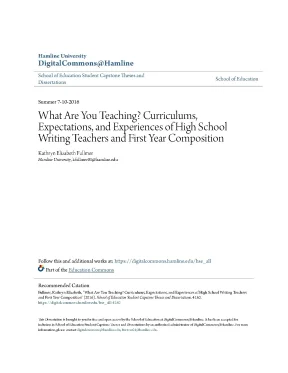
Tải xuống để đọc toàn bộHamline University DigitalCommons@Hamline School of Education Student Capstone Theses and School of Education Dissertations Summer 7-10-2016 What Are You Teaching? Curriculums, Expectations, and Experiences of High School Writing Teachers and First Year Composition Kathryn Elizabeth Fullmer Hamline University, kfullmer01@hamline.edu Follow this and additional works at: https://digitalcommons.edu/hse_all Part of the Education Commons Recommended Citation Fullmer, Kathryn Elizabeth, "What Are You Teaching? Curriculums, Expectations, and Experiences of High School Writing Teachers and First Year Composition" (2016). School of Education Student Capstone Theses and Dissertations.edu/hse_all/4150 This Dissertation is brought to you for free and open access by the School of Education at DigitalCommons@Hamline. It has been accepted for inclusion in School of Education Student Capstone Theses and Dissertations by an authorized administrator of DigitalCommons@Hamline. For more information, please contact digitalcommons@hamline.edu, lterveer01@hamline.
WHAT ARE YOU TEACHING? A CASE STUDY OF CURRICULUMS, EXPECTATIONS, AND EXPERIENCES OF HIGH SCHOOL WRITING TEACHERS AND FIRST YEAR COMPOSITION TEACHERS By Kathryn Elizabeth Fullmer A dissertation submitted in partial fulfillment of the requirements for the degree of Doctorate in Education Hamline University St. Paul, MN Summer 2016 Dissertation Chair: Terri Christenson Reader: Kristina Deffenbacher Reader: Jennifer McCarty Plucker 2 Copyright by KATHRYN ELIZABETH FULLMER, 2016 All Rights Reserved 3 To my parents who told me I could be whoever I wanted as long as I had an education. To my sister who was my first student. To my nieces who will someday know what Auntie Kate did.
To my grandmothers who are the two strongest women I know. To my students who couldn’t believe I wanted to go to more school. To the women teachers who went before me. And finally, to all students who ever struggled in school.
4 “Everywhere I go I’m asked if I think the universities stifle writers. My opinion is that they don’t stifle enough of them. There’s many a best seller that could have been prevented by a good English teacher. -Flannery O’Connor 5 ACKNOWLEDGEMENTS I am grateful to the many professors at Hamline University who took me through this process.
As the saying goes, the days are long and the years are short. Those weekend classes, after a long week of teaching, were more than I could handle most of the time, but now I wonder where the time went. Special thanks to Kristina Deffenbacher and Jennifer McCarty Plucker who agreed to serve as members of my dissertation. I remember thinking, three women with doctorates and one woman on her way towards earning hers—Girl Power! I offer profound thanks to Terri Christenson who served as my dissertation committee chair and provided me with answers, encouragement, and nudges.
I remember our dinner and coffee meetings where this project began and ended. Thank you to the five writing instructors I interviewed and who shared teaching documents with me as well as their passion. Thank you to my colleagues who listened to me complain and who celebrated each deadline and chapter with me. Thank you to all of my students who shared this journey with me.
Homework sure ruins a lot of fun! And finally, thank you to my cats, Whitman and Zelda, who snoozed on piles of books, knocked over stacks of papers, flicked at my pens with their paws, and walked across my computer keyboard. 6 TABLE OF CONTENTS CHAPTER ONE: Introduction to the Research Question. 16 Journey to the Research Question. 16 My department’s tensions and questions.
23 Variable use of AP credits. 27 Defining the goals of college-level writing. 29 Preparing high school students for college. 31 Description of Theoretical Foundations.
33 CHAPTER TWO: Literature Review. 35 Writing Curriculum in High School and College. 39 Five paragraph essay assignment. 40 Formulaic writing assignments.
41 Conforming and covering an approved curriculum. 41 Preparing students for college entrance exams. 42 Irrelevant extension activities. 43 Instructional focus on content or conventions.
44 Assessment in writing. 45 7 Role of grammar in assessment. 45 Align assessments with instruction. 45 Expectations of High School and College Writing.
46 Large class size. 47 Resources available and faculty background. 47 Lack of qualified writing instructors. 50 Experiences and Perspectives of High School and College Teachers.
50 Little teacher training in writing. 51 Teachers do not write themselves. 52 High school schedule. 53 Teaching grammar and punctuation.
55 Communication between high school and college. 55 Writing classroom culture. 57 Different departmental focus. 59 Influences on classroom experience.
62 8 CHAPTER THREE: Methodology. 63 Qualitative Research Framework. 69 Setting and Participants. 71 Methodology for Data Collection.
80 CHAPTER FOUR: Results. 84 Materials and standards. 111 Document Analysis and summary. 114 CHAPTER FIVE: Conclusion.
118 High school is everything. 120 PLC and course approval. 122 Five paragraph essay. 122 Rubrics and grades.
125 Effect of others on grades. 126 Context and Schedule. 128 Student development and maturity. 129 Teachers need to read and write.
131 Teachers enjoy teaching. 131 Lack of pedagogical knowledge. 132 Technology and plagiarism. 135 Sample size and type.
136 Implications and Suggestions. 138 For high school. 139 For professional development. 140 For other stake-holders.
144 11 APPENDICES APPENDIX A: Document Analysis (National Archives) APPENDIX B: Modified Document Analysis for Writing Curriculum APPENDIX C: Interview Questions APPENDIX D: Consent Letter APPENDIX E: Consent Signature Form 12 TABLE OF TABLES 2.1 2010 Minnesota Academic Standards for English Language Arts 2. 2010 Minnesota Academic Standards for English Language Arts 4.1 Summary of Data Addressing the Writing Curriculum 4.2 Summary of Data Addressing Expectations in the Writing Classroom 4.3 Summary of Data Addressing Teaching Experiences in the Classroom 4.4 Summary of Data Addressing Instructional Documents 5.1 2010 Minnesota Academic Standards for English Language Arts 5.2 Remedial Education Rates for Minnesota Students 13 Abstract Fullmer, K. What Are You Teaching? Curriculums, Expectations, and Experiences of High School Writing Teachers and First Year Composition (2016) The purpose of this study was to explore the teaching of writing in high school and first year composition. In depth interviews and document analysis were employed to allow five writing instructors to detail their curriculums, expectations, and experiences of teaching writing.
Findings suggest that the teaching of writing is nuanced and is affected by many outside variables. Implications for future research include the possibility of developing better communication between high school and colleges, more and better professional development for writing instructors at both levels, and an evaluation of current practices at the high school and college level. 14 Definition of Terms ACT (American College Testing)--This is a standardized test that high school students take to determine college readiness and college admissions. They are tested on reading, grammar, math, science and reading.
The College Board produces it. Advanced Placement classes (AP)-- In the 1950s the College Board developed a series of classes for advanced high school students to earn possible college credit. Today, high school teachers teach these classes and students can earn college credit by taking a test in May. They are often combined with high school English content.
For the purpose of this dissertation, AP refers to AP Literature and Composition and AP Language and Composition. AMA –American Medical Association--A writing style used primarily in the medical field. APA – American Psychological Association-- A writing style format used primarily by the social sciences. ASA –American Sociological Association--A writing style used primarily in the sociology field.
Chicago--A writing style used primarily by history departments. College Board--an organization that prepares and administers standardized tests that are used in college admission and placement. Common Core State Standards (CCSS)--Corestandards. These learning goals outline what a student should know and be able to do at the end of each grade.
The standards were created to ensure that all students graduate from high school with the skills and knowledge necessary to succeed in college, career, and life, regardless of where they live. Forty-two states, the District of Columbia, four territories, and the Department of Defense Education Activity (DoDEA) have voluntarily adopted and are moving forward with the Common Core.” Communities of Practice (COP)--According to Wegner, McDermott, and Snyder (2002), a community of practice is a group of people who engage in a process of collective learning. They are also groups of people who share a concern or a passion for something they do and learn how to do it better as they interact regularly. 15 First Year Composition (FYC)--for the purpose of this dissertation, First Year Composition (FYC) is any freshman level English class.
Other descriptors might be English 101, Freshman Comp, and Introduction to College Writing. This class might fall under the English department, the rhetoric department, the General Studies Department, or as its own department. Five Paragraph Essay (FPE)--an organizational pattern for essays. It includes an introductory paragraph, three body paragraphs, and a conclusion Minnesota Academic Standards for the English Language Arts (MNELA Standards)-- include reading, writing, speaking, viewing, listening, media literacy, and language standards, were revised in 2010.
All schools must implement the 2010 standards by the 2012-2013 school year. The standards will be reviewed again during the 2018-2019 school year. MLA (Modern Language Association)-- A writing style format used primarily by English departments and other humanities. SAT (Scholastic Aptitude Test)--Similar to the ACT, it is a standardized test that high school students take to determine college readiness and college admissions.
They are tested on math, critical reading, and writing. The College Board produces it. Writing Across the Curriculum (WAC) –is a movement within contemporary composition studies that concerns itself with writing in classes outside of composition, literature, and other English courses. Minnesota Academic Standards for the English Language Arts (MNELA Standards)— include reading, writing, speaking, viewing, listening, media literacy, and language standards, were revised in 2010.
All schools must implement the 2010 standards by the 2012-2013 school year. The standards will be reviewed again during the 2018-2019 school year. 16 CHAPTER ONE Introduction to the Research Question All teachers want to help students learn academic skills, be prepared for the next level, and be good citizens of this planet. As a high school English teacher, I want to help my students communicate well and be prepared for the next level—college English.
Is it possible for high school writing teachers to prepare students for a variety of colleges with differing expectations and an even more diverse college writing curriculum? In this study, I am interested in bridging the gap between high school writing and first year composition (FYC). I want to explore the curriculums, expectations, and experiences found in both high school and college composition courses. This dissertation will seek to find commonalities and differences that will help to inform and align instruction in the writing process. In this chapter, a presentation of the primary research question will provide the foundation for the work and its three related areas of literature.
This chapter will also include my research journey and my personal experience as a writing teacher. A rationale for the research question will be presented and a conclusion will close the chapter with ideas leading to the literature review. Journey to the Research Question Teaching has been wrought with conflict ever since Horace Mann (1796-1859) decided to take on the task of uniting America’s fledgling schools. What should be taught? Who would teach? What kinds of students? What is the purpose of our public 17 schools? The curriculum conflicts continued through the twentieth century as John Dewey (1859-1952) and Edward Thorndike (1874-1949) argued, then Sputnik was launched and scared Americans about their education (Ravitch, 2013).
Nội dung được bảo vệ bản quyền — Tải xuống đầy đủ
Trích dẫn luận án này
Kathryn Elizabeth Fullmer (2016). What are you teaching curriculums expectations and experienc [Luận án tiến sĩ, Hamline University]. LuanAn.net. https://luanan.net/khoa-hoc-giao-duc/what-are-you-teaching-curriculums-expectations-and-experiences
Câu hỏi thường gặp
Luận án "What are you teaching curriculums expectations and experienc" nghiên cứu về vấn đề gì?
Khảo sát giáo dục: Dự kiến chương trình giảng dạy, kỳ vọng và trải nghiệm học tập.
Luận án "What are you teaching curriculums expectations and experienc" được bảo vệ tại trường nào?
Luận án này được bảo vệ tại Hamline University. Năm bảo vệ: 2016.
Luận án "What are you teaching curriculums expectations and experienc" thuộc chuyên ngành gì?
Luận án "What are you teaching curriculums expectations and experienc" thuộc chuyên ngành Education. Danh mục: Khoa Học Giáo Dục.
Luận án "What are you teaching curriculums expectations and experienc" có bao nhiêu trang?
Luận án "What are you teaching curriculums expectations and experienc" có 165 trang. Bạn có thể xem trước một phần tài liệu ngay trên trang web trước khi tải về.
Cách tải luận án "What are you teaching curriculums expectations and experienc" về máy như thế nào?
Để tải luận án về máy, bạn nhấn nút "Tải xuống ngay" trên trang này, sau đó hoàn tất thanh toán phí lưu trữ. File sẽ được tải xuống ngay sau khi thanh toán thành công. Hỗ trợ qua Zalo: 0559 297 239.