University of bradford phd thesis 4
Tìm luận án PhD ngành 4 tại University of Bradford. Khám phá nghiên cứu tiên phong và đóng góp cho lĩnh vực học thuật.
University of Bradford
Peace Studies and International Development
Luan An
Luận án tiến sĩ
Năm xuất bản
Số trang
365
Thời gian đọc
55 phút
Lượt xem
0
Lượt tải
0
Phí lưu trữ
60 Point
Tổng quan nhanh
- Chủ đề:
- Critical Evaluation of Niger Delta Amnesty DDR Programme
- Số trang:
- 365 trang
- Trường:
- University of Bradford
- Chuyên ngành:
- Peace Studies and International Development
- Tác giả:
- Solomon Inuwa
- Năm:
- 2017
Tóm tắt nội dung luận án
I.Critical Evaluation of Niger Delta Amnesty DDR Programme
This University of Bradford PhD thesis presents a critical evaluation of the 2009 Niger Delta Amnesty, Disarmament, Demobilisation, and Reintegration (ADDR) programme. The study focuses on its efficacy in conflict prevention and resolution. It provides a comprehensive analysis of the programme's implementation and outcomes within Nigeria's Niger Delta region. The research addresses the complex dynamics of post-conflict peacebuilding. Understanding the ADDR programme's nuances is crucial for future interventions globally. The thesis contributes significantly to the field of peace studies and international development. Its findings offer valuable insights for policymakers and practitioners working in similar contexts. This academic writing represents a major contribution to understanding peace processes. The doctoral research explores multifaceted aspects of the programme's design and execution.
1.1. Thesis Focus 2009 Niger Delta ADDR Programme
This PhD dissertation critically evaluates the 2009 Niger Delta Amnesty, Disarmament, Demobilisation, and Reintegration (ADDR) programme. The study focuses on its efficacy in conflict prevention and resolution. It provides a comprehensive analysis of the programme's implementation and outcomes within Nigeria's Niger Delta region. The research addresses the complex dynamics of post-conflict peacebuilding. Understanding the ADDR programme's nuances is crucial for future interventions globally. The thesis contributes significantly to the field of peace studies and international development. Its findings offer valuable insights for policymakers and practitioners working in similar contexts. This academic writing represents a major contribution to understanding peace processes. The doctoral research explores multifaceted aspects of the programme's design and execution.
1.2. Author and Institutional Affiliation Solomon Inuwa
This doctoral research was conducted by Solomon Inuwa. The research was submitted for the Degree of Doctor of Philosophy. The institutional affiliation is the Division of Peace Studies and International Development. This division is part of the Faculty of Social Sciences and Humanities. The study was completed at the University of Bradford in 2017. This academic setting provides a strong foundation for critical evaluation and scholarly inquiry. The University of Bradford is renowned for its peace studies programs, attracting many doctoral candidate. The research reflects rigorous academic writing standards. It demonstrates a profound commitment to scholarly inquiry. Thesis submission marks the culmination of extensive study.
II.Research Frameworks and Core Methodologies for Evaluation
The study employs a dual-framework approach for evaluation. It utilizes both minimalist and maximalist perspectives drawn from extensive DDR literature. The minimalist framework assesses basic security stabilization measures. It examines the immediate return of ex-combatants to pre-conflict conditions. The maximalist framework, conversely, evaluates transformative potential. It considers the programme's ability to address the fundamental root causes of violence. This comparative analysis provides a nuanced understanding of DDR effectiveness in complex environments. The academic writing meticulously details each framework's application and limitations. Such methodological rigor is central to effective doctoral research outcomes. This approach ensures a comprehensive and critical assessment.
2.1. Methodological Approach Minimalist vs. Maximalist Frameworks
The study employs a dual-framework approach for evaluation. It utilizes both minimalist and maximalist perspectives drawn from extensive DDR literature. The minimalist framework assesses basic security stabilization measures. It examines the immediate return of ex-combatants to pre-conflict conditions. The maximalist framework, conversely, evaluates transformative potential. It considers the programme's ability to address the fundamental root causes of violence. This comparative analysis provides a nuanced understanding of DDR effectiveness in complex environments. The academic writing meticulously details each framework's application and limitations. Such methodological rigor is central to effective doctoral research outcomes. This approach ensures a comprehensive and critical assessment.
2.2. Key Research Keywords Nigeria Amnesty Reintegration State
The PhD dissertation identifies several key keywords central to its inquiry. These include Nigeria, Niger-Delta, Amnesty, Disarmament, Demobilisation, Reinsertion, and Reintegration. Additional critical keywords are Neopatrimonialism, State, and Patronage. These terms are fundamental to the research scope and its analytical depth. They guide the detailed analysis of the ADDR programme's context and its multifaceted impact. Each keyword highlights a critical aspect of the study's theoretical and empirical focus. They collectively help define the specific academic inquiry. This precise keyword selection ensures research clarity and focus. The language used reflects specialized academic writing conventions.
III.Significant Findings and Transformative DDR Programme Insights
A significant finding highlights the inherent limitations of minimalist DDR approaches. Such approaches primarily achieve superficial security stabilization. They often return ex-combatants to the pre-conflict societal status quo-ante. Crucially, pre-conflict grievances frequently remain completely unaddressed in these scenarios. This outcome carries a dangerously high potential for relapse to violence. The doctoral research emphasizes the urgent need for deeper, more comprehensive interventions. Purely minimalist programs risk fostering only temporary peace. This finding is crucial for understanding sustained conflict resolution strategies globally. The thesis underscores the importance of truly comprehensive strategies for lasting peace. It serves as a vital warning against incomplete peacebuilding efforts.
3.1. Minimalist DDR Limitations Relapse to Violence Potential
A significant finding highlights the inherent limitations of minimalist DDR approaches. Such approaches primarily achieve superficial security stabilization. They often return ex-combatants to the pre-conflict societal status quo-ante. Crucially, pre-conflict grievances frequently remain completely unaddressed in these scenarios. This outcome carries a dangerously high potential for relapse to violence. The doctoral research emphasizes the urgent need for deeper, more comprehensive interventions. Purely minimalist programs risk fostering only temporary peace. This finding is crucial for understanding sustained conflict resolution strategies globally. The thesis underscores the importance of truly comprehensive strategies for lasting peace. It serves as a vital warning against incomplete peacebuilding efforts.
3.2. Maximalist DDR Imperative Addressing Root Causes of Conflict
The study concludes that DDR must be maximalist to prove truly effective. An effective DDR mechanism requires a genuinely transformative agenda. This agenda must aim to comprehensively address the root causes of violence, not just symptoms. Such an approach fosters genuine, long-term conflict prevention and resolution. It actively promotes sustainable post-conflict peacebuilding. The conceptualization, design, and implementation must therefore be thoroughly comprehensive in nature. This recommendation is central to the PhD dissertation's policy implications. It offers a clear and actionable path for future DDR programmes. The supervisor would have guided the doctoral candidate towards this critical insight. This finding is a key contribution of this extensive doctoral research.
IV.University of Bradford Thesis Submission and Access Details
This University of Bradford PhD thesis is publicly accessible through Bradford Scholars. Bradford Scholars serves as the University's official Open Access repository. It provides full metadata for this doctoral research. The repository facilitates global access to academic works. It ensures strict compliance with postgraduate regulations for thesis submission. Researchers and interested parties can contact the repository team for further information or assistance. This system exemplifies the University of Bradford Library's strong commitment to open scholarship. Access to such valuable resources significantly benefits the wider academic community worldwide. The thesis contributes to a growing body of knowledge within the research repository.
4.1. University of Bradford Library and Research Repository
This University of Bradford PhD thesis is publicly accessible through Bradford Scholars. Bradford Scholars serves as the University's official Open Access repository. It provides full metadata for this doctoral research. The repository facilitates global access to academic works. It ensures strict compliance with postgraduate regulations for thesis submission. Researchers and interested parties can contact the repository team for further information or assistance. This system exemplifies the University of Bradford Library's strong commitment to open scholarship. Access to such valuable resources significantly benefits the wider academic community worldwide. The thesis contributes to a growing body of knowledge within the research repository.
4.2. Licensing and Reuse Information for Academic Works
The University of Bradford theses, including this PhD dissertation, are licensed under a Creative Commons Licence. Specifically, the "by-nc-nd/3.0/" license applies. This license permits reuse under particular, well-defined conditions. It allows non-commercial use, provided proper attribution is given. Crucially, it prohibits modifications or derivatives of the original work. This licensing framework ensures proper citation practices and maintains academic integrity. Understanding these specific rights is paramount for any researcher accessing or intending to reuse the work. This information is highly important for those considering thesis submission to open access platforms. This policy reflects institutional guidelines for comprehensive academic writing dissemination.
V.Acknowledgements and Support for Doctoral Research Journey
The doctoral candidate received profound appreciation for the comprehensive supervisory support provided. Professor Neil Cooper served as the dedicated lead supervisor, offering consistent guidance. Professor Donna Pankhurst provided invaluable second supervisor support. Professor David Francis initially laid a solid academic foundation as the first supervisor. Their useful comments, insightful remarks, and robust engagement consistently inspired the research process. This expert mentoring is absolutely crucial for high-quality academic writing development. The completed thesis stands as clear evidence of sincere supervisory guidance and commitment. Effective supervision is a fundamental cornerstone of successful PhD dissertation completion. A strong supervisor relationship proves invaluable for any doctoral candidate throughout their journey.
5.1. Supervisory Guidance and Academic Mentorship Received
The doctoral candidate received profound appreciation for the comprehensive supervisory support provided. Professor Neil Cooper served as the dedicated lead supervisor, offering consistent guidance. Professor Donna Pankhurst provided invaluable second supervisor support. Professor David Francis initially laid a solid academic foundation as the first supervisor. Their useful comments, insightful remarks, and robust engagement consistently inspired the research process. This expert mentoring is absolutely crucial for high-quality academic writing development. The completed thesis stands as clear evidence of sincere supervisory guidance and commitment. Effective supervision is a fundamental cornerstone of successful PhD dissertation completion. A strong supervisor relationship proves invaluable for any doctoral candidate throughout their journey.
5.2. Funding and Institutional Support for the PhD Programme
Funding was absolutely critical for undertaking this extensive PhD programme. The Nigerian Army graciously granted official permission for the study's commencement. The Petroleum Technology Development Fund (PTDF) provided essential financial support. This crucial funding enabled the doctoral candidate to complete the research effectively. Institutional backing and financial assistance are undeniably vital for postgraduate studies of this magnitude. Acknowledgement also extends to family members, colleagues, and friends. Their consistent support, both spiritual and academic, proved truly invaluable. This collective encouragement significantly facilitates the arduous, often challenging, journey of doctoral research. These contributions ensure successful thesis submission.
Mục lục chi tiết luận án
Tải xuống file đầy đủ để xem toàn bộ nội dung
Tải đầy đủ (365 trang)Trích đoạn nội dung luận án
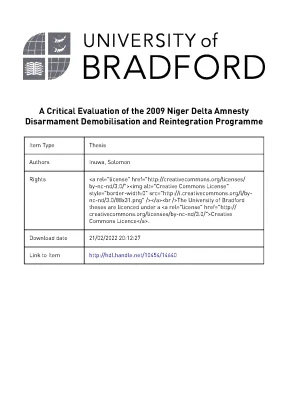
Tải xuống để đọc toàn bộA Critical Evaluation of the 2009 Niger Delta Amnesty Disarmament Demobilisation and Reintegration Programme Item Type Thesis Authors Inuwa, Solomon Rights <a rel="license" href="http://creativecommons.org/licenses/ by-nc-nd/3.0/"><img alt="Creative Commons License" style="border-width:0" src="http://i.org/l/by- nc-nd/3.png" /></a><br />The University of Bradford theses are licenced under a <a rel="license" href="http:// creativecommons.org/licenses/by-nc-nd/3.0/">Creative Commons Licence</a>. Download date 21/02/2022 20:12:27 Link to Item http://hdl.net/10454/14640 University of Bradford eThesis This thesis is hosted in Bradford Scholars – The University of Bradford Open Access repository. Visit the repository for full metadata or to contact the repository team © University of Bradford. This work is licenced for reuse under a Creative Commons Licence.
A Critical Evaluation of the 2009 Niger Delta Amnesty Disarmament Demobilisation and Reintegration Programme Solomon Inuwa Submitted for the Degree of Doctor of Philosophy Division of Peace Studies and International Development Faculty of Social Sciences and Humanities University of Bradford 2017 Abstract Solomon Inuwa A Critical Evaluation of the 2009 Niger Delta Amnesty Disarmament Demobilisation and Reintegration Programme Keywords: Nigeria, Niger-Delta, Amnesty, Disarmament, Demobilisation, Reinsertion, Reintegration, Neopatrimonialism, State, Patronage. Disarmament, Demobilisation and Reintegration (DDR) have become a key component of the postconflict peacebuilding orthodoxy. Therefore, this study evaluates the efficacy of Amnesty, Disarmament, Demobilisation and Reintegration (ADDR) in conflict prevention and resolution using the 2009 Niger Delta ADDR programme as a case study. The study evaluated the effectiveness of the programme using the minimalist and maximalist framework advanced in the DDR literature.
The key findings and conclusions of the Study were that a minimalist DDR would only achieve security stabilisation and return ex- combatants to the status quo- ante society with all the pre-conflict grievances unaddressed thereby bequeathing a high potential of relapse to violence. Furthermore, for DDR to be an effective conflict prevention and resolution mechanism and postconflict peacebuilding force, its conceptualisation, design and implementation must be maximalist in nature with a transformative agenda that aims to address the roots causes of violence. i Acknowledgement Foremost, I give all honour and glory to God Almighty for giving me the grace that enabled me to complete the programme in good health and with a high spirit of motivation. Accordingly, I want to thank Pastor Akpo Onduku and his dear wife Pastor Andrea of Chapel of Grace Bradford and the entire congregation for their consistent support; spiritual and otherwise.
I would also like to express my profound appreciation to my lead supervisor Professor Neil Cooper for the useful comments, remarks and robust engagement I received from him which kept inspiring me throughout the programme. I also want to acknowledge the support I received from my second supervisor Professor Donna Pankhurst. This thesis is an evidence of my supervisors’ sincere mentoring. I also want to acknowledge Professor David Francis who was my first supervisor when I registered in the PhD programme, for laying the solid foundation that my subsequent supervisors built on.
I want to sincerely thank the Nigerian Army for granting me the permission to undertake this study and the Petroleum Technology Development Fund (PTDF) for providing the funding that enabled me to undertake this PhD programme. I also want to acknowledge Professor Kenneth Omeje for being supportive both spiritually and academically. I also wish to acknowledge the support of my brothers and sisters particularly Professor Samuel Inuwa Zalanga of Bethel University Minnesota, who has been a consistent source of support and a role model to me. I also acknowledge the support of my dear wife Peace and son Joseph for bearing with me throughout the period of my research.
I also wish to acknowledge the support of senior military officers and colleagues both serving and retired, particularly Brigadier Generals LF Abdullahi and BH Muhammed, Colonels S Ibrahim, UM Mammadi and Captain ST Uba as well as retired Major Generals AT Umaru, AK Kwaskebe and PG Ogah and Brigadier General Dr MIU Adeka I do also appreciate the support and encouragement I received from elders like Dr Muhammed Ngala and Dr Inwang both based in Bradford. I also appreciate the support of all my friends for being a source of psychological encouragement to me. I must also acknowledge all my PhD cohort in Bradford too numerous to mention their names. Finally, I appreciate family friends in Bradford such as Brother Aike Aimufua, Madam Safiya Zakama, Haruna Isah, Barrister Mustapha, Brother Peter Ishola and Mr Barry Katu.
ii Dedication This thesis is dedicated to my late mother and the oppressed and marginalised people of Niger Delta. iii Table of Contents Abstract. iii Table of Contents. iv List of Figures.
x List of Tables. xii Chapter One. Genesis of the Research. Introduction and Background to the Research Questions.
Primary Research Questions. Secondary Research Questions. Significance of the Case Study. Overview of Research Methodology and Methods.
Researcher’s Broader Theoretical Framework: Liberalism. Overall Research Strategy- the Case Study Approach. Justifications for Adopting the Case Study Method. Research Methods and Procedures.
Sample Size, Method and Access to Research Participants. Methods of Data Collection. Semi-Structured In-Depth Interviews. Focus Group Discussions.
Research Delimitations and Limitations. Method of Data Analysis. Challenges in the Field. Problematising the Niger Delta and Niger Delta Conflict.
Problematising the Niger Delta. Problematising the Niger Delta Conflict. The Structure of the Thesis and Synopsis of Chapters. 35 Review of Relevant Literature: Amnesty, Disarmament, Demobilisation and Reintegration.
Conceptualising Amnesty, Review of Empirical Application and Nexus with DDR. Amnesty: Review of Empirical Application and Relationship to Disarmament Demobilisation and Reintegration. Conceptualising Disarmament, Demobilisation, Reintegration and Review of Relevant Literature. Conceptualising Disarmament, Demobilisation and reintegration.
Review of Relevant Disarmament Literature. Disarmament: Planning Considerations and Implementation Challenges. Incentives and Motivations in Disarmament. Management and Handling of Weapons Collected During Disarmament.
Review of Relevant Literature Demobilisation. Conventional Versus Nonconventional Perspectives on Demobilisation. Demobilisation with or Without Cantonment. Payment of Reinsertion Assistance During Demobilisation.
Review of Relevant Literature: Reintegration. Minimalist and Maximalist Perspectives on Reintegration. Minimalist Perspective and Assumptions on Reintegration and Counter Views. The Funding and Ownership of DDR.
Measuring Success in DDR. 104 The Origin, Dynamics and Nigerian State Management of the Niger Delta Conflict. Theoretical Framework of Analysis: Explaining the Origin and Dynamics of the Niger Delta Conflict. The Precolonial and Colonial Foundation of the Contemporary Niger Delta Oil Conflict.
Pre-colonial Foundations of Violent Conflict in the Niger Delta. Colonial Foundations of the Niger Delta Conflict. The Contemporary Nigerian State and the Roots of the Niger Delta Conflict 114 3. Theorising the Changing Dynamics, Post-Kaiama Declaration and MEND’s Era of the Niger Delta Conflict.
Changing Dynamics of the Niger Delta Conflict. Theorising the Post-Kaiama Declaration and the Sustained Armed Rebellion by MEND against the Nigerian State. Summary of Theoretical Arguments. Genesis and Periodisation in the Niger Delta Conflict.
The Pre-independence Agitation of Minorities of the Niger Delta 141 3. The Era of Community Based Agitations 1970s- 1980s. The 1990s Movement for the Survival of Ogoni People (MOSOP) 145 3. The Kaiama Declaration and Ijaw Youth Council (IYC).
The Movement for the Emancipation of the Niger Delta (MEND) 155 3. Comparing the Impact of the MOSOP and MEND Eras of the Niger Delta Conflict. The Management of the Niger Delta Conflict by the Nigerian State. 168 The Niger Delta Amnesty Disarmament Demobilisation and Reintegration Programme: Conceptualisation, Negotiation, Planning and Implementation.
The Niger Delta amnesty, Disarmament, Demobilisation and Reintegration Programme and the Politics of Conceptualisation. The Niger Delta ADDR Negotiation. The Planning and Implementation of the Niger Delta ADDR Programme 184 4. The Planning Process of the Niger Delta ADDR Programme.
The PAPC Terms of Reference and the Planning Process. The Implementation of the Niger Delta Amnesty Disarmament Demobilisation and Reintegration Programme. 193 Knowledge and Skills Acquisition. The Implementation of the Disarmament Phase.
The Implementation of the Demobilisation Phase. The Implementation of the Reintegration Phase. Summary of Key Arguments: Conceptualisation, Negotiation, Planning and Implementation. Challenges, Problems and Lessons to be Learned from the Niger Delta ADDR Programme.
Challenges and Problems due to the Nature and Character of the Nigerian State (Rentier Neopatrimonialism and Law and Order Nature of the Nigerian State). Challenges and Problems Due to the Dysfunctionality of the Nigerian State (Incompetent/Ineffective Nature of the Nigerian State). Challenges and Problems due to Competition Between Leading Security Agencies of the Nigerian State. Challenges and Problems due to Geographical Impediment.
232 The Niger Delta Amnesty Disarmament Demobilisation and Reintegration Programme and Goal Accomplishment. The Niger Delta ADDR Programme and Security Stabilisation. Amnesty and Security Stabilisation in the Niger Delta. Disarmament and Security Stabilisation in the Niger Delta.
Demobilisation and Security Stabilisation in the Niger Delta. Reintegration and Security Stabilisation in the Niger Delta. The Niger Delta Amnesty Disarmament Demobilisation and Reintegration Programme from the Perspective of the Technical Committee on the Niger Delta. Overview of the Niger Delta Amnesty Disarmament Demobilisation and Reintegration Programme as Recommended by the Technical Committee on the Niger Delta.
Evaluating the Niger Delta Amnesty Disarmament Demobilisation and Reintegration Programme as Conceptualised by the Technical Committee on the Niger Delta. The Implementation of the TCND’s Recommendations, Liberalism and the Maximalist Perspective to DDR. 287 viii General Conclusion. Main Research Question and Empirical Findings.
Theoretical and Empirical Contributions. Potential Concerns for Future Research. 348 ix List of Figures Figure 1.1: Map of Nigeria Showing the 9 oil Producing States .1: Phases/Periodisation in the Niger Delta Conflict and the Corresponding Drivers of the Conflict .1: Key areas of Meeting Career Aspirations of the Demobilised Militants .1: Cassava Farm in Bayelsa state Flooded with oil as at 12/11/2011. 275 x List of Tables Table 1.1: Categories and Number of Respondents Interviewed and held Focus Group Discussion (FGD) with .1: Phases of the DDR Programme and Key Activities to be Carried out .2: Number of militants Disarmed and Quantity of Weapons, Ammunitions, Unexploded Ordinance (UXO), D-caps, Dynamites and Magazines Recovered 6 August-4 October 2009 .3: Names and Locations of high-profile Militants’ Groups Disarmed 6 August-4 October 2009 .4: The demobilisation of 20, 192 militants that disarmed during the first phase of disarmament held from 6 August – 4 October 2009 .5: Foreign Countries where Demobilised Ex-militants were Deployed or about to be Deployed for Reintegration Training as of December 2011 .6: Quick Facts on Reintegration as at June 2013.
208 xi Glossary ADDR Amnesty, Disarmament, Demobilisation and Reintegration AIGP Assistant Inspector- General of Police AOR Area of Operational Responsibility BIO Brigade Intelligence Officer C&C Command and Control CAFFs Children Associated with Fighting Forces CBA Community-Based Approaches CBOs Community Based Organisations CDS Chief of Defense Staff CSOs Civil Society Organisations DDR Disarmament Demobilisation and Reintegration DPKOs Department of Peacekeeping Operations DSS Department of State Service ECOMOG Economic Community of West African States Monitoring Group. EFCC Economic and Financial Crimes Commission EITI Extractive Industry Transparency International EMIROAF Ethnic Minority Rights Organisation of Africa FGD Focus Group Discussion FMLN Farabundo Martí National Liberation Front GAFFs Girls Associated with Fighting Forces GMoU General Memorandum of Understanding HR Human Resource ICPC Independent Corrupt Practices and Other Related Offences Commission IDDRS Integrated Disarmament, Demobilisation and Reintegration Standards IFIs International Financial Institutions (IFIs) IMF International Monetary Fund INGOs International Nongovernmental Organisations IT Information Technology IYC Ijaw Youth Council JTF Joint Task Force LIMUP Liberation Movement for the Urhobo People xii M&E Monitoring and Evaluation MA Master of Art MEND Movement for the Emancipation of the Niger Delta MNOCs Multinational Oil Companies.
Nội dung được bảo vệ bản quyền — Tải xuống đầy đủ
Trích dẫn luận án này
Solomon Inuwa (2017). University of bradford phd thesis 4 [Luận án tiến sĩ, University of Bradford]. LuanAn.net. https://luanan.net/khoa-hoc-giao-duc/university-of-bradford-phd-thesis-4
Câu hỏi thường gặp
Luận án "University of bradford phd thesis 4" nghiên cứu về vấn đề gì?
Tìm luận án PhD ngành 4 tại University of Bradford. Khám phá nghiên cứu tiên phong và đóng góp cho lĩnh vực học thuật.
Luận án "University of bradford phd thesis 4" được bảo vệ tại trường nào?
Luận án này được bảo vệ tại University of Bradford. Năm bảo vệ: 2017.
Luận án "University of bradford phd thesis 4" thuộc chuyên ngành gì?
Luận án "University of bradford phd thesis 4" thuộc chuyên ngành Peace Studies and International Development. Danh mục: Khoa Học Giáo Dục.
Luận án "University of bradford phd thesis 4" có bao nhiêu trang?
Luận án "University of bradford phd thesis 4" có 365 trang. Bạn có thể xem trước một phần tài liệu ngay trên trang web trước khi tải về.
Cách tải luận án "University of bradford phd thesis 4" về máy như thế nào?
Để tải luận án về máy, bạn nhấn nút "Tải xuống ngay" trên trang này, sau đó hoàn tất thanh toán phí lưu trữ. File sẽ được tải xuống ngay sau khi thanh toán thành công. Hỗ trợ qua Zalo: 0559 297 239.