Shamon allen dissertation with signature page pdf
Luận văn "Shamon allen dissertation" bao gồm bản thảo chính với trang ký tên.
Franklin University
Instructional Design Leadership
Luan An
Luận án tiến sĩ
Năm xuất bản
Số trang
178
Thời gian đọc
27 phút
Lượt xem
1
Lượt tải
0
Phí lưu trữ
50 Point
Tổng quan nhanh
- Chủ đề:
- Official Shamon Allen Dissertation Approval Page
- Số trang:
- 178 trang
- Trường:
- Franklin University
- Chuyên ngành:
- Instructional Design Leadership
- Tác giả:
- Shamon A. Allen
- Năm:
- 2020
Tóm tắt nội dung luận án
I.Official Shamon Allen Dissertation Approval Page
The official Shamon Allen dissertation, titled "Project Management in Instructional Design," signifies a significant academic achievement. This document represents the culmination of a Doctor of Professional Studies degree from Franklin University. The dissertation approval page confirms the successful completion of rigorous research and scholarly work. It bears the crucial signatures of the doctoral committee and university officials. This formal approval validates the academic integrity and scholarly contribution of the Shamon Allen thesis. Its December 2020 completion marks a pivotal moment in instructional design research. This verified dissertation serves as an authoritative academic paper.
1.1. Doctoral Degree Acknowledgment
Shamon A. Allen earned a Doctor of Professional Studies in Instructional Design Leadership. Franklin University in Columbus, Ohio, awarded this degree. The degree requirements were fully met in December 2020. This official thesis document signifies advanced expertise. It confirms a high level of academic accomplishment.
1.2. Dissertation Committee Signatures
The dissertation approval page features multiple committee signatures. Joel Gardner, Ph., served as Faculty Mentor and Chair. Lewis Chongwony, Ph., and Niccole Hyatt, Ph., were Committee Members. Yi Yang, Ph., signed as Program Chair for DPS. Wendell Seaborne, Ph., approved as Dean of Doctoral Studies. These signatures formally endorse the quality of the Shamon Allen PhD research.
1.3. Formal Thesis Verification
The approval page explicitly states the dissertation prepared by Shamon Allen was approved. It met all requirements for the Doctor of Professional Studies degree. Dates of approval, including December 16 and 17, 2020, are recorded. This process provides a verified dissertation. It confirms the academic paper's legitimacy. The official thesis document is now part of scholarly publications.
II.Shamon Allen PhD Research Project Management
Shamon Allen's PhD research focused on "Project Management in Instructional Design." This scholarly publication addresses a critical need within the field. Instructional design projects are inherently complex. Managing these projects effectively presents significant challenges. The study highlights disruptions from globalization, technology, and pandemics. These factors necessitate adaptable learning solutions. Instructional designers play a vital role in creating such solutions. However, limited research exists on specific project management practices most crucial for instructional design. This graduate thesis aims to fill that knowledge gap. It provides practical insights for professionals. The Shamon Allen thesis contributes to effective project management strategies.
2.1. Addressing Instructional Design Complexity
Instructional design is an intricate process. Developing personalized learning experiences requires systematic approaches. Organizations rely on instructional designers for training and performance solutions. Managing large, complex instructional design projects is difficult. Effective strategies are essential for success. This academic paper acknowledges these complexities.
2.2. Gap in Project Management Research
Existing research links instructional design and project management. Yet, specific guidance on most important practices remains scarce. Many studies are qualitative. They involve limited participants. This makes generalization to diverse contexts challenging. The Shamon Allen doctoral dissertation sought to expand this research base. It aimed for broader applicability.
2.3. Purpose of Shamon Allen s Study
The primary purpose of this PhD research was clear. It aimed to identify and validate critical project management competencies. These competencies are crucial for instructional design projects. This verified dissertation offers empirical evidence. It provides a foundation for future practice. The Shamon Allen thesis delivers valuable insights.
III.Methodology of Shamon Allen Doctoral Dissertation
The Shamon Allen doctoral dissertation employed a robust two-part methodological approach. This ensured comprehensive identification and validation of key competencies. The research targeted instructional design professionals. A systematic process was followed to gather and analyze data. This methodology enhances the credibility of the Shamon Allen thesis. It contributes to the rigor of this academic paper. The findings are grounded in careful data collection. This approach strengthens the scholarly publication's impact. The methodology ensures a verified dissertation outcome.
3.1. Systematic Literature Review Approach
Initial research involved a systematic review. Instructional design project management literature was thoroughly examined. This step identified key project management competencies. Common themes emerged from this qualitative analysis. This foundation informed subsequent research stages. It provided a theoretical grounding for the study.
3.2. Survey Instrument Development Process
A survey instrument was then created. It reflected themes identified during the literature review. Subject matter experts validated this instrument. Their input ensured relevance and accuracy. This step was crucial for reliable data collection. The carefully designed survey bolstered the Shamon Allen PhD research.
3.3. Participant Sampling and Data Collection
An online, cross-sectional survey was distributed. Invitations reached 62 colleges and universities. Ten instructional design LinkedIn groups were included. One professional organization also posted the survey. Convenience sampling was utilized. Eighty-six instructional design professionals participated. This broad reach strengthened the study's scope.
IV.Key Instructional Design Project Management Competencies
The Shamon Allen thesis successfully identified critical project management competencies. These findings are central to the Shamon Allen doctoral dissertation. Six most crucial competencies for instructional design projects were validated. This scholarly publication offers concrete guidance. It helps professionals navigate project complexities. The verified dissertation provides actionable insights. These competencies are essential for effective instructional design project leadership. This academic paper clarifies vital skills.
4.1. Identification of Core Competencies
The main research question yielded specific results. Six primary instructional design project management competencies were identified. These are considered most crucial. Examples include ethical behavior, strong organization skills, and adaptability to change. Effective communication also emerged as critical. These core skills underpin successful project execution.
4.2. Role and Industry Analysis Results
A sub-analysis examined potential differences. It looked at competencies based on professional role and industry. No statistically significant differences were found. This suggests universal applicability of the identified competencies. The findings hold true across various instructional design contexts. This broad applicability strengthens the Shamon Allen PhD research.
4.3. Practical Implications of Findings
The identified competencies offer practical value. Organizations can use them for professional development. Training programs can incorporate these essential skills. Instructional designers can prioritize self-improvement in these areas. This verified dissertation empowers better project outcomes. It enhances the strategic management of learning initiatives. The Shamon Allen thesis provides a clear roadmap.
Mục lục chi tiết luận án
Tải xuống file đầy đủ để xem toàn bộ nội dung
Tải đầy đủ (178 trang)Trích đoạn nội dung luận án
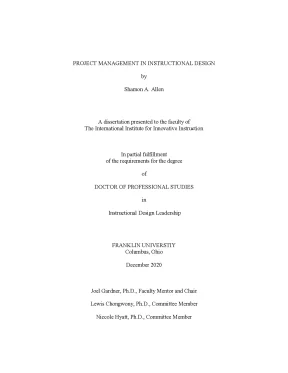
Tải xuống để đọc toàn bộPROJECT MANAGEMENT IN INSTRUCTIONAL DESIGN by Shamon A. Allen A dissertation presented to the faculty of The International Institute for Innovative Instruction In partial fulfillment of the requirements for the degree of DOCTOR OF PROFESSIONAL STUDIES in Instructional Design Leadership FRANKLIN UNIVERSTIY Columbus, Ohio December 2020 Joel Gardner, Ph., Faculty Mentor and Chair Lewis Chongwony, Ph., Committee Member Niccole Hyatt, Ph., Committee Member Franklin University This is to certify that the dissertation prepared by Shamon Allen “Project Management in Instructional Design” Has been approved by his committee as satisfactory completion of the dissertation requirements for the degree of Doctor of Professional Studies in Instructional Design Leadership 12/16/2020 Joel Gardner, Ph., Committee Chair Niccole Hyatt 12/16/2020 Niccole Hyatt (Dec 16, 2020 08:25 EST) Niccole Hyatt, Ph., Committee Member 12/16/2020 Lewis Chongwony, Ph., Committee Member Yi Yang Yi Yang (Dec 16, 2020 21:36 EST) 12/16/2020 Yi Yang, Ph., Program Chair, DPS 12/17/2020 Wendell Seaborne, Ph., Dean, Doctoral Studies ii Copyright Shamon A. Allen 2020 iii ABSTRACT Project Management in Instructional Design by Shamon A. Allen, Doctor of Professional Studies Franklin University, 2020 Major Professor: Dr.
Gardner Department: International Institute for Innovative Instruction This study surveyed 86 instructional design professionals based on a two-part approach to identify and validate the most critical instructional design project management competencies. First, a systematic review of instructional design project management literature was conducted to identify key project management competencies. Next, a survey instrument was created based on common themes identified during the systematic analysis of qualitative study results on instructional design project management competencies. Validation of the survey instrument was conducted by subject matter experts.
An online, cross-sectional survey invitation was sent to 62 colleges and universities with instructional design or related programs, ten instructional design or related LinkedIn groups, and one professional organization to post for alumni and professionals using convenience sampling. A sub-analysis was conducted to determine statistically significant differences in instructional design project management competencies based on role and industry. Globalization, technology, and most recently, the Covid-19 pandemic are causing disruptions to the nature of work and forcing organizations to quickly adapt to heightened competition and disruptions (Djankov & Saliola, 2018). To support employee learning and adaptability, many organizations employ instructional designers to create training, develop performance solutions, and lead learning initiatives.
The purpose of instructional design is to iv create learning experiences that improve learning and performance. Instructional designers use a systematic process to develop personalized learning experiences that support organizations' learning outcomes (Brown & Green, 2018; Dick et al. Instructional design is inherently complex (Dick et al., 2009), and it can be challenging to manage large, complex instructional design projects effectively (Dick et al. Preparing people in organizations with the right knowledge and skills to identify, respond, and overcome challenges faced by disruptions due to globalization, competition, or pandemics can help organizations adapt more quickly.
Project management is one field of knowledge that could provide insight into and strategies for managing instructional design effectively. Project management is the process of applying knowledge, skills, tools, and techniques to project activities to meet or exceed project requirements (Project Management Institute, 2017). Some research exists related to instructional design and project management (e., McDaniel & Liu, 1996; Williams van Rooij, 2011; Williams van Rooij, 2013; Kang & Ritzhaupt, 2015; York & Ertmer, 2016; Gardner, Bennett, Hyatt & Stoker, 2017; Gardner, Chongwony & Washington, 2018; Nall, 2019). However, there is limited research on which project management practices are most important in managing instructional design projects.
Further, some of the existing studies are qualitative studies with limited participants, making it difficult to generalize to multiple contexts. Therefore, the purpose of this study is to identify and validate the most critical project management competencies for instructional design projects. The main research question results included the six most crucial instructional design project management competencies in instructional design projects. There were no statistically significant differences in the most critical instructional design project management competencies based on role or industry.
Ethical behavior, keeping organized, being adaptable to change, and v demonstrating effective communication are critical instructional design project management competencies for the success of any project but can have a more significant impact when considered at onset and throughout the implementation and closing of instructional design projects. Keywords: Project management, instructional design vi ACKNOWLEDGEMENTS I am grateful to my family for supporting me and being committed to my success in this endeavor. Thank you for growing with me during this journey. I am grateful to my dissertation committee for their guidance on this journey of transformation.
Your expertise, mentorship, and kindness have continued to inspire me to bring out my best. I thank my committee chair, Dr. Joel Gardner, for his dedication to my success throughout this process. Your leadership and friendship have been invaluable experiences that I will always treasure.
I also want to acknowledge and thank all the teachers, mentors, friends, and colleagues who have influenced my path by presenting new information that led to earning a doctorate. I promise to continue to pay it forward. vii TABLE OF CONTENTS ABSTRACT. vi LIST OF TABLES.
xii LIST OF FIGURES. xv CHAPTER ONE: INTRODUCTION. 2 Project Management in Instructional Design. 3 Statement of the Problem.
4 Significance of the Study. 6 Definition of Key Terms. 6 Overview of Upcoming Chapters. 8 CHAPTER TWO: REVIEW OF LITERATURE.
10 Disruption and Competition. 12 Instructional Design Project Management. 15 Strengths and Weaknesses of Existing Studies. 22 Summary and Overview of Upcoming Chapter.
22 viii CHAPTER THREE: METHOD. 23 Measurement and Instrumentation. 30 Validity and Reliability Issues. 31 The Population of Study and Sampling Plan.
34 Power and Size Determination. 37 Data Collection Procedures. 37 Data Analysis Procedures. 38 CHAPTER FOUR: RESULTS.
41 Reliability of the Survey Instrument. 41 Data Screening and Cleaning. 45 Research Question Results. 49 Instructional Design Project Management Competency Comparison Based on Role.
54 Instructional Design Project Management Competency Comparison Based on Industry. 58 Qualitative Data Analysis. 60 Summary of the Chapter. 62 ix Overview of Upcoming Chapter.
63 CHAPTER FIVE: DISCUSSION. 64 Summary of Chapters 1-4. 64 Interpretation of Results. 65 Highest Ranked Instructional Design Project Management Competencies.
65 Instructional Design Project Management Categories. 69 Lowest Ranked Instructional Design Project Management Competencies. 70 Lowest-Ranked Instructional Design Project Management Categories. 72 Research Question 2: Roles.
74 Research Question 3: Industries. 82 Implications for Instructional Design Project Management Research. 82 Top Three Competencies Compared: Roles, Higher Education, and Overall Highest-Ranks. 83 Implications for Instructional Design Project Management Practice.
86 Suggestions for Further Research. 103 Appendix A: Research Studies Included in Systematic Review of Literature. 104 x Appendix B: 10 PMBOK Key Concepts. 108 Appendix C: PM in ID Questionnaire.
113 Appendix D: Professional Organization Invitation Email Template. 121 Appendix E: Instructional Design or Related Programs. 122 Appendix F: University Invitation Email Template. 125 Appendix G: Research Consent Form.
126 Appendix H: PM in ID Research Study Invitation - Professional Organizations with Link 128 Appendix I: PM in ID Research Study Modified Post – LinkedIn. 129 Appendix J: PM in ID Research Study Modified Post – LinkedIn Edited. 130 Appendix K: PM in ID Research Study - Universities with Link. 131 Appendix L: Reminder 1 - PM in ID Research Study Modified - LinkedIn.
132 Appendix M: Reminder 1 - PM in ID Research Study - Modified University. 133 Appendix N: Reminder 2 - PM in ID Research Study – Modified LinkedIn. 134 Appendix O: Reminder 2 - PM in ID Research Study-Universities and AECT Modified. 135 Appendix P: PM in ID Research Study Modified – Universities (no initial response).
136 Appendix Q: Full List of Instructional Design Project Management Competencies and Ratings by Category. 138 Appendix R: Additional Instructional Design Project Management Competencies. 142 Appendix S: Instructional Design Project Management Competencies for Instructional Designers. 145 Appendix T: Instructional Design Project Management Competencies for Managers of Instructional Designers.
147 xi Appendix U: Instructional Design Project Management Competencies for Project Managers of Instructional Design Programs. 149 Appendix V: Instructional Design Project Management Competencies for Business. 151 Appendix W: Instructional Design Project Management Competencies for Government. 153 Appendix X: Instructional Design Project Management Competencies for Higher Education.
156 Appendix Y: Instructional Design Project Management Competencies for Non-Profit. 158 Appendix Z: Instructional Design Project Management Competencies for Government/Non- Profit Combined. 161 xii LIST OF TABLES Table 3. 82 xv LIST OF FIGURES Figure 2.
85 CHAPTER ONE: INTRODUCTION Globalization, Competition, and Disruption Organizations face many challenges; some of these challenges require them to quickly adapt and make difficult changes. The speed at which organizations adapt to change is one organizational problem that can no longer be ignored (Denning, 2016). Globalization and technology have been fundamental drivers in the changing nature of work (Djankov & Saliola, 2018), and technology and the advancement of algorithms have increased the ability to scale on- demand quickly, heightening competition, and disrupting existing markets (Christensen, 2000; Denning, 2016; Djankov & Saliola, 2018; Gans, 2016). In the past, value chain inputs, such as fuel or the cost of capital, were the leading disruptions that organizations had to contend with (Rummler & Brache, 1995).
Now, the marketplace has expanded globally and changed the way we access many goods and services from a nine-to-five conventional business hour model to 24/7 on-demand availability. Rummler & Brache (1995) advise a holistic approach to assessing the needs of an organization’s performance goals, design, and management at the organization, process, and job/performer levels to sustain a competitive advantage. At a time when technology is a pervasive part of daily life, organizations in all sectors must employ practices that help them adapt more quickly to disruptions to remain competitive (Christensen, 2000; Friedman, Gerstein & Hertz, 2018; Ramesh, Mohan & Cao, 2012). Preparing people in organizations with the right knowledge and skills to identify, respond, and overcome challenges faced by disruptions due to globalization, competition, or pandemics can help organizations adapt more quickly.
Instructional Design Developing talent has continued to be a top priority for many organizations to maximize learning and efficiently manage workforce performance (Ho, 2015). To aid in supporting 2 employee learning and adaptation to change, many organizations employ instructional designers to create training and performance solutions, and to lead learning initiatives (Tracey & Morrison, 2012). Instructional design uses a systematic approach to assess learning needs and goals, and to diagnose and solve workplace problems (Dick, Carey, & Carey, 2009; Fortney & Yamagata- Lynch, 2013; Gagné & Merrill, 1990; Jonassen, 1997). Instructional design professionals create learning experiences that are intended to improve learning and performance, using a systematic process to develop personalized learning experiences that support learning outcomes (Brown & Green, 2018; Dick, Carey, & Carey, 2009).
Still, instructional design is inherently complex (Dick, Carey, & Carey, 2009), and managing large, complex instructional design projects can be difficult (Atkinson, Crawford, & Ward, 2006; Gardner, Bennett, Hyatt, & Stoker, 2017). In some cases, poor management of an instructional design project can result in a negative impact on learning outcomes if instructional design projects are not managed effectively (Dick, Carey, & Carey, 2009). As work competition increases, and work becomes more complex and changes quickly, organizations cannot afford to have failed instructional design projects because the consequences could result in failure to meet learning needs and adapt to change. Project Management Project management is one field of knowledge that could provide insight and strategies into how to manage instructional design projects effectively (Brill, Bishop, & Walker, 2006; Gardner, Bennett, Hyatt, & Stoker, 2017; Gardner, Chongwony, & Washington, 2018; Jovanović & Berić, 2018; Mustaro & Rossi, 2013; Tynan, Adlington, Stewart, Vale, Sims, & Shanahan, 2010; Williams van Rooij, 2013).
Nội dung được bảo vệ bản quyền — Tải xuống đầy đủ
Trích dẫn luận án này
Shamon A. Allen (2020). Shamon allen dissertation with signature page pdf [Luận án tiến sĩ, Franklin University]. LuanAn.net. https://luanan.net/khoa-hoc-giao-duc/shamon-allen-dissertation-with-signature-page-pdf
Câu hỏi thường gặp
Luận án "Shamon allen dissertation with signature page pdf" nghiên cứu về vấn đề gì?
Luận văn "Shamon allen dissertation" bao gồm bản thảo chính với trang ký tên.
Luận án "Shamon allen dissertation with signature page pdf" được bảo vệ tại trường nào?
Luận án này được bảo vệ tại Franklin University. Năm bảo vệ: 2020.
Luận án "Shamon allen dissertation with signature page pdf" thuộc chuyên ngành gì?
Luận án "Shamon allen dissertation with signature page pdf" thuộc chuyên ngành Instructional Design Leadership. Danh mục: Khoa Học Giáo Dục.
Luận án "Shamon allen dissertation with signature page pdf" có bao nhiêu trang?
Luận án "Shamon allen dissertation with signature page pdf" có 178 trang. Bạn có thể xem trước một phần tài liệu ngay trên trang web trước khi tải về.
Cách tải luận án "Shamon allen dissertation with signature page pdf" về máy như thế nào?
Để tải luận án về máy, bạn nhấn nút "Tải xuống ngay" trên trang này, sau đó hoàn tất thanh toán phí lưu trữ. File sẽ được tải xuống ngay sau khi thanh toán thành công. Hỗ trợ qua Zalo: 0559 297 239.