Radcliffe dissertation victoria radcliffe
Luận văn của Victoria Radcliffe: Khám phá các chủ đề nghiên cứu, phương pháp luận và kết quả đột phá từ công trình của Radcliffe.
The University of Leeds
Disability and Gender
Luan An
Luận văn thạc sĩ
Năm xuất bản
Số trang
112
Thời gian đọc
17 phút
Lượt xem
0
Lượt tải
0
Phí lưu trữ
40 Point
Tổng quan nhanh
- Chủ đề:
- 1. Victoria Radcliffe Dissertation: Disabled Mothers' Rights
- Số trang:
- 112 trang
- Trường:
- The University of Leeds
- Chuyên ngành:
- Disability and Gender
- Tác giả:
- Victoria Radcliffe
- Năm:
- 2008
Tóm tắt nội dung luận án
I. Victoria Radcliffe Dissertation Disabled Mothers Rights
This academic writing presents Victoria Radcliffe's comprehensive Masters of Arts dissertation. The study, submitted to The University of Leeds, focuses on "Being Brave": Disabled Women and Motherhood. It explores the complex relationship between women with impairments and societal perceptions of motherhood in Western society. Radcliffe's dissertation meticulously examines the historical and social factors contributing to the uneasy association surrounding disabled mothers. This scholarly publication highlights crucial issues of discrimination and human rights for women with disabilities. The research topic delves into often-overlooked aspects of maternal autonomy and societal inclusion. This rigorous academic work contributes significantly to the fields of disability studies and gender studies. The document, dated September 1st, 2008, offers a foundational understanding of the challenges faced by disabled women seeking to become mothers. It provides invaluable insight into the intersection of disability, gender, and societal expectations.
1.1. Victoria Radcliffe s Academic Writing on Motherhood
Victoria Radcliffe's dissertation serves as a pivotal piece of academic writing. It thoroughly investigates the experiences of disabled women in their journey to motherhood. The work acknowledges the lack of visibility for disabled parents within traditional parenting literature and feminist discourse. Radcliffe's research topic addresses this critical gap directly. The study emphasizes the importance of recognizing the parenting capabilities of women with impairments. This rigorous inquiry contributes to the broader discussion on human rights and social justice. The findings challenge prevailing societal norms and stereotypes. The dissertation exemplifies dedicated scholarly publication aimed at social change. It provides a strong basis for further academic exploration and advocacy.
1.2. Unpacking Disability Rights in Scholarly Publication
The dissertation places the rights of disabled women within an international human rights framework. It references the UN Convention on the Elimination of All Forms of Discrimination against Women (CEDAW). It also cites the UN Convention on the Rights of Persons with Disabilities (CRPWD). These conventions assert the right of women to decide on childbearing and the right of disabled people to become parents. This scholarly publication argues that the ability to parent is a key social marker of adult status. However, disabled mothers often remain invisible or face significant barriers. Radcliffe's academic writing illuminates these discrepancies. It calls for greater recognition and protection of reproductive and parental rights for disabled individuals. The dissertation performs a vital function in advancing discourse on these fundamental rights.
II. Exploring Disability and Motherhood in Western Society
Victoria Radcliffe's dissertation critically examines the prevailing societal attitudes towards disabled mothers in Western contexts. The research topic probes why motherhood and women with impairments remain an "uneasy association." It suggests that negative perceptions are deeply embedded in cultural narratives. This scholarly publication identifies how stereotypes impact the lives of disabled women. The literature review explores the historical evolution of these views. It highlights the influence of various social movements and theories. Radcliffe’s academic writing exposes systemic biases. The study underscores the need for a paradigm shift in how society views and supports disabled mothers. This extensive analysis forms a crucial part of the overall doctoral study framework, even for a Master's degree, demonstrating the depth of inquiry.
2.1. The Uneasy Association Women with Impairments
The dissertation’s core research topic is the discomfort surrounding disabled women as mothers. It investigates how society perceives women with impairments. Stereotypes often depict them as asexual, dependent, or incompetent. These assumptions create negative attitudes towards their capacity for motherhood. This academic writing argues such views enforce a taboo. The study seeks to deconstruct these harmful misconceptions. It reveals how societal constructs rather than individual capabilities define the problem. Radcliffe’s scholarly publication challenges these deep-seated biases directly. The work advocates for a more inclusive understanding of motherhood. It highlights the need to dismantle discriminatory frameworks.
2.2. Historical Context Feminist Movements Disability Activism
A significant portion of the dissertation involves an in-depth literature review. This review traces the evolution of the feminist movement. It also examines the development of disability activism. The analysis scrutinizes the place of women with impairments within both movements. Radcliffe’s academic writing reveals how disabled women often found themselves marginalized in these historical struggles. The study explains how societal views on disability have shaped the treatment of disabled mothers. This comprehensive overview provides a crucial context for understanding current challenges. It forms a key part of this important scholarly publication, bridging historical context with contemporary issues.
2.3. Eugenics and Stereotypes Social Perceptions
The dissertation reviews the pervasive influence of eugenic theories. It shows how these theories have historically impacted perceptions of disabled individuals, especially women. Such ideologies fostered beliefs about genetic fitness and reproductive control. The study connects eugenic thinking to enduring stereotypes. These stereotypes perpetuate negative attitudes towards disabled women’s maternal abilities. They reinforce the notion that disabled individuals should not reproduce. Radcliffe’s academic writing argues that these historical influences continue to manifest as structural barriers and attitudinal discrimination today. The analysis of these elements is central to the dissertation's robust exploration of its research topic, making it a valuable scholarly publication.
III. Methodology Victoria Radcliffe s Research Approach
Victoria Radcliffe's dissertation employs a clear and ethical research methodology. The study adopts an inductive approach, grounded in the social model of disability. This framework prioritizes understanding societal barriers over individual impairments. The academic writing outlines the careful design of the empirical research dimension. It involved a small, focused group of participants. This approach allowed for an in-depth exploration of lived experiences. Radcliffe’s commitment to participant voices is evident throughout. The methodology ensures a rich qualitative data collection process. This meticulous planning is typical of high-quality doctoral study, even for a master's thesis, providing rigorous insights.
3.1. Inductive Study with the Social Model of Disability
The dissertation builds its argument on the social model of disability. This model posits that disability arises from societal barriers, not individual limitations. Radcliffe's research uses an inductive approach. This means drawing general conclusions from specific observations. The study explores the experiences of disabled mothers without pre-imposed hypotheses. This allows for emergent themes and insights. The academic writing emphasizes the importance of listening to the voices of disabled women. It critically analyzes how social structures create disabling environments for mothers. This methodological choice underpins the entire scholarly publication, shaping its findings.
3.2. Empirical Research Participants Lived Experiences
The empirical dimension of the dissertation involved a small research group. Seven women with impairments participated in the study. Data collection utilized questionnaires and telephone interviews. This approach gathered personal narratives and experiences. The study drew parallels between existing literature and participants' lived realities. This method allowed for a nuanced understanding of discrimination. It explored the extent to which negative attitudes affect their lives. This direct engagement with disabled mothers forms a powerful component of Victoria Radcliffe's academic writing. The rich data provides compelling evidence for the study’s conclusions, reflecting the depth of thorough doctoral study.
IV. Key Findings Discrimination Against Disabled Women
Victoria Radcliffe's dissertation presents significant findings regarding discrimination faced by disabled women. The study revealed consistent patterns of negative attitudes. Participants encountered various structural barriers in their journeys to motherhood. The research underscores the pervasive nature of these challenges in Western society. While the study's scope was small, its qualitative depth offers crucial insights. It provides concrete examples of how societal perceptions impact individual lives. The academic writing clearly articulates the detrimental effects of such discrimination. This scholarly publication serves as a vital resource for understanding the realities of disabled mothers. It reinforces the urgent need for social change and policy reform in this critical area, reflecting robust doctoral study analysis.
4.1. Negative Attitudes and Structural Barriers Identified
The study found that all participants encountered attitudes making them uncomfortable. These attitudes questioned their pregnancies and their capabilities as mothers. Their situations were compounded by additional structural barriers. These barriers included limited access to information, inadequate support systems, and prejudicial healthcare interactions. Radcliffe's academic writing meticulously documents these challenges. The dissertation highlights the systemic nature of discrimination. It reveals how social norms and physical environments conspire against disabled women. This section of the scholarly publication provides compelling evidence of pervasive societal issues. The findings are clear and impactful, forming a key part of this research topic.
4.2. Impact on Pregnancy and Motherhood Abilities
The dissertation details how negative societal attitudes affect disabled women's reproductive journeys. Participants felt judged regarding their ability to be "effective" mothers. This judgment stemmed from a lack of understanding and pervasive stereotypes. The study demonstrated the psychological and practical burdens placed on these women. It showed how discrimination impacts their confidence and access to necessary resources. Radcliffe’s academic writing emphasizes the disabling effects of such attitudes. The research provides a sobering look at the daily realities faced by disabled mothers. This scholarly publication makes a strong case for increased awareness and support. The insights gained are critical for advancing discussions around parental rights and inclusive practices.
V. Future Research and Impact of Radcliffe s Study
Victoria Radcliffe's dissertation lays crucial groundwork for future academic inquiry. The study identifies several areas requiring further investigation. It highlights the continued correlation between negative societal attitudes and structural barriers. This scholarly publication offers a compelling call to action for researchers and policymakers. The findings underscore the enduring impact of discrimination on disabled mothers. Radcliffe’s academic writing contributes significantly to the body of knowledge on disability and gender. The dissertation, a rigorous piece of doctoral study, serves as an essential reference point. Its insights inform ongoing disability activism and advocacy efforts. The work encourages a more inclusive and equitable society for all mothers. This research topic remains highly relevant for contemporary discussions on human rights.
5.1. Insights for Ongoing Disability Activism
The dissertation’s findings offer invaluable insights for disability activism. It provides concrete evidence of discrimination against disabled mothers. Activist groups can utilize this scholarly publication to advocate for policy changes. The study reinforces the need to challenge stereotypes and dismantle structural barriers. Radcliffe’s academic writing empowers disabled women by validating their experiences. It calls for greater recognition of their rights as parents. The work supports campaigns for improved accessibility, inclusive healthcare, and comprehensive support systems. The dissertation serves as a powerful tool for promoting social justice within the disability community. It fuels ongoing efforts for systemic reform, making the research topic highly pertinent for advocacy.
5.2. Advancing Scholarly Discussion on Maternal Rights
Victoria Radcliffe’s dissertation significantly advances scholarly discussion on maternal rights. It contributes a unique perspective on the intersection of disability and motherhood. The academic writing prompts further exploration into specific correlations between attitudes and daily barriers. Future research can expand on this foundation, utilizing more extensive samples. This scholarly publication encourages interdisciplinary studies involving sociology, psychology, and public policy. The work reinforces the importance of qualitative research in understanding complex social issues. The dissertation, a robust example of academic writing and thorough doctoral study, inspires continued inquiry into parental autonomy and inclusion for disabled individuals globally. Its impact resonates across various academic and social spheres.
Mục lục chi tiết luận án
Tải xuống file đầy đủ để xem toàn bộ nội dung
Tải đầy đủ (112 trang)Trích đoạn nội dung luận án
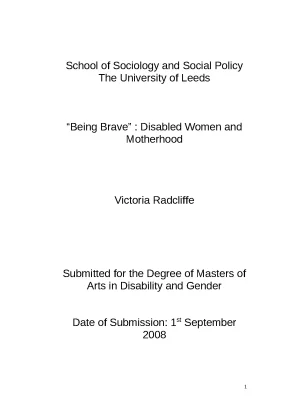
Tải xuống để đọc toàn bộSchool of Sociology and Social Policy The University of Leeds “Being Brave” : Disabled Women and Motherhood Victoria Radcliffe Submitted for the Degree of Masters of Arts in Disability and Gender Date of Submission: 1st September 2008 1 Acknowledgements I wish to sincerely thank everyone that has made this dissertation possible. Particular heartfelt thanks are due to: The research participants who willingly shared their thoughts and experiences with me. I have really valued the insight, enthusiasm and time they have contributed to this project. Angharad Beckett whose continual encouragement, support and advice have been invaluable.
I have really appreciated it. The Isle of Man government for their financial assistance. And finally my mother and Thomas for their encouragement and unwavering support. 2 Abstract This dissertation seeks to explore the reasons why motherhood and women with impairments remains an uneasy association in Western society.
Firstly an in depth literature study examines the feminist movement, disability activism and the place of women with impairments within both in order to explain how women with impairments are viewed in society. The focus then shifts to look at stereotypes and commonly held assumptions surrounding women with impairments such as their perceived asexuality, dependence and incompetence and how this “creates” negative attitudes towards, and enforces the taboo of, women with impairments as mothers. The influence and impact of eugenic theories will also be reviewed in relation to this subject. A commitment to the social model of disability provides the basis for an inductive approach to the research in this study.
A small research group of seven women with impairments make up the empirical research dimension of this dissertation through questionnaires and telephone interviews. Parallels are drawn between current literature regarding this topic and the lived experience of participants to examine if mothers with impairments are discriminated against and if so the extent to which this affects their lives. This study cannot draw conclusions representative of society as a whole; however, it is evident that of participants studied all encountered attitudes that made them feel uncomfortable about their pregnancies and their abilities to become “effective” mothers. Their “situations” were compounded by additional structural barriers they encountered.
This small study has raised issues for further study surrounding the correlation between negative societal attitudes towards mothers with impairments and the every day structural barriers mothers with impairments encounter. The continued influence of such attitudes pervades society and has disabling effects. 3 Table of Contents “Being Brave” : Disabled Women and Motherhood Acknowledgments Abstract Contents Chapter 1 Introduction………………………….…5 Chapter 2 Disabled Mothers in Context…….…18 Chapter 3 Research Explained……………….48 Chapter 4 Barriers to Motherhood……….88 Appendix 1 Internet Posting………………….95 Appendix 2 An Example Questionnaire…….98 Appendix 3 Extract of a Transcript………….103 Appendix 4 Information & Consent Form….108 4 Chapter One Introduction The UN Convention on the Elimination of All Forms of Discrimination against Women (CEDAW) came into force in September 1981. The convention protects women against all forms of discrimination and states that organizations and authorities must ensure that all women are treated on an equal basis with men (CEDAW).
Section E of Article 16 proclaims that women have the right to decide how many children they wish to bear and to the necessary information and education to assist them in exercising their rights as potential mothers. Twenty-six years later the UN Convention on the Rights of Persons with Disabilities was opened for signature. The Convention asserts disabled people’s right to become parents. It declares that information on reproduction and family planning are to be provided to disabled individuals together with the means required to exercise this right (CRPWD).
Broadly speaking this Convention declares persons with disabilities’ right to life: the most basic of all human rights (Clements & Read, 2008). 5 Defining how an individual leads a full and enriching life is a complex issue. Priestley believes an individual’s ability to parent is a key cultural and social marker of adult status in Western Society (Priestley, 2003). Similarly Wates believes the social role of parent eases individuals into mainstream adult life (Wates, 1997).
While child rearing can be considered an integral element of adult life and a Human Right, disabled parents and more specifically disabled mothers, have until relatively recently remained invisible in parenting literature, in disability activism issues and feminist writings (Campion, 1995; Mintz, 2007; Morris, 1996; Olsen & Clarke, 2003; Prilleltensky, 2003; Wates, 1997). This dissertation seeks to explore whether disabled women face attitudinal and structural barriers as they contemplate motherhood, throughout their pregnancy and during the post partum period. This study includes an empirical aspect which aims to examine the voices of a small number of women with impairments regarding their experiences of motherhood and pregnancy. The aim of this research is to compare participants experiences with the issues covered in disability and feminist literature, and, to explore the reasons why motherhood among women with 6 impairments has historically been a taboo subject and if it indeed remains so today in Western society.
The main objectives of the research are to: Examine the historical reasons for the attitudinal barriers which women with impairments and mothers with impairments face and the disabling effects of such. Highlight the lived experiences of a small group of mothers with impairments and compare it to existing literature that discusses this topic. Explore if, in a social climate that promotes human rights and equality, women with impairments are still assumed incapable of motherhood, and if so, why is this the case? Defining Disability It is necessary to define the difference between disability and impairment and the definitions used throughout this study. Focusing on impairment and “what the body cannot do” defines disability through one’s pathology.
This “medical model” of disability advocates a “cure or care” philosophy which is individualistic, attributing disability to the 7 body’s inability to function in a “normal” way. Medical theories and practices are thus applied to “treat” disability. Patronizing notions of tragedy and sympathy are used to explain living one’s life as a disabled person. As Barnes states, ‘In short, disability amounts to a “personal tragedy” and a social problem or a “burden” for the rest of society.’ (Barnes & Mercer, 2003, pp.
1) The social model of disability however, defines the disadvantage and exclusion experienced by individuals with impairments as a result of a segregating society which does not account for individuals with impairments and thus excludes them from the “mainstream”; it is a social issue (UPIAS, 1976 cited in Barnes & Mercer, 2003). Thus, 'Disability is the restriction imposed on top of our impairments by the way our society is formed' (Sheldon, 2004, pp. 69) 8 Impairment refers to the functional limitations individuals experience (Barnes & Mercer, 2003). This dissertation is written from a social model perspective where disability is defined in social terms and impairment as a functional limitation.
Setting the Scene Historically the role of women has been to bear children. Woman’s ability to create life justified her purpose on earth; her reproductive rights however, were controlled by men (Sullerot, 1971). In the ancient world women’s sexuality was controlled by men. Promiscuity and adultery were punishable by death (Sullerot, 1971).
Myths and beliefs were also used to explain female sexuality and reproduction, assigning certain character traits to women on account of biological difference such as, woman as overly emotional, fragile and irrational. Women were subject to the unpredictable and mysterious womb leaving them hysterical, weak, vulnerable and incapable of controlling their own lives (Greer, 2006). As women were irrational and uncontrollable, patriarchal rule was justified and necessary to maintain social order. 9 Traditionally understood as a negative trait, feminism now celebrates woman’s connection with nature and her ability to use emotion to understand the world.
Notions of woman as “dependant” and “weak” have been challenged through feminism, and the concept of motherhood has been reclaimed through exploring the miraculous ability a woman has to nurture life. Feminism has however, come under increasing scrutiny for its initial categorization of women as one homogeneous group. Ethnicity, sexuality, class and impairment were not originally differentiated within feminism. Some women were thus marginalized within the women’s movement itself.
As women with impairments were still perceived as weak and dependant they were largely excluded from feminist literature. Their “difference” also disrupts the notion that all women are united and wish for liberation in the same way. This tension within the feminist movement continues to be confronted by women with impairments writing about their own experiences. The Impact of a Stereotype Notions of difference create stereotypes.
The disabling consequences of attitudes towards individuals with 10 impairments as “different”, “lacking” and “without” has a long history. Traditionally myths and superstitions have identified individuals with impairments as sinister and pathetic (Barnes, 1991). Impairment has been portrayed through the media as evil, sinister, the result of sin and association with the devil (Barnes, 1992). Individuals with impairments are often subject to violence, victimization and are the subject of ridicule (Barnes, 1992).
There is an extensive list of such stereotypes. In relation to women with impairments some are perhaps more relevant than others. Impaired bodies are seen as deficient and unable to function “properly” (Barnes & Mercer, 2003). This perceived physical “malfunction” influences societal perceptions of the emotional capacity of individuals with impairments to form physical relationships.
The rare association of sexuality and “disability” is often related to men who fall prey to two stereotypes: assumed impotence, or, sexually starved and degenerate (Barnes, 1992; Sanders, 2007). In contrast women with impairments are often depicted as asexual; without sexual drives or desires. The assumption is made that women with impairments will not and do not experience sex. 11 As individuals with impairments are seen as incompetent and “burdensome” it is understood that they will not form intimate relationships.
This is perpetuated through charity advertising and telethons that focus on the “doom and despair” of impairment (Barnes, 1992). Thus, impairment becomes synonymous with dependency, a trait that does not sit well with “would be” mothers. In contrast however, individuals with impairments can also be portrayed as exceptional or “super human”. Achievements become over achievements and are met with excessive amounts of praise (Barnes, 1992).
“Overcoming one's disability” is used to “celebrate” the ability of individuals with impairments but actually perpetuates the stereotype of difference. “Disabled mothers” can fall prey to the “super cripple” stereotype when they bear children “against all odds.” It is attitudes such as these that have their origins in history but continue to linger today creating further disabling consequences for individuals with impairments. Impairment Equals Incompetence Although there is much written on the social model of disability, the medical model continues to influence literature 12 and societal attitudes. Historically the small amount of literature surrounding mothers with impairments has centered on individual impairment and the assumed negative impact, and risk this has on children (Olsen & Clarke, 2003).
Much focus is given to the early stages of a child’s life and the need for practical and physical care from “competent” mothers. The ability to perform tasks unaided such as nappy changing, lifting and feeding become the bench mark of a successful mother. The perceived inability of mothers with impairments to fulfill such tasks independently provides the basis for their scrutiny by professionals. Thus, women with impairments have historically been discouraged from contemplating motherhood, advised to abort babies or encouraged to be sterilized (Asch & Fine, 1998).
The labeling of individuals with impairments as incompetent and dependant creates a category of “other” where individuals who deviate from society’s “norms” are grouped together at the margins of “acceptable society”. The Influence of Eugenic Principles It is not only the “fear” that mothers with impairments are unable to cope with the demands of motherhood that 13 places them on the societal margin. The notion that babies with impairments are born from women with impairments influences attempts to deter them from bearing children. This view echoes theories of eugenics where the fittest and strongest individuals are encouraged to reproduce a healthy and strong nation.
Nội dung được bảo vệ bản quyền — Tải xuống đầy đủ
Trích dẫn luận án này
Victoria Radcliffe (2008). Radcliffe dissertation victoria radcliffe [Luận án tiến sĩ, The University of Leeds]. LuanAn.net. https://luanan.net/khoa-hoc-giao-duc/radcliffe-dissertation-victoria-radcliffe
Câu hỏi thường gặp
Luận án "Radcliffe dissertation victoria radcliffe" nghiên cứu về vấn đề gì?
Luận văn của Victoria Radcliffe: Khám phá các chủ đề nghiên cứu, phương pháp luận và kết quả đột phá từ công trình của Radcliffe.
Luận án "Radcliffe dissertation victoria radcliffe" được bảo vệ tại trường nào?
Luận án này được bảo vệ tại The University of Leeds. Năm bảo vệ: 2008.
Luận án "Radcliffe dissertation victoria radcliffe" thuộc chuyên ngành gì?
Luận án "Radcliffe dissertation victoria radcliffe" thuộc chuyên ngành Disability and Gender. Danh mục: Khoa Học Giáo Dục.
Luận án "Radcliffe dissertation victoria radcliffe" có bao nhiêu trang?
Luận án "Radcliffe dissertation victoria radcliffe" có 112 trang. Bạn có thể xem trước một phần tài liệu ngay trên trang web trước khi tải về.
Cách tải luận án "Radcliffe dissertation victoria radcliffe" về máy như thế nào?
Để tải luận án về máy, bạn nhấn nút "Tải xuống ngay" trên trang này, sau đó hoàn tất thanh toán phí lưu trữ. File sẽ được tải xuống ngay sau khi thanh toán thành công. Hỗ trợ qua Zalo: 0559 297 239.