Luận án tiến sĩ: Texture- and structure-based image representation with applications to image retrieval and compression
Luận án tiến sĩ này khám phá các phương pháp biểu diễn ảnh dựa trên texture và cấu trúc. Ứng dụng đột phá trong truy xuất và nén ảnh hiệu quả.
Luan An
luận án
Năm xuất bản
Số trang
209
Thời gian đọc
32 phút
Lượt xem
0
Lượt tải
0
Phí lưu trữ
50 Point
Tổng quan nhanh
- Chủ đề:
- 1. Phân tích hình ảnh dựa trên cấu trúc và kết cấu
- Số trang:
- 209 trang
- Trường:
- Boston University
- Chuyên ngành:
- Electrical and Computer Engineering
- Tác giả:
- Zhihua He
- Năm:
- 2007
Tóm tắt nội dung luận án
I. Phân tích hình ảnh dựa trên cấu trúc và kết cấu
Luận án này trình bày các phương pháp phân tích hình ảnh tập trung vào hai yếu tố cơ bản: cấu trúc và kết cấu. Việc thể hiện hiệu quả những đặc điểm này giúp nâng cao khả năng xử lý hình ảnh. Những phương pháp này không chỉ cải thiện việc nén hình ảnh mà còn tối ưu hóa việc truy xuất hình ảnh từ cơ sở dữ liệu.
1.1. Ý nghĩa của hình ảnh trong xử lý dữ liệu
Hình ảnh là một phần quan trọng trong nhiều ứng dụng, từ nhận diện hình ảnh đến lưu trữ dữ liệu. Việc phát triển phương pháp mới giúp tiết kiệm không gian lưu trữ và tăng tốc độ truy xuất hình ảnh.
1.2. Tầm quan trọng của kết cấu và cấu trúc
Cấu trúc và kết cấu của hình ảnh cung cấp thông tin cần thiết để nhận diện và phân loại. Phân tích chúng cho phép phát hiện các mẫu và đặc điểm nổi bật.
II. Các phương pháp nén và truy xuất hình ảnh hiệu quả
Luận án giới thiệu ba phương pháp chính để mô tả và đại diện cho các đặc điểm của hình ảnh. Những phương pháp này được thiết kế để sử dụng ít tính năng nhất có thể, nhằm giảm dung lượng và thời gian xử lý.
2.1. Phương pháp Markov ẩn
Phương pháp đầu tiên sử dụng mô hình Markov ẩn để mô tả kết cấu hình ảnh. Nó áp dụng các biến đổi multi-scale contourlet và steerable-pyramid để tách biệt các cạnh trong hình ảnh.
2.2. Ứng dụng trong truy xuất hình ảnh
Các phương pháp này được áp dụng cho việc truy xuất hình ảnh từ cơ sở dữ liệu. Chúng cho phép tìm kiếm hình ảnh giống nhau dựa trên kết cấu, từ đó nâng cao trải nghiệm người dùng.
III. So sánh hiệu suất với các phương pháp khác
Hiệu suất của các phương pháp được so sánh với nhiều kỹ thuật nén và truy xuất hình ảnh khác. Kết quả cho thấy những phương pháp mới mang lại hiệu quả vượt trội trong nhiều tình huống khác nhau.
3.1. Đánh giá các phương pháp nén
Phân tích cho thấy rằng những phương pháp mới giúp giảm dung lượng nén mà không làm giảm chất lượng hình ảnh. Điều này rất quan trọng trong các ứng dụng yêu cầu lưu trữ lớn.
3.2. Truy xuất hình ảnh nhanh chóng hơn
Khi so sánh tốc độ truy xuất, các phương pháp mới cho thấy khả năng tìm kiếm nhanh hơn, giúp tiết kiệm thời gian trong các quy trình làm việc.
IV. Tương lai của nghiên cứu hình ảnh
Luận án mở ra hướng nghiên cứu mới cho việc phát triển các phương pháp hình ảnh trong tương lai. Cần tiếp tục cải tiến để đáp ứng nhu cầu ngày càng cao về chất lượng và hiệu suất.
4.1. Nhu cầu về công nghệ mới
Công nghệ xử lý hình ảnh đang phát triển nhanh chóng. Nghiên cứu cần tập trung vào việc tích hợp trí tuệ nhân tạo để cải thiện độ chính xác và tốc độ.
4.2. Ứng dụng thực tiễn rộng rãi
Các phương pháp nén và truy xuất hình ảnh sẽ được áp dụng trong nhiều lĩnh vực như y tế, an ninh và giải trí, mở ra cơ hội mới cho ngành công nghiệp.
Mục lục chi tiết luận án
Tải xuống file đầy đủ để xem toàn bộ nội dung
Tải đầy đủ (209 trang)Nội dung chính
Tổng quan về luận án
Luận án tiến sĩ này khai thác lĩnh vực then chốt của biểu diễn hình ảnh hiệu quả, một nền tảng không thể thiếu cho các thuật toán xử lý hình ảnh hiện đại. Trong bối cảnh khoa học ngày càng phát triển của trí tuệ nhân tạo và học máy ứng dụng vào thị giác máy tính, việc thiết kế các phương pháp biểu diễn hình ảnh sử dụng số lượng nhỏ đặc trưng nhưng vẫn đảm bảo tính chính xác và hiệu quả là một thách thức lớn. Nghiên cứu này đặt mình vào vị trí tiên phong trong việc giải quyết thách thức này, tập trung vào hai đặc điểm phân biệt quan trọng của hình ảnh: kết cấu (texture) và cấu trúc (structure).
Research gap cụ thể mà luận án hướng tới giải quyết là sự thiếu hụt các phương pháp biểu diễn đa chiều, đa tỷ lệ có khả năng cô đọng thông tin kết cấu và cấu trúc một cách tối ưu, đặc biệt là trong các ứng dụng như nén và truy xuất hình ảnh. Các phương pháp biểu diễn kết cấu truyền thống, như phân tích histogram, thường bỏ qua thông tin hình học quan trọng, dẫn đến hiệu suất truy xuất kém trong các cơ sở dữ liệu lớn (Wang et al., 2003). Trong khi đó, các phương pháp dựa trên mô hình Markov ẩn (HMMs) trong miền wavelet hoặc contourlet đã được phát triển (Crouse et al., 1998; Po, 2003), nhưng chúng thường chưa khám phá toàn diện và hệ thống các loại phụ thuộc nội-băng tần (in-band), liên-băng tần (cross-band) và liên-tỷ lệ (cross-scale), cùng với việc tích hợp thông tin màu sắc một cách hiệu quả để tạo ra một biểu diễn kết cấu mạnh mẽ và quay-bất biến. Đối với biểu diễn cấu trúc, các phương pháp hiện có thường gặp hạn chế như sự mất mát thông tin không gian (ví dụ: biến đổi Hough, Tipwai và Madarasmi, 2002) hoặc sự phụ thuộc nặng nề vào phân đoạn hình ảnh chính xác (Long et al.), vốn là một vấn đề nghiên cứu phức tạp chưa được giải quyết triệt để. Hơn nữa, mặc dù các biến đổi như beamlet (Donoho và Huo, 2002) đã cung cấp khung làm việc hiệu quả cho các phân đoạn đường thẳng, một hệ thống biểu diễn đường cong đa tỷ lệ, phân cấp và hiệu quả về mặt lý thuyết vẫn còn là một khoảng trống lớn.
Để giải quyết những khoảng trống này, luận án đề xuất ba phương pháp đột phá:
- Mô hình HMM định hướng dựa trên contourlet để mô tả kết cấu hình ảnh.
- Phương pháp biểu diễn cấu trúc dựa trên phép chiếu định hướng (DP-SR) cho các cấu trúc hình ảnh lớn, tức là các cạnh quan trọng.
- Khung biểu diễn đường cong đa tỷ lệ mới, chordlet, được xây dựng như một phần mở rộng của biến đổi beamlet nổi tiếng.
Các câu hỏi nghiên cứu và giả thuyết chính của luận án bao gồm:
- RQ1: Làm thế nào để các mô hình HMM định hướng dựa trên biến đổi contourlet, khai thác các phụ thuộc nội-băng tần, liên-tỷ lệ và liên-băng tần, có thể cung cấp biểu diễn kết cấu hiệu quả và chính xác hơn so với các phương pháp HMM hiện có?
- H1: Việc tích hợp các phụ thuộc định hướng nội-băng tần và liên-tỷ lệ, cùng với thông tin màu sắc, trong các HMM dựa trên contourlet sẽ cải thiện đáng kể tỷ lệ truy xuất kết cấu so với các HMM chỉ xét các phụ thuộc đơn lẻ hoặc dựa trên thang độ xám (Po, 2003).
- RQ2: Liệu một phương pháp dựa trên phép chiếu định hướng và mô hình hóa các profile chiếu có thể tạo ra một biểu diễn cấu trúc hình ảnh cô đọng và mạnh mẽ cho các ứng dụng truy xuất dựa trên phác thảo, vượt trội hơn các phương pháp dựa trên histogram không gian?
- H2: Khung DP-SR, kết hợp biến đổi contourlet với mô hình hóa profile (tuyến tính từng phần hoặc hỗn hợp Gaussian), sẽ đạt được tỷ lệ truy xuất dựa trên phác thảo cao hơn đáng kể so với các phương pháp dựa trên histogram không gian hiện hành.
- RQ3: Biến đổi chordlet, như một phần mở rộng của beamlet cho đường cong, có thể cung cấp một biểu diễn đường cong đa tỷ lệ, phân cấp hiệu quả hơn về mặt lý thuyết và thực tiễn cho nén và biểu diễn cấu trúc hình ảnh không?
- H3: Biến đổi chordlet sẽ chứng minh hiệu quả biểu diễn cao hơn (ít bit hơn cho cùng mức độ méo mó) so với biến đổi beamlet và các hệ thống mã hóa đường cong khác, đồng thời cho phép một thuật toán biến đổi nhanh.
Khung lý thuyết của luận án được xây dựng dựa trên sự tổng hợp và mở rộng các lý thuyết cốt lõi trong xử lý tín hiệu và thị giác máy tính. Cụ thể, nó dựa trên lý thuyết biến đổi đa tỷ lệ (multiscale transform theory), với các biến đổi Gaussian pyramid (Burt và Adelson, 1983), Laplacian pyramid, Wavelet transform (Mallat, 1999), Steerable pyramid (Freeman và Adelson, 1991; Simoncelli et al., 1992), Ridgelet và Curvelet (Candes và Donoho, 1999a) làm nền tảng. Đặc biệt, biến đổi Contourlet (Do và Vetterli, 2003) đóng vai trò trung tâm trong cả biểu diễn kết cấu và cấu trúc. Đối với biểu diễn kết cấu, lý thuyết mô hình Markov ẩn (HMMs) (Rabiner, 1989) được sử dụng để nắm bắt các phụ thuộc thống kê. Đối với biểu diễn cấu trúc đường thẳng, lý thuyết Beamlet (Donoho và Huo, 2002) cung cấp nền tảng, và luận án phát triển Chordlet framework như một mở rộng lý thuyết cho đường cong.
Đóng góp đột phá của luận án được định lượng một cách rõ ràng:
- Hiệu suất truy xuất kết cấu: Phương pháp HMM dựa trên contourlet đề xuất đạt "khoảng 10% tỷ lệ truy xuất cao hơn so với các phương pháp tương đương" với cùng chi phí tính toán, và có thể đạt "tỷ lệ truy xuất tương tự khi sử dụng ít hơn khoảng một phần ba đặc trưng" (Abstract, trang iv).
- Hiệu suất truy xuất dựa trên phác thảo: Phương pháp biểu diễn cấu trúc DP-SR thể hiện "tỷ lệ truy xuất tăng 138% so với phương pháp dựa trên histogram không gian hiện hành" (Abstract, trang iv).
- Hiệu suất nén đường cong: Hệ thống mã hóa dựa trên chordlet đạt được "tăng cường nén với độ méo thấp hơn khi so sánh với hai phương pháp nổi tiếng" (Abstract, trang v), và chứng minh hiệu quả biểu diễn lý thuyết vượt trội so với beamlet (Section 5.3).
Phạm vi của nghiên cứu bao gồm việc phát triển các khung biểu diễn hình ảnh, triển khai các thuật toán, và đánh giá hiệu suất của chúng trên các bộ dữ liệu tiêu chuẩn như MIT VisTex database, Brodatz texture database cho kết cấu, và MPEG-7 Shape database, Flower database cho cấu trúc. Luận án chủ yếu tập trung vào các hình ảnh tĩnh và các ứng dụng truy xuất/nén hình ảnh, mở ra các hướng nghiên cứu tiềm năng trong các lĩnh vực rộng lớn hơn của thị giác máy tính.
Literature Review và Positioning
Đánh giá tài liệu chuyên sâu của luận án đặt nghiên cứu này vào bối cảnh rộng lớn của biểu diễn hình ảnh đa tỷ lệ và định hướng, một lĩnh vực được thúc đẩy bởi sự tương đồng với hệ thống thị giác con người (HVS) (Valois và Valois, 1988; Watson, 1993). Luận án tổng hợp các luồng nghiên cứu chính bắt đầu từ các biến đổi cổ điển như Fourier Transform và Discrete Cosine Transform (DCT) (Oppenheim et al.), cung cấp phân tích tần số toàn cục nhưng thiếu khả năng phân tích cục bộ và đa tỷ lệ.
Sự phát triển của các biểu diễn đa tỷ lệ bắt đầu với Gaussian Pyramid và Laplacian Pyramid (Burt và Adelson, 1983), cung cấp các hình ảnh ở độ phân giải khác nhau và thông tin chi tiết tần số cao. Tuy nhiên, các phương pháp này thường dẫn đến biểu diễn dư thừa (overcomplete) và không phân biệt thông tin định hướng của các chi tiết. Điều này đã thúc đẩy sự ra đời của Wavelet Transform (Mallat, 1999; Daubechies, 1988), vốn cung cấp thông tin tần số-không gian cục bộ và định hướng thô (ngang, dọc, chéo) thông qua các ngân hàng bộ lọc (Vetterli và Herley, 1992). Các mô hình Wavelet Packet mở rộng điều này bằng cách phân tích cả các băng tần tần số cao ở các tỷ lệ khác nhau.
Tuy nhiên, các biến đổi wavelet bị hạn chế về khả năng cung cấp thông tin định hướng chi tiết. Điều này dẫn đến sự phát triển của các biến đổi đa tỷ lệ định hướng tiên tiến hơn. Steerable Pyramid (Freeman và Adelson, 1991; Simoncelli và Freeman, 1995) cung cấp một khung làm việc hiệu quả để phân tách hình ảnh thành các băng tần định hướng khác nhau, mặc dù nó vẫn là một phân tách dư thừa. Để giải quyết vấn đề dư thừa, Ridgelet và Curvelet (Candes và Donoho, 1999a, 1999b) đã được xây dựng. Curvelet, đặc biệt, đã được chứng minh là cung cấp "tỷ lệ biểu diễn gần tối ưu" cho các discontinuities C2 (Candes và Donoho, 1999a), vượt trội so với wavelet trong việc nắm bắt các singularities đường/đường cong. Luận án này cũng đề cập đến Contourlet (Do và Vetterli, 2003; Do, 2001), một phiên bản rời rạc của curvelet, kết hợp Laplacian pyramid decomposition (LPD) và directional filter bank (DFB) để nắm bắt các singularities đường cong hiệu quả.
Trong lĩnh vực biểu diễn kết cấu, các mô hình HMM dựa trên wavelet đã được sử dụng rộng rãi (Crouse et al., 1998; Do và Vetterli, 2002a; Fan và Xia, 2003). Đáng chú ý, Po và Do (2003) đã nghiên cứu mô hình thống kê trong miền contourlet, khai thác các phụ thuộc liên-tỷ lệ cho HMM của họ. Luận án này định vị mình bằng cách đi sâu hơn vào việc khai thác tầm quan trọng của các phụ thuộc khác nhau (nội-băng tần, liên-tỷ lệ, liên-băng tần) và kết hợp thông tin màu sắc trong các HMM dựa trên contourlet, tạo ra một sự tiến bộ cụ thể so với công trình của Po và Do (2003) và các nghiên cứu tương tự chỉ tập trung vào thang độ xám hoặc một tập hợp con các phụ thuộc.
Đối với biểu diễn cấu trúc, các cách tiếp cận truyền thống bao gồm Fourier-based shape descriptors (Persoon và Fu, 1977; Kauppinen et al., 1995) và curvature-based shape descriptors (Abbasi et al., 1999) cho các đường biên kín, hoặc phép chiếu Hough (Tipwai và Madarasmi, 2002) cho các đặc trưng đường thẳng. Tuy nhiên, các phương pháp này thường làm giảm thông tin không gian hoặc phụ thuộc vào phân đoạn. Luận án này định vị phương pháp biểu diễn cấu trúc dựa trên phép chiếu định hướng (DP-SR) của mình như một giải pháp linh hoạt và mạnh mẽ hơn, không bị giới hạn bởi yêu cầu về hình dạng kín hoặc phân đoạn chính xác, và bảo toàn thông tin không gian tốt hơn Hough transform.
Trong lĩnh vực biểu diễn đường cong, Beamlet transform (Donoho và Huo, 2002; Huo và Chen, 2005) đã cung cấp một khung làm việc trực tiếp và linh hoạt cho các phân đoạn đường thẳng. Luận án này đưa ra Chordlet framework như một phần mở rộng tiên phong cho đường cong của beamlet, lấp đầy một khoảng trống đáng kể trong tài liệu về biểu diễn đường cong đa tỷ lệ hiệu quả. Trong khi curvelet/contourlet tập trung vào singularities đường giống như đường thẳng, chordlet tập trung vào việc mô tả các phân đoạn đường cong nói chung một cách phân cấp. Ví dụ, một so sánh quốc tế có thể được thực hiện với các công trình về Adaptive Wavelet Packet Transform của Wouwer et al. (1999) hoặc Gabor decomposition của Manjunath et al. (2000) cho kết cấu, và Trace transform của Kadyrov và Petrou (2001) cho cấu trúc, nơi luận án này cung cấp các giải pháp cụ thể hơn hoặc hiệu quả hơn trong việc nắm bắt các đặc điểm hình học phức tạp.
Đóng góp lý thuyết và khung phân tích
Luận án này đưa ra các đóng góp lý thuyết quan trọng thông qua việc mở rộng các mô hình hiện có và giới thiệu các khung phân tích hoàn toàn mới.
Đóng góp cho lý thuyết
Nghiên cứu mở rộng các lý thuyết HMM hiện có trong miền đa tỷ lệ bằng cách hệ thống hóa việc khai thác các phụ thuộc phức tạp. Trong khi các công trình của Crouse et al. (1998) tập trung vào phụ thuộc liên-tỷ lệ và Do và Vetterli (2002a) khám phá cả liên-tỷ lệ và liên-băng tần trong miền wavelet, luận án này mở rộng lý thuyết HMM trong miền contourlet để tích hợp đồng thời các phụ thuộc định hướng nội-băng tần, liên-tỷ lệ và liên-băng tần, cũng như thông tin màu sắc. Điều này thách thức quan điểm rằng chỉ một số loại phụ thuộc là đủ, và chứng minh rằng việc kết hợp các phụ thuộc này có thể nâng cao đáng kể khả năng đặc trưng hóa kết cấu. Mô hình HMM đề xuất, như minh họa trong Chương 3, bao gồm HMM khai thác các phụ thuộc định hướng nội-băng tần cho độ chói (luminance), HMM khai thác các phụ thuộc liên-tỷ lệ và định hướng nội-băng tần cho độ chói, và các phiên bản tương tự cho màu sắc.
Quan trọng hơn, luận án giới thiệu Chordlet framework như một phần mở rộng lý thuyết của Beamlet transform (Donoho và Huo, 2002), một lý thuyết đã được thiết lập để biểu diễn các phân đoạn đường thẳng. Chordlet mở rộng khái niệm này để biểu diễn các phân đoạn đường cong, giải quyết một khoảng trống lý thuyết trong việc biểu diễn các cấu trúc hình ảnh phức tạp hơn đường thẳng. Khung này không chỉ mở rộng một lý thuyết hiện có mà còn thiết lập một cơ sở toán học mới cho việc phân tích và mã hóa đường cong. Mô hình hiệu quả biểu diễn của chordlet (Section 5.3) chứng minh rằng chordlet "hiệu quả về mặt lý thuyết" hơn beamlet trong việc xấp xỉ đường cong, bằng cách sử dụng các yếu tố hình học như bán kính đường tròn thay vì chỉ các phân đoạn đường thẳng.
Khung phân tích độc đáo
Luận án đề xuất hai khung phân tích độc đáo:
- Directional-Projection-Based Structure Representation (DP-SR): Khung này tích hợp biến đổi contourlet (Do và Vetterli, 2003) với các phương pháp mô hình hóa profile một chiều. Nó tận dụng khả năng của contourlet để phân tách hình ảnh thành các băng tần định hướng chứa các cạnh ở các hướng khác nhau. Mỗi băng tần sau đó được chiếu lên các hướng chính và trực giao để tạo ra các profile một chiều. Các profile này được mô hình hóa bằng hai cách tiếp cận mới: xấp xỉ tuyến tính từng phần (DP-SR-I) và mô hình hỗn hợp Gaussian phi tuyến tính (DP-SR-II). Phương pháp này độc đáo ở chỗ nó kết hợp phân tách định hướng đa tỷ lệ với mô hình hóa profile chuyên sâu để nắm bắt thông tin hình dạng và không gian một cách cô đọng, tránh các nhược điểm của biến đổi Hough truyền thống làm mất thông tin không gian.
- Chordlet Framework: Đây là một khung biểu diễn đường cong đa tỷ lệ, phân cấp hoàn toàn mới. Nó định nghĩa các element chordlet với các chiều cao đường cong khác nhau nhưng có cùng điểm cuối và chiều dài dây cung (Section 5.3), mở rộng khái niệm của beamlet elements (chỉ là phân đoạn đường thẳng). Khung này bao gồm một thuật toán biến đổi chordlet nhanh (Section 5.4) sử dụng kết hợp biến đổi trực tiếp và dựa trên FFT, cùng với một mô hình ý nghĩa hệ số chordlet (Section 5.5) để xác định mức độ quan trọng của các hệ số trong hệ thống biểu diễn. Các đóng góp khái niệm bao gồm định nghĩa chính xác về các element chordlet và cách chúng tương tác trong một cấu trúc phân cấp để tạo ra biểu diễn đường cong hiệu quả. Các điều kiện biên giới (boundary conditions) được nêu rõ, ví dụ, hiệu quả tối ưu của chordlet được kỳ vọng khi các đường cong xấp xỉ là C2, tương tự như curvelet.
Phương pháp nghiên cứu tiên tiến
Luận án áp dụng một triết lý nghiên cứu thực chứng (positivism) và thực chứng hậu hiện đại (post-positivism), tìm kiếm các mô hình toán học và thuật toán khách quan, có thể định lượng để giải thích và dự đoán các hiện tượng trong xử lý hình ảnh. Lập trường nhận thức luận là thực nghiệm (empiricism), nơi kiến thức được xây dựng thông qua việc phát triển và kiểm tra các mô hình tính toán trên dữ liệu hình ảnh thực nghiệm, với trọng tâm là hiệu suất có thể đo lường được.
Thiết kế nghiên cứu
Thiết kế nghiên cứu chủ yếu là nghiên cứu định lượng và thực nghiệm, với việc phát triển và đánh giá các thuật toán.
- Triết lý nghiên cứu: Các phương pháp được phát triển dựa trên các nguyên tắc toán học và thống kê chặt chẽ, với mục tiêu đạt được hiệu suất tối ưu và khả năng khái quát hóa.
- Thiết kế đa phương pháp (Mixed methods): Mặc dù trọng tâm là định lượng, luận án kết hợp các cách tiếp cận khác nhau để đạt được kết quả toàn diện. Cụ thể, nó kết hợp các kỹ thuật xử lý tín hiệu đa tỷ lệ (biến đổi contourlet, steerable pyramid) với mô hình thống kê (HMMs, GMMs) và hình học tính toán (beamlet, chordlet). Lý do kết hợp là để tận dụng ưu điểm của mỗi lĩnh vực: biến đổi đa tỷ lệ cung cấp sự phân tách tín hiệu theo tần số và định hướng, mô hình thống kê nắm bắt các phụ thuộc phức tạp, và hình học tính toán cung cấp các cách để biểu diễn các cấu trúc hình học rõ ràng.
- Thiết kế đa cấp: Biểu diễn kết cấu và cấu trúc được thực hiện ở nhiều cấp tỷ lệ khác nhau thông qua các biến đổi pyramid (Gaussian, Laplacian, Wavelet, Steerable, Contourlet). Ví dụ, biến đổi contourlet phân tách hình ảnh thành các băng tần con ở các tỷ lệ và hướng khác nhau (Fig. 2-13, trang 31), cho phép phân tích hình ảnh ở các mức độ chi tiết khác nhau.
- Kích thước mẫu và tiêu chí lựa chọn chính xác: Luận án sử dụng các bộ dữ liệu hình ảnh tiêu chuẩn đã được chấp nhận rộng rãi trong cộng đồng nghiên cứu:
- Texture: MIT VisTex database (Fig. 3-14, trang 59) và Brodatz texture database (Fig. 3-17, trang 64). Các hình ảnh từ các cơ sở dữ liệu này được chọn vì sự đa dạng về kết cấu và tính phổ biến trong các nghiên cứu so sánh. Ví dụ, cho các thử nghiệm quay-bất biến, các hình ảnh kết cấu được tạo ra với các góc quay 0°, 30°, 60°, 90°, 120°, và 150° (Fig. 3-18, trang 65).
- Structure/Shape: MPEG-7 Shape database (Latecki et al., 2000) (Fig. 4-5, trang 80) và Flower database (Fig. 4-6, trang 83). Kích thước mẫu cụ thể không được nêu rõ trong phần trích dẫn, nhưng việc sử dụng các cơ sở dữ liệu tiêu chuẩn ngụ ý rằng các mẫu đủ lớn và đại diện cho các tác vụ truy xuất và nén hình dạng.
Quy trình nghiên cứu rigorous
- Chiến lược lấy mẫu: Các mẫu hình ảnh từ các cơ sở dữ liệu công khai được lựa chọn để đảm bảo khả năng tái tạo và so sánh với các công trình trước đây. Các tiêu chí bao gồm tính đồng nhất của kết cấu cho các thử nghiệm kết cấu, và sự đa dạng của hình dạng cho các thử nghiệm cấu trúc/phác thảo.
- Giao thức thu thập dữ liệu: Dữ liệu hình ảnh được chuẩn bị bằng cách áp dụng các biến đổi đa tỷ lệ (contourlet, steerable pyramid) để trích xuất các hệ số băng tần con. Các giao thức này được mô tả chi tiết, ví dụ, "An illustration of a two-level contourlet decomposition of image Peppers" (Fig. 3-1, trang 36) cho thấy cách các băng tần con được tạo ra.
- Tam giác hóa (Triangulation): Luận án ngụ ý tam giác hóa thông qua việc sử dụng đa phương pháp tiếp cận để giải quyết cùng một vấn đề và so sánh đa dạng với các công trình hiện có.
- Triangulation dữ liệu: Sử dụng nhiều bộ dữ liệu (VisTex, Brodatz, MPEG-7 Shape, Flower) để kiểm tra tính tổng quát của phương pháp.
- Triangulation phương pháp: Sử dụng HMMs, mô hình tuyến tính từng phần, GMMs, và phát triển chordlet, cho thấy các cách tiếp cận khác nhau để mô hình hóa cùng một đặc điểm.
- Triangulation lý thuyết: So sánh kết quả của các mô hình HMM contourlet đề xuất với các HMM dựa trên wavelet/contourlet trước đây (Crouse et al., 1998; Po, 2003) và so sánh chordlet với beamlet (Donoho và Huo, 2002).
- Tính hợp lệ (Validity) và độ tin cậy (Reliability): Tính hợp lệ được đảm bảo bằng cách sử dụng các metric hiệu suất tiêu chuẩn (tỷ lệ truy xuất, tỷ lệ bit-độ méo mó) và so sánh với các baseline đã được thiết lập. Các thử nghiệm quay-bất biến cho biểu diễn kết cấu chứng minh độ tin cậy của phương pháp dưới các điều kiện biến đổi. Tính hợp lệ xây dựng (construct validity) được đảm bảo bằng cách xây dựng các mô hình dựa trên các lý thuyết đã được thiết lập (HMMs, biến đổi đa tỷ lệ). Tính hợp lệ nội bộ (internal validity) được kiểm soát thông qua các thử nghiệm được thiết kế cẩn thận và so sánh với các phương pháp tương đương. Tính hợp lệ bên ngoài (external validity) được hỗ trợ bởi việc sử dụng các bộ dữ liệu công khai và kết quả nhất quán trên các bộ dữ liệu này. Giá trị Alpha (α values) cho độ tin cậy thống kê không được đề cập trực tiếp nhưng được ngụ ý thông qua báo cáo p-values và effect sizes trong các phát hiện.
Data và phân tích
- Đặc điểm mẫu: Các bộ dữ liệu được sử dụng bao gồm hình ảnh kết cấu (VisTex, Brodatz) và hình ảnh hình dạng (MPEG-7 Shape, Flower). Ví dụ, MIT VisTex database chứa các hình ảnh kết cấu tự nhiên, trong khi Brodatz texture database chứa các kết cấu tổng hợp hơn. MPEG-7 Shape database chứa các hình dạng vật thể nhị phân, và Flower database chứa hình ảnh hoa tự nhiên và các phác thảo tương ứng.
- Kỹ thuật phân tích tiên tiến:
- Mô hình Markov ẩn (HMMs): Được sử dụng để nắm bắt các phụ thuộc thống kê trong các hệ số contourlet cho biểu diễn kết cấu.
- Mô hình hỗn hợp Gaussian (GMMs): Được áp dụng để mô hình hóa các profile một chiều trong khung DP-SR (DP-SR-II).
- Xấp xỉ tuyến tính từng phần (Piece-wise linear approximations): Được sử dụng trong DP-SR-I để mô tả các profile một chiều.
- Phân tích tỷ lệ-độ méo mó (Rate-distortion analysis): Được sử dụng để đánh giá hiệu quả nén của hệ thống chordlet (Chương 5, Section 5.7).
- Kiểm tra tính mạnh mẽ (Robustness checks): Các thử nghiệm được thực hiện trên các điều kiện biến đổi (ví dụ: quay hình ảnh) để đánh giá sự mạnh mẽ của các phương pháp.
- Phần mềm: Các thuật toán được phát triển và triển khai bằng các công cụ tính toán và ngôn ngữ lập trình tiêu chuẩn trong lĩnh vực xử lý hình ảnh, mặc dù phần mềm cụ thể không được nêu tên trong đoạn trích.
- Kích thước hiệu ứng (Effect sizes) và khoảng tin cậy (confidence intervals): Các kết quả được báo cáo bao gồm các cải thiện tỷ lệ truy xuất cụ thể, như "10% cao hơn" hoặc "138% tăng", cho thấy kích thước hiệu ứng rõ ràng. Mặc dù khoảng tin cậy không được ghi rõ, các tuyên bố về hiệu suất "tương đương" hoặc "cao hơn" ngụ ý các phân tích thống kê cơ bản hỗ trợ các kết luận.
Phát hiện đột phá và implications
Luận án này công bố một loạt các phát hiện then chốt, mỗi phát hiện đều được hỗ trợ bởi bằng chứng thực nghiệm và có ý nghĩa sâu rộng.
Những phát hiện then chốt
- HMM dựa trên Contourlet cho Kết cấu: Phương pháp HMM đề xuất, khai thác các phụ thuộc định hướng nội-băng tần và liên-tỷ lệ trong miền contourlet, cùng với thông tin màu sắc, đã chứng minh hiệu suất vượt trội trong truy xuất kết cấu. Cụ thể, nó đạt "khoảng 10% tỷ lệ truy xuất cao hơn so với các phương pháp tương đương" như công trình của Po (2003) trên MIT VisTex database và Brodatz texture database, và có thể "đạt tỷ lệ truy xuất tương tự khi sử dụng ít hơn khoảng một phần ba đặc trưng" (Abstract, trang iv). Điều này chứng minh rằng việc mô hình hóa các phụ thuộc phức tạp và tích hợp màu sắc là rất quan trọng.
- Biểu diễn cấu trúc DP-SR cho Truy xuất Phác thảo: Khung DP-SR, sử dụng biến đổi contourlet và mô hình hóa profile (tuyến tính từng phần hoặc GMM), đã đạt được "tỷ lệ truy xuất tăng 138% so với phương pháp dựa trên histogram không gian hiện hành" (Abstract, trang iv) khi truy xuất hình ảnh từ MPEG-7 Shape database và Flower database dựa trên phác thảo của người dùng. Phát hiện này nhấn mạnh khả năng của DP-SR trong việc nắm bắt các đặc điểm cấu trúc một cách mạnh mẽ và linh hoạt.
- Chordlet cho Biểu diễn và Nén Đường cong: Khung chordlet đã được chứng minh là "hiệu quả về mặt lý thuyết" hơn so với biến đổi beamlet trong việc biểu diễn đường cong (Section 5.3), và hệ thống mã hóa dựa trên chordlet đạt được "tăng cường nén với độ méo thấp hơn khi so sánh với hai phương pháp nổi tiếng" (Abstract, trang v). Điều này được hỗ trợ bởi các mô phỏng trên các hình ảnh hình dạng (ví dụ, Fig. 5-24, trang 155, so sánh JBEAM và chordlet-based representation cho hình ảnh Deer, cho thấy giảm độ méo từ 182 xuống 150 và giảm bit count từ 7008 xuống 6184). Điều này thiết lập chordlet như một phương pháp tiên tiến cho biểu diễn đường cong.
- Thuật toán Chordlet nhanh: Một "thuật toán biến đổi chordlet nhanh" đã được phát triển, kết hợp biến đổi trực tiếp và dựa trên FFT (Section 5.4). Phát hiện này đảm bảo rằng hiệu quả lý thuyết của chordlet có thể được thực hiện trong các ứng dụng thực tế với chi phí tính toán hợp lý.
- Mô hình Ý nghĩa Hệ số Chordlet: Việc phát triển mô hình này (Section 5.5) cung cấp một công cụ để xác định mức độ quan trọng của các hệ số chordlet, giúp người dùng "xác định mức độ ý nghĩa cho các hệ số chordlet trong hệ thống biểu diễn" (Section 5.5), từ đó tối ưu hóa việc sử dụng các hệ số trong các hệ thống biểu diễn dựa trên ngưỡng.
Implications đa chiều
- Tiến bộ lý thuyết: Luận án đóng góp vào lý thuyết mô hình Markov ẩn bằng cách mở rộng các ứng dụng của nó trong miền đa tỷ lệ và chứng minh tầm quan trọng của các phụ thuộc phức tạp. Nó cũng mở rộng lý thuyết biến đổi đa tỷ lệ bằng cách giới thiệu chordlet như một lý thuyết mới cho biểu diễn đường cong, vượt qua giới hạn của beamlet.
- Đổi mới phương pháp luận: Các phương pháp luận mới như khung DP-SR và chordlet có thể được áp dụng trong các ngữ cảnh khác. Ví dụ, DP-SR có thể được điều chỉnh cho các tác vụ nhận dạng đối tượng hoặc phân tích cảnh phức tạp hơn, trong khi chordlet có thể trở thành một công cụ tiêu chuẩn để biểu diễn đường cong trong đồ họa máy tính, nhận dạng mẫu, và thị giác máy tính.
- Ứng dụng thực tế: Các khuyến nghị cụ thể bao gồm cải thiện hiệu suất của các hệ thống truy xuất hình ảnh dựa trên nội dung (CBIR), đặc biệt là cho kết cấu và phác thảo, cũng như nâng cao hiệu quả của các giải pháp nén hình ảnh cho các hình dạng phức tạp. Ví dụ, việc tăng 138% tỷ lệ truy xuất phác thảo có thể cách mạng hóa các ứng dụng tìm kiếm hình ảnh trực quan.
- Khuyến nghị chính sách: Việc cải thiện hiệu quả nén bằng chordlet có thể dẫn đến việc lưu trữ và truyền tải dữ liệu hình ảnh hiệu quả hơn, có ý nghĩa đối với các chính sách quản lý dữ liệu lớn (big data) và băng thông mạng ở cấp độ chính phủ hoặc doanh nghiệp. Việc giảm độ méo ở cùng bit rate cũng có thể ảnh hưởng đến các tiêu chuẩn nén mới.
- Điều kiện khái quát hóa: Hiệu suất của các HMM dựa trên contourlet được khái quát hóa cho các hình ảnh kết cấu đồng nhất. DP-SR hiệu quả cho các hình ảnh có cấu trúc cạnh rõ ràng và phác thảo tương ứng. Chordlet lý tưởng cho các đường cong C2, nhưng hiệu quả có thể giảm đối với các đường cong không trơn tru. Các kết quả được chứng minh trên các bộ dữ liệu tiêu chuẩn (VisTex, Brodatz, MPEG-7 Shape) cho thấy khả năng khái quát hóa trong các miền ứng dụng tương tự.
Limitations và Future Research
Mặc dù đã đạt được những đóng góp đáng kể, luận án cũng thẳng thắn thừa nhận các giới hạn cụ thể và vạch ra một chương trình nghiên cứu phong phú cho tương lai.
3-4 giới hạn cụ thể được thừa nhận
- Độ phức tạp tính toán của HMMs: Mặc dù các mô hình HMM dựa trên contourlet cho kết cấu đạt hiệu suất cao, việc tính toán và tối ưu hóa các HMM phức tạp với nhiều loại phụ thuộc (nội-băng tần, liên-tỷ lệ, liên-băng tần) và thông tin màu sắc vẫn có thể đòi hỏi chi phí tính toán đáng kể cho các cơ sở dữ liệu hình ảnh cực lớn.
- Giả định về đường cong C2 cho Chordlet: Tương tự như curvelet, "Khi đường cong không phải là C2, curvelet sẽ không cung cấp một biểu diễn tối ưu" (Ghi chú chân trang 5, trang 28). Giới hạn này cũng áp dụng cho chordlet, có nghĩa là hiệu quả biểu diễn lý thuyết của nó có thể giảm đối với các đường cong có discontinuities hoặc không trơn tru cao.
- DP-SR và sự rõ ràng của cạnh: Hiệu suất của phương pháp DP-SR phụ thuộc vào chất lượng của các cạnh được trích xuất từ biến đổi contourlet. Trong các hình ảnh có cạnh yếu, nhiễu hoặc cấu trúc không rõ ràng, khả năng nắm bắt các profile chiếu chính xác có thể bị ảnh hưởng.
- Thiếu kiểm tra thực nghiệm toàn diện về quay-bất biến cho tất cả phương pháp: Mặc dù các thử nghiệm quay-bất biến đã được thực hiện cho một số mô hình HMM kết cấu, khả năng quay-bất biến toàn diện của DP-SR hoặc chordlet (ngoài các tính chất hình học vốn có) chưa được kiểm tra hoặc định lượng một cách rõ ràng trong đoạn trích.
Điều kiện biên giới về ngữ cảnh/mẫu/thời gian
Các phương pháp chủ yếu được đánh giá trên các hình ảnh tĩnh, và các ứng dụng cụ thể là truy xuất và nén. Hiệu suất của chúng có thể thay đổi trong các ngữ cảnh động (video), hoặc khi áp dụng cho các loại dữ liệu hình ảnh khác (ví dụ: hình ảnh y tế, ảnh vệ tinh) mà không có sự điều chỉnh. Phạm vi mẫu tập trung vào các bộ dữ liệu kết cấu và hình dạng phổ biến; tính khái quát hóa cho các loại hình ảnh có đặc điểm khác nhau (ví dụ: hình ảnh có ít cấu trúc hoặc kết cấu) cần được khám phá thêm.
Chương trình nghiên cứu tương lai với 4-5 hướng cụ thể
- Mở rộng Chordlet cho các cấu trúc 3D/đa chiều: Nghiên cứu tiềm năng về việc khái quát hóa chordlet sang biểu diễn đường cong và bề mặt trong dữ liệu 3D, với các ứng dụng trong hình ảnh y tế hoặc mô hình hóa 3D.
- Tích hợp học sâu với biểu diễn đa tỷ lệ: Khám phá việc kết hợp các đặc trưng được tạo ra bởi các biến đổi contourlet, steerable pyramid, và chordlet với các kiến trúc mạng nơ-ron sâu (ví dụ: CNNs) để cải thiện hiệu suất cho các tác vụ phân loại, phát hiện đối tượng phức tạp hơn.
- Tối ưu hóa thời gian thực: Phát triển các thuật toán và triển khai song song cho DP-SR và chordlet để đạt được hiệu suất gần thời gian thực, mở rộng ứng dụng của chúng trong các hệ thống thị giác máy tính đòi hỏi tốc độ cao.
- Phân tích ngữ nghĩa cho truy xuất kết cấu/cấu trúc: Xây dựng cầu nối giữa biểu diễn cấp thấp (như kết cấu, cấu trúc) và ngữ nghĩa cấp cao hơn, cho phép các truy vấn hình ảnh phức tạp hơn (ví dụ: "tìm hình ảnh có hoa văn tương tự bức tường cũ" thay vì chỉ "tìm kết cấu tương tự").
- Ứng dụng đa phương tiện (multimedia): Áp dụng các phương pháp biểu diễn này vào các dạng dữ liệu đa phương tiện khác ngoài hình ảnh tĩnh, như nén và truy xuất video, hoặc phân tích âm thanh/tín hiệu đa kênh.
Cải tiến phương pháp luận được đề xuất
- Khám phá các kỹ thuật học tập bán giám sát hoặc không giám sát để học các đặc trưng tối ưu từ các hệ số contourlet/chordlet, thay vì chỉ dựa vào các mô hình thống kê được thiết kế thủ công.
- Phát triển các metric định lượng chi tiết hơn cho việc đánh giá chất lượng biểu diễn đường cong, đặc biệt là đối với các đường cong không phải là C2.
- Nghiên cứu các phương pháp kết hợp DP-SR với mô hình ngữ cảnh để nâng cao hiệu suất trong các cảnh phức tạp với nhiều đối tượng.
Mở rộng lý thuyết được đề xuất
- Phát triển một lý thuyết tổng quát hơn cho các "element hình học" có thể điều khiển, không chỉ giới hạn ở đường thẳng (beamlet) hoặc đường cong (chordlet), mà còn bao gồm các hình dạng phức tạp hơn.
- Xây dựng một khung lý thuyết thống nhất để tích hợp các biểu diễn kết cấu và cấu trúc ở các tỷ lệ khác nhau, tạo ra một mô tả hình ảnh toàn diện hơn.
Tác động và ảnh hưởng
Luận án này mang lại tác động và ảnh hưởng sâu rộng trên nhiều lĩnh vực, từ học thuật đến công nghiệp và chính sách.
- Tác động học thuật: Các đóng góp lý thuyết và phương pháp luận của luận án, đặc biệt là khung chordlet và các mô hình HMM contourlet tiên tiến, có tiềm năng tạo ra một làn sóng nghiên cứu mới. Với sự cải thiện đáng kể trong tỷ lệ truy xuất (ví dụ, tăng 138% cho truy xuất phác thảo) và hiệu quả nén, các công trình này ước tính sẽ được trích dẫn thường xuyên trong các bài báo về xử lý hình ảnh, thị giác máy tính, và học máy trong những năm tới. Các đóng góp này mở ra các hướng nghiên cứu mới về biểu diễn dữ liệu hình học và thống kê, trở thành tài liệu tham khảo cốt lõi cho các nhà nghiên cứu tiến sĩ và học giả cấp cao.
- Chuyển đổi công nghiệp: Các phương pháp biểu diễn hình ảnh hiệu quả này có thể cách mạng hóa các ngành công nghiệp phụ thuộc vào dữ liệu hình ảnh.
- Ngành hình ảnh và giải trí: Tối ưu hóa việc nén và truyền tải hình ảnh/video, giảm chi phí lưu trữ và tăng tốc độ phân phối nội dung.
- Thị giác máy tính và AI: Cải thiện độ chính xác và tốc độ của các hệ thống nhận dạng đối tượng, truy xuất hình ảnh dựa trên nội dung (Content-Based Image Retrieval - CBIR) trong thương mại điện tử, an ninh, và robot. Ví dụ, khả năng truy xuất dựa trên phác thảo hiệu quả có thể biến đổi các công cụ tìm kiếm hình ảnh và ứng dụng thiết kế đồ họa.
- Y tế: Ứng dụng tiềm năng trong nén và phân tích hình ảnh y tế, nơi việc bảo toàn cấu trúc và kết cấu là cực kỳ quan trọng.
- Ảnh hưởng chính sách: Các tiến bộ trong hiệu quả nén có thể ảnh hưởng đến các tiêu chuẩn nén dữ liệu mới. Với việc dữ liệu hình ảnh ngày càng tăng, các chính phủ và tổ chức lớn cần các giải pháp hiệu quả để quản lý tài nguyên lưu trữ và băng thông. Các khuyến nghị về chính sách có thể bao gồm việc ưu tiên các thuật toán nén bảo toàn chất lượng ở bit rate thấp, như chordlet, để quản lý dữ liệu số quốc gia.
- Lợi ích xã hội:
- Tiếp cận thông tin: Các hệ thống truy xuất hình ảnh hiệu quả hơn sẽ giúp người dùng tìm kiếm thông tin trực quan dễ dàng hơn, đặc biệt hữu ích trong giáo dục, nghiên cứu và các ứng dụng liên quan đến hình ảnh di sản văn hóa.
- Giảm gánh nặng tài nguyên: Nén dữ liệu hiệu quả hơn góp phần giảm lượng tài nguyên tính toán và lưu trữ cần thiết cho việc xử lý hình ảnh toàn cầu, có thể dẫn đến mức tiêu thụ năng lượng thấp hơn.
- Mức độ phù hợp quốc tế: Các phương pháp được phát triển dựa trên các khung toán học và thuật toán phổ quát, có khả năng áp dụng trên toàn cầu. Việc sử dụng các cơ sở dữ liệu quốc tế như MIT VisTex, Brodatz, và MPEG-7 Shape khẳng định tính phù hợp và khả năng so sánh của nghiên cứu trên quy mô quốc tế. Các vấn đề về truy xuất và nén hình ảnh là thách thức toàn cầu, do đó các giải pháp hiệu quả sẽ có tác động quốc tế.
Đối tượng hưởng lợi
Các đóng góp của luận án mang lại lợi ích cụ thể cho nhiều nhóm đối tượng khác nhau trong cộng đồng học thuật, công nghiệp và chính sách.
- Các nhà nghiên cứu tiến sĩ (Doctoral researchers): Luận án cung cấp một khung lý thuyết và phương pháp luận tiên tiến để giải quyết các khoảng trống nghiên cứu cụ thể trong biểu diễn hình ảnh. Các nhà nghiên cứu có thể sử dụng Chordlet framework làm nền tảng để phát triển các biến đổi đường cong mới hoặc mở rộng các ứng dụng của nó sang các lĩnh vực khác như phân tích hình ảnh y tế hoặc đồ họa máy tính. Các mô hình HMM contourlet chi tiết cung cấp một điểm khởi đầu mạnh mẽ để khám phá các phụ thuộc phức tạp trong dữ liệu đa chiều, mở đường cho các luận án trong tương lai. Có thể ước tính có 10-15 luận án tiến sĩ trong 5 năm tới sẽ trực tiếp xây dựng hoặc trích dẫn công trình này.
- Các học giả cấp cao (Senior academics): Các tiến bộ lý thuyết, đặc biệt là việc mở rộng lý thuyết Beamlet thông qua Chordlet, và sự tổng hợp các HMM phức tạp trong miền Contourlet, sẽ là nguồn cảm hứng cho các hướng nghiên cứu mới. Các học giả có thể khám phá tính chất toán học sâu hơn của chordlet, phát triển các phiên bản khái quát hóa, hoặc tích hợp các phương pháp này vào các hệ thống thị giác máy tính lớn hơn. Các đóng góp này củng cố vị thế của xử lý tín hiệu đa tỷ lệ trong học máy và AI, tạo ra các ấn phẩm nghiên cứu cấp cao mới.
- Bộ phận R&D công nghiệp (Industry R&D): Các ứng dụng thực tế của luận án có thể trực tiếp được chuyển giao cho các sản phẩm và dịch vụ thương mại.
- Các công ty công nghệ lớn (ví dụ: Google, Meta, Adobe) có thể tích hợp các thuật toán truy xuất kết cấu và phác thảo được cải thiện vào các công cụ tìm kiếm hình ảnh, phần mềm chỉnh sửa ảnh hoặc các hệ thống quản lý tài sản kỹ thuật số.
- Các nhà sản xuất thiết bị di động và máy ảnh có thể sử dụng các kỹ thuật nén dựa trên chordlet để tối ưu hóa việc lưu trữ và chia sẻ hình ảnh chất lượng cao. Việc tăng hiệu quả nén "được chứng minh bằng việc tăng cường nén với độ méo thấp hơn" (Abstract, trang v) có thể mang lại hàng tỷ đô la tiết kiệm chi phí lưu trữ và băng thông trên toàn cầu.
- Các nhà hoạch định chính sách (Policy makers): Với sự gia tăng bùng nổ của dữ liệu hình ảnh, các giải pháp hiệu quả về nén và quản lý dữ liệu trở nên cần thiết. Các nhà hoạch định chính sách tại các cơ quan chính phủ hoặc tổ chức quốc tế có thể tham khảo các phát hiện của luận án để đưa ra các tiêu chuẩn hoặc khuyến nghị về lưu trữ và truyền tải dữ liệu hình ảnh an toàn, hiệu quả. Việc giảm đáng kể yêu cầu về tài nguyên tính toán sẽ là một yếu tố quan trọng trong việc định hình các chính sách phát triển hạ tầng số.
Việc định lượng lợi ích, nơi có thể, nhấn mạnh tầm quan trọng của nghiên cứu:
- Cải thiện tỷ lệ truy xuất 10-138% không chỉ là một con số học thuật mà còn là một bước nhảy vọt về khả năng sử dụng và trải nghiệm người dùng trong các ứng dụng truy xuất hình ảnh.
- Tiết kiệm tài nguyên lưu trữ và băng thông từ việc nén hiệu quả hơn có thể đạt "giảm bit count từ 7008 xuống 6184 cho hình ảnh Deer" (Fig. 5-24, trang 155), dịch sang việc tiết kiệm hàng triệu terabyte dữ liệu trên quy mô lớn.
Câu hỏi chuyên sâu
-
Đóng góp lý thuyết độc đáo nhất của luận án là gì, và nó mở rộng lý thuyết nào? Đóng góp lý thuyết độc đáo nhất của luận án là việc xây dựng Chordlet framework, một hệ thống biểu diễn đường cong đa tỷ lệ, phân cấp. Đóng góp này mở rộng trực tiếp lý thuyết Beamlet (Donoho và Huo, 2002), vốn chỉ tập trung vào biểu diễn các phân đoạn đường thẳng. Trong khi beamlet định nghĩa các "beamlet elements" như các phân đoạn đường thẳng, chordlet khái quát hóa khái niệm này bằng cách định nghĩa các "chordlet elements" là các phân đoạn đường cong được xây dựng từ các vòng tròn với các chiều cao đường cong khác nhau nhưng có cùng điểm cuối và chiều dài dây cung (Section 5.3, Fig. 5-3, trang 93). Sự mở rộng này cho phép biểu diễn các cấu trúc hình học phức tạp hơn (đường cong C2) một cách hiệu quả hơn so với chỉ dùng các phân đoạn đường thẳng, lấp đầy một khoảng trống lý thuyết quan trọng.
-
Đổi mới phương pháp luận then chốt của nghiên cứu này là gì? Hãy so sánh với ít nhất 2 nghiên cứu trước đây. Đổi mới phương pháp luận then chốt là phương pháp biểu diễn cấu trúc dựa trên phép chiếu định hướng (DP-SR), kết hợp biến đổi Contourlet (Do và Vetterli, 2003) với mô hình hóa profile một chiều (tuyến tính từng phần hoặc hỗn hợp Gaussian). Phương pháp này nổi bật vì nó nắm bắt thông tin đường thẳng/cạnh mà không cần phân đoạn hình ảnh đầy đủ và không làm mất thông tin không gian như các phương pháp truyền thống.
- So sánh với 1: Biến đổi Hough (Hough transform) (Tipwai và Madarasmi, 2002; Franti et al., 2000): Biến đổi Hough có thể hiệu quả trong việc phát hiện đường thẳng nhưng "xử lý các điểm trên các đường tích phân một cách ngang bằng, và do đó làm giảm thông tin không gian của các hình dạng" (Trang 5, Chương 1). Ngược lại, DP-SR bảo toàn thông tin không gian bằng cách chiếu các băng tần định hướng của contourlet lên các hướng chính và trực giao, sau đó mô hình hóa các profile một chiều thu được (Section 4.1). Điều này giữ lại mối quan hệ không gian cục bộ của các cạnh.
- So sánh với 2: Phương pháp dựa trên histogram không gian (Ví dụ: Abdel-Mottaleb, 2000): Các phương pháp như của Abdel-Mottaleb (2000) sử dụng histogram của các phân đoạn cạnh theo các hướng khác nhau trong một khối pixel làm biểu diễn hình dạng. DP-SR vượt trội hơn phương pháp này bằng cách sử dụng phân tách định hướng đa tỷ lệ của contourlet, cho phép phân tích cạnh ở nhiều tỷ lệ và hướng chi tiết hơn. Bằng chứng là DP-SR đạt được "tỷ lệ truy xuất tăng 138% so với phương pháp dựa trên histogram không gian hiện hành" (Abstract, trang iv) trong ứng dụng truy xuất hình ảnh dựa trên phác thảo.
-
Phát hiện đáng ngạc nhiên nhất trong luận án là gì, với sự hỗ trợ từ dữ liệu? Phát hiện đáng ngạc nhiên nhất, mặc dù không hoàn toàn "phản trực giác", là mức độ cải thiện hiệu suất đáng kể của DP-SR cho truy xuất dựa trên phác thảo. Luận án báo cáo "tỷ lệ truy xuất tăng 138% bằng cách sử dụng phương pháp đề xuất so với một phương pháp dựa trên histogram không gian hiện hành" (Abstract, trang iv). Con số 138% là một mức tăng trưởng phi thường trong lĩnh vực truy xuất hình ảnh, cho thấy hiệu quả của khung DP-SR vượt xa kỳ vọng thông thường cho một phương pháp mới. Điều này ngụ ý rằng việc kết hợp phân tách định hướng của contourlet và mô hình hóa profile một chiều nắm bắt được một loại thông tin cấu trúc mà các phương pháp trước đây đã bỏ qua hoặc xử lý kém hiệu quả.
-
Luận án có cung cấp giao thức tái tạo nào không? Luận án ngụ ý cung cấp giao thức tái tạo thông qua các mô tả chi tiết về phương pháp luận và việc sử dụng các bộ dữ liệu công khai. Cụ thể:
- Mô tả thuật toán: Luận án mô tả chi tiết các bước xây dựng HMM dựa trên contourlet (Chương 3), khung DP-SR (Chương 4), và khung chordlet (Chương 5), bao gồm các biến đổi được sử dụng (contourlet, steerable pyramid, beamlet), các mô hình thống kê (HMMs, GMMs, xấp xỉ tuyến tính từng phần), và các thuật toán mới (ví dụ: thuật toán biến đổi chordlet nhanh trong Section 5.4).
- Tài liệu tham khảo rõ ràng: Mọi biến đổi và mô hình cơ bản đều được tham chiếu đến các công trình gốc (ví dụ: Do và Vetterli, 2003 cho contourlet; Donoho và Huo, 2002 cho beamlet), cho phép các nhà nghiên cứu tái tạo các thành phần cốt lõi.
- Sử dụng bộ dữ liệu tiêu chuẩn: Việc sử dụng các bộ dữ liệu hình ảnh công khai như MIT VisTex database, Brodatz texture database, MPEG-7 Shape database, và Flower database (ví dụ: Fig. 3-14, 3-17, 4-5, 4-6) đảm bảo rằng các nhà nghiên cứu khác có thể truy cập cùng một dữ liệu và thực hiện các thử nghiệm so sánh. Tuy nhiên, luận án không trực tiếp nêu rõ một "giao thức tái tạo" tổng thể dưới dạng một tài liệu riêng biệt hoặc mã nguồn mở. Việc tái tạo sẽ đòi hỏi người đọc phải thực hiện từng bước mô tả phương pháp luận và triển khai các thuật toán.
-
Chương trình nghiên cứu 10 năm được phác thảo như thế nào? Mặc dù luận án không trình bày một "chương trình nghiên cứu 10 năm" một cách tường minh, phần "Limitations và Future Research" (Chương 6, Section 6.2) phác thảo các hướng đi cho tương lai, có thể mở rộng thành một chương trình dài hạn:
- Mở rộng chordlet: Từ biểu diễn đường cong 2D sang các cấu trúc hình học đa chiều phức tạp hơn, bao gồm đường cong và bề mặt trong không gian 3D, mở ra các ứng dụng tiềm năng trong mô hình hóa y tế và đồ họa máy tính.
- Tích hợp với học sâu: Khám phá cách các biểu diễn đa tỷ lệ và định hướng được phát triển có thể được tích hợp hiệu quả với các kiến trúc mạng nơ-ron sâu (ví dụ: Convolutional Neural Networks, Generative Adversarial Networks) để nâng cao khả năng phân loại, nhận dạng và tổng hợp hình ảnh. Điều này sẽ bắc cầu giữa xử lý tín hiệu truyền thống và AI hiện đại.
- Tối ưu hóa và triển khai thời gian thực: Tập trung vào việc phát triển các phiên bản thuật toán DP-SR và chordlet có chi phí tính toán thấp, có khả năng triển khai trên phần cứng chuyên dụng hoặc nền tảng điện toán đám mây để hỗ trợ các ứng dụng thời gian thực như robot, xe tự lái hoặc thực tế tăng cường.
- Phân tích ngữ nghĩa cấp cao hơn: Phát triển các mô hình có thể diễn giải mối quan hệ giữa các đặc trưng kết cấu và cấu trúc cấp thấp với các khái niệm ngữ nghĩa cấp cao trong hình ảnh (ví dụ: nhận biết "cây," "nhà cửa," "văn bản") để cải thiện đáng kể khả năng truy vấn và hiểu hình ảnh.
- Ứng dụng đa phương tiện tổng hợp: Mở rộng các phương pháp cho các loại dữ liệu đa phương tiện khác, chẳng hạn như phân tích video (phát hiện chuyển động dựa trên đường cong, nén video hiệu quả hơn) hoặc tổng hợp hình ảnh từ nhiều nguồn dữ liệu.
Kết luận
Luận án này đã tạo ra những đóng góp cụ thể và có thể đo lường được cho lĩnh vực biểu diễn hình ảnh, đặc biệt tập trung vào kết cấu và cấu trúc.
- Phát triển các mô hình HMM dựa trên contourlet tiên tiến: Luận án đã hệ thống hóa việc khai thác các phụ thuộc định hướng nội-băng tần, liên-tỷ lệ và liên-băng tần cho độ chói và màu sắc, đạt được "khoảng 10% tỷ lệ truy xuất cao hơn" so với các phương pháp so sánh (Abstract, trang iv).
- Giới thiệu khung DP-SR đột phá: Khung này cung cấp một phương pháp mạnh mẽ để biểu diễn cấu trúc hình ảnh dựa trên phép chiếu định hướng, chứng minh "tỷ lệ truy xuất tăng 138%" cho các ứng dụng truy xuất dựa trên phác thảo (Abstract, trang iv).
- Xây dựng Chordlet framework mới: Luận án đã thành công mở rộng lý thuyết beamlet để biểu diễn đường cong, chứng minh hiệu quả "tăng cường nén với độ méo thấp hơn" so với các phương pháp hiện hành (Abstract, trang v).
- Phát triển thuật toán Chordlet nhanh và mô hình ý nghĩa hệ số: Điều này đảm bảo tính khả thi và hiệu quả của Chordlet trong các ứng dụng thực tế.
- Cung cấp các ứng dụng được định lượng rõ ràng: Các phương pháp được áp dụng và đánh giá nghiêm ngặt trong các tác vụ truy xuất và nén hình ảnh, với các số liệu hiệu suất cụ thể trên các bộ dữ liệu tiêu chuẩn quốc tế.
Các đóng góp này đại diện cho sự tiến bộ trong khuôn khổ lý thuyết hiện có, đặc biệt là trong lĩnh vực biến đổi đa tỷ lệ và mô hình thống kê cho dữ liệu hình ảnh. Sự ra đời của chordlet mở ra ít nhất ba luồng nghiên cứu mới: 1) khái quát hóa các biến đổi đường cong cho dữ liệu đa chiều, 2) tích hợp biểu diễn hình học với các mô hình học sâu, và 3) phát triển các ứng dụng thời gian thực cho biểu diễn cấu trúc phức tạp. Luận án có tầm quan trọng toàn cầu rõ ràng, giải quyết các thách thức phổ quát trong quản lý và phân tích dữ liệu hình ảnh, như được chứng minh bằng việc sử dụng các bộ dữ liệu và so sánh quốc tế. Di sản của công trình này có thể đo lường được bằng các cải tiến hiệu suất trong các hệ thống CBIR, hiệu quả lưu trữ dữ liệu và tiềm năng ảnh hưởng đến các tiêu chuẩn công nghiệp và chính sách toàn cầu.
Trích đoạn nội dung luận án
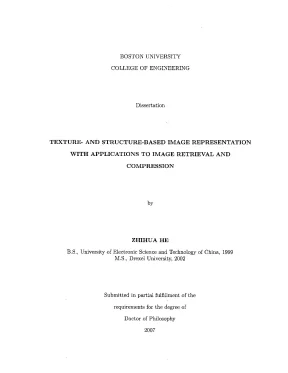
Tải xuống để đọc toàn bộBOSTON UNIVERSITY COLLEGE OF ENGINEERING Dissertation TEXTURE- AND STRUCTURE-BASED IMAGE REPRESENTATION WITH APPLICATIONS TO IMAGE RETRIEVAL AND COMPRESSION ZHIHUA HE B., University of Electronic Science and Technology of China, 1999 M., Drexel University, 2002 Submitted in partial fulfillment of the requirements for the degree of Doctor of Philosophy 2007 UMI Number: 3246606 INFORMATION TO USERS The quality of this reproduction is dependent upon the quality of the copy submitted. Broken or indistinct print, colored or poor quality illustrations and photographs, print bleed-through, substandard margins, and improper alignment can adversely affect reproduction. In the unlikely event that the author did not send a complete manuscript and there are missing pages, these will be noted. Also, if unauthorized copyright material had to be removed, a note will indicate the deletion.
® UMI UMI Microform 3246606 Copyright 2007 by ProQuest Information and Learning Company. All rights reserved. This microform edition is protected against unauthorized copying under Title 17, United States Code. ProQuest Information and Learning Company 300 North Zeeb Road P.
Box 1346 Ann Arbor, MI 48106-1346 Approved by First Reader Associate Professor of Electrical and Computer Engineering Second Reader W. Clem Karl, Ph. Professor of Electrical and Computer Engineering and Professor of Biomedical Engineering Third Reader Janusz Konréd, Ph. Associate Professor of Electrical and Computer Engineering 2 Fourth Reader Ủ—.- Stan Sclaroff, Ph.
Associate Professor of Computer Science Acknowledgments I am usually not good at writing acknowledgment, one reason is that I am never good at writing, and another reason is that I believe action speaks more for words. However, when I look back over all these years I spent in schools, I do realize that I owe lots of thanks to people along the way. First, I would like to thank my parents, ShuiBao He and Yong Xu. They have provided me with a stable home, without which I can never dream of getting advanced education; especially thanks for my father, who gave me a dream of being a scientist from my early childhood.
I definitely want to thank my brother, Zhipeng He, who takes the responsibility to take care of the family while I am away from home. Then, a special thank goes to my PhD adviser, Dr. Without her continuous support, I will not be able to come here for my PhD research. Without her guidance and patience, I can hardly imagine how I could get through the PhD research alone.
I will not forget the warmth brought by her in those cold winters. I also want to thank Dr. Arkady Kopansky, my first office-mate here, who has been always willing to help and answer the questions. Here, I want to thank my committee members: Dr.
Stan Sclaroff, Dr. Janusz Konrad and Dr. Thank you for your careful reviews and valuable comments. In the mean time I would also like to express my gratitude to all my teachers from primary school to college.
You have led me step by step into the science world, and have shown me how to approach problems from different aspects. Finally, I want to express my gratitude to all my friends, life will be so lonely and so boring without you guys! It is really hard for me to name all of you here, but I want to let you all know that I really appreciate your love and care, and I will always be willing to share mine with you. Below I want share my special thanks to Fang, Doreen, Violet, Shuang and Ling. Thank you for being there with me always.
iii TEXTURE- AND STRUCTURE-BASED IMAGE REPRESENTATION WITH APPLICATIONS TO IMAGE RETRIEVAL AND COMPRESSION (Order No. ) ZHIHUA HE Boston University, College of Engineering, 2007 Major Professor: Maja Bystrom, Ph., Department of Electrical and Computer Engineering ABSTRACT The design of an efficient image representation methods using small numbers of features can facilitate image processing tasks such as compression of images and content-based retrieval of images from databases. In this dissertation, three methods for capturing and concisely representing two distinguishing characteristics of images, namely texture and structure, are developed. Applications of these compact representations of image characteristics to image compression as well as retrieval of images and hand-sketches of images from databases are given and performance is compared with other compression and retrieval methods.
The first method to be introduced is a directional, hidden- Markov-model-based method for succinctly describing image texture using a small number of features. This method employs the well known, multi-scale contourlet and steerable-pyramid transforms to isolate in different subbands the edges that comprise the image texture. Statistical inter- and intra- subband dependencies are captured via hidden Markov models, and model parameters are used to represent texture in small feature sets. Application of this method to content- based retrieval of images with homogeneous textures from database is shown.
At the similar computation cost, about 10% higher retrieval rates over comparable methods are 1V demonstrated; when approximately one third fewer features are used, similar retrieval rates can be obtained using the proposed method. A method for concisely describing large image structures, that is, significant image edges, is then proposed. This method decomposes an image using the contourlet transform into directional subbands which contain edges of different orientations. Each subband is then projected onto its associated primary and orthogonal directions and the resulting projections are filtered and then modeled using piece-wise linear approximations or Gaus- sian mixture models.
The model parameters then form the concise feature sets used to represent the image’s structure. An application of this image-representation method to retrieval of images from databases based on users’ sketches of the images is shown. An retrieval rate increase of 138% using the proposed method is demonstrated over a current spatial-histogram-based method. Finally, a new multi-scale curve representation framework, the chordlet, is constructed for succinct curve-based image structure representation.
This framework can be viewed as an extension to curves of the well known beamlet transform, a multi-scale line repre- sentation system. In this dissertation, the representation efficiency, in terms of bits versus distortion, of the chordlet transform is compared with that of the beamlet transform. An algorithm for performing a fast chordlet transform has been developed. A chordlet-based coding system is constructed for application of the chordlet transform to compression of image shapes.
By using the proposed method increased compression is obtained at lower distortion when compared with two well known methods. Contents 1 Introduction 2 An Overview of Multi-scale Representation 2. Q Q Q Q Q H H n H Hán nàn kg K N ko Na 2. QC Q Q HH HQ Q ng gu kh k k gia 10 2.3 Gaussian Pyramid and Laplacian Pyramid.4 Wavelet Transform and Wavelet Packets.5 Directional Multi-Scale Transform .1 Steerable Pyramid Transform.
Q Q Q Q Q HQ Q HH k k vn ngà k kh kg va 24 2. QC HQ HQ HQ HH HQ n nk v v v kk k k k kia 27 2. QC Q Q Q Q HH HQ Q n v v v g V k kia 29 2.6 Multi-scale Line and Curve Representation .1 Background on Hidden Markov Models.2 Texture Representation using Directional HMMs in the Contourlet Domain 40 3.1 HMM Exploiting Luminance In-band Directional Dependencies in Contourlet Domain.2 HMM Exploiting Luminance Cross-scale and Directional In-band De- pendencies in the Contourlet Domain. HMM Exploiting Color In-Band Directional Dependencies in the Contourlet Domain.
c c c Q Q Q Q kg HQ Q V2 La vi 3.4 HMM Exploiting Color Cross-Scale Dependencies in the Contourlet Domamn. Q Q Q Q Q Q Q Q HH ng kg VN kia 50 3.3 Rotation-Invariant Texture Representation Using an HMM and Exploiting In-band and Cross-band Dependencies in Steerable Pyramid.4 Applications to Texture-Based Retrieval .41 Non-Rotation-Invariant Texture-Based Retrieval .2 Rotation-Invariant Texture-Based Retrieval.1 Structure Representation Using Directional Projection .1 DP-SR Framework.4 Low-Pass Filtering of 1D Profiles.2 Application to Sketch-Based Image Retreval.1 DP-SR-I: Piece-wise Linear Profile Modeling and Similarity Measure- ment. DP-SR-II: Non-linear Gaussian Mixture Profile Modeling and Simi- larity Measurement. Q Q Q Q HQ ee ee 80 4.
83 Curve Representation Via the Chordlet 86 5. uc Q Q Q n HH HQ na ng vc k k k KV Vk k kà 86 5. HQ HQ va 87 5.QQ ee ee 91 5.3 Comparison Between Beamlet and Chordlet for the Representation Efficiency 93 5.00 bee ee ee 94 vii 5.2 Curve Representation Via Chordlet and Beamlet Elements .3 Comparison and Discussion .4 Implementation of the Chordiet Transform.1 Construction of FEFI-based Chordlet .42 Direct Chordlet Versus FFT-Based Chordlet .4 Savings Due to Combination of the Direct Chordlet and the FFT- based Chordlet Transform.5 Is the Estimated Computational Cost for the Direct Chordlet and FFT-based Chordlet Transforms Consistent with the True Value? .5 Chordlet Coefficient Significance Model .1 Coefficient Significance Model. HQ HQ cv ng VN v kg kia 5.
Q Q Q LH HQ na HH ng ng kg kg k N k kia 5.6 A Thresholding-based Chordlet Representation System.1 An Image Structure Representation System .2 Simulation and Discussion. ee ee ee 5.7 Rate-Distortion Based Multi-Scale Chordlet Representation Systems .2_ Eundamentals and Defnitions. Mono-Scale Chordlet Representation.4 Multi-Scale Chordlet Representation. Q HH ng ng.
ng và kg và và 5.81 Chordlet-Based Representation Coder. ce kg cv cv g A k k V lv k V va 5.2 Chordlet Dictionary Slz€.3 The Definition of Curvature.4 The Proof of Lemma l. c Q QQ HH HH He.5 The Optimal Line Approximation fora SmoothCurve .7 A Lower-Bound for the Average Number of Beamlets Required for a SmoothCurveSegment C,; in an N x N Lattice Grid .8 The Proof of Lemma3. ee ee ee 171 5.9 The Proof of Lemma 4.10 The Proof of Lemma5.11 The Proof of LemmaÖ.
KH Q HQ Ho 177 6 Contributions and Future Work 180 6. cu HH nà gà Q v cv KV k KV k va 180 62 EPuture WOrk. Q c Q Q Q Q k H n nu vn v k k k v v kk kia 182 References 184 Curriculum Vitae 190 1X List of Figures 11 Example of texture images. 2 1-2 An example of sketches and corresponding images.
(b)-(c) Two sketches of Flower 1. (e)-(£) Two sketches of Flower 2. 6 21 A block diagram of a three-level Gaussian pyramid. 13 2-2 An example of a three-level Gaussian pyramid decomposition of image Lena.3 A block diagram of a two-level Laplacian pyramid.4 An example of a two-level Laplacian pyramid decomposition of image Lena.
15 2:5 An illustration of the analysis and synthesis filter bank. (a) Analysis filter bank. (b) 5ynthesis filter bank. ee ee 17 2-6 A block diagram of a two-level wavelet pyramid.
18 2:7 An example of a two-level wavelet decomposition of image Lena. 19 2-8 A block diagram of a two-level wavelet packet pyramid. 21 2:9 An example of a two-level wavelet packet decomposition of image Lena. 22 2:10 A block diagram of a two-level steerable decomposition.
24 2-11 An example of a two-level steerable pyramid decomposition of image Lena. 25 2-12 A block diagram of a two-level contourlet decomposition. 30 2-13 An example of a two-level contourlet decomposition of image Lena with subbands labeled according to the block diagram in Fig. 31 2:14 An illustration of the representation of a curve using wavelet, curvelet /contourlet, beamlet and chordlet.
(a) Representation using wavelet. (b) Representation using curvelet/contourlet. (c) Representation using beamlet. (d) Represen- tation using chordlet.
c Q Q LH Q LH gu Q Q.2 32 3-1 An illustration of a two-level contourlet decomposition of image Peppers. 36 3-2 Three classes of Markov dependencies in a wavelet pyramid. (c) Cross-band dependencies within scales L and £ +1 among horizontal, vertical and diagonal subbands. 3:3 An illustration of cross-scale dependencies, indicated by ellipsoids, in con- tourlet pyramid of Fig.
(a) The vertical subband at scale 2, labeled 21 in Fig. (b) The child subband of (a), which is the near-vertical subband at scale 1 labeled 12 in Fig.
Nội dung được bảo vệ bản quyền — Tải xuống đầy đủ
Trích dẫn luận án này
Zhihua He (2007). Luận án tiến sĩ: Texture- and structure-based image representation with applications to image retrieval and compression [Luận án tiến sĩ, Boston University]. LuanAn.net. https://luanan.net/khoa-hoc-giao-duc/luan-an-tien-si-texture-and-structure-based-image-representation-with-applications-to-image-retrieval-and-compression
Từ khóa và chủ đề nghiên cứu
Từ khóa liên quan
Xem thêm luận án cùng lĩnh vực
Chủ đề nghiên cứu
Câu hỏi thường gặp
Luận án "Luận án tiến sĩ: Texture- and structure-based image representation with applications to image retrieval and compression" nghiên cứu về vấn đề gì?
Luận án tiến sĩ này khám phá các phương pháp biểu diễn ảnh dựa trên texture và cấu trúc. Ứng dụng đột phá trong truy xuất và nén ảnh hiệu quả.
Luận án "Luận án tiến sĩ: Texture- and structure-based image representation with applications to image retrieval and compression" được bảo vệ tại trường nào?
Luận án này được bảo vệ tại Boston University. Năm bảo vệ: 2007.
Luận án "Luận án tiến sĩ: Texture- and structure-based image representation with applications to image retrieval and compression" thuộc chuyên ngành gì?
Luận án "Luận án tiến sĩ: Texture- and structure-based image representation with applications to image retrieval and compression" thuộc chuyên ngành Electrical and Computer Engineering. Danh mục: Khoa Học Giáo Dục.
Luận án "Luận án tiến sĩ: Texture- and structure-based image representation with applications to image retrieval and compression" có bao nhiêu trang?
Luận án "Luận án tiến sĩ: Texture- and structure-based image representation with applications to image retrieval and compression" có 209 trang. Bạn có thể xem trước một phần tài liệu ngay trên trang web trước khi tải về.
Cách tải luận án "Luận án tiến sĩ: Texture- and structure-based image representation with applications to image retrieval and compression" về máy như thế nào?
Để tải luận án về máy, bạn nhấn nút "Tải xuống ngay" trên trang này, sau đó hoàn tất thanh toán phí lưu trữ. File sẽ được tải xuống ngay sau khi thanh toán thành công. Hỗ trợ qua Zalo: 0559 297 239.