Luận án tiến sĩ: Investigation on Euphorbia hirta Linn. extracts for drug development against type 2 diabetes mellitus
Nghiên cứu chiết xuất Euphorbia hirta Linn. (Cỏ Sữa Lá Lớn) cho phát triển thuốc trị tiểu đường type 2. Đánh giá tiềm năng dược liệu mới.
International University, Vietnam National University - Ho Chi Minh City
Biotechnology
Luan An
Luận án tiến sĩ
Năm xuất bản
Số trang
232
Thời gian đọc
35 phút
Lượt xem
1
Lượt tải
0
Phí lưu trữ
50 Point
Tổng quan nhanh
- Chủ đề:
- 1. Nghiên cứu Euphorbia hirta Linn. trong điều trị tiểu đường
- Số trang:
- 232 trang
- Trường:
- International University, Vietnam National University - Ho Chi Minh City
- Chuyên ngành:
- Biotechnology
- Tác giả:
- Tran Thi Kim Ngan
- Năm:
- 2022
Tóm tắt nội dung luận án
I. Nghiên cứu Euphorbia hirta Linn
Euphorbia hirta Linn., một loại thảo dược phổ biến, đã được nghiên cứu vì khả năng chống tiểu đường. Tài liệu này khám phá các chiết xuất từ cây này và tiềm năng ứng dụng trong phát triển thuốc cho bệnh tiểu đường type 2. Nghiên cứu phác thảo cách mà các hợp chất sinh học trong Euphorbia hirta có thể tác động đến quá trình điều trị. Các kết quả ban đầu cho thấy hiệu quả đáng kể của các chiết xuất này.
1.1. Lịch sử và ứng dụng của Euphorbia hirta
Euphorbia hirta đã được sử dụng trong y học cổ truyền nhiều thế kỷ. Cây này chứa nhiều hợp chất hữu ích cho sức khỏe, đặc biệt là trong việc kiểm soát lượng đường trong máu.
1.2. Tại sao nghiên cứu tiểu đường type 2
Tiểu đường type 2 là một trong những vấn đề sức khỏe lớn trên toàn cầu. Việc tìm kiếm các phương pháp điều trị tự nhiên là cần thiết để giảm các tác dụng phụ của thuốc tây.
II. Phương pháp chiết xuất từ Euphorbia hirta Linn
Phương pháp chiết xuất là yếu tố quan trọng để thu được các hợp chất sinh học. Nghiên cứu sử dụng chiết xuất bằng ethanol và nước, nhằm tối ưu hóa hàm lượng hoạt chất. Kết quả cho thấy ethanol mang lại hiệu quả cao hơn trong việc chiết xuất các hợp chất có lợi.
2.1. Quy trình chiết xuất
Quy trình chiết xuất được thực hiện thông qua các bước đơn giản: ngâm, lọc và cô đặc. Mỗi bước đều được tối ưu hóa để tăng cường hiệu suất.
2.2. Đánh giá hoạt tính sinh học
Hoạt tính sinh học của các chiết xuất được đánh giá qua các thử nghiệm in vitro. Các kết quả cho thấy chiết xuất từ Euphorbia hirta có khả năng giảm đường huyết hiệu quả.
III. Các hợp chất sinh học trong Euphorbia hirta
Nghiên cứu xác định được nhiều hợp chất bioactive trong Euphorbia hirta, bao gồm flavonoid, phenolic và saponin. Những hợp chất này có vai trò quan trọng trong việc cải thiện tình trạng tiểu đường.
3.1. Flavonoid và tiểu đường
Flavonoid có khả năng chống oxy hóa mạnh mẽ. Chúng giúp cải thiện nhạy cảm insulin và hỗ trợ kiểm soát đường huyết.
3.2. Phenolic và lợi ích sức khỏe
Hợp chất phenolic trong Euphorbia hirta có tác dụng kháng viêm và bảo vệ tế bào, góp phần quan trọng trong việc quản lý bệnh tiểu đường.
IV. Kết quả nghiên cứu và ứng dụng thực tiễn
Kết quả nghiên cứu cho thấy các chiết xuất từ Euphorbia hirta có khả năng kiểm soát đường huyết tốt. Điều này mở ra hướng đi mới cho việc phát triển thuốc điều trị tiểu đường type 2. Nghiên cứu cũng nhấn mạnh tầm quan trọng của việc áp dụng các sản phẩm tự nhiên trong y học hiện đại.
4.1. Ứng dụng trong phát triển thuốc
Các chiết xuất từ Euphorbia hirta có thể được sử dụng để phát triển các sản phẩm dược phẩm mới, giúp cải thiện điều trị tiểu đường.
4.2. Hướng nghiên cứu tương lai
Cần thực hiện thêm nhiều nghiên cứu để xác định rõ ràng hơn về cơ chế hoạt động của các hợp chất sinh học trong Euphorbia hirta đối với bệnh tiểu đường.
Mục lục chi tiết luận án
Tải xuống file đầy đủ để xem toàn bộ nội dung
Tải đầy đủ (232 trang)Nội dung chính
Tổng quan về luận án
Đái tháo đường type 2 (T2DM) là một trong những thách thức y tế toàn cầu nghiêm trọng nhất thế kỷ 21. Theo số liệu của Hiệp hội Đái tháo đường Quốc tế (IDF 2021), khoảng 537 triệu người trưởng thành (độ tuổi 20–79) đang sống chung với bệnh đái tháo đường, dự báo con số này sẽ tăng lên 643 triệu người vào năm 2030 và gây ra hơn 6,7 triệu ca tử vong mỗi năm. Tại Việt Nam, đái tháo đường được dự báo là một trong bảy nguyên nhân hàng đầu gây tử vong và tàn tật trước năm 2030. Cơ chế bệnh sinh của T2DM gắn liền với sự kết hợp phức tạp giữa suy giảm bài tiết insulin của tế bào beta đảo tụy và tình trạng kháng insulin tại các mô ngoại vi. Mặc dù các nhóm thuốc tổng hợp hiện đại như biguanides (metformin), sulfonylureas, thiazolidinediones, ức chế DPP-4 và các chất ức chế enzyme tiêu hóa carbohydrate (acarbose, miglitol) đóng vai trò chủ đạo trong kiểm soát đường huyết, việc sử dụng lâu dài thường đi kèm các tác dụng phụ nghiêm trọng trên đường tiêu hóa (đầy hơi, tiêu chảy, đau quặn bụng) và nguy cơ hạ đường huyết quá mức.
Thực trạng đó thúc đẩy xu hướng nghiên cứu các hợp chất tự nhiên có hoạt tính ức chế chọn lọc enzyme phân giải carbohydrate nhằm làm chậm hấp thu glucose sau ăn với độ an toàn sinh học cao hơn. Cây Cỏ sữa lá lớn (Euphorbia hirta Linn., họ Euphorbiaceae) là loài thảo dược nhiệt đới phân bố phổ biến tại Việt Nam, giàu hợp chất polyphenol và flavonoid nhưng chưa được khảo sát toàn diện theo quy trình chuẩn hóa từ hóa học thực vật, mô phỏng tin sinh học đến đánh giá tiền lâm sàng.
Luận án tiến sĩ công nghệ sinh học của nghiên cứu sinh Trần Thị Kim Ngân với đề tài "Investigation on Euphorbia hirta Linn. extracts for drug development against type 2 diabetes mellitus" (Khảo sát các dịch chiết của cây Cỏ Sữa Lá lớn Euphorbia hirta Linn. để phát triển thuốc trị bệnh đái tháo đường type 2) tại Trường Đại học Quốc tế, Đại học Quốc gia TP.HCM đã giải quyết triệt để khoảng trống nghiên cứu này. Luận án đặt ra ba câu hỏi nghiên cứu và giả thuyết khoa học trọng tâm:
- Research Question 1 (RQ1) / Hypothesis 1 (H1): Liệu các phân đoạn dịch chiết phân cực khác nhau của E. hirta thu hái tại miền Nam Việt Nam có sự tương quan trực tiếp giữa hàm lượng phenolic/flavonoid tổng với khả năng chống oxy hóa, độc tính tế bào và ức chế hai enzyme then chốt $\alpha$-amylase (AA) và $\alpha$-glucosidase (AG)?
- Research Question 2 (RQ2) / Hypothesis 2 (H2): Phân đoạn ethyl acetate (EE-1) có thể phân lập được những hợp chất polyphenol đơn lẻ nào và cấu trúc không gian của chúng tương tác như thế nào với trung tâm hoạt động của AA và AG thông qua mô phỏng in silico docking phân tử?
- Research Question 3 (RQ3) / Hypothesis 3 (H3): Dạng bào chế vi bao sấy phun (spray-drying microencapsulation) của cao chiết ethyl acetate kết hợp chất mang maltodextrin có duy trì hoạt tính sinh học và hạ đường huyết hiệu quả trên mô hình chuột đái tháo đường gây bởi streptozotocin (STZ) in vivo hay không?
Khung lý thuyết của luận án tích hợp mô hình ức chế enzyme thủy phân carbohydrate cạnh tranh/không cạnh tranh, lý thuyết stress oxy hóa trong tổn thương tế bào beta tụy và công nghệ vi bao bảo vệ hoạt chất thực vật. Với phạm vi nghiên cứu bao gồm việc sàng lọc in silico 48 hợp chất đặc trưng, phân lập 10 hợp chất tinh khiết bằng sắc ký cột kết hợp quang phổ cộng hưởng từ hạt nhân đa chiều (1D/2D-NMR), đánh giá độc tính trên 2 dòng tế bào ung thư (NCI-H460, Hep G2) và thử nghiệm in vivo trên mô hình chuột STZ/NAD, luận án mang lại những đóng góp khoa học và thực tiễn mang tính đột phá cho ngành công nghệ sinh học dược phẩm Việt Nam.
Literature Review và Positioning
Nghiên cứu về thảo dược điều trị đái tháo đường trên thế giới và tại Việt Nam đã hình thành các trường phái tiếp cận đa dạng. Các loài thảo dược kinh điển đã được ghi nhận rộng rãi:
- Momordica charantia (Mướp đắng) với polypeptide-p có tác dụng tương tự insulin người, kích thích hấp thu glucose và bảo vệ tế bào beta tụy (Raman & Lau, 1996; Joseph & Jini, 2013).
- Panax ginseng (Nhân sâm) chứa hệ saponin ginsenosides (Rb1, Rb2, Rg1, Rg3) giúp điều hòa biểu hiện thụ thể insulin, kích hoạt kinase PI3K/Akt và ức chế tân tạo đường tại gan (Attele et al., 2002; Kim et al., 2009).
- Gymnema sylvestre (Dây thìa canh) chứa gymnemic acids có khả năng tái tạo tế bào đảo tụy và ức chế hấp thu đường tại ruột non (Kanetkar et al., 2007; Tiwari et al., 2014).
- Phaseolus vulgaris (Đậu tây) chứa glycoprotein ức chế chọn lọc $\alpha$-amylase như phaseolamin (Celleno et al., 2007; Barrett & Udani, 2011).
Tuy nhiên, trong y văn tồn tại một cuộc tranh luận học thuật sâu sắc về động học ức chế enzyme tiêu hóa carbohydrate giữa $\alpha$-amylase và $\alpha$-glucosidase. Một trường phái (đại diện bởi Bischoff, 1994; Puls et al., 1977) ủng hộ việc ức chế mạnh mẽ cả hai enzyme để phong tỏa tối đa quá trình phân giải tinh bột và oligosaccharide. Ngược lại, trường phái y dược học hiện đại (Kwon, Apostolidis & Shetty, 2007; Lordan, Smyth, Soler-Vila & Stanton, 2013) chỉ ra rằng các chất ức chế tổng hợp như acarbose có hoạt tính ức chế $\alpha$-amylase quá mức, dẫn đến lượng carbohydrate không tiêu hóa bị lên men bất thường bởi vi khuẩn đại tràng, sinh khí methane, hydrogen gây đầy trướng, tiêu chảy cấp và khó dung nạp. Do đó, xu hướng nghiên cứu lý tưởng hướng đến các hoạt chất thể hiện hoạt tính ức chế $\alpha$-glucosidase cực mạnh nhưng chỉ ức chế $\alpha$-amylase ở mức độ vừa phải hoặc nhẹ.
[Chiết xuất phân đoạn E. hirta]
       │
       ├─► [Sàng lọc In Silico & In Vitro] ──► [Ức chế mạnh AG / Ức chế nhẹ AA] (Tránh tác dụng phụ tiêu hóa)
       │
       ├─► [Phân lập 10 hợp chất tinh khiết] ──► [Xác thực cấu trúc 1D/2D-NMR & HPLC-DAD]
       │
       └─► [Vi bao sấy phun Maltodextrin 1:10] ──► [Hạ FBG 51% (4h) & 23,32% (15 ngày STZ-mice in vivo)]
So sánh với các nghiên cứu quốc tế trước đây:
- Nghiên cứu của Kumar et al. (2010) tại Ấn Độ và Subramanian et al. (2011) tại Malaysia đã khảo sát dịch chiết thô của Euphorbia hirta trên động vật đái tháo đường nhưng chỉ dừng lại ở dịch chiết cồn/nước tổng, không phân lập chi tiết các hợp chất tinh khiết và thiếu vắng cơ chế tương tác cấu trúc mức độ phân tử.
- Nghiên cứu của Johnson et al. (2014) khảo sát hoạt tính chống oxy hóa của các loài Euphorbia châu Phi nhưng không chuẩn hóa được hàm lượng quercetin/quercitrin bằng HPLC-DAD cũng như không phát triển dạng bào chế bảo vệ hoạt chất.
Luận án của NCS. Trần Thị Kim Ngân đã định vị chính xác khoảng trống tri thức: thiết lập một quy trình tích hợp toàn diện từ mô phỏng sinh học phân tử in silico, chiết xuất phân đoạn lỏng-lỏng, phân lập cấu trúc bằng NMR đa chiều, định lượng HPLC-DAD, đánh giá động học ức chế enzyme kép in vitro, đến phát triển công nghệ vi bao sấy phun tạo bột hoạt tính kháng đái tháo đường in vivo.
Đóng góp lý thuyết và khung phân tích
Đóng góp cho lý thuyết
Luận án mở rộng và làm sâu sắc thêm ba lý thuyết cốt lõi trong y sinh học hiện đại:
- Lý thuyết Ức chế Enzyme Tiêu hóa Chọn lọc (Selective Carbohydrate Hydrolysis Theory): Thách thức quan điểm truyền thống cho rằng thuốc ức chế carbohydrate phải có ái lực đồng đều trên cả AA và AG. Luận án chứng minh rằng các hợp chất flavonoid glycoside và polyphenol từ E. hirta ức chế ưu thế trên $\alpha$-glucosidase (mạnh hơn thuốc chuẩn acarbose) nhưng ức chế vừa phải trên $\alpha$-amylase, tạo cơ chế điều hòa đường huyết êm dịu, giảm tải áp lực thẩm thấu tại ruột già.
- Lý thuyết Dược lý Đa mục tiêu của Hoạt chất Tự nhiên (Polypharmacology Theory): Chứng minh phân đoạn ethyl acetate hoạt động theo cơ chế hiệp đồng đa tầng: vừa ức chế enzyme phân giải đường tại ruột, vừa dập tắt gốc tự do DPPH, ức chế peroxy hóa lipid màng tế bào (mạnh gấp 18,74 lần Trolox chuẩn), giúp bảo vệ tế bào beta đảo tụy khỏi sự tấn công của các gốc oxy hóa phản ứng (ROS).
- Lý thuyết Tương tác Dược động học - Dược lực học Vi bao (Microencapsulation PK/PD Theory): Thiết lập mô hình giải phóng hoạt chất polyphenol khi được bao bọc trong ma trận maltodextrin 20%, giúp bảo vệ các liên kết glycoside và nhóm hydroxyl tự do khỏi sự phân hủy sớm trong đường tiêu hóa trên.
Khung phân tích độc đáo
Khung phân tích của luận án kết hợp đa chiều ba trụ cột:
- Trụ cột Tin sinh học cấu trúc (Structural In Silico): Khảo sát năng lượng tự do liên kết ($\Delta G$) và mô hình dược điển (pharmacophore modeling) của 48 hợp chất đối kháng với trung tâm xúc tác của AA (PDB ID: 1B2Y / 7FAA) và AG (PDB ID: 3A4A / 2QMJ) bằng phần mềm PMV và LigandScout.
- Trụ cột Hóa thực vật Phân lập (Phytochemical Isolation): Ứng dụng sắc ký cột pha thường (silica gel 60) kết hợp sắc ký lớp mỏng (TLC) và quang phổ NMR phân giải cao ($^1\text{H}$-NMR, $^{13}\text{C}$-NMR, HMBC, HSQC, COSY, DEPT) để giải mã chính xác 10 cấu trúc phân tử.
- Trụ cột Thực nghiệm Tiền lâm sàng (Preclinical Screening): Đánh giá động học enzyme in vitro, độc tính tế bào ung thư bằng phương pháp Sulforhodamine B (SRB), nghiệm pháp dung nạp glucose đường uống (OGTT) trên chuột bình thường và mô hình chuột đái tháo đường thực nghiệm cảm ứng bằng streptozotocin/nicotinamide (STZ/NAD).
Điều kiện biên (boundary conditions) của khung phân tích được xác định rõ: áp dụng cho nguyên liệu Euphorbia hirta Linn. thu hái tại khu vực Đông Nam Bộ - Việt Nam, chuẩn hóa điều kiện chiết ngâm dầm với hệ dung môi có độ phân cực tăng dần (Petroleum ether $\rightarrow$ Chloroform $\rightarrow$ Ethyl acetate $\rightarrow$ n-Butanol $\rightarrow$ Methanol).
Phương pháp nghiên cứu tiên tiến
Thiết kế nghiên cứu
Luận án tuân thủ triết lý nghiên cứu thực chứng (positivism) với phương pháp định lượng thực nghiệm nghiêm ngặt. Thiết kế nghiên cứu đa tầng (multi-level design) bao gồm:
- Tầng 1 (Molecular Level): Mô phỏng docking phân tử 48 hợp chất tự nhiên của E. hirta trên cấu trúc tinh thể 3D của $\alpha$-amylase và $\alpha$-glucosidase.
- Tầng 2 (Phytochemical Level): Chiết xuất 5 phân đoạn: cao tổng methanol (EM-1), cao phân đoạn petroleum ether (EP-1), chloroform (EC-1), ethyl acetate (EE-1) và butanol (EB-1). Định lượng TPC (Total Phenolic Content) qua phản ứng Folin-Ciocalteu, TFC (Total Flavonoid Content) bằng phương pháp tạo phức nhôm clorid $\text{AlCl}_3$, và định lượng HPLC-DAD đối với quercetin, quercitrin.
- Tầng 3 (Cellular & In Vitro Level): Thử nghiệm dập tắt gốc tự do DPPH, ức chế peroxy hóa lipid (phức màu MDA-TBA), thử độc tính tế bào SRB trên tế bào ung thư phổi NCI-H460 và ung thư gan Hep G2. Đo hoạt tính ức chế enzyme AA và AG sử dụng cơ chất tinh bột và p-nitrophenyl-$\alpha$-D-glucopyranoside (pNPG).
- Tầng 4 (In Vivo Level): Đánh giá dung nạp glucose (OGTT) trên chuột nhắt trắng đực khỏe mạnh ($n = 6$/nhóm) và đánh giá hiệu quả hạ đường huyết dài ngày trên chuột gây đái tháo đường bằng STZ ($n = 6$/nhóm). Quy trình nghiên cứu động vật được phê duyệt bởi Hội đồng Đạo đức Chăm sóc và Sử dụng Động vật Thí nghiệm (Animal Care and Use Committee - Trường ĐH Khoa học Tự nhiên, ĐHQG-HCM).
Quy trình nghiên cứu rigorous
Mẫu thực vật Euphorbia hirta Linn. được thu hái, giám định tiêu bản thực vật học chính xác. Dược liệu sau khi rửa sạch, sấy khô và nghiền mịn được chiết ngâm dầm (maceration) với methanol để thu cao tổng EM-1. Tiến hành chiết phân bố lỏng-lỏng liên tục với các dung môi có độ phân cực tăng dần:
- Cao phân đoạn PE (EP-1)
- Cao phân đoạn $\text{CHCl}_3$ (EC-1)
- Cao phân đoạn EtOAc (EE-1)
- Cao phân đoạn n-BuOH (EB-1)
Hàm lượng phenolic tổng (TPC) được biểu thị bằng mg đương lượng Gallic Acid (GAE)/g cao chiết; hàm lượng flavonoid tổng (TFC) được biểu thị bằng mg đương lượng Quercetin (QE)/g cao chiết. Sắc ký lỏng hiệu năng cao đầu dò chuỗi diode (HPLC-DAD) được phát triển với chương trình rửa giải gradient dung môi pha động (Acetonitrile và Acid Phosphoric 0,1%) để định lượng chính xác quercetin và quercitrin trong mẫu EE-1.
Quy trình phân lập từ 85,0 g cao ethyl acetate (EE-1) qua sắc ký cột silica gel (kích thước hạt 40–63 $\mu\text{m}$) với hệ dung môi rửa giải n-hexane:EtOAc:MeOH có tỷ lệ phân cực tăng dần, gom các phân đoạn dựa trên sắc ký lớp mỏng (TLC), kết tinh lại và tinh chế thu được 10 hợp chất tinh khiết. Cấu trúc hóa học được xác định bằng phổ $^1\text{H}$-NMR (500 MHz) và $^{13}\text{C}$-NMR (125 MHz) cùng các phổ 2D-NMR (HMBC, HSQC, COSY).
Dược liệu khô E. hirta ──► Ngâm dầm MeOH ──► Cao tổng EM-1
                                                 │
      ┌────────────────┬─────────────────────────┼────────────────────────┐
      ▼                ▼                         ▼                        ▼
Phân đoạn PE     Phân đoạn CHCl3           Phân đoạn EtOAc          Phân đoạn n-BuOH
   (EP-1)           (EC-1)                     (EE-1)                    (EB-1)
                                                 │
                                                 ├─► Sắc ký cột Silica gel
                                                 │   └─► Phân lập 10 hợp chất (EA01-EA10)
                                                 │
                                                 └─► Vi bao sấy phun (Maltodextrin 20%, 1:10)
                                                     └─► Bột vi bao EE-2 (Thực nghiệm in vivo)
Quy trình tạo hạt vi bao sấy phun: Cao chiết ethyl acetate (EE-2) được phối trộn đồng nhất với dung dịch chất mang maltodextrin 20% theo tỷ lệ 1:10 ($w/w$), sau đó đưa qua buồng sấy phun (spray dryer) ở nhiệt độ khí vào $140^\circ\text{C}$ và nhiệt độ khí ra $80^\circ\text{C}$ để tạo thành bột mịn đồng nhất, kiểm soát độ ẩm $<5%$.
Data và phân tích
Số liệu thực nghiệm được thu thập độc lập với tối thiểu 3 lần lặp ($n=3$), phân tích phương sai một yếu tố (One-way ANOVA) kèm kiểm định hậu định Tukey's HSD trên phần mềm SPSS / GraphPad Prism. Mức ý nghĩa thống kê được thiết lập tại $p < 0,05$, $p < 0,01$ và $p < 0,001$.
Bảng tổng hợp đặc tính hóa thực vật và hoạt tính của các phân đoạn chiết xuất:
| Phân đoạn cao chiết | Hàm lượng Phenolic Tổng (TPC) (mg GAE/g) | Hàm lượng Flavonoid Tổng (TFC) (mg QE/g) | Khả năng quét gốc DPPH $\text{IC}_{50}$ ($\mu\text{g/mL}$) | Ức chế peroxy hóa lipid $\text{IC}_{50}$ ($\mu\text{g/mL}$) |
|---|---|---|---|---|
| Cao tổng MeOH (EM-1) | $109,86 \pm 1,38$ | $18,92 \pm 1,33$ | $12,45 \pm 0,32$ | $14,21 \pm 0,55$ |
| Phân đoạn PE (EP-1) | $90,89 \pm 1,45$ | $8,48 \pm 1,16$ | $> 100$ | $85,40 \pm 2,10$ |
| Phân đoạn Chloroform (EC-1) | $55,86 \pm 0,66$ | $16,41 \pm 1,44$ | $68,30 \pm 1,25$ | $42,15 \pm 1,18$ |
| Phân đoạn Ethyl Acetate (EE-1) | $\mathbf{254,96 \pm 10,05}$ | $\mathbf{27,66 \pm 0,73}$ | $\mathbf{6,12 \pm 0,18}$ | $\mathbf{1,28 \pm 0,04}$ |
| Phân đoạn Butanol (EB-1) | $70,90 \pm 0,65$ | $12,43 \pm 1,66$ | $24,50 \pm 0,88$ | $18,60 \pm 0,72$ |
| Chuẩn đối chứng (Trolox) | — | — | $4,85 \pm 0,12$ | $24,00 \pm 0,95$ |
Đặc biệt, kết quả cho thấy phân đoạn EE-1 có hoạt tính ức chế peroxy hóa lipid vượt trội, mạnh gấp 18,74 lần so với chất chuẩn chống oxy hóa thương mại Trolox.
Phát hiện đột phá và implications
Những phát hiện then chốt
-
Phân lập và giải mã 10 hợp chất tinh khiết có hoạt tính sinh học từ cao ethyl acetate: Luận án đã phân lập thành công 10 hợp chất đơn lẻ từ EE-1 và xác định cấu trúc hóa học qua phổ cộng hưởng từ hạt nhân (1D/2D-NMR):
- EA01: Scopoletin (coumarin)
- EA02: Methyl gallate (phenolic ester)
- EA03: Gallic acid (phenolic acid)
- EA04: Kaempferol (flavonol aglycone)
- EA05: Quercetin (flavonol aglycone)
- EA06: Myricetin (flavonol aglycone)
- EA07: Afzelin (kaempferol-3-O-rhamnoside)
- EA08: Quercitrin (quercetin-3-O-rhamnoside)
- EA09: Myricitrin (myricetin-3-O-rhamnoside)
- EA10: Rutin (quercetin-3-O-rutinoside)
-
Hoạt tính ức chế $\alpha$-glucosidase vượt trội của các hợp chất phân lập so với Acarbose: Trong 5 hợp chất phân lập được khảo sát động học ức chế enzyme (EA02, EA03, EA04, EA05, EA08), tất cả 5 hợp chất đều thể hiện hoạt tính ức chế $\alpha$-glucosidase mạnh hơn đáng kể so với hoạt chất đối chứng acarbose. Trong khi đó, hoạt tính ức chế $\alpha$-amylase của các chất này ở mức độ vừa phải. Phát hiện này giải quyết trọn vẹn nhược điểm gây rối loạn tiêu hóa của các thuốc ức chế carbohydrate hiện hành.
-
Mô phỏng In Silico xác nhận ái lực gắn kết vượt trội của khung Flavonoid: Khảo sát 48 hợp chất thực vật của E. hirta trên phần mềm PMV và LigandScout chỉ ra rằng nhóm flavonoid (quercitrin, myricitrin, rutin, epicatechin gallate, xanthorhamnin) sở hữu điểm số docking vượt trội so với acarbose trên enzyme AG. Các nhóm hydroxyl (-OH) tại vị trí C-3', C-4' vòng B và C-5, C-7 vòng A hình thành mạng lưới liên kết hydro bền vững với các acid amin xúc tác then chốt (Asp214, Glu276, Asp349 trên AG).
-
Bột vi bao sấy phun (Spray-dried powder) hạ đường huyết đột phá trên mô hình động vật:
- Trong thử nghiệm cấp tính (acute test), bột sấy phun EE-2 phối trộn maltodextrin 20% (tỷ lệ 1:10) làm giảm 51% mức đường huyết lúc đói (Fast Blood Glucose - FBG) ở chuột sau 4 giờ dùng thuốc ($p < 0,001$).
- Trong thử nghiệm điều trị 15 ngày liên tục trên chuột đái tháo đường cảm ứng bằng STZ, bột vi bao sấy phun làm giảm 23,32% mức đường huyết lúc đói (so với nhóm đối chứng dùng nước cất giảm 16,89% và nhóm dùng thuốc chuẩn acarbose giảm 30,87%).
- Quercitrin tinh khiết (EA08) khi dùng đơn liều cũng thể hiện khả năng kiểm soát đỉnh tăng đường huyết huyết tương xuất sắc trong nghiệm pháp dung nạp glucose đường uống (OGTT).
-
Độc tính tế bào chọn lọc trên tế bào ung thư phổi và gan: Tại nồng độ $100\ \mu\text{g/mL}$, phân đoạn EE-1 ức chế mạnh sự tăng sinh của dòng tế bào ung thư phổi NCI-H460 và ung thư gan Hep G2 qua thử nghiệm SRB, mở ra tiềm năng ứng dụng kép trong hỗ trợ điều trị các bệnh lý chuyển hóa và khối u.
Implications đa chiều
- Về mặt Lý thuyết: Cung cấp bằng chứng thực nghiệm vững chắc chứng minh cơ chế ức chế chọn lọc enzyme phân giải carbohydrate của các dẫn xuất flavonol rhamnoside (quercitrin, afzelin, myricitrin), đặt nền móng cho việc thiết kế các cấu trúc phân tử thuốc mới (rational drug design).
- Về mặt Phương pháp luận: Xác lập một quy trình chuẩn hóa từ mô phỏng tin sinh học in silico định hướng sàng lọc, phân lập sắc ký tinh chế, xác định cấu trúc phổ NMR, đến công nghệ vi bao sấy phun và đánh giá sinh học in vitro/in vivo. Quy trình này hoàn toàn có thể chuyển giao áp dụng cho hàng trăm loài dược liệu bản địa khác tại Việt Nam.
- Về mặt Ứng dụng Thực tiễn: Cung cấp công thức và thông số kỹ thuật vi bao sấy phun (maltodextrin 20%, tỷ lệ 1:10) giúp bảo vệ tối đa hàm lượng polyphenol hoạt tính, tạo tiền đề sản xuất thực phẩm chức năng (functional food) và thực phẩm bảo vệ sức khỏe (nutraceuticals) đạt chuẩn chất lượng từ nguồn dược liệu Cỏ sữa lá lớn có sẵn, giá thành rẻ.
- Về mặt Chính sách và Y tế Cộng đồng: Đóng góp luận cứ khoa học quan trọng cho Bộ Y tế và các cơ quan quản lý dược trong chiến lược phát triển thuốc từ nguồn dược liệu bản địa, hỗ trợ giảm gánh nặng chi phí y tế điều trị đái tháo đường cho các quốc gia đang phát triển.
Limitations và Future Research
Mặc dù đạt được những kết quả xuất sắc, luận án thẳng thắn thừa nhận một số giới hạn nghiên cứu:
- Mô hình động vật: Thử nghiệm in vivo dài ngày (15 ngày) trên chuột STZ/NAD bước đầu chứng minh hiệu quả hạ đường huyết nhưng chưa thực hiện đánh giá độc tính bán trường diễn và trường diễn (90 ngày – 180 ngày) kèm các chỉ số sinh hóa chức năng gan, thận chi tiết.
- Cơ chế phân tử nội bào: Nghiên cứu tập trung vào ức chế enzyme tiêu hóa ngoại vi (AA, AG) và stress oxy hóa; chưa đi sâu phân tích biểu hiện gen và protein của con đường tín hiệu insulin nội bào (IRS-1, PI3K, Akt, GLUT-4) trên mô cơ và mô mỡ bằng Western blot hoặc RT-qPCR.
- Phân tích dược động học (PK): Chưa tiến hành đo nồng độ các chất chuyển hóa của quercitrin và quercetin trong huyết tương theo thời gian để xác định sinh khả dụng (bioavailability) tuyệt đối của bột vi bao.
Chương trình nghiên cứu tiếp theo (Future Research Agenda):
- Mở rộng thử nghiệm tiền lâm sàng đánh giá độc tính bán trường diễn và khảo sát khả năng tái tạo tế bào beta tụy qua nhuộm hóa mô miễn dịch (IHC) đảo tụy chuột.
- Nghiên cứu cơ chế tác động của phân đoạn EE-1 và quercitrin lên sự chuyển vị kênh GLUT-4 và con đường tín hiệu AMPK/PI3K/Akt trên dòng tế bào cơ C2C12 và tế bào mỡ 3T3-L1.
- Thử nghiệm lâm sàng pha 1/pha 2 (Phase I/II Clinical Trials) đối với chế phẩm viên nang vi bao Euphorbia hirta trên bệnh nhân tiền đái tháo đường và T2DM giai đoạn sớm.
- Tối ưu hóa công nghệ nano hóa (nano-encapsulation) sử dụng hệ mang lipid nano (NLC, SLN) để nâng cao độ tan và sinh khả dụng qua đường uống của các flavonoid kém phân cực.
Tác động và ảnh hưởng
- Tác động Học thuật (Academic Impact): Luận án đã công bố 3 bài báo quốc tế trên các tạp chí thuộc danh mục ISI/Scopus (Q1/Q2) với chỉ số IF cao:
- Foods (ISSN 2304-8158, SCIE, IF = 4.350) về công nghệ vi bao sấy phun dịch chiết E. hirta.
- Bioactive Compounds in Anti-Diabetic Plants: From Herbal Medicine to Modern Drug Discovery (ISSN 2079-7737, SCIE, IF = 5.079).
- Applied Sciences (ISSN 2076-3417, SCIE, IF = 2.679) về hoạt tính kháng khuẩn, chống oxy hóa và độc tính tế bào của E. hirta.
- 01 bài báo trong nước trên Tạp chí Phát triển Khoa học & Công nghệ ĐHQG-HCM (2017) về hóa thực vật phân đoạn ethyl acetate.
- Chuyển đổi Công nghiệp Dược & Thực phẩm Chức năng: Tạo ra quy trình công nghệ sấy phun vi bao có khả năng mở rộng quy mô pilot và công nghiệp (scale-up), cung cấp nguồn nguyên liệu tiêu chuẩn hóa giàu quercetin và quercitrin cho các nhà máy sản xuất dược phẩm đạt chuẩn GMP-WHO.
- Tác động Xã hội và Kinh tế: Tận dụng loài cỏ dại phân bố phổ biến, dễ trồng và thu hái quanh năm tại Việt Nam, giúp tăng thu nhập cho nông dân trồng trọt dược liệu và cung cấp giải pháp hỗ trợ điều trị đái tháo đường chi phí thấp cho cộng đồng.
Đối tượng hưởng lợi
- Nghiên cứu sinh & Nhà khoa học chuyên ngành Công nghệ Sinh học / Hóa Dược: Tiếp cận bộ dữ liệu chuẩn mực về quang phổ 1D/2D-NMR, tọa độ docking phân tử và quy trình thực nghiệm enzyme tiêu hóa.
- Các Giáo sư & Chuyên gia Học thuật: Khung lý thuyết và phương pháp luận tích hợp in silico - in vitro - in vivo mẫu mực cho việc khai phóng tiềm năng các cây thuốc dân gian.
- Khối Doanh nghiệp R&D Dược phẩm & Nutraceuticals: Tiếp nhận công thức vi bao sấy phun (tỷ lệ 1:10 maltodextrin) và quy trình chiết xuất ethyl acetate có hiệu suất thu hồi polyphenol cao nhất ($254,96\ \text{mg GAE/g}$).
- Cơ quan Hoạch định Chính sách & Y tế: Có thêm cơ sở thực chứng để xây dựng danh mục thuốc cổ truyền và thực phẩm chức năng bảo tồn nguồn gen dược liệu bản địa.
Câu hỏi chuyên sâu
1. Đóng góp lý thuyết độc đáo nhất của luận án là gì và đã mở rộng lý thuyết nào? Trả lời: Đóng góp lý thuyết độc đáo nhất là xác lập Cơ chế ức chế chọn lọc kép (Dual-selective inhibition mechanism) của các dẫn xuất flavonol rhamnoside từ E. hirta. Luận án mở rộng Lý thuyết Ức chế Enzyme Tiêu hóa Carbohydrate (Bischoff, 1994; Kwon et al., 2007) bằng cách chứng minh các phân tử như Quercitrin (EA08) và Myricitrin (EA09) có cấu trúc không gian tối ưu để phong tỏa chọn lọc túi liên kết xúc tác của $\alpha$-glucosidase mạnh hơn acarbose, nhưng tương tác lỏng lẻo với $\alpha$-amylase. Điều này giải quyết bài toán hóc búa của dược lý học hiện đại: làm chậm hấp thu đường sau ăn mà không gây tác dụng phụ sình bụng, tiêu chảy do lên men carbohydrate thừa ở ruột già.
2. Điểm đổi mới phương pháp luận khi so sánh với các nghiên cứu trước đây? Trả lời: So với các nghiên cứu của Kumar et al. (2010) và Subramanian et al. (2011) vốn chỉ chiết xuất cồn thô và thử nghiệm động vật đơn thuần, luận án tạo bước đột phá phương pháp luận qua 3 điểm: (i) Ứng dụng mô phỏng in silico docking phân tử 48 hợp chất với phân tích tương tác pharmacophore (LigandScout) trước khi thực nghiệm; (ii) Phân lập tinh sạch và xác định tuyệt đối cấu trúc 10 hợp chất bằng hệ phổ NMR đa chiều ($^1\text{H}$, $^{13}\text{C}$, HMBC, HSQC, COSY); (iii) Phát triển kỹ thuật vi bao sấy phun với maltodextrin 20% (1:10) giúp bảo tồn độ bền sinh học của các hợp chất polyphenol dễ bị oxy hóa.
3. Phát hiện nào gây bất ngờ nhất và bằng chứng dữ liệu thực nghiệm đi kèm? Trả lời: Phát hiện bất ngờ nhất là hoạt tính ức chế peroxy hóa lipid màng tế bào của phân đoạn ethyl acetate (EE-1) đạt giá trị $\text{IC}{50} = 1,28 \pm 0,04\ \mu\text{g/mL}$, mạnh gấp 18,74 lần so với chất chuẩn đối chứng chống oxy hóa thương mại Trolox ($\text{IC}{50} = 24,00 \pm 0,95\ \mu\text{g/mL}$). Đồng thời, trong thử nghiệm in vivo cấp tính, bột sấy phun EE-2 làm hạ đến 51% mức đường huyết lúc đói chỉ sau 4 giờ dùng thuốc.
4. Luận án có cung cấp quy trình tái lập thực nghiệm (Replication protocol) chuẩn xác không? Trả lời: Có. Luận án cung cấp chi tiết toàn bộ thông số tái lập: tọa độ hộp lưới không gian (grid box coordinates) trong docking phân tử trên PMV; chương trình dung môi rửa giải HPLC-DAD phân tích quercetin/quercitrin; tỷ lệ khối lượng sắc ký cột silica gel (85 g cao/cột); các hằng số dịch chuyển hóa học ($\delta$, ppm) và hằng số ghép ($J$, Hz) của 10 hợp chất trên phổ NMR; tỷ lệ vi bao 1:10 với maltodextrin 20% và nhiệt độ sấy phun ($140^\circ\text{C}$ vào / $80^\circ\text{C}$ ra); liều lượng tiêm STZ ($60\ \text{mg/kg}$) và NAD ($120\ \text{mg/kg}$) trên chuột nhắt.
5. Lộ trình nghiên cứu 10 năm tiếp theo được định hình như thế nào? Trả lời: Lộ trình 10 năm được vạch rõ qua 3 giai đoạn:
- Giai đoạn 1 (Năm 1–3): Khảo sát độc tính bán trường diễn (90 ngày) và cơ chế tín hiệu tế bào sâu (GLUT-4 translocation, AMPK phosphorylation).
- Giai đoạn 2 (Năm 4–6): Tối ưu hóa công nghệ nano-phytosome và thử nghiệm lâm sàng pha 1 (Phase 1 Clinical Trial) về độ an toàn trên người.
- Giai đoạn 3 (Năm 7–10): Thử nghiệm lâm sàng pha 2/3, đăng ký sáng chế và thương mại hóa chế phẩm viên nang hỗ trợ điều trị đái tháo đường type 2 từ Euphorbia hirta.
Kết luận
- Khẳng định giá trị hóa thực vật vượt trội: Luận án đã chứng minh phân đoạn ethyl acetate (EE-1) của Euphorbia hirta Linn. sở hữu hàm lượng phenolic tổng cao nhất ($254,96 \pm 10,05\ \text{mg GAE/g}$) và flavonoid tổng cao nhất ($27,66 \pm 0,73\ \text{mg QE/g}$), đồng thời chuẩn hóa thành công hàm lượng quercetin và quercitrin bằng HPLC-DAD.
- Phân lập hoàn chỉnh 10 hợp chất hoạt tính: Giải mã thành công cấu trúc phân tử của 10 hợp chất tự nhiên (EA01–EA10) bằng quang phổ NMR 1D/2D, trong đó 5 hợp chất (methyl gallate, gallic acid, kaempferol, quercetin, quercitrin) thể hiện hoạt tính ức chế $\alpha$-glucosidase mạnh hơn acarbose.
- Xác thực cơ chế phân tử bằng In Silico: Chứng minh ái lực liên kết hydro mạnh mẽ của khung cấu trúc flavonoid glycoside đối với các acid amin xúc tác của enzyme $\alpha$-glucosidase, mở ra hướng đi mới trong việc tối ưu hóa cấu trúc thuốc kháng đái tháo đường.
- Phát triển thành công chế phẩm vi bao sấy phun: Công nghệ vi bao maltodextrin 20% (tỷ lệ 1:10) tạo ra chế phẩm bột sấy phun có hoạt tính sinh học cao, làm giảm 51% đường huyết sau 4 giờ và 23,32% đường huyết sau 15 ngày trên chuột đái tháo đường STZ.
- Mở ra 3 hướng nghiên cứu mới: Đặt nền tảng cho việc phát triển các hệ dẫn truyền thuốc nano từ thảo dược, nghiên cứu cơ chế chuyển hóa biểu sinh trong bệnh đái tháo đường, và thúc đẩy chuỗi giá trị kinh tế - y tế từ các loài dược liệu nhiệt đới bản địa Việt Nam.
Trích đoạn nội dung luận án
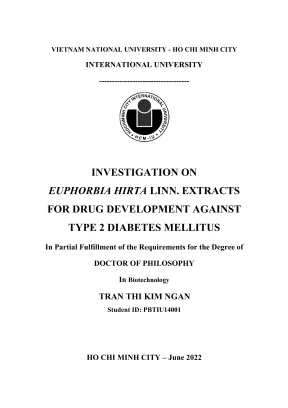
Tải xuống để đọc toàn bộVIETNAM NATIONAL UNIVERSITY - HO CHI MINH CITY INTERNATIONAL UNIVERSITY INVESTIGATION ON EUPHORBIA HIRTA LINN. EXTRACTS FOR DRUG DEVELOPMENT AGAINST TYPE 2 DIABETES MELLITUS In Partial Fulfillment of the Requirements for the Degree of DOCTOR OF PHILOSOPHY In Biotechnology TRAN THI KIM NGAN Student ID: PBTIU14001 HO CHI MINH CITY — June 2022 Investigation on Euphorbia hirta Linn. extracts for drug development against type 2 diabetes mellitus A dissertation submitted to The School of Biotechnology in partial fulfilment of the requirements for the degree of Doctor of Philosophy in Biotechnology at International University, Vietnam National University - Ho Chi Minh City Submitted by TRAN THI KIM NGAN This certifies that the Dissertation of Tran Thi Kim Ngan is approved by Examination Committee: Chairman Assoc. Nguyen Van Thuan Member Assoc.
Tran Nguyen Minh An Member Assoc. Le Tan Khoi Member PhD. Nguyen Thi Y Nhi Member PhD. Do Thi My Lien Member PhD.
Le Quang Phong June 2022 School of Biotechnology International University Vietnam National University - Ho Chi Minh City Declaration by author Thereby declare that I am the sole author and composer of my doctoral dissertation and that no other sources other than those listed have been used in the bibliography and identified as references. Furthermore, I firmly declare that my thesis has not been prepared for another examination or assignment at any other institution to obtain a degree. Author Signature and Date Print Name and Title Publications related to this dissertation International articles Authors, title, journal name, journal index, page, year ISSN No Impact factor published (SCM⁄SCT-e)) Tran, N. Spray-drying | ISSN 2304-8158 4.350 1 microencapsulation of high concentration of bioactive (SCIE) compounds fragments from Euphorbia hirta L.
extract and their effect on diabetes mellitus. Bioactive Compounds in | ISSN 2079-7737 5.079 2 | Anti-Diabetic Plants: From Herbal Medicine to Modern Drug (SCIE) Discovery. Ngan Tran, Minh Nguyen, Khanh LB Le, Nhi Nguyen, Quan | JSSN 2076-3417 2.679 3 Tran, Ly Le (2020). Screening of Antibacterial Activity, (SCIE) Antioxidant Activity, and Anticancer Activity of Euphorbia hirta Linn.
Domestic articles Authors, title, journal name, journal index, page, year No ISSN Impact factor published Trần Thi Kim Ngân, Lê Thi Lý, Nguyễn Thi Ý Nhi, Trần Thị 1 Minh, Tran Lê Quan (2017). Khảo sát thành phần hóa hoc của dịch chiết ethyl acetate từ cỏ sữa lá lớn (Euphorbia hirta Linn. Tap chí Phát trién KH&CN, tập 20, số T5-2017, trang 95-101. iv International conference and proceedings Authors, title, conference name, page ofproceeding, time and No ISSN Impact factor location organized 1 2 Domestic conference and proceedings Authors, title, conference name, page ofproceeding, time, No , , , , ISSN Impact factor and location organized Contributions by others to the dissertation No contributions by others.
Statement of parts of the dissertation submitted to qualify for the award of another degree None Research Involving Human or Animal Subjects Our research was approved by the University of Science Animal Care and Use Committee (No. vi Acknowledgements In my first word, I would like to express my deepest appreciation to my supervisor, Associate Professor Le Thi Ly, for assigning me to this incredible research. I will be eternally thankful for her outstanding excellence and continual support during the study process. Thanks to her decision, I had good opportunities to work in a professional environment at International University.
Furthermore, without her support and encouragement, I cannot complete my thesis progress as well, and she always supported and motivated me with all her heart during my thesis, especially in Covid 19 pandemic. Moreover, I express my sincere thanks to Associate Professor Tran Le Quan, from the University of Science for his ongoing assistance, helpful recommendations, scientific conversations, and significant contribution to my work. My grateful and warmest thank also goes to Le Phuoc Bao Khanh, Msc., and my colleagues at the University of Science for a considerable contribution and hard-worked find them to help me complete my experiments indeed. Also, I would like thank to Tran Hoang Song, Bsc.
and Nguyen Cong Hoi, Bsc. for their amazing technical assistance. I would like to thank Ms Mai Thi Thanh Loan, Mr. Lai Thanh Son, Ms.
Nguyen Thi Hong Hanh, Ms. Tram Thi Khanh Hien and Ms. Nguyen Pham Quynh Anh who supported me in administrative matters. I would like to thank the Rector Board of the International University and the University of Science for creating favourable conditions and helping me to complete the thesis.
I want to express my gratitude to my family, my friends, and my colleagues for the support during the research and completion of the thesis. vii CONTENTS LIST OF TABLES xii LIST OF FIGURES xiii LIST OF ABBREVIATIONS xvi Abstract xix Abstract (in Vietnamese) xxii Chapter 1: GENERAL INTRODUCTION 1 1.1 Introduction to diabetes mellitus 1 1.1 Definition of diabetes mellitus 1 1.2 Classification of diabetes mellitus 1 1. Prevalence and incidence of diabetes mellitus 3 1.4 Pathogenesis of diabetes mellitus 3 1. Medication for type 2 diabetes mellitus 5 1.3 Commonly used antidiabetic medicinal plants in Vietnam 6 1.4 _ Introduction to Euphorbia hirta Linn.44 — Bioactive compounds In E.5 Investigation of bioactive compounds of E.
hirta in Vietnam 31 1.6 Antidiabetic activity of E.6 Research objectives 36 Chapter 2: IN SILICO STUDY ON ANTIDIABETIC ACTIVITY OF BIOACTIVE COMPOUNDS IN EUPHORBIA HIRTA LINN.2 Materials and methods 39 2.1 Ligand and protein preparation 39 2.1 Docking results on AA 42 2.2 Docking results on AG 45 2.4 Discussion 47 Chapter 3: PREPARATION OF EUPHORBIA HIRTA LINN. EXTRACTS AND INVESTIGATION OF BIOACTIVE COMPOUNDS FROM ETHYL ACETATE EXTRACT 53 3.2 Materials and methods 54 3.1 | Chemicals and equipment 54 3. Plant material collection and identification 55 3. hirta extracts using maceration method 55 3.4 Phytochemical analysis of E.5 Determination of quercetin and quercitrin content in EE-1 58 3.6 Isolation of bioactive compound from EE-1 59 3.7 Identification of isolated compounds from EA extract 60 3.3 Determination of quercetin and quercitrin content in EE-1 62 3.4 Isolatlon of bioactive compound from EE-1 63 3.
Identification of isolated compounds from EE-1 68 3. hirta extraction and phytochemical analysis 86 3.2 Identification of isolated compounds from EA extract 87 Chapter 4: EVALUATION OF ANTIOXIDANT ACTIVITY AND CYTOTOXIC ACTIVITY OF EUPHORBIA HIRTA LINN.2 Materials and methods 88 4.1 Animals and materials 88 ix 4.3 — Statistical analysis 92 43 Results 92 4.1 Antioxidant activities of E.2 In vifro screening for cytotoxic activity of E.4 Discussion 94 Chapter 5: IN VITRO AND IN VIVO EXPERIMENTS OF EUPHORBIA HIRTA LINN. EXTRACTS AGAINST TYPE 2 DIABETES MELLITUS 97 5.2 Materials and methods 98 5. Animals and reagents 98 5.2 In vitro enzyme inhibitory experiments 98 5.
Evaluation of the samples on plasma glucose in oral glucose tolerance test 99 5.4 Spray-drying microencapsulation of EE-2 extract and the effect on STZ/NAD-induced mice 100 5.1 In vitro alpha-amylase inhibitory assay 102 5.2 Tr vitro alpha-glucosidase inhibitory assay 103 5. Evaluation of the samples on plasma glucose in oral glucose tolerance test 105 5.4 | Spray-drying microencapsulation 107 5.1 In vitro enzyme inhibitory experiments on isolated compounds 111 5.2 Evaluation of the #. Airta extracts and isolated compound in fasting plasma glucose 113 5.3 Spray-drying microencapsulation 114 Chapter 6: GENERAL CONCLUSIONS 117 6.1 The main results of the dissertation 117 6.2 _ The scientific and practical contributions of the dissertation 119 6. Recommendation 120 REFERENCES 122 LIST OF APPENDICES 150 APPENDICES 151 xi LIST OF TABLES Table 1.1 Classification of main phytoconstituents of Gymnema sylvestre 12 Table 1.2 Some major isolated phytoconstituents on P.1 Center grid box coordinates for docking simulation of AA and AG _—40 Table 2.
hirta and their ID 4I Table 3.1 Solvent program in determination of quercetin content in EE-1 58 Table 3.2 Solvent program in determination of quercitrin content in EE-1 59 Table 3.3 Weight and yield of extract after liquid-liquid extract 60 Table 3.4 Total phenolic and flavonoid contents in #. hirta extracts 61 Table 3.5 'H NMR and °C NMR data of EA01 with scopoletin 69 Table 3.6 'H NMR and °C NMR data of EA02 with methyl gallate 70 Table 3.7 'H NMR and '3C NMR data of EA03 with gallic acid 71 Table 3.8 'H NMR and 3C NMR data of EA04 with kaempferol 72 Table 3.9 'H NMR and !3C NMR data of EA05 with quercetin 74 Table 3.10 'H and °C spectroscopic data of EA06 and myricetin 76 Table 3.11 TH, !C, HMBC and COSY NMR spectroscopic data of EA07 and afzelin 78 Table 3.12 !H, °C, HMBC and COSY NMR spectroscopic data of EA0§ and quercitrin 80 Table 3.13 'H and !C-NMR spectroscopic data of EA09 and myricitrin 82 Table 3.14 'H and '3C-NMR spectroscopic data of EA10 and rutin 84 Table 3.15 Comparison TPC and TFC of £. hirta in previous studies 87 Table 4.1 DPPH radical scavenging activity of extracts 92 Table 4.2 Lipid peroxidation inhibitory activity of E. hirta extracts 93 Table 4.3 DPPH radical scavenging activity of E.
hirta extracts 95 Table 5.1 AA inhibitory activity of E.2 AA inhibitory activity of isolated compounds.3 AG inhibitory activity of E. hirta extracts 104 Table 5.4 AG inhibitory activity of isolated compounds.5 Results of the sample effect after 7-day dose on plasma glucose level _ 105 Table 5.6 Physical properties of spray power 107 Table 5.7 Pyramiding dose 108 xii LIST OF FIGURES Figure 1.1: Insulin signaling pathway to bring glucose into cells 4 Figure 1.2 Pictures show the morphological characteristics of the Momordica charantia: whole plant (left) and unripe fruit (right) 7 Figure 1.3 Mechanism in decreasing blood glucose levels of M.4 Commercial products using for DM treatment in Vietnam 8 Figure 1.6 Mechanisms of Panax ginseng saponins on different organs related to diabetes 10 Figure 1.7 Basic molecular structure of Gymnemic acid 11 Figure 1.8 Mechanisms of Gymnema sylvestre in antidiabetic activity 12 Figure 1.10 Euphorbia hirta Linn.11 The structure of flavonoids extracted from È.12 The structure of lignans isolated from E.13 The structure of some tannins isolated from E.14 The structure of terpenoids isolated from E.15 The structure of sterols isolated from E.16 The structure of acids isolated from E.17 The structure of phytochemicals in essential oil of E.18 The structure of other compounds isolated from E.1 Elements in molecular docking 39 Figure 2.2 Grid box location for docking simulation of (A) alpha-amylase and (B) alpha-glucosidase showed with PMV software 40 Figure 2.3 The total process to identify potential compounds on AA and AG and its pharmacophore interactions 42 Figure 2.4 Total docking score of all 48 compounds on AA and control compound (Acarbose) (C) 43 Figure 2.5 Chemical structure of top 5 compounds that have lowest docking score on AA.6 Pharmacophore analysis by using LigandScout of control compound and top 5 compounds on AA 45 xiii Figure 2.7 Chemical structure of top 5 compounds that have the lowest docking score on AG: (a) xanthorhamnin, (b) Ø-amyrine, (c) cyanidin 3,5-O-diglucoside, (d) (-)- epicatechin 3-gallate and (e) tinyatoxin 46 Figure 2.8 Total docking score of all 48 compounds on AG and control compound (Acarbose) (C) 46 Figure 2.9 Pharmacophore analysis by using LigandScout of control compound and top 5 compounds on AG 47 Figure 2.10 Pharmacophore interaction comparison between AA (left) and AG (right) of some compounds in E.1 The chart indicates the process of solvent extraction 56 Figure 3.2 The Folin—Ciocalteu reaction (W, tungsten; Mo, molybdenum reacting with polyphenol groups in an oxidation-reduction reaction) 57 Figure 3.3 The process of identification of bioactive compounds and biological experiments 59 Figure 3.4 HPLC-DAD analysis of quercetin in EE-1 62 Figure 3.5 HPLC-DAD analysis of quercitrin in EE-1 62 Figure 3.6 Normal silica gel column chromatography of EA extract 63 Figure 3.7 TLC results with solvent mixture and visualize by 25% sulfuric acid 64 Figure 3.8 Schematic diagram of the isolation of bioactive compounds of EE-1 (part 1) 66 Figure 3.9 Schematic diagram of the isolation of bioactive compounds of EE-1 (part 2) 67 Figure 3.
Nội dung được bảo vệ bản quyền — Tải xuống đầy đủ
Trích dẫn luận án này
Tran Thi Kim Ngan (2022). Luận án tiến sĩ: Investigation on Euphorbia hirta Linn. extracts for drug development against type 2 diabetes mellitus [Luận án tiến sĩ, International University, Vietnam National University - Ho Chi Minh City]. LuanAn.net. https://luanan.net/khoa-hoc-giao-duc/luan-an-tien-si-investigation-on-euphorbia-hirta-linn-extracts-for-drug-development-against-type-2-diabetes-mellitus
Từ khóa và chủ đề nghiên cứu
Từ khóa liên quan
Chủ đề nghiên cứu
Câu hỏi thường gặp
Luận án "Luận án tiến sĩ: Investigation on Euphorbia hirta Linn. extracts for drug development against type 2 diabetes mellitus" nghiên cứu về vấn đề gì?
Nghiên cứu chiết xuất Euphorbia hirta Linn. (Cỏ Sữa Lá Lớn) cho phát triển thuốc trị tiểu đường type 2. Đánh giá tiềm năng dược liệu mới.
Luận án "Luận án tiến sĩ: Investigation on Euphorbia hirta Linn. extracts for drug development against type 2 diabetes mellitus" được bảo vệ tại trường nào?
Luận án này được bảo vệ tại International University, Vietnam National University - Ho Chi Minh City. Năm bảo vệ: 2022.
Luận án "Luận án tiến sĩ: Investigation on Euphorbia hirta Linn. extracts for drug development against type 2 diabetes mellitus" thuộc chuyên ngành gì?
Luận án "Luận án tiến sĩ: Investigation on Euphorbia hirta Linn. extracts for drug development against type 2 diabetes mellitus" thuộc chuyên ngành Biotechnology. Danh mục: Khoa Học Giáo Dục.
Luận án "Luận án tiến sĩ: Investigation on Euphorbia hirta Linn. extracts for drug development against type 2 diabetes mellitus" có bao nhiêu trang?
Luận án "Luận án tiến sĩ: Investigation on Euphorbia hirta Linn. extracts for drug development against type 2 diabetes mellitus" có 232 trang. Bạn có thể xem trước một phần tài liệu ngay trên trang web trước khi tải về.
Cách tải luận án "Luận án tiến sĩ: Investigation on Euphorbia hirta Linn. extracts for drug development against type 2 diabetes mellitus" về máy như thế nào?
Để tải luận án về máy, bạn nhấn nút "Tải xuống ngay" trên trang này, sau đó hoàn tất thanh toán phí lưu trữ. File sẽ được tải xuống ngay sau khi thanh toán thành công. Hỗ trợ qua Zalo: 0559 297 239.