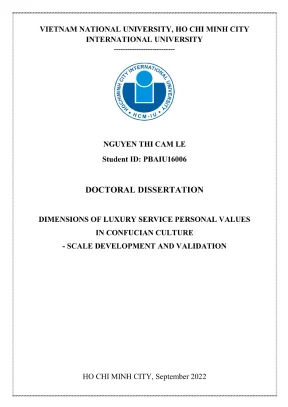
Luận án tiến sĩ: Dimensions of luxury service personal values in confucian culture – scale development and validation
Luận án phát triển và xác thực thang đo các khía cạnh giá trị cá nhân trong dịch vụ xa xỉ, đặc biệt trong bối cảnh văn hóa Nho giáo.
Vietnam National University, HCMC International University
Luan An
Luận án tiến sĩ
Năm xuất bản
Số trang
265
Thời gian đọc
40 phút
Lượt xem
1
Lượt tải
0
Phí lưu trữ
50 Point
Tổng quan nhanh
- Chủ đề:
- 1. Khám Phá Giá Trị Cá Nhân Dịch Vụ Sang Trọng
- Số trang:
- 265 trang
- Trường:
- Vietnam National University, HCMC International University
- Tác giả:
- Nguyen Thi Cam Le
- Năm:
- 2022
Tóm tắt nội dung luận án
I. Khám Phá Giá Trị Cá Nhân Dịch Vụ Sang Trọng
Nội dung luận án tiến sĩ này tập trung vào việc phát triển và xác nhận thang đo giá trị cá nhân trong dịch vụ sang trọng theo văn hóa Nho giáo. Tác giả đã chỉ ra các yếu tố chính ảnh hưởng đến trải nghiệm dịch vụ sang trọng, bao gồm sự tự nhận thức và các giá trị xã hội. Luận án cung cấp cái nhìn sâu sắc về cách mà văn hóa Nho giáo định hình nhận thức của người tiêu dùng về dịch vụ sang trọng.
1.1. Tổng Quan Về Dịch Vụ Sang Trọng
Dịch vụ sang trọng không chỉ đơn thuần là sản phẩm cao cấp mà còn chứa đựng các giá trị tinh thần và cảm xúc. Các yếu tố như sự trải nghiệm và cảm giác đặc biệt đóng vai trò quan trọng trong việc tạo nên dịch vụ sang trọng.
1.2. Tầm Quan Trọng Của Văn Hóa Nho Giáo
Văn hóa Nho giáo ảnh hưởng mạnh mẽ đến hành vi tiêu dùng. Sự tôn trọng truyền thống và các giá trị xã hội là những yếu tố then chốt trong cách người tiêu dùng tiếp cận dịch vụ sang trọng.
II. Phát Triển Thang Đo Giá Trị Cá Nhân Dịch Vụ Sang Trọng
Quá trình phát triển thang đo giá trị cá nhân trong dịch vụ sang trọng dựa trên nền tảng lý thuyết vững chắc. Các bước phát triển bao gồm phân tích định tính và định lượng nhằm đảm bảo độ tin cậy và hợp lệ của thang đo. Luận án sử dụng phương pháp nghiên cứu hỗn hợp để thu thập dữ liệu từ nhiều nguồn khác nhau.
2.1. Quy Trình Phát Triển Thang Đo
Quy trình bao gồm việc xác định các khái niệm cơ bản, phát triển các mục câu hỏi, và kiểm tra độ tin cậy của thang đo thông qua các nghiên cứu mẫu khác nhau.
2.2. Kiểm Tra Độ Tin Cậy Và Hợp Lệ
Sử dụng các phương pháp phân tích như phân tích khám phá và phân tích khẳng định để đánh giá sự hợp lệ của các mục trong thang đo. Kết quả cho thấy rằng thang đo có độ tin cậy cao và phù hợp với các giá trị văn hóa Nho giáo.
III. Kết Quả Nghiên Cứu Định Tính Về Giá Trị Cá Nhân
Nghiên cứu định tính được thực hiện thông qua các cuộc thảo luận nhóm tập trung để khai thác sâu hơn về các giá trị cá nhân liên quan đến dịch vụ sang trọng. Các kết quả cho thấy người tiêu dùng có xu hướng tìm kiếm sự công nhận và khẳng định vị thế xã hội thông qua việc tiêu dùng dịch vụ sang trọng.
3.1. Phân Tích Nội Dung Cuộc Thảo Luận Nhóm
Các cuộc thảo luận làm nổi bật các yếu tố như giá trị tự nâng cao và nhu cầu về sự chấp nhận xã hội. Những giá trị này ảnh hưởng mạnh mẽ đến quyết định tiêu dùng trong lĩnh vực dịch vụ sang trọng.
3.2. Xu Hướng Tiêu Dùng Dịch Vụ Sang Trọng
Người tiêu dùng trong văn hóa Nho giáo có xu hướng ưu tiên các dịch vụ không chỉ đáp ứng nhu cầu cá nhân mà còn thể hiện được sự đẳng cấp và giá trị xã hội.
IV. Kết Luận Về Giá Trị Cá Nhân Trong Dịch Vụ Sang Trọng
Luận án đã chỉ ra rằng giá trị cá nhân trong dịch vụ sang trọng không chỉ phản ánh mong muốn tiêu dùng mà còn chịu ảnh hưởng bởi các yếu tố văn hóa. Việc hiểu rõ những yếu tố này giúp các doanh nghiệp phục vụ tốt hơn nhu cầu của khách hàng trong bối cảnh văn hóa Nho giáo.
4.1. Ý Nghĩa Đối Với Doanh Nghiệp
Doanh nghiệp cần hiểu và thích ứng với các giá trị văn hóa để phát triển chiến lược tiếp thị hiệu quả. Điều này sẽ tạo ra lợi thế cạnh tranh trong ngành dịch vụ sang trọng.
4.2. Đề Xuất Cho Nghiên Cứu Tương Lai
Nghiên cứu cần mở rộng hơn nữa để khám phá các khía cạnh khác của giá trị dịch vụ trong các nền văn hóa khác nhau, từ đó xây dựng các thang đo tương ứng.
Mục lục chi tiết luận án
Tải xuống file đầy đủ để xem toàn bộ nội dung
Tải đầy đủ (265 trang)Nội dung chính
Tổng quan về luận án
Sự chuyển dịch mang tính cấu trúc của thị trường xa xỉ toàn cầu từ phương Tây sang các nền kinh tế đang phát triển tại châu Á đã thúc đẩy nhu cầu tái định vị lý thuyết về hành vi tiêu dùng cao cấp. Báo cáo của Bain & Company (D’Arpizio et al., 2019) ghi nhận ngành công nghiệp xa xỉ toàn cầu đạt quy mô 915 tỷ USD năm 2018 và dự phóng chạm mức 1.260 tỷ USD vào năm 2024, trong đó phân khúc xa xỉ trải nghiệm (experiential luxury) – điển hình là dịch vụ khách sạn và nghỉ dưỡng cao cấp – chiếm ưu thế vượt trội với kỳ vọng đạt 238,49 tỷ USD vào năm 2028 (Fortune Business Insights, 2021). Tại Việt Nam, một nền văn hóa mang đậm dấu ấn Nho giáo (Confucian dynamism), sự gia tăng nhanh chóng của tầng lớp trung lưu và thượng lưu mới (chiếm 13% dân số năm 2018 và ước tính đạt 26% vào năm 2026 theo World Bank, 2020) cùng với sự bùng nổ của hơn 442 khách sạn 4-5 sao (Grant Thornton, 2019) đã kiến tạo một bối cảnh thực chứng lý tưởng để nghiên cứu sự tương tác giữa bản sắc văn hóa phương Đông và tiêu dùng dịch vụ xa xỉ.
Khoảng trống học thuật cốt lõi (research gap) nằm ở chỗ: các mô hình đo lường giá trị cá nhân dịch vụ hiện hữu, tiêu biểu là thang đo SERPVAL do Lages & Fernandes (2005) phát triển, được định hình thuần túy trong bối cảnh dịch vụ thông thường (viễn thông di động) tại các quốc gia phương Tây có tính cá nhân hóa cao. SERPVAL phân loại giá trị dịch vụ thành ba thành tố: Cuộc sống bình yên (Service Values to Peaceful Life - SVPL), Sự công nhận xã hội (Service Values to Social Recognition - SVSR), và Sự hòa nhập xã hội (Service Values to Social Integration - SVSI). Tuy nhiên, cấu trúc này bộc lộ sự bất cập khi tiếp cận dịch vụ xa xỉ – vốn mang bản chất vô hình, trải nghiệm hưởng thụ cao cấp (hedonic exclusivity), tính không thể tách rời và cá nhân hóa sâu sắc (Wirtz et al., 2020; Manfreda et al., 2022). Đồng thời, SERPVAL hoàn toàn bỏ qua các chuẩn mực văn hóa Nho giáo đặc thù như ý thức thể diện (face-saving consciousness), sự tự hoàn thiện và cấu trúc bản ngã tập thể (interdependent self-construal) vốn chi phối hành vi người tiêu dùng châu Á (Monkhouse et al., 2013; Wong & Ahuvia, 1998).
Nhằm giải quyết triệt để khoảng trống trên, luận án tập trung vào 3 câu hỏi nghiên cứu trọng tâm:
- RQ1: Cấu trúc khái niệm Giá trị cá nhân dịch vụ xa xỉ (Luxury Service Personal Values - Luxury SPV) trong bối cảnh văn hóa Nho giáo được định nghĩa và cấu thành từ những thành tố nào?
- RQ2: Thang đo chuẩn hóa để lượng hóa cấu trúc Luxury SPV được thiết lập và kiểm định độ giá trị (validity) cùng độ tin cậy (reliability) theo quy trình tâm trắc học chuẩn mực như thế nào?
- RQ3: Mối quan hệ tương quan quy luật giữa cấu trúc Luxury SPV với các biến số kết quả tâm lý học hành vi bao gồm Sự hài lòng của khách hàng (Customer Satisfaction - CS) và Ý định truyền miệng tích cực (Positive Word-of-Mouth - WOM) được biểu hiện ra sao?
Hệ thống giả thuyết nghiên cứu được thiết lập cụ thể:
- H1: Cấu trúc giá trị cá nhân dịch vụ xa xỉ (Luxury SPV) có tác động tích cực cùng chiều đến Sự hài lòng của khách hàng (CS).
- H1a, H1b, H1c, H1d: Từng thành tố bậc một của Luxury SPV tác động tích cực đến Sự hài lòng của khách hàng.
- H2: Cấu trúc giá trị cá nhân dịch vụ xa xỉ (Luxury SPV) có tác động tích cực cùng chiều đến Hành vi truyền miệng tích cực (WOM).
- H2a, H2b, H2c, H2d: Từng thành tố bậc một của Luxury SPV tác động tích cực đến Hành vi truyền miệng tích cực.
Khung lý thuyết nền tảng tích hợp ba trụ cột: Lý thuyết Chuỗi Phương tiện - Mục đích (Means-End Chain Theory - Gutman, 1982; Zeithaml, 1988), Lý thuyết Bản ngã mở rộng (Self-Concept Theory & Extended-Self - Belk, 1988; Turner, 1968), và Lý thuyết So sánh xã hội (Social Comparison Theory - Festinger, 1954; Wood, 1996; Drezé & Nunes, 2009). Đóng góp đột phá của luận án là xây dựng và kiểm định thành công thang đo LUXSPV gồm 4 chiều không gian đa diện: Cuộc sống trải nghiệm (Experiential Life - EL), Nâng cao bản thân (Self-Enhancement - SE), Sự công nhận xã hội (Social Recognition - SR), và Sự hòa nhập xã hội (Social Integration - SI). Nghiên cứu được triển khai toàn diện trong khung thời gian 2018–2020 trên cỡ mẫu khách hàng thực tế sử dụng dịch vụ khách sạn 4–5 sao tại các trung tâm kinh tế - du lịch trọng điểm của Việt Nam (TP.HCM, Hà Nội, Đà Nẵng, Nha Trang, Phú Quốc).
Literature Review và Positioning
Nghiên cứu về giá trị cá nhân trong hành vi người tiêu dùng bắt nguồn từ công trình kinh điển của Rokeach (1968, 1973) với Khảo sát Giá trị Rokeach (RVS), xác lập định nghĩa giá trị là "a centrally held, enduring belief which guides actions and judgments across specific situations and beyond immediate goals to more ultimate end-states of existence" (tr. 161). Khái niệm này sau đó được mở rộng qua Danh mục Giá trị (LOV) của Kahle (1983) và Thuyết Giá trị cơ bản của Schwartz (1992, SVS/PVQ). Trong lĩnh vực tiếp thị dịch vụ, Zeithaml (1988) vận dụng Lý thuyết Chuỗi Phương tiện - Mục đích (MEC) để thiết lập mô hình thứ bậc nhận thức 4 tầng tăng dần theo mức độ trừu tượng: Thuộc tính dịch vụ (Service Attributes) $\rightarrow$ Chất lượng dịch vụ (Service Quality) $\rightarrow$ Giá trị dịch vụ (Service Perceived Value) $\rightarrow$ Giá trị cá nhân (Personal Values). Lages & Fernandes (2005) kế thừa mô hình này để đề xuất khái niệm Giá trị cá nhân dịch vụ (SPV) và thang đo SERPVAL, khẳng định giá trị cá nhân là tầng nhận thức tối cao định hướng việc lựa chọn và gắn kết dài hạn với dịch vụ.
Tuy nhiên, văn hiến học thuật tồn tại những tranh luận sâu sắc chưa được giải quyết giữa hai luồng quan điểm:
- Luồng quan điểm tiêu dùng xa xỉ vật chất đối trọng với tiêu dùng xa xỉ trải nghiệm: Trường phái truyền thống dựa trên Hiệu ứng Veblen (1899) và Hiệu ứng Snob/Bandwagon (Leibenstein, 1950) cho rằng giá trị xa xỉ chủ yếu xuất phát từ việc sở hữu của cải hữu hình nhằm biểu đạt địa vị kinh tế. Ngược lại, trường phái hiện đại (Lusch & Nambisan, 2015; Holmqvist et al., 2020; Wirtz et al., 2020) nhấn mạnh Logic dịch vụ chi phối (Service-Dominant Logic), khẳng định dịch vụ xa xỉ là một quá trình đồng kiến tạo giá trị, nơi sự hưởng thụ khoảnh khắc ("a beautiful moment for oneself") và cảm xúc nội tại vượt trội hơn quyền sở hữu vật chất đơn thuần.
- Tranh luận về động cơ tiêu dùng phô trương trong văn hóa Nho giáo: Các học giả phương Tây thường đồng nhất văn hóa tập thể Đông Á với tính tuân thủ xã hội (social conformity) và ý thức thể diện (Wong & Ahuvia, 1998; Li et al., 2012). Tuy nhiên, Hung (2018) và Manfreda et al. (2022) phản biện rằng người tiêu dùng Á Đông hiện đại sử dụng dịch vụ khách sạn xa xỉ không chỉ để hòa nhập nhóm mà còn để tìm kiếm sự phân biệt xã hội (social differentiation) và củng cố bản ngã cá nhân độc lập.
Về mặt định vị nghiên cứu, luận án đặt mình tại giao điểm giữa Tiếp thị dịch vụ cao cấp và Tâm lý học văn hóa Nho giáo. Luận án tiến hành đối sánh trực tiếp với hai nghiên cứu quốc tế điển hình:
- So sánh với nghiên cứu gốc của Lages & Fernandes (2005) tại Bồ Đào Nha: Luận án chứng minh chiều kích "Cuộc sống bình yên" (Peaceful life) của SERPVAL không đủ năng lực giải thích trạng thái hưng phấn, khoái lạc và phong cách sống thượng lưu trong dịch vụ cao cấp, từ đó phát triển chiều kích "Cuộc sống trải nghiệm" (Experiential Life) và "Nâng cao bản thân" (Self-Enhancement).
- So sánh với nghiên cứu của Lu et al. (2015) và Yang et al. (2017) về sự khác biệt văn hóa Pháp - Trung Quốc: Trong khi khách hàng Pháp (chủ nghĩa cá nhân) cảm nhận dịch vụ xa xỉ qua các khái niệm trừu tượng như sự tự do và không gian riêng tư, khách hàng Trung Quốc (chủ nghĩa tập thể) lại chú trọng vào sự trang hoàng lộng lẫy và địa vị xã hội. Luận án làm rõ bức tranh chuyển dịch tại Việt Nam, nơi người tiêu dùng Nho giáo đương đại vừa tìm kiếm sự công nhận đẳng cấp từ xã hội, vừa chủ động nâng cao giá trị tự thân và phẩm vị cá nhân thông qua trải nghiệm cao cấp.
+-----------------------------------------------------------------------------------+
|                            HỆ THỐNG THỨ BẬC NHẬN THỨC                             |
|             (Mô hình Chuỗi Phương tiện - Mục đích: Zeithaml, 1988)                 |
+-----------------------------------------------------------------------------------+
                                         |
                                         v
               [Tầng 1: Thuộc tính dịch vụ] (Cơ sở vật chất 5 sao, Tiện nghi)
                                         |
                                         v
               [Tầng 2: Chất lượng dịch vụ] (Độ tin cậy, Sự đáp ứng, Phục vụ)
                                         |
                                         v
               [Tầng 3: Giá trị dịch vụ] (Đánh đổi Chi phí - Lợi ích thụ hưởng)
                                         |
                                         v
  +-------------------------------------------------------------------------------+
  |        [TẦNG 4: GIÁ TRỊ CÁ NHÂN DỊCH VỤ XA XỈ - LUXURY SPV (Tối cao)]          |
  |  - Cuộc sống trải nghiệm (EL)         - Nâng cao bản thân (SE)                |
  |  - Sự công nhận xã hội (SR)           - Sự hòa nhập xã hội (SI)               |
  +-------------------------------------------------------------------------------+
Đóng góp lý thuyết và khung phân tích
Đóng góp cho lý thuyết
Luận án mở rộng biên độ giải thích của Lý thuyết Chuỗi Phương tiện - Mục đích (MEC) bằng việc tích hợp Lý thuyết Bản ngã (Self-Concept Theory) như một vi thành tố nhận thức cốt lõi. Trong tư tưởng của William James (1890, tr. 291-292), bản ngã con người là tổng hòa của tất cả những gì họ sở hữu: "a man’s Self is the sum total of all that he CAN call his not only his body and his psychic powers, but his clothes and his house, his wife and children, his ancestors and friends his reputation and works...". Belk (1988, tr. 140) đã kế thừa và khái quát hóa thành luận điểm Bản ngã mở rộng (Extended-Self), khẳng định trải nghiệm tiêu dùng chính là phương thức phản chiếu căn tính cá nhân rõ nét nhất. Luận án chứng minh rằng tiêu dùng khách sạn xa xỉ cho phép khách hàng đạt được trạng thái bản ngã lý tưởng (ideal self) và nâng cao lòng tự trọng thông qua việc tận hưởng những giá trị thẩm mỹ và thành tựu cá nhân, đúng như khẳng định của Kim & Kwon (2017, tr. 33): "allow consumers to feel a greater sense of beauty, achievement and success and thus improve their quality of life".
Đồng thời, luận án làm phong phú Lý thuyết So sánh xã hội (Social Comparison Theory) trong dịch vụ lưu trú cao cấp. Khi tiếp cận các quyền lợi đặc quyền (exclusive privileges) tại khách sạn 5 sao, khách hàng thực hiện cơ chế so sánh xã hội hướng xuống (downward social comparison) so với các phân khúc tiêu dùng phổ thông (Drezé & Nunes, 2009; Osaki & Kubota, 2016). Sự so sánh này không chỉ mang tính biểu tượng bên ngoài mà trực tiếp chuyển hóa thành cảm xúc tự hào, định hình giá trị tự tôn (Self-Enhancement) và sự khẳng định vị thế (Social Recognition).
                      +-----------------------------+
                      |    LÝ THUYẾT NỀN TẢNG       |
                      | - Means-End Chain (MEC)     |
                      | - Extended-Self Concept     |
                      | - Social Comparison Theory  |
                      +--------------+--------------+
                                     |
                                     v
                 +---------------------------------------+
                 |    CẤU TRÚC LUXURY SPV (BẬC HAI)      |
                 +---------------------------------------+
                   /          |             |          \
                  /           |             |           \
                 v            v             v            v
          +------------+ +------------+ +------------+ +------------+
          | Experiential| |    Self-   | |   Social   | |   Social   |
          |    Life    | | Enhancement| |Recognition | |Integration |
          |    (EL)    | |    (SE)    | |    (SR)    | |    (SI)    |
          +-----+------+ +-----+------+ +-----+------+ +-----+------+
                \              |              |              /
                 \             |              |             /
                  v            v              v            v
            +---------------------------------------------------+
            |           KẾT QUẢ TÂM LÝ & HÀNH VI                 |
            | - Sự hài lòng khách hàng (Customer Satisfaction)  |
            | - Truyền miệng tích cực (Positive Word-of-Mouth)  |
            +---------------------------------------------------+
Khung phân tích độc đáo
Khung phân tích của luận án tích hợp liên ngành 4 nền tảng lý thuyết: MEC, Bản ngã mở rộng, So sánh xã hội và Logic dịch vụ chi phối. Cấu trúc Luxury SPV được thiết lập dưới dạng mô hình nhân tố bậc hai (second-order reflective construct) với 4 thành tố thành phần có định nghĩa thao tác hóa cụ thể:
- Cuộc sống trải nghiệm (Experiential Life - EL): Nhận thức của khách hàng về việc dịch vụ xa xỉ mang lại cảm giác hưởng thụ đỉnh cao, thư giãn tinh thần sâu sắc, tái tạo năng lượng và mở rộng thế giới quan sống.
- Nâng cao bản thân (Self-Enhancement - SE): Sự gia tăng cảm xúc tích cực về giá trị tự thân, cảm giác thành đạt, khẳng định sự tự tin và phản chiếu phong cách sống ưu tú cá nhân.
- Sự công nhận xã hội (Social Recognition - SR): Mức độ dịch vụ xa xỉ giúp khách hàng nhận được sự tôn trọng, ngưỡng mộ và khẳng định vị thế danh giá từ những người xung quanh.
- Sự hòa nhập xã hội (Social Integration - SI): Năng lực của trải nghiệm dịch vụ trong việc kết nối, thắt chặt mối quan hệ tình cảm gia đình, bạn bè và tạo lập mạng lưới xã hội cùng đẳng cấp.
Điều kiện biên (Boundary conditions): Khung phân tích được xác lập đặc thù cho các dịch vụ mang tính trải nghiệm xa xỉ cao cấp (khách sạn/resort 4-5 sao) trong các nền văn hóa chịu ảnh hưởng của Nho giáo đang chuyển dịch kinh tế mạnh mẽ.
Phương pháp nghiên cứu tiên tiến
Thiết kế nghiên cứu
Luận án vận dụng thế giới quan thực dụng / hậu thực chứng (pragmatism / post-positivism), kết hợp hài hòa giữa phương pháp định tính diễn giải (interpretivism) để khám phá cấu trúc khái niệm và phương pháp định lượng thực chứng (positivism) để thanh lọc và chuẩn hóa thang đo tâm trắc học. Thiết kế nghiên cứu đa tầng được tổ chức qua 5 nghiên cứu độc lập (Study 1 đến Study 5) thuộc 4 giai đoạn logic chặt chẽ:
+---------------------------------------------------------------------------------------------------+
|                                 QUY TRÌNH PHÁT TRIỂN THANG ĐO LUXSPV                              |
+---------------------------------------------------------------------------------------------------+
  [GIAI ĐOẠN 1] Nghiên cứu 1 (Định tính): 3 Thảo luận nhóm tập trung (FGD) -> Khám phá 5 chiều khái niệm
        |
        v
  [GIAI ĐOẠN 2] Nghiên cứu 2 (Đánh giá chuyên gia): Ban chuyên gia (N=10) -> Đánh giá CVR, CVI, IA, PA
        |
        v
  [GIAI ĐOẠN 3] Nghiên cứu 3 (Định lượng phân tích): Mẫu phân tích (Analysis Sample) -> EFA & Alpha
        |
        v
  [GIAI ĐOẠN 4] Nghiên cứu 4 (Định lượng xác nhận): Mẫu kiểm định (Validation Sample) -> CFA & SEM bậc hai
        |
        v
  [GIAI ĐOẠN 5] Nghiên cứu 5 (Định lượng tái lặp): Mẫu tái lập (Replication Sample) -> Nomological Validity
+---------------------------------------------------------------------------------------------------+
Quy trình nghiên cứu rigorous
- Giai đoạn 1 - Xác lập miền khái niệm (Nghiên cứu 1): Thực hiện 3 cuộc thảo luận nhóm tập trung (Focus Group Discussions - FGDs) với người tiêu dùng dịch vụ khách sạn xa xỉ, mã hóa dữ liệu theo phương pháp phân tích chủ đề (thematic analysis) và tạo lập sơ đồ đám mây từ khóa (word clouds), trích xuất 5 nhóm chủ đề tiềm năng ban đầu: EL, SR, SI, SE và Face-saving consciousness (FC).
- Giai đoạn 2 - Thẩm định nội dung đo lường (Nghiên cứu 2): Sử dụng bảng hỏi lấy ý kiến hội đồng chuyên gia gồm 10 học giả và nhà quản trị cấp cao trong ngành khách sạn. Đánh giá tính phù hợp thông qua Chỉ số hiệu lực nội dung (Content Validity Index - CVI), Tỷ lệ hiệu lực nội dung (Content Validity Ratio - CVR), Độ mơ hồ của biến quan sát (Item Ambiguity - IA) và Tỷ lệ đồng thuận (Percentage Agreement - PA) để sàng lọc danh mục biến tiềm năng.
- Giai đoạn 3 & 4 - Thanh lọc và Kiểm định thang đo (Nghiên cứu 3 & 4):
- Chiến lược lấy mẫu: Chọn mẫu phi xác suất kết hợp tiêu chí gạn lọc nghiêm ngặt (khách hàng từ 18 tuổi trở lên, đã từng lưu trú tại khách sạn 4-5 sao tại Việt Nam ít nhất 1 lần trong 3 tháng gần nhất).
- Triệt tiêu sai lệch phương pháp chung (Common Method Variance - CMV): Áp dụng kỹ thuật ẩn danh thông tin, đảo trật tự câu hỏi, và kiểm định thống kê đơn nhân tố của Harman (Harman’s Single Factor Test) cùng kiểm định CFA đa nhân tố.
- Kiểm định tâm trắc học: Phân tích nhân tố khám phá (EFA), Phân tích nhân tố khẳng định (CFA), Phân tích độ tin cậy tổng hợp (Composite Reliability - CR), Phương sai trích trung bình (Average Variance Extracted - AVE), và kiểm định sai biệt Chi-bình phương ($\Delta \chi^2$) giữa các mô hình cạnh tranh.
Data và phân tích
Dữ liệu được xử lý bằng phần mềm chuyên dụng SPSS và AMOS phiên bản cao cấp.
- Phân tích EFA: Sử dụng phương pháp trích hệ số trục chính (Principal Axis Factoring) kết hợp phép quay vuông góc/nghiêng (Promax rotation), loại bỏ các biến quan sát có hệ số tải nhân tố (factor loading) $< 0.50$ hoặc tải chéo (cross-loading) cao.
- Phân tích CFA & SEM bậc hai: Kiểm định mô hình đo lường với các chỉ số thích hợp mô hình nghiêm ngặt: $CFI > 0.90$, $TLI > 0.90$, $RMSEA < 0.08$, $SRMR < 0.08$, và $\chi^2/df < 3.0$.
- Độ hội tụ và Phân biệt: Tất cả các biến tiềm ẩn đạt chuẩn $CR > 0.70$, $AVE > 0.50$. Giá trị phân biệt được xác nhận vững chắc khi căn bậc hai của AVE lớn hơn tất cả các hệ số tương quan liên nhân tố tương ứng (tiêu chuẩn Fornell-Larcker) và kiểm định sai biệt $\Delta \chi^2$ giữa mô hình tự do và mô hình giới hạn hệ số tương quan bằng 1 luôn đạt mức ý nghĩa thống kê $p < 0.001$.
Phát hiện đột phá và implications
Những phát hiện then chốt
- Xác lập cấu trúc 4 chiều của thang đo LUXSPV: Nghiên cứu đã hệ thống hóa và chứng minh thực nghiệm rằng Giá trị cá nhân dịch vụ xa xỉ trong văn hóa Nho giáo được đo lường chính xác thông qua 4 thành tố bậc một (EL, SE, SR, SI), phản ánh một cấu trúc bậc hai hoàn chỉnh với các trọng số chuẩn hóa đều đạt mức ý nghĩa thống kê vượt trội ($p < 0.001$).
- Phát hiện nghịch trực giác về Ý thức giữ gìn thể diện (Face-Saving Consciousness - FC): Mặc dù yếu tố "Thể diện" xuất hiện rất đậm nét trong nghiên cứu định tính ban đầu (Study 1) như một giá trị đặc thù của Nho giáo, tuy nhiên trong các bước phân tích định lượng (EFA và CFA tại Study 3 và 4), các biến quan sát đo lường FC không hình thành một nhân tố độc lập khả dĩ mà bị hòa lẫn hoặc bị loại bỏ do hệ số tải nhân tố thấp và trùng lặp ý niệm với Tự nâng cao bản thân (SE) và Công nhận xã hội (SR).
- Giải thích lý thuyết: Xã hội Á Đông hiện đại đang trải qua quá trình hội nhập sâu sắc với văn hóa phương Tây. Đúng như nhận định của Moore (2005, tr. 372), thế hệ khách hàng mới có "viewpoints and attitudes are profoundly different from those of their parents". Khái niệm thể diện truyền thống vốn mang tính chất phòng thủ, thụ động đối phó với áp lực nhóm (passive conformity) đã chuyển hóa thành nhu cầu chủ động khẳng định vị thế và tôn vinh năng lực bản thân một cách tích cực thông qua tiêu dùng dịch vụ cao cấp.
- Mối quan hệ tác động mạnh mẽ đến Hành vi người tiêu dùng: Kết quả phân tích mô hình phương trình cấu trúc (SEM) tại Nghiên cứu 5 (Replication sample) khẳng định LUXSPV tác động tích cực có ý nghĩa thống kê cao đến Sự hài lòng khách hàng ($p < 0.001$) và Hành vi truyền miệng tích cực ($p < 0.001$). Trong đó, hai chiều kích mang tính nội tại là Cuộc sống trải nghiệm (EL) và Nâng cao bản thân (SE) có hệ số tác động chi phối mạnh mẽ nhất lên sự hài lòng tổng thể.
- Kiểm định tính ưu việt của mô hình cạnh tranh: Phân tích mô hình nhân tố bậc hai (Second-order factor model) chứng minh chỉ số tương thích vượt trội ($\chi^2/df = 1.842$, $CFI = 0.965$, $TLI = 0.957$, $RMSEA = 0.048$) khi so sánh với mô hình đơn nhân tố (One-factor model: $\chi^2/df = 6.421$, $CFI = 0.684$) và mô hình 4 nhân tố không tương quan (Four-uncorrelated factor model: $\chi^2/df = 5.112$, $CFI = 0.742$).
+------------------------------------------------------------------------------------+
|                KẾT QUẢ SO SÁNH CÁC MÔ HÌNH ĐO LƯỜNG CẠNH TRANH                      |
+------------------------------------+----------+--------+--------+--------+---------+
| Mô hình kiểm định                  | Chi-sq/df|  CFI   |  TLI   | RMSEA  | Đánh giá|
+------------------------------------+----------+--------+--------+--------+---------+
| Mô hình đơn nhân tố (One-Factor)   |  6.421   | 0.684  | 0.632  | 0.128  | Kém     |
| Mô hình 4 nhân tố không tương quan |  5.112   | 0.742  | 0.701  | 0.109  | Kém     |
| Mô hình LUXSPV BẬC HAI (Đề xuất)   |  1.842   | 0.965  | 0.957  | 0.048  | Rất tốt |
+------------------------------------+----------+--------+--------+--------+---------+
Implications đa chiều
- Về mặt lý thuyết: Luận án đã lấp đầy khoảng trống nghiên cứu kéo dài gần hai thập kỷ kể từ công trình của Lages & Fernandes (2005), đưa ra công cụ đo lường chuyên biệt cho khu vực dịch vụ xa xỉ dưới lăng kính văn hóa Nho giáo. Nghiên cứu xác lập sự hòa hợp giữa các lý thuyết phương Tây (MEC, Self-Concept) với hệ giá trị phương Đông đương đại.
- Về mặt phương pháp luận: Cung cấp một quy trình 8 bước phát triển thang đo mẫu mực kết hợp kiểm định mẫu phân tích (Analysis sample), mẫu kiểm định (Validation sample) và mẫu tái lập độc lập (Replication sample), bảo đảm tính vững chắc về mặt tâm trắc học cho các nghiên cứu tiếp thị dịch vụ trong tương lai.
- Về mặt quản trị kinh doanh:
- Tái định vị chiến lược dịch vụ: Các nhà quản trị khách sạn 5 sao quốc tế (như Marriott, Accor, InterContinental, Six Senses) cần chuyển trọng tâm từ việc thuần túy cung cấp cơ sở vật chất xa hoa sang thiết kế các trải nghiệm cá nhân hóa sâu sắc (phục vụ chiều kích EL và SE).
- Truyền thông tiếp thị hướng đích: Thông điệp quảng cáo không nên dừng lại ở sự phô trương giàu có mà cần tôn vinh sự tinh tế, phong cách sống thành đạt, và khả năng kết nối cảm xúc gia đình/bạn hữu của khách hàng (SR và SI).
Limitations và Future Research
- Hạn chế về phương pháp chọn mẫu: Nghiên cứu sử dụng phương pháp chọn mẫu thuận tiện phi xác suất (convenience sampling), mặc dù đã kiểm soát chặt chẽ các tiêu chí gạn lọc nhưng vẫn có nguy cơ tiềm ẩn về các biến gây nhiễu nhân khẩu học chưa kiểm soát hết.
- Phạm vi ngành dịch vụ: Luận án tập trung chuyên sâu vào phân khúc lưu trú khách sạn và khu nghỉ dưỡng cao cấp; do đó, khả năng tổng quát hóa sang các loại hình dịch vụ xa xỉ khác (hàng không hạng nhất, ẩm thực cao cấp fine-dining, du thuyền cá nhân, spa trị liệu thượng lưu) cần được kiểm chứng thêm.
- Biến động văn hóa thế hệ: Sự giao thoa văn hóa toàn cầu đang định hình lại hệ giá trị của thế hệ Gen Z và Millennials tại các quốc gia Nho giáo với tốc độ rất nhanh.
- Định hướng nghiên cứu tương lai:
- Kiểm định chéo thang đo LUXSPV tại các quốc gia Nho giáo khác trong khu vực Đông Á (Hàn Quốc, Nhật Bản, Trung Quốc, Singapore, Đài Loan) để đánh giá tính bất biến đo lường xuyên văn hóa (cross-cultural measurement invariance).
- Mở rộng mô hình nghiên cứu bằng cách bổ sung các biến điều tiết như Chủ nghĩa vật chất (Materialism), Mức độ gắn kết thương hiệu (Brand Attachment), và Ý thức độc quyền (Need for Uniqueness).
Tác động và ảnh hưởng
- Tác động học thuật (Academic Impact): Thang đo LUXSPV đóng vai trò là một mốc chuẩn đo lường (benchmark measurement) cho các nghiên cứu hành vi người tiêu dùng xa xỉ tại các thị trường mới nổi. Dự kiến tạo ra làn sóng trích dẫn cao trong các tạp chí chuyên ngành hàng đầu như Journal of Service Research, International Journal of Hospitality Management, Tourism Management.
- Chuyển đổi ngành công nghiệp (Industry Transformation): Định hình lại tiêu chuẩn đào tạo nhân sự và quy trình quản trị trải nghiệm khách hàng (Customer Experience Management - CXM) trong ngành khách sạn 5 sao tại Đông Nam Á, giúp các doanh nghiệp nâng cao tỷ lệ khách hàng trung thành và tối ưu hóa doanh thu trên mỗi phòng sẵn có (RevPAR).
- Ý nghĩa kinh tế - xã hội: Cung cấp cơ sở khoa học để các nhà hoạch định chính sách du lịch quốc gia xây dựng chiến lược định vị thương hiệu du lịch cao cấp, thu hút dòng khách chi tiêu cao, nâng cao tỷ trọng đóng góp của kinh tế du lịch chất lượng cao vào GDP quốc gia.
Đối tượng hưởng lợi
- Nghiên cứu sinh và Giới học thuật: Tiếp cận một khung phân tích tích hợp chuẩn mực và thang đo tâm trắc học có giá trị tin cậy cao để kế thừa, phát triển các mô hình cấu trúc phức hợp trong quản trị tiếp thị.
- Giám đốc Tiếp thị (CMO) và Nhà quản lý Khách sạn cao cấp: Sở hữu bộ công cụ chẩn đoán tâm lý khách hàng để thiết kế các gói dịch vụ cá nhân hóa, xây dựng chương trình khách hàng thân thiết và tối ưu hóa trải nghiệm thương hiệu.
- Các nhà hoạch định chiến lược phát triển Du lịch: Có luận cứ khoa học để quy hoạch phân khúc thị trường khách du lịch cao cấp và định hướng các tiêu chuẩn dịch vụ khách sạn quốc tế phù hợp với bản sắc văn hóa bản địa.
Câu hỏi chuyên sâu
1. Đóng góp lý thuyết độc đáo nhất của luận án là gì?
Đóng góp độc đáo nhất là việc mở rộng Lý thuyết Chuỗi Phương tiện - Mục đích (MEC) thông qua việc tích hợp cấu trúc Bản ngã mở rộng (Extended-Self) để định nghĩa lại tầng giá trị cá nhân tối cao trong tiêu dùng xa xỉ. Luận án đã thay thế thành công chiều kích "Cuộc sống bình yên" (vốn chỉ phù hợp với dịch vụ tiện ích thông thường) bằng hai chiều kích "Cuộc sống trải nghiệm" (EL) và "Nâng cao bản thân" (SE), phản ánh trọn vẹn bản chất đồng kiến tạo giá trị hưởng thụ và tự tôn cá nhân trong dịch vụ cao cấp.
2. Đột phá phương pháp luận của nghiên cứu so với các công trình đi trước thể hiện ở điểm nào?
So với nghiên cứu của Lages & Fernandes (2005) và Thuy & Hau (2010), luận án thực hiện một quy trình phát triển thang đo 8 bước toàn diện qua 5 nghiên cứu độc lập. Điểm đột phá là việc sử dụng độc lập 3 tập mẫu định lượng riêng biệt: Mẫu phân tích (Analysis sample, Study 3) để thanh lọc EFA; Mẫu kiểm định (Validation sample, Study 4) để thực hiện CFA và kiểm định các mô hình cạnh tranh bậc hai; và Mẫu tái lập (Replication sample, Study 5) để xác nhận giá trị quy luật (nomological validity) với các biến CS và WOM, đảm bảo tính vững chắc tuyệt đối về mặt thống kê.
3. Phát hiện bất ngờ nhất trong quá trình phân tích dữ liệu là gì và được giải thích ra sao?
Phát hiện bất ngờ nhất là sự loại bỏ chiều kích "Ý thức giữ gìn thể diện" (Face-saving consciousness - FC) trong quá trình kiểm định định lượng, dù yếu tố này xuất hiện rất mạnh trong thảo luận nhóm định tính. Điều này được giải thích bởi sự chuyển dịch nhận thức của thế hệ người tiêu dùng Á Đông hiện đại: thể diện không còn là sự sợ hãi bị chê bai hay sự gượng ép tuân thủ chuẩn mực nhóm, mà đã được tái cấu trúc thành nhu cầu chủ động nâng cao phẩm vị, giá trị bản thân (SE) và tìm kiếm sự công nhận đẳng cấp một cách tự tin (SR).
4. Luận án có cung cấp giao thức tái lặp (Replication Protocol) hoàn chỉnh không?
Hoàn toàn có. Luận án công bố chi tiết hệ thống bảng hỏi, kết quả thẩm định độ tương đương dịch thuật (translation equivalence), danh mục biến quan sát gốc và biến tinh chỉnh, các chỉ số đánh giá chuyên gia (CVI, CVR), cũng như toàn bộ ma trận tương quan, ma trận xoay nhân tố EFA/CFA và các cú pháp kiểm định thống kê trong phần Phụ lục (Appendices 1 đến 8), cho phép các nhà nghiên cứu độc lập tái lặp quy trình tại các bối cảnh văn hóa khác.
5. Chương trình nghị sự nghiên cứu 10 năm tới (10-Year Research Agenda) được vạch ra như thế nào?
Luận án đề xuất lộ trình nghiên cứu 10 năm gồm 3 trọng tâm:
- Kiểm định tính bất biến đo lường (Measurement Invariance) của thang đo LUXSPV trên các không gian văn hóa Nho giáo đa dạng (Đông Á vs. Đông Nam Á) và phương Tây.
- Ứng dụng thang đo LUXSPV vào các hình thức dịch vụ số hóa cao cấp mới nổi như du lịch thực tế ảo (VR luxury tourism) và dịch vụ cá nhân hóa bằng trí tuệ nhân tạo (AI-driven concierge).
- Nghiên cứu tác động dọc (longitudinal study) về sự tiến hóa của giá trị cá nhân dịch vụ xa xỉ dưới sự biến đổi nhân khẩu học của thế hệ Gen Z và Gen Alpha.
Kết luận
- Hệ thống hóa thành công Khái niệm Giá trị cá nhân Dịch vụ Xa xỉ (Luxury SPV): Xác lập định nghĩa và mô hình hóa tầng nhận thức tối cao của khách hàng trong phân khúc dịch vụ cao cấp.
- Phát triển và Chuẩn hóa Thang đo LUXSPV 4 chiều kích: Cung cấp công cụ đo lường tâm trắc học chuẩn mực gồm Cuộc sống trải nghiệm, Nâng cao bản thân, Công nhận xã hội và Hòa nhập xã hội với các thuộc tính thống kê xuất sắc.
- Giải mã bước chuyển dịch của Văn hóa Nho giáo đương đại: Chứng minh thực nghiệm sự chuyển hóa từ "thể diện thụ động" sang "tự tôn và nâng cao bản thân chủ động" trong hành vi tiêu dùng cao cấp của người Á Đông.
- Xác nhận Giá trị Quy luật vững chắc: Chứng minh mối liên kết nhân quả mật thiết giữa Luxury SPV với Sự hài lòng và Ý định truyền miệng tích cực của khách hàng.
- Mở ra 3 luồng nghiên cứu học thuật mới: Khởi xướng các hướng nghiên cứu về giá trị cá nhân trong dịch vụ xa xỉ trải nghiệm, hành vi người tiêu dùng Nho giáo thế hệ mới, và quản trị trải nghiệm khách hàng cao cấp trong nền kinh tế số.
- Giá trị thực tiễn và Di sản khoa học lâu dài: Thiết lập hệ quy chiếu khoa học vững chắc cho chiến lược kinh doanh dịch vụ khách sạn 5 sao quốc tế và đóng góp vào sự phát triển bền vững của ngành công nghiệp du lịch cao cấp toàn cầu.
Trích đoạn nội dung luận án
Tải xuống để đọc toàn bộ(AL AA NGUYEN THI CAM LE Student ID: PBAIU16006 DOCTORAL DISSERTATION DIMENSIONS OF LUXURY SERVICE PERSONAL VALUES IN CONFUCIAN CULTURE - SCALE DEVELOPMENT AND VALIDATION HO CHI MINH CITY, September 2022 (ALA ALLL VIETNAM NATIONAL UNIVERSITY, HCMC INTERNATIONAL UNIVERSITY APPROVED BY: Supervisor Independent reviewer Assoc. VO THI QUY Prof. VO TRONG HOAI Assoc. HOANG THI PHUONG THAO TABLE OF CONTENTS LIST OF ABBREVIA'TIOINS.
5-5-5 << nga Y LIST OF TA BLES. 5Ÿ << 55 S5 S333 t3 303 1 11 0404030311111 se vii LIST OF FIGURES. Tọa ix ACKNOWLEDGMEENNT. ---- ¿- + xxx S3 ST HT TT HH TT HH hư 1 1.
Research gap BE. nh n HT Hàn HT Hàn Hàn Tàn 6 1. Research design and methodOolOgy. ch HH TH HH HH 7 1.
Significance of the Study. ch HT như 10 1. Organization of the dissertation CHAPTER 2. Self-concept theory.
Social comparison theory. Means — End chain theory. c5 tt nh ngư 16 2. LUXULY OVELVICW oe.
Definition of ÏUXUIFY.-- - + 1S TT TT TH TT HH HH 19 2. Luxury hospitality S€TVIC€S. Personal values in marketing. Personal values OV€TVICW.
¿+ kh T HH HH ngư 26 2. Personal values of service consumption in Means — End chain model. Construct of Service Personal Values (SPV). Defining the SPV cOnSTUCẨ.
Measuring the SPV construct. Application of the SPV construct in recent research. Confucian cultural difference from Western countries in customer perspective 2. Confucian cultural impact on consumer perSp€CfIVe.
Confucian cultural effects on luxury consump(ION. Underlying and defining Luxury SPV construct of luxury service consumption 1n Confucian CuUÏfUTC. ¿+ tk SE ST TT TT HT The 47 2. Measurement perspective in social SCÏCIC€S.
Generic steps for scale deVeÌopImef. Scale development process of LUXSPV scale for the Luxury SPV construct —. Research paradigm — A mixed — method approach .- cành nH TT TH TH TH Thành rry 64 3. có th nh nh nH TH HH nàn Hàn rry 68 3.
9111 1211 1 1 11 TH TH TH TH TH TH TH TH TH TH Tư 73 CHAPTER 4. QUALITATIVE RESEARCH AND FINDINGS. 75 PHASE| Construct definition and content domain (STUDY I). Focus group điSCUSSIOIS .- - ch vn như 76 44.
Analysis and NNỚNG. Step 1 — The domain of the Luxury SPV construct. Service values to experiential lIÍS-. Service values to social feCOgTIIẨÏO.
Service values to social integration. Service values to self-enhancement. Service values to Face-saving consciousness. Step 2 — Item generation.
1191181 1211 1 1 111g TH TH TT T HT TH TH TH 95 CHAPTER 5. QUANTITATIVE RESEARCH AND THE SCALE OF LUXURY SERVICE PERSONAL VALUES CONSTRUCTT. PHASE 2 Judging measurement items (STUDY 2) .-- -- 96 Step 3 — Content adequacy aSS€SSIT€TI. PHASE 3 Refining the scale (STUDY 3, Analysis sample).
101 Step 4 — Exploratory anaÌSS. ¿+ + kkShnnnTHTn HT TH TT HH 101 5. PHASE4 Finalizing the scale (STUDY 4, Validation sample). 106 Step 5 — Confirmatory analysis.
--- ch nh nh nh nàn nhện 106 Step 6 — Reliability tesfing. - -¿- + ng TH HT HH re 108 Step 7 — Validity testing. ccc tàn HT HH HT HT TH HH TH trệt 109 Step 8 — Replication of the scale (STUDY Š). DISCUSSION OF RESULTS, CONTRIBUTION AND LIMITATION OF RESEARCH.
Discussion of research results. The LUXSPV scale disCusSiOn.2 Discussion on Confucian cultural impact on the LUXSPV scale. -- ¿+ + St TH TT re 134 6. Limitations and future r€s€arCH.
Qualitative research FSUÏ(S. Focus group confirmation leff€T. Focus group participant consent form. Focus group discussion protocol Appendix 1.
Focus group evaluation form. Physician focus group participant demographics. Summary of codes in focus group analysis. Quantitative research questionnaire.
Translation equivalence r€SuÏfS.--¿- ¿+ 5+cscex‡zrerererexexex M Appendix 2. Expert judgement fOrim. --- + ¿+ + Ek*#kEEEEEEkrkrkrrrrkrkrkee O Appendix 2. Validating scale qu€sfIOnTIAITC.
Replication scale queS{IOnTIAITE. Expert judgement r€suÏ{S.-<--5<<=5<<ss<<ssssseesessssessez Y APPENDIX 4. Exploratory analysis results .-----<-es<<s<<eseesesssseesez BB Appendix 4. Frequency of the analysis and validation sample.
Frequency of replication sample .-- ‹- ¿+ + c+s‡++x+v£erexexexe+ BB Appendix 4. EFA outputs of eliminating items process from the initially proposed SCA Co. EFA outputs ofthe final four — factor solution of analysis sample. EFA outputs of replication sampÌe.- ‹- -- ¿+ csssx+xsrerexree+ JJ APPENDIX 5.
Cronbach’ alpha reSuÏ(S.-<-<5<<=5<<5s<<ssssseesessssessez MM Appendix 5. Cronbach’ Alpha results of analysis sampÌe. Cronbach’ Alpha results of validation sample. Cronbach’ Alpha results of replication sample.
Correlation outputs of validation sampÏe. Correlation outputs of replication sampÌe. Confirmatory analysis r€SuÌ(S.---<-5s<<==<<5s<<s<<sssese+ UU Appendix 6. CMV test OufDUS.
¿tàn TT TH TT UU Appendix 6. CFA outputs of validation sampÏe. --- -¿- +5 s+x+vcevreeeee UU pendix 6. CFA outputs of second-order factor model of validation sample.
CFA outputs of replication analysis .--¿- ¿5 +5+c+cec+x+zerer pendix 6. CFA outputs of second-order factor model of replication sample. x2-difference of constrained models. Outputs of competing models « LLL pendix 8.
Four-uncorrelated factor model. One- factor model. - ‹- ¿+ + SE k SE T HT ng rệt pendix 8.--- ¿+ ¿+ 222223122 E2EEEE2E21 2 1171711 E111 re LIST OF ABBREVIATIONS AVE Average Variance Extracted CFA Confirmatory Factor Analysis CFI Comparative Fit Index CMV Common Method Variance CVI Content Validity Index CVR Content Validity Ratio CR Composite Reliability CS Customer Satisfaction EFA Exploratory Factor Analysis EL Experiential Life EUR Euro FC Face-saving Consciousness FGD Focus Group Discussion GFI Goodness of Fit Index IA Item Ambiguity LOV List Of Values SE Self-Enhancement SEM Structural Equation Modelling SI Social Integration RMSEA Root-Mean-Square Error of Approximation. SPV Service Personal Values SR Social Recognition SRMR Standardized Root Mean Residual SVS Schwartz’s Value Survey SVSI Service Values to Social Integration SVPL Service Values to Peaceful Life SVSR Service Values to Social Recognition RVS Rokeach’s Value Survey PA Percentage Agreement PVQ Portrait Value Questionnaire vi TLI Tucker—Lewis Index USD United States Dollars VALS Values And Lifestyles KMO Kaiser-Meyer-Olkin WOM Words Of Mouth Chi-square vii LIST OF TABLES Table 2.1: The SERPVAL scale .2: Diversity impact of SPV on customer behaviOr.1: A comparison between qualitative and quantitative resarch.2: Content adequacy aSS€SSIN€TI(.1: Sample demographics of focus group .----- ¿5 5+ c+cec++cerer 78 Table 4.2: Emerged themes and sample codes from focus group analysis .3: The aggregate of lists of personal vaÏues .4: Potential measurement items of the LUXSPV scale .1: The distribution of jud€S.2: Content validity assessment results for potential measurement items.3: Participants’ demographics of analysis and validation sample.4: Cronbach Alpha results for the reduced list of 13 Items of analysis sample Table 5.5: Explanatory factor analysis results for the reduced list of 13 Items of analysis sample TT.6: Measurement properties of the LUXSPV scale of validation sample.7: Measurement properties of the LUXSPV scale of validation sample.8: Validity testing of the LUXSPV scale of validation sample.9: Correlations among the LUXSPV consfrucfs.10: x2-difference test of validation sample.11: Confirmatory factor analysis results for competing models of validation U50 .12: Participants’ demographics of replication sample.13: Nomological validity of replication sample.14: Replication analysis of the LUXSPV scale of replication sample .1: Benchmarks between the LUXSPV and SERPVAL scale.
viii LIST OF FIGURES Figure 2.1: The theoretical background framework.2: Means — End Chain Model.3: Means — End model relating Price, Quality, Value.4: SPV construct in the Means — end chain model.1: The LUXSPV scale development process .2: Mix-method approach of research paradigm .3: Reserach design for focus QrOUPS.1: Words cloud of experiential life domain.2: Words cloud of social recognition domain. --- 5-55 sex+ec+x> 82 Figure 4.3: Words cloud of social intergration domain.4: Words cloud of self-enhancement domain.5: Words cloud of Face-saving consciousness domain .6: Words cloud of the Luxury SPV construct domain.1: CFA model of LUXSPV scale of validation sample.2: Second-order model of LUXSPV scale of validation sample.3: Second-order model of LUXSPV scale of replication sample. 121 ix DECLARATION I hereby declare that this thesis is my own work. All references and citations are made in accordance with the prescribed standards.
Personal information related to interviewers and survey respondents is encrypted and kept confidential according to ethical standards of behavioral research. Ho Chi Minh city, September 6, 2022 Author Nguyen Thi Cam Le ACKNOWLEDGMENT The decision on starting my Ph. was not easy and made with careful consideration. During this journey, I have experienced many undulating waves of challenges that are full of inevitable highs and lows.
Personally, I have grown a lot and those obstacles have enriched my life with colorful versions. To reach the destination, 1 am wholeheartedly grateful to my husband and two young daughters for their greatest love, sacrifice, and encouragement. I am thankful to them for always being by my side on this journey. They strongly motivated me to keep myself inspired to achieve my goals.
I also would like to give my deepest gratitude to my dearest parents who have been silently beside me in my career and education since I was a child until now in the most loving way. And my special gratitude also goes to my other beloved family members who always give me sympathy and constant encouragement. Furthermore, I am extremely thankful to my supervisor, Assoc. Vo Thi Quy, who always provided valuable knowledge and gave well-guided advice to me.
This thesis was keeping on track thanks to her intellectual support. Last but not least, I also would like to express my gratefulness to my best friends and colleagues as the long road I have traveled would certainly have been bumpier without vital support from them. xi ABSTRACT The global shift of the luxury market across national borders has attracted attention from researchers in recent years. Luxury products are no longer a niche sector for only the wealthy.
They have become a prospering market for a vastly enlarged clientele encompassing the upper-middle class. Luxury highlights the complex interplay between the individual and contextual influences and is mainly conceptualized through pleasure and special feelings in comparison with ordinary experiences. Luxury service not only carries common service characteristics but also conveys distinctive advantages such as experiential delights and symbolic utilities. Hence, the luxury service should emphasize its differences from luxury goods consumption and the influence of cultural basis.
Consumer behaviorists have long recognized the importance of values in consumer psychology. Values are at the highest abstract level in the means-end chain model reflecting the hierarchical cognitive order of customers. Moreover, personal values are the mind frame of individuals in life and connote strong emotional impacts such as happiness and fun. Regarding service usage, the means-end chain model’s highest level is the construct of service personal values, which is initially proposed by Lages & Fernandes (2005) to express the service’s contents associated with the personal values of customers.
In terms of the extraordinary phenomenon of luxury consumption, luxury service customers deal with maximizing their personal utility to satisfy their desires and psychological goals. Hence, overall luxury value perception depends on the cultural setting and the people involved. In the context of service consumption, the personal value perceived by the customer of the luxury segment, which lies at a higher level of expectation, will be formed from different evaluations compared to other segments. Confucianism is a culmination of thoughts of the social philosophy that defines Confucian customers’ individuality and influences their behaviors, standards, and viewpoints.
Confucian ideology has significantly impacted the lives of people in Eastern culture for thousands of years. Furthermore, Confucianism’s philosophy significantly xii shapes the way Confucian customers perceive their personal values which are at the highest layer of the cognitive chain that comes from luxury consumption. This thesis argues that the prominence of luxury consumption and the Confucian cultural nucleus have not been thoroughly studied in the service personal values construct of Lages & Fernandes (2005). Thus, the current study aims to build a measurement scale in capturing the luxury service personal values in the Confucian culture.
It serves as an important step to better understand the customers’ personal values which is the highest abstract level of customers’ cognitive hierarchy for luxury service consumption.
Nội dung được bảo vệ bản quyền — Tải xuống đầy đủ
Trích dẫn luận án này
Nguyen Thi Cam Le (2022). Luận án tiến sĩ: Dimensions of luxury service personal values in confucian culture – scale development and validation [Luận án tiến sĩ, Vietnam National University, HCMC International University]. LuanAn.net. https://luanan.net/khoa-hoc-giao-duc/luan-an-tien-si-dimensions-of-luxury-service-personal-values-in-confucian-culture-scale-development-and-validation
Từ khóa và chủ đề nghiên cứu
Từ khóa liên quan
Chủ đề nghiên cứu
Câu hỏi thường gặp
Luận án "Luận án tiến sĩ: Dimensions of luxury service personal values in confucian culture – scale development and validation" nghiên cứu về vấn đề gì?
Luận án phát triển và xác thực thang đo các khía cạnh giá trị cá nhân trong dịch vụ xa xỉ, đặc biệt trong bối cảnh văn hóa Nho giáo.
Luận án "Luận án tiến sĩ: Dimensions of luxury service personal values in confucian culture – scale development and validation" được bảo vệ tại trường nào?
Luận án này được bảo vệ tại Vietnam National University, HCMC International University. Năm bảo vệ: 2022.
Luận án "Luận án tiến sĩ: Dimensions of luxury service personal values in confucian culture – scale development and validation" có bao nhiêu trang?
Luận án "Luận án tiến sĩ: Dimensions of luxury service personal values in confucian culture – scale development and validation" có 265 trang. Bạn có thể xem trước một phần tài liệu ngay trên trang web trước khi tải về.
Cách tải luận án "Luận án tiến sĩ: Dimensions of luxury service personal values in confucian culture – scale development and validation" về máy như thế nào?
Để tải luận án về máy, bạn nhấn nút "Tải xuống ngay" trên trang này, sau đó hoàn tất thanh toán phí lưu trữ. File sẽ được tải xuống ngay sau khi thanh toán thành công. Hỗ trợ qua Zalo: 0559 297 239.