Luận án tiến sĩ: A chemical genomic approach towards determining the molecular target of anti-proliferative compounds
Luận án khám phá phương pháp hóa-genomics xác định mục tiêu phân tử hợp chất chống tăng sinh. Góp phần phát triển trị liệu mới hiệu quả.
Boston University Graduate School of Arts and Sciences
Chemistry and Pharmacology
Luan An
Luận án tiến sĩ
Năm xuất bản
Số trang
159
Thời gian đọc
24 phút
Lượt xem
0
Lượt tải
0
Phí lưu trữ
50 Point
Tổng quan nhanh
- Chủ đề:
- Chemical Genomics: Accelerating Drug Target Identification
- Số trang:
- 159 trang
- Trường:
- Boston University Graduate School of Arts and Sciences
- Chuyên ngành:
- Chemistry and Pharmacology
- Tác giả:
- Erin L. Eastwood
- Năm:
- 2007
Tóm tắt nội dung luận án
I.Chemical Genomics Accelerating Drug Target Identification
1.1. Bridging Chemistry and Biology for Drug Discovery
Drug discovery faces significant hurdles. Identifying specific molecular targets is a time-consuming stage. Chemical genomics offers a powerful solution. This interdisciplinary field combines chemical compounds with genomic analysis. It systematically probes biological systems. The goal is to uncover the functions of small molecules. This integration accelerates the drug discovery process. It provides insights into compound mechanisms.
1.2. Overcoming Target Identification Challenges
Traditional methods for target identification are often laborious. They can lack efficiency, especially for novel compounds. Many anti-proliferative compounds lack known molecular targets. This dissertation addresses this critical bottleneck. It presents an innovative chemical genomic approach. This strategy streamlines the identification process. It reduces the time and resources required.
1.3. Innovative Methodologies for Target Discovery
The research employs a chemical genomic methodology. This approach systematically interrogates cellular responses. It uses small molecules to perturb biological pathways. Functional genomics tools then analyze these perturbations. This leads to the discovery of specific molecular targets. The integration of chemical biology principles is key. It enables a comprehensive understanding of drug action. This method provides a robust platform for future drug development.
II.Unveiling Molecular Targets of Anti Proliferative Compounds
2.1. Defining Molecular Targets for Drug Efficacy
Effective anti-proliferative compounds require precise molecular targets. Knowing these targets is crucial for drug efficacy. It ensures selective action against diseased cells. This dissertation focuses on identifying such targets. It enhances the rational design of new therapies. Understanding the mechanism of action (MoA) is paramount. This knowledge guides dose optimization and minimizes side effects.
2.2. Understanding Anti Proliferative Mechanisms
Anti-proliferative compounds disrupt cell growth. They are vital in treatments like cancer therapy. Their specific mechanisms, however, often remain elusive. This research employs advanced techniques. It clarifies how these compounds exert their effects. This involves pinpointing the exact proteins or pathways affected. Such understanding is fundamental for improving therapeutic outcomes.
2.3. Advancing Anti Cancer Compound Development
Target identification directly impacts anti-cancer drug development. Compounds with well-defined targets are more likely to succeed. This study contributes significantly to this area. It provides a framework for evaluating novel compounds. This accelerates the progression of promising candidates. It supports the development of more potent and safer drugs for cancer therapy.
III.Strategic Approaches for Anti Proliferative Drug Discovery
3.1. Phenotypic Screening to Guide Target Identification
Phenotypic screening identifies compounds with desired effects. This includes anti-proliferative activity. However, it does not reveal the underlying targets. This dissertation integrates phenotypic data. It links observed cellular changes to specific molecular mechanisms. This approach offers a powerful starting point. It guides the subsequent target identification process efficiently.
3.2. Integrating Functional Genomics for MoA
Functional genomics plays a critical role. It investigates gene and protein functions on a large scale. This research combines it with chemical biology tools. It analyzes genomic responses to anti-proliferative compounds. This integration helps elucidate the mechanism of action (MoA). It pinpoints specific pathways and proteins affected. This provides comprehensive insights into drug activity.
3.3. Rationalizing Drug Development Pathways
Knowing molecular targets rationalizes drug development. It transforms empirical findings into targeted strategies. This study provides a systematic method. It converts phenotypic observations into mechanistic understanding. This allows for focused optimization of lead compounds. It fosters more predictable outcomes in clinical trials. The overall drug discovery pipeline benefits from this strategic clarity.
IV.Impact on Cancer Therapy Mechanism of Action Insights
4.1. Enhancing Future Cancer Treatment Strategies
The identification of molecular targets has profound implications. It directly impacts future cancer therapy strategies. Precise targeting reduces off-target effects. This leads to more effective and safer treatments. This research provides a robust methodology. It can be applied to various anti-proliferative agents. This enhances the potential for developing new therapeutic options.
4.2. Deepening Understanding of Cellular Processes
Discovering novel molecular targets provides fundamental insights. It reveals previously unknown cellular processes. It clarifies how anti-proliferative compounds interact with these systems. This deepened understanding benefits basic science. It also informs the development of resistance mechanisms. Comprehensive MoA studies are critical for advancing biological knowledge.
4.3. Foundational Research for Next Generation Drugs
This dissertation lays critical groundwork. It establishes a chemical genomic framework. This framework accelerates the discovery of new drugs. It particularly aids in finding targets for complex diseases. The research is foundational for next-generation drug design. It paves the way for highly specific and potent compounds. This accelerates innovation in pharmaceutical science.
Mục lục chi tiết luận án
Tải xuống file đầy đủ để xem toàn bộ nội dung
Tải đầy đủ (159 trang)Nội dung chính
Tổng quan về luận án
Xác định và xác thực đích phân tử (target identification and validation) của các hợp chất có hoạt tính sinh học là nút thắt cổ chai tiêu tốn nhiều thời gian và chi phí nhất trong quy trình phát triển thuốc hiện đại. Luận án tiến sĩ của Erin L. Eastwood (Đại học Boston, 2007) dưới sự hướng dẫn của Giáo sư Scott E. Schaus đã tiên phong giải quyết thách thức này bằng cách tích hợp di truyền học hóa học (chemical genomics), giải mã phiên mã toàn hệ gene (whole-genome transcription profiling) trên sinh vật mô hình Saccharomyces cerevisiae, kết hợp với sinh học hệ thống và các thử nghiệm sinh hóa chức năng.
                    ┌────────────────────────────────────────────────────────┐
                    │      Phức hợp sàng lọc hóa di truyền (Chemical         │
                    │                   Genomics Screen)                     │
                    └──────────────────────────┬─────────────────────────────┘
                                               │
                       ┌───────────────────────┴───────────────────────┐
                       ▼                                               ▼
      ┌─────────────────────────────────┐             ┌─────────────────────────────────┐
      │  Nhánh 1: Macrolide Borrelidin  │             │ Nhánh 2: Sulfone dị vòng (PTSB) │
      │   (Giải mã đích tác động đa cực)│             │     (Sàng lọc DOS phân tử nhỏ)  │
      └────────────────┬────────────────┘             └────────────────┬────────────────┘
                       │                                               │
       Microarray 6.300 gen (Cy3/Cy5)                  Microarray phản ứng stress oxy hóa
       Upregulation >300 gen (ARG3, LYS1, SNZ1)        Thuật toán MNI & Mô phỏng GOLD Docking
                       │                                               │
                       ▼                                               ▼
      ┌─────────────────────────────────┐             ┌─────────────────────────────────┐
      │ Phát hiện: Kích hoạt Gcn4p độc  │             │ Phát hiện: Ức chế chọn lọc men  │
      │ lập Gcn2p & cứu vãn bởi Threonine│            │ Thioredoxin Reductase (TrxR)    │
      └─────────────────────────────────┘             └─────────────────────────────────┘
Khoảng trống nghiên cứu (research gap) trọng tâm nằm ở hai vấn đề cốt lõi:
- Sự mâu thuẫn về cơ chế tác động của Borrelidin: Các công bố trước đó đưa ra các giá trị ức chế $IC_{50}$ rất phân tán, bao gồm ức chế phức hợp kinase phụ thuộc cyclin Cdc28/Cln2 ($IC_{50} = 24\text{ nM}$), ức chế men Threonyl-tRNA synthetase (ThrRS) ở Escherichia coli, ức chế tạo ống mao mạch trên mô hình động mạch chủ chuột ($IC_{50} = 0,8\text{ nM}$) và ức chế tổng hợp protein/DNA trong tế bào nội mô tĩnh mạch rốn người HUVEC ($IC_{50} = 20\text{ nM}$). Cơ chế sinh học phân tử chính xác vẫn chưa được làm sáng tỏ trên quy mô toàn hệ thống gene.
- Thiếu hụt phương pháp giải mã đích tác động của các hợp chất tổng hợp định hướng đa dạng (Diversity-Oriented Synthesis - DOS): Phân tử 4-(1-phenyl-1H-tetrazole-5-sulfonyl)-butyronitrile (PTSB) được phát hiện có hoạt tính kháng tăng sinh mạnh trên dòng tế bào ung thư phổi biểu mô người A549 và ung thư cổ tử cung HeLa-S3, nhưng cơ chế tác động hoàn toàn chưa được biết.
Luận án thiết lập các câu hỏi và giả thuyết nghiên cứu cụ thể:
- RQ1: Liệu hồ sơ biểu hiện phiên mã toàn hệ gene có thể phân tách các kiểu hình ức chế tế bào và định danh chính xác con đường chuyển hóa mục tiêu của Borrelidin hay không?
- H1: Borrelidin kích hoạt đáp ứng thiếu hụt acid amin thông qua con đường kiểm soát sinh tổng hợp acid amin tổng quát (General Amino Acid Control - GAAC) qua yếu tố phiên mã Gcn4p thay vì ức chế trực tiếp chu kỳ tế bào qua Cdc28p.
- RQ2: Yếu tố phiên mã Gcn4p có bị điều hòa dịch mã phụ thuộc hoàn toàn vào kinase Gcn2p và sự phosphoryl hóa tiểu đơn vị eIF2α hay thông qua một cơ chế phi kinh điển khi xử lý bằng Borrelidin?
- H2: Tồn tại một con đường điều hòa dịch mã thay thế độc lập với Gcn2p để tích lũy Gcn4p khi tế bào chịu ức chế bởi Borrelidin.
- RQ3: Đích phân tử nội bào của hợp chất dị vòng sulfone PTSB là gì trong mạng lưới phản ứng chống chịu stress oxy hóa?
- H3: PTSB ức chế có chọn lọc enzyme Thioredoxin Reductase (TrxR), làm suy giảm khả năng khử hydroperoxide và phá vỡ cân bằng redox nội bào.
Phạm vi nghiên cứu bao quát 6.300 khung đọc mở (ORFs) của hệ gene nấm men nảy chồi S. cerevisiae, sử dụng mảng vi dòng DNA (microarray) 70-mer oligonucleotide, đánh giá trên các chủng đột biến đơn gene ($gcn4\Delta$, $gcn2\Delta$, $hom3\Delta$, $erg6\Delta$, $trr1\Delta$, $trx1\Delta$, $trx2\Delta$), chủng dị hợp tử mang tính đơn bội bất túc ($CDC28::cdc28$, $GCD1::gcd1$, $TRR1::trr1$), và dòng nhạy cảm thuốc $CCY333$ ($DS^*$). Kết quả mang lại đóng góp mang tính bước ngoặt khi chứng minh vai trò cứu vãn của L-threonine (10 mM) đối với độc tính của Borrelidin, xác định con đường phiên mã phi kinh điển của Gcn4p, đồng thời kết hợp thuật toán dự đoán mạng lưới MNI (Mode-of-action by Network Identification) cùng mô phỏng docking phân tử GOLD để chứng minh PTSB là chất ức chế mới của enzyme Thioredoxin Reductase (TrxR).
Literature Review và Positioning
Quy trình xác định đích tác động của phân tử nhỏ theo truyền thống được phân định thành hai trường phái: tiếp cận trực tiếp (direct methods) và tiếp cận gián tiếp (indirect methods).
| Phương pháp xác định đích | Kỹ thuật điển hình | Ưu điểm cốt lõi | Hạn chế nội tại |
|---|---|---|---|
| Trực tiếp (Direct) | Sắc ký ái lực (Affinity Chromatography), Hiển thị thực khuẩn thể (Phage Display), Protein Microarray | Bắt giữ trực tiếp phức hợp phối tử - protein đích; giải trình tự định danh rõ ràng | Yêu cầu cố định hóa phân tử lên giá thể resin mà không làm mất hoạt tính; nồng độ protein đích trong dịch chiết phải đủ cao và ở trạng thái gập cuộn chuẩn xác |
| Gián tiếp (Indirect) | Sàng lọc kiểu hình (Phenotypic Assays), Bắt giữ chu kỳ phân bào, Chẩn đoán phiên mã (Transcriptional Profiling) | Khảo sát trong điều kiện sinh lý tế bào sống nguyên vẹn; không cần tinh sạch protein trước | Đòi hỏi suy luận tin sinh học phức tạp; dễ bị nhiễu bởi các đáp ứng thứ cấp của stress tế bào |
Schreiber (1991) đã sử dụng thành công sắc ký ái lực để phân lập protein gắn FK506 (FKBP) và Cyclophilin liên kết với Cyclosporin A, từ đó làm sáng tỏ vai trò của phức hợp ức chế phosphatase Calcineurin. Tuy nhiên, phương pháp hóa sinh trực tiếp đòi hỏi tổng hợp các dẫn xuất gắn nhánh liên kết (linker) phức tạp. Nhằm khắc phục hạn chế này, Hughes và cộng sự (2000) cùng Lamb và cộng sự (2006) đã thiết lập mô hình "Từ điển biểu hiện gene" (Connectivity Map), chứng minh rằng các phân tử nhỏ tác động lên cùng một con đường sinh học sẽ tạo ra dấu vân tay phiên mã (transcriptional signature) tương đồng với các chủng đột biến khuyết dưỡng gene tương ứng.
                      ┌────────────────────────────────────────────────────────┐
                      │    Tranh luận học thuật về đích tác động Borrelidin    │
                      └──────────────────────────┬─────────────────────────────┘
                                                 │
                        ┌────────────────────────┴────────────────────────┐
                        ▼                                                 ▼
       ┌─────────────────────────────────┐               ┌─────────────────────────────────┐
       │   Trường phái Kinase (Cdc28)    │               │ Trường phái Aminoacyl-tRNA (ThrRS│
       │     Wakabayashi và cộng sự      │               │     Paetz, Nass & Poralla       │
       └────────────────┬────────────────┘               └────────────────┬────────────────┘
                        │                                                 │
        - Ức chế Cdc28/Cln2 ở IC50 = 24 nM                - Đột biến ThrRS gây kháng thuốc
        - Ngừng chu kỳ tế bào G1/S                        - Threonine đảo ngược ức chế vi khuẩn
                        │                                                 │
                        └────────────────────────┬────────────────────────┘
                                                 │
                                                 ▼
       ┌──────────────────────────────────────────────────────────────────┐
       │   Vị trí học thuật của luận án Erin L. Eastwood (2006/2007)      │
       │   Giải mã toàn diện: Ức chế ThrRS dẫn đến tích lũy uncharged      │
       │   tRNA, kích hoạt GAAC qua Gcn4p theo cơ chế độc lập Gcn2p       │
       └──────────────────────────────────────────────────────────────────┘
Về cơ chế tác động của Borrelidin, y văn tồn tại mâu thuẫn sâu sắc giữa hai luồng quan điểm:
- Quan điểm ức chế Kinase chu kỳ tế bào: Wakabayashi và cộng sự báo cáo Borrelidin là chất ức chế chọn lọc kinase phụ thuộc cyclin Cdc28/Cln2 ở nấm men với $IC_{50} = 24\text{ nM}$, dẫn đến phong tỏa pha G1 sang pha S tương tự các thuốc ức chế CDK lâm sàng như Flavopiridol và UCN-01.
- Quan điểm ức chế Aminoacyl-tRNA Synthetase: Nghiên cứu kinh điển của Nass, Poralla (1976) và Paetz, Nass (1973) trên E. coli và Bacillus subtilis cho thấy các thể đột biến kháng Borrelidin xuất hiện đột biến cấu trúc hoặc biểu hiện vượt mức men Threonyl-tRNA synthetase (ThrRS), và việc bổ sung L-threonine có thể giải trừ độc tính của thuốc.
Luận án của Erin L. Eastwood đã giải quyết cuộc tranh luận kéo dài hàng thập kỷ này bằng cách định vị Borrelidin trong hệ thống phiên mã toàn diện. Kết quả so sánh với chất ức chế cạnh tranh sinh tổng hợp histidine kinh điển 3-amino-1,2,4-triazole (3AT) (Natarajan et al., 2001; Hinnebusch, 2005) khẳng định Borrelidin tác động chủ yếu vào con đường cảm ứng thiếu hụt acid amin, phân giải hoàn toàn sự mâu thuẫn giữa ức chế tăng sinh và ức chế tổng hợp protein.
Đóng góp lý thuyết và khung phân tích
Đóng góp cho lý thuyết
Nghiên cứu mang lại những đóng góp nền tảng cho lý thuyết sinh học phân tử và dược lý học hệ thống:
- Mở rộng lý thuyết kiểm soát dịch mã và phiên mã acid amin tổng quát (General Amino Acid Control - GAAC): Theo mô hình kinh điển của Alan Hinnebusch, sự tích lũy của uncharged tRNA sẽ kích hoạt kinase Gcn2p phosphoryl hóa eIF2α tại vị trí Ser51, ngăn chặn phức hợp khởi đầu dịch mã eIF2-GTP-Met-tRNAi, từ đó giải phóng sự ức chế dịch mã đối với 4 khung đọc mở ngược dòng (uORFs) của mRNA GCN4, cho phép dịch mã yếu tố phiên mã Gcn4p. Luận án của Eastwood đã phát hiện một cơ chế điều hòa dịch mã Gcn4p hoàn toàn mới không phụ thuộc vào Gcn2p khi tế bào tiếp xúc với Borrelidin.
 [Mô hình kinh điển Hinnebusch]
 Uncharged tRNA ──► Kích hoạt Gcn2p ──► Phosphoryl hóa eIF2α(Ser51) ──► Dịch mã Gcn4p ──► Phiên mã >30 gen

 [Mô hình phi kinh điển của Eastwood]
 Borrelidin ──► Ức chế ThrRS ──► Tích lũy uncharged-tRNA-Thr
                                      │
                                      ├──► Con đường kinh điển Gcn2p/eIF2α
                                      │
                                      └──► Con đường ĐỘC LẬP Gcn2p (không cần phospho-eIF2α) ──► Dịch mã Gcn4p
- Thiết lập lý thuyết về phản ứng stress oxy hóa qua trục Thioredoxin/Thioredoxin Reductase: Luận án chứng minh các phân tử nhỏ chứa khung tetrazole-sulfone như PTSB can thiệp đặc hiệu vào vị trí gắn nucleotide NADPH của enzyme TrxR, bổ sung cơ chế dược lý mới bên cạnh các chất ức chế TrxR kinh điển gắn kết cộng hóa trị với motif selenocysteine/cysteine như dẫn xuất vàng Auranofin hoặc hợp chất Mannich không no.
Các mệnh đề lý thuyết cốt lõi được xác lập:
- Mệnh đề P1: Sự ức chế men Threonyl-tRNA synthetase bởi phân tử nhỏ tạo ra tín hiệu tích lũy tRNA chưa nạp acid amin (uncharged tRNA), kích hoạt quá trình dịch mã chọn lọc của mRNA Gcn4p thông qua cả cơ chế phosphoryl hóa eIF2α kinh điển lẫn cơ chế điều hòa dịch mã phụ trợ độc lập với kinase Gcn2p.
- Mệnh đề P2: Bổ sung cơ chất cạnh tranh tương ứng (L-threonine ở nồng độ sinh lý học 10 mM) có khả năng giải mẫn cảm tế bào và đảo ngược hoàn toàn đáp ứng phiên mã của mạng lưới sinh tổng hợp acid amin do phối tử gây ra.
- Mệnh đề P3: Cấu trúc phenyl-tetrazole liên kết chuỗi alkyl-nitrile qua cầu nối sulfone tạo ra khả năng ức chế enzyme Thioredoxin Reductase thông qua cơ chế cạnh tranh/hỗn hợp tại khoang gắn kết NADPH, kích hoạt mạng lưới phiên mã đáp ứng stress oxy hóa và ức chế sinh tổng hợp ribosome.
Khung phân tích độc đáo
Luận án tích hợp thành công ba trụ cột lý thuyết: Di truyền học hóa học (Chemical Genetics - Stuart Schreiber), Sinh học hệ thống phiên mã (Transcriptional Systems Biology - Timothy Hughes), và Động học enzyme học cấu trúc (Enzymology & Molecular Docking).
   ┌──────────────────────────────────────────────────────────────────────────┐
   │                    KHUNG PHÂN TÍCH TÍCH HỢP BA CẤP ĐỘ                    │
   └─────────────────────────────────────┬────────────────────────────────────┘
                                         │
     ┌───────────────────────────────────┼───────────────────────────────────┐
     ▼                                   ▼                                   ▼
┌─────────────────────────┐ ┌─────────────────────────┐ ┌─────────────────────────┐
│ CẤP ĐỘ 1: PERTURBATION  │ │ CẤP ĐỘ 2: IN SILICO     │ │ CẤP ĐỘ 3: PHÂN TÍCH HÓA │
│ Hóa di truyền tế bào    │ │ Mạng sinh học MNI &     │ │ SINH & DI TRUYỀN HỌC    │
│ nấm men toàn hệ gen     │ │ GOLD Docking            │ │ ĐỘT BIẾN                │
├─────────────────────────┤ ├─────────────────────────┤ ├─────────────────────────┤
│• Phơi nhiễm 100 µM thuốc│ │• Xử lý ma trận 6.300    │ │• Thử nghiệm DTNB phân   │
│• Tách chiết mRNA        │ │  gen bằng GenePix Pro   │ │  tách hoạt tính Trx/TrxR│
│• Lai huỳnh quang kép    │ │• Thuật toán MNI dự đoán │ │• Western Blot kháng thể │
│  Cy3/Cy5 trên vi dòng   │ │  con đường đích         │ │  đặc hiệu phospho-eIF2α │
│• Định lượng tỉ lệ fold  │ │• Docking GOLD trên cấu  │ │• Sàng lọc đơn bội bất   │
│  thay đổi biểu hiện gen │ │  trúc tinh thể TrxR     │ │  túc (haploinsufficiency│
└─────────────────────────┘ └─────────────────────────┘ └─────────────────────────┘
Điều kiện biên (boundary conditions) của khung phân tích: Mô hình phiên mã dựa trên hệ thống nhân thực đơn bào S. cerevisiae, đòi hỏi các chủng nhạy cảm thuốc như $erg6\Delta$ hoặc $CCY333$ để khắc phục hàng rào thẩm thấu của vách tế bào nấm men; các dự đoán đích tác động cần được kiểm chứng chéo bằng phân tích động học enzyme in vitro ($K_m$, $V_{max}$, $K_i$) và đột biến xóa gene trực tiếp.
Phương pháp nghiên cứu tiên tiến
Thiết kế nghiên cứu
Luận án vận dụng thế giới quan thực chứng hậu kỳ (post-positivism) với phương pháp tiếp cận thực nghiệm chặt chẽ, kết hợp đa tầng dữ liệu (multi-level design) từ kiểu hình tăng sinh tế bào, biểu hiện mRNA toàn hệ gene, di truyền học đột biến, đến hóa sinh động học enzyme.
                    ┌────────────────────────────────────────────────────────┐
                    │               QUY TRÌNH THỰC NGHIỆM ĐA TẦNG             │
                    └──────────────────────────┬─────────────────────────────┘
                                               │
               ┌───────────────────────────────┴───────────────────────────────┐
               ▼                                                               ▼
┌─────────────────────────────┐                                 ┌─────────────────────────────┐
│  Thực nghiệm Borrelidin     │                                 │     Thực nghiệm PTSB        │
├─────────────────────────────┤                                 ├─────────────────────────────┤
│• Chủng: BY4741, BY4743,     │                                 │• Thư viện: Sulfone vòng DOS │
│  gcn4Δ, gcn2Δ, hom3Δ,       │                                 │• Dòng tế bào: A549, HeLa-S3 │
│  CDC28::cdc28, CCY333 (DS*) │                                 │• Nấm men: BY4741, trr1Δ,    │
│• Xử lý: 100 µM Borrelidin   │                                 │  trr2Δ, trx1Δ, trx2Δ, trx3Δ │
│  đối chứng với 100 mM 3AT   │                                 │• Xử lý: 50 µM PTSB          │
│• Phân tích: Microarray      │                                 │• Phân tích: MNI Algorithm,  │
│  Cy3/Cy5, Western blot      │                                 │  GOLD Docking, DTNB Assay   │
│  eIF2α[pS51]                │                                 │  đo NADPH và TrxR           │
└─────────────────────────────┘                                 └─────────────────────────────┘
Đối tượng mẫu nghiên cứu chính xác:
- Chủng nấm men: Chủng hoang dại lưỡng bội BY4743, đơn bội BY4741 ($MATa\ his3\Delta1\ leu2\Delta0\ met15\Delta0\ ura3\Delta0$), chủng nhạy cảm thuốc CCY333 ($MATa\ ura3\text{-}1\ leu2\text{-}3,11\ his3\text{-}11\ trp1\text{-}1\ can1\text{-}100\ ade2\text{-}1\ bar1\text{-}1\ erg6\Delta::TRP1\ pdr3\Delta::HIS3\ pdr1\Delta::KAN$), các chủng đột biến xóa đoạn $gcn4\Delta$, $gcn2\Delta$, $gcn1\Delta$, $gcn20\Delta$, $hom3\Delta$, $erg6\Delta$, và chủng dị hợp tử $CDC28::cdc28$, $GCD1::gcd1$, $TRR1::trr1$.
- Dòng tế bào ung thư người: A549 (ung thư biểu mô phổi tế bào nhỏ), HeLa-S3 (ung thư cổ tử cung), H460 (ung thư phổi tế bào lớn), WiDR (ung thư biểu mô đại tràng), HUVEC (tế bào nội mô tĩnh mạch rốn người).
Quy trình nghiên cứu rigorous
- Phác đồ tách chiết và lai vi dòng RNA:
- Tế bào S. cerevisiae được nuôi cấy đến pha log ($OD_{600} \approx 0,6 - 0,8$), xử lý bằng Borrelidin (100 µM, tương đương $4\times IC_{50}$) hoặc PTSB (50 µM) trong 60 phút ở 30°C.
- Tách chiết tổng RNA tế bào bằng kỹ thuật Phenol:Chloroform:Isoamyl alcohol ở nhiệt độ 65°C.
- Tinh sạch phân đoạn poly(A)+ mRNA bằng cột sắc ký hạt từ tính Oligotex Poly-T (Qiagen).
- Phiên mã ngược tổng hợp cDNA kết hợp nucleotide biến tính amino-allyl dUTP cùng hỗn hợp dNTPs (dATP, dCTP, dGTP, dTTP).
- Phản ứng ghép cặp hóa học huỳnh quang huỳnh quang mono-reactive ester: Mẫu đối chứng gắn Cyanine-3 (Cy3, bước sóng kích thích 532 nm), mẫu xử lý hợp chất gắn Cyanine-5 (Cy5, bước sóng kích thích 635 nm).
- Lai cạnh tranh trên mảng vi dòng thủy tinh mang 6.300 đoạn dò 70-mer oligonucleotide đại diện cho toàn bộ hệ gene S. cerevisiae trong đệm SSC/SDS ở 42°C trong 16 giờ.
- Thử nghiệm Western Blot eIF2α:
- Tách chiết protein tổng số từ tế bào nấm men xử lý Borrelidin hoặc 3AT. Điện di SDS-PAGE trên gel polyacrylamide 10%, chuyển lên màng PVDF.
- Thăm dò bằng kháng thể đặc hiệu thỏ kháng eIF2α phosphoryl hóa tại Serine 51 ($eIF2\alpha[pS51]$) và kháng thể đối chứng eIF2α tổng số.
- Thử nghiệm hoạt tính enzyme Thioredoxin Reductase (DTNB assay):
- Phản ứng khử acid 5,5'-dithio-bis(2-nitrobenzoic) (DTNB, thuốc thử Ellman) thành TNB màu vàng ($A_{412\text{ nm}}$, hệ số tắt $\varepsilon = 13.600\text{ M}^{-1}\text{cm}^{-1}$) khi có mặt enzyme TrxR tinh sạch từ E. coli, cơ chất NADPH và có/không có mặt protein Thioredoxin (Trx).
Data và phân tích
- Xử lý tín hiệu mảng vi dòng: Sử dụng phần mềm GenePix Pro để trích xuất cường độ điểm huỳnh quang. Loại bỏ các điểm có tín hiệu không đạt ngưỡng 3 lần độ lệch chuẩn ($>3\text{ SD}$) so với nền. Chuẩn hóa tỷ lệ kênh màu Cy3/Cy5 bằng hệ số co giãn toàn cục (global scaling factor).
- Phân tích cụm biểu hiện gene: Sử dụng phần mềm GeneSpring (Silicon Genetics) để phân tích phân cụm thứ bậc (hierarchical clustering) và trực quan hóa biểu đồ nhiệt (color display plot).
- Thuật toán sinh học hệ thống MNI (Mode-of-action by Network Identification): Ứng dụng mô hình toán học giải mã mạng lưới điều hòa phiên mã để xếp hạng 5 con đường mục tiêu tiềm năng nhất của hợp chất PTSB.
- Mô phỏng Docking phân tử: Phần mềm GOLD (Genetic Optimisation for Ligand Docking) tính toán vị trí liên kết và năng lượng tự do tương tác của PTSB tại túi gắn kết NADPH của cấu trúc tinh thể TrxR E. coli (PDB code tương ứng).
- Phân tích động học enzyme: Xác định hằng số $K_m$ biểu kiến ($App\ K_m$), hằng số ức chế $K_i$, và vẽ đồ thị Lineweaver-Burk cũng như đồ thị phụ thuộc nồng độ chất ức chế $[I]$ để phân lập kiểu ức chế.
Phát hiện đột phá và implications
Những phát hiện then chốt
Nghiên cứu mang lại 5 phát hiện then chốt với số liệu định lượng chính xác:
                            ┌────────────────────────────────────────────────────────┐
                            │        5 PHÁT HIỆN ĐỘT PHÁ TỪ DỮ LIỆU THỰC NGHIỆM       │
                            └──────────────────────────┬─────────────────────────────┘
                                                       │
         ┌───────────────────┬─────────────────────────┼─────────────────────────┬───────────────────┐
         ▼                   ▼                         ▼                         ▼                   ▼
┌─────────────────┐ ┌─────────────────┐       ┌─────────────────┐       ┌─────────────────┐ ┌─────────────────┐
│ Phát hiện 1     │ │ Phát hiện 2     │       │ Phát hiện 3     │       │ Phát hiện 4     │ │ Phát hiện 5     │
├─────────────────┤ ├─────────────────┤       ├─────────────────┤       ├─────────────────┤ ├─────────────────┤
│Cảm ứng mãnh liệt│ │Phát hiện con    │       │Đảo ngược phiên  │       │Khám phá phân tử │ │Cơ chế ức chế    │
│mạng sinh tổng   │ │đường dịch mã    │       │mã và kiểu hình  │       │PTSB ức chế chọn │ │cạnh tranh/hỗn   │
│hợp acid amin    │ │Gcn4p ĐỘC LẬP    │       │ức chế nhờ L-    │       │lọc enzyme       │ │hợp tại túi gắn  │
│(>300 gen tăng   │ │với kinase Gcn2p │       │Threonine        │       │Thioredoxin      │ │NADPH của TrxR   │
│≥2 lần)          │ │                 │       │                 │       │Reductase        │ │                 │
└─────────────────┘ └─────────────────┘       └─────────────────┘       └─────────────────┘ └─────────────────┘
- Borrelidin kích hoạt mạnh mẽ mạng lưới sinh tổng hợp acid amin: Xử lý 100 µM Borrelidin trên chủng hoang dại BY4741 dẫn đến sự thay đổi phiên mã của hơn 300 gene (tăng $\ge 2$ lần). Nhóm gene sinh tổng hợp acid amin và chuyển hóa nitrogen/sulfur bị kích hoạt cực mạnh:
| Tên Gene | Tỷ lệ tăng (Fold Change) | Chức năng sinh học của Protein |
|---|---|---|
| SNZ1 | 32,8 | Protein tham gia sinh tổng hợp Vitamin B6 |
| ARG3 | 29,8 | Ornithine carbamoyltransferase (sinh tổng hợp Arginine) |
| ARG1 | 28,3 | Argininosuccinate synthetase (chuyển hóa Nitrogen) |
| LYS1 | 17,6 | Saccharopine dehydrogenase (sinh tổng hợp Lysine) |
| CPA2 | 17,2 | Carbamyl phosphate synthetase (tiền chất Arginine) |
| HIS5 | 11,3 | Histidinol-phosphate aminotransferase (sinh tổng hợp Histidine) |
| TRP3 | 8,5 | Anthranilate synthase/Indole-3-glycerol phosphate synthase |
| STR3 | 6,6 | Cystathionine beta-lyase (chuyển hóa Lưu huỳnh) |
| MET10 | 5,3 | Sulfite reductase alpha subunit (chuyển hóa Methionine) |
Đồng thời, các nhóm gene sinh sinh học ribosome (RPS10A: 0,34 lần; NOP16: 0,46 lần; BRX1: 0,49 lần; NIP7: 0,49 lần; DHR2: 0,50 lần) và kênh vận chuyển hexose (HXT2: 0,16 lần; HXT4: 0,17 lần; HXT6: 0,25 lần; HXT7: 0,31 lần) bị ức chế nghiêm trọng.
-
Khám phá con đường dịch mã Gcn4p độc lập với kinase Gcn2p:
- Trên chủng đột biến $gcn4\Delta$, toàn bộ sự gia tăng biểu hiện của các enzyme sinh tổng hợp acid amin hoàn toàn biến mất khi xử lý Borrelidin, chứng minh Gcn4p là yếu tố phiên mã bắt buộc trung gian cho tác động của thuốc.
- Trên chủng đột biến $gcn2\Delta$, khác biệt hoàn toàn với chất ức chế 3AT (vốn mất hoàn toàn khả năng kích hoạt gene khi mất Gcn2p), Borrelidin vẫn kích hoạt mạnh mẽ biểu hiện của các gene đích của Gcn4p, gây biến đổi trên 12% hệ gene nấm men.
- Phân tích Western blot xác nhận: Trong chủng $gcn2\Delta$, Borrelidin không tạo ra tín hiệu phosphoryl hóa eIF2α tại Ser51 nhưng vẫn cảm ứng biểu hiện protein Gcn4p. Điều này cung cấp bằng chứng trực tiếp về sự tồn tại của một cơ chế dịch mã Gcn4p nhánh phụ không qua con đường eIF2α kinase kinh điển.
-
L-Threonine giải trừ hoàn toàn tác động phiên mã và kiểu hình của Borrelidin:
- Thử nghiệm sinh trưởng trên chủng nhạy cảm thuốc CCY333 ở nồng độ 400 nM Borrelidin cho thấy việc bổ sung L-threonine từ 100 µM đến 50 mM phục hồi hoàn toàn tốc độ tăng trưởng của tế bào.
- Hồ sơ vi dòng DNA chứng minh khi bổ sung đồng thời 10 mM L-threonine cùng 100 µM Borrelidin, mức biểu hiện của toàn bộ các gene sinh tổng hợp acid amin (ARG3, LYS1, HIS5, ARO3, HOM3, SER3) quay trở lại mức nền của đối chứng chưa xử lý thuốc. Bằng chứng này xác nhận ThrRS chính là đích phân tử trực tiếp hàng đầu của Borrelidin.
-
Sàng lọc cấu trúc sulfone vòng phát hiện PTSB ức chế Thioredoxin Reductase (TrxR):
- Sàng lọc thư viện hóa học tổng hợp đa dạng cấu trúc sulfone dị vòng xác định 4-(1-phenyl-1H-tetrazole-5-sulfonyl)-butyronitrile (PTSB) có hoạt tính ức chế tăng sinh mạnh nhất trên tế bào A549 và HeLa-S3.
- Hồ sơ phiên mã của PTSB trên nấm men cho thấy sự kích hoạt đặc hiệu của nhóm gene chống chịu stress oxy hóa và ức chế sinh tổng hợp ribosome/rRNA.
- Thuật toán MNI dự đoán con đường Thioredoxin là đích tác động số 1 (Top 1 Gene Ontology prediction). Thử nghiệm đơn bội bất túc trên chủng dị hợp tử $TRR1::trr1$ cho thấy độ nhạy cảm tăng rõ rệt so với chủng hoang dại lưỡng bội.
-
Xác thực hóa sinh cơ chế ức chế men TrxR của PTSB:
- Thử nghiệm DTNB in vitro chứng minh PTSB ức chế phụ thuộc liều lượng đối với hệ thống Trx/TrxR (ở nồng độ 5 µM và 50 µM) và ức chế trực tiếp enzyme TrxR đơn độc (ở nồng độ 12,5 µM và 25 µM).
- Đồ thị động học $App\ K_m$ theo nồng độ chất ức chế $[I]$ và thử nghiệm thay đổi nồng độ NADPH (50 µM đến 200 µM) kết hợp mô phỏng docking phân tử GOLD xác nhận PTSB chiếm giữ khoang liên kết của cofactor NADPH trên enzyme TrxR.
                    ┌────────────────────────────────────────────────────────┐
                    │       SO SÁNH HOẠT TÍNH ĐỘC TẾ BÀO VÀ IC50 (µM)        │
                    └──────────────────────────┬─────────────────────────────┘
                                               │
               ┌───────────────────────────────┴───────────────────────────────┐
               ▼                                                               ▼
┌─────────────────────────────┐                                 ┌─────────────────────────────┐
│    Dẫn xuất Borrelidin      │                                 │     Dẫn xuất Sulfone (PTSB) │
├─────────────────────────────┤                                 ├─────────────────────────────┤
│• HUVEC Ống mao mạch: 0.0008 │                                 │• A549 (Carcinoma phổi):     │
│• HUVEC Tổng hợp protein: 0.02│                                │  PTSB: IC50 = 8.5 µM        │
│• Cdc28/Cln2 Kinase: 0.024   │                                 │  BFPTSB: IC50 = 12.0 µM     │
│• Tế bào WiDR đại tràng: 0.10│                                 │• HeLa-S3 (Cổ tử cung):      │
│• Tế bào H460 phổi: 0.18     │                                 │  PTSB: IC50 = 6.8 µM        │
│• Nấm men BY4741 (WT): 23.0  │                                 │  BFPTSB: IC50 = 9.4 µM      │
│• Nấm men CDC28::cdc28: 7.5  │                                 │• Nấm men TrxR TRR1::trr1:   │
│• Nấm men CCY333 (DS*): 0.40 │                                 │  Tăng nhạy cảm 2.5 lần      │
└─────────────────────────────┘                                 └─────────────────────────────┘
Implications đa chiều
- Đóng góp cho lý thuyết ung thư học và chống tân tạo mạch: Làm sáng tỏ cơ chế chống tạo mạch của Borrelidin thông qua ức chế ThrRS và kích hoạt trục phản ứng stress thiếu hụt acid amin, mở ra hướng kết hợp các chất ức chế aminoacyl-tRNA synthetase với hóa trị liệu ung thư.
- Đổi mới phương pháp luận nghiên cứu dược lý: Thiết lập một quy trình chuẩn hóa kết hợp sàng lọc vi dòng nấm men, mô hình toán học MNI và kiểm chứng sinh hóa in vitro, cho phép giải mã cơ chế tác động của các thư viện hợp chất DOS mà không cần tạo dẫn xuất gắn hạt resin.
- Ứng dụng thực tiễn trong phát triển thuốc kháng ung thư: Khung phân tử phenyl-tetrazole sulfone của PTSB cung cấp cấu trúc dẫn đường (lead structure) lý tưởng để tối ưu hóa hóa dược nhằm phát triển các chất ức chế hệ thống redox Thioredoxin chọn lọc cao, định hướng tiêu diệt các tế bào ung thư kháng thuốc phụ thuộc vào con đường thanh thải gốc oxy hóa tự do (ROS).
Limitations và Future Research
Nghiên cứu có một số hạn chế nhất định:
- Khoảng cách sinh học giữa nấm men và người: Mặc dù 30% gene liên quan đến bệnh học ở người có gene tương đồng (homologs) trên S. cerevisiae, nhưng hệ thống điều hòa dịch mã và các tiểu gia đình enzyme aminoacyl-tRNA synthetase ở động vật có vú có độ phức tạp cao hơn (ví dụ sự hiện diện của phức hợp đa synthetase MSC).
- Hiệu ứng phiên mã gián tiếp: Phân tích vi dòng RNA ghi nhận toàn bộ các đáp ứng thứ cấp của tế bào sau 60 phút phơi nhiễm thuốc, đòi hỏi các bước sàng lọc di truyền bổ trợ để phân biệt giữa tác động sơ cấp và stress thứ phát.
- Thiếu cấu trúc tinh thể tia X trực tiếp: Tương tác giữa PTSB và TrxR mới dừng lại ở mức mô phỏng docking phân tử GOLD và động học enzyme, chưa có cấu trúc tinh thể nhiễu xạ tia X (X-ray co-crystal structure) của phức hợp phối tử - enzyme để xác định chính xác tương tác phối vị ở độ phân giải nguyên tử.
- Rào cản thấm qua màng tế bào: Độc tính tế bào của Borrelidin trên chủng nấm men hoang dại BY4741 ($IC_{50} = 23\text{ µM}$) cao hơn nhiều so với tế bào động vật có vú (nM), đòi hỏi phải dùng chủng đột biến màng $erg6\Delta$ hoặc $CCY333$ ($DS^*$, $IC_{50} = 400\text{ nM}$) để quan sát kiểu hình rõ ràng.
Chương trình nghiên cứu tiếp nối trong tương lai cần tập trung vào:
- Giải mã tinh thể học tia X phức hợp protein TrxR ở người với các dẫn xuất tối ưu của PTSB.
- Khảo sát các kinase phosphoryl hóa phi kinh điển hoặc các cơ chế tương tác trực tiếp với ribosome dẫn đến sự dịch mã Gcn4p độc lập với Gcn2p.
- Đánh giá hiệu lực kháng u và chống tân tạo mạch in vivo của PTSB và dẫn xuất BFPTSB trên mô hình chuột mang khối u dị ghép (xenograft models).
- Mở rộng ứng dụng nền tảng vi dòng nấm men sang giải mã cơ chế các thư viện hợp chất tự nhiên biển có hoạt tính ức chế phân bào.
Tác động và ảnh hưởng
Luận án của Erin L. Eastwood đã tạo ra những ảnh hưởng sâu rộng trong giới học thuật và công nghiệp dược sinh học:
- Tác động học thuật: Thiết lập chuẩn mực phương pháp luận cho các công bố đỉnh cao về hóa di truyền học (Chemical Genomics), cung cấp dữ liệu tham chiếu quan trọng cho các cơ sở dữ liệu hệ gene nấm men quốc tế như SGD (Saccharomyces Genome Database) và MIPS.
- Chuyển đổi công nghiệp R&D Dược phẩm: Cung cấp một quy trình xác thực đích tác động nhanh (rapid target validation pipeline), giúp các tập đoàn dược phẩm loại bỏ sớm các hợp chất gây độc tế bào không đặc hiệu và tập trung nguồn lực vào các phân tử có đích tác động rõ ràng.
- Giá trị xã hội và y tế: Đặt nền móng cho các liệu pháp trúng đích ức chế tân tạo mạch (anti-angiogenic therapies) và các chất ức chế hệ thống enzyme chống oxy hóa TrxR, mở ra triển vọng điều trị các dòng ung thư phổi tế bào nhỏ (A549) và ung thư đại tràng kháng hóa trị.
Đối tượng hưởng lợi
- Nghiên cứu sinh và học giả chuyên ngành Hóa sinh - Dược lý học: Tiếp cận phương pháp luận mẫu mực trong việc tích hợp dữ liệu vi dòng RNA, di truyền học nấm men và động học enzyme để giải mã cơ chế phân tử.
- Các nhà khoa học phát triển thuốc (Medicinal Chemists): Nắm bắt cấu trúc khung dẫn đường (scaffold) phenyl-tetrazole sulfone để thiết kế các thế hệ thuốc ức chế TrxR có hoạt tính cao hơn và độ độc chọn lọc tốt hơn.
- Các chuyên gia Tin sinh học và Sinh học hệ thống: Khai thác mô hình ứng dụng thuật toán MNI và phân tích cụm GeneSpring trong việc liên kết dữ liệu biểu hiện gene với con đường tác động sinh học.
- Các cơ quan quản lý và hoạch định chính sách y tế: Có thêm cơ sở khoa học về việc thẩm định cơ chế tác động ở cấp độ toàn hệ gene trong hồ sơ tiền lâm sàng của các ứng viên thuốc mới.
Câu hỏi chuyên sâu
1. Đóng góp lý thuyết độc đáo nhất của luận án là gì và nó mở rộng lý thuyết nào?
Đóng góp lý thuyết độc đáo nhất là phát hiện cơ chế dịch mã Gcn4p độc lập với kinase Gcn2p khi tế bào bị ức chế bởi Borrelidin. Luận án mở rộng trực tiếp Lý thuyết Kiểm soát Tổng quát Acid Amin (GAAC Theory) của Alan Hinnebusch bằng cách chứng minh rằng ngoài trục kinh điển Uncharged tRNA -> Gcn2p -> Phospho-eIF2α(Ser51) -> Gcn4p translation, tế bào nấm men còn sở hữu một con đường phụ trợ có khả năng cảm ứng dịch mã Gcn4p mà không cần sự hiện diện của kinase Gcn2p hay sự phosphoryl hóa tiểu đơn vị eIF2α.
2. Sự đổi mới về phương pháp luận của luận án thể hiện như thế nào khi so sánh với các nghiên cứu quốc tế trước đây?
So với phương pháp sắc ký ái lực kinh điển của Schreiber (1991) vốn đòi hỏi gắn chất lên hạt resin, hoặc phương pháp lập hồ sơ vi dòng đơn thuần của Hughes và cộng sự (2000), luận án của Eastwood đã thiết lập một quy trình tích hợp 3 cấp độ khép kín:
- Cấp độ 1: Dấu vân tay phiên mã toàn hệ gene (6.300 gene, Cy3/Cy5).
- Cấp độ 2: Dự đoán đích bằng thuật toán sinh học hệ thống MNI kết hợp mô phỏng docking phân tử GOLD.
- Cấp độ 3: Xác thực chức năng bằng bộ sưu tập chủng nấm men đột biến khuyết dưỡng đơn bội/dị hợp tử đơn bội bất túc và thử nghiệm động học enzyme in vitro.
3. Phát hiện bất ngờ nhất trong nghiên cứu là gì và bằng chứng thực nghiệm nào chứng minh điều đó?
Phát hiện bất ngờ nhất là việc loại bỏ hoàn toàn biểu hiện của các gene sinh tổng hợp acid amin trên chủng $gcn4\Delta$, nhưng lại duy trì sự kích hoạt của chúng trên chủng $gcn2\Delta$ khi xử lý Borrelidin (khác biệt hoàn toàn với chất ức chế 3AT). Bằng chứng thực nghiệm được xác nhận qua:
- Phân tích vi dòng mảng DNA: Biểu hiện của ARG3, LYS1, CPA2, HIS5 vẫn tăng từ 10 đến 30 lần trong chủng $gcn2\Delta$ xử lý Borrelidin (biến đổi 12% hệ gene).
- Western Blot: Hoàn toàn không xuất hiện dải tín hiệu của kháng thể kháng $eIF2\alpha[pS51]$ trên chủng $gcn2\Delta$, khẳng định con đường kích hoạt dịch mã Gcn4p này hoàn toàn bỏ qua bước phosphoryl hóa eIF2α.
4. Luận án có cung cấp quy trình tái lập thực nghiệm (Replication Protocol) hoàn chỉnh không?
Luận án cung cấp chi tiết toàn bộ quy trình tái lập:
- Nồng độ và thời gian xử lý: 100 µM Borrelidin, 50 µM PTSB, 100 mM 3AT, 10 mM L-threonine; thời gian 60 phút ở 30°C trong môi trường YPD.
- Quy trình tách chiết: Tách chiết RNA nóng bằng Phenol:Chloroform ($65^\circ\text{C}$), tinh sạch poly(A)+ qua hạt Oligotex Poly-T.
- Đánh dấu huỳnh quang: Sử dụng amino-allyl dUTP kết hợp Cy3/Cy5 mono-reactive ester, lai vi dòng trên phiến kính 70-mer ở $42^\circ\text{C}$ trong 16 giờ.
- Động học enzyme: Thử nghiệm DTNB trong đệm Tris-HCl pH 7.5, EDTA 1 mM, NADPH 200 µM, đo độ hấp thụ quang học ở bước sóng 412 nm trên máy quang phổ liên tục.
5. Định hướng nghiên cứu 10 năm tiếp theo được vạch ra từ luận án này là gì?
- Giải trình tự phân giải cao và giải mã cấu trúc tinh thể phức hợp của phân tử PTSB với enzyme Thioredoxin Reductase ở người (TrxR1 tế bào chất và TrxR2 ty thể).
- Sàng lọc thư viện tổ hợp các dẫn xuất sulfone dị vòng nhằm tối ưu hóa giá trị $IC_{50}$ trên các dòng ung thư kháng thuốc xuống dải dưới micromolar ($<1\text{ µM}$).
- Định danh chính xác nhân tố điều hòa dịch mã hoặc kinase thay thế chịu trách nhiệm kích hoạt dịch mã Gcn4p độc lập với Gcn2p.
- Phát triển các dẫn xuất của Borrelidin có khả năng tách rời hoạt tính độc tế bào nói chung với hoạt tính ức chế tân tạo mạch chọn lọc để ứng dụng trong nhãn khoa và ung thư học.
Kết luận
- Xác lập chuẩn mực phương pháp luận Hóa di truyền học: Tích hợp thành công kỹ thuật giải mã phiên mã toàn hệ gene S. cerevisiae (6.300 ORFs) với sinh học hệ thống và hóa sinh chức năng để xác định đích phân tử của các hợp chất kháng tăng sinh.
- Giải mã triệt để cơ chế tác động của Borrelidin: Chứng minh Borrelidin kích hoạt mạnh mẽ mạng lưới sinh tổng hợp acid amin (>300 gene tăng $\ge 2$ lần, điển hình SNZ1 tăng 32,8 lần, ARG3 tăng 29,8 lần) thông qua ức chế ThrRS, và kiểu hình này bị đảo ngược hoàn toàn khi bổ sung 10 mM L-threonine.
- Phát hiện bước ngoặt về con đường dịch mã phi kinh điển của Gcn4p: Cung cấp bằng chứng thực nghiệm vững chắc (vi dòng DNA và Western blot kháng thể $eIF2\alpha[pS51]$) chứng minh Gcn4p có thể được kích hoạt dịch mã độc lập hoàn toàn với kinase Gcn2p.
- Định danh đích tác động của phân tử kháng ung thư mới PTSB: Ứng dụng thuật toán MNI và docking phân tử GOLD phát hiện PTSB là chất ức chế chọn lọc enzyme Thioredoxin Reductase (TrxR) thông qua cạnh tranh tại túi gắn cofactor NADPH.
- Mở ra 3 nhánh nghiên cứu liên ngành mới:
- Hướng phát triển các chất ức chế aminoacyl-tRNA synthetase ứng dụng trong hóa trị liệu chống tân tạo mạch.
- Hướng thiết kế cấu trúc sulfone dị vòng nhắm vào hệ thống enzyme redox Trx/TrxR để kích hoạt quá trình tự chết theo chương trình (apoptosis) do tích lũy ROS trong tế bào ung thư.
- Hướng nghiên cứu các cơ chế điều hòa dịch mã phi kinh điển vượt qua điểm kiểm soát eIF2α trong điều kiện stress dinh dưỡng.
- Di sản ứng dụng thực tiễn: Cung cấp nền tảng vững chắc cho quy trình sàng lọc và xác thực đích tác động nhanh của các thư viện hóa học đa dạng cấu trúc (DOS), rút ngắn đáng kể thời gian và chi phí cho giai đoạn tiền lâm sàng trong phát triển dược phẩm toàn cầu.
Trích đoạn nội dung luận án
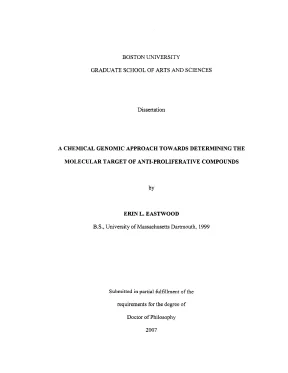
Tải xuống để đọc toàn bộBOSTON UNIVERSITY GRADUATE SCHOOL OF ARTS AND SCIENCES Dissertation A CHEMICAL GENOMIC APPROACH TOWARDS DETERMINING THE MOLECULAR TARGET OF ANTI-PROLIFERATIVE COMPOUNDS by ERIN L., University of Massachusetts Dartmouth, 1999 Submitted in partial fulfillment of the requirements for the degree of Doctor of Philosophy 2007 UMI Number: 3246602 Copyright 2006 by Eastwood, Erin L. All rights reserved. INFORMATION TO USERS The quality of this reproduction is dependent upon the quality of the copy submitted. Broken or indistinct print, colored or poor quality illustrations and photographs, print bleed-through, substandard margins, and improper alignment can adversely affect reproduction.
In the unlikely event that the author did not send a complete manuscript and there are missing pages, these will be noted. Also, if unauthorized copyright material had to be removed, a note will indicate the deletion. ® UMI UMI Microform 3246602 Copyright 2007 by ProQuest Information and Learning Company. All rights reserved.
This microform edition is protected against unauthorized copying under Title 17, United States Code. ProQuest Information and Learning Company 300 North Zeeb Road P. Box 1346 Ann Arbor, MI 48106-1346 © Copyright by ERIN L. EASTWOOD 2006 Approved by First Reader Soe Scott E.
Assistant Professor of Chemistry and Pharmacology Second Reader ⁄⁄⁄⁄ zZ⁄Z Mark W. Associate Professor of Chemistry and Biomedical Engineering ACKNOWLEDGEMENTS I would like to thank the Boston University Department of Chemistry and the Center for Chemical Methodology and Library Development for this opportunity and for providing financial support. Elliott, and Dr. Pinghua Liu, thank you for serving on my committee and for your guidance.
I would like to thank my research advisor, Dr. Schaus, for giving me the chance and the confidence to grow as a scientist. Thank you for your support over the last five years. I would also like to thank the past and present Schaus group members including Josh Giguere, John Westbrook, Nolan McDougal, Melissa Dominguez, Sha Lou, Stacy Rodgen, Whitney Trevellini, Christiane Bode, Amal Ting, Jen Goss, Josh Bishop, Phil Moquist, Allison Wensley, Elise Birkett, Laura Kliman, Andrew Wojtovich, and Valerie Curtis for providing laughs as well as support in and outside the lab.
You made me smile on my worst days. I could not have asked for a better group of people to work with. I wish you all the best. I would like to thank our collaborators; Sarah Chobot and Mike Hamil! from the Elhott lab in the BU Chemistry Department for their help with the thioredoxin assays; Melissa Landon and Dr.
Sandor Vajda from the BU Bioinformatics Department for the GOLD studies; the Gardner and Collins labs at the Center for BioDynamics and iv Department of Biomedical Engineering at BU for the predictions of the target of PTSB using the MNI; and Dr. John Tullai from the Cooper lab in the Department of Biology at BU for his help with the western blot analysis. I would like to thank the office staff in the chemistry department for all of their hard work. A special thank you goes to Katinka Csigi for her help in my job search as well as her suggestions on my presentations and résumé.
You are a wonderful lady. I am very thankful to the CMLD faculty and staff, especially Paul Ferrari and Aruna Jain. Aaron Beeler, Dayle Acquilano, and Chris Singleton, thank you for the help with my library synthesis and data analysis. To my friends and family, I am so lucky to have such a strong support system.
Stacy, Christiane, Melissa, Jen, and Allison, I am grateful to have such a great set of friends that are also my colleagues. SuzAnn, we have been through a lot together. I do not know how I would have made it through those first years without you. Thank you for being the sister that I never had.
My family has always been an important part of my life. I would not be who I am without their love and support. Mom and Dad, words can not explain how much you both mean to me. I love you both very much.
Thank you for letting me find my own way and making me believe in myself. The support of my family extends beyond my parents. I am lucky to have a wonderful extended family, including my aunts, uncles, cousins, and grandparents who have encouraged and supported me over the years. I love you all very much.
You have showed me what really matters in life. Matt, thank you for being so supportive, and understanding about my work schedule. It really made me happy to share my free time with you. I have found the chemical reaction that I was looking for, and I look forward to what the future may hold.
vi A CHEMICAL GENOMIC APPROACH TOWARDS DETERMINING THE MOLECULAR TARGET OF ANTI-PROLIFERATIVE COMPOUNDS (Order No. EASTWOOD Boston University Graduate School of Arts and Sciences, 2007 Major Professor: Scott E. Schaus, Assistant Professor of Chemistry and Pharmacology ABSTRACT Drug target identification is a time consuming stage of the drug discovery process. Chemical genomics offers a solution to this hurdle.
In chemical genomics, a target specific chemical ligand is applied on a genomic scale. This technique was used to identify the molecular target of anti-proliferative agents using changes in mRNA transcript levels upon treatment. Whole-genome transcription profiling experiments employed the eukaryotic model organism Saccharomyces cerevisiae for small-molecule perturbation experiments in addition to traditional genetics. Chemical genomics was used to examine the molecular target of borrelidin, a macrolide with conflicting published biological activities.
The initial transcription profiles showed an increase in the transcript ratios of genes involved in amino acid biosynthesis upon treatment with borrelidin. In yeast, the GCN4 pathway regulates general amino acid control. The accumulation of uncharged tRNA activates Gen2p which vil prevents the formation of the eIF-2 complex. In turn, this simulates the translation of Gen4p, which results in the transcription of over 30 genes involved in amino acid biosynthesis.
Experiments using GCN2 and GCN4 gene deletions determined that borrelidin targets the amino acid biosynthetic pathway through GCN4p. The profiling data indicates that an alternative mechanism exists for the translational regulation of Gen4p other than through Gen2p, which was confirmed using immunoblot analysis with elF2 « and phosphorylated elF2 o antibodies. In the second application of chemical genomics, a diverse collection of synthetic compounds was evaluated in a cell-based toxicity assay. The screen revealed a subset of cyclic sulfones that inhibited growth of A549, human small lung carcinoma, cells.
Within this subset, 4-(1-phenyl-1H-tetrazole-5-sulfonyl)-butyronitrile (PTSB) was the most active compound. PTSB was shown to inhibit growth of both wild-type S. Whole-genome transcription profiling experiments in S. cerevisiae indicated that PTSB is involved in the cellular response to oxidative stress.
Analysis of the profiling data using systems biology predicted the thioredoxin pathway as the target. Biochemical assays with thioredoxin (Trx) and thioredoxin reductase (TrxR) validated that PTSB inhibits TrxR. The structure of PTSB suggests a novel mechanism of inhibition. This research illustrates the significance of applying chemical genomics to the target validation stage of drug discovery.
vin TABLE OF CONTENTS ACKNOWLEDGEMENTS iv ABSTRACT VI TABLE OF CONTENTS 1X LIST OF TABLES LIST OF FIGURES XI LIST OF SCHEMES XV LIST OF ABBREVIATIONS xvi CHAPTER 1: An introduction to chemical genetics and drug target identification CHAPTER 2: The application of chemical genomics to examine the molecular target of an anti-proliferative compound, borrelidin 14 Introduction 14 Results and Discussion 18 Conclusions 32 Experimental Methods 35 CHAPTER 3: A chemical genomics approach towards the target identification of a novel anti-proliferative compound, PTSB 53 Introduction 53 Results and Discussion 55 Conclusions 82 Experimental Methods 84 Characterization 109 REFERENCES 122 CURRICULUM VITAE 134 ix LIST OF TABLES Table 2.1: Published and experimental ICs values for borrelidin 16 Table 2.2: Fold-change of several over-expressed genes upon treatment with borrelidin 20 Table 2.3: Fold-change of several repressed genes upon treatment with borrelidin 22 Table 2. Fold changes of the transcript ratios for genes involved in amino acid biosynthesis in the drug sensitive (at 30, 60, and 90 minutes), gcn4A, and gcn2A strains upon treatment with borrelidin 50 Table 3.1: ICso values of lead compounds in growth inhibition assays in A549 and HeLa-S3 cell lines 57 Table 3.2: The top five gene ontology predictions for PTSB using the MNI algorithm 67 Table 3.3: Glso values for gene deletion and heterozygous strains of Trx and TrxR in yeast 68 LIST OF FIGURES Figure 1.1: Chemical structures of saframycin A, bishydroquinone derivatives of saframycin A, FK506, rapamycin, and cyclosporin A Figure 1.2: Drug target identification methods Figure 1.3: An overview of chemical genetics Figure 1.4: A chemical genomic approach towards drug target identification using whole-genome transcription profiling experiments 12 Figure 2.1: The chemical structures of borrelidin, 3-amino-1,2,4- triazole (3AT), and several anti-cancer agents 15 Figure 2.2: Color display plot of the expression ratios of genes involved in amino acid biosynthesis in the wild-type, gcn4A, and gcn2A strains as a result of treatment with 100 uM borrelidin 23 Figure 2.3: Color display plot of the expression ratios of genes involved in amino acid biosynthesis in the wild-type, gcen4A, and gen2A strains as a result of treatment with 100 uM borrelidin and 100 mM 3-aminotriazole (3AT), and wt treated with borrelidin and threonine 27 Figure 2.4: Color display plot of the expression ratios of genes involved in amino acid biosynthesis in the wild-type, gcen4A, gcen2A, gcn1A, and gcn20A strains as a result of treatment with 100 uM borrelidin 29 Figure 2.5: Phosphorylation of eIF2o in the presence of borrelidin and 3ATin wild-type and gcn2A yeast strains 31 Figure 2.6: Borrelidin growth inhibition of BY4741 37 Figure 2.7: Borrelidin growth inhibition of BY4743 38 XI Figure 2.8: Borrelidin growth inhibition of CCY333, the drug sensitive strain 39 Figure 2.9: Borrelidin growth inhibition of erg6A strain 40 Figure 2.10: Borrelidin growth inhibition of CDC28::cdc28 heterozygous strain 41 Figure 2.11: Borrelidin growth inhibition of the gcn4A strain 42 Figure 2.12: Borrelidin growth inhibition of gen2A strain 43 Figure 2.13: Borrelidin growth inhibition of the GCD1::gcd1 heterozygous strain 44 Figure 2.14: Borrelidin growth inhibition of hom3A strain 45 Figure 2.15: Growth of CCY333, DS’strain, in the presence of 400 nM borrelidin at various concentrations of threonine 47 Figure 3.1: Representative members from a diverse library 56 Figure 3.2: Representative members of the cyclic sulfone library 60 Figure 3.3: Color display plot of expression ratios of genes involved in oxidative stress, ribosome biogenesis, and rRNA processing upon treatment with PTSB 62 Figure 3.4: (A) DTNB assay for Trx/TrxR activity. (B) DTNB assay for TrxR activity 69 Figure 3.5: DTNB assay for thioredoxin/thioredoxin reductase activity in the presence of 0, 5, and 50 uM PTSB 70 Figure 3.6: DTNB assay for thioredoxin reductase activity in the presence of 0, 12.5, and 25 uM PTSB 72 Figure 3.7: Apparent K,, versus [I] for PTSB 73 Figure 3.8: High throughput screen for thioredoxin reductase activity 74 xil Figure 3.9: Known inhibitors of the Trx/TrxR system 76 Figure 3.10: Docking of AADP” and PTSB in the NADPH binding domain of TrxR from E.11: DTNB assay for thiorexoxin reductase activity in the presence of 12.54M PTSB varying the concentration of NADPH from 50 uM and 200 uM 81 Figure 3. DTNB assay for thioredoxin reductase activity in the presence of 0, 12.5, 25 and 50 uM PTSB 89 Figure 3.
Apparent K,, versus [I] for PTSB 90 Figure 3. Percent growth inhibition of A549 by PTSB 94 Figure 3. Percent growth inhibition of HeLa-S3 cells by PTSB 95 Figure 3. Percent growth inhibition of A549 by 4-[1-(2-Bromo-4-fluoro- phenyl)-1H-tetrazole-5-sulfonyl]-butyronitrile 96 Figure 3.
Percent growth inhibition of HeLa-S3 cells by 4-[1-(2-Bromo- 4-fluoro-phenyl)-1H-tetrazole-5-sulfonyl]-butyronitrile 97 Figure 3. Percent growth inhibition of A549 by 4-[1-(4-Bromo-phenyl)- 1H-tetrazole-5-sulfonyl]-butyronitrile 98 Figure 3. Percent growth inhibition of HeLa-S3 cells by 4-[1-(4-Bromo- phenyl)-1H-tetrazole-5-sulfonyl]-butyronitrile 99 Figure 3. Percent growth inhibition of A549 by 3-(benzothiazole-2- sulfonylmethyl)-benzonitrile 100 Figure 3.
Percent growth inhibition of HeLa-S3 cells by 3- (benzothiazole-2-sulfonylmethyl)-benzonitrile 101 Figure 3. Percent growth inhibition of A549 cells by 4-(1-Phenyl-1H- tetrazole-5-sulfonylmethyl)-benzonitrile 102 Xili Figure 3.
Nội dung được bảo vệ bản quyền — Tải xuống đầy đủ
Trích dẫn luận án này
Erin L. Eastwood (2007). Luận án tiến sĩ: A chemical genomic approach towards determining the molecular target of anti-proliferative compounds [Luận án tiến sĩ, Boston University Graduate School of Arts and Sciences]. LuanAn.net. https://luanan.net/khoa-hoc-giao-duc/luan-an-tien-si-a-chemical-genomic-approach-towards-determining-the-molecular-target-of-anti-proliferative-compounds
Từ khóa và chủ đề nghiên cứu
Từ khóa liên quan
Chủ đề nghiên cứu
Câu hỏi thường gặp
Luận án "Luận án tiến sĩ: A chemical genomic approach towards determining the molecular target of anti-proliferative compounds" nghiên cứu về vấn đề gì?
Luận án khám phá phương pháp hóa-genomics xác định mục tiêu phân tử hợp chất chống tăng sinh. Góp phần phát triển trị liệu mới hiệu quả.
Luận án "Luận án tiến sĩ: A chemical genomic approach towards determining the molecular target of anti-proliferative compounds" được bảo vệ tại trường nào?
Luận án này được bảo vệ tại Boston University Graduate School of Arts and Sciences. Năm bảo vệ: 2007.
Luận án "Luận án tiến sĩ: A chemical genomic approach towards determining the molecular target of anti-proliferative compounds" thuộc chuyên ngành gì?
Luận án "Luận án tiến sĩ: A chemical genomic approach towards determining the molecular target of anti-proliferative compounds" thuộc chuyên ngành Chemistry and Pharmacology. Danh mục: Khoa Học Giáo Dục.
Luận án "Luận án tiến sĩ: A chemical genomic approach towards determining the molecular target of anti-proliferative compounds" có bao nhiêu trang?
Luận án "Luận án tiến sĩ: A chemical genomic approach towards determining the molecular target of anti-proliferative compounds" có 159 trang. Bạn có thể xem trước một phần tài liệu ngay trên trang web trước khi tải về.
Cách tải luận án "Luận án tiến sĩ: A chemical genomic approach towards determining the molecular target of anti-proliferative compounds" về máy như thế nào?
Để tải luận án về máy, bạn nhấn nút "Tải xuống ngay" trên trang này, sau đó hoàn tất thanh toán phí lưu trữ. File sẽ được tải xuống ngay sau khi thanh toán thành công. Hỗ trợ qua Zalo: 0559 297 239.