Adanin kristina accepted dissertation 10 30 20 fa 2020
Luận văn Adanin Kristina được chấp nhận ngày 30/10/2020, FA 2020. Khám phá nghiên cứu chuyên sâu về lĩnh vực này.
Ohio University
Educational Studies
Luan An
Luận án tiến sĩ
Năm xuất bản
Số trang
201
Thời gian đọc
31 phút
Lượt xem
0
Lượt tải
0
Phí lưu trữ
50 Point
Tổng quan nhanh
- Chủ đề:
- Kristina Adanin's Doctoral Thesis Approved in 2020
- Số trang:
- 201 trang
- Trường:
- Ohio University
- Chuyên ngành:
- Educational Studies
- Tác giả:
- Kristina Adanin
- Năm:
- 2020
Tóm tắt nội dung luận án
I.Kristina Adanin s Doctoral Thesis Approved in 2020
Kristina Adanin's doctoral thesis received full approval in December 2020. This significant academic achievement was presented to The Gladys W. Patton College of Education at Ohio University. The dissertation accepted marks a pivotal moment in her university graduation journey. This comprehensive graduate research explores critical intersections of technology and environmental education. The approval reflects a rigorous PhD defense and exceptional scholarly contribution.
1.1. Adanin Kristina s PhD Awarded by Ohio University
The Doctor of Philosophy degree was conferred upon Adanin Kristina in December 2020. This recognition from Ohio University signifies successful completion of advanced studies. Her doctoral thesis is a testament to dedicated graduate research efforts. It contributes valuable insights to the field of Educational Studies.
1.2. Groundbreaking Graduate Research on VR Technology
The research paper focuses on Virtual Reality (VR) applications. It investigates VR's role in climate change education. Protecting endangered environments is another key aspect. This graduate research introduces innovative approaches to global challenges. It highlights the potential of immersive technologies in learning.
1.3. Dissertation Acceptance Marks Major Academic Milestone
Official dissertation acceptance confirms the quality and originality of the work. This academic achievement by Adanin Kristina provides a new foundation for future studies. The comprehensive nature of the doctoral thesis stands out. It represents years of rigorous academic pursuit and commitment.
II.VR for Climate Change Education A Key Research Focus
The doctoral thesis addresses pressing global issues. Climate change, marked by rising temperatures and environmental disasters, requires informed action. This research paper examines how Virtual Reality (VR) can educate individuals. It explores the role of VR in fostering awareness about climate change and protecting vital ecosystems. Adanin Kristina's work proposes VR as a powerful tool for engagement.
2.1. Addressing Global Challenges with Innovative Technology
The world faces unprecedented environmental crises. Rapid climate shifts demand new educational strategies. VR offers a unique platform to convey complex issues effectively. It brings remote environmental impacts directly to students. This innovative approach is central to the graduate research.
2.2. Virtual Reality s Potential in Environmental Learning
VR technology, including 360-degree video, creates immersive experiences. It simulates real-life situations. This enables students to learn about distant tropical regions. The dissertation accepted explores VR's capacity to raise climate change awareness. It bridges geographical and experiential gaps.
2.3. Bridging Educational Gaps with Advanced Digital Tools
VR's integration into education is largely untapped. Many school systems lack understanding of its benefits. This research paper identifies critical gaps needing investigation. It focuses on factors influencing students' intent to use VR. The study aims to enhance the academic quality of environmental courses.
III.Students Intentions to Adopt VR for Environmental Learning
A core objective of the doctoral thesis was to understand student perceptions. It investigated students’ attitudes and behavioral intentions. The focus was on using VR for climate change education. Understanding these intentions is crucial for successful technology integration. This graduate research provides insights into user acceptance. The findings offer valuable guidance for educators and policymakers.
3.1. Understanding Student Attitudes Toward VR Education
The study delved into students' beliefs about VR. Phase 1 involved 65 students. Participants reported VR's potential benefits for climate change learning. An overwhelming 95.2% agreed on its educational value. These findings are foundational to the research paper.
3.2. Factors Influencing VR Use for Climate Awareness
Multiple factors shape students' decisions to use VR. This dissertation accepted examined key variables. These included perceived usefulness and ease of use. Understanding these influences can lead to more effective VR deployment. It promotes greater engagement with climate education.
3.3. Assessing Behavioral Intentions for Technology Adoption
The study specifically measured students' behavioral intentions. This indicates their readiness to adopt VR for learning. The findings can encourage students to participate responsibly. They contribute to the global development of VR education. This assessment is a key contribution of Adanin Kristina's work.
IV.Dissertation Methodology Analyzing VR Technology Acceptance
The doctoral thesis employed a robust methodology. It combined the Technology Acceptance Model (TAM) by Davis (1989) with a spatial presence experience scale. This comprehensive approach allowed for a detailed analysis of student intentions. The research paper utilized a two-phase study design. This ensured thorough data collection and analysis. Adanin Kristina's methodological rigor strengthens the study's conclusions.
4.1. Applying the Technology Acceptance Model TAM
The TAM framework was instrumental in the study. It helped explain user acceptance of VR. Variables like perceived usefulness and perceived ease of use were central. This model provided a theoretical lens for interpreting student behaviors. It is a well-established model in technology adoption graduate research.
4.2. Phased Research Approach with Global Participants
Phase 1 gathered qualitative insights from 65 students. Phase 2 involved 227 students from around the globe. This pseudo-experimental design allowed participants to use their own devices. This approach provided diverse perspectives on VR learning. It enhanced the generalizability of the dissertation accepted.
4.3. Key Variables for Assessing VR Learning Intentions
Six variables were analyzed in Phase 2. These included attitude toward use, perceived usefulness, and self-location. Perceived ease of use, possible action, and behavioral intention were also examined. These variables provided a comprehensive picture of student engagement. Their interrelationships were crucial for the doctoral thesis.
V.Key Findings Perceived Usefulness Drives VR Adoption
The dissertation accepted revealed significant findings. Perceived usefulness emerged as the most powerful predictor. It strongly influenced students' intentions to use VR for learning. This highlights the importance of practical value in technology adoption. The study's models were refined through rigorous statistical analysis. These insights are critical for future VR educational strategies.
5.1. Perceived Usefulness Predicts VR Learning Intention
The primary finding indicated that students use VR when they perceive its utility. This variable had the strongest impact on behavioral intention. This insight from Adanin Kristina's graduate research guides VR content development. Focus should be on demonstrating tangible learning benefits.
5.2. Model Refinement Through Confirmatory Factor Analysis
A Confirmatory Factor Analysis (CFA) improved the model. Spatial presence variables were modified. This adjustment enhanced the statistical robustness of the research paper. It ensured the accuracy of the relationships between constructs. This meticulous approach underscores the academic achievement.
5.3. Structural Equation Modeling Reveals Variable Relationships
Path analysis determined the relationships between variables. The strongest regression weight was from perceived usefulness to behavioral intention. Structural Equation Modeling (SEM) further optimized the model. It combined possible action and self-location into one factor. These detailed analyses are central to the doctoral thesis.
VI.Future Directions for VR in Environmental Graduate Research
The dissertation accepted offers a clear path for future inquiry. It encourages students to play an active role in VR education development. The findings demonstrate VR's potential to enhance academic quality globally. While this graduate research focused on students, it opens doors for broader investigations. Including instructor perspectives represents a vital next step.
6.1. Encouraging Responsible VR Education Development
The study's outcomes can inspire students worldwide. They can actively participate in designing and implementing VR education. This proactive engagement ensures VR's responsible integration. It fosters a new generation of environmentally conscious learners. Adanin Kristina's work lays this groundwork.
6.2. Enhancing Academic Quality with VR Technology
VR has proven capabilities to elevate learning experiences. It benefits both instructors and students. The insights from this academic achievement support curriculum innovation. They advocate for the wider adoption of immersive educational tools. This contributes to better teaching and learning outcomes.
6.3. Expanding Research Scope Instructor Perspectives
This study primarily examined student viewpoints. Future graduate research should include instructors. Their insights into VR's practical implementation are invaluable. Incorporating diverse perspectives will provide a holistic understanding. This broadens the impact of VR in climate change education. The PhD defense underscored this necessity.
Mục lục chi tiết luận án
Tải xuống file đầy đủ để xem toàn bộ nội dung
Tải đầy đủ (201 trang)Trích đoạn nội dung luận án
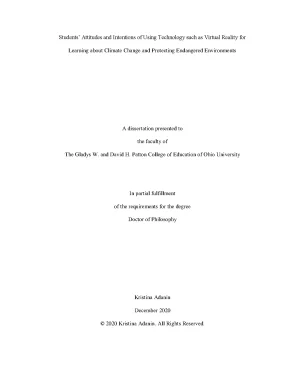
Tải xuống để đọc toàn bộStudents’ Attitudes and Intentions of Using Technology such as Virtual Reality for Learning about Climate Change and Protecting Endangered Environments A dissertation presented to the faculty of The Gladys W. Patton College of Education of Ohio University In partial fulfillment of the requirements for the degree Doctor of Philosophy Kristina Adanin December 2020 © 2020 Kristina Adanin. All Rights Reserved. 2 This dissertation titled Students’ Attitudes and Intentions of Using Technology such as Virtual Reality for Learning about Climate Change and Protecting Endangered Environments by KRISTINA ADANIN has been approved for Educational Studies and The Gladys W.
Patton College of Education by Greg Kessler Professor of Educational studies Renée A. Middleton Dean, The Gladys W. Patton College of Education 3 Abstract ADANIN KRISTINA, Ph., December 2020, Educational Studies Students’ Attitudes and Intentions of Using Technology such as Virtual Reality for Learning about Climate Change and Protecting Endangered Environments Director of Dissertation: Greg Kessler At a time when the world is facing a range of significant challenges, including a rise in air temperature, rapidly evolving droughts in some areas, and floods, a new technology in education can help inform people of current issues that may not be close to them but, nevertheless, can have a significant impact in the future. Our planet has been warming steadily for over a century, and the preponderance of evidence has pointed at human action as the main contributor to the change (Hansen et al.
The evolution of technology has brought tremendous change. Virtual Reality (VR), 360-degree video, has the potential to bring the environment to the students since it can provide a close to real-life situation. The use of VR for educational purposes has been quite unknown to most school systems. There are many gaps that need to be investigated prior to the effective implementation of VR-learning, such as the factors that influence students’ intention to use it.
This study fulfilled some of these gaps by focusing on the potential of using VR for future education and raising awareness of the climate change occurring in remote areas, specifically tropical regions. The findings of this study will hopefully encourage students to play a more responsible role in the development and implementation of VR education worldwide and help enhance the academic quality of courses for instructors 4 and students. This study examined students’ behavioral intentions towards using VR in their learning about climate change utilizing the Technology Acceptance Model of Davis (1989), combined with the spatial presence experience scale (Hartmann et al. Phase 1 was created in order to understand students’ salient beliefs about the use of VR for educational purposes and learning about climate change.
Furthermore, 65 students participated in this phase and reported that VR can be beneficial for educational purposes to learn about global climate change, and 95.2% of participants fully agreed. Phase 2 occurred among 227 students from around the globe. The Phase 2 study was manipulated because students chose their own technology devices to watch the VR content about the last tropical glaciers, thereby making it a pseudo-experimental study. Six variables were used to explain students’ intention of using VR: attitude toward use, perceived usefulness, self-location, perceived ease of use, possible action and behavioral intention.
The best predictor of intention to use VR was perceived usefulness. On the other hand, after doing a confirmatory factor analysis (CFA), the spatial presence variables were modified, which improved the model. A path analysis was conducted in order to define the relationship between the variables. The path coefficient from perceived usefulness to behavioral intention had the strongest regression weight, while from perceived ease of use to attitude toward use had the lowest regression weight.
The structural equation model (SEM) indicated that the best model excluded factors, such as attitude toward use, and combined possible action and self-location as one factor. This study only included students as participants. Future studies including instructors could bring a new perspective for using VR in education to learn about climate change. 5 Dedication Vse je to Pot… 6 Acknowledgments On this expedition, I was lucky to have a badass committee (See Appendix E for the meaning of the word).
I can say this expedition would not be successful without my advisor, Dr. Greg Kessler, as well as my supervisor, Dr. Alan Wu showed me how education can be better with the use of new technologies, and Brian Plow taught me how much storytelling plays an important role. Bob West helped me to put my thoughts on paper.
He was with me from the first page to the last, even for this section, too. Let me start from the beginning. When I quit working on my undergraduate studies, Dr. Sretenka Dugalić did not give up on me.
She pushed me to finish my undergraduate degree and gave me hope that education is the key. I need to apologize to my family because I stressed them every day, sharing with them my ideas and projects that were difficult to follow. I want to thank my brothers, Goran Kovačević and Boris Toljaga, and their families, for supporting me all these years and taking care of Mira. I wish I could share my degree with my husband, Miha, because he deserves this as much as I do.
I hope he will soon have the opportunity to do his own doctoral degree. Two people that have had the biggest influence on me to go farther in academia and in doing what I want to do were Rob Warner (soon to be a doctor) and Dr. Guys, when I grow up, I want to be like you two, also badass! Kristin Diki, Elizarni, Andrew Wild and Preeti Patil, we can move the mountain together, and I hope our roads will cross again soon! Life without telenovela is boring! 7 Dr. Jorge Ceballos, thank you for taking us to Nevado Santa Isabel and been a real protector of tropical glaciers.
This project would never be done without your expertise and help in Colombia. Thank you to the GRID lab and Terrance Reimer for helping me with all of the equipment that I used on the expedition. Terrance, I can’t thank you enough for all of your help with editing the video. Don, Lisa and Beth, you were the best bosses that a student could have.
8 Table of Contents Page Abstract .6 List of Tables. 11 List of Figures. 23 Significance of Study. 25 Organization of Dissertation.
26 Chapter 2: Literature Review. 28 VR and Educational Technology. 33 VR and Diversely Abled Populations. 38 Storytelling as Tool for Advocacy.
45 VR and Storytelling. 47 VR as a Safe Learning Experience. 49 Distance Transformative and Adventure Education. 52 Climate Change and Education.
54 Effects of Climate Change on Tropical Glaciers. 56 The Role of Education on Climate Change. 61 Technology Acceptance Model. 74 9 Research Questions and Hypotheses.
78 Instrumentation and Measures. 80 Phase 1 – Elicitation Study. 81 Phase 2 – Final Study. 83 Ethical Protection of Research Participants.
87 Techniques for Ensuring Reliable and Valid Data. 89 Internal Consistency Reliability. 93 Phase 1 – Elicitation Study. 94 Data Collection and Response Rate for Phase 1.
95 Question 1: Do Students Think the Use of Technology as Virtual Reality will Impact Students’ Learning Outcomes Related to Climate Change and Tropical Glaciers?. 96 Phase 2 – Final Study. 107 Test of Reliability and Validity. 111 Exploratory Factor Analysis.
114 Confirmatory Factor Analysis. 114 First Model - The Hypothesized Model. 115 Question 2: Do College Students Intend to Use Virtual Reality Applications for their Future Learning and Understanding the Climate Change at the Tropical Region. 126 Question 3: Does the VRTAM Model Predict Intention to use Virtual Reality among College Students?.
144 Summary of the Study. 149 10 Review of the Methodology. 150 Phase 1 & Overview of Research Question 1. 150 Phase 2 & Overview of Research Questions 2 and 3.
152 Practical and Theoretical Implications. 155 The Challenge of VR Design for Education. 159 Recommendations for Future Research. 163 Appendix A: Phase 1 Elicitation Study.
194 Appendix B: Phase 2 Final Study. 196 Appendix C: Approval for the use of SPES questioner. 199 Appendix E: Meaning “badass”. 200 11 List of Tables Page Table 1 Salient Behaviour Beliefs.
100 Table 2 Demographic Information for Phase 2. 109 Table 3 Knowlage and Interest in Climate Change and Tropical Glaciers. 110 Table 4 Cronbach’s Aplha for the Variables. 112 Table 5 Final CFA.
117 Table 6 Goodness of Fit for Model 1 and 2. 119 Table 7 Descriptives Statistics. 122 Table 8 Correlations Between VRTAM Factors. 124 Table 9 Multiple Linear Regression.
125 Table 10 VRTAM Analysis of Hypothesis. 128 Table 11 Estimated Model 1. 132 Table 12 Compared Models 1 2 3. 135 Table 13 Estimated Model 3.
137 Table 14 Descriptive Information for Ed. 139 Table 15 Descriptive Information for Device Users. 140 12 List of Figures Page Figure 1. Multimedia Cone of Abstraction.
Hypothesized VRTAM Model. Garther Hype Cycle for Emerging Technologies. Hypothesized Model and Modified VRTAM Model. CFA for Hypothesized Model.
Model 2 CFA after Modification. Model 2 SEM Diagram. Model 3 SEM Diagram. Model 3 Path Diagram.
Canonical Scores and the Structire for Device Users. Nevado Santa Isabel Glacier 2010 and 2020. Hypothesis Diagram among all Variables for VRTAM. 154 13 Chapter 1: Introduction Education is the most powerful weapon which you can use to change the world.
—Nelson Mandela, Madison Park High School, Boston, 23 June 1990 Our planet has been warming steadily for over a century, and the preponderance of evidence points to human activities as the main contributor to this potentially unstoppable phenomenon (Hansen et al. Imagine that every day we are bombarded with shocking news stories of myriad events worldwide: war, conflict, displacement, and natural catastrophes, such as droughts and floods, which create burdens on many affected societies. However, most of the time, conflicts such as war, displacement and discrimination have their roots in the deep desire of one group to impose its superiority over others. It seems that these conflicts are about humans dominating other humans.
But then how about the existence of non-human entities like glaciers that keep shrinking every day? Who should be held accountable for their destruction? To solve human conflicts, there are options available to implement, such as peace building and infrastructure reconstruction, when these conflicts end. But this is not the case for the current climate crisis. How can we address this issue since climate is an intangible and abstract concept? In this case, educators can offer informative approaches to evoke a critical awareness of how we as humans can take a moral stance when it comes to protecting the environment. Education plays an important role in changing how humans understand climate change and how they can respond to this problem.
In my opinion, Nelson Mandela would agree with this argument, perhaps largely because he believed that “education is the most 14 powerful weapon which you can use to change the world.” Again, critical educational theorists, such as Freire, would remind us of the need for education to foster critical consciousness raising. The United Nations Intergovernmental Panel on Climate Change (IPCC) in 2007 brought together 1,300 scientists from all over the world to evaluate the impact of human activity on rising temperatures and to present mitigation strategies that policy makers could use in the future. In its Fifth Assessment Report, the panel asserted, with over 95 percent probability, that human action significantly contributed to change. The IPCC estimated there to be an average rise in temperature on a global level of 1 degree Celsius in the last 150 years (between 0.2°C) with a predicted future increase of 0.2 degree Celsius per decade.
Nội dung được bảo vệ bản quyền — Tải xuống đầy đủ
Trích dẫn luận án này
Kristina Adanin (2020). Adanin kristina accepted dissertation 10 30 20 fa 2020 [Luận án tiến sĩ, Ohio University]. LuanAn.net. https://luanan.net/khoa-hoc-giao-duc/adanin-kristina-accepted-dissertation-10-30-20-fa-2020
Câu hỏi thường gặp
Luận án "Adanin kristina accepted dissertation 10 30 20 fa 2020" nghiên cứu về vấn đề gì?
Luận văn Adanin Kristina được chấp nhận ngày 30/10/2020, FA 2020. Khám phá nghiên cứu chuyên sâu về lĩnh vực này.
Luận án "Adanin kristina accepted dissertation 10 30 20 fa 2020" được bảo vệ tại trường nào?
Luận án này được bảo vệ tại Ohio University. Năm bảo vệ: 2020.
Luận án "Adanin kristina accepted dissertation 10 30 20 fa 2020" thuộc chuyên ngành gì?
Luận án "Adanin kristina accepted dissertation 10 30 20 fa 2020" thuộc chuyên ngành Educational Studies. Danh mục: Khoa Học Giáo Dục.
Luận án "Adanin kristina accepted dissertation 10 30 20 fa 2020" có bao nhiêu trang?
Luận án "Adanin kristina accepted dissertation 10 30 20 fa 2020" có 201 trang. Bạn có thể xem trước một phần tài liệu ngay trên trang web trước khi tải về.
Cách tải luận án "Adanin kristina accepted dissertation 10 30 20 fa 2020" về máy như thế nào?
Để tải luận án về máy, bạn nhấn nút "Tải xuống ngay" trên trang này, sau đó hoàn tất thanh toán phí lưu trữ. File sẽ được tải xuống ngay sau khi thanh toán thành công. Hỗ trợ qua Zalo: 0559 297 239.