Tư Đức Hạnh Hoàn Hảo: Legenda Maior của Bonaventure trong Truyền Thống Hagiography
View 11 cung cấp giải pháp phân tích và trực quan hóa dữ liệu hiệu quả. Công cụ mạnh mẽ hỗ trợ ra quyết định nhanh chóng và chính xác hơn.
The Catholic University of America
Theology and Religious Studies
Luan An
Luận án tiến sĩ
Năm xuất bản
Số trang
209
Thời gian đọc
32 phút
Lượt xem
0
Lượt tải
0
Phí lưu trữ
50 Point
Tổng quan nhanh
- Chủ đề:
- 1. Giới Thiệu Thánh Bonaventure
- Số trang:
- 209 trang
- Trường:
- The Catholic University of America
- Chuyên ngành:
- Theology and Religious Studies
- Tác giả:
- Matthew William Kozlowski
- Năm:
- 2020
Tóm tắt nội dung luận án
I. Giới Thiệu Thánh Bonaventure
Thánh Bonaventure là một trong những nhà thần học và triết học nổi tiếng nhất của thế kỷ 13. Ông là người đã viết tác phẩm 'Legenda Maior' về cuộc đời của Thánh Phanxicô Assisi.
1.1. Cuộc Đời Của Thánh Bonaventure
Thánh Bonaventure sinh năm 1221 tại Bagnoregio, Ý. Ông gia nhập Dòng Phanxicô và trở thành một nhà thần học và triết học nổi tiếng.
1.2. Tác Phẩm Legenda Maior
Tác phẩm 'Legenda Maior' của Thánh Bonaventure là một trong những tác phẩm quan trọng nhất về cuộc đời của Thánh Phanxicô Assisi. Tác phẩm này được viết để giới thiệu cuộc đời và đức hạnh của Thánh Phanxicô.
II. Đức Hạnh Kitô Giáo
Đức hạnh Kitô giáo là một trong những chủ đề quan trọng nhất trong tác phẩm 'Legenda Maior' của Thánh Bonaventure. Ông trình bày cuộc đời của Thánh Phanxicô như một tấm gương về đức hạnh và sự hoàn thiện tâm linh.
2.1. Sự Hoàn Thiện Tâm Linh
Sự hoàn thiện tâm linh là một trong những chủ đề quan trọng nhất trong tác phẩm 'Legenda Maior'. Thánh Bonaventure trình bày cuộc đời của Thánh Phanxicô như một quá trình hoàn thiện tâm linh.
2.2. Triết Lý Đạo Đức
Triết lý đạo đức của Thánh Bonaventure dựa trên ý tưởng về sự kết hợp giữa đức hạnh và sự hoàn thiện tâm linh. Ông trình bày cuộc đời của Thánh Phanxicô như một tấm gương về triết lý đạo đức này.
III. Hagiography Và Thánh Tích Học
Hagiography và thánh tích học là hai lĩnh vực nghiên cứu quan trọng về cuộc đời của các thánh. Thánh Bonaventure là một trong những nhà nghiên cứu hàng đầu về hagiography và thánh tích học.
3.1. Hagiography
Hagiography là lĩnh vực nghiên cứu về cuộc đời của các thánh. Thánh Bonaventure là một trong những nhà nghiên cứu hàng đầu về hagiography.
3.2. Thánh Tích Học
Thánh tích học là lĩnh vực nghiên cứu về các thánh tích của các thánh. Thánh Bonaventure là một trong những nhà nghiên cứu hàng đầu về thánh tích học.
IV. Thần Học Kinh Viện
Thần học kinh viện là một trong những lĩnh vực nghiên cứu quan trọng nhất của Thánh Bonaventure. Ông trình bày cuộc đời của Thánh Phanxicô như một tấm gương về thần học kinh viện.
4.1. Thần Học Kinh Viện Và Đức Hạnh
Thần học kinh viện của Thánh Bonaventure dựa trên ý tưởng về sự kết hợp giữa đức hạnh và sự hoàn thiện tâm linh. Ông trình bày cuộc đời của Thánh Phanxicô như một tấm gương về thần học kinh viện này.
4.2. Thần Bí Học Kitô Giáo
Thần bí học Kitô giáo là một trong những lĩnh vực nghiên cứu quan trọng nhất của Thánh Bonaventure. Ông trình bày cuộc đời của Thánh Phanxicô như một tấm gương về thần bí học Kitô giáo.
V. Kết Luận
Tóm lại, tác phẩm 'Legenda Maior' của Thánh Bonaventure là một trong những tác phẩm quan trọng nhất về cuộc đời của Thánh Phanxicô Assisi. Ông trình bày cuộc đời của Thánh Phanxicô như một tấm gương về đức hạnh, sự hoàn thiện tâm linh và triết lý đạo đức.
5.1. Ý Nghĩa Của Tác Phẩm
Tác phẩm 'Legenda Maior' của Thánh Bonaventure có ý nghĩa quan trọng trong việc giới thiệu cuộc đời và đức hạnh của Thánh Phanxicô Assisi.
5.2. Ảnh Hưởng Của Tác Phẩm
Tác phẩm 'Legenda Maior' của Thánh Bonaventure đã có ảnh hưởng quan trọng đến việc phát triển của thần học kinh viện và thánh tích học.
Tải xuống file đầy đủ để xem toàn bộ nội dung
Tải đầy đủ (209 trang)Trích đoạn nội dung luận án
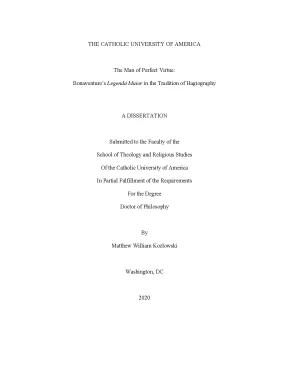
Tải xuống để đọc toàn bộTHE CATHOLIC UNIVERSITY OF AMERICA The Man of Perfect Virtue: Bonaventure’s Legenda Maior in the Tradition of Hagiography A DISSERTATION Submitted to the Faculty of the School of Theology and Religious Studies Of the Catholic University of America In Partial Fulfillment of the Requirements For the Degree Doctor of Philosophy By Matthew William Kozlowski Washington, DC 2020 The Man of Perfect Virtue: Bonaventure’s Legenda Maior in the Tradition of Hagiography Matthew William Kozlowski Director: Raymond Studzinski, PhD Abstract In 1263, Bonaventure of Bagnoregio submitted a new life of Francis of Assisi. The Legenda Maior Sancti Francisci (Major Legend of Saint Francis) was soon decreed as the official biography for the Franciscan order. Despite its ongoing importance to the order, the Legenda Maior came under criticism in the 20th century for its perceived lack of attention to the ‘true’ historical Francis. Paul Sabatier, for example, evaluated the earlier accounts of Francis as being far superior.
More recently, scholars have come to see Bonaventure’s text as a masterpiece of spiritual and theological insight. What Sabatier seems to have overlooked is that the Legenda Maior was, and is, a hagiography. The genre of hagiography is unique in that the life of a saint is presented for the purpose of forming and edifying those who encounter it as readers (or just as commonly, listeners). This dissertation will first examine several well-known hagiographies, such as the life of St.
Antony the Great. Next, early Franciscan texts such as Thomas of Celano’s Life of St. Francis will be discussed. It will be shown that all of these texts share a focus on virtue – in many cases the virtues of the saints are presented as being equally important as miracles.
With this groundwork laid, the dissertation will offer an in-depth reading of Bonaventure’s Legenda Maior, focusing on virtue. It will be shown how Bonaventure presented the virtue of Francis as a manifestation of grace, tightly connected to Francis’ imitation of Christ. In this way, the Legenda Maior presents Francis as not only a great saint, but as one perfectly conformed to Christ, and the man of perfect virtue. Bonaventure’s overall theory of grace, free will, virtue, and moral progress are also discussed.
The dissertation concludes with a short chapter on the stigmata. Overall, it is argued that modern readers who approach Bonaventure’s Francis today may be inspired to pursue virtue in their own lives. In this way, the Legenda Maior functions as hagiography, forming and edifying those who encounter the text. This dissertation by Matthew William Kozlowski fulfills the dissertation requirements for the doctoral degree in Theology and Religious Studies approved by Raymond Studzinski, PhD, as Director, and by Joshua Benson, PhD, and David Elliot, PhD as Readers.
________________________________________ Raymond Studzinski, PhD, Director ________________________________________ Joshua Benson, PhD, Reader ________________________________________ David Elliot, PhD, Reader ii CONTENTS Introduction 1 Chapter 1. Virtue in the Lives of the Saints 12 Chapter 2. The Emerging Portrait of Francis 53 Chapter 3. Bonaventure’s Francis: The Man of Perfect Virtue 98 Chapter 4.
Reading the Legenda Maior as Hagiography Today 146 Conclusion. The Stigmata and Moral Progress 182 Bibliography 194 iii INTRODUCTION Between 1260 and 1263, Bonaventure of Bagnoregio completed a new life of Francis of Assisi. The Legenda Maior Sancti Francisci (Major Legend of Saint Francis) was soon decreed as the official biography for the Franciscan order. At the time, there were other vitae of Francis in circulation: works written by Thomas of Celano, Julian of Speyer, and other ‘companions’ of Francis who had known him before his death in 1226.
What all of these works had in a common was a desire to present the person and life of Francis, both to the world and to the members of the order that he had founded. The term “Legend” is often confusing for English speakers, as it conjures up notions of fantasy or myth. For a 13th century audience, however, Legenda, from the Latin legere (to read), referred to the fact that the life of a saint was to be read, usually aloud at worship or during meals. As a text read aloud, the vita of a saint was, and is, more than a biography – rather, it is a hagiography.
The difference between these two terms is not merely a question of terminology. While a biography ostensibly aims to report the facts of a person’s life, hagiography has a different intention, which is to shape and form those readers (or listeners) who encounter it. The unwillingness of some 20th century scholars to view the lives of the saints (hagiographies) as representing a unique genre with unique motivations has led to some unfortunate conclusions. In the case of Bonaventure’s Legenda Maior, the work has been often criticized for not being authentic to the historical Francis.
Paul Sabatier and others claimed that the author offered too much of his own agenda, producing a text that had little value for 1 2 1 understanding the ‘real’ Francis of Assisi. The problem with this approach was not that it lacked appropriate historical curiosity, but rather that it asked something of hagiography that the genre never promised to deliver. As Jean Leclercq so cogently explains, “The reason for recording a saint's life is not always, as we might believe at first thought, to tell the story of his life. For what is being dealt with is the existence not of just any outstanding personality… but of a Christian who has achieved sanctity.”2 Facts do matter to the hagiographer, but only in so far as those facts relate to the broader project of edification.
Indeed, the primary aim of hagiography is formation. The following dissertation approaches Bonaventure’s Legenda Maior with this understanding in mind: that the text was, and is, a work of hagiography with an intention to shape and form those who encounter it. How the text achieves that aim is the main question of the dissertation. The short answer to this question can be summed up in one word: virtue.
In the tradition of Christian hagiography, the presentation of a saint’s virtue was almost always a central theme. Again, in the words of Jean Leclercq, “What matters is less the circumstances of his [the saint’s] existence than the opportunities they afforded him to practice virtue.”3 The saints, for all their extraordinary words and deeds, were also put forth as models of charity, humility, patience, fortitude, and a host of other virtues. In many cases, the presentation of these 1 Sabatier wrote, for example, that “circumstances controlled his [Bonaventure’s] work, and it is no injustice to him to say that it is fortunate for Francis, and especially for us, that we have another biography of the Poverello than that of the Seraphic Doctor.” Paul Sabatier, The Life of St. Francis of Assisi, trans.
2 Jean Leclercq, The Love of Learning and the Desire for God: A Study of Monastic Culture (New York: Fordham University Press, 1996), 161. 3 4 virtues was even more important than the miracles that the saints performed. This dissertation will therefore approach the genre of hagiography through the lens of virtue, arguing that an understanding of virtue allows for a fruitful reading of Bonaventure’s Legenda Maior in particular. What is a Virtue? The contemporary field of virtue ethics has become a well-known method of moral reasoning.
Pushing back against the previous traditions of deontology (ethics based on duty), virtue ethics, broadly speaking, emphasizes the notion of ‘being’ over ‘doing.’5 This is not to say that actions do not matter, for they matter deeply. Rather, the suggestion is that actions flow out of consistent dispositions that guide behavior – these dispositions are virtues. Thus the ethical ‘task’ for the individual is to develop the character necessary to practice right action, regardless of the situation. Such an understanding of virtue is actually rooted in ancient thought.
Aristotle’s definition of virtue is as follows: “virtue in a man will be the disposition (habitus) which renders him a good man and also which will cause him to perform his function well.”6 4 For example, the authors of the Legenda Trium Sociorum (Legend of the Three Companions, abbreviated as L3C) reveal a clear preference of virtue over miracles. They write, “We do not intend merely to relate miracles, which demonstrate, but do not cause sanctity. Our intention is to point out some striking aspects of his holy manner of life.” L3C Letter (Fontes, 1374; FAED II, 67): Non contenti narrare solum miracula, quae sanctitatem non faciunt sed ostendunt, sed etiam sanctae conversationis eius insignia. Latin from Fontes Franciscani, ed.
Menestò, Enrico and Stefano Brufani (Assisi: Porziuncola, 1995), hereafter Fontes. English translation Francis of Assisi Early Documents, ed. Armstrong, Wayne Hellmann, and William J. Short (New York: New City Press, 2000-2001), hereafter FAED.
5 Stanley Hauerwas, A Community of Character: Toward a Constructive Christian Social Ethic (Notre Dame, IN: University of Notre Dame Press, 1981), 113. 6 Nicomachean Ethics II. 4 Christian theologians in the medieval scholastic period, having rediscovered the works of Aristotle with access to Latin translations, crafted a theory of virtue that was similar in many ways to the Greek tradition. Both Thomas Aquinas and Bonaventure agreed, for example, that a virtue was a stable disposition (habitus) out of which a person acts well.7 Conversely, a vice is a habitus out of which one acts poorly.
Key to this understanding of habitus – and this point is also crucial in contemporary virtue ethics – is that habits are shaped and formed over time. In other words, one is not simply born as an honest or dishonest person. Rather, one becomes an honest person through practice and the ongoing cultivation of the virtue of honesty, thereby shaping a disposition toward honest actions. In this way of thinking, virtue is more than a good character trait – virtue is deeper, for indeed it is a way of being.
In Christian virtue theory, the process of ‘habituation’ is sustained by God’s grace, and therefore it is not simply a human endeavor. In other words, grace is inextricably bound to the virtues.8 Virtue in the Lives of the Saints A central argument of this dissertation is the fact that the lives of the saints, upon examination, reveal a well-developed understanding and presentation of virtue. Saints such as Antony the Great, the famous desert ascetic, are consistently described as acting with courage, temperance, humility, and a host of other key virtues. It is clear in these descriptions that the 7 Bonaventure’s definition is found in his Commentary on the Sentences II.
Aquinas’ definition is found in the Summa Theologica I-II. 8 Bonaventure writes that grace is “the origin, the end, and the form of virtuous habits.2 (Opera Omnia V, 256; Monti, 183): quae est habituum virtualium origo finis et forma. Latin text taken from Bonaventure Doctoris seraphici S. Bonaventurae opera omnia, ed.
Fathers of the Collegium S. Bonaventurae (Quaracchi, 1882–1902), hereafter Opera Omnia. English from Breviloquium, trans. Bonaventure, NY: Franciscan Institute, 2005).
5 hagiographers do not regard such virtues as mere character traits. Rather, the holy actions of the saints flow out of well-formed dispositions that govern their behaviors. Antony, to give an example, is not shown to be courageous in some situations but cowardly others – on the contrary, he displays fortitude consistently across a variety of circumstances. It is also clear that the authors of the lives of the saints showcased the virtues of the saints with an eye toward edification.
In other words, the saint is held up as a model of virtue in order that the faithful might follow the example of right living. As Athanasius states in his preface to the Life of Antony: “the very act of remembering Antony is of enormous profit and benefit to me and I am sure that you, listening in wonder, will be keen to follow his commitment: for to know who Antony was offers us the perfect path to virtue.
Nội dung được bảo vệ bản quyền — Tải xuống đầy đủ
Trích dẫn luận án này
Matthew William Kozlowski (2020). Tư Đức Hạnh Hoàn Hảo: Legenda Maior của Bonaventure [Luận án tiến sĩ, The Catholic University of America]. LuanAn.net. https://luanan.net/giao-duc-hoc/tam-ly-hoc-giao-duc/tu-duc-hanh-hoan-hao-legenda-maior-bonaventure-hagiography
Câu hỏi thường gặp
Luận án "Tư Đức Hạnh Hoàn Hảo: Legenda Maior của Bonaventure" nghiên cứu về vấn đề gì?
View 11 cung cấp giải pháp phân tích và trực quan hóa dữ liệu hiệu quả. Công cụ mạnh mẽ hỗ trợ ra quyết định nhanh chóng và chính xác hơn.
Luận án "Tư Đức Hạnh Hoàn Hảo: Legenda Maior của Bonaventure" được bảo vệ tại trường nào?
Luận án này được bảo vệ tại The Catholic University of America. Năm bảo vệ: 2020.
Luận án "Tư Đức Hạnh Hoàn Hảo: Legenda Maior của Bonaventure" thuộc chuyên ngành gì?
Luận án "Tư Đức Hạnh Hoàn Hảo: Legenda Maior của Bonaventure" thuộc chuyên ngành Theology and Religious Studies. Danh mục: Tâm Lý Học Giáo Dục.
Luận án "Tư Đức Hạnh Hoàn Hảo: Legenda Maior của Bonaventure" có bao nhiêu trang?
Luận án "Tư Đức Hạnh Hoàn Hảo: Legenda Maior của Bonaventure" có 209 trang. Bạn có thể xem trước một phần tài liệu ngay trên trang web trước khi tải về.
Cách tải luận án "Tư Đức Hạnh Hoàn Hảo: Legenda Maior của Bonaventure" về máy như thế nào?
Để tải luận án về máy, bạn nhấn nút "Tải xuống ngay" trên trang này, sau đó hoàn tất thanh toán phí lưu trữ. File sẽ được tải xuống ngay sau khi thanh toán thành công. Hỗ trợ qua Zalo: 0559 297 239.